
In a feedback loop, a response refers to
a. the number of times a consumer must hear a message before it can be accurately
decoded.
b. the impact the message had on the receiver’s knowledge, attitude, or behaviors during
the communications process.
c. the positive or negative feedback that a consumer expresses immediately after
exposure to a company’s message.
d. the impact, either positive or negative, that occurs when one consumer interprets a
firm’s message through word of mouth to another potential consumer using his or her
own words.
e. the length of time required for a typical customer to associate a specific slogan,
theme, melody, or logo with a specific product brand.
Answer:
Like personal selling, __________ has the advantage of being customized to match the
needs of specific target markets. Messages can be developed and adapted quickly to
facilitate one-to-one relationships with customers.
a. advertising
b. a sales promotion
c. publicity
d. direct marketing
e. a public service announcement
Answer:
Figure 1.
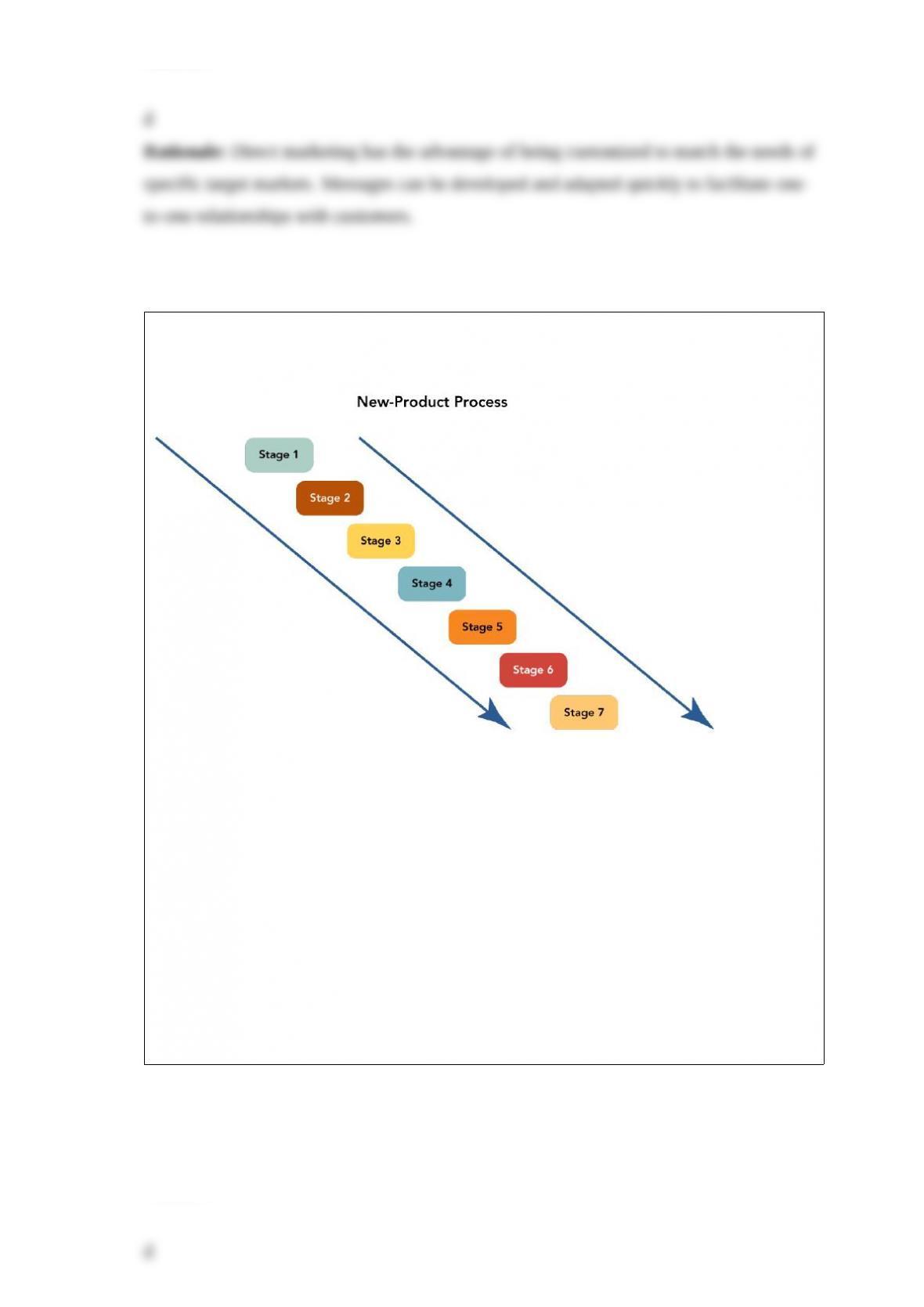
Figure 1. above represents the seven stages of the new-product development process.
Stage 1 is the __________ stage.
a. idea generation
b. screening and evaluation
c. screening and analysis
d. new-product strategy development
e. product assessment
Answer:
In classifying social media, media richness is __________, whereas self-disclosure is
__________.
a. the degree to which a person’s thoughts, feelings, likes, and dislikes are made public;
the degree of acoustic, visual, and personal contact between two communication
partners.
b. the degree of acoustic, visual, and personal contact between two communication
partners; the degree to which a person’s thoughts, feelings, likes, and dislikes are made
public.
c. the quality of the graphics and video on a website; the online conduct that leads to an
unfavorable impression.
d. a visual measure; an emotional measure.
e. the extent to which a user personalizes his or her profile page; adding contact
information (telephone, address, and e-mail) on one’s Facebook page.
Answer:
The oldest retail setting, usually located in the community’s downtown area, is referred
to as
a. the central business district.
b. main street.
c. community anchor.
d. uptown center.
e. historical commerce district.
Answer:
In terms of its effect on faxing, e-mail has __________.
a. led to a significant number of improvements in fax machine technology to keep the
product class competitive
b. led to a significant decrease in fax machine sales because e-mail better suits the
needs of the business community
c. led to a significant increase in fax machine purchases due to distrust of e-mail spam
d. a minimal impact since the two technologies do not directly compete with each other
e. caused most fax machine manufacturers to incorporate new Internet technology to
send, receive, and print e-mails through a wireless connection to a personal computer
Answer:
One advantage of using magazines as an advertising medium is
a. the relatively short time it takes to place an ad.
b. high-quality color is available if needed or desired.
c. the cost of placing a magazine ad is extremely low.
d. the ease of translating consumer interests into a successful publication.
e. there is little need or benefit to incorporate four-color graphics.
Answer:
The Starch test uses a(n) __________ to determine the percentages of those who
remember seeing a specific magazine ad, who saw or read any part of the ad identifying
the product or brand, who read any part of the ad’s copy, and who read at least half of
the ad.
a. attitude test
b. prompted response test
c. inquiry test
d. concept test
e. aided recall test
Answer:
During late summer and early fall, there is a large demand for containers located in Asia
that are used to ship consumer goods from Asia to the United States in time for the
holiday selling season. The demand for these containers is referred to as __________
demand.
a. unitized
b. derived
c. reseller
d. applied
e. implied
Answer:
The most likely market for cosmetic dentistry, which can cost $15,000 for straightening
and whitening, is
a. toddlers with crooked baby teeth, when crooked teeth run in the family.
b. all former smokers who have been smoke free for at least one year.
c. anyone who has the time, the money, and the desire to undergo the procedures.
d. anyone who has dental insurance.
e. adults who want to make a good first impression for a job interview.
Answer:
The average amount of money received for selling one unit of a product, or simply the
price of that unit, is referred to as __________.
a. profit
b. total revenue
c. unit variable revenue
d. average revenue
e. marginal revenue
Answer:
According to Porter’s four generic business strategies framework, a __________
strategy focuses on reducing expenses and, in turn, lowers product prices, while
targeting a broad array of market segments.
a. differentiation focus
b. cost focus
c. cost leadership
d. differentiation
e. supply focus
Answer:
Figure 1.
According to Figure 1. above, ‘set research objectives” occurs during which step of the
five-step marketing research approach?
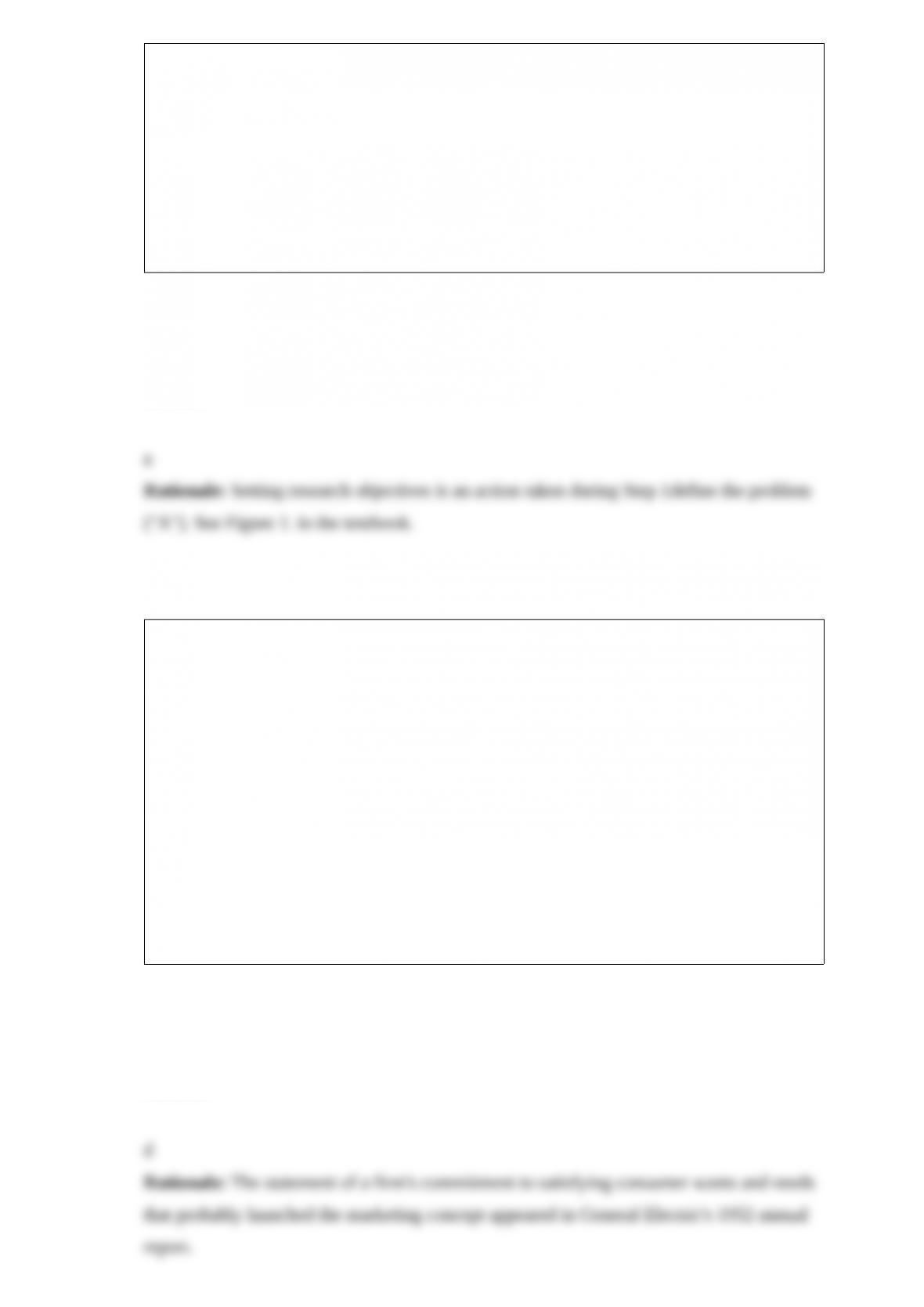
a. “A”
b. “B”
c. “C”
d. “D”
e. “E”
Answer:
In 1952, General Electric’s annual report stated, “The concept introducesmarketingat the
beginning rather than the end of the production cycle and integrates marketing into each
phase of the business.” This is a brief statement of what has come to be known as the
a. sustainability perspective.
b. age of consumerism.
c. sales concept.
d. marketing concept.
e. customer relationship management concept.
Answer:
In the VALS framework, consumers who place importance on imagenot as evidence of
power or status, but as an expression of cultivated tastes, independence, and
characterare referred to as __________.
a. Actualizers
b. Innovators
c. Achievers
d. Makers
e. Strivers
Answer:
The intangibility element of a service refers to the fact that it
a. has value that can only be determined by using subjective criteria.
b. can”t be held, seen, or touched before the purchase decision.
c. cannot be described, only experienced.
d. can maintain or accumulate inventory.
e. can be objectively evaluated.

Answer:
The various forms of online media content that are publicly available and created by
end users are referred to as
a. user-generated content (UGC).
b. wikis.
c. net platforms.
d. Facebook pages.
e. mass media.
Answer:
The purpose of patent law is to
a. provide incentives for increased competition.
b. give an author of a literary, dramatic, musical, or artistic work the exclusive right to
print, perform, or otherwise copy that work.
c. give inventors the right to exclude others from making, using, or selling products that
infringe the patented invention.
d. guarantee the quality and safety of any product produced or distributed in the United
States.
e. level the playing field between inventors who work for large corporations and those
who work on their own.
Answer:
A code of ethics is a formal statement of rules of conduct and
a. legal restrictions.
b. moral laws.
c. ethical principles.
d. core values.
e. cultural values.
Answer:
In terms of performance measures, fans are
a. the total number of unique visitors to a Facebook Page in a given time period.

b. the number of people who have opted in to a brand’s messages through a social media
platform at a given time.
c. the percentage of people who have clicked on a link on the Page to visit a specific
site.
d. the number of people who interact with a Post (“like,” make a comment, and so on)
divided by the total number of people seeing the Post.
e. the brand’s share or percentage of all the online social media chatter related to its
product category or a topic.
Answer:
A person“s ability to perceive differences in stimuli is referred to as
a. selective comprehension.
b. selective retention.
c. stimulus generalization.
d. stimulus discrimination.
e. routine problem solving.
Answer:
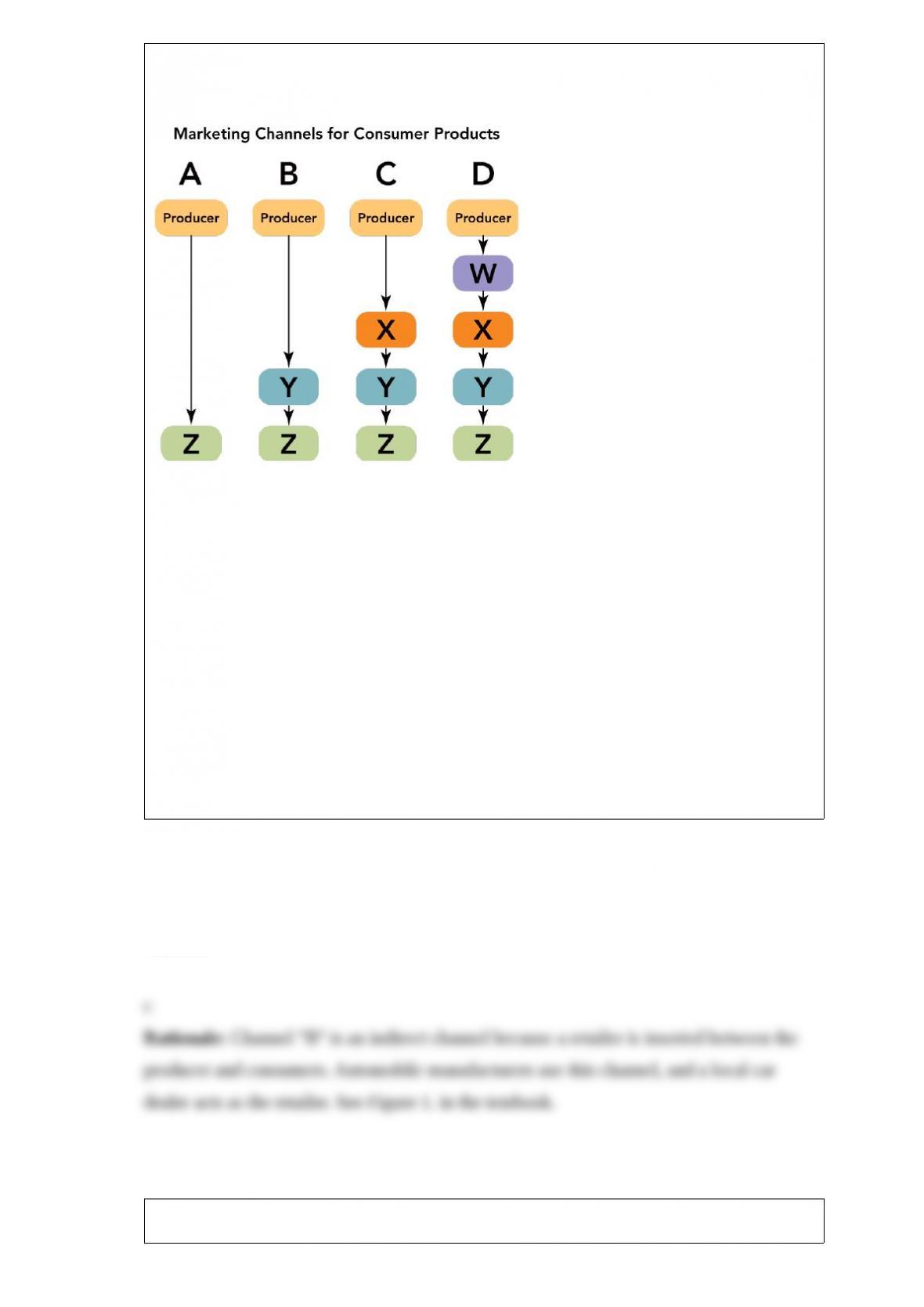
Figure 1.
Figure 1. above depicts four common marketing channels for consumer products and
services that differ by the kind and number of intermediaries. Channel “B” would be an
appropriate marketing channel for which of the following?
a. insurance products
b. direct-to-home food products
c. automobiles
d. construction machinery
e. candy
Answer:
The four Ps of the marketing mix are
a. priorities, personnel, placement, and profits.
b. prediction, production, pricing, and promotion.
c. product, price, production, and place.
d. product, price, promotion, and place.
e. predict, produce, package, and persuade.
Answer:
A permanent institution that sets rules governing trade between its members through a
panel of trade experts who decide on trade disputes between members and issue binding
decisions is referred to as the __________.
a. League of Nations
b. World Trade Organization (WTO)
c. Association for Commerce Equity (ACE)
d. United Nations Board of Trade (UNBT)
e. Global Better Business Bureau (BBB-G)
Answer:
USA.gov
a. is a depository of information on U.S. business, economic and trade activity collected
by the federal government.
b. is a portal to all government websites that can be found by topic or keyword.
c. provides up-to-the-minute business news and security prices plus research reports of
companies, industries, and countries.
d. is the most popular Internet portal to enter key words or topics for specific searches.
e. accesses information in online databases and an index of blogs by primary topic.
Answer:
Personal selling serves three major roles in a firm’s overall marketing effort.
Salespeople: (1) are the critical link between a firm and its customers; (2) are the
company in consumers’ eyes; and (3) __________.
a. play a key role in research and development
b. are the ultimate channel of distribution
c. provide the most valuable resource for segmenting and selecting target markets
d. are one of many people in a firm that contacts potential customers
e. may play a dominant role in a firm’s marketing program
Answer:
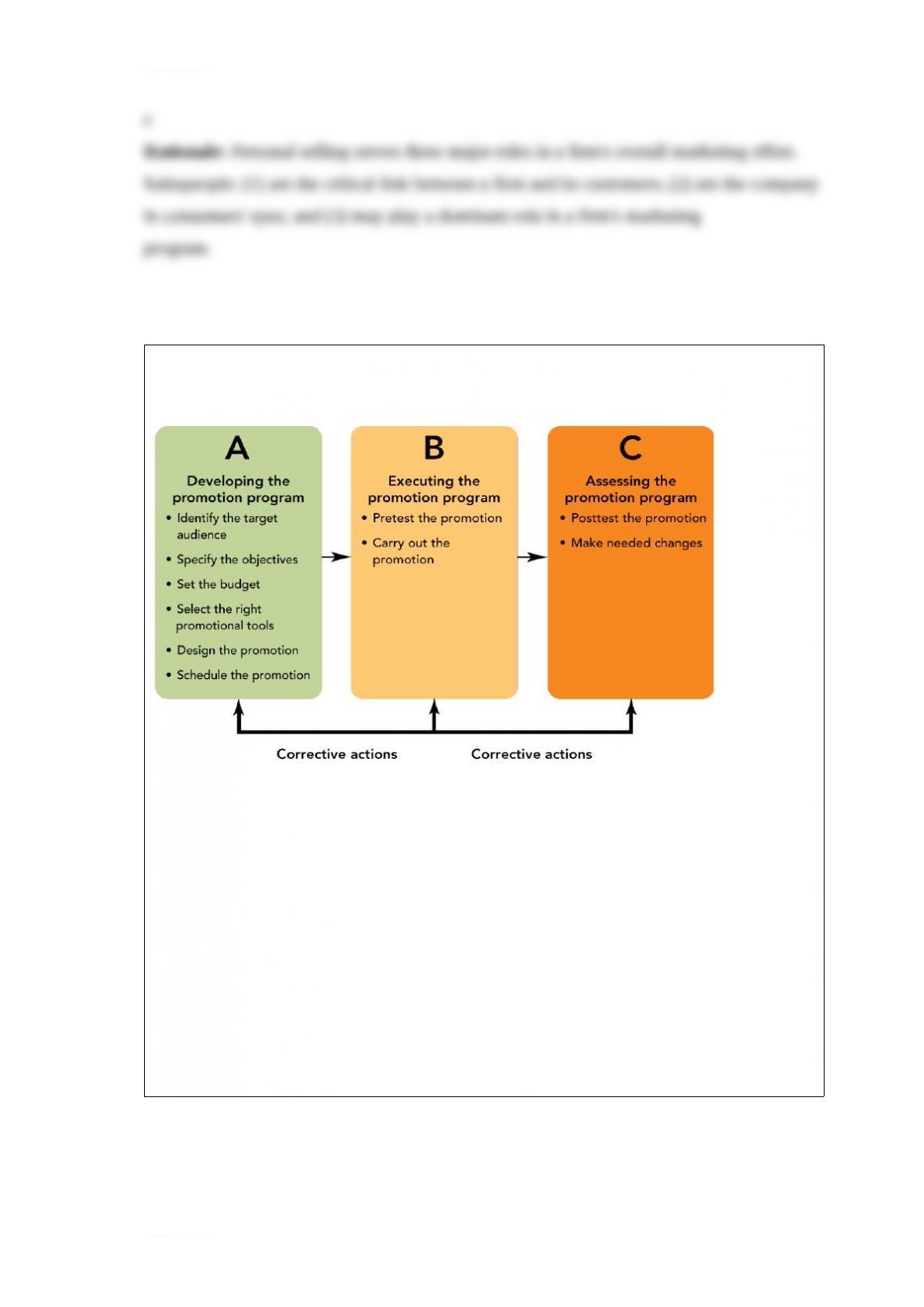
Figure 1.
The promotion decision process is divided into three phases. In Figure 1. above, “C”
refers to the _________ phase.
a. planning
b. implementation
c. forecasting
d. discharge
e. evaluation
Answer:
An information- and communication-based electronic exchange environment mostly
occupied by sophisticated computer and telecommunications technologies and digitized
offerings is referred to as __________.
a. Internet marketing
b. marketspace
c. electronic commerce
d. marketplace
e. e-exchange
Answer:
A metropolitan division
a. can be divided into even smaller units called micropolitan divisions.
b. is called a metropolitan megamarket if it has a population of 1,000,000 or more.
c. can be divided into even smaller units called metroplex divisions.
d. is part of a metropolitan statistical area that contains a population of 2.5 million or
more.
e. has its own zip code to reflect the U.S. Postal Service designation.
Answer:
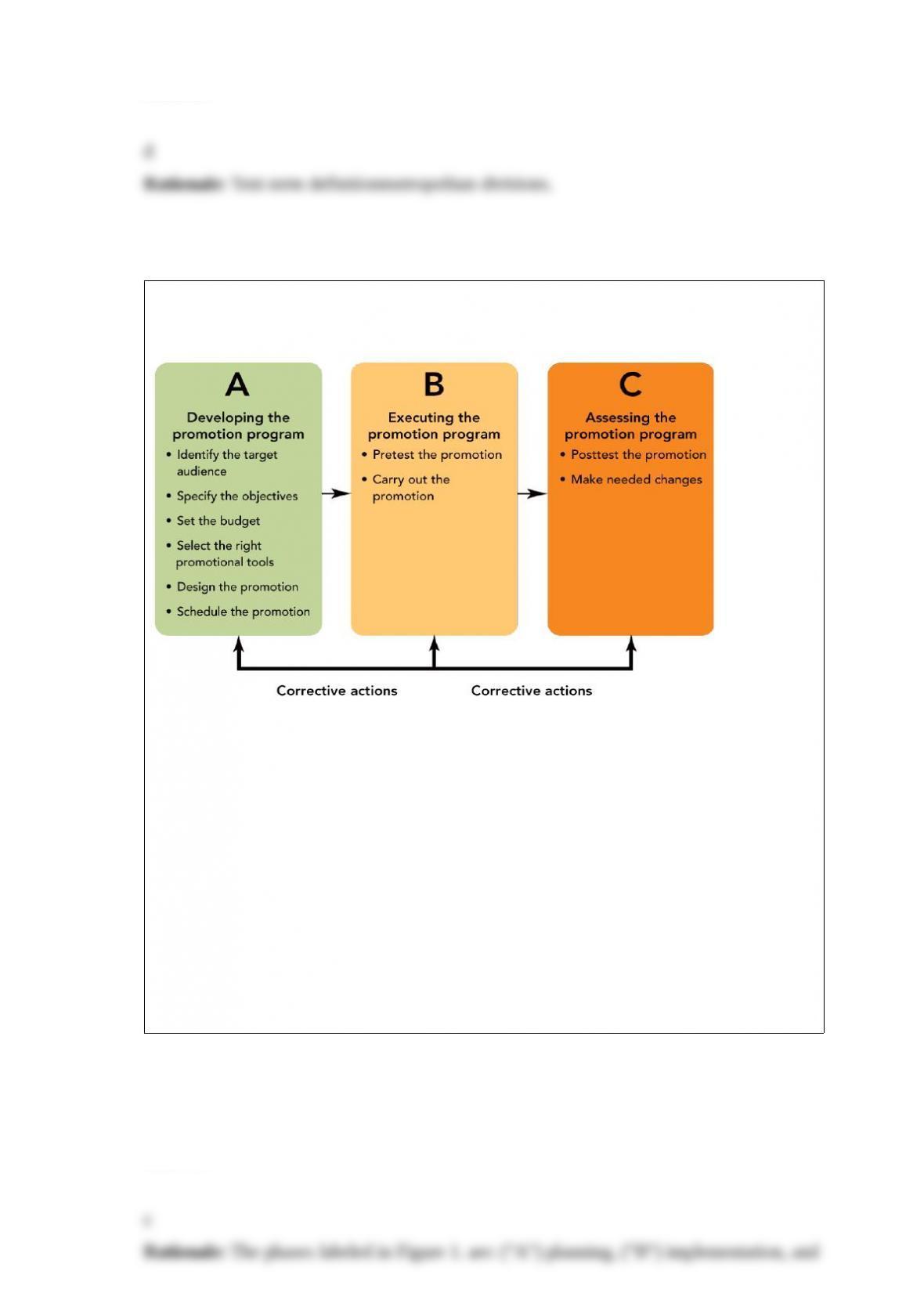
Figure 1.
The promotion decision process is divided into three phases. In Figure 1. above, “B”
refers to the _________ phase.
a. scheduling
b. development
c. implementation
d. evaluation
e. planning
Answer:
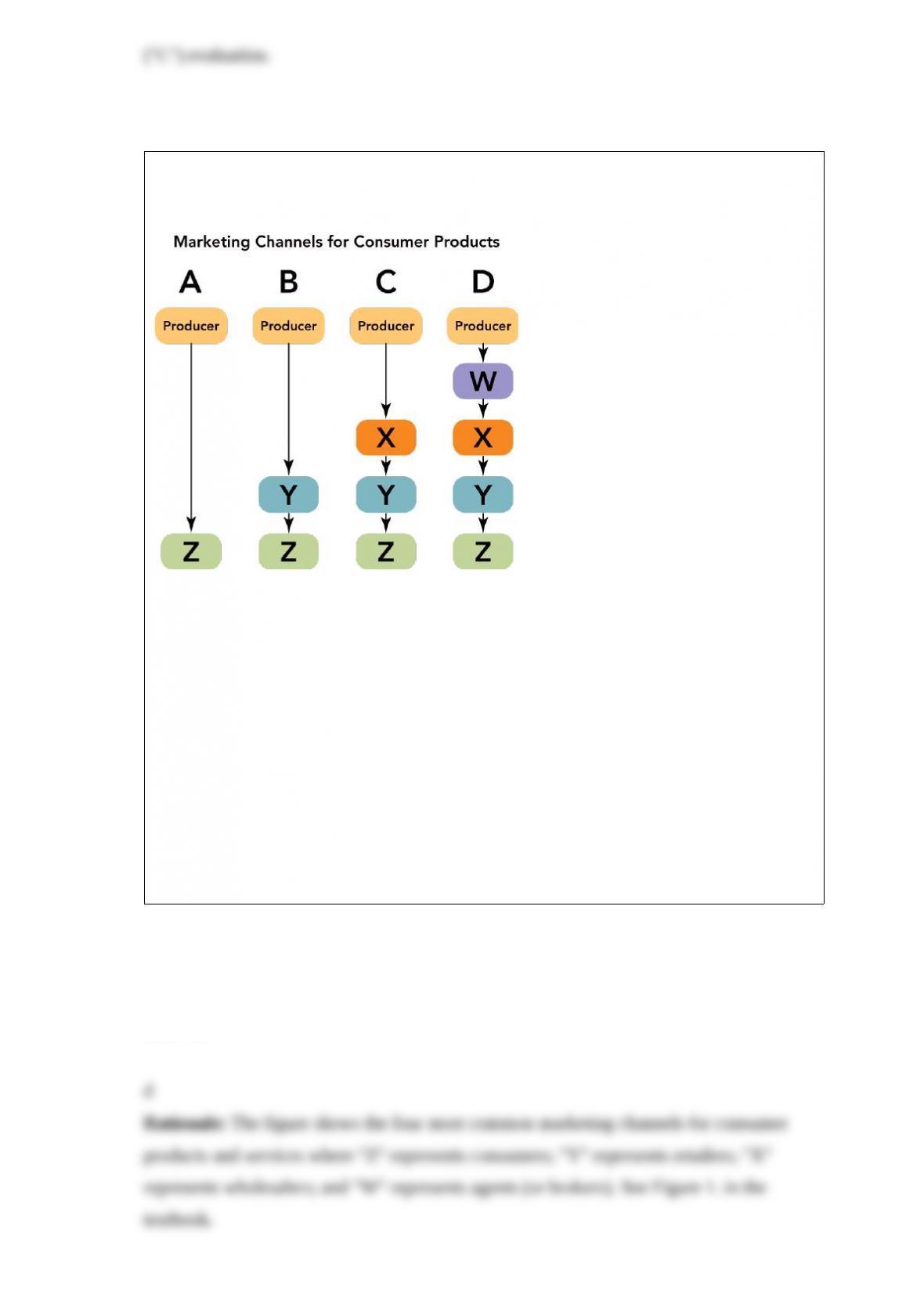
Figure 1.
Figure 1. above depicts the four most common marketing channels for consumer
products and services. “W” represents
a. consumers.
b. industrial users.
c. wholesalers.
d. agents or brokers.
e. retailers.
Answer:
How does Facebook generate its sales revenue from ads?
a. Facebook allows companies’ ads to show up in pop-up windows throughout the site.
b. Facebook charges companies to create a Facebook Page for their brands.
c. Facebook charges for ads to appear along the right-hand section of a Facebook
webpage.
d. Facebook staff members create ads for companies who want to advertise on
Facebook.
e. Facebook charges companies every time their brand is mentioned in a user’s profile.
Answer:
Which of the following pieces of information is used in the development of the
marketing program, the third step of the planning phase of the strategic marketing
process?
a. marketing return on investment
b. market-product grids with target segments and product groupings
c. detailed plans to execute the marketing program
d. market potential studies
e. trends for industry and competitors
Answer:
The manufacturers of drugs encourage patients to learn more about the drugs and ask
for them by name from the doctor. The manufacturers of these drugs are using a(n)
__________ promotional strategy.
a. pull
b. intense
c. push
d. inertia
e. exclusive
Answer:
Which of the following products would have a low-learning product life cycle curve?
a. electric cars
b. Fusion razor
c. interactive television
d. software for learning a foreign language

e. convection ovens
Answer: