An organization’s foundation can be broken into three key elements. They are
a. products, services, and ideas.
b. business definition, long-term goals, and short-term objectives.
c. board of directors, top management, and stakeholders.
d. corporate-level strategies, SBU-level strategies, and functional-level strategies.
e. core values, mission/vision, and organizational culture.
Answer:
The most common form of outdoor advertising is/are __________.
a. transit
b. point-of-purchase displays
c. billboards
d. kiosks
e. in-store signage
Answer:
When a product that spreads through the population, it is called the __________.
a. spread of innovation.
b. proliferation of innovation
c. open innovation
d. dispersal of innovation
e. diffusion of innovation
Answer:
A short-term inducement of value offered to arouse interest in buying a product or
service is referred to as __________.
a. customer incentive
b. customer enticement
c. free publicity
d. sales promotion
e. purchase incentive
Answer:
Office Depot has leveraged its store, website, and catalog channels with impressive
results. The promotion of all three information and delivery channels indicates that
Office Depot would like its customers to think of all of its channels as Office Depot.
Office Depot is likely following a(n) __________ strategy.
a. cross-functional
b. interlocking marketing
c. multichannel marketing
d. dual distribution
e. market penetration
Answer:
A branding strategy in which a firm markets some products under its own name(s) and
other products under the name of a reseller because the segment attracted to the reseller
is different from its own market is referred to as __________.
a. multibranding
b. generic branding
c. private branding
d. mixed branding

e. multiproduct branding
Answer:
An industrial distributor refers to
a. an intermediary that performs a variety of marketing channel functions involving
selling, stocking, delivering a full product assortment, and financing.
b. an intermediary that maintains its own salesforce and performs all channel functions.
c. an intermediary that deals exclusively with the selling, stocking, and delivery of raw
materials used by manufacturers in the production of its products.
d. an intermediary that deals with a single product line within a single industry.
e. an intermediary that performs functions involving selling, stocking, and delivery of
industrial goods but is unable to provide financing due to the normally large
expenditures.
Answer:
Warranties that have no limits of noncoverage are called __________ warranties.
a. guaranteed

b. full
c. implied
d. coverage
e. express
Answer:
The brochure for Spa Sydell has photographs of people enjoying the various spa
amenities. By seeing the pictures of what is available at the spa, a customer has a better
idea of what she is buying. Spa Sydell uses a brochure to help customers deal with the
__________ that is associated with using the service.
a. incongruity
b. inconsistency
c. inventory costs
d. inseparability
e. intangibility
Answer:
Services refer to
a. ideas that consist of a bundle of tangible and intangible attributes that satisfies
consumers’ needs and is received in exchange for money or something else of value.
b. intangible activities or benefits that an organization provides to satisfy consumers’
needs in exchange for money or something else of value.
c. philanthropic activities performed in without expectations of monetary remuneration.
d. any intangible activity that provides a benefit to a consumer that he or she could not
have obtained or performed on his or her own.
e. any tangible activity that provides a benefit to a consumer that he or she could not
have obtained or performed on his or her own.
Answer:
A(n) __________carries 4,000 to 8,000 items and usually stocks just one brand of
appliance or food product.
a. warehouse club
b. single-price retailer
c. extreme value retailer
d. hypermarket
e. supercenter
Answer:
In a brainstorming session for a new drug to lower cholesterol, the members of the
marketing department agreed the benefits of the new drug could best be promoted by
comparing the drug to those currently on the market. In terms of the communication
process, the transformation of this idea into an ad campaign is an example of
__________.
a. noise
b. receiving
c. encoding
d. decoding
e. messaging
Answer:
Figure 1.
Figure 1. above represents the six steps in the price-setting process. Which letter
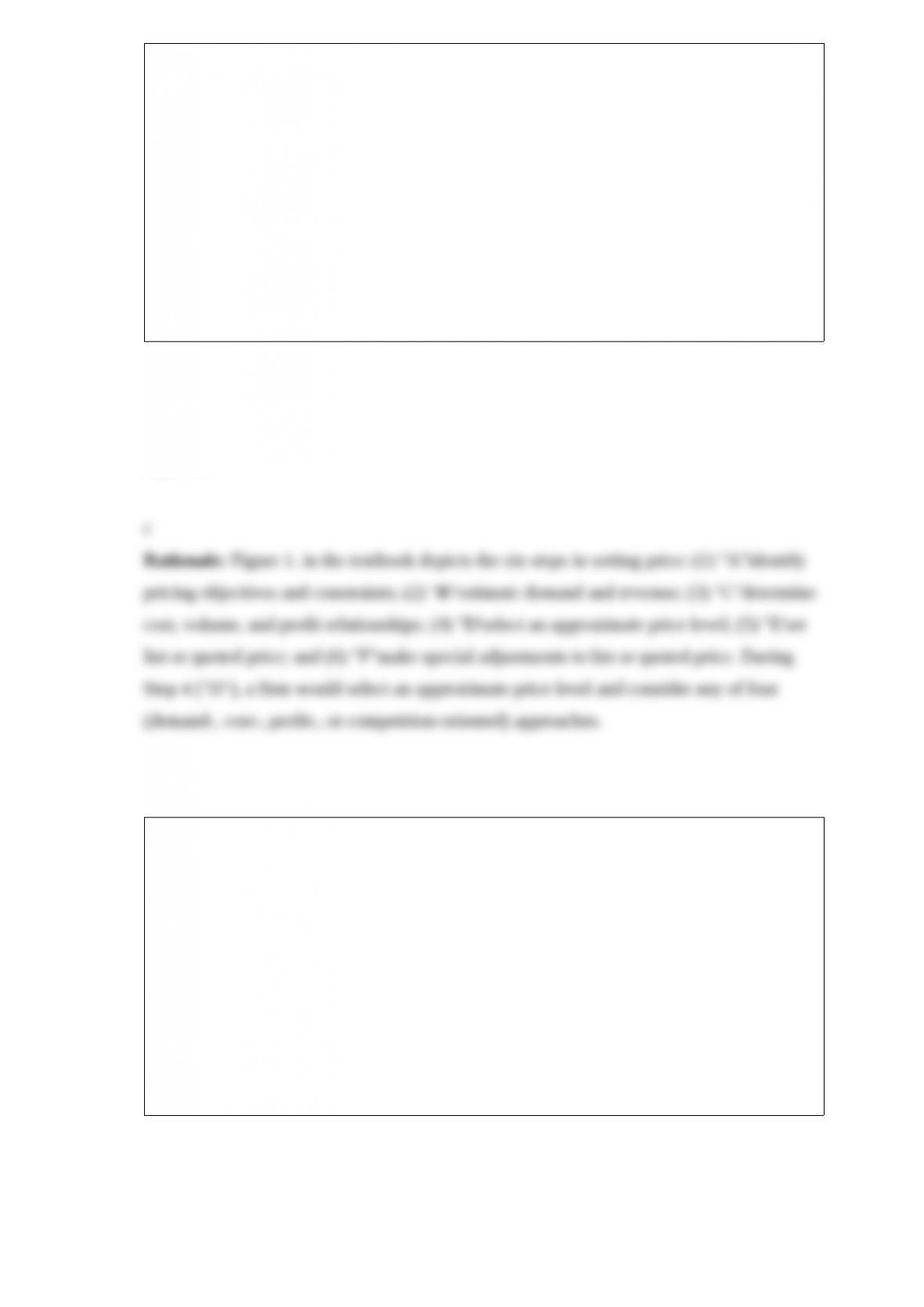
represents the step where a firm would consider a demand-, cost-, profit-, or
competition-oriented approach?
a. “B”
b. “C”
c. “D”
d. “E”
e. “F”
Answer:
Which type of purchase is most likely to be the result of joint decision making?
a. groceries
b. children’s toys
c. medicine
d. home appliances
e. breakfast cereal
Answer:
Geographical adjustments are made by manufacturers or even wholesalers to list or
quoted prices to reflect
a. loyalty to the local economy whether it be city, state, or nationally designated.
b. changes in price due to tariffs or excise taxes.
c. the cost of transportation of the products from seller to buyer.
d. the differentiated aspect of the particular product or service.
e. simplicity in pricing structures.
Answer:
Which of the following statements regarding organizational foundation is most
accurate?
a. An organizational foundation specifies its goals.
b. An organizational foundation defines the business that it is in.
c. An organization’s foundation empowers stakeholders to have a voice in the strategic
marketing process.
d. An organization’s foundation is its philosophical reason for beingwhy it exists.
e. An organization’s foundation is the company, its product, and its customers.
Answer:
Objectives like profit, market share, and survival as well as constraints such demand for
product class and brand, newness, costs, and competition are issues that would be
addressed during __________ of the price-setting process.
a. Step 1
b. Step 2
c. Step 3
d. Step 4
e. Step 5
Answer:
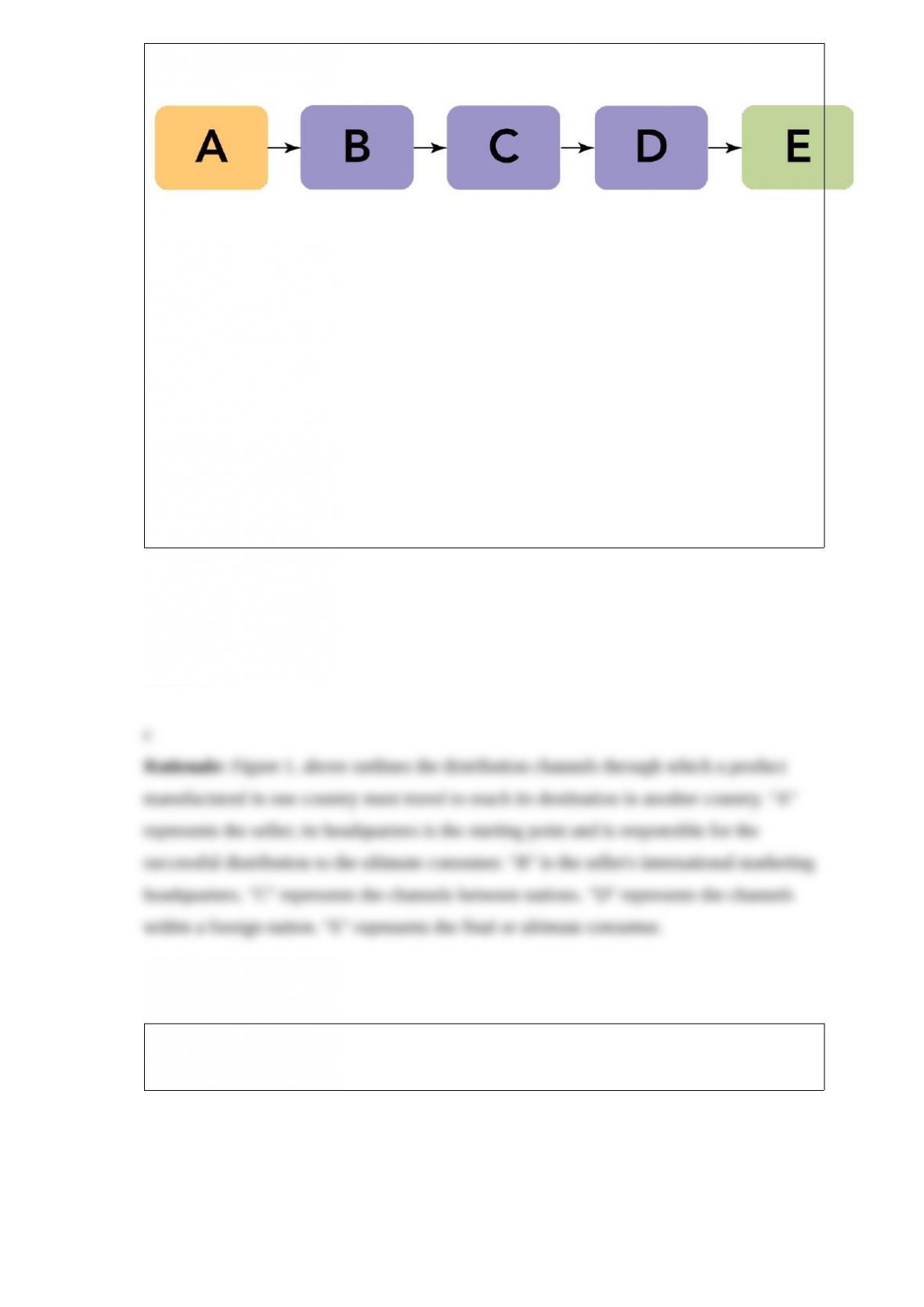
Figure 1.
Figure 1. above outlines the distribution channels through which a product
manufactured in one country must travel to reach its destination in another country. “B”
represents the
a. channels within foreign nations.
b. channels between nations.
c. seller’s international marketing headquarters.
d. political forces.
e. final consumer.
Answer:
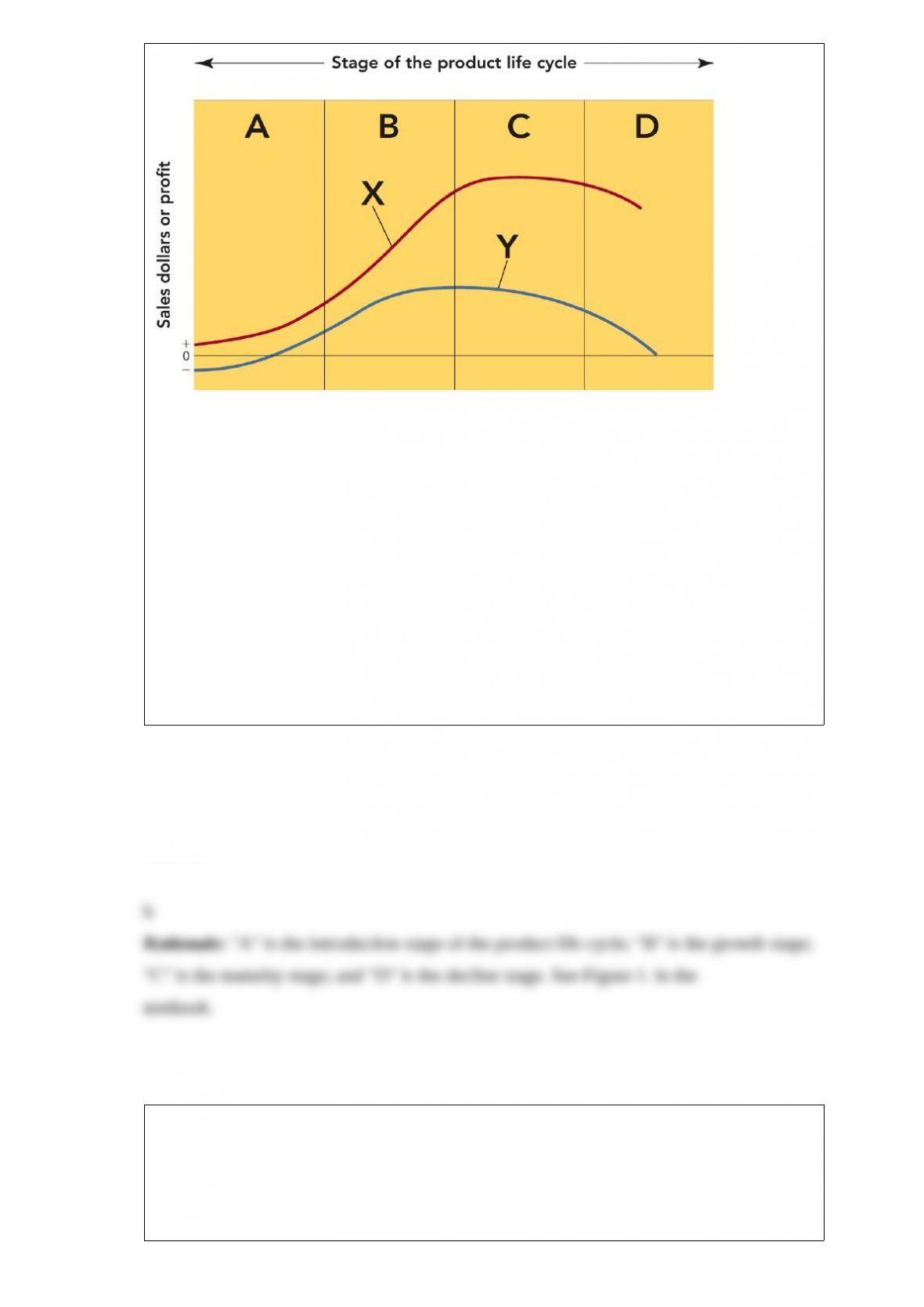
Figure 1.
Figure 1. above represents the stages of the product life cycle. What does the portion of
the curve labeled “C” represent?
a. introduction
b. maturity
c. growth
d. accelerated development
e. decline
Answer:
Enlightened carmakers hired women designers, engineers, and marketing executives to
better understand the way women decide to buy cars. They learned that
a. meeting the expectations of men during the car purchasing process was more difficult
than meeting those of women.
b. men make the majority of car purchasing decisions.
c. women and men think differently about the car-buying experience.
d. women care more about quality than men.
e. men care more about price than women.
Answer:
What is considered normal and expected about the way people do things in a specific
country is referred to as __________.
a. morals
b. ethics
c. values
d. customs
e. beliefs
Answer:

People with both the desire and ability to buy a specific offering are referred to as [a(n)]
__________.
a. shoppers
b. customer base
c. market
d. bazaar
e. emporium
Answer:
Diversification analysis refers to
a. a technique that seeks opportunities by finding the optimum balance between
marketing efficiencies versus R&D”manufacturing efficiencies.
b. a framework to relate the market segments of potential buyers to products offered or
potential marketing actions by an organization.
c. a technique that helps a firm search for growth opportunities from among current and
new markets as well as current and new products.
d. a technique used to determine the appeal of each SBU or offering and then the
amount of cash, if any, each should receive.
e. a framework that identifies four “generic” strategies to achieve a competitive
advantage.
Answer:
A customer value proposition is
a. the unique combination of benefits received by targeted buyers that includes quality,
convenience, on-time delivery, and both before-sale and after-sale service at a specific
price.
b. a statement that, before product development begins, identifies (1) a well-defined
target market; (2) specific customers’ needs, wants, and preferences; and (3) what the
product will be and do to satisfy consumers.
c. a unique strength relative to competitors that provides superior returns, often based
on quality, time, cost, or innovation.
d. the characteristics of a product that make it superior to competitive substitutes.
e. the cluster of benefits that an organization promises customers to satisfy their needs.
Answer:
With profit-oriented approaches to pricing, a price setter may choose to balance both
_________ and _________ to set price.
a. cost; profit
b. cost; service
c. cost; revenue
d. cost; supply
e. cost; demand
Answer:
Which of the following statements about the World Trade Organization (WTO) is most
accurate?
a. The World Trade organization is a temporary group that meets on an as needed basis.
b. The 153 member countries of the WTO account for approximately 55 percent of
world trade.
c. The WTO sets rules governing trade between its members and the remainder of the
world.
d. The WTO uses panels of trade experts who can issue binding decisions.
e. The WTO was formed by the United Nations.
Answer:
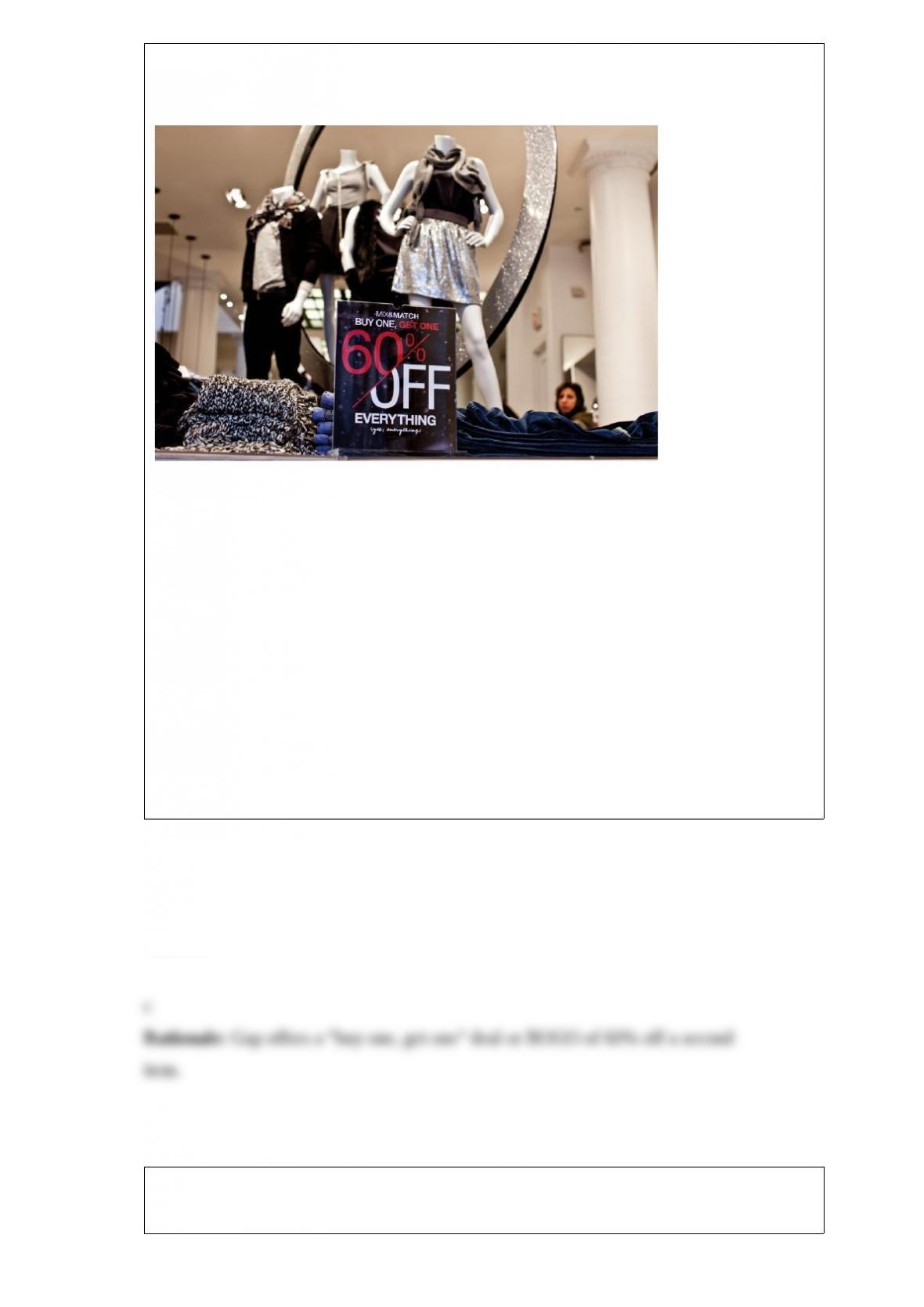
Gap In-Store Signage Photo
The Gap in-store signage photo above shows that customers can save 60 percent off a
second item if they purchase one at the full price. This is an example of a __________
deal to entice shoppers to buy additional items.
a. Big Clearance
b. Extra Value
c. BOGO
d. Inventory Reduction
e. Barter
Answer:
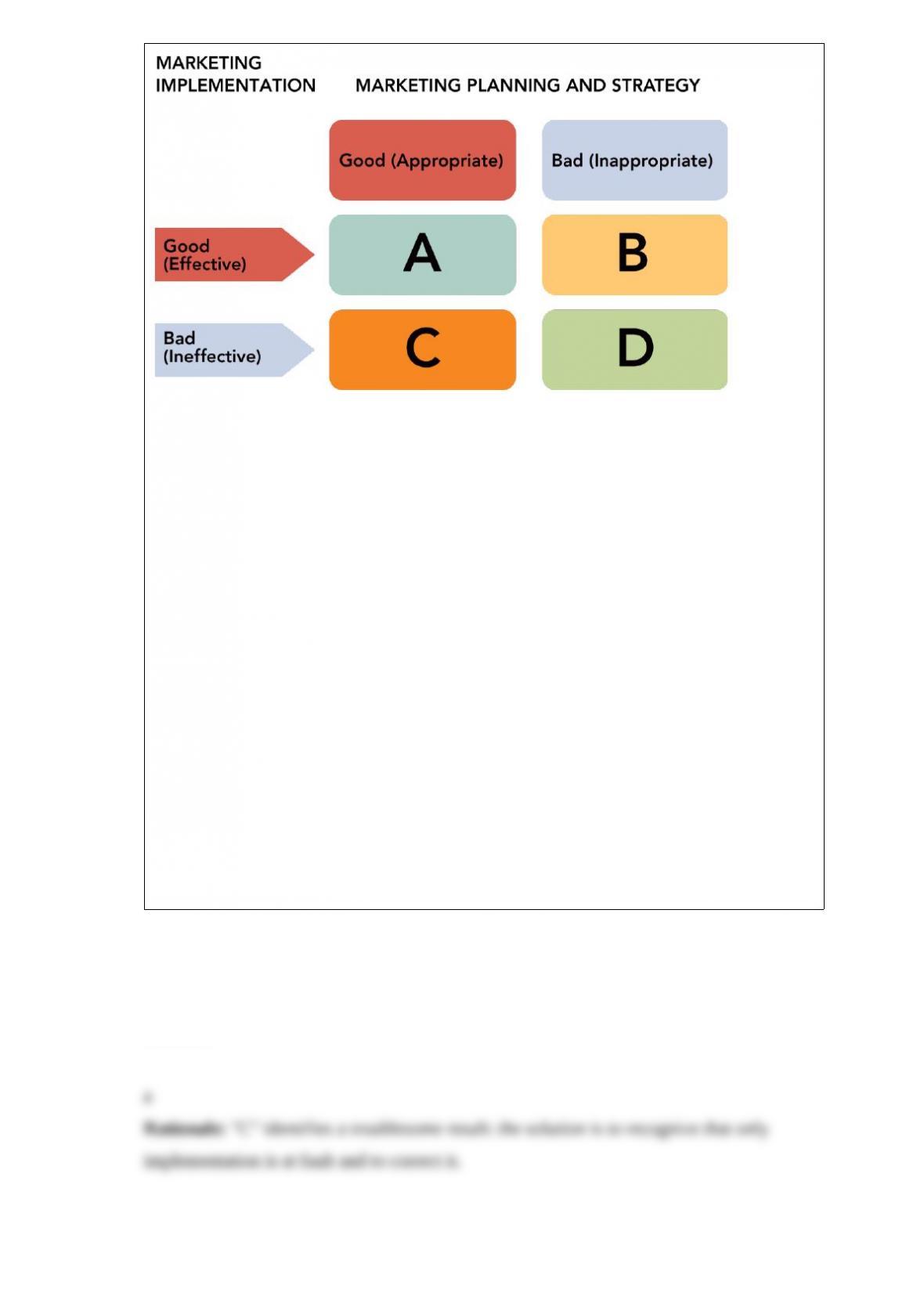
Figure 22-A
Consider Figure 22-A above. Effective managers track the progress of their marketing
plans to identify problems that need to be corrected. Sometimes, the problems are with
the marketing plan and its strategies; at other times, they may be due to their
implementation; and at still other times, they may be due to both. Recall that research
on what really works shows that successful firms have excellence on both the planning
and strategy side and the implementation or execution side. As Figure 22-A shows,
marketers can develop and implement strategies that have four possible results. For “C,”
identify the likely result of the planning and implementation of the marketing plan and
its strategies for a product or service.
a. Trouble: The solution is to recognize that only implementation is at fault and to
correct it.
b. Success: The marketing program achieves its objectives.
c. Failure: The marketing program flounders and fails to achieve its objectives.
d. Trouble: The solution is to recognize that only the strategy is at fault and to correct it.
e. Cannot be determined with the information provided.
Answer:
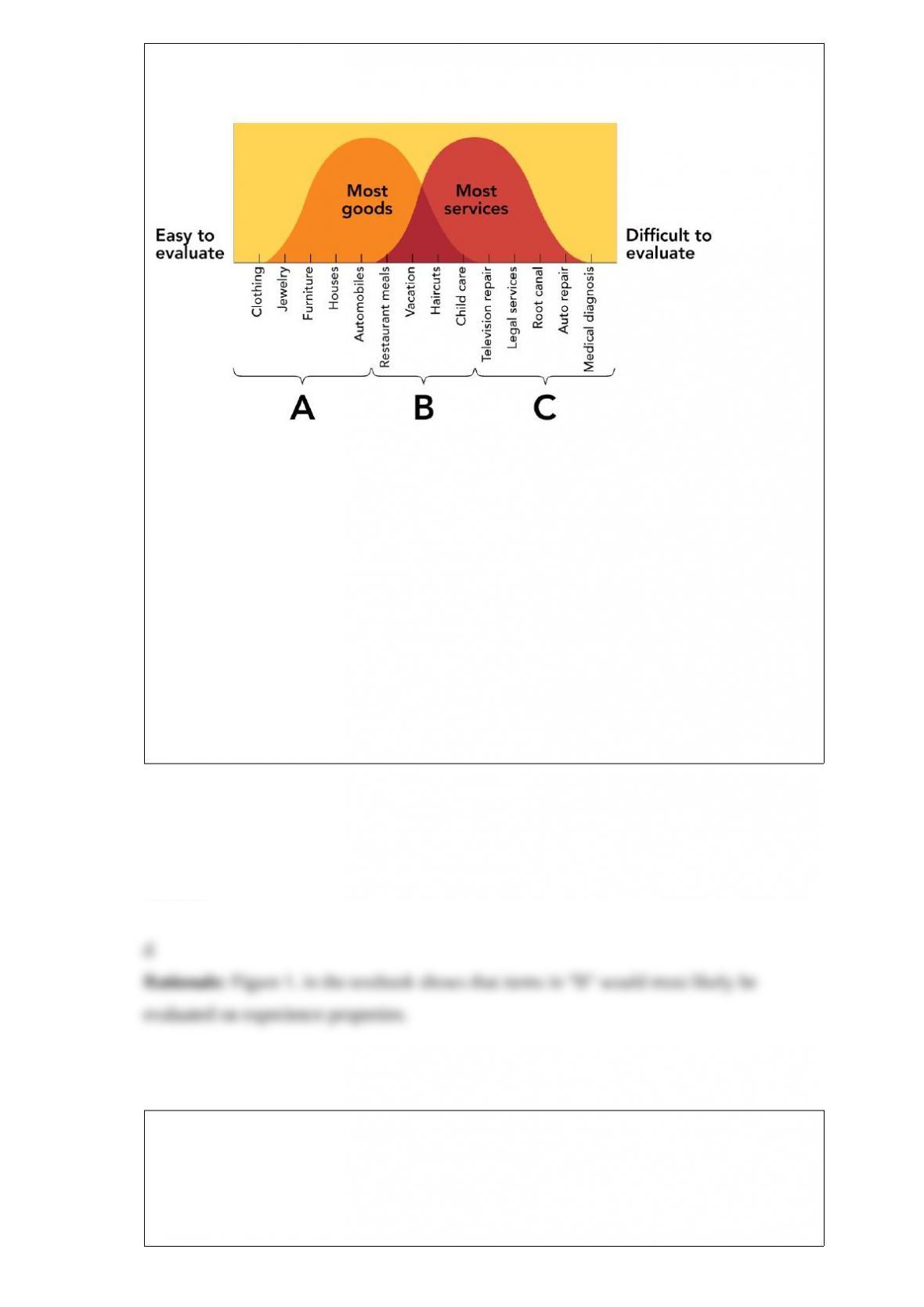
Figure 1.
According to Figure 1. above, purchases labeled “B” would most likely be evaluated on
__________ properties.
a. value
b. search
c. credence
d. experience
e. expenditure
Answer:
Moral idealism refers to
a. a personal moral philosophy that focuses on the greatest good for the greatest number
by assessing the costs and benefits of the consequences of ethical behavior.
b. a democratic consensus of moral principles and laws that govern the behavior of
individuals based on legislation adopted at the federal, state, and local levels.
c. a societal moral philosophy based on the Golden Rule of the Judeo-Christian ethic
embodied in the U.S. Constitution’s Bill of Rights.
d. a formal statement of ethical principles and rules of conduct.
e. a personal moral philosophy that considers individual rights or duties as universal,
regardless of the outcome.
Answer:
A comparative ad
a. reinforces previous knowledge of a product.
b. assures current users they made the right choice.
c. promotes a specific brand’s features and benefits.
d. tells people what a product is, what it can do, and where it can be found.
e. shows one brand’s strengths relative to those of competitors.
Answer:
The element of the marketing mix demonstrated when an art gallery suggests a $2.00
donation at the door is __________.
a. philanthropy
b. place
c. product
d. promotion
e. price
Answer: