Five pricing practices are closely scrutinized because of potential unethical or illegal
actions. They include: (1) price fixing; (2) price discrimination; (3) deceptive pricing;
(4) geographical pricing; and (5) __________.
a. predatory pricing
b. price discounting
c. lateral price fixing
d. regional rollbacks
e. delayed payment penalties
Answer:
Which of the following statements regarding Ben & Jerry’s is most accurate?
a. Ben & Jerry’s is owned by Unilever, the market leader in the global ice cream
industry.
b. Ben & Jerry’s is a privately owned ice cream producer.
c. Ben & Jerry’s prides itself on offering more ice cream flavors than its competitors.
d. Ben and Jerry are not real people; the names were a clever reference to Tom and
Jerry cartoon characters in order to capitalize on childhood nostalgia.
e. Ben & Jerry’s has only been in business for twenty years and is already the industry
leader in premium ice cream.
Answer:
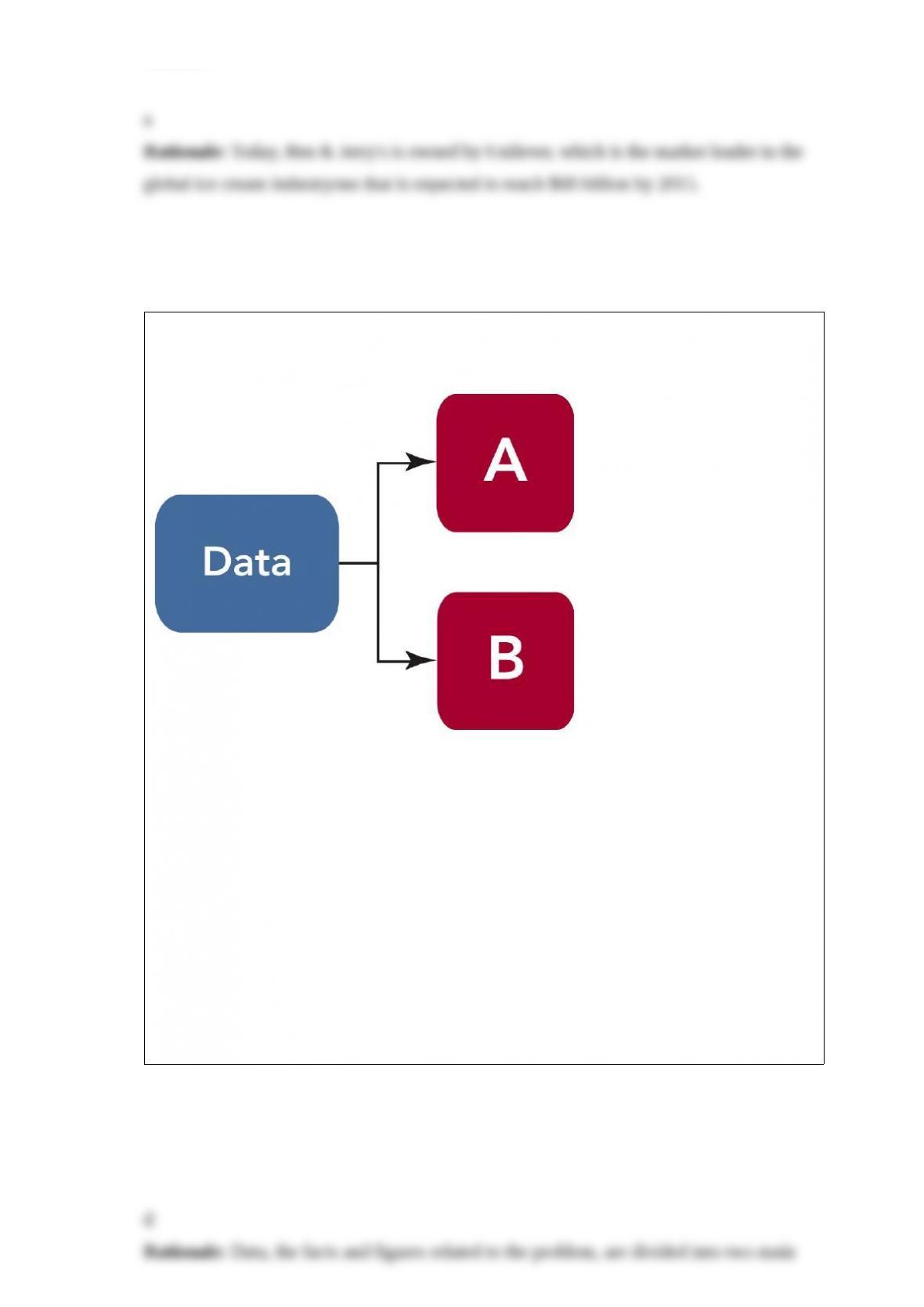
Figure 1.a
Figure 1.a above shows the two main types of data. If “A” represents the facts and
figures that are newly collected for the project, which type of data is “A?”
a. internal primary data
b. secondary data
c. external primary data
d. primary data
e. internal secondary data
Answer:
Direct orders refer to
a. direct communication with consumers to generate a response in the form of an order,
a request for further information, or a visit to a retail outlet.
b. products that are shipped directly to the place of purchase rather than being stored or
distributed through intermediaries.
c. the result of offers that contain all the information necessary for a prospective buyer
to make a decision to purchase and complete the transaction.
d. the outcome of an offer designed to motivate people to visit a business.
e. the result of an offer designed to generate interest in a product or service and a
request for additional information.
Answer:
The first decision in developing an advertising program is to
a. set the budget.
b. state its mission.
c. identify the target audience.
d. select the appeal.
e. select the media.
Answer:
The actions taken in the development of the marketing program, Step 3 of the planning
phase, include: (1) develop the program’s marketing mix actions and (2) __________.
a. select target markets
b. identify industry trends
c. position the product
d. find points of difference
e. develop the budget by estimating revenues, expenses, and profits
Answer:
A marketing strategy is the means by which a marketing goal is to be achieved. The two
factors that usually characterize a marketing strategy are
a. specific organizational goals and objectives.
b. a detailed marketing plan and a marketing budget.
c. marketing strategies and marketing tactics.
d. a specified target market and a marketing program to reach it.
e. marketing programs and marketing dashboards to evaluate them.
Answer:
Which of the following statements about inquiry tests is MOST accurate?
a. With inquiry tests, a question such as, “What ads do you remember seeing
yesterday?” is asked of respondents without any other prompting to determine whether
they saw or heard advertising messages.
b. With inquiry tests, additional product information, product samples, or premiums are
offered to an ad’s readers or viewers, and ads generating the most inquiries are
presumed to be the most effective.
c. Inquiry tests involve studies such as controlled experiments and consumer purchase
tests.
d. In an inquiry test, respondents are asked questions to measure changes in their
attitudes after an advertising campaign, such as whether they had a more favorable
attitude toward the product advertised.
e. In an inquiry test, respondents are first shown an ad and then asked whether their
previous exposure to it was through reading, viewing, or listening.
Answer:
Which of the following statements regarding communication is most accurate?
a. Communication as a function of customer service refers to oral rather than written
exchange of information.
b. Communication as a function of customer service refers to written rather than oral
exchange of information.
c. Communication as a function of customer service refers exclusively to exchanges
between the retailer and the ultimate consumer.
d. There should be little if any communication between an ultimate consumer and the
manufacturer.
e. Improvement in transportation carrier information has improved the ability to trace
information and schedule shipments.
Answer:
In terms of website design and the online customer experience, commerce refers to
a. business-to-business only transactions that take place between one firm’s website and
another firm’s site.
b. Internet-based networks that permit communication between a company and its
supplier, distributors, and other partners.
c. websites specifically designed for electronic funds transfer, such as banks, and/or
private institutions, such as PayPal.
d. the application of information and communication technologies in support of the
firm’s entire business activities.
e. the website’s ability to conduct sales transactions for products and services.
Answer:
The online consumer lifestyle segment called “time-sensitive materialists”
a. are married couples with children at home who use the Internet like a consumer
magazine.
b. rarely spend money online and use the Internet only as an information source.
c. regularly visit their favorite bookmarked websites and spend the most money online.
d. regard the Internet as a convenient tool for buying music, books, and computer
software.
e. consist of young, affluent single consumers who spend more time online than any
other segment.
Answer:
If a purchase is a new buy for a manufacturer, the seller should be prepared to act as a
consultant to the buyer, work with technical personnel, and
a. expect a long time for a buying decision to be reached.
b. neutralize a lot of conflict.
c. expect specifications to be changed several times before the buy is completed.
d. expect to have to do some favors for the decision makers.
e. avoid making concessions or compromises.
Answer:
The belief that products originating from one country would be of better or worse
quality than the products from another country illustrates the _____ benefits that
packaging information can provide.
a. functional be
b. financial
c. physical
d. perceptual
e. communication
Answer:
Pretzels were first introduced as a salty snack. Later, the product was repositioned as a
low-fat snack in order to __________.
a. respond to a competitor’s head-to-head positioning strategy
b. reach a new market
c. catch a rising trend
d. change the value offered
e. change its target audience
Answer:
Speed or __________ is often vital in introducing a new product.
a. perpendicular development
b. red tape cutting
c. time to market
d. fast concepting
e. delivery expediting
Answer:
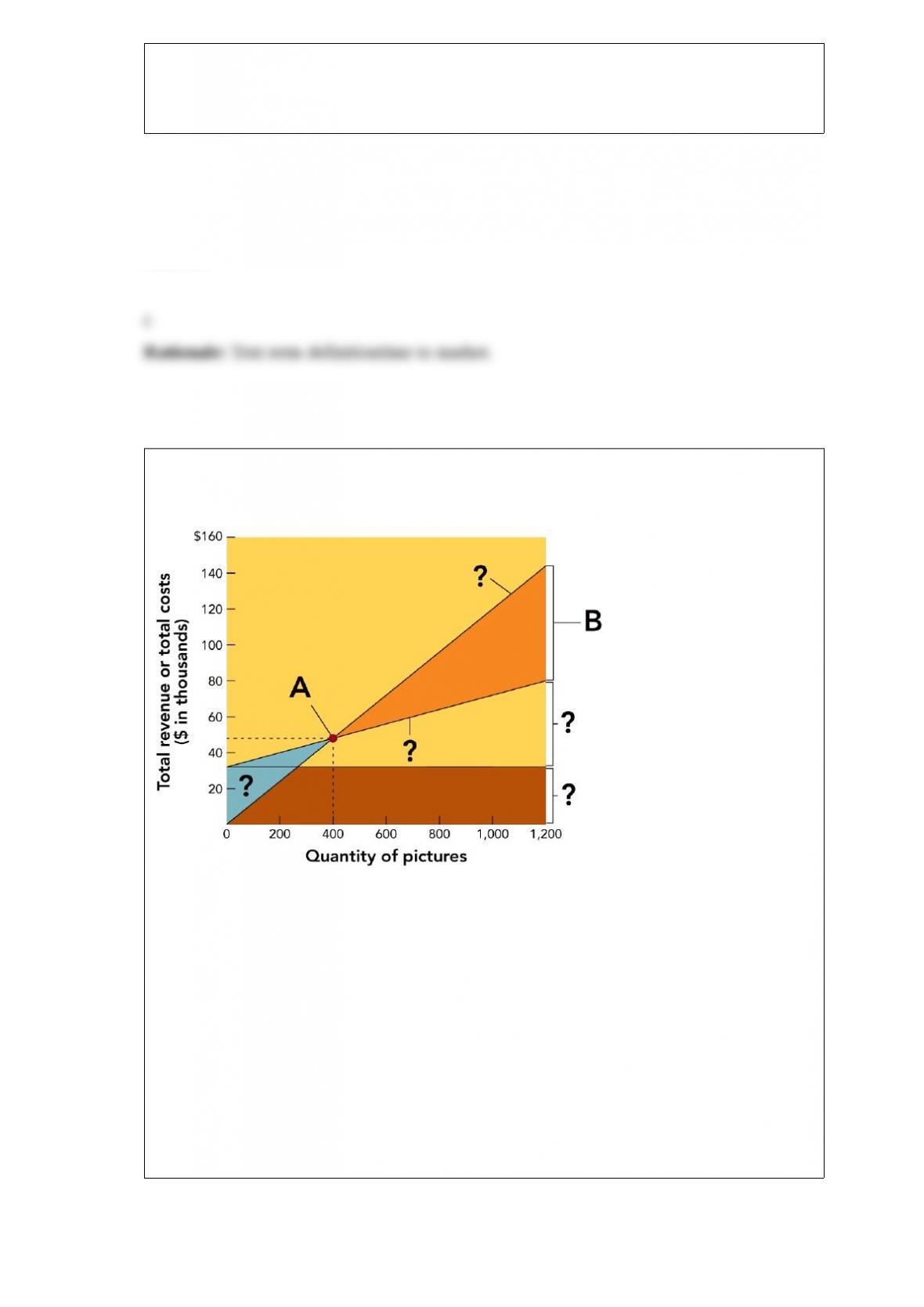
Figure 1.
Figure 1. above shows that by selling 200 pictures, the firm will
a. break even.
b. earn a profit.
c. incur a loss.
d. have no fixed costs.
e. have no variable costs.
Answer:
According to the personal moral philosophy of __________, if the benefits exceed the
costs, the behavior is ethical.
a. hedonism
b. utilitarianism
c. existentialism
d. moral idealism
e. socialism
Answer:
The purpose of the five key steps in segmenting and targeting markets that link
customer needs to marketing actions is to
a. identify competitors that provide similar products that satisfy a firm’s customers’
needs.
b. provide guidance to reposition products.
c. generate new products ideas for firms that are not growing in market share.
d. link market needs of customers to the organization’s marketing program.
e. correspond directly to each of the five environmental forces.
Answer:
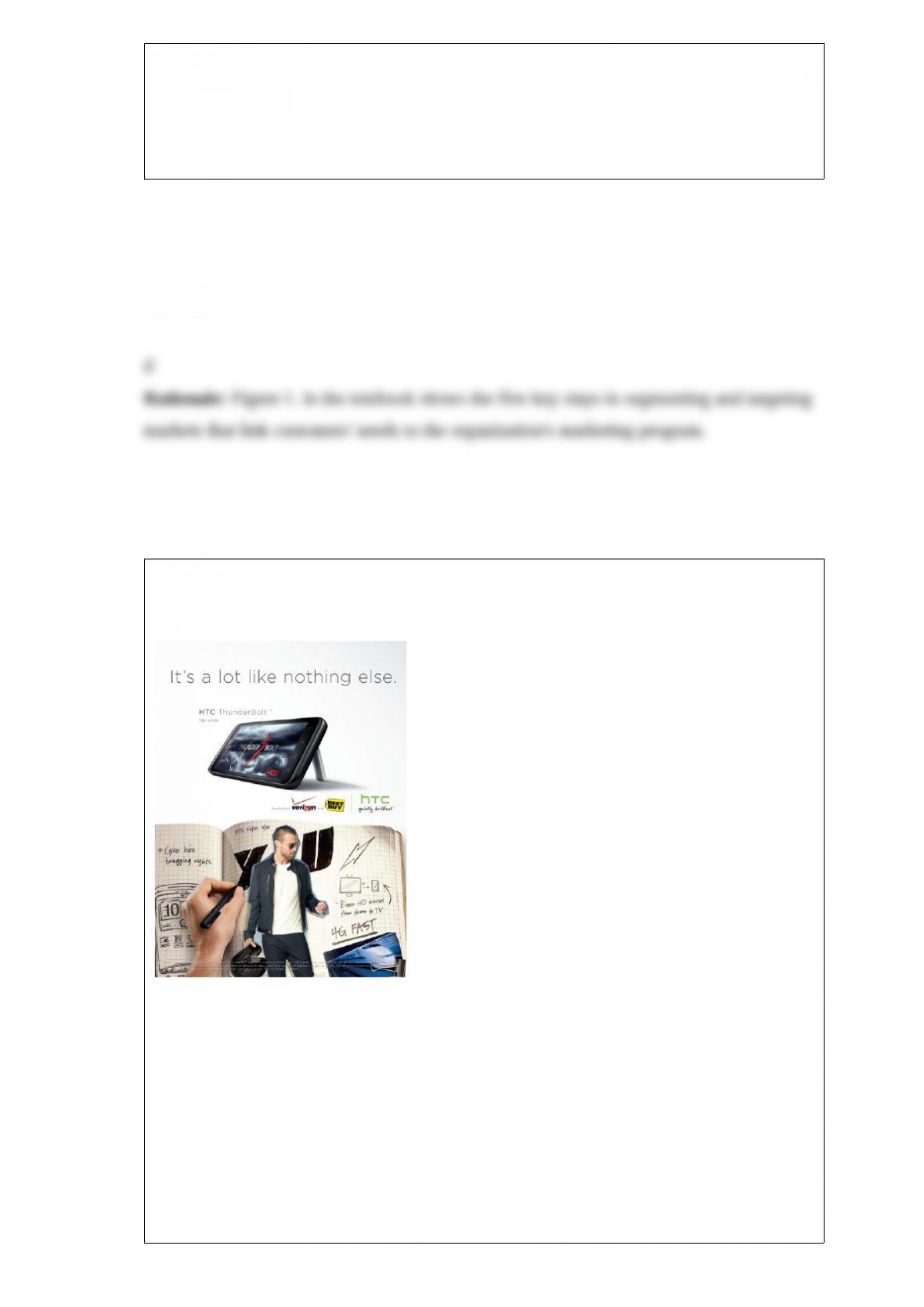
HTC Thunderbolt Ad
Which generational cohort is the HTC Thunderbolt ad above most likely trying to
reach?
a. Generation X
b. baby boomers
c. Generation Z
d. baby busters
e. Generation Y
Answer:
Pure monopoly is the competitive market situation where
a. many sellers follow market price for identical, commodity products.
b. one seller sets the price for a unique product.
c. few sellers are sensitive to one another’s prices.
d. many sellers compete on nonprice factors.
e. one or few sellers compete solely on nonprice factors.
Answer:
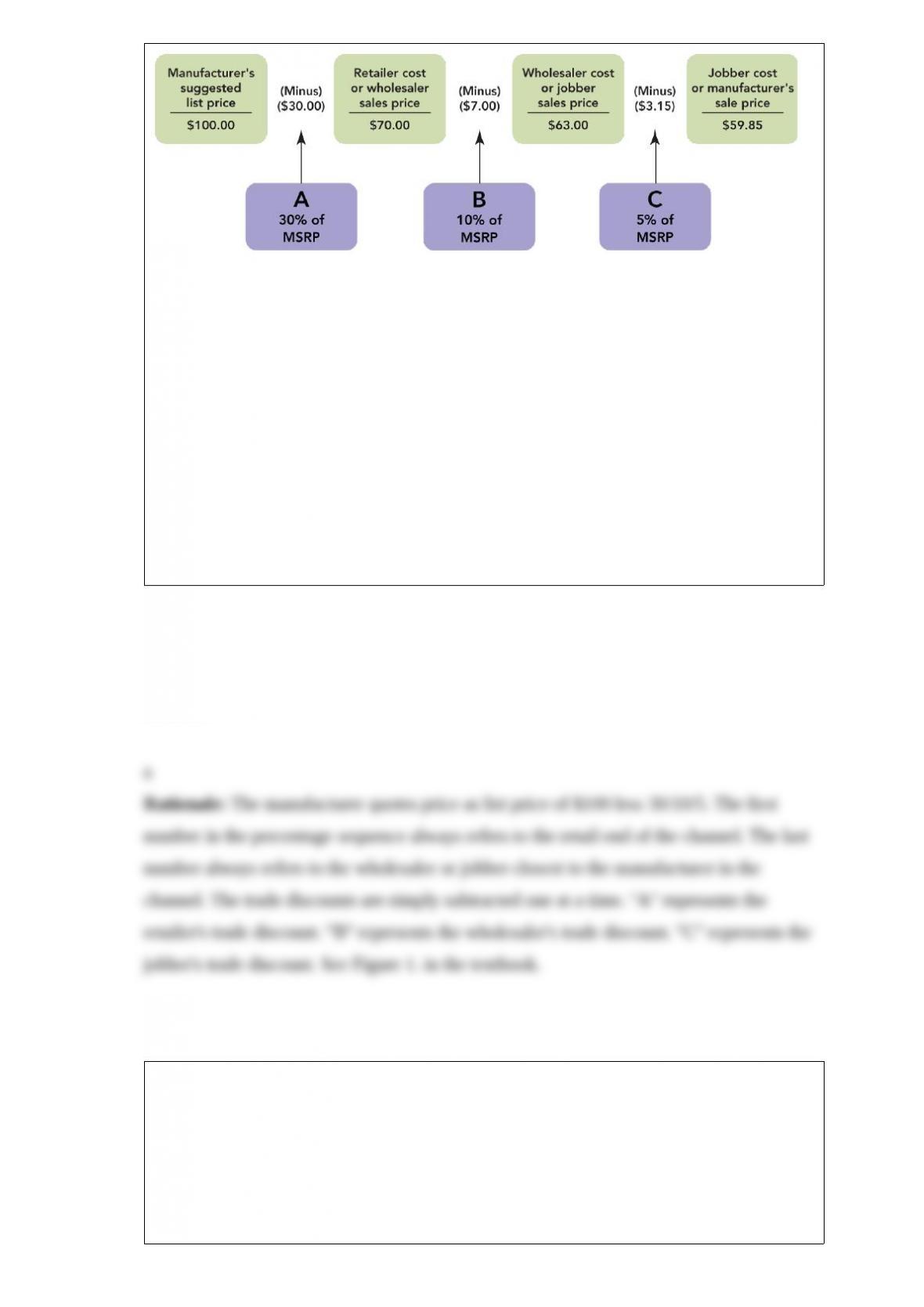
Figure 1.
Consider Figure 1. above. Suppose a manufacturer quotes price in the following form:
List price$100 less 30/10/5. What does “B” represent?
a. the wholesaler’s trade discount
b. the retailer’s trade discount
c. the jobber’s trade discount
d. the manufacturer’s trade discount
e. the manufacturer’s markup
Answer:
An example of a dramatic __________ change is the increasing use of e-readers like
Amazon’s Kindle and tablet devices like Apple’s iPad to read digital books.
a. managerial
b. technological
c. ethical
d. regulatory
e. economic
Answer:
The EU has benefited its member nations because
a. there is immunity against world recessions.
b. there is a common language advantage among EU consumers.
c. most companies within the EU are engaging in strategic global partnerships.
d. there is a legally binding code of economic conduct.
e. firms do not need to market their products and services on a nation-by-nation basis.
Answer:
A cross-channel shopper refers to
a. the online consumer who researches products online and then purchases them at a
retail store.
b. the online consumer who purchases a product online and then returns it at a retail
store for store credit.
c. a consumer who e-mails or forwards a copy of a competitor’s coupon to another firm
in hopes that the offer will be matched.
d. shoppers from one country who make online purchases from a company in a different
country.
e. shoppers who purchase products under different screen names or avatars in order to
protect their privacy.
Answer:
A buying center refers to
a. an online trading community that brings together buyers and supplier organizations to
make possible the real time exchange of information, money, products, and services.
b. the department within a firm responsible for the logistics of placing, tracking, and
delivering orders to other departments within the firm.
c. the department within a firm responsible for the logistics of placing, tracking, and
delivering orders to ultimate consumers.
d. the group of people within an organization who participate in the buying process and
share common goals, risks, and knowledge important to a purchase decision.

e. the department within a firm that allows purchases to be made from a centralized
location from multiple vendors at the same time.
Answer:
In the world of marketing, __________ are ideas about products or services.
a. theories
b. notions
c. perceptions
d. impressions
e. concepts
Answer:
Contracting with a foreign firm to assemble parts and components that have been
shipped to that country is referred to as
a. direct exporting.
b. indirect exporting.
c. direct investment.
d. contract manufacturing.
e. contract assembly.
Answer:
When a company uses a product line extension, it __________.
a. manufactures a product under a new brand name so that consumers will view it as an
entirely new product line
b. manufactures a new product with the current brand name to enter a new market
segment in its product class
c. speeds up the movement of a product through its product life cycle
d. contracts with another firm to manufacture modified versions of the original products
e. applies the current brand name to enter a completely different product class
Answer:
Dell has adopted a(n) __________ supply chain strategy to better serve its customers.
a. responsive
b. reactionary
c. efficient
d. proficient
e. economical
Answer:
Support products are items used to assist in producing other goods and services. These
include installations, industrial services, accessory equipment, and __________.
a. components
b. supplies
c. materials
d. derived products
e. complementary products
Answer:

The three major categories of expenses are:
a. direct, semi-direct, and indirect.
b. variable, fixed, and semi-variable.
c. external, internal, and personal.
d. manufacturing, promotion, and distribution.
e. selling, administrative, and general.
Answer:
There are several factors why a consumer would be reluctant to adopt a new product.
For example, a consumer might be reluctant to adopt a new product because of a value
barrier, which occurs when __________.
a. there are physical, economic, or social risks
b. there are cultural differences
c. the financial commitment is too great
d. there is no incentive to change
e. the product is not consistent with existing habits
Answer:
Retailing refers to all activities involved in the
a. selling, renting, and providing of products and services to ultimate consumers for
personal, family, or household use.
b. selling of tangible products to ultimate consumers for personal, family, or household
use.
c. selling of tangible products to ultimate consumers for personal, household, or
industrial use.
d. selling, renting, leasing, or reselling of products and services to ultimate consumers
or small industrial users.
e. selling, renting, and providing of products and services without retaining the title to
these offerings.
Answer:
A joint venture refers to
a. offering the right to a trademark, patent, trade secret, or similarly valued items of
intellectual property in return for a royalty or fee.
b. contracting with a foreign firm to manufacture products according to certain
specifications.
c. when a foreign company and a local firm invest together to create a local business.
d. having a company handle its own exports directly, but using intermediaries for
importing.
e. exporting through an intermediary, which often has the knowledge and means to
succeed in selling a firm’s product abroad.
Answer:
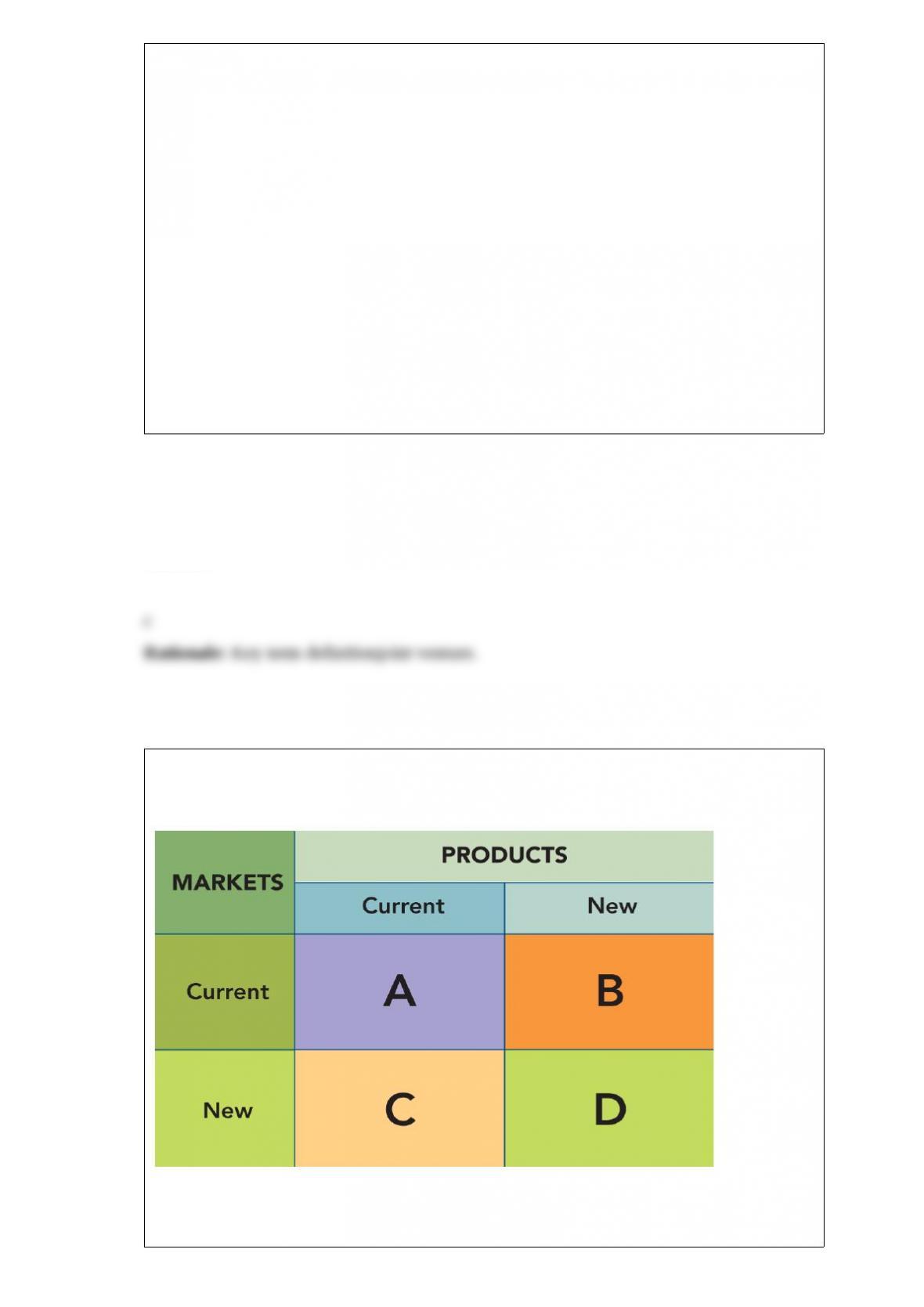
Figure 1.
Consider Figure 1. above. A small family owns gelato business in the town’s favorite
place where parents and children stop on their way home from work to relax or school
to play. However, the business owner is barely making ends meet. He experiments by
purchasing a refrigerated cart and takes it to the local ball fields where he sells the
gelato to the teams and their fans. Profits begin to rise. This is an example of a
__________ strategy that would be found in quadrant __________.
a. market penetration; “A”
b. product development; “B”
c. product penetration; “B”
d. market development; “C”
e. market expansion; “C”
Answer: