The prescribed penalty for agents of foreign governments found guilty of economic
espionage is
a. up to 15 years in prison and fines up to $500,000.
b. life in prison with chance of parole after 25 years.
c. 25 years in prison and a $10 million fine.
d. permanent expulsion from the United States.
e. 30 years in prison and fines proportional to the damage caused.
Answer:
The three commonly used compensation plans are __________.
a. incremental salary, input-based commission, and output-based commission
b. straight salary, straight commission, and graded-scale competitive pay
c. percentage of sales, percentage of profits, and straight salary
d. straight salary, straight commission, and a combination of salary and commission
e. straight commission, percentage of market share, and a combination of salary and
commission
Answer:
Organizational buyers are described as
a. only purchasers of raw materials and natural resources.
b. employees who purchase household items for their personal use.
c. manufacturers, retailers, or government agencies that buy products for their own use
or for resale.
d. any individual or group making a purchase worth over $100,000.
e. any man, woman, or child who uses products purchased for a household.
Answer:
Dick’s Sporting Goods carries baseballs all year around. The same is true for footballs
and tennis equipment. Dick’s Sporting Goods offers __________ utility for these
products.
a. time
b. place
c. possession
d. market
e. form
Answer:
The ___________ for American Red Cross is “to provide relief to victims of disasters
and help prevent, prepare for, and respond to emergencies.”
a. core benefit proposition
b. business definition
c. sustainability doctrine
d. mission statement
e. core value proposition
Answer:
Pepsi’s Super Bowl ads generated a __________ increase in its Facebook “likes.”
a. 7%
b. 37%
c. 67%
d. 97%
e. 100%
Answer:
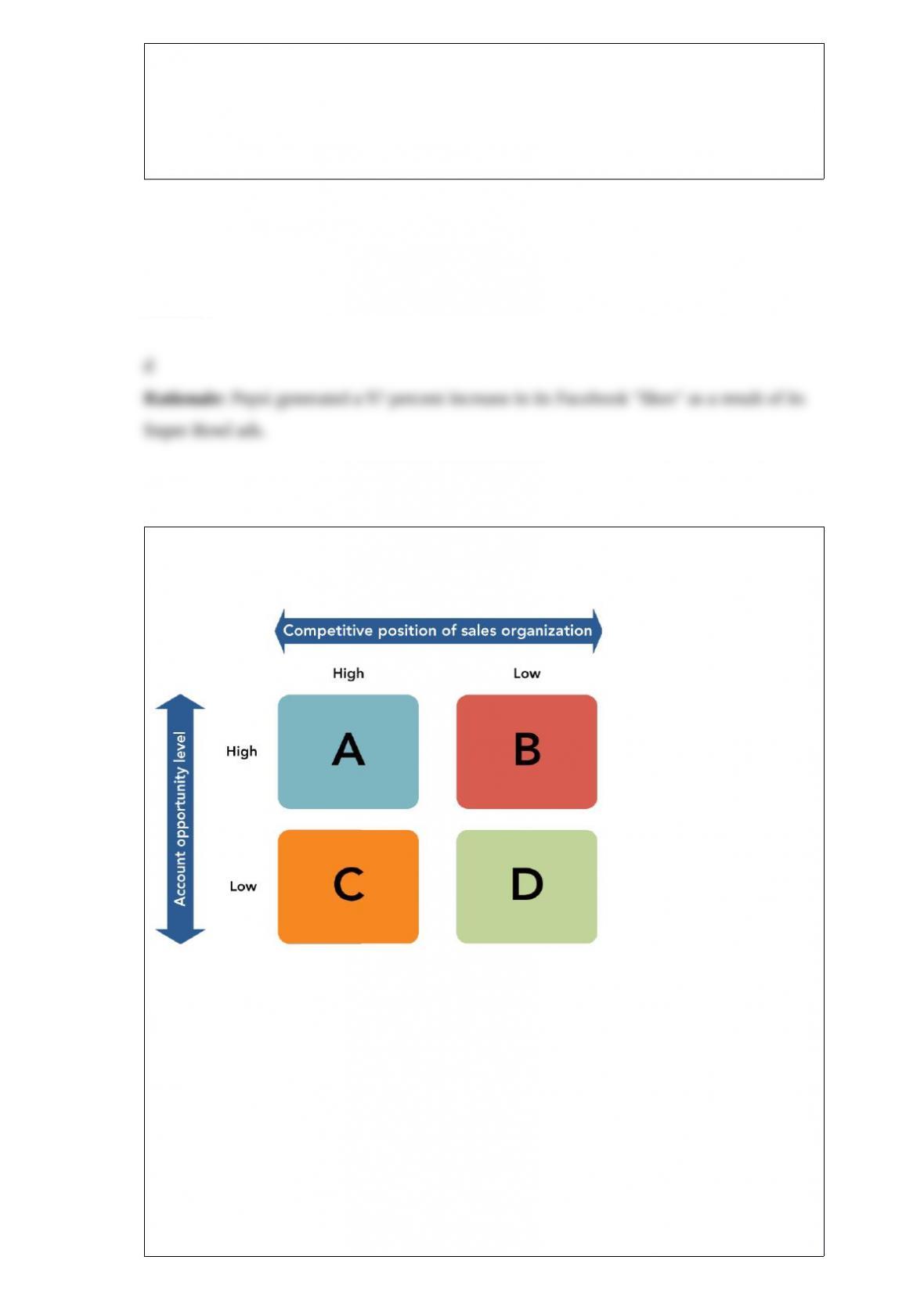
Figure 1.
Consider Figure 1. above, which is an account management policy grid that groups
customers according to level of opportunity and the firm’s competitive sales position.
“A” represents what account management policy?
a. Consider (1) replacing personal calls with telephone sales or direct mail to service
accounts and (2) dropping the account if it is unprofitable.
b. Emphasize a heavy sales organization position or shift resources to other accounts if
a stronger sales organization position is impossible.
c. Take advantage of a good opportunity because the accounts have high potential and
the sales organization has a strong position.
d. Accounts should receive a high level of sales calls and service to retain and possibly
build accounts.
e. Accounts should receive moderate level of sales and service to maintain current
position of sales organization.
Answer:
Generational marketing refers to
a. the process of continually acquiring information on different age groups to identify
and interpret potential trends.
b. the factors that represent both the objective and subjective attributes of a brand
Generations X and Y use to compare different products and brands.
c. the distinct phases that a generational cohort progresses through from family
formation to retirement, each phase bringing with it identifiable purchasing behaviors.
d. the sequence of stages a buyer of each generational cohort goes through from initial
awareness of a product to its trial or adoption.
e. different marketing programs developed for each generational cohort due to each
group’s distinctive attitudes and behaviors.
Answer:
Which of the following statements describes a key difference between advertising and
publicity?
a. Publicity is more expensive on a cost-per-contact basis than advertising.
b. Publicity is usually directly paid, and advertising is usually indirectly paid.
c. Advertising is usually directly paid, and publicity is usually indirectly paid.
d. Advertising provides an immediate feedback loop, and publicity does not.
e. Publicity always has a much greater reach than advertising.
Answer:
Which online consumer lifestyle segment is most likely to visit auction websites?
a. hunter-gatherers
b. hooked, online, and single
c. click-and-mortar
d. brand loyalists
e. time-sensitive materialists
Answer:
The purchase of bottled water is a low-involvement purchase. How can a market leader
like Perrier convince people to buy its brand instead of one of the numerous other
brands displayed on retailers’ shelves?
a. avoid Perrier brand stockouts in retailers
b. make the purchase decision a high-involvement one
c. offer coupons for Perrier bottled water
d. convince retailers to offer only Perrier water
e. denigrate its competition
Answer:
The four stages of the retail life cycle are
a. introduction, growth, maturity, and decline.
b. awareness, inquiry, alternative evaluation, and purchase.
c. early growth, accelerated development, maturity, and decline.
d. innovation, standardization, adaptation, and obsolescence.
e. innovation, adaptation, imitation, and obsolescence.
Answer:
Which of the following statements about stakeholders is most accurate?
a. Ultimately, the only relevant stakeholder is the ultimate consumer.
b. The organization, suppliers, shareholders, employees, and consumers are all
stakeholders of an organization and all should benefit from the organization’s marketing
activities.
c. Employees can be stakeholders only if they own shares in their company.
d. Suppliers are the most important stakeholders because without them, products could
never be produced.
e. The only way to be a stakeholder is to have a financial investment in an
organization’s product, service, or idea.
Answer:

A live theatre performance tends to be an experience that is consumed at the point
where it is purchased. This is an example of a(n) __________.
a. utility
b. product
c. value
d. service
e. idea
Answer:
To gauge stickiness, companies use the following formula:
a. Average Time Spent per Unique Hourly visitor (minutes) = (Average Visits per
Unique Hourly Visitor) (Average Time Spent per Visit (minutes).
b. Average Time Spent per Unique Daily visitor (minutes) = (Average Visits per Unique
Daily Visitor) (Average Time Spent per Visit (minutes).
c. Average Time Spent per Unique Weekly visitor (minutes) = (Average Visits per
Unique Weekly Visitor) (Average Time Spent per Visit (minutes).
d. Average Time Spent per Unique Yearly visitor (minutes) = (Average Visits per
Unique Yearly Visitor) (Average Time Spent per Visit (minutes).
e. Average Time Spent per Unique Monthly visitor (minutes) = (Average Visits per
Unique Monthly Visitor) (Average Time Spent per Visit (minutes).
Answer:
Customer value can assume numerous forms. For Pez Candy, Inc., customer value
manifests itself in the form of __________.
a. an upbeat jingle
b. character candy dispensers
c. a stylish logotype
d. sour taste
e. sugar coating
Answer:
An unsatisfied customer who switches brands is hard to replace. Which stage of the
product life cycle is focused on maintaining loyal buyers so that customers will not
switch brands?
a. introduction
b. maturity
c. growth
d. incubation
e. decline
Answer:
Consumer behavior refers to
a. the aspects of a consumer’s decision-making processes that cannot be measured.
b. the actions a person takes in purchasing and using products and services, including
the mental and social processes that come before and after these actions.
c. the five stages a buyer passes through in making choices about which product and
service to buy.
d. the mental and social processes that are innate in a person from birth.
e. those behaviors that result from (1) repeated experience and (2) reasoning.
Answer:
As a consultant to a brand manager, which social media marketing strategy would you
recommend to your client to build the customer base?
a. Hire celebrities to tweet about using their product.
b. Run concurrent specials on multiple social media platforms such as Facebook and
Twitter.
c. Use tweets to drive traffic to the brand’s website.
d. All of the above.
e. None of the above.
Answer:
A promotion alternative that uses direct communication with consumers to generate a
response in the form of an order, a request for further information, or a visit to a retail
outlet is referred to as __________.
a. personal selling
b. sales promotion
c. publicity
d. advertising
e. direct marketing
Answer:
Which of the following would be an example of an objective in Step 1 of the
price-setting process?
a. “We need to set an initial price of $259 dollars per unit.”
b. “We need to obtain a 10 percent market share.”
c. “We need to find the least expensive distributor.”
d. “We need to make allowances for large quantity orders.”
e. “We need to increase the price during the holiday shopping season.”
Answer:
The two-way flow of communication between a buyer and a seller, often in a
face-to-face encounter, designed to influence a person’s or group’s purchase decision is
referred to as
a. sales promotion.
b. personal selling.
c. direct selling.
d. advertising.
e. public relations.
Answer:
The long-running U.S. Army recruiting advertisement that invited enlistees to “Be All
You Can Be” appeals to which of hierarchy of needs level?
a. physiological needs
b. safety needs
c. social needs
d. personal needs
e. self-actualization needs
Answer:

Marketing plans must enable results to be compared with planned targets, which allows
__________, the flexibility to update original plans.
a. replanning
b. contingency planning
c. recursive planning
d. dynamic planning
e. proactive change
Answer:
The __________ stage of the product life cycle is characterized by rapid increases in
sales.
a. introduction
b. growth
c. maturity
d. decline
e. harvest
Answer:
With the purchase of a Happy Meal, McDonald’s offered free, collectable toys that
portrayed the movie characters in Rio. These toys are an example of a __________.
a. deal
b. premium
c. rebate
d. coupon
e. sample
Answer:
When a firm sells a product in a foreign country below its domestic price or below its
actual cost, it is referred to as
a. loss-leader pricing.
b. surplus marketing.
c. dumping.
d. second-market pricing.
e. entrepreneurial pricing.
Answer:
Once a company has decided to enter the global marketplace, it must select a means of
market entry. Four general options exist: (1) exporting; (2) licensing; (3) joint venture;
and (4) __________.
a. franchising
b. shared
c. combined
d. cooperative
e. direct investment
Answer:
Sales activities occurring before, during, and after the sale itself, consisting of six
stages, are referred to as __________.
a. the new-product process
b. the strategic marketing process
c. the personal selling process
d. the consumer purchase decision process
e. relational selling
Answer:
Which of the following pieces of information is used in a SWOT analysis, the first step
of the planning phase of the strategic marketing process?
a. marketing return on investment
b. market share for the product
c. trends for industry and competitors
d. revenues associated with each point of market share
e. possible cannibalization effects on other products in the line
Answer:
The form of competition in which there are many sellers and they each have a similar
product is referred to as __________.
a. pure competition
b. singular competition
c. an oligopoly
d. monopolistic competition
e. a monopoly
Answer:
At which stage of the organizational buying decision process would purchasing and
engineering personnel visit potential suppliers to assess their quality control?
a. alternative evaluation
b. problem recognition
c. information search
d. purchase decision
e. postpurchase behavior
Answer:
After establishing the market segments and product groupings on a market-product
grid, the next step is to
a. fill in the appropriate cells with precise statistical data from primary and/or secondary
sources.
b. make intelligent “guesstimates” of the market size for each cell using a simple scale
from zero to three (“0” = no market; “1” = a small market; “2” = a medium market; and
“3” = a large market).
c. total the vertical columns to identify the greatest marketing synergies and
efficiencies.
d. total the horizontal rows to identify greatest operations/production synergies and
efficiencies.
e. identify a marketing action for every product-market combination in the grid.
Answer:
An example of a performance measure linked to inputs or costs in social media
advertising is
a. Facebook allows companies’ ads to show up in pop-up windows throughout the site.
b. Facebook charges companies to create a Facebook Page for their brands.
c. Facebook staff members create ads for companies who want to advertise on
Facebook.
d. Facebook charges for ads to appear along the right-hand section of a Facebook
webpage.
e. Facebook charges companies every time their brand is mentioned in a user’s profile.

Answer:
While consumer tastes and price and availability of similar products determine what
consumers want to buy, consumer income determines
a. where they buy.
b. the degree of brand loyalty.
c. the degree of repeat buys.
d. what they can buy.
e. their desire to buy.
Answer: