The acronym “SWOT” in the term “SWOT analysis” stands for __________.
a. strengths, weaknesses, opportunities, and tactics
b. strengths, weaknesses, options, and tactics
c. strengths, weaknesses, opportunities, and threats
d. simple, workable, optimal, and timely
e. state the problem, work out a strategy, organize your team, and take action
Answer:
Figure 1.
There are three concepts of social responsibility, each relating to particular
constituencies. According to Figure 1. above, “C” represents __________ responsibility.
a. societal

b. stakeholder
c. profit
d. customer
e. seller
Answer:
Custom Foot runs six retail locations. At first glance, none looks any different from
your basic old-fashioned shoe store, but the only boots on hand are display models.
There’s no inventory for sale and customers go home empty-handedat least initially.
Customers browse the store, mixing and matching design components such as style,
color, and leather type. About 100 display boots provide style guidelines. Once you
choose a boot style, you select materials, colors, and textures. Custom Foot guarantees
your boots will be ready within three weeks. This is an example of
a. mass customization.
b. specialty customization.
c. virtual merchandising.
d. one product and multiple market segments.
e. multiple products and multiple market segments.
Answer:
When Callaway opened its “online” store, it wanted to be very careful not to ruin the
good relationship it had with its loyal trade partners. To make sure this did not happen,
Callaway
a. offered its retail partners greater trade allowances.
b. offered its retail partners Callaway stock options.
c. had one of its retail stores get the credit for an online sale.
d. offered incentives for retailers if they encouraged their store customers to shop
online.
e. discounted merchandise in retail outlets but not online.
Answer:
The Terrafugia Transition is a flying car with an anticipated price of $250,000. The
MOST LIKELY prospective customers for this aircraft/vehicle would be
a. college students who are interested in high technology products.
b. retired seniors who live off their Social Security checks.
c. corporate executives of Fortune 1000 companies whose time is valuable.
d. 16-year old teenagers who just got their drivers’ licenses.
e. no one, since the Transition is too revolutionary and expensive for anyone to buy it.
Answer:
Figure 1.
A firm following a cost focus strategy shown in Figure 1. above would be found in
__________.
a. “A”

b. “B”
c. “C”
d. “D”
e. both “A” and “C”
Answer:
When JCPMedia buys paper, it considers suppliers’ forest management and other
environmental practices. A supplier’s view of its __________ is an important selection
criterion for JCPMedia.
a. profit responsibility
b. societal responsibility
c. ecological accountability
d. environmental autonomy
e. stakeholder responsibility
Answer:
Two key elements in deciding how to collect marketing data are __________ and
__________.
a. concepts; notions
b. concepts; methods
c. notions; hypotheses
d. perceptions; impressions
e. methods; theories
Answer:
Figure 1.
As shown in Figure 1. above, the smallest dollar amount of retail sales in the United

States is generated by __________.
a. automotive dealers
b. food and beverage stores
c. sporting goods, books, and music stores
d. electronic stores
e. furniture and home furnishing stores
Answer:
The manager of a small gasoline station observes that while gasoline sales have been
steady, the service side of the business has fallen off, and mechanics are often idle. He
decides to offer a promotiona $20 off coupon for an oil change that is to be mailed to
800 households within a two-mile radius from the gas station. The cost of printing and
mailing is $1,000. The normal cost of an oil change is $40. Materials and labor per oil
change costs $15. If 200 customers use the coupon, what will be the total profit of the
promotion based on the profit equation?
a. ($4,000)
b. ($1,000)
c. $0
d. $1,000
e. $4,000
Answer:

Temporal effects include
a. the purpose of the purchase.
b. other people present.
c. the time of day of the purchase.
d. the crowding in retail stores.
e. the consumer’s mood while engaged in the purchase.
Answer:
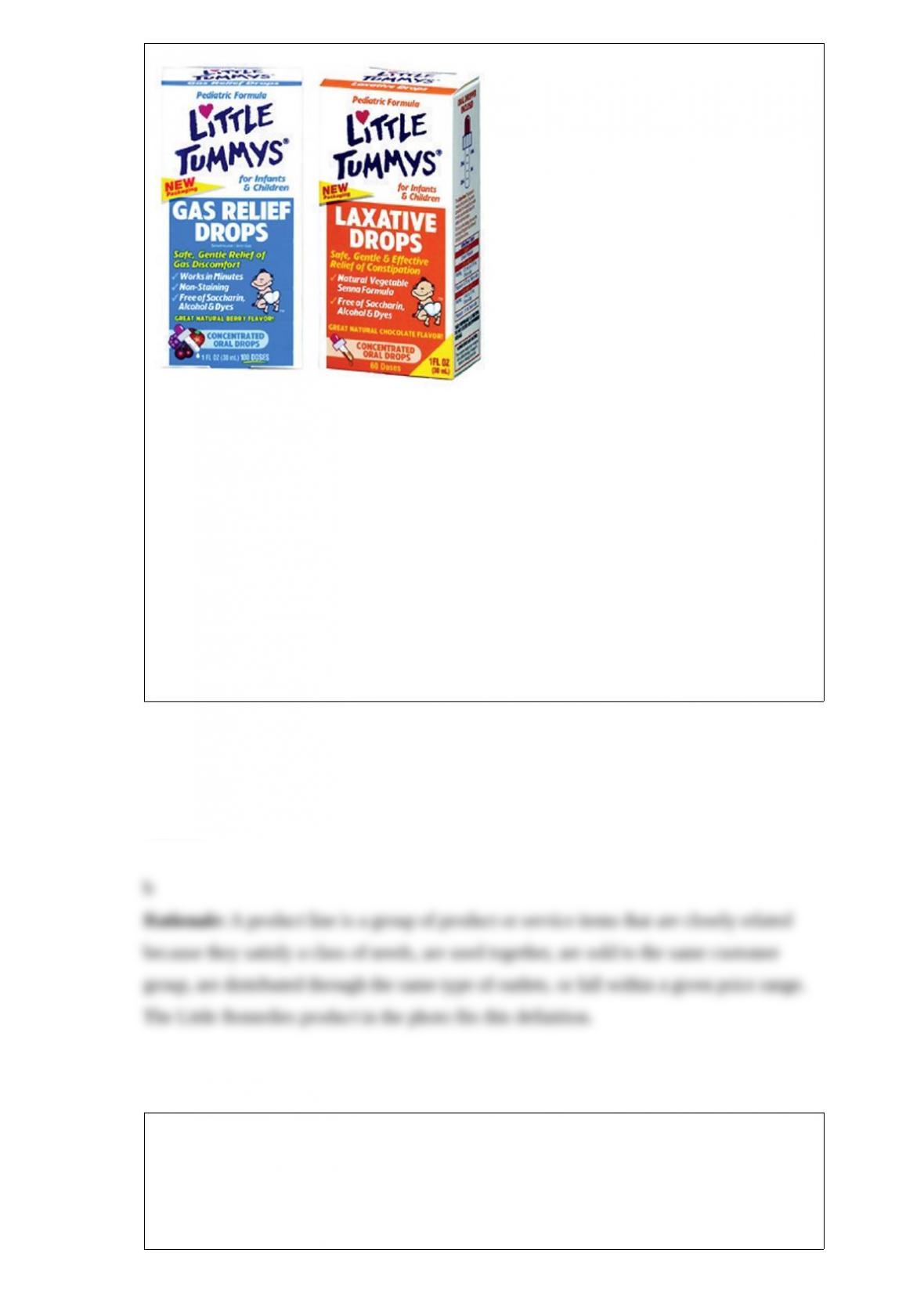
Little Remedies Products
The Little Remedies products shown above best describe which of the following?
a. product item
b. product line
c. product mix
d. product category
e. brand line
Answer:
Another name for pioneering advertising is __________ advertising.
a. differentiation

b. persuasive
c. prospecting
d. awareness
e. informational
Answer:
Inelastic demand exists when
a. a small percentage decrease in price produces a smaller percentage increase in
quantity demanded and total revenue falls.
b. a small percentage increase in price produces a smaller percentage increase in
quantity demanded and total revenue falls.
c. an increase in price causes a larger increase in quantity demanded and total revenue
falls to zero.
d. the quantity demanded remains the same regardless of level of price and total
revenue is unchanged.
e. a small percentage decrease in price produces a smaller percentage decrease in
quantity demanded and total revenue increases.
Answer:

When preparing to go shopping after the Christmas holidays, Christy actively scans the
ads in the local newspaper for coupons and contests. While in the store, Christy also
looks for free samples of new products and products she hasn”t purchased previously.
The coupons, contests, and free samples are all examples of __________.
a. advertising
b. publicity
c. sales promotions
d. personal selling
e. direct marketing
Answer:
A strategic business unit (SBU) refers to
a. a single product or service identification code used to identify items for strategic
marketing planning purposes.
b. a small number of people from different departments in an organization who are
mutually accountable to accomplish a task or common set of performance goals.
c. a strategic product that has a unique brand, size, or price.
d. a privately owned franchise under the auspices of a larger group or organization
bearing the same name.
e. a subsidiary, division, or unit of an organization that markets a set of related offerings
to a clearly defined group of customers.

Answer:
Reverse auctions
a. are seller-initiated.
b. benefit the buyers significantly more than the sellers.
c. have an increasing number of buyers as the auction progresses.
d. do not have sequential bidding.
e. have many buyers at the start of the auction.
Answer:
What global market-entry strategy involves slightly more risk than indirect exporting
for a company but also opens the door to increased profits?
a. direct exporting
b. licensing

c. cooperative
d. joint venture
e. direct investment
Answer:
Febreeze is an odor-controlling spray that is manufactured by Procter & Gamble. When
Febreeze was introduced, a few people in a chat room stated that the product was
harmful to house pets. Unfortunately, the rumor spread. If P&G had not been convinced
it would be a very successful product, it would have dropped Febreeze from its P&G
product line as a result of
a. negative word of mouth.
b. a lack of back translation.
c. cultural insensitivity.
d. consumer ethnocentrism.
e. poor opinion leadership.
Answer:

The marketing manager from a heavy-equipment manufacturer in Dallas, Texas, was
attending an international trade show in Japan. There were many prospective customers
from different countries who seemed interested in the firm’s product. However, they had
difficulty following the manager’s explanations of product features due to his heavy
Texas drawl. In this case, the accent would be considered __________.
a. an encoding error
b. a decoding error
c. culture shock
d. noise
e. distortion
Answer:
The categories for equipment-based services include
a. unskilled labor, those operated by relatively unskilled operators, and automated
(self-serve).
b. professionals, those operated by relatively unskilled operators, and automated
(self-serve).
c. automated (self-serve), those operated by relatively unskilled operators, and those
operated by skilled operators.
d. unskilled labor, skilled labor, and professionals.
e. those operated by skilled operators, unskilled labor, and professionals.
Answer:
Figure 1.
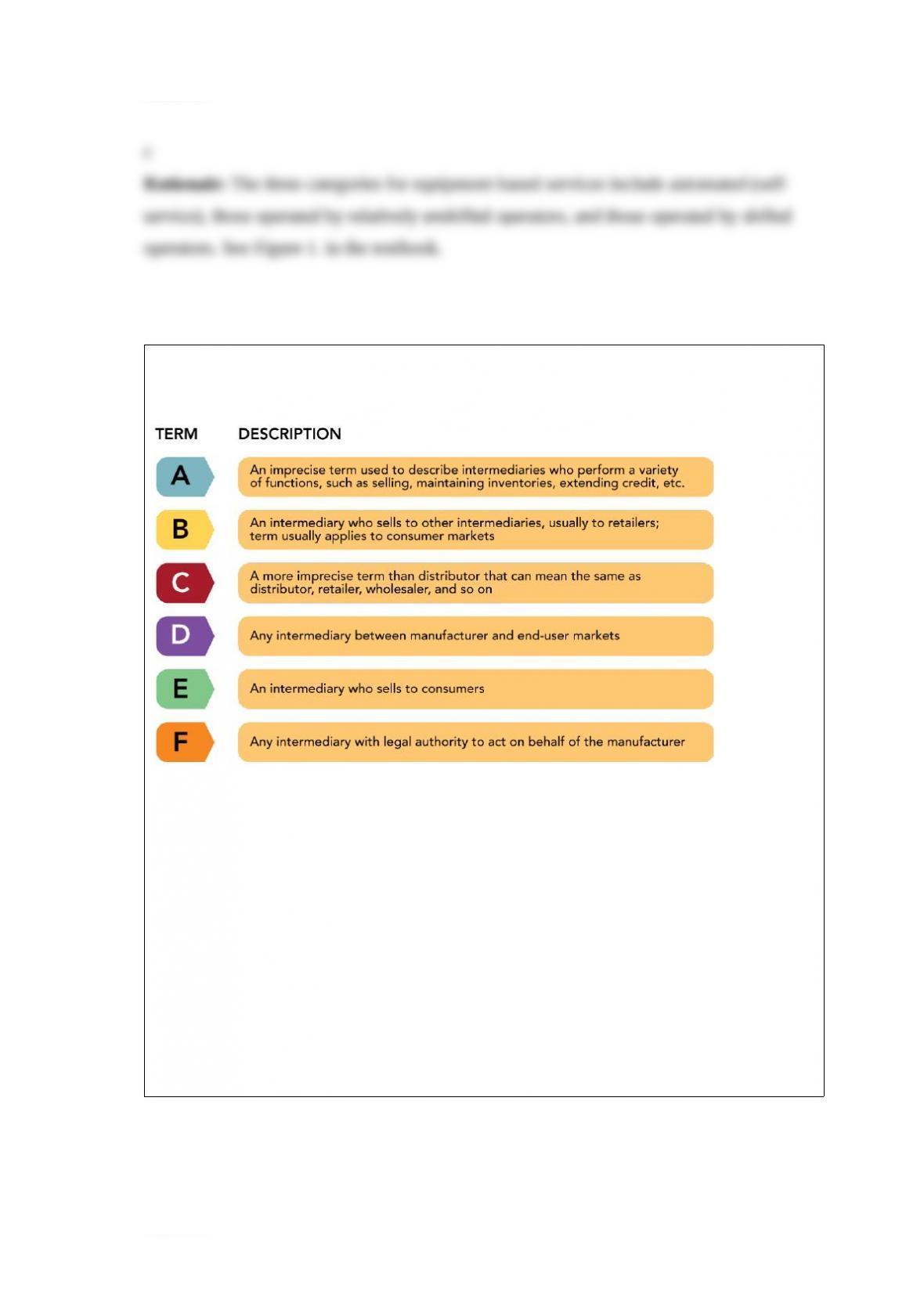
A variety of terms are used for marketing intermediaries. According to Figure 1. above,
“E” represents a(n) __________.
a. retailer
b. middleman
c. wholesaler
d. distributor
e. agent or broker
Answer:

The Phillies ‘special promotions days” fall into three distinct categories:
a. theme nights, event days, and premium gift days.
b. team-oriented, fan-oriented, and family-oriented.
c. revenue generating, market share building, and goodwill generating.
d. ticket discounts, trip giveaways, and contests.
e. televised games, community outreach, and loyal fan promotions.
Answer:
Strategy refers to
a. an organization’s long-term course of action designed to deliver a unique customer
experience while achieving its goals.
b. an organization’s corporate tactical or action plan.
c. statements of an accomplishment of a task to be achieved by a certain time.
d. a statement of the organization’s function in society, often identifying its customers,
markets, product, and technologies.

e. a road map for the entire organization for a specified future period of time, such as
one or five years.
Answer:
A product is a good, service, or idea consisting of a bundle of tangible and intangible
attributes that satisfy consumers’ needs and is received in exchange
a. only for legal tender (money).
b. for providing value.
c. only for barter.
d. for a person’s time and effort.
e. for money or something else of value.
Answer:
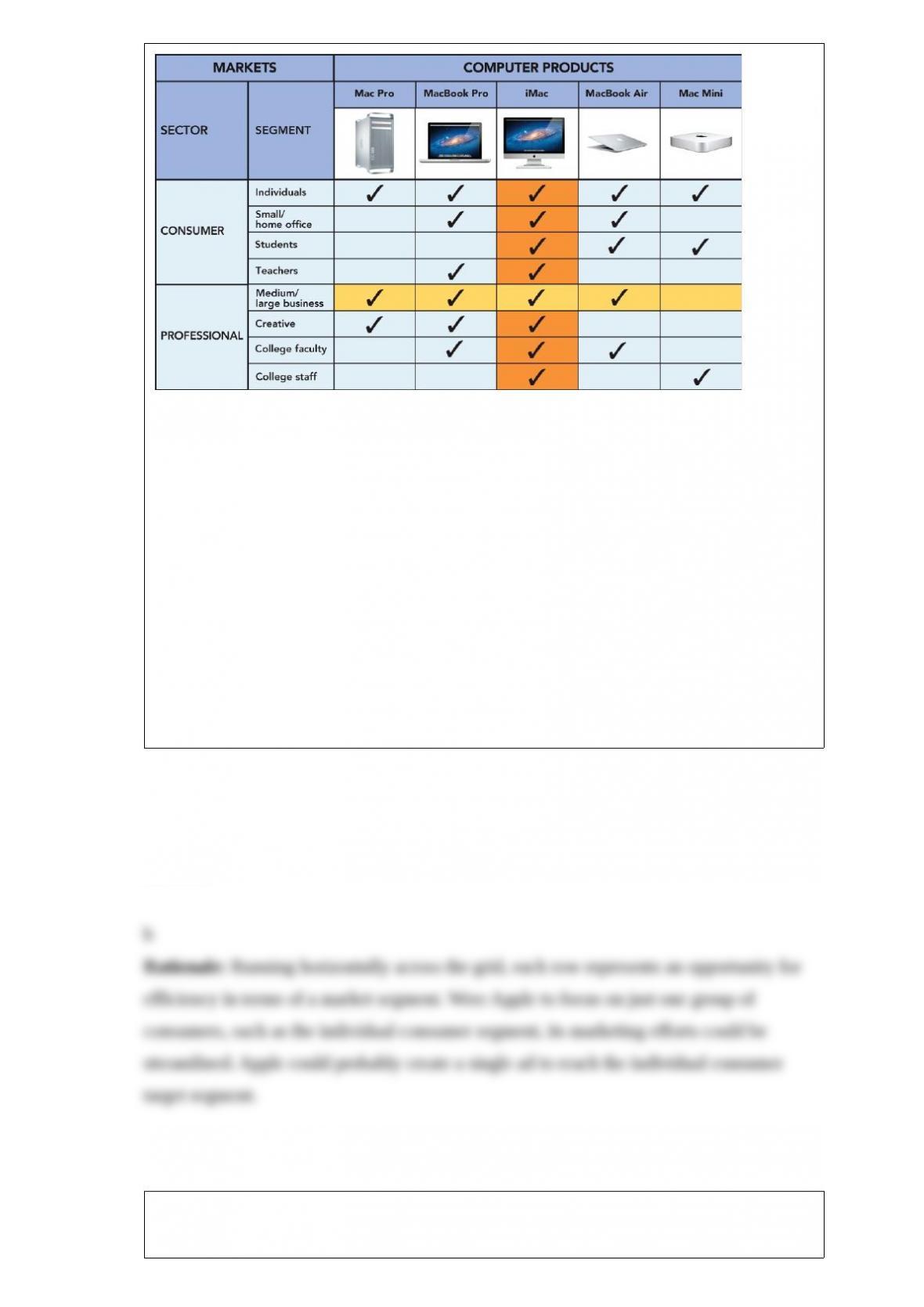
Apple Market-Product Grid
In the Apple market-product grid shown above for its computer line, the “individuals”
consumer segment seems willing to purchase each item in Apple’s product line. This
allows Apple to enjoy __________.
a. segmentation synergies
b. marketing synergies
c. product synergies
d. 80/20 rule
e. usage rates
Answer:
The primary purpose of a marketing metric is to

a. assign qualitative values to quantitative data.
b. allow the sharing of information across product lines.
c. measure the quantitative value of a marketing activity.
d. forecast potential product/service opportunities over a period of five years.
e. provide a numerically precise measurement of management judgment for an
industry’s growth.
Answer:
Which of the following statements regarding the Pew Internet & American Life Project
is most accurate?
a. The Pew Internet & American Life Project has identified 10 unique groups, labeled
with names such as Omnivores, based on their use of information and communication
technology.
b. The Pew Internet & American Life Project monitors websites to protect against
consumer fraud.
c. The Pew Internet & American Life Project independently rates websites effectiveness
form commercial firms.
d. The Pew Internet & American Life Project awards 10 prizes, including the “Mobile
Centric” award, to the most creative and productive websites each year.
e. The Pew Internet & American Life Project has classified people into nine different
groups of information and communication technology users.
Answer:

The ability to understand one’s own emotions and the emotions of people with whom
one interacts on a daily basis is referred to as __________.
a. empathetic intelligence
b. emotional empathy
c. emotional intelligence
d. subliminal intelligence
e. cognitive empathy
Answer:
A growing trend to “Buy American” has caused U.S. automakers to increase political
pressure on Washington to pass legislation for more restrictive quotas on Japanese car
imports. In addition, a decline in the value of the U.S. dollar would be instrumental in
Toyota’s decision to build a manufacturing plant in the United States instead of
continuing to export cars from Japan. If Toyota builds the plant, its decision would
reflect
a. a reactive strategy that would impact the competitive environmental force.
b. a proactive maneuver to manipulate and impact the social environmental force.

c. a positive result from regulatory and economic environmental forces.
d. a positive response to a technological environmental force.
e. a negative impact as a result of adverse competitive, regulatory, and technological
environmental forces.
Answer:
Managers often use two special indexes to help identify strong and weak market
segments in order to provide direction for marketing efforts. The two indexes focus on
__________.
a. marketing efficiency and production efficiency
b. dollar market share and unit market share
c. monthly dollar sales by channel and monthly number of units sold by channel
d. sales per square foot and same-store sales growth
e. category development and brand development
Answer:

The fastest growing form of Internet advertising is __________.
a. interstitials
b. rich media
c. paid search
d. spam
e. wikis
Answer:
What is product differentiation? How does it relate to market segmentation? How does
it potentially improve a firm’s revenues?
Answer:
When John subscribed to a financial news publication online, the company told him
that as a service it would be creating a cookie. Explain what the online publication did.
Answer:
List and briefly describe the four customer service factors that must be balanced in a
logistics system.
Answer:
Name and describe the three main kinds of marketing research.
Answer:
What are the conditions favoring the use of penetration pricing?
Answer:
Explain how the Pizza Hut website uses the seven website design elements.
Answer:
Name the five situational influences that affect the consumer purchase decision process.
Answer:
What is the difference between intangibility and inseparability of services?
Answer:
A recent survey found that 79 percent of Internet and e-commerce companies take
absolutely no social responsibility. Even more worrying is the finding that 75 percent of
these Internet companies justify this omission on the grounds that they don”t have any
environmental or social impacts, while 55 percent said they didn’t have time to think
about these issues, and 50 percent said they didn’t have the expertise to address them.
Would these Internet-based companies benefit from acting more socially responsible?
Explain your answer.
Answer:
What are the five steps in the marketing research approach?
Answer:
What is StubHub’s pricing formula?
Answer:
What are the criteria used to select target markets?
Answer:
How does the relationship between YouTube and Vimeo reflect the development of
network television?
Answer:

Explain the difference between dumping and parallel importing.
Answer:
What factors determine price elasticity of demand?
Answer:
Step 1 of the price-setting process identifies pricing objectives and constraints. Describe
the constraints a firm is likely to face.
Answer: