
A cosmetic manufacturer that targets young women was looking at a graphical display
of how women perceived different brands of cosmetics. They found that their brand was
clustered with brands that are targeted toward older women. This graphical depiction of
the positioning of competing brands used by the marketer is an example of a _____.
a. perceptual map
b. BCG matrix
c. competitive matrix
d. competitive array
e. positioning plot
Customer share is sometimes referred to as share of _____.
a. wallet
b. stock
c. cost
d. distribution
e. equity

When John bought himself a phone with a camera, he chose the one that could take
12-megapixel pictures over the one that could take 8-megapixel pictures. According to
John, the picture resolution of the one he bought was much better than the alternative
choice. In buying the camera phone with a better picture resolution, John’s judgment is
most likely affected by _____.
a. just noticeable difference
b. attribute correlation
c. brand name associations
d. consumer personality
e. financial considerations
Which of the following characteristics of relationship quality represents the
understanding between a consumer and a firm as essentially “speaking the same
language”?
a. Equity
b. Competence
c. Individualization
d. Communication
e. Personalization

Fred has an analog television without cable or satellite. He will not switch to a digital
TV until the old one breaks down. Which of the following adopter categories best
describes Fred?
a. Innovator
b. Early adopter
c. Early majority
d. Impulse purchaser
e. Laggard
Which of the following leads to consumer satisfaction?
a. Positive disconfirmation
b. Negative disconfirmation
c. Neutral confirmation
d. Reverse expectation
e. Perceptual expectation

According to the social judgment theory, a message that is perceived as being opposed
to the original attitude position will fall within the _____.
a. latitude of acceptance
b. central route
c. latitude of indifference
d. latitude of rejection
e. high-involvement hierarchy
RESTAURANT RESEARCH SCENARIO
Insight Research, a marketing research company, has been hired by a national chain of
family restaurants to help them better understand their customers and their preferences.
The restaurant chain has several competitors competing for the same customer
segments and has experienced sales declines in the past few years. Researchers go
“under cover” and pretend to be customers so that they will fit in while they observe the
interactions between customers and the wait staff. Subsequently, they write a report of
their interpretations of what they experienced personally while pretending to be a
customer. They also add in details of what they saw regarding interactions of other
customers with each other and with the employees of the restaurant. Some conclusions
drawn were that the employees were not especially attentive to the customers and that
customers were overheard saying they didn”t intend to return. Some researchers also
noted that the food was not very good and they saw several customers return
orders.Refer to Restaurant Research Scenario. Which of the following is the best reason
why this restaurant chain should be concerned about customer satisfaction?
a. Because all restaurants should be concerned about customer satisfaction
b. Because treating customers well is the concern of all businesses
c. Because the marketplace is competitive and the restaurant is dependent on repeat
business
d. Because serving customers well is a part of the training module for the new

employees at the restaurant
e. Because performance incentives are closely tied to customer satisfaction in this chain
of restaurants
IMMIGRANT SCENARIO
Anita, a second-generation-Asian immigrant, just started college. A self-assured girl,
she displays none of the self-conscious traits one usually sees in her parents. Unlike
Anita, her parents have had it tough with only enough money to make both ends meet.
Till the time Anita was born, they could not afford to live in any of the respectable
residential neighborhoods. Some of the neighborhood authorities make it mandatory for
aspiring residents to submit details like age, ethnicity, sex, occupation, income, region,
religion, and gender. Anita has always seen her parents juggle between two world-views
whenever they had to make up their minds as they try to negotiate between a perceived
sense of guilt for their native country and a perceived sense of loyalty for the host
country. Despite their insistence that she joins an Asian community, Anita joined Delta,
a sorority for geometry lovers. She has always been passionate about geometry and her
membership to Delta, not only defines her on-campus personality, it makes her “cool”
in front of her other peers. Refer to Immigrant Scenario. Some of the neighborhood
authorities make it mandatory for aspiring residents to submit details like age, ethnicity,
sex, occupation, income, region, religion, and gender. The neighborhood authorities are
concerned with the _____ of the aspiring residents.
a. orthographics
b. ethnographics
c. psychographics
d. demographics
e. geographics

The marketing technique that involves compensating consumers to talk about, or
promote, products without disclosing that they are working for the company is called
_____.
a. infiltrating
b. activating
c. invading
d. shilling
e. diffusing
The association between nodes in an associative network is shown by _____.
a. scripts
b. paths
c. traces
d. tags
e. schemas

CHRISTMAS SHOPPING SCENARIO
Maisie waits for Black Friday each year to do her Christmas gift shopping. She
maintains the tradition of gift-giving faithfully, as it makes her feel a sense of kinship
and attachment with her family and close friends. As she lives alone, she strongly feels
the need for relationships at this time of year. She steps out wearing her warm fur coat
to protect herself from the sub-zero temperatures. As she shops for her gifts, she comes
across a pair of designer sunglasses that are on sale. She buys them immediately as she
does not like her old pair, and has been thinking of replacing her it with a new one. As a
rule, every year, she buys her mother’s gift last, after she has checked out all the
available gift options. This year, she gets her mother a pair of exquisite pearl drop
earrings. She is a bit anxious because they are very expensive and she hopes that her
mother will like them. While at the jeweler, she decides to buy herself an ornate
Christmas dove as an indulgence. Maisie has had a fascination for them for as long as
she can remember. She has a huge collection of Christmas doves in various sizes and
colors. Maisie comes back tired, but satisfied with her day’s shopping. Refer to
Christmas Shopping Scenario. Maisie has had a fascination for Christmas doves for as
long as she can remember. She has a huge collection of them in various sizes and
colors. Which of the following is exemplified by Maisie’s involvement with doves?
a. Monetary involvement
b. Enduring involvement
c. Situational involvement
d. Momentary involvement
e. Contextual involvement
When Anna goes shopping for groceries every week, she buys the same brand of orange
juice that her family has been consuming for years. She picks up the juice without
looking at the product information prior to buying it. Which of the following types of

decision-making approaches is Anna is most likely adopting while buying orange juice?
a. Extended decision making
b. Rational decision making
c. Habitual decision making
d. Involved decision making
e. Timed decision making
Which of the following is true of the physical characteristics of a message?
a. Consumers’ attention and comprehension become less likelier as pictures in messages
get larger or movements become more intense.
b. Consumers’ comprehension is not influenced by the use of colors in marketing
messages.
c. Consumers derive meaning from the actual text of a message and the visual
presentation of the message.
d. Consumers’ comprehension of a message is not influenced by the physical
characteristics of the message.
e. Consumers display greater recall of an intended message when information is
presented in sequence rather than in intervals.

MNC SCENARIO
Mr. Adam Smith works as a senior executive for Corebiz Corp., a multinational
company with subsidiaries in many Asian countries. The firm believes in a marketing
strategy that strongly resonates the essence of the local culture in its implementation.
The company relocates Mr. Smith to Beijing to handle their operations in China. A few
months into his stay, Mr. Smith begins to learn the ways of life and appropriate
behavior in China. When Mr. Smith was invited for tea by his colleagues, he observed
people around him and learned the right way to tap his finger and fold a napkin. He also
learned that the Chinese revere their elders and treat them with respect. Even when
there is no kinship involved, an older person should never be addressed with his/her
name. Any show of disrespect, especially “name calling,” is shunned upon by society;
and the person found doing so, risks being ridiculed by everyone. Though these
learnings can sometimes be inconvenient for Mr. Smith owing to the vast cultural
difference between the United States and China, Mr. Smith thinks that it is worth all the
trouble. Refer to MNC Scenario. When Mr. Smith was invited for tea, he observed
people around him and learned the right way to tap his finger and fold a napkin. Such
kind of learning is an example of _____.
a. diffusing
b. reinforcing
c. renquing
d. modeling
e. shaping
A planned way of doing something is known as _____.
a. marketing myopia
b. a mission
c. a strategy
d. utilization

e. a terminal value
RESTAURANT RESEARCH SCENARIO
Insight Research, a marketing research company, has been hired by a national chain of
family restaurants to help them better understand their customers and their preferences.
The restaurant chain has several competitors competing for the same customer
segments and has experienced sales declines in the past few years. Researchers go
“under cover” and pretend to be customers so that they will fit in while they observe the
interactions between customers and the wait staff. Subsequently, they write a report of
their interpretations of what they experienced personally while pretending to be a
customer. They also add in details of what they saw regarding interactions of other
customers with each other and with the employees of the restaurant. Some conclusions
drawn were that the employees were not especially attentive to the customers and that
customers were overheard saying they didn”t intend to return. Some researchers also
noted that the food was not very good and they saw several customers return
orders. Refer to Restaurant Research Scenario. What are the interactions between the
customers and the wait staff called?
a. Attributes
b. Interactions
c. Process nodes
d. Touchpoints
e. Intersections

John, an American, works for a U.S. law firm that transferred him to their office in
Brazil for three years. During his stay there, John also learnt the Brazilian culture. This
is an example of _____.
a. acculturation
b. enculturation
c. externalization
d. adaptation
e. acclimatization
Which of the following explains why groups of people replace one set of acceptable
norms with another set that others view as unacceptable?
a. Criminalization
b. Psychopathy
c. Differential association
d. Pathological socialization
e. Reintegrative shaming

Attention that is beyond the conscious control of the consumer and that occurs as the
result of exposure to surprising or novel stimuli is known as _____ attention.
a. involuntary
b. selective
c. split
d. explicit
e. joint
Patrick graduated from college this year, however, he decided to stay with his parents in
order to save money and pay off his college debts. Patrick is most likely to be described
as being a part of _____.
a. the sandwich generation
b. Generation X
c. the boomerang kids generation
d. the baby boomers generation
e. Generation Jones
Which of the following types of customer involvement represents a continuing interest
in some product or activity?
a. Enduring involvement
b. Contextual involvement
c. Situational involvement
d. Shopping involvement
e. Monetary involvement
ATTITUDE SCENARIO
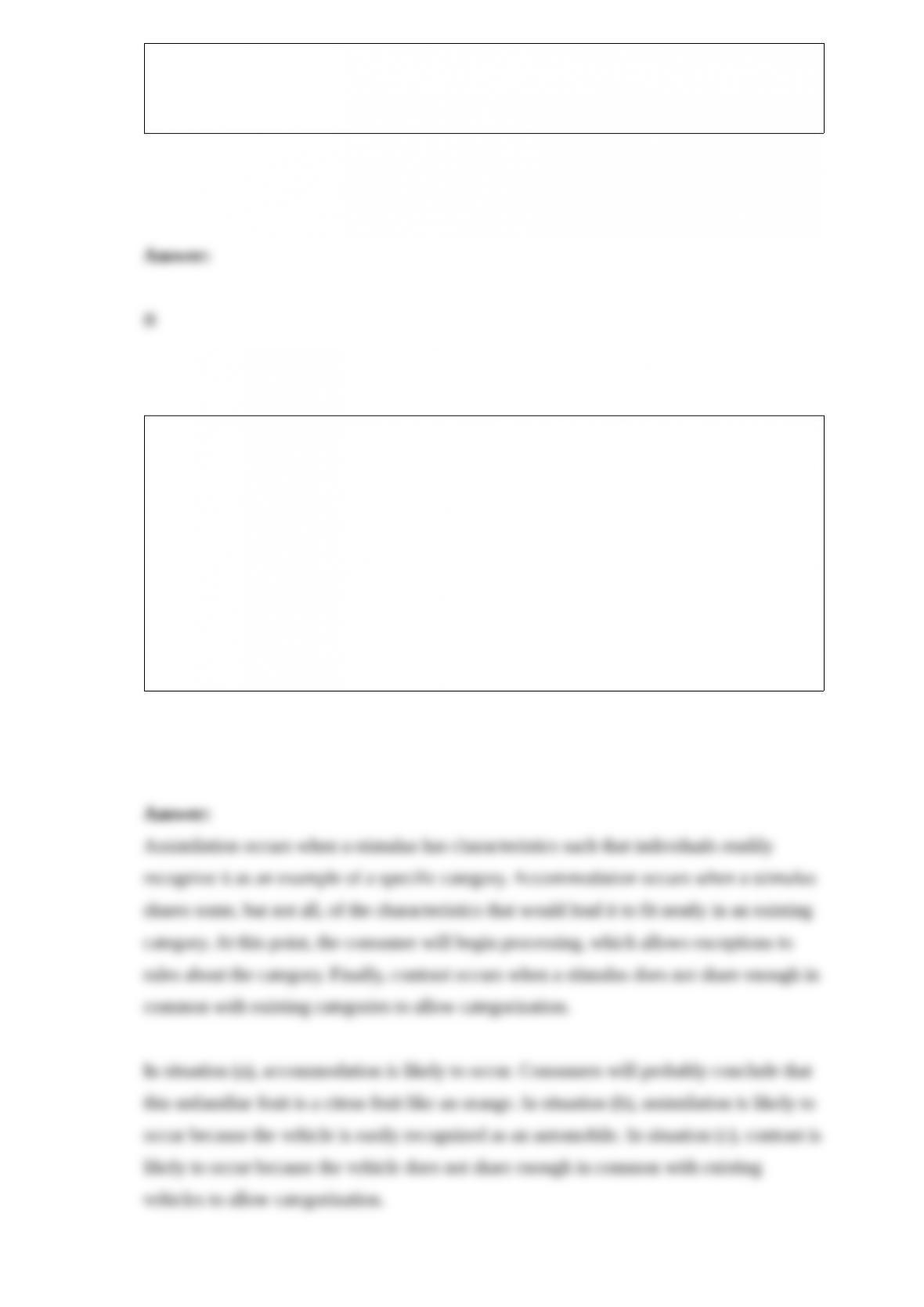
Serena wants to buy a new hair dryer. She surfs the Internet and finally considers
buying either a model from Philips or Braun. She rates them on their price, energy
consumption, and design. Her evaluative ratings (e) for each attribute and her beliefs of
how each brand performs on a given attribute (b) are given below:
Refer to the Attitude Scenario. Based on the attitude-toward-the-object model, what is
Serena’s overall attitude ( ) toward Braun Model B?
a. 23
b. 54
c. 50
d. 44
e. 62
Describe the processes of assimilation, accommodation, and contrast and explain
whether you think assimilation, accommodation, or contrast will occur in each of the
following situations:
a. A consumer picks up an unfamiliar piece of fruit that looks like a tiny orange, but it is
about the size of a walnut instead of the size of a typical orange. The skin appears to be
the same as an orange and it smells like an orange.
b. A consumer sees a vehicle like the car they drive.
c. A consumer sees a vehicle with two people in it flying 18 inches above the ground.

Retailers specializing in things like a wide selection of goods, low prices, guarantees,
and knowledgeable employees use a type of positioning which emphasizes the _____
quality of a retail store.
a. affective
b. experiential
c. epistemic
d. adaptive
e. functional
Highly individualistic societies differ from highly collectivist societies in that highly
individualistic societies:
a. take their identities from the groups to which they belong.
b. place a lot of importance on group achievements.
c. are loyal to the groups to which they belong.
d. place high value on self-reliance.
e. tend to live in extended families.

CIGARETTE MARKETING SCENARIO
The marketing of cigarettes, a legal product, has a storied past. Prior to 1971, this
product was advertised heavily on television. Some ads even suggested that doctors
recommended certain brands over others. Consumer groups have claimed that tobacco
manufacturers knew the harmful effects of smoking but hid it from consumers and
continued to market the product. Now there are several restrictions on the marketing of
cigarettes, many resulting from a master settlement with several states to limit liability
from future lawsuit claims. Gone are the days of sports sponsorships and billboards that
tobacco manufacturers relied on heavily after the broadcast advertising ban. The current
threat to cigarette marketing is the Tobacco Control Act, which requires graphic
warning labels that will take up a substantial portion of the package. Refer to Cigarette
Marketing Scenario. Tobacco companies have lost several lawsuits brought by smokers
or their families, and juries have awarded them damages to cover the cost of their health
care as well as damages to punish the companies for their wrongdoing, resulting in
multi-million dollar awards to the plaintiffs. Damages intended to cover the cost of
consumers’ health care are called _____ damages.
a. punitive
b. compensatory
c. statutory
d. nominal
e. exemplary
Wen, a consumer researcher, is conducting a research on the buying behavior of the
Hispanics. As part of her study, she calculates a consumer’s buying power by relating it
to the consumer’s income. The consumer attributes that Wen employs in her research
can best be described as _____.
a. geographics
b. demographics
c. ethnographics

d. psychographics
e. orthographics
Which of the following terms refers to the efforts put forth by employees in carefully
managing their own personal appearances as a requisite to performing their job well?
a. Emotional labor
b. Emotional contagion
c. Emotional flow
d. Aesthetic labor
e. Aesthetic expression
Which of the following theories plays a role in dealing with negative publicity?
a. Self-evaluation maintenance theory
b. Theory of reasoned action
c. Elaboration likelihood theory
d. Attribution theory

e. Balance theory
Situational influences change the desirability of consuming things and therefore change
the value of these things.
Perception represents an objective reality.
Psychographic techniques use quantitative methods that can be used in developing
lifestyle profiles.

According to the elaboration likelihood model, if the central route to persuasion is
activated, the consumer develops a number of cognitive responses regarding the
incoming message that may either support or contradict the information.
Denials should be made only when the evidence unambiguously supports the actual
truth.
Consumer wants are a function of the need driven by homeostasis.
Describe the three major decision-making perspectives. Describe a purchase decision
you or your family made that illustrates a combination of these perspectives.
Explain the meaning, if any, your native culture gives to the following and describe the
traditions, if any, associated with the object or activity:
(1) ring
(2) school graduation
(3) a specific number
(4) four-leaf clover
(5) red dot on forehead
(6) head covering

(7) a specific type of animal
A chunk includes seven memory units.

Perception refers to a change in behavior resulting from the interaction between a
person and a stimulus.
Personality characteristics can affect the way consumers respond or demonstrate their
emotions.
People who age in the same generation belong to the same cohort.

Define attitude and describe the ABC approach to attitudes. For each component of this
approach, give an example that illustrates that component of your attitude regarding a
product or activity.
Source effects is a term used to describe how the appeal of a message and its
construction affect persuasion.

Consumption is a value producing process in which the marketer and the consumer
interact to produce value.
Barring some physical incapacity, long-term memory represents permanent information
storage.
According to the psychoanalytic approach, the id differs from the ego in that the id
focuses on utilitarian value.