The objective of information and logistics management in a customer-driven supply
chain is to minimize logistics costs while
A. satisfying suppliers.
B. maximizing profits.
C. maximizing supply chain membership.
D. delivering the appropriate level of customer service.
E. maximizing supply chain inefficiency.
Answer:
The search for and qualification of potential customers during the personal selling
process is referred to as __________.
A. prospecting
B. customer mining
C. lead initiation
D. cold calling
E. gleaning

Answer:
One marketing action that can be taken to sell a single product or service to multiple
market segments is to
A. develop and produce another version of the product.
B. manufacture products that appeal to different markets.
C. develop separate promotional campaigns.
D. purchase another firm that has additional products that would appeal to multiple
markets.
E. issue stock to fund additional research and development for new products.
Answer:
By promising to change engine oil and filters quickly, Jiffy Lube is appealing to which
buyer requirement?
A. information
B. convenience
C. variety
D. pre- or postsale services
E. adaptability
Answer:
Social Network Image (A)
Recently, Facebook made all of the following changes to its site to improve the user
experience EXCEPT:
A. Facebook acquired Oculus, a virtual reality headset company.
B. Facebook announced that a version of its News Feed was being tailored for images
to appear on mobile devices.
C. Facebook launched hashtags.
D. Facebook eliminated privacy settings for all but it paid advertisers.
E. Facebook was able to generate revenues by placing ads on the small screens of
smartphones.
Answer:
Goods can be divided into __________ goods and __________ goods.
A. functional; aesthetic
B. required; desired
C. tactile; conceptual
D. durable; nondurable
E. product; service
Answer:
A __________ explains: (1) to whom a salesperson reports; (2) how a salesperson
interacts with other company personnel; (3) the customers to be called on; (4) the
specific activities to be carried out; (5) the physical and mental demands of the job; and
(6) the types of products and services to be sold.
A. sales plan
B. job analysis
C. sales performance audit
D. job description
E. personal performance plan
Answer:
In a recent survey, consumers were asked the following question: “Who should take the
lead in addressing environmental issues?” Results suggest that consumers expect that
__________ should.
A. the federal government
B. businesses
C. individuals
D. environmental groups
E. state governments
Answer:
One reason new products fail is that although most major corporations use a formal
decision making process, sometimes they fail to critically evaluate the progress along
the way. This is why many firms have a __________ to ensure that problems are
corrected before proceeding to the next stage.
A. written protocol
B. Stage-Gate process
C. cross-functional team
D. prototype test
E. test market
Answer:
Informational ads, particularly those with specific information, have been found to be
interesting, convincing, and
A. inexpensive.
B. humorous.
C. expensive.
D. effective.
E. competitive.
Answer:
In many geographic areas, there is only a single provider for gas and electric service for
businesses and consumers. However, the government regulates that firm to ensure price
protection for the buyer. This is an example of
A. pure competition.
B. a pure monopoly.
C. an oligopoly.
D. monopolistic competition.
E. a megopoly.
Answer:
A job analysis refers to
A. a thorough evaluation of a salesperson’s performance based upon both input and
output objectives.
B. a detailed assessment to determine what occurred at which stage in the selling
process that prevented a qualified lead from being converted into a sale.
C. a study of a particular sales position, including how the job is to be performed and
the tasks that make up the job.
D. a protocol used to assign relative weights to various aspects of the selling process to

create an individualized compensation plan.
E. a written document that describes the job relationships and requirements that
characterize each sales position.
Answer:
A retail chain hires a company to design and install a computer network that would
allow each store in the chain to check the inventory of others in the chain for
customer-requested items. The retail chain purchased which kind of business products?
A. accessory equipment
B. industrial services
C. supply materials
D. component parts
E. installations
Answer:
The City of Denver contracts with Solid Waste Management to provide trash collection
services for its citizens. The city is operating as a(n)
A. government unit.
B. industrial market.
C. business market.
D. consumer market.
E. service provider.
Answer:
The way people see themselves and the way they believe others see them is referred to
as
A. self-evaluation.
B. self-concept.
C. self-actualization.
D. individualized perception.
E. personal perception.
Answer:
Pizza Hut revolutionized the quick serve restaurant (QSR) world through a(n)
__________ marketing approach that created a customer experience and a customer
engagement platform that was second to none.
A. interface
B. cross-channel shopper
C. behavioral targeting
D. symbiotic
E. multichannel
Answer:
Which of the following statements regarding corporate chains is most accurate?
A. Corporate chains cannot bargain with a manufacturer to obtain product volume
discounts due to federal anticompetitive legislation.
B. Corporate chains generally own most if not all of their suppliers, a practice known as
forward integration, so they can save distribution costs.
C. Consumers have fewer choices in merchandise since all buying decisions are made
by a decentralized buying committee.
D. Corporate chains offer the least benefit to consumers since they are the farthest
removed from the ultimate consumer.
E. Corporate chains are multiple outlets under common ownership.
Answer:
An assessment of the fit of the proposed new products, from whether it can be
economically developed and manufactured to the marketing strategy needed, take place
during which stage of the new-product process?
A. business analysis
B. screening and evaluation
C. new-product strategy development
D. development
E. These activities are addressed at every stage with the exception of new-product
strategy development.
Answer:
Global companies have five strategies for matching products and their promotion
efforts to global markets. Changing a product in some way to make it more appropriate
for a country’s climate or preferences is an example of which type of global marketing
product and promotion strategy?
A. product extension
B. product customization
C. product adaptation
D. product invention
E. product integration
Answer:
Which statement regarding efficient supply chains is most accurate?

A. Efficient supply chains use common platforms and common components across
several products.
B. Efficient supply chains rely on large geographically dispersed inventory warehouses.
C. Efficient supply chains traditionally use expensive, but faster, modes of
transportation.
D. Efficient supply chains may utilize cross-docking.
E. Efficient supply chains emphasize economies of scale by increasing the variety of
system configurations offered.
Answer:
Which of the following statements regarding diversification analysis is most accurate?
A. Companies should only use diversification analysis if they are well-established; new
companies that use this process run the risk of trying to do too much too soon.
B. For any product, there is both a current and a new market; for any market, there is
both a current and a new product.
C. Most companies discover that there is at least one product that is targeted to the
wrong market.
D. Diversification analysis is only effective for consumer products.
E. Diversification analysis is used to forecast and calculate industry sales for new
products.
Answer:
By 2015, which racial or ethnic group will have the greatest economic impact in the
U.S. in terms of its buying power?
A. Asian Americans
B. Hispanics
C. African Americans
D. American Indian and other native populations
E. Indian immigrants (from India)
Answer:
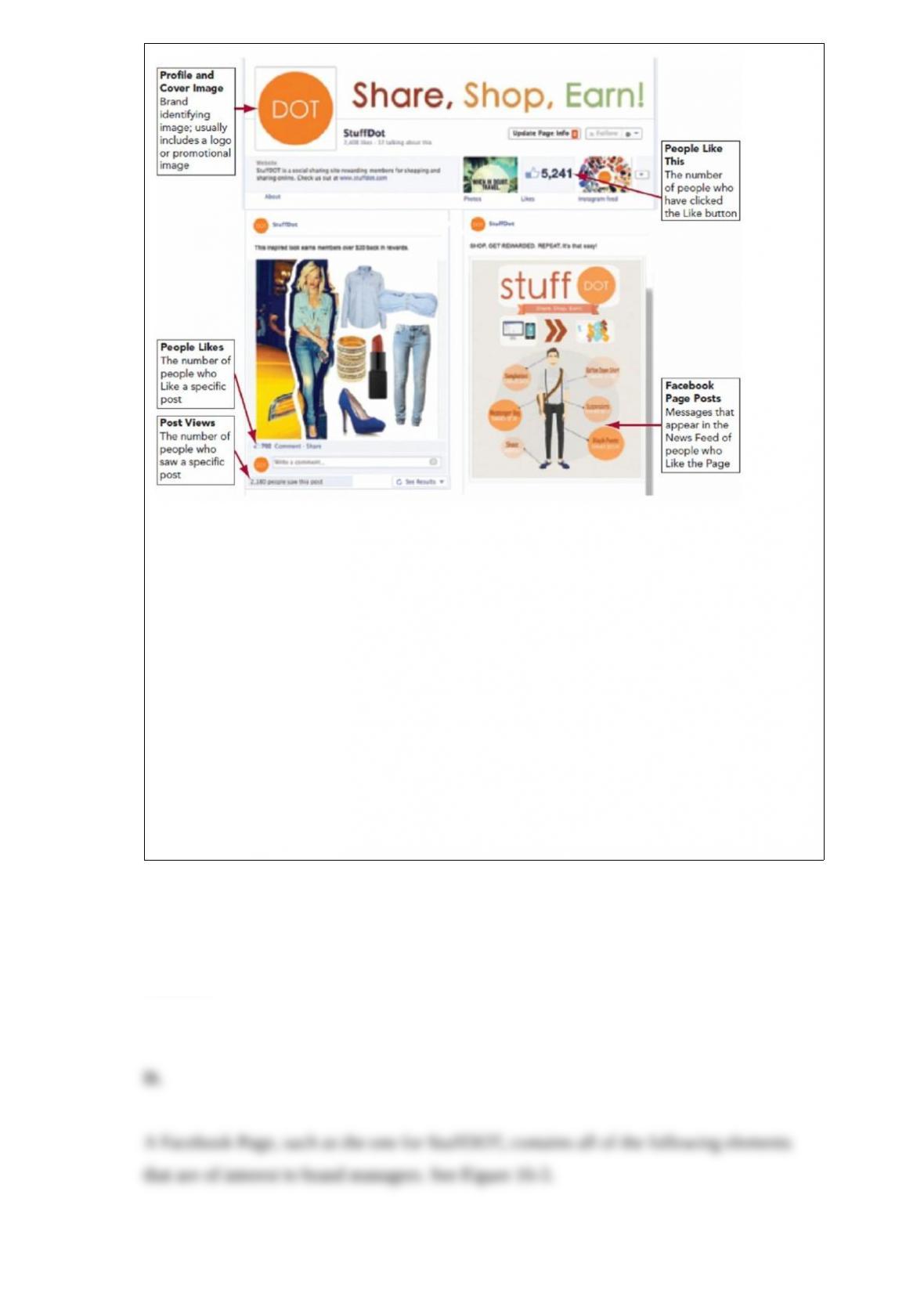
Figure 16-3
A Facebook Page, such as the one for StuffDOT, contains all of the following elements
that are of interest to brand managers EXCEPT:
A. a cover image.
B. Facebook Page posts that appear in the News Feed.
C. analytics about users.
D. the ability to “tweet” a comment on an ad a firm has posted on its Facebook Page.
E. the number of people who clicked the “Like” button.
Answer:
Which of the following statements regarding pricing constraints is most accurate?
A. Generally, the greater the demand for a product, the higher the price that can be set.
B. At the corporate level, when setting pricing constraints, a firm must disregard current
conditions in the marketplace because they are too temporal for long-term planning.
C. Pricing constraints must always be set, but they are rarely enforced.
D. It is possible to create pricing constraints with the greatest range possible in order to
anticipate any and all changes in the marketing environment.
E. Even if a firm is trying to satisfy its obligations to its customers and society in
general, it should ignore setting pricing constraints.
Answer:
Ann’s young son suffers from allergies and complains about his watery eyes and
drowsiness. Ann feels bad because she thought there was nothing she could do to help
him. When Ann saw the ad for a new drug that counters these symptoms in Martha
Stewart Living magazine, she vowed to ask his doctor about this product on her son’s
next visit. Ann is at which stage in the hierarchy of effects?
A. She is the trial stage and will move to the interest stage soon.
B. She has moved quickly from the awareness stage to the interest stage.
C. She was in the consumer development stage and will more than likely move to the
transition stage.
D. She is in the evaluation stage and will move to the interest stage soon.
E. She was in the interest stage and then moved quickly to the diffusion stage.
Answer:
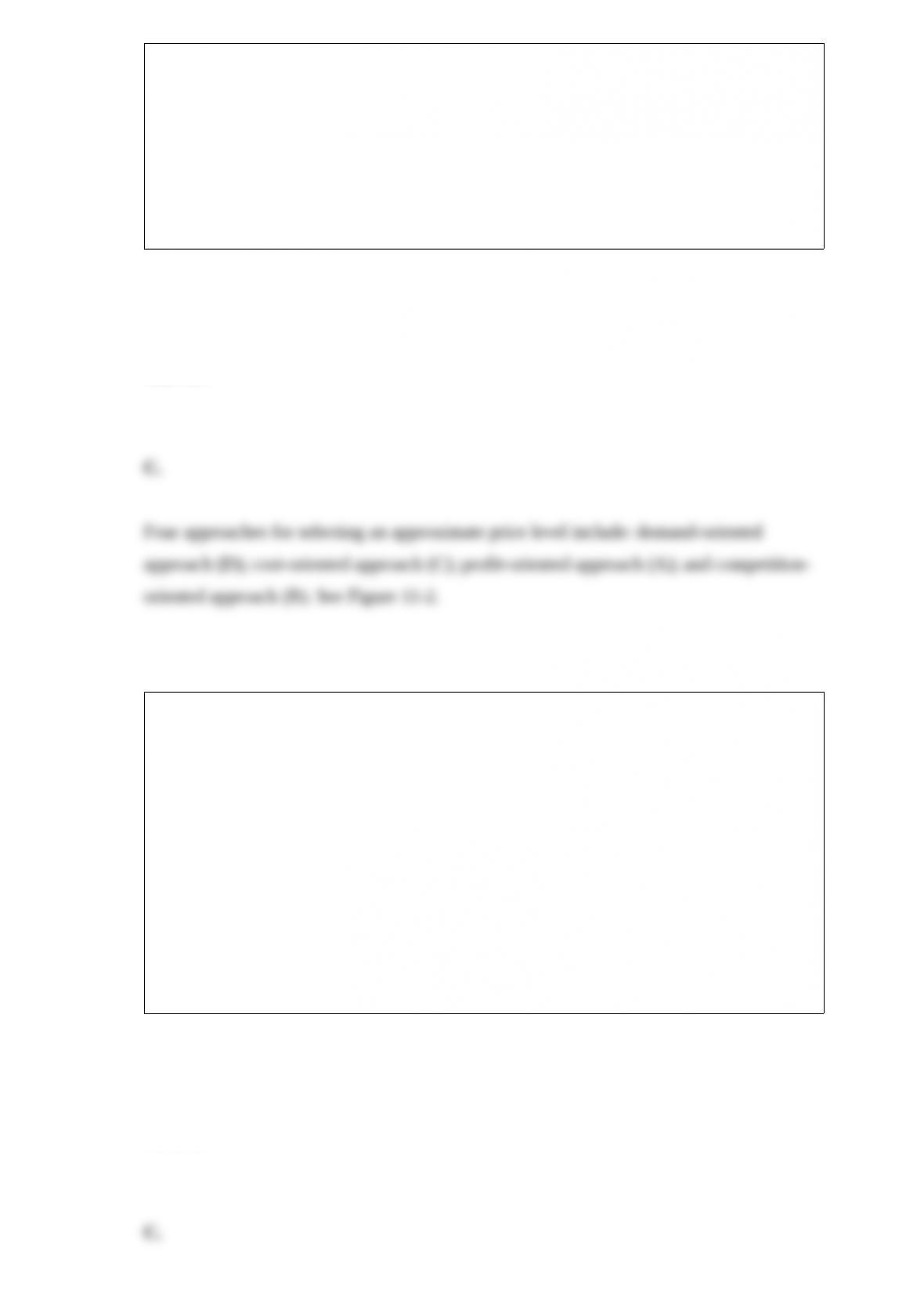
Figure 11-2
Figure 11-2 above represents the four approaches to selecting an appropriate price level.
Box B includes standard markup and cost-plus so it represents which approach?
A. demand-oriented approach
B. profit-oriented approach
C. competition-oriented approach
D. results-oriented approach
E. cost-oriented approach
Answer:
Coca-Cola, Gillette razors, and Nike apparel and shoes are being sold in the same form
in many countries. This is an example of which type of global marketing product and
promotion strategy?
A. product customization
B. product adaptation
C. product extension
D. product integration
E. product invention
Answer:

In marketspace, buzz refers to __________.
A. instant messaging
B. twittering or tweeting
C. word-of-mouth behavior
D. firm-based viral marketing
E. negative online ads
Answer:
Sales tools like coupons and premiums that are used to support a company’s advertising
and personal selling directed to ultimate consumers are referred to as __________.
A. trade-oriented sales promotions
B. manufacturers’ promotions
C. channel promotions
D. consumer-oriented sales promotions
E. reseller promotions

Answer:
All of the following guidelines help ensure the success of mobile marketing EXCEPT:
A. match product characteristics to their needs, preferences, and lifestyles.
B. should facilitate multitasking.
C. create a mobile-ready app that is flashy and fun.
D. mobile apps should help shoppers make price comparisons.
E. communication must use extensive text and images to explain the purpose and value
of the brand.
Answer:
The three primary types of product advertisement are pioneering, competitive, and
__________.
A. informational
B. industrial
C. reminder
D. persuasive
E. subliminal
Answer:
The prescribed penalty for individuals found guilty of the theft of trade secrets is
A. up to 25 years in prison and fines up to $10 million.
B. life in prison with chance of parole after 25 years.
C. expulsion from the United States and/or revocation of citizenship.
D. 30 years in prison and fines to be determined by the courts.
E. up to 15 years in prison and fines up to $500,000.
Answer:
Among teenagers, Pez has a __________ percent awareness level.
A. 50%
B. 60%
C. 75%
D. 89%
E. 98%
Answer:
The __________ department of an organization is responsible for facilitating
relationships, partnerships, and alliances with the organization’s customers,
shareholders, suppliers, and other organizations.
A. purchasing
B. marketing
C. human resources
D. accounting
E. information systems
Answer:
To increase the demand for complementary products, the price of a product often is
A. marked up.
B. marked down.
C. off-priced.
D. value-subtracted.
E. maintained.
Answer: