Sterile Feral, Inc. is a nonprofit organization that catches wild or stray cats, and then
neuters, vaccinates, and releases them back into the wild. The personnel of the nonprofit
organization are caring people who love animals and try to do what they can to meet the
needs of each cat they care for. The caring nature of the personnel relates to which
service quality dimension?
a. assurance
b. tangibility
c. reliability
d. credibility
e. empathy
Answer:
In the VALS framework, consumers motivated by achievement look for products and
services that demonstrate success to their peers or to a peer group they aspire to. One
segment of the two achievement-motivated groups, known as __________, have a busy,
goal-directed lifestyle and a deep commitment to career and family. Image is important
to them.
a. Experiencers
b. Believers
c. Makers
d. Achievers
e. Thinkers
Answer:
At a price of $2.00 each, SHAPE magazine sells 1 million copies of its magazine
targeted to young women seeking a healthier lifestyle. If the price per issue is increased
to $2.50, only 800,000 copies would be sold. From the information provided here, the
price elasticity of demand for SHAPE magazine in this price range can be described as
a. inelastic demand.
b. elastic demand.
c. unitary demand.
d. null elasticity.
e. subsidized elasticity.
Answer:
Stores that carry a considerable assortment (depth) of a related line of items are referred
to as
a. limited-line stores.
b. general merchandise stores.
c. scrambled merchandise stores.
d. hypermarkets.
e. intertype outlets.
Answer:
All of the following are multiproduct branding practices EXCEPT __________.
a. co-branding

b. product line extensions
c. multibranding
d. brand extensions
e. subbranding
Answer:
Ducti is a small company that manufacturers duct-tape wallets. Ducti founder, David
Pippenger, discovered there is a large demand for the wallets and watches that Ducti
sells. In fact, its product line has expanded to include bags as well. Clearly, some
consumers have a favorable evaluation of Ducti products. To have a favorable
evaluation, consumers must first
a. experience problem recognition.
b. consult a public source of information.
c. consult a personal source of information.
d. make a purchase decision.
e. experience cognitive dissonance.
Answer:
Laws refer to
a. a specific set of behaviors a given society considers ethical.
b. society’s values and standards that are enforceable in the courts.
c. the agreed upon codes of behavior for a given nation, community, religious group, or
family.
d. written documentation of a prescribed set of attitudes, beliefs, and values.
e. a code of ethics that defines what may be done in specific business circumstances.
Answer:
Marketers have developed generational marketing programs because
a. grandparents are moving into their children’s homes as a result of the recent
economic downturn, so it is easier for marketers to reach them.
b. it is better to find one market niche and stay with it rather than to cross generational
lines.
c. it doesn”t really matter when people are born; what really matters is what they buy.
d. members of each generation are distinctive in their attitudes and consumer behavior.
e. even though people are labeled as being part of a generational cohort, it doesn”t mean
that they will have different buyer attitudes and behaviors as other cohorts.
Answer:
Which promotional element is particularly important to business buyers?
a. public relations
b. publicity
c. sales promotion
d. rebates
e. personal selling
Answer:
All of the following statements about the growth of social networks like Facebook are
true EXCEPT:
a. the Federal Trade Commission (FTC) has had a laissez faire policy of not interfering
with the development and marketing of social media websites.
b. Internet access and smartphones became more affordable to consumers around the
world.
c. several companies provided many social networking alternatives.
d. advances in data storage, server speed, and software programming made social
networks fast and convenient.
e. people became increasingly interested in the social aspects of the Internet.
Answer:
The process by which an individual selects, organizes, and interprets information to
create a meaningful picture of the world is referred to as __________.
a. motivation
b. attitude formation
c. learning
d. perception
e. illumination
Answer:
The three basic functions intermediaries perform are
a. accommodating functions, logistical functions, and transactional functions.
b. implementation functions, accommodating functions, and contractual functions.
c. contractual functions, facilitating functions, and logistical functions.
d. transactional functions, logistical functions, and facilitating functions.
e. facilitating functions, accommodating functions, and implementation functions.
Answer:
The customer who wants or needs the product is referred to as a __________.
a. hot lead
b. cold call
c. lead
d. prospect
e. qualified prospect
Answer:
Changing a product in some way to make it more appropriate for a country’s climate or
preferences is an example of which type of product strategy?
a. product extension
b. product customization
c. product adaptation
d. product invention
e. product integration
Answer:
The Walt Disney Company carefully markets two distinct Winnie-the-Poohssuch as the
original line-drawn figures on fine china sold at Nordstrom and a cartoon-like Pooh on
polyester bed sheets sold at Walmart. This is an example of
a. mass customization.
b. one product and multiple market segments.
c. price discrimination.
d. a “Tiffany/Walmart” strategy.
e. psychographic market segmentation.
Answer:
Which of the following is most accurate in regards to the Asian free trade agreements?
a. Efforts to liberalize trade in East Asia are growing.
b. Asian free trade agreements are more formal than those of the EU and NAFTA.
c. Asian free trade agreements are based on ethnicity rather than geographical borders.
d. Asian free trade agreements encourage the formation of multinational corporations.
e. Asian free trade agreements recently include India and China.
Answer:
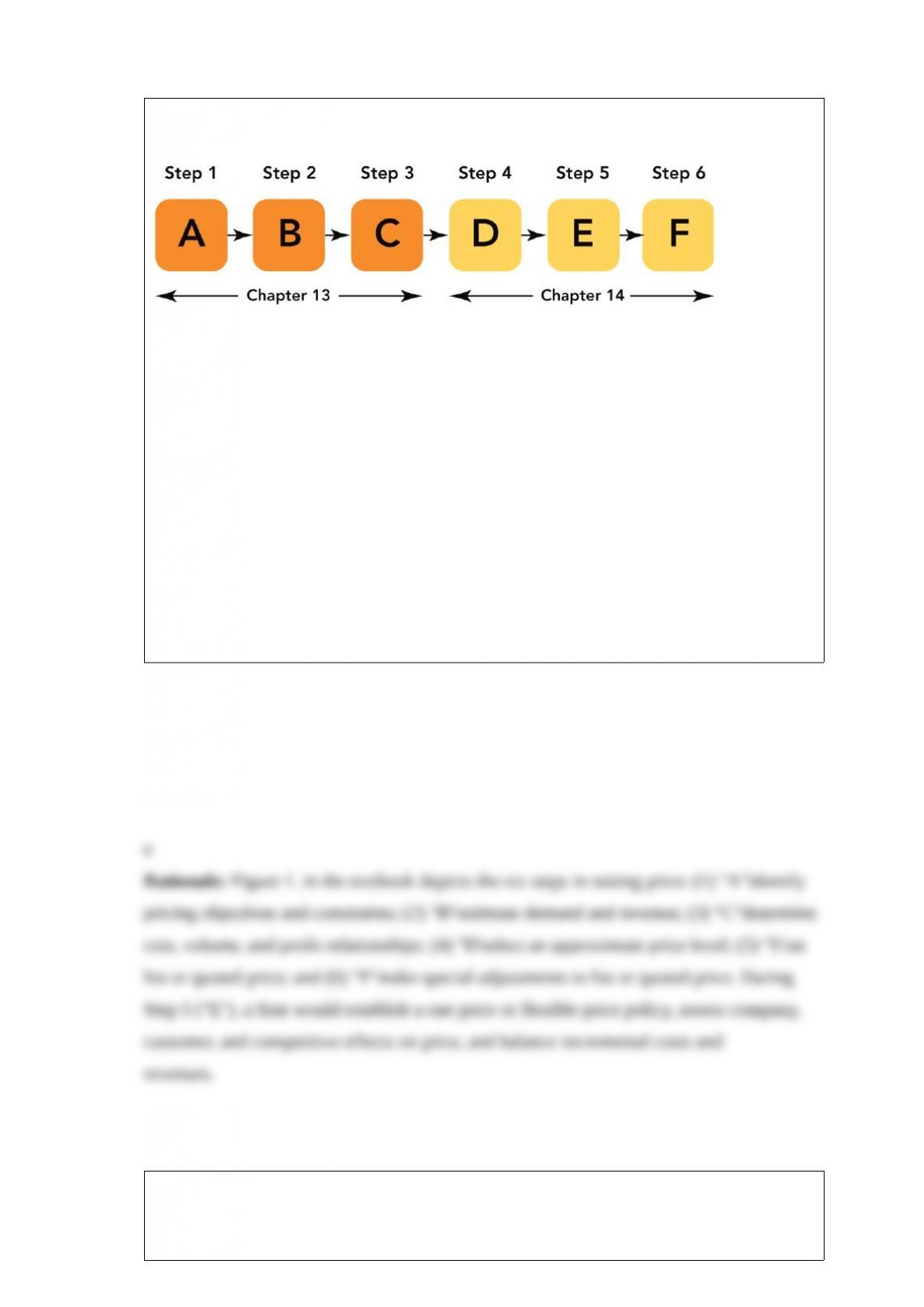
Figure 1.
Figure 1. above represents the six steps in the price-setting process. Which letter
represents the step where a firm would assess company, customer, and competitive
effects on price?
a. “B”
b. “D”
c. “F”
d. “C”
e. “E”
Answer:
If competitive market circumstances are such that there are few sellers who are
sensitive to each other’s prices, and the purpose of advertising is to inform but avoid
price competition, then __________ must exist in the industry.
a. a pure monopoly
b. monopolistic competition
c. pure competition
d. an oligopoly
e. oligopolistic competition
Answer:
Social media are
a. online games.
b. online media where users submit news, photos, and videosoften accompanied by a
feedback process to identify “popular” topics.
c. any type of medium in which large groups of people read content generated by a
business, government, or corporation.
d. only media that allow face-to-face communication.
e. all forms of electronic media.
Answer:
In a __________ presentation, the salesperson tries one appeal after another, hoping to
“hit the right button.”
a. formula selling
b. persuasive sales
c. stimulus-satisfaction
d. stimulus-response
e. stimulus-selling
Answer:
Which of the following statements about environmental forces is most accurate?
a. Environmental forces are almost always controllable if the marketing department
correctly scans them.
b. An organization that incorporates the marketing concept can exert just as much
influence on environmental forces as they can exert on that organization.
c. Environmental forces consistently result in negative outcomes for an organization.
d. Some environmental forces can actually enhance a firm’s marketing opportunities.
e. Environmental forces can almost always be predicted.
Answer:
The term that describes the rapid growth in world population is called the __________.
a. population expansion
b. population inversion
c. population migration
d. population explosion
e. population eruption
Answer:
The Limited employs a quick response system to order fast-moving fashion items. The
Limited’s point-of-sale scanner records each sale. When stock falls below a minimum
level, the system automatically sends an electronic order to the manufacturer, which
processes the order immediately. This system has effectively reduced
a. dependability.
b. product flow.
c. replenishment time.
d. supply lag.
e. logistical lag.
Answer:
Which type of outlet is most likely in its early growth stage of the retail life cycle?
a. single-price stores
b. online retailers
c. supermarkets
d. warehouse clubs
e. business-district retailers
Answer:
By 2015, which racial or ethnic group will have the greatest economic impact in the
United States in terms of its buying power?
a. Asian Americans

b. Hispanics
c. African Americans
d. American Indian and other native populations
e. Indian immigrants (from India)
Answer:
Strategic channel alliances refer to
a. an arrangement whereby a firm reaches different buyers by employing two or more
different types of channels for the same basic product.
b. a practice whereby one firm’s marketing channel is used to sell another firm’s
products.
c. the blending of different communication and delivery channels that are mutually
reinforcing in attracting, retaining, and building relationships with consumers who shop
and buy in traditional intermediaries and online.
d. an arrangement whereby companies reduce distribution costs by sharing facilities,
equipment, and transportation.
e. a practice whereby consumers can interact with various advertising media to buy
products without a face-to-face meeting with a salesperson.
Answer:

Which of the following statements reflects Michael Porter’s theory regarding national
competitive advantage?
a. Clusters of strong suppliers can interfere with entry into a global market.
b. A firm that succeeds in global markets has often left a domestic market because it
was too competitive.
c. A country’s natural resources, education, and infrastructure can be turned into a
competitive advantage.
d. The first goal of a global marketer is to actively educate a nation’s domestic
customers.
e. A nation’s domestic workforce is more motivated to work for foreign corporations
than its own.
Answer:
A__________ product requires little learning by the consumer, and the benefits of the
purchase are readily understood.
a. high-learning
b. fashion
c. fad
d. substitute
e. low-learning
Answer:
Which of the following statements about Asian American buying patterns is most
accurate?
a. There is no real diversity among Asian American subcultures.
b. Assimilated Asian Americans exhibit buying patterns that are very different from the
typical American consumer.
c. Because McDonald’s standardizes its products across all cultures, it does not actively
market to Asian Americans.
d. The Asian American subculture is the most entrepreneurial in the United States.
e. Consumer research on Asian Americans suggests individuals and families divide into
three groupsassimilated, non-assimilated, and recent immigrants.
Answer:
One way to provide consumers authentic offerings is to provide personal interaction.
Which of the following actions provides the best example of this approach?
a. Geico advertises that its insurance specialists are available 24/7 (24 hours per day, 7
days per week).
b. iPods allow customers to create personalized playlists.
c. YouTube, Twitter, and Facebook create a forum for expressing personal experiences.
d. Cirque du Soleil combines the original elements of street performance, the circus,
and live theater.
e. Bloomingdales provides dressing rooms with huge electronic mirrors.
Answer:
Internet-enabled technologies provide communication capabilities that take three forms.
They are
a. a highly interactive and individualized information and exchange environment, phone
customer service, and order processing via PayPal.
b. marketer-to-consumer e-mail notification, phone customer service, and order
processing via PayPal.
c. consumer-to-marketer buying and service requests, marketer-to-consumer e-mail
notification, and phone customer service.
d. recording a user’s visits to websites, consumer-to-marketer buying and service
requests, and marketer-to-consumer e-mail notification.
e. marketer-to-consumer e-mail notification, consumer-to-marketer buying and service
requests, and consumer-to-consumer chat rooms, instant messaging, and social
networking websites.
Answer:
When CNS decided to enter the global market for its Breathe Right strips, there were
many contributing factors for doing so. However, according to Kevin McKenna, vice
president for international at CNS, the real key to successfully enter a specific global
market is
a. selecting a country where there will be virtually no product competition.
b. having a local partner that is entrepreneurial with an ability to distribute and sell.
c. capitalizing on America’s reputation as a leader in medical product innovation.
d. having an internationally known celebrity spokesperson who transcends national
boundaries.
e. having a quality product that can easily be manufactured and distributed.
Answer:
At a Hallmark store you can find several different product lines of greeting cards, likely
including Fresh Ink, Nature’s Sketchbook, Shoebox, Maxine, Mahogany, and Tree of
Life cardsall made by Hallmark for sale in its stores and intended to appeal to different
target markets. The Mahogany line is designed to appeal to African-Americans. This is
an example of __________ segmentation.
a. regional
b. demographic
c. lifestyle
d. geographic
e. psychographic
Answer:
The BCG has given specific names and descriptions to the four resulting quadrants in
its growth-share matrix based on the amount of cash they generate for or require from
the organization. “Cash cows” are SBUs that are classified as having
a. high market growth rates and high relative market shares.
b. low market growth rates but high relative market shares.
c. low market growth rates and low relative market shares.
d. high market growth rates but low relative market shares.
e. medium market growth rates and medium relative market shares.
Answer:
A good, service, or idea consisting of a bundle of tangible and intangible attributes that
satisfies consumers’ needs and is received in exchange for money or something else of
value is known as a(n)
a. utility.
b. item.
c. service.
d. marketing program.
e. product.
Answer: