Chapter Nine
Summary
Approximately 3-7% of all school-aged children have some form of attention deficit disorder. Additionally,
about 70% of these children will go on to demonstrate attention deficit into their adult years. Diagnosis can be difficult
as many children also have comorbid conduct, substance abuse, oppositional disorders, and bipolar illness.
Etiology appears to be linked to frontal lobe dysfunction and a dysregulation of the neurotransmitters
dopamine and norepinephrine. The basil ganglia, the amygdala, and possibly the reticular formation have also been
mentioned as areas of the brain that are affected by neurotransmitter dysregulation.
Diagnosis and treatment address both the neurological manifestations and the behavioral manifestations of
the disorder. First, a careful and thorough assessment must be conducted. This includes both a complete history and
physical examination, and an assessment with parents, teachers and others who observe the child or adult. The use of
psychological testing and rating instruments are often helpful along with the client’s own assessment of his/her level
of functioning.
Specific Discussion Questions:
1. What types of things should a therapist ask about or look for when a parent presents a child for an ADHD
assessment?
2. Why is counseling and psychotherapy necessary along with medication in the treatment of ADHD and other
related disorders?
Possible True/False Questions:
1. Approximately 3-7% of all school-aged children have an attention deficit.
2. As many as 70% of children with ADHD go on to demonstrate symptoms into their adult years.
3. Mydayis is available for both narcolepsy and ADHD.
4. The neurotransmitter serotonin has been implicated in the etiology of ADHD.
5. MRI and other scans have shown that neurotransmitter irregularities in the frontal striatal networks and in the
cingulated gyrus may result in attention and learning disorders.
6. The Conner’s Rating Scales Revised is often used in the assessment of ADHD.
7. Typical side effects of stimulants include hypertension, insomnia, weight loss, and headaches.
8. Stratera along with other stimulants may be habit forming.
9. Concerta, Metadate ER and Aptensio XR are longer-acting, sustained release formulated stimulants.
10. Buproprion and disipramine are common antidepressants used in the treatment of ADHD.
11. ADHD is diagnosed much more often in boys than in girls.
12. ADHD remains one of the most treatable conditions in the DSM-5.
Possible Multiple Choice Questions:
1. Approximately ____% of school-aged children demonstrate an attention deficit?
a. 1-2%
b. 3-5 %
c. 3-7%
d. 8-10%
2. What percentage of ADHD youth will go on to demonstrate adult ADHD?
a. 40%
b. 50%
c. 60%
d. 70%
3. Irregularities of which neurotransmitter(s) has been implicated in ADHD?
a. Serotonin
b. Norepinephrine
c. Dopamine
d. both b and c
4. Which of the following stimulants offers an oral liquid option?
a. Concerta
b. Dyanavel
c. Adderal
d. None of these
5. Which stimulant uses a polymer, multi-particulate bead system?
a. Stratera
b. Ritalin SR
c. Tenex
d. None of these
6. Which of the following is not a stimulant per se, but rather an antidepressant with stimulant qualities?
a. Cylert
b. Ritalin
c. Stratera
d. Adderal
7. A typical dose of Adderall for a child is in the range of:
a. 5-10 mg per day
b. 5-15 mg per day
c. 5-30 mg per day
d. 30-60 mg per day
8. Insomnia, a common side effect of stimulants, may be reduced by:
a. Using stimulants with shorter half-lives.
b. Using stimulants with longer half-lives.
c. Combining stimulants with medications like Intuniv.
d. Both a and c above.
9. Which drug for ADHD is less likely to be abused due to the nature in which it is metabolized?
a. Ritalin
b. Vyvanse
c. Focalin
d. None of these
10. For patients who cannot tolerate stimulants, Alpha-2 agonists such as ______ may be helpful.
a. Concerta
b. Daytrana
c. Intuniv
d. All of these
Alternative Class Assignments and Essay Questions:
1. Have students role play a session with a mother concerned about whether to use medications to treat her
ADHD son. What suggestions or parent education should be suggested?
2. You are working with an ADHD child who functions well during school hours, but fails to complete
homework and other duties after school hours when the medication wears-off. What suggestions could you
make to the parents and the prescribing professional?
Case 1 and 2 Vignette Discussion Questions:
1. What is the major pathology or diagnosis presented in each case?
2. Is there another disorder that may apply or should be ruled–out in each case?
3. Do you agree with the medication suggestions made in each case?
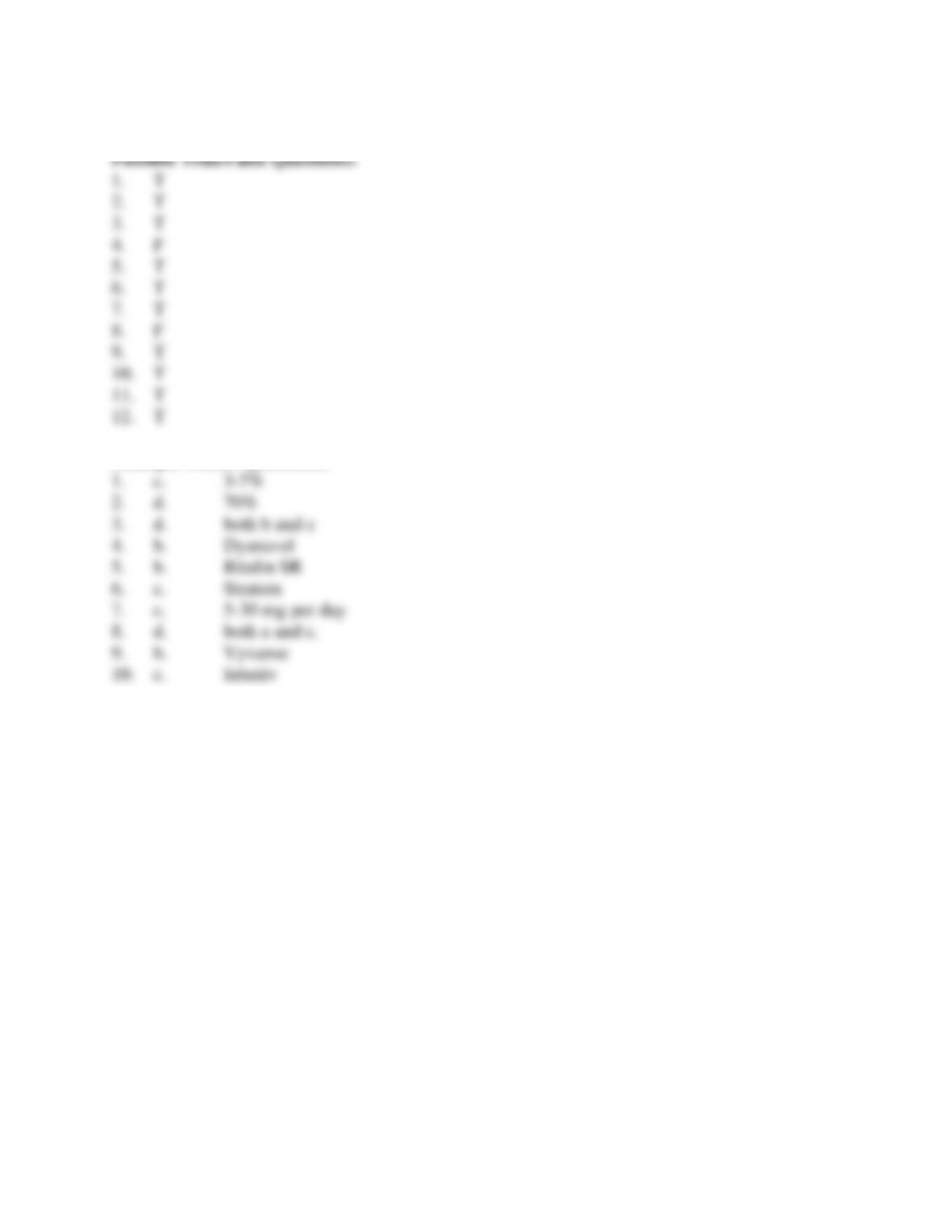
Answer Key to Possible True/False and Multiple Choice Questions Chapter Nine
Multiple Choice Questions: