Chapter Six
Summary
Bipolar disorder is characterized by cycling between extreme highs or mania, and extreme lows or depression.
For some, the mania may be less intense and troublesome, so we refer to this as hypomania. While the typical age of
onset is about 19, it may be several years before a definitive diagnosis is made, especially for women. Although
effective treatments are available, most patients will fail to maintain treatment protocol in the first five years.
In contrast to unipolar depression, bipolar depression is thought to be endogenously caused. It may however,
be triggered by exogenous stimuli. The concordance rates among monozygotic twins can be as high as 70%. In many
cases, physicians and others fail to obtain adequate history and treat the more obvious depressive symptoms first. This
may trigger a manic or hypomanic episode.
Many other diseases have been known to cause or exacerbate mania. These include brain tumors, syphilis,
CNS trauma, delirium and dementia, hyperthyroidism, cancer, MS, Parkinson’s, hemodialysis, stroke, epilepsy, and
vitamin deficiencies just to name a few. Furthermore, drugs of abuse and other medications may cause manic type
symptoms. These include anti-hypertensives, antidepressants, cimetidine, steroids, disulfiriam, cocaine,
hallucinogens, PCP, opioids, and various stimulants.
Treatment of bipolar conditions can be difficult. Medications include mood stabilizers like lithium and other
anticonvulsants, but they may also include atypical antipsychotics . The choice of medication depends on which phase
of depression or mania the patient is exhibiting. Lithium is the “gold standard” as it may be used to control both the
manic and depressive aspects of the illness. Careful monitoring of lithium levels is essential to prevent toxic levels
that are very close to the actual therapeutic level.
Anticonvulsants are believed to increase the levels of GABA, the inhibiting neurotransmitter. This increased
inhibition leads to less neurotransmission and reductions in manic symptoms. These drugs include valproate,
carbamazepine and oxcarbazepine. Newer drugs like lamotrigine and topiramate may also be used. Topiramate has
an advantage over the others, as it is not associated with weight gain, and does not cause toxic rashes like lamotrigine.
It may also be helpful for patients who abuse drugs and alcohol as part of their mental illness.
Specific Discussion Questions:
1. Explain the major differences between Bipolar Type I and II. How would a medication regime change to
address the differences?
2. Explain why Bipolar illness is thought to have a genetic predisposition.
3. Why are good patient education and family therapy so important when working with Bipolar patients?
4. Aside from anticonvulsants, which anti psychotics have been approved for treating manic symptoms?
7. Why is good history taking so important when decided to medicate a depressed or manic patient?
Possible True/False Questions:
1. SSRI medications alone do not trigger a manic episode in a bipolar patient.
2. Topamax or topiramate is believed to increase GABA and block glutamate receptors .
3. Both lithium and olanzepine are FDA approved as mono-therapies for Bipolar illness.
4. Most atypical antipsychotics and neuroleptics are approved for use with bipolar patients.
5. For acute manic states, lithium or valproate would be approved medications.
6. Olanzepine and Lamictal ODT are also available as an orally disintegrating tablet.
7. Most anticonvulsants and other medications like lithium are safe to use during pregnancy.
8. Medications like lithium, carbamazepine, and clozapine require blood monitoring.
9. Vraylar, Rexulti, and Latuda are newer atypicals used in the treatment of bipolar and other psychotic
spectrum illnesses.
Multiple Choice Questions:
1. Which of the following drugs is thought to be the “gold standard” for treating Bipolar Illness?
a. Lamictal
b. Topamax
c. Lithium
d. Tegretol
2. Oxcarbazepine or Trileptal is similar to ________, but does not cause agranulocytosis or aplastic anemia?
a. Lithium
b. Tegretol
c. Neurontin
d. None of these
3. Which of the following is not associated with significant weight gain?
a. Lithium
b. Zyprexa
c. Topamax
d. Depakote
4. Which of the following may cause a toxic rash?
a. Lamotrigine
b. Gabapentin
c. Topiramate
d. None of these
5. Which of the following benzodiazepines is often used for its mood-stabilizing properties?
a. Xanax
b. Ativan
c. Klonopin
d. All of the above
6. Typically, we should wait about ____ days to see if a particular anti-manic medication is working before we
consider another.
a. 2-5 days
b. 5-10 days
c. 5-15 days
d. 15-20 days
7. A typical two-drug combinations for Bipolar Illness include:
a. An SSRI plus an MAOI
b. An SSRI plus a neuroleptic
c. Lithium plus an anticonvulsant
d. All of the above
8. A typical three-drug combination could include all except
a. An SSRI plus an MAOI, plus an atypical antipsychotic.
b. An antipsychotic, a mood stabilizer, and an antidepressant.
c. Bupropion, a mood stabilizer, and an antipsychotic.
d. None of these
9. Typical three drug combinations include:
a. An SSRI, a benzo, and an anticonvulsant.
b. An MAOI, A benzo, and an anticonvulsant.
c. Lithium, a stimulant and a benzo.
d. Lithium, an anticonvulsant, and an atypical antipsychotic.
10. Which of the following atypicals is less sedating and less likely to cause weight gain?
a. Rexulti
b. Abilify
c. Zyprexa
d. Clozaril
Alternative Class Assignments and Essay Questions:
1. Explain why bipolar patients abuse drugs/alcohol in both the depressed and manic phase of their illness.
2. Why is good history taking so important in deciding if a patient has a Bipolar Type I or II presentation?
3. Can bipolar patients demonstrate aggressive even assaultive behaviors, explain?
4. Have students pair off with one person playing the therapist role and the other posing as a parent of a patient
with Bipolar Illness. What facts or points should be stressed and what suggestions could be given?
Case 1 and 2 Vignette Discussion Questions:
1. What is the major pathology or diagnosis presented in each case?
2. Is there another disorder that may apply or should be ruled-out?
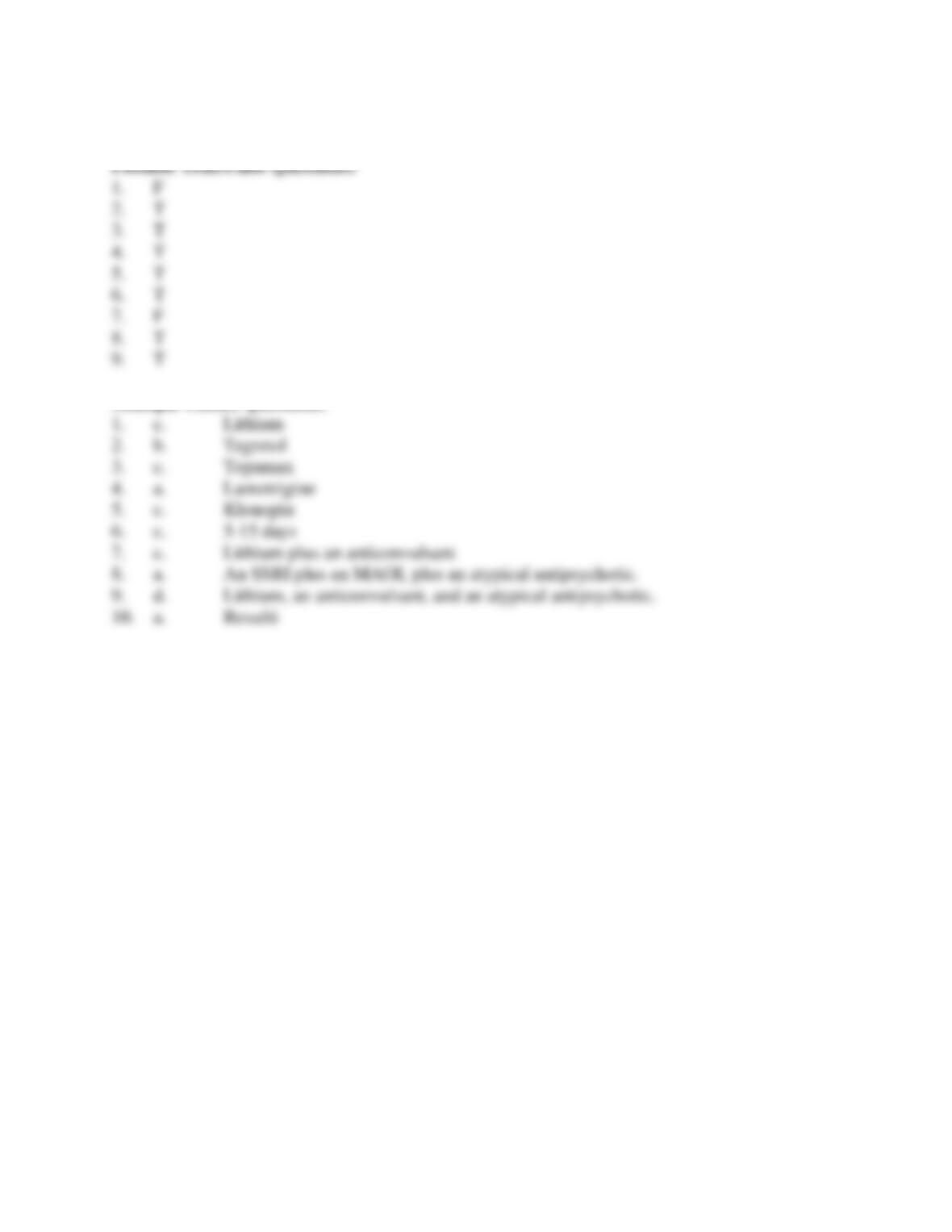
Answer Key to Possible True/False and Multiple Choice Questions
Chapter Six
Multiple Choice Questions: