Chapter Two
Summary
Chapter Two addressed the basic biological explanations of how the brain and the nervous system function
and control human behavior. We examined the role of exogenous and endogenous substances in the body and how
they affect various systems and conditions. We learned that via the central nervous system, the neurons communicate
with each other through chemical messengers called neurotransmitters. Within the cell or neuron, electrical activity
plays a role in activating the cell to fire or release a message to another cell within the system. A chemical message is
released from the terminal button at the end of a neuron, crosses the physical space or synaptic gap, and activates
receptor sites on a neighboring cell’s dendrite. Some neurons are excitatory and others are inhibitory.
There are three major neurotransmitters responsible for human behavior and emotions. They are
norepinephrine, serotonin, and dopamine. It is theorized that depleted levels of norepinephrine may contribute to
depression and decreased learning, motivation, and attention. Lower levels of dopamine may lead to depression and
reduced levels of attention and inhibition, while higher levels may lead to mania or psychosis. Dopamine is also
implicated in the reward system associated with chemical abuse. Reduced levels of serotonin lead to depression,
aggression, and often obsession, while higher levels may contribute to mania.
There are other substances endogenous to the body that play a role in behavior. Glutamate is the body’s
excitatory neurotransmitter, whereas GABA plays an inhibitory role.
Specific Discussion Questions:
1. Explain the main differences between exogenous and endogenous substances, and give specific examples of
each.
2. Explain how various cells within the CNS communicate both electrically and chemically.
3. Explain the function of various parts of a neuron.
4. When a cell is stimulated or polarized, it fires an action potential. Explain the process and how
neurotransmitters are dispersed to other neighboring cells across the synapse.
5. What are the four stages of exocytosis?
Possible True/False Questions:
1. Exogenous substances are produced within the body.
2. Endogenous substances include endorphins, insulin and adrenalin.
3. Exogenous substances include caffeine, vitamins, and herbs.
4. Cells within the central nervous system communicate both electrically and chemically.
5. Within cells this communication is electrical and between cells it is chemical.
6. There are three basic parts of a neuron.
7. The synapse is the physical space between neurons.
8. When the cell fires, or experiences an action potential, neurotransmitter substance is released from the
dendrite.
9. The soma or cell body contains the vital parts of the cell including the nucleus, the mitochondria and the
cytoplasm.
10. The most common ions found in the extracellular spaces are sodium and chloride ions.
11. We usually refer to the resting potential as -140 mV.
12. Cells are often bombarded by many signals both excitatory and inhibitory.
13. G proteins are so called because they bind guanine nucleotides.
14. Drugs that increase the availability or action of a neurotransmitter in called an antagonist.
15. Monosodium glutamate or MSG is often found in Chinese food.
Possible Multiple Choice Questions:
1. A drug of a substance that facilitates the effects of a particular neurotransmitter on the post-synaptic cell and
likely to stimulate an action potential is known as a/an:
a. antagonist
b. agonist
c. G protein
d. None of these
2. The body’s main inhibitory neurotransmitter/neuromodulator is:
a. glutamate
b. L-dopa
c. GABA
d. tryptophan
3. For exocytosis to occur _______ causes the docked neurotransmitter pods to release their contents:
a. calcium
b. MAO
c. dopamine
d. All of these
4. Which of the following does not fit with the others?
a. norepinephrine
b. dopa-decarboxylase
c. serotonin
d. L-dopa
5. Which of the following are found in the soma?
a. Terminal button and axon.
b. The dendrites and the terminal buttons
c. The axon and the dendrites
d. The nucleus and the mitochondria.
6. Which of these is the correct progression of events.
a. Action potential, exocytosis, re-uptake.
b. Exocytosis, action potential, re-uptake.
c. Re-uptake, action potential, exocytosis.
d. None of these
7. Exogenous substances include all of the following except:
a. vitamins
b. minerals
c. herbs
d. hormones
8. The physical space between neurons is called:
a. the intracellular space
b. the extracellular space
c. the cytoplasm
d. the synapse

9. G proteins are also known as:
a. monoamines
b. secondary messengers
c. indolamines
d. peptides
10. When a cell is at its resting state, the resting potential is about:
a. -70 mV
b. 70mV
c. 170 mV
d. -140 mV
11. Tyrosine is the amino acid precursor substance that is needed to produce:
a. Tylenol
b. serotonin
c. dopamine
d. GABA
12. Dietary sources of tyrosine include all of the following except:
a. meat
b. fish
c. tofu
d. wheat
13. GABA is the body’s main inhibitory neurotransmitter substance, and ___________ is the excitatory
substance.
a. tryptophan
b. calcium phosphate
c. glutamate
d. None of these
14. Which two of the following appear to play a major role in learning and attention?
a. serotonin and dopamine
b. norepinephrine and dopamine
c. norepinephrine and serotonin
d. GABA and acetylcholine
15. Excessive amounts of ________ may be implicated in psychosis.
a. serotonin
b. norepinephrine
c. GABA
d. dopamine
16. Excessive amounts of ________ may be implicated in mania.
a. serotonin
b. norepinephrine
c. GABA
d. dopamine
Alternative Class Assignments and Essay Questions:
1. Starting with the precursor substance tyrosine, draw a diagram showing how the various enzymes convert this
substance to dopamine and norepinephrine.
2. Draw a neuron on your paper or the board. Label the parts and briefly describe their function.
3. Explain what happens within the cell when it experiences an action potential.
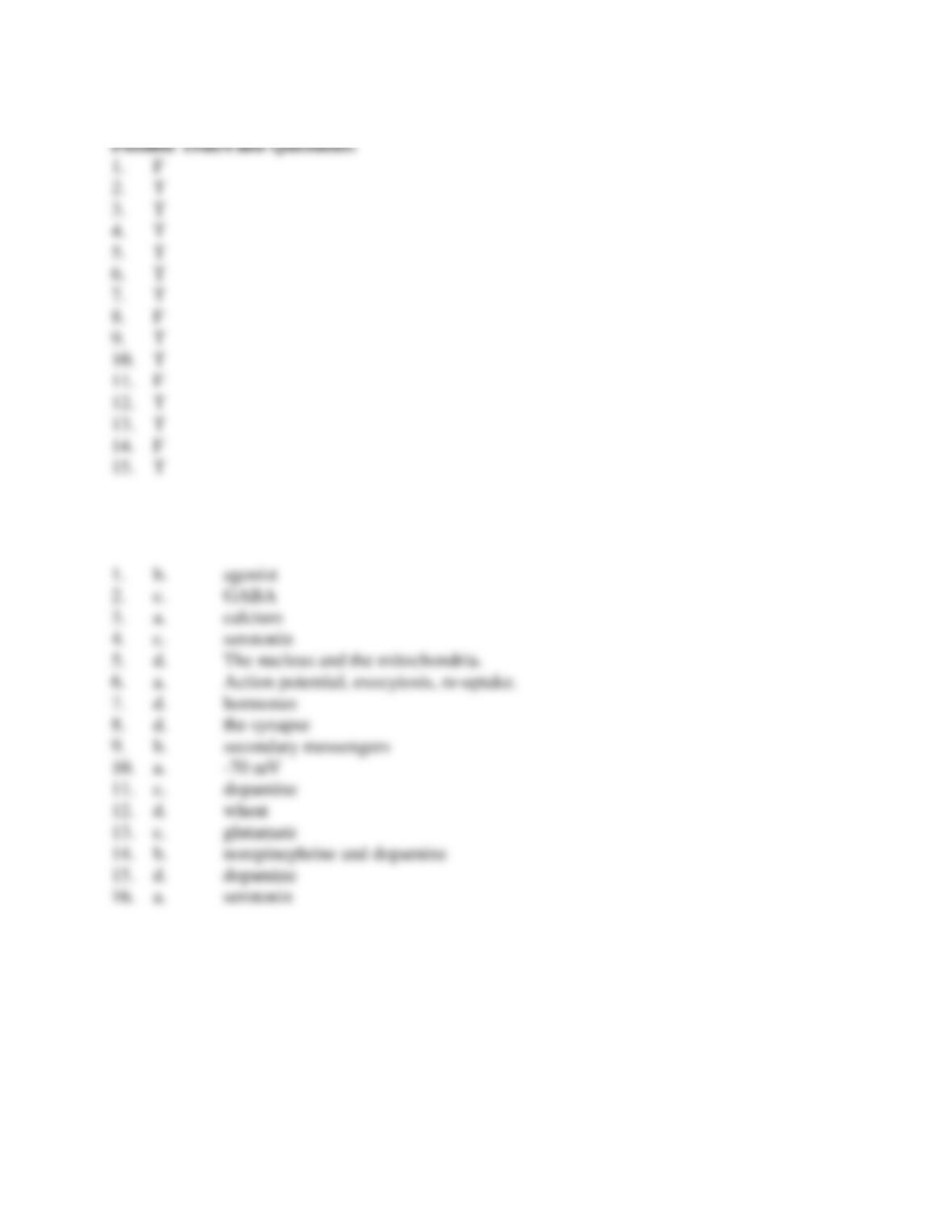
Answer Key to Possible True/False and Multiple Choice Questions
Chapter Two
Multiple Choice Questions: