Phase #2: Trivial Pursuit Quiz
A. Information and expertise are power resources. If a group member knows the
answer to one of the questions, he or she becomes a “hero” and earns points for
the group. Status increases.
Phase #3: Blind Draw (5 Rounds)
A. Creates possibility of a power shift. Sometimes loss of power is a matter of luck.
B. Will power shift produce retribution? Payback time for competitive choices made
earlier in the exercise?
Phase #4: Talent Show
A. Personal qualities act as power resources.
B. Some groups just have more charisma, more “stars” who can connect with an
audience. Increases status within the group and the class when a great
Phase #5: The Egg Drop
A. Big lesson in cooperation (power sharing). Groups that work together not against
each other, usually do better on the egg drop. Sharing resources to protect all the
eggs can be quite productive.
B. Power and creativity are linked. Creativity is often rewarded.
C. Dominant members tend to bully the group into one design without careful
Phase #6: The Auction
A. Competitive strategy of trying to outbid other teams is a loser.
VII. Excerpt from Michael Moore’s TV Nation, Vol. 2.
A. Show the segment about 10 minutes into the video that shows Janeane Garofalo
organizing a group to invade a private beach in Connecticut. Segment runs about
beach on the ocean?” People interviewed on the street and virtually all students in
class answer a loud No. The clear power distance between the residents who “pay
taxes” to have a private beach and the interlopers who try to invade but are turned
away by police and the Coast Guard will spark interesting class discussion.
NOTE: Many segments from TV Nation, Vols. 1 & 2, illustrate the clash that occurs
when power is imbalanced (see especially Vol.1 segment, “I Need a Cab” and Vol. 2
VIII. “Stand Up, Sit Down” assertiveness exercise
A. Purposes:
1. To teach students the difference between aggressiveness, passivity, and
assertiveness.
2. To help students appreciate the mostly nonverbal nature of assertiveness.
3. To provide an opportunity for students to learn the assertiveness skill.
B. Time required: approximately 25 minutes
C. Instructions:
1. Divide the class into dyads (pairs).
2. Have partners designate who is “A” and who is “B.” A tells B to “stand up.”
B will obey and physically stand up ONLY when the statement by A
seems assertive. If the statement “stand up” seems too pleading, questioning,
or begging, B will remain seated and give feedback to A (e.g., “too passive”).
If the statement is too much of a command, sounds like an order, A will
remain seated and give feedback (“too aggressive”). Do not allow any words
to be used except “stand up.”
3. Once A gets B to “stand up,” he/she then says “sit down.” B again will obey
4. Roles will now switch. B will issue the statements “stand up” and “sit down”
and A will obey if it is deemed assertive.
5. Break the class into groups of 6-9 members. Have each member, in turn,
D. Processing:
1. Note that groups will sometimes comply all together. When all nonverbal
cues communicate assertiveness (tone of voice, facial expressions, eye
contact, gestures, posture), all group members will comply. When mixed
messages are communicated from contradictory nonverbal cues (i.e.,
2. Assertiveness is mostly nonverbal in nature. The statements “standup” and
“sit down” seem to be inherently commands, thus aggressive. Yet this
3. The multiple nonverbal cues that together comprise assertiveness,
ELEMENTS OF ASSERTIVE COMMUNICATION
NONVERBAL ELEMENTS
Eye Contact Inadequate eye contact is usually interpreted as exhibiting
anxiety, dishonesty, shame, boredom, or embarrassment. Direct
eye contact typically communicates self-confidence and
directness (assertiveness).
Facial Expressions Facial expressions should match verbal statements. Smiling while
displeased or smirking when anxious gives a mixed message.
Frowning may communicate aggressiveness.
Gestures/Posture Fidgeting, nervous shifting from one foot to another, slumped
shoulders, or bent over posture often communicate passivity.
Similarly, frantic gesturing, energetic stabbing motions with the
Vocal elements Watch out for tag questions: raising your voice at the end of a
declarative statement (“stand up?”; “Dinner at 7:00?”). This
communicates passivity. Consider other vocal aspects as well.
Distance Too close, especially with strangers appears “pushy” and
aggressive. Too far apart seems passive: afraid to approach. Find
VERBAL ELEMENTS
Despite the mostly nonverbal nature of assertiveness, there are some verbal aspects to
consider. Think before you speak. Saying whatever comes to mind may appear anxious,
even fearful. Strive for clarity. A jumbled verbal message can seem passive, lacking in
confidence. Don’t overqualify statements. For example:
“You probably will think I’m being touchy, but…”

IX. Assertiveness Self-assessment
A. Purposes
1. To provide an opportunity for group members to assess their own level of
assertiveness.
2. To allow group members to discuss assertiveness in a group context.
B. Time required: approximately 30 minutes.
C. Instructions
1. Have all group members fill out the Assertiveness Self-assessment
questionnaire.
2. Have groups open a discussion of the results of this questionnaire. Tell them
to draw some conclusions from the questionnaire (what patterns do they
see?).
3. Open discussion of the questionnaire results to the whole class.
D. Processing
1. Emphasize the situational nature of assertiveness: we may be assertive in
some situations but not in others. Which situations seem most difficult to be
assertive?
2. Discuss the difficulties being assertive when there is a power imbalance.
3. Was any student/group member assertive in all situations? Are we as a
culture, mostly assertive? Which category averaged highest: aggressiveness,
assertiveness, passivity? Were your averages high for any category?
Medium? Low? Interpret the results. (Averages of 4.0or above indicate a
strong tendency. Averages of around 3.0 show no strong tendency generally.
Less than 3.0, especially in the 1.0: 2.0 range indicate no tendency in
situations described.) If you had high average scores for two or all three
categories, what does this mean? Passive in some situations? Aggressive in
other situations? Assertive in still other situations? Explain what situations
produce which response.
4. In which situations addressed in the questionnaire might assertiveness be
counterproductive? Why?
5. This exercise links nicely with the “stand up, sit down” exercise. The “stand
ASSERTIVENESS SELF-ASSESSMENT QUESTIONNAIRE
Fill out the following Assertiveness Self-Assessment Questionnaire. Be as honest as you
can. This is not an assessment of your “ideal self.” This should be your “real self.” For
each situation indicate how likely you would be to take the action indicated by using the
following scale:
5 = Very likely
4 = Likely
3 = Maybe
2 = Unlikely
1 = Very unlikely
____ 1. You have been invited to a party but you don’t know anyone except the friend
who invited you who is not present when you enter the room. You see dozens
of strangers. You walk up to a group of people and introduce yourself and
begin a conversation.
____ 2. There is a definite undercurrent of tension and conflict in your group. You are
feeling that tension as your group begins discussing their project for class. You
stop the discussion, indicate that there is unresolved conflict in the group and
request that the group address this issue.
____ 3. You strongly disagree with your group’s choice for a symposium project.
Nevertheless, you say nothing and go along with the majority decision.
____ 4. During class your instructor makes a point that angers you greatly. You raise
your hand, are recognized by the instructor, and you vehemently challenge your
instructor’s position, raising your voice to almost a shout.
____ 5. You’re sitting in the back of the class. Two students sitting beside you engage
in an audible conversation that is distracting. You can’t concentrate on the
instructor’s lecture. You lean over and calmly ask them to stop talking so you
can listen to your instructor.
____ 6. At a family holiday dinner gathering, your uncle makes a blatantly racist
remark, then tells a sexist joke. You sit silently.
____ 7. While on vacation you sign up to receive a group lesson in a new sport (jet
skiing, rock climbing, snow skiing). After the instructor has explained the
basics, everyone in the group appears to understand perfectly. You, however,
are unclear about a couple of instructions. You raise your hand and ask the
instructor to repeat the instructions and explain them more fully.
____ 8. Three individuals representing a religious group knock on your door. When
you answer they begin to proselytize, trying to sell you on their religious point
of view. You stand there waiting patiently for them to finish, wishing they
would go away.
____ 9. A small group of teenagers talk loudly during a movie you attend at a local
theater. You become increasingly annoyed but say nothing to them.
____10. You live in a dorm room with two roommates. Next door loud music is playing
making it impossible for you to study. Your roommates seem not to care but
you are becoming increasingly annoyed by the noise. You walk next door,
pound on the door, and, when the door is opened you demand that the music be
turned way down immediately.
____ 11. A member of your group couldn’t afford to buy the textbook for the class. He
asks you if he can borrow your book for “a couple of days.” You agree. He has
had the book for more than a week and shows no sign of returning it to you.
You wait for him to return the book or explain why he hasn’t mentioned it.
____ 12. At work, you are a member of a project team. Every member of the team makes
considerably more money than you do yet your jobs are equivalent. You
believe that you deserve a hefty raise. You make an appointment with your
boss to ask for a substantial raise.
____ 13. You receive an e-mail from a team member that has a condescending tone. It
angers you that this team member, who you view as a bit of a screw-up,
lectures you on the “right way” to approach your part of the group task. You
write back a sarcastic, biting reply.
____ 14. The coach of your sports team berates players at a team meeting for “lackluster
play” and “lackadaisical attitudes.” The coach is shouting and abusive. You
believe the criticism is mostly unfair and doesn’t apply to most of the players.
You remain silent, wishing he/she would wind down.
____ 15. A group member pulls you aside and begins accusing you of “unethical
behavior.” She is shouting at you, her face is flush red and she is wildly
gesturing. People are noticing. You shout back at her.
____ 16. The family that lives next door has a dog that barks all hours of the night. It is
disturbing to you and your family members. You meet one of the dog owners
during a walk through the neighborhood. You stop, begin to talk, and you
calmly bring up the barking dog problem.
____ 17. You are taking an exam. You notice several students cheating on exam. You’re
upset because this gives these students an undeserved advantage and may lower
your own grade because the instructor grades on a curve. The instructor doesn’t
notice the cheating. You report the cheating to the instructor after class.
____ 18. During a group discussion, your point of view clashes with another group
member. You want very much to convince the group that your viewpoint
should be accepted. You interrupt when the member who disagree with you
tries to voice her opinion, you keep talking when she tries to disagree with a
point you make, and you insist that she is wrong and you are right.
____ 19. At work, a member of your project team “steals” your idea and takes credit for
work you have done. You angrily denounce him in front of the entire team and
insist that he own up to his deception.
____ 20. One of your team members has extremely bad breath. This is a common
problem when you meet. His bad breath bothers you a great deal. Nevertheless,
you say nothing and try sitting as far away from him as possible during
meetings.
____ 21. You are waiting in line to be served at a local store. Just as you are about to be
waited on a group of three individuals step in front of you. You demand that
they step aside, insisting that you were in line ahead of them.
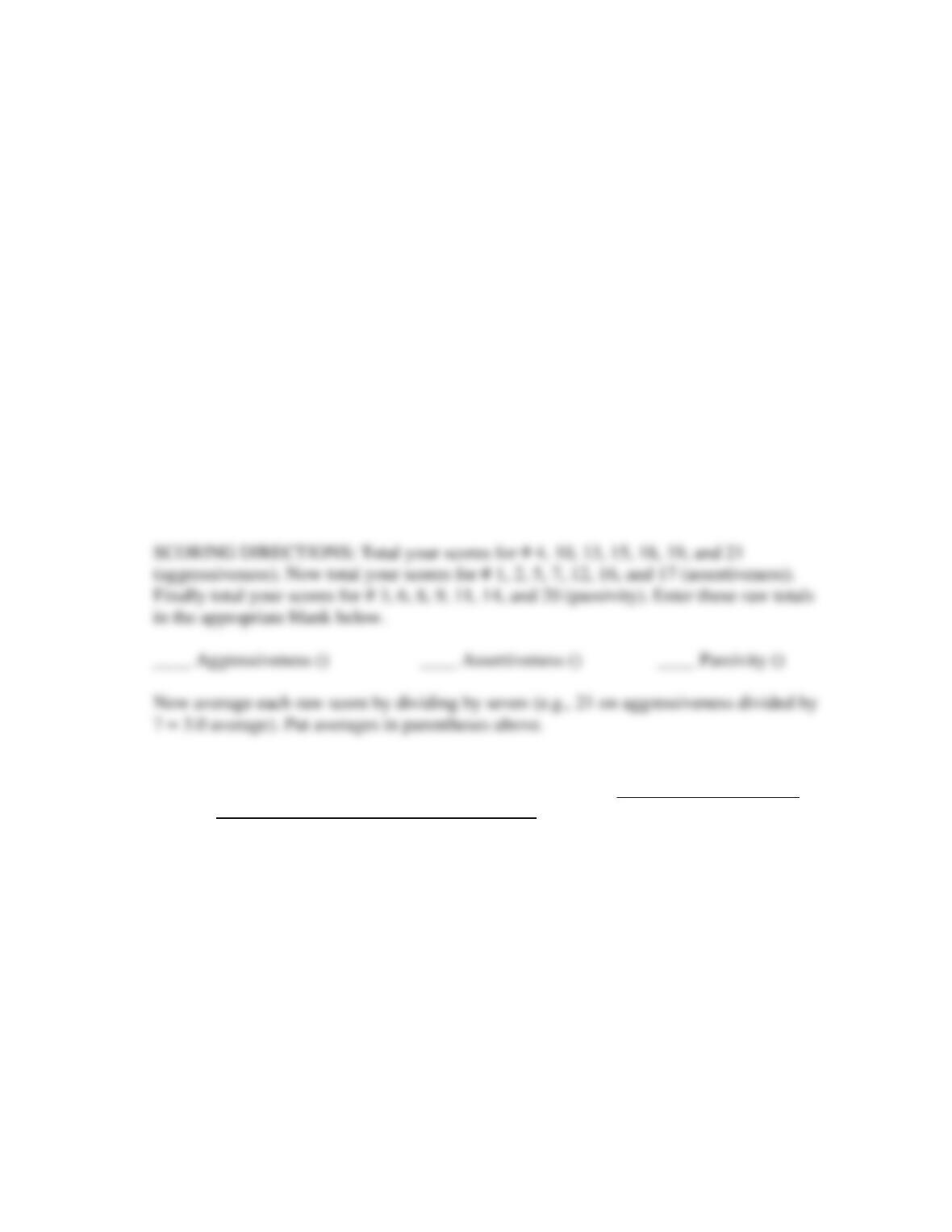
NOTE:
Generally speaking, you want to score an average of between 4.0 :5.0 on assertiveness, and
average 2.0 or less on aggressiveness and passivity. This reflects the general desirability of
assertiveness and the general undesirability of aggressiveness and passivity. A low score on a
specific assertiveness scenario or a high score on a specific aggressiveness or passivity scenario
may also mean a need for improvement in these particular situations. Please note, however, that
the appropriateness of assertiveness, aggressiveness, and passivity is situational. Assertiveness,
although generally a desirable skill, is not always appropriate, especially if harm may come to you
by being assertive. Conversely, aggressiveness, although generally an undesirable communication
pattern, is not always inappropriate. Likewise, occasionally the appropriate choice is passivity.
FORMS OF POWER
TYPES DEFINITION DESCRIPTION
DOMINANCE POWER OVER ACTIVE
COMPETENT COMMUNICATOR’S
POWER RESOURCE GUIDE
POWER RESOURCE COMMUNICATION
GUIDELINE
INFORMATION
PROVIDE GROUP SCARCE BUTUSEFUL INFORMATION
BE CERTAIN INFORMATION IS ACCURATE
EXPERTISE
MAINTAIN KNOWLEDGE CURRENCY
DEMONSTRATE TRUSTWORTHINESS
AND CREDIBILITY
INDICATORS OF POWER
GENERAL INDICATORS
WHO DEFINES WHOM
WHOSE DECISIONS ARE FOLLOWED
VERBAL INDICATORS
POWERLESS/POWERFUL SPEECH PATTERNS
NONVERBAL INDICATORS
SPACE
POSTURE AND GESTURAL COMMUNICATION
TOUCH
RESISTANCE STRATEGIES
STRATEGIC STUPIDITY
SMART PEOPLE ACTING DUMB ON PURPOSE
LOSS OF MOTOR FUNCTION
SUDDEN ATTACK OF THE CLUMSIES
MISUNDERSTANDING MIRAGE
ILLUSORY MISTAKES
DEFIANCE IN GROUPS
FACTORS AFFECTING GROUP REACTION
SIGNIFICANCE OF NORM TO GROUP
EXTINGUISHING DEFIANCE
REASON: CONVINCING WITH LOGIC
INFLUENCE STRATEGIES OF DEFIANT
MEMBERS
GROUP CANNOT OSTRACIZE: DEVIANT REMAINS CONSISTENT
THROUGHOUT DISCUSSION
GROUP CAN EXCLUDE: REMAIN CONSISTENT UNTIL GROUP IS ABOUT
FED UP, THEN INDICATE WILLINGNESS TO COMPROMISE