CHAPTER THREE
Group Development
I. Lecture/discussion on periodic phases of group development
A. Forming: reasons why groups form
B. Storming: tension and conflict in groups
C. Norming: standards of appropriate behavior are established
D. Performing: task accomplishment
II. Excerpts from “Candid Camera” showing conformity to norms. Order the Candid
Camera excerpts from McGraw-Hill at 1-800-338-3987 for about $40. Ask for the
III. Excerpts of norm violations from popular movies
A. Excerpts from popular movies such as Liar, Liar (almost any scene showing Jim
Carrey telling the unvarnished truth); Never Been Kissed (take your pick of
scenes where the Drew Barrymore character dresses “abnormally,” acts
strangely, and makes numerous mistakes); Groundhog Day (numerous scenes
where the Bill Murray character violates norms once he figures out that there are
B. Discuss the movie excerpts in terms of implicit and explicit norms and how
groups handle norm violations. You may decide to discuss strategies for dealing
IV. “Building Blocks: Group Polarization and Pressure” exercise
NOTE: See ancillary videotape, Working Together, for a depiction of this exercise.
A. Purposes
1. To illustrate that the process of competing, not necessarily what we compete
for (prizes, money, etc.), produces frequently negative effects.
2. To demonstrate the group polarization effect.
3. To demonstrate pressure on individuals to conform to the wishes of the group
even when honesty (ethics) is an issue.
4. To make the point that in-group versus out-group competition can produce
in-group cohesiveness: team building.
B. Time required: 50 minutes to run the exercise. Another 15-20 minutes to process
it.
C. Instructions:
1. Have the class form into four term groups (5-7 in each group)
2. Pour blocks onto a sturdy table in front of class. There should be about 50-60
blocks. Simple blocks made from scraps of wood work quite nicely,
especially when the blocks do not form perfect geometric shapes.
3. Explain the following to the class:
a. Goal of the exercise: to accumulate the highest number of team points.
b. There will be three (3) rounds. DO NOT ALLOW ANYONE TO
DISCUSS THIS EXERCISE WITH OTHER GROUP MEMBERS
UNTIL GROUPS ARE INSTRUCTED TO DO SO. SILENCE MUST
BE MAINTAINED UNTIL GROUPS ARE PERMITTED TO DISCUSS.
Points for Round #1 will be acquired by:
1). A group estimating how many blocks can be stacked in double
columns side-by-side and meeting or exceeding that estimate. For
instance, if the group estimates 20 blocks, then members of the
group must stack 20 blocks in two columns(10 per column) in order
to gain any points for that round.
2). Three members of the group must stack in proper sequence (first,
then second, then third, then first member etc.).
3). Each group will have 45 seconds to meet its estimate.
4). Zero points for this round if the estimate is not met within the time
limit.
5). Zero points if the stack (or any part, even a single block) falls over
for any reason (bumping table or whatever).
6). Team members stacking blocks may not hold onto the stacked
blocks and once the hand has left the block the block must remain
where it is even if precariously placed.
7). If the group successfully meets its estimate, the group gets the total
number of blocks stacked plus ten (10) times the original estimate.
Example: 20 blocks stacked plus 10 times the estimate (20) equals
220 points for round one.
c. Once the above rules and scoring system have been explained, instruct
each person to write down the total number of blocks he or she thinks
the group should estimate for Round One. Each individual should also
write down on the slip of paper the group identification (designate
d. Give groups 3-5 minutes to discuss the estimate for Round One, then
have them write down the group estimate on a slip of paper with the
group identification (A,B,C,D). Write the estimates on the board
according to groups. Then begin the block stacking with group A.
e. Keep a running point total on the board for all three rounds.
f. Rounds Two and Three will have additional rules:
1). Multiply the group estimate by 20 for Round Two and by 30for
Round Three. For example: if the estimate is 20 and the group
stacks successfully, then total points for Round Two will be
figured by adding the 20 plus 20 times the estimate(20) which
equals 420.
2). The Group with the highest estimate receives 100 Bonus points
for Round Two; 300 points for Round Three. If there is a
tie, split the points between groups unless one group chooses to
increase its estimate higher than other groups. If a group fails to
meet its estimate or its stack falls over: No Bonus!
3). An “ALIEN” will be sent from another group to each of the four
groups (designate who goes where). Each group will interview its
alien (member of another competing group)for 1 minute, then
decide whether to keep the alien or send him/her back to their
VARIATIONS AND SIMPLIFICATIONS:
V. Add a bonus period to Rounds Two and Three. Once the group has successfully met
its estimate, allow an additional 15 seconds to stack as many blocks as the group
members can. Each additional block will be worth 30 points apiece (if the group
estimate is at least 20; no bonus for stacking additional blocks above the estimate if
estimate is below 20). If the stack falls over, however, zero points are awarded for
that round.
VI. Delete the secret estimates before group members engage in discussion of Round
One group estimate. The same point on group polarization can still be made without
this fairly complicated step by noting which groups made a low estimate (caution)
and which made a high estimate (risk) and discussing with the class why each group
made the opening Round One estimate that it did.
D. Processing the exercise
1. Group polarization effect.
a. The norm for the group (social comparison theory) can be determined
by computing the mean score for original estimates of group members
PRIOR TO DISCUSSION. For example (from actual class), if the
individual estimates were 23, 20, 20, 25, and 30, the average is
23.6.Since three estimates are below this average and only two are
b. Persuasive argumentation (informational influence) can also explain
some of the results of this exercise. Group members are exposed to
arguments and information not available to them prior to discussing the
task with group members.
2. Group pressure: this exercise creates tension between an “alien’s” desire to
promote his/her group in the competition and personal standards of fair play.
Sabotage is always an issue during Rounds Two and Three. Sometimes aliens
3. Team building: this exercise is an excellent initial activity for term groups to
create an instant sense of groupness and an esprit de corp. Although stacking
blocks seems childish on the surface, the intensity displayed by participants
(shaky hands, shouting, exuberance) clearly reveals that much more is going
on than mere block stacking.
4. Effects of competition: creates intragroup cohesiveness but intergroup conflict
and hostility. These effects occur almost instantly. This exercise powerfully
demonstrates the effects of competition. It makes the point that what groups
compete over is far less important than the mere fact that they see themselves
as adversaries. Competing for meaningless points for stacking blocks when
no rewards are given to the winning group does not dampen the enthusiasm
5. Ethics: an interesting discussion of communication ethics can follow this
exercise. Aliens will lie to groups (“No, I won’t knock over the blocks”), then
sabotage. Why? As competition increases, the pressure to cheat and be
V. Symposium preparation – have term groups meet and prepare their first symposium
presentation. A fifty minute class period is usually about right.
VI. Cooperative exam #1: consult the sample syllabus for directions.
COMPETENT
COMMUNICATION AND
GROUP DEVELOPMENT
FORMING PERIODIC PHASE
EXPRESS POSITIVE ATTITUDES AND FEELINGS
APPEAR FRIENDLY, OPEN, AND INTERESTED
STORMING PERIODIC PHASE
TOLERATE, EVEN ENCOURAGE, DISAGREEMENT
KEEP A CIVIL TONGUE
BE AN ACTIVE LISTENER
NORMING PERIODIC PHASE
ADAPT COMMUNICATION TO THE NORMS OF THE GROUP
ENCOURAGE CHANGE WHEN NORMS ARE EXCESSIVELY
RIGID
ENCOURAGE CHANGE WHEN NORMS ARE TOO ELASTIC
PERFORMING PERIODIC PHASE
FOCUS ON THE TASK
ENCOURAGE PARTICIPATION FROM GROUP MEMBERS
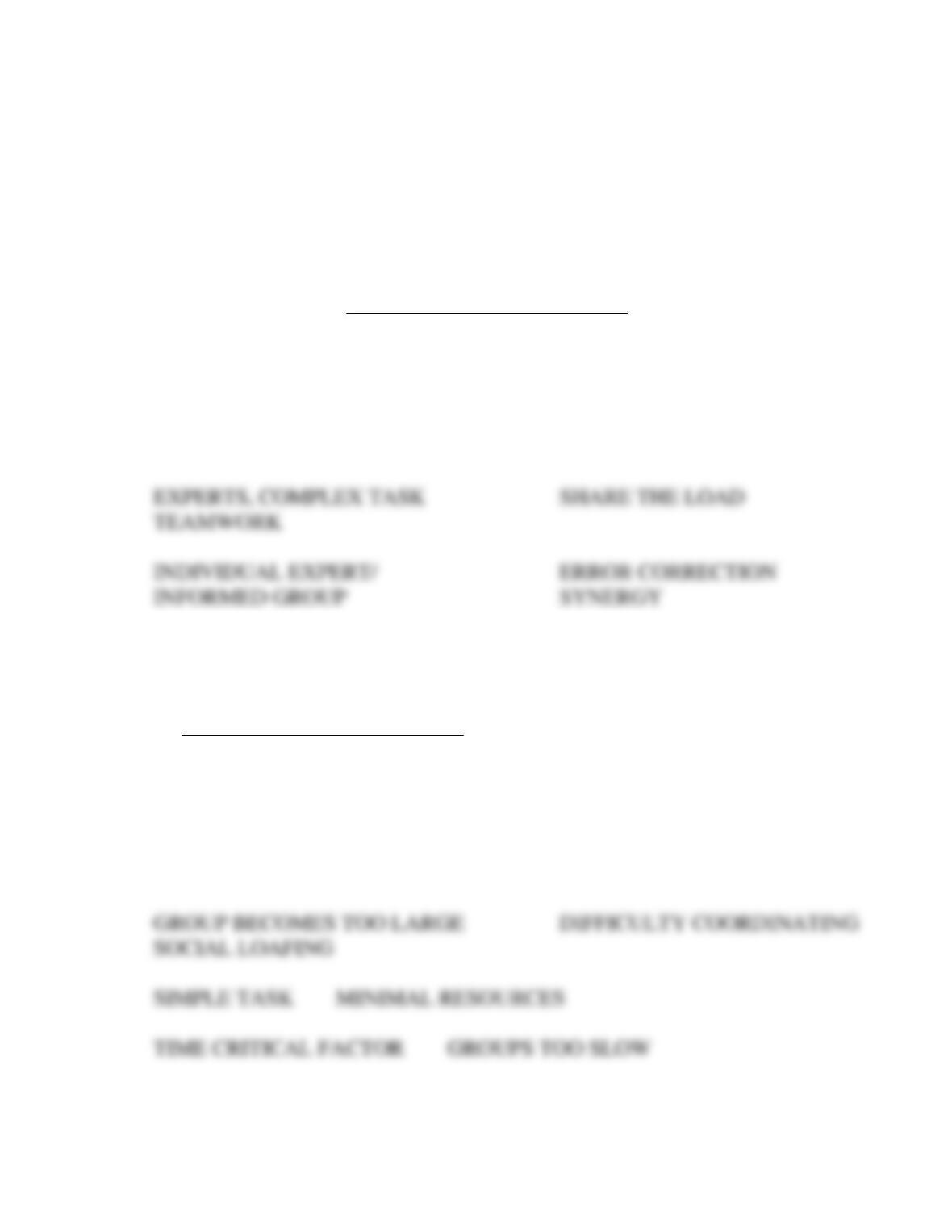
INDIVIDUAL VS GROUP
PERFORMANCE
GROUP SUPERIOR TO INDIVIDUAL
CONDITIONSREASON(S)
BROAD RANGE TASK POOL KNOWLEDGE,GROUP
REMEMBERING
NEITHER HAVE EXPERTISE SYNERGY
INDIVIDUAL SUPERIOR TO GROUP
CONDITIONSREASON(S)
INDIVIDUAL EXPERT/ POOLING INFO
UNINFORMED GROUP NEGATIVE SYNERGY
MEDIOCRITY GROUP NORM INSUFFICIENT MOTIVATION