CHAPTER TEN
Conflict Management in Groups
I. Second symposium presentation.
II. Lecture/discussion on conflict styles and negotiating strategies.
A. Destructive versus constructive conflict
B. Conflict styles
1. Collaborating
2. Accommodating
3. Compromising
4. Avoiding
5. Competing
C. Negotiating strategies
1. Tit-for-tat
2. Reformed sinner
3. Positional bargaining
4. Principled negotiating
III. “Conflict Case Studies” exercise
A. Purposes:
1. Require students to apply theoretical material on conflict styles.
2. Require students to apply theoretical material on negotiating strategies.
B. Time required: About 40-50 minutes.
C. Instructions:
1. Divide class into groups of 5-7 members.
2. Distribute the two case studies (see following pages).
3. Have groups indicate how best to handle these conflicts, applying the text
material on conflict styles and negotiating strategies.

CASE STUDY #1
The scene is Piedmont College in Lost Horizon, Connecticut. Piedmont College sports
an admirable academic reputation nationally. It has a student body of 10,000
(exclusively commuters). Its student newspaper, The Scorch, has excellent facilities for
on-campus printing.
A group interested in publishing a campus literary magazine, The Crucible, has received
$200 each from 3 departments on campus (English, Speech, and Journalism) to begin
work on the magazine. The purpose of the magazine is to promote student creativity and
act as a vehicle for student literary expression.
The Problem
It is too costly to publish The Crucible off-campus and The Crucible has a very tight
budget. Since The Scorch has excellent printing facilities, the staff at The Scorch offered
the use of its facilities for preparing and printing The Crucible (for a nominal fee of $200
per issue). The point of conflict arises each week on Tuesday and Wednesday prior to
In addition, one of the machines used in preparing photographs for publication has been
broken due to carelessness. No one will own up to having broken the machine. The
Scorch had to foot the repair bill ($525.00) since the machine was originally purchased
to publish The Scorch, and must be used for this purpose each week.
You’re the arbitrator of this conflict. What would you suggest?

The Analysis
A. Both groups should confront the problem directly. Working together rather than
pointing fingers is appropriate.
B. An integrative solution is possible.
1.. Suggest that The Scorch have exclusive use of the facilities Monday through
Wednesday (right before publication when the facilities are needed most). Have
The Crucible use the facilities Thursday and Friday (mostly “down time” for The
Scorch staff).
2. Ask the college administration to hire a work study student to operate the
machine (trained, of course, and paid for by government money). Then if
anything happens to the machine, neither group will blame the other. Chances of

CASE STUDY #TWO
The Problem
A primary school teacher (3rd grade) has had some discipline problems in the classroom.
Several students have been chronically disruptive. The teacher has disciplined them in
various ways (e.g., verbal reprimand, extra homework, detention after school) with little
success. The students’ clownish antics threaten to turn the classroom into a zoo.
As a “last resort” the teacher sends the disruptive students to the principal whose policy
is that a little corporal punishment (spanking) will solve most problems of disruption
(“Spare the rod, spoil the child”). The teacher is uncomfortable with this policy,
abhorring violence, but desperate people do desperate things. The spankings temporarily
reduce the disruption but it is beginning to increase once again. To make matters worse,
The teacher is beginning to lose motivation to continue teaching. The classroom has
become a battlefield and large amounts of time are spent disciplining students. Little
All right, you brilliant conflict managers, help this poor beleaguered teacher. What
should the teacher do?

The Analysis
A. The only communication style used by the teacher has been competing/forcing.
As is typical of such a strategy, competition breeds conflict and exacerbates the
disruption. The teacher has turned discipline problems into a contest of wills.
B. Confrontation needs to take place between the teacher and the disruptive
students’ parents. The parents, if made to see that their children are preventing
learning from taking place in the classroom by their disruptive antics, may lend
assistance to the teacher. If not, nothing is lost. Confrontation also needs to occur
between the teacher and the disruptive students. A clear and consistently applied
discipline plan should be instituted, one that the students help formulate. Experts
C. There needs to be greater emphasis on positive reinforcement of admirable
behavior than has taken place. In addition, the class should be made more
interesting. In terms of principled negotiation strategies, the interest of the
teacher is to make order out of what has become chaos. The interest of the
IV. “Conflict Resolution Questionnaire”: A self-assessment
A. Purpose: To give students an opportunity to analyze their own conflict
management approaches and skills and to receive feedback from group members.
(This exercise works best when conflict styles and principled negotiation have
already been discussed in class.)
B. Time required: approximately 30 minutes (if questionnaire is filled out in
advance)
C. Instructions
3. Be sure all students have scored the questionnaire accurately before
proceeding. Scoring instructions are included on the Web site.
4. Have groups form. Give groups about 15 minutes to discuss the results of the
D. Processing
1. Discuss with class how useful they think the questionnaire was. Did it
provide useful information for assessing their own knowledge and skill on
conflict management?
2. Discuss with the class what likely happens when group members have
different levels of knowledge and skill for managing conflict. How should
groups deal with such diversity?
V. Excerpt from the movie, Ordinary People
A. Show clip about mid-film where Conrad (Timothy Hutton) and his dad (Donald
Sutherland) bring a Christmas tree home. Conrad’s mom (Mary Tyler Moore)
enters the living room while Conrad and his dad trim the tree. End the segment
when Conrad’s dad leaves Conrad’s room after a terrible fight has ensued. Give
B. This is a powerful, disturbing excerpt that illustrates well several communication
styles of conflict management and their likely results. Most students have never
seen this movie so it will be a fresh experience.
1. Conrad’s mom confronts Conrad about quitting the swim team, but she
2. At first, Conrad plays dumb, trying to avoid an ugly conflict with his mother.
It doesn’t work. Conrad’s dad, ever the peacemaker, tries to smooth things,
but ends up looking like an ineffectual referee separating mother and son
3. Conrad retreats to his bedroom. Conrad’s dad asks his wife to join him to talk
to their son about what had just transpired. She refuses, attacking him as
over-protective. Conrad’s dad explodes at his wife, then tries to smooth
things (“Let’s not fight.”). Too late. Power-forcing styles have corroded the
atmosphere making smoothing ineffectual. Conrad’s dad sits down with
Conrad, who is lying on his bed with his face covered. Conrad’s dad
confronts his son in an empathic, collaborating way. Conrad finally opens up
VI. Excerpt from the movie, Saving Private Ryan
A. Following a discussion of anger management, show a 5-minute clip from the
movie Saving Private Ryan. The clip is approximately 70minutes into the film.
Captain Miller (Tom Hanks) has just released a German hostage. His unit is
deeply divided about this action. One of his platoon members (Edward Burns)
decides to desert. A sergeant (Tom Sizemore) pulls out a weapon and threatens to
B. This scene depicts an extremely intense situation that is masterfully diffused by
Captain Miller. As men under his command erupt into rage, he remains
completely calm (asymmetrical). He diverts attention from the increasingly
VII. Excerpt from movie, The Negotiator.
A. Choose any scene in movie where either Samuel L. Jackson (beginning of movie)
or Kevin Spacey (later in movie) act as negotiators trying to defuse a hostage
situation.
B. Each negotiator works hard at being asymmetrical, trying to divert attention,
validating, probing, and problem solving. Shows that we can train ourselves to
respond to the anger of others without also “losing it.”
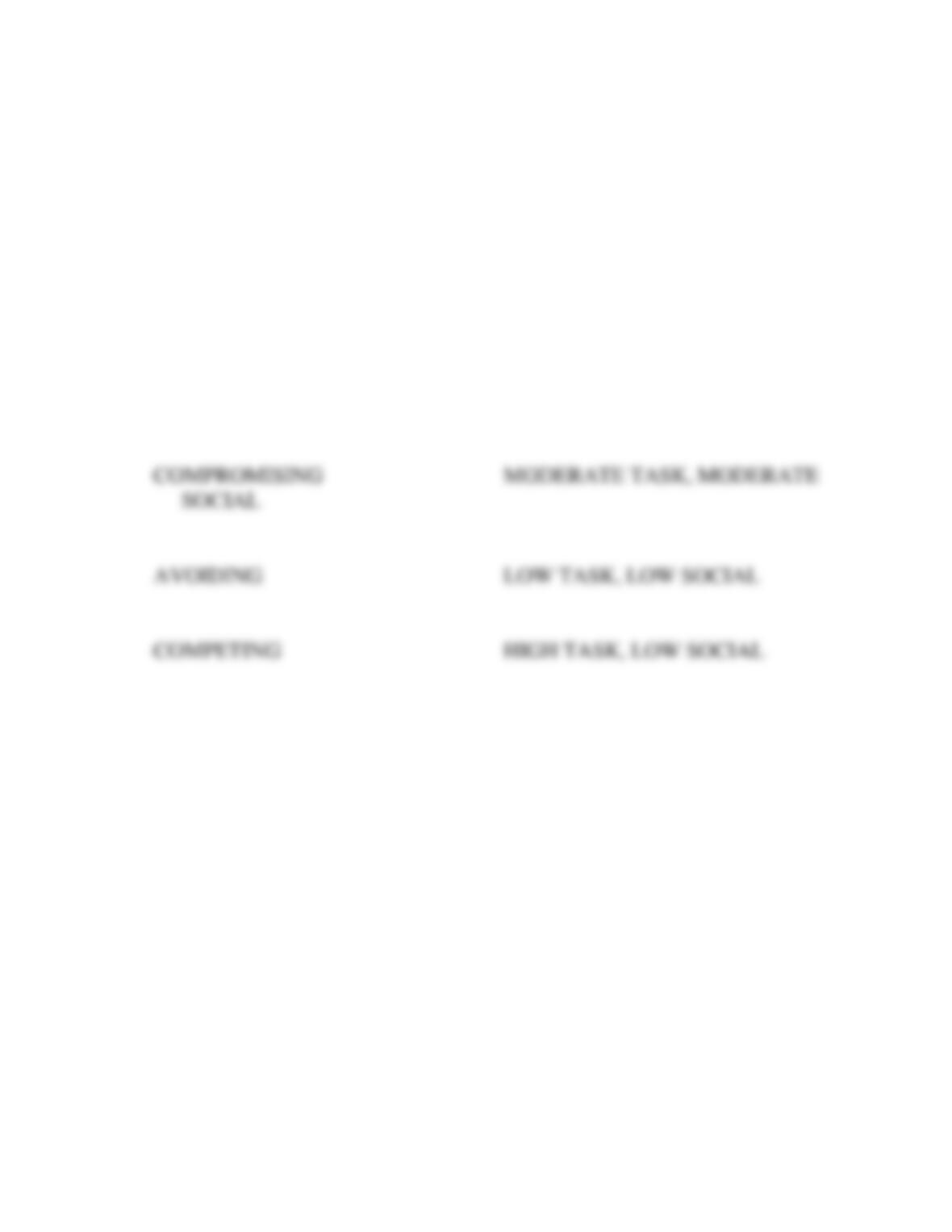
COMMUNICATION STYLES
OF CONFLICT MANAGEMENT
STYLETASK-SOCIAL DIMENSION
COLLABORATING HIGH TASK, HIGH SOCIAL
ACCOMMODATING LOW TASK, HIGH SOCIAL
NOTE: There are exceptions to the above. One may accommodate to move
the task forward, or avoid to prevent social disharmony. The above
characterizations are tendencies not absolutes.
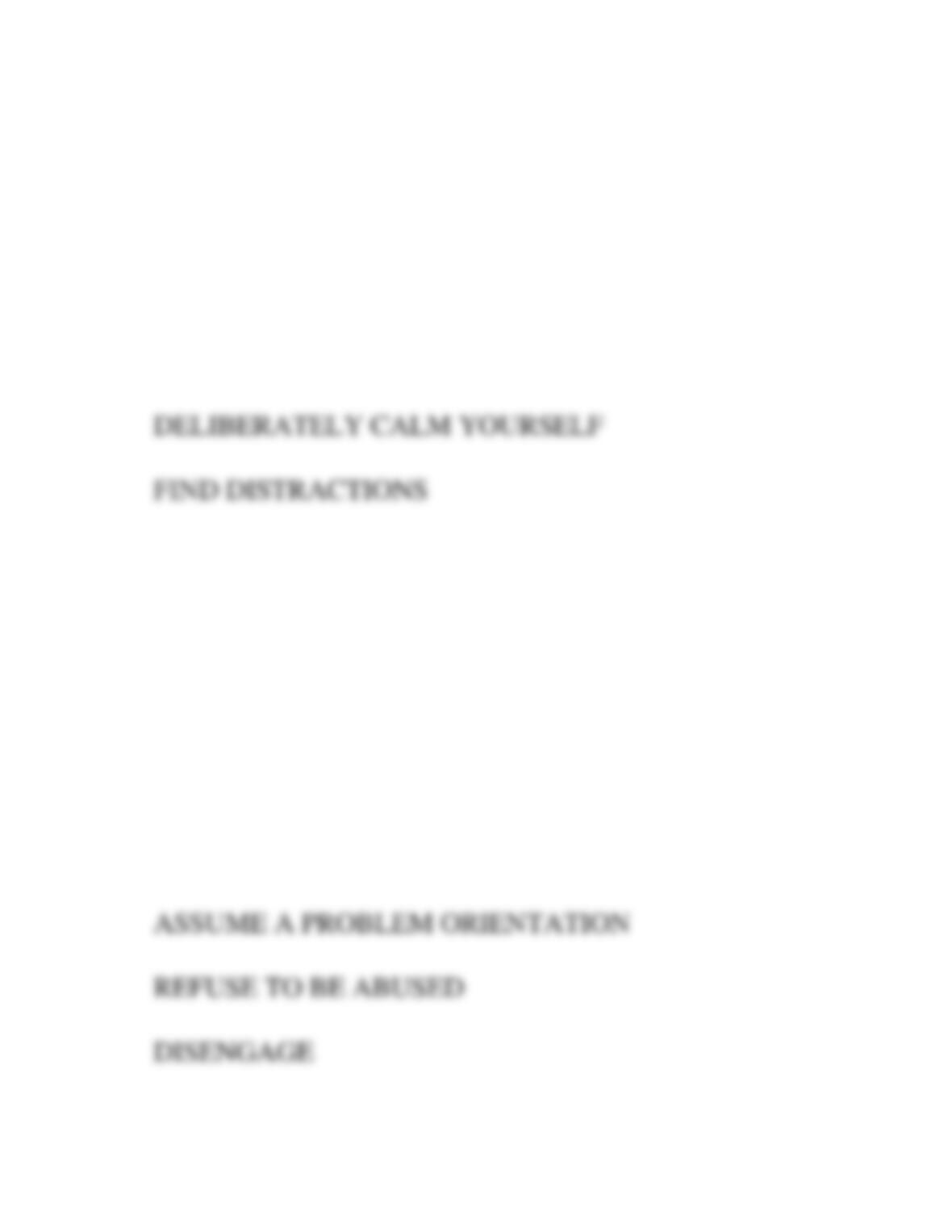
ANGER MANAGEMENT
MANAGING YOUR OWN ANGER
REFRAME SELF-TALK
LISTEN NONDEFENSIVELY
MANAGING THE ANGER OF OTHERS
BE ASYMMETRICAL
VALIDATE THE OTHER PERSON
PROBE
DISTRACT

Full-length Movies for Analysis
I. Stand By Me: An excellent movie for analyzing a group as a system, faced with
unexpected changes, outside input that is disruptive, competitive communication
(defensive versus supportive), informal roles, emergent leadership, leadership styles,
decision-making and problem solving, power resources, power imbalances, defiance,
and conflict management.
II. Lord of the Flies (1963 or 1990 version). This is a film based on William Golding’s
famous novel about a group of boys stranded on an island after their boat capsizes
and sinks. Wonderful illustration of autocratic versus democratic leadership styles,
competition versus cooperation, conformity, defiance, roles, norms, power
imbalances, power resources, power transactions, and conflict.
III. The Commitments. This film shows the development and dissolution of a Dublin,
IV. A League of Their Own. Wonderfully entertaining film on development of a
women’s professional baseball league during World War II. Excellent for analysis of
V. Gung Ho. Enjoyable look at the clash of cultures when working in groups. Excellent
for analysis of individualism-collectivism, power-distance, and high-context versus
low-context communication patterns.
VI. Twelve Angry Men (1957 or 1997 version). Classic film on group conflict and power.
See earlier discussion of this movie.
VII. The Dream Team. Extremely entertaining movie. Excellent for analysis of team
VIII. The Breakfast Club. Best used for analyzing how to cope with a difficult group
member and manage conflict. Shows dramatically how a single individual can
have a ripple effect on an entire group. See also earlier references to this film.

GRADING FORMS
GROUP SYMPOSIUM
Group Critique (40 points)
A. Organization (15 points)
B. Information/Content/Research (15 points)
C. Attention/Interest (5 points)
D. Performance/Style/Delivery (5 points)
Group Total:____________
Individual Critique (60 points)Name: ________________
A. Organization (15 points)
B. Information/Content/Research (15 points)
C. Attention/Interest (15 points)
D. Performance/Style/Delivery (15 points)
Individual Total:______________
Grand Total:________________

GROUP SYMPOSIUM
Group Critique
TOPIC:_______________
I. Organization (10 points) ___________
A. Clear division of labor
B. Balanced division of time between members
C. Clear, concise, precise presentation of information
D. Comments:
II. Content (10 points) __________
A. Evidence of research
B. Documentation cited to support claims where necessary
C. Information provided that is relevant to main focus
D. Comments:
III. Attention/Interest (10 points) _________
A. Visual Aids used
B. Effort made to keep interest
C. Comments:
IV. Performance/Delivery/Style (10 points)________
A. Eye contact
B. Body movement
C. Poise/energy/enthusiasm
D. Comments:
Group Total Score: _________
GROUP SYMPOSIUM
Individual Critique
Name: _________________Topic: ____________________
I. Organization (15 points) __________
A. Clear purpose statement
B. Main points previewed
C. Signposting
D. Kept within time limit
E. Comments:
II. Content (15 points) _________
A. Documentation used where necessary to support claims
B. Evidence of research
C. Logical and complete presentation of information
D. Comments:
III. Attention/Interest (15 points) _________
A. Attention step used in introduction
B. Use of visual aids where appropriate
C. Effort made to maintain interest of audience
D. Comments:
IV. Performance/Delivery/Style (15 points) _________
A. Used extemporaneous style of speaking
B. Eye contact direct and plentiful
C. Body movement
D. Poise
E. Comments:
Total Individual Score: _________
Combined Group and Individual Score: _________