CHAPTER ONE
Communication Competence
I. Overview of class
A. Identify goals of class
B. Explain syllabus/ attendance policy/grading procedure
II. “Similarities/Differences” exercise
A. Purpose:
1. Ice-breaker.
2. To get students acquainted with several other classmates (helps them make
informed choice when they form term groups).
B. Time required: about 45 minutes
C. Instructions:
1. Have students form pairs (dyads). If there is an odd number of students, the
instructor may form a pair with a student or there can be one threesome
(triad).
2. Students in each pair will write down whether they think they are similar to
or different from their partners in the following areas:
e. Geographic home (Midwest, Southwest, East, etc.)
3. NOTE: Students do not talk to each other until they have finished the above.
4. Have students discuss their guesses with their partner and find out how
accurate they were.
III. Lecture/discussion: “Transactional Communication and the Communication
Competence Model”
A. Review and discuss the main points covered in text on transactional
communication.
B. Briefly review and discuss the communication competence model detailed in
text.
IV. The Joy Luck Club movie excerpt.
A. Show excerpt about a third of the way into the movie. The clip begins with
Waverly, a young Asian woman bringing her boyfriend, Rich, to her parents’
house for dinner. End the clip about 4 minutes later with Waverly and Rich in
their car driving home.
B. This clip shows intercultural miscommunication resulting from the
individualism-collectivism dimension. Rich is direct in his communication,
sometimes too direct for a collectivist Asian family. His individualism shows
starkly. Rich looks “selfish” and Me-oriented (individualistic) when he pours
himself a second glass of wine before anyone else has done more than take a first
V. Excerpt from movie, Mystic Pizza
A. Show the segment where Julia Roberts’ character, Daisy, has dinner with her
boyfriend, Charley’s rich family and her boyfriend destroys the evening. End the
segment with the scene where Daisy says she wants to go home.
B. Discuss this excerpt with the class in terms of transactional communication and
especially the communication competence model:
1. We-not-Me orientation: the boyfriend disrupts dinner to make an
inappropriate point.
2. Sensitivity: the boyfriend shows no sensitivity to his date who feels awkward
from the outset, nor to the dinner guests who are visibly embarrassed by the
verbal boxing match between father and son. The server, Teresa, also exhibits
insensitivity to her friend, Daisy (Julia Roberts).
3. Appropriateness: Teresa shows inappropriateness when she begins
VI. Excerpt of movie Home for the Holidays
A. Begin the clip about 30 minutes into the movie, a Thanksgiving dinner disaster.
Aunt Glad (Geraldine Chaplin) is singing. Soon she says, “You’re the best thing
on two legs, Henry Lawson.” End the clip when the Holly Hunter character
follows her mother out of the room.
B. Almost every standard of competent communication is violated during the
dinner. Family members exhibit a pronounced Me-orientation, spilling family
VII. Hindsight Bias Test
A. Make a transparency of the Hindsight Bias Test (see below). Display the test
questions on a screen for all students to see easily. Instruct students to write
their answers for each question on a sheet of paper appropriately
numbered. NOTE: there are four possible answers and one, two, three, or
all four may be correct. Correct the exam in class when all students have
B. Make a transparency of the scoring system (included after the test). Explain to
students how to score their test: Each multiple-choice question is worth 4
points total (one point for each answer) and each true/false question is worth 2
points. Tell students to deduct one point for every wrong answer on a
multiple-choice question (one point deduction for each answer chosen that
shouldn’t have been and one point deduction for each answer that wasn’t
chosen but should have been—errors of omission and commission). Deduct 2
Total possible points: 40

HINDSIGHT TEST
Multiple Choice (More than one answer could be correct)
1. In general, competition
a. increases motivation to perform at peak levels for most group members
b. is embraced by all cultures as a natural aspect of our biological makeup as
human beings
c. encourages cheating and dishonesty
d. increases the self-esteem of most group members
2. Increasing the size of a group
a. is almost always constructive because it increases the group’s resources
b. usually increases the pressure to conform to group norms and opinions
c. usually makes decision-making more complex and difficult
d. often produces an increasing number of nonparticipating group members
3. Leaders in groups must _________ to be effective.
a. be highly intelligent
b. be highly competitive
c. use the democratic leadership style (members participate in decision-making)
d. be flexible in their communication with group members
4. Which of the following will likely reduce friction and conflict between two groups
that dislike each other?
a. Providing opportunities for the two groups to come in contact with each
other, such as eating together or living in the same dorm
b. Providing opportunities for groups to engage in “friendly” team competition
with each other
c. Providing opportunities for the two groups to work on a desirable common
project that requires effort from both groups for success
d. Persistently encouraging group members to just get along and stop warring
with each other.
5. Which of the following are effective strategies for dealing with difficult group
members (disruptive troublemakers)?
a. Provide opportunities for the difficult group member to air his/her
disagreement, allowing whatever amount of time is necessary
b. Permit the difficult member to interrupt the group proceedings so he/she can
“blow off some steam.”
c. Encourage a competitive group climate where everyone is free to argue,
disagree, and attempt to “win” points with the group.
d. Confront the difficult group member directly; if the entire group is affected
then the group as a whole should confront the troublemaker.

TRUE-FALSE
1. Groups should never close off communication because remaining open to others is a
key principal of competent communication.
2. Compromising should be the ultimate and most desired goal when we try to resolve
conflicts in groups.
3. Venting your anger, not holding it in, is a constructive and productive way to manage
your anger because it allows you to “blow off steam” before it builds to an explosive
point.
4. Reward systems that stress individual achievement, such as merit pay plans where the
highest performing group members receive bonuses or pay increases, work well to
boost motivation and performance of most group members.
5. Competition builds character and teaches most group members “how to lose” and
accept defeat gracefully.
6. If you are highly intelligent, have excellent speaking skills, and are physically
attractive, you are highly likely to be an effective group leader.
7. The more information a group can find on an issue or problem being deliberated, the
greater the likelihood that the group will make an effective, high-quality decision.
8. The greater the harmony within a group and the greater the cohesiveness (desire of
members to remain in the group), the better will be the decisions made by the group.
9. Achieving a consensus (unanimity) is always possible in groups if members try hard
enough and are skillful in their communication.
10. Some group members can be completely powerless.

Answers for Hindsight Bias Test
Multiple Choice
True-False
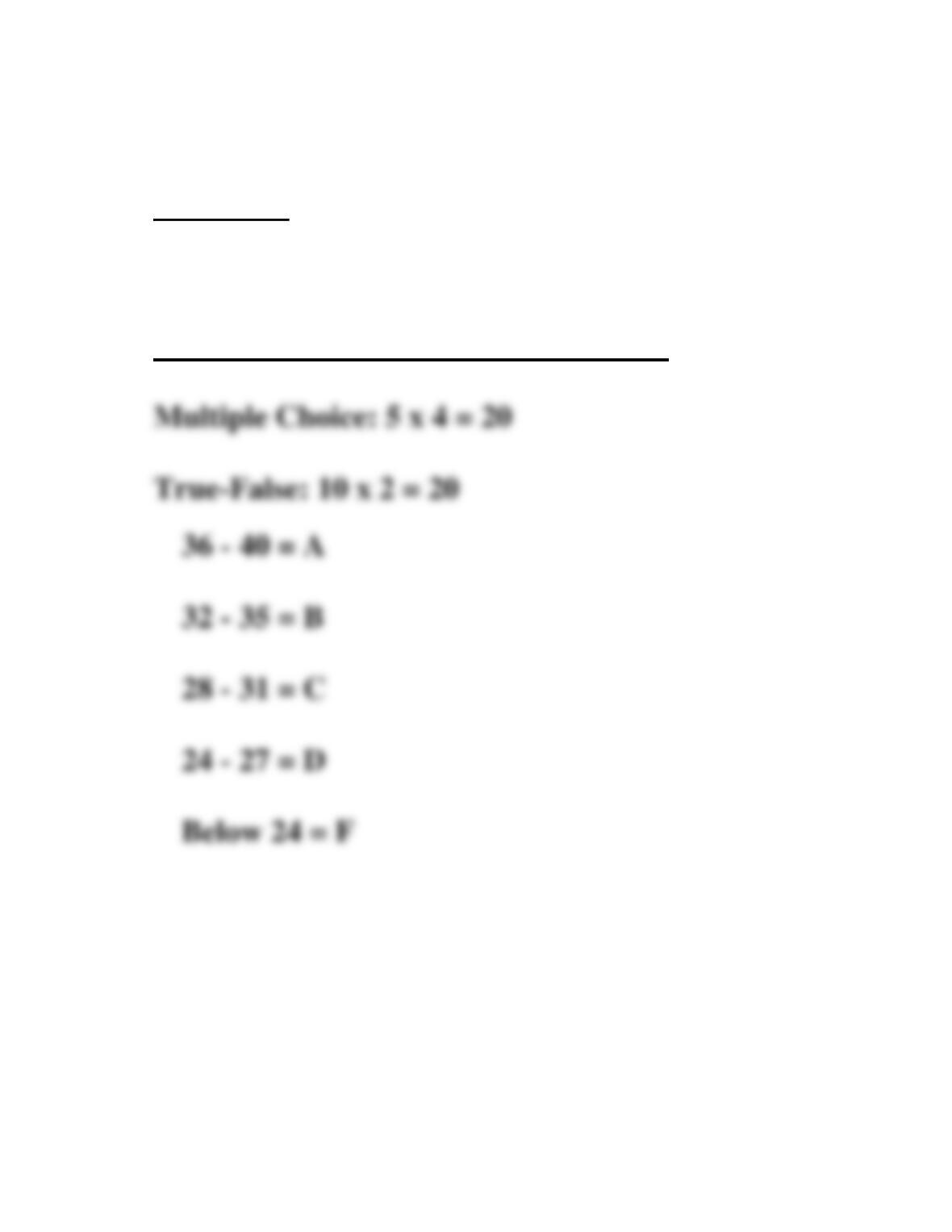
SCORING:
Each answer on a Multiple-Choice question is worth 1 point (4
points for each question). Each answer on a True/False question
is worth 2 points.
15 QUESTIONS: Maximum 40 points:
VIII. Excerpt from movie, Sleepless in Seattle
A. Show brief 5-minute clip from the movie Sleepless in Seattle. Clip begins about
two-thirds of the way into the movie when Sam (Tom Hanks) is having dinner
with his sister (Rita Wilson) and his brother-in-law. Begin the scene when his
B. This scene makes the point that men and women do not communicate in exactly
the same ways, nor appreciate the same things. The comparison of the movie An
IX. “Gender Differences” exercise
A. Purposes
1. To illustrate gender differences in communication.
1. To elicit personal reactions from students that are relevant to Tannen’s
perspective on male/female communication patterns.
B. Time required: approximately 30 minutes
C. Instructions:
1. Break class into groups according to their sex (no mixed-sex groups).
Depending on the mix of your class, there may be 2 or 3 groups of one sex
and only 1 or 2 groups of the other sex (keep groups no larger than about 7
members).
2. Have each group generate a list of responses for the following incomplete
statements about the sex opposite their own (men do only women and women
do only men):
a. “When women/men talk they…”
3. Allow about 10 minutes to generate the lists.
4. Have a representative from each group read his/her list to the class. Discuss
the results.
D. Processing the exercise:
1. Note differences in the responses from male groups and female
groups.
2. Discuss why there are differences.
X. “Is It Masculine or Is It Feminine?” exercise
A. Purposes:
1. To determine whether students recognize the common gender
differences in male/female communication patterns.
2. To discuss the gender differences in communication.
B. Time required: approximately 30-45 minutes
C. Instructions:
1. Pass out a copy of the questionnaire to every student in class.
2. Have each student complete the questionnaire without talking to anyone.
D. Processing the exercise

1. When the class has completed the questionnaire, take a poll (show of hands)
on each statement (“How many say mostly masculine?” How many say
QUESTIONNAIRE
For each statement below, indicate whether the behavior seems more typically
masculine (M) or feminine (F).
_____ 1. Interrupt conversations to gain conversational control.
_____ 2. Take up more space in sitting and standing regardless of physical size.
_____ 3. Talkative in mixed-sex conversations.
_____ 4. Tell jokes.
_____ 5. Engage in “troubles talk” (talk about personal problems).
_____ 6. Give “minimum response cues,” such as, “yeah” or “nope” without
elaboration when asked questions during conversation.
_____ 7. Engage in self-disclosure.
_____ 8. Give advice.
_____ 9. Use greater volume and stronger inflection to highlight ideas.
_____ 10. Switch or reroute the topic of conversation in mixed-sex groups.
_____ 11. Tell secrets.
_____ 12. Make statements, such as, “Oh, you must feel terrible.”
_____ 13. Make statements, such as, “I kind of feel you may be overreacting.”
_____ 14. Tell stories about themselves instead of about other people.
_____ 15. Tell stories about themselves that make them look foolish.
_____ 16. Ask for directions when lost.
_____ 17. Challenge the point of view of an expert in a public forum.
_____ 18. Use slang and verbal obscenity.
_____ 19. Listen intently.
_____ 20. Apologize; say “I’m sorry.”
ANSWERS: (see Tannen, D. You Just Don’t Understand, 1990; Wood, J. Gendered
Lives, 1997; Stewart, L. Communication and Gender, 1996.)
Taciturnity creates mystery (enigma), and thus control.
special person).
female because more definite, absolute assertions tend to close off
conversation (connection).
(equality :we all do foolish things).
conversely, establishes disconnection with expert.
deflating) in verbal skills games (contest); obscene language associated
with disconnection (offensive).
and concern.
status.
E. VARIATION: Divide class into small groups and have them answer the
questionnaire as groups, not individuals. Allow more time for exercise.
COMMUNICATION
COMPETENCE MODEL
DEFINITION ELEMENTS
MATTER OF DEGREE KNOWLEDGE

TANNEN’S
GENDER COMMUNICATION
MODEL
STATUS CONNECTION
INDEPENDENCE INTERDEPENDENCE