Chapter 4 HVAC Load Management
MULTIPLE CHOICE. Choose the one alternative that best completes the statement or answers the question.
1) The middle United States is which ASHRAE Std. 90.1 Climate Zone? 1) _______
A) Climate Zone 2. B) Climate Zone 4. C) Climate Zone 3.
SHORT ANSWER. Write the word or phrase that best completes each statement or answers the question.
2) This Chapter covers eleven load management strategies. Seven of them are concerned
with building envelope. Name them:
A. ________
B. ________
C. ________
D. ________
E. ________
F. ________
G. ________
2)
_____________
TRUE/FALSE. Write ‘T’ if the statement is true and ‘F’ if the statement is false.
3) Reducing load will reduce construction cost through smaller HVAC systems. However, there
will generally be an offsetting cost for features required to effect the load reduction.
3) _______
4) A proposed air conditioning system costs $3,000/ton. The capacity of a 1000-ton system is
reduced by 50 tons through load management. The cost savings in HVAC will be $150,000.
4) _______
MULTIPLE CHOICE. Choose the one alternative that best completes the statement or answers the question.
5) Which of the following are not procedures for energy estimating? Select all that apply. 5) _______
A) Equivalent full load hour.
B) Load distribution method.
C) Degree-day method.
D) Bin analysis.
E) Annual percentage reconciliation.
TRUE/FALSE. Write ‘T’ if the statement is true and ‘F’ if the statement is false.
6) If the average cost of electric is $0.10/kWh, and a cooling system uses 1.6 kW per ton of cooling,
the cost of one ton-hour will be $0.10 × 1.6, or $0.16 per ton-hour.
6) _______
MULTIPLE CHOICE. Choose the one alternative that best completes the statement or answers the question.
7)
A 100,000 ft2 office building might have 500 occupants. A 1% improvement in occupant
productivity would have approximately what economic value, assuming an average occupant
compensation of $75,000 per year?
7) _______
A) $375,000 per year. B) $175,000 per year.
C) $75,000 per year. D) $275,000 per year.
8) Which of the following are indoor environmental quality factors which could increase occupant
productivity? Select all that apply.
8) _______
A) Designer masking odorant.
B) High-quality lighting.
C) Daylight and views.
D) Thermal comfort.
E) All of the above.
9) Several small buildings with the same total area as one large building will have higher surface
area. Which of the following statements apply? Select all that apply.
9) _______
A) General construction costs will be higher for the multiple smaller buildings.
B) Long term economics will surely favor the larger building due to lower first cost and
utilities.
C) In general, HVAC loads will be higher for the smaller buildings than the large one.
D) More occupants will have access to daylight and views in the multiple buildings.
10) The ideal orientation for windows in commercial buildings is north. Which reasons support this
conclusion? Select all that apply.
10)
______
A) There is no glare due to direct solar radiation.
B) Statistically, most good views are in the north.
C) Solar heat gains are lower than other orientations.
D) North winds are milder in the winter.
11) Compare air conditioning loads for heavy thermal mass roofs and walls with air conditioning
loads for light thermal mass roofs and walls. Select all that apply.
11)
______
A) They are higher. B) They occur later in the day.
C) They occur earlier in the day. D) They are lower.
TRUE/FALSE. Write ‘T’ if the statement is true and ‘F’ if the statement is false.
12) Adding thermal mass to save energy is a good economic investment. 12)
______
13) Owners should be encouraged to use more insulation than the minimum prescribed by
ASHRAE Std. 90.1.
13)
______
MULTIPLE CHOICE. Choose the one alternative that best completes the statement or answers the question.
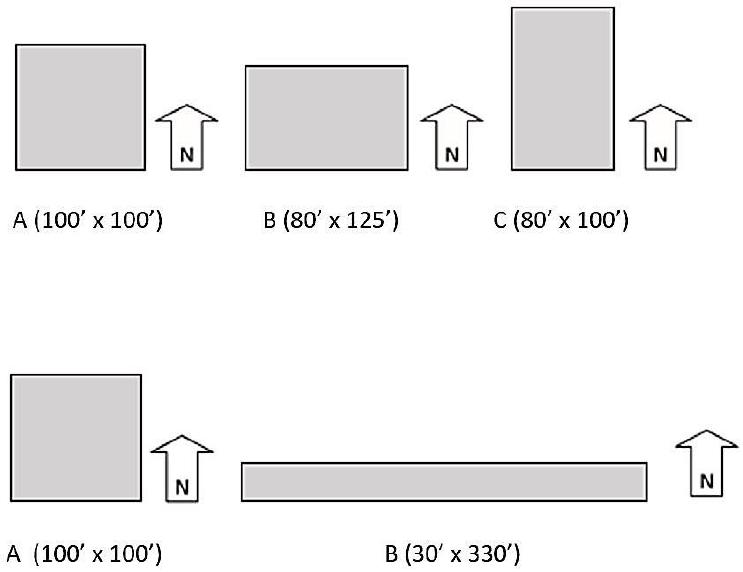
14) Which of these building plans will exhibit the least air conditioning load?
14)
______
A) (100′ × 100′) B) (80′ × 125′) C) (80′ × 100′)
15) Which of these building plans (below) will exhibit the least air conditioning load?
15)
______
A) (100′ × 100′) B) (30′ × 330′)
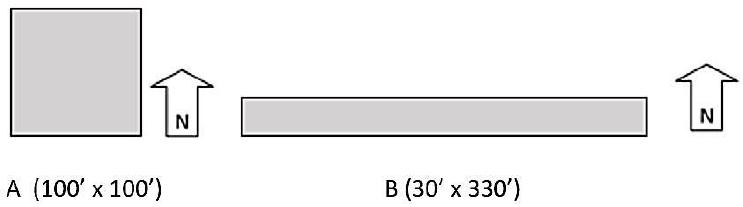
16) Which of these building plans is most economical in the long term?
16)
______
A) (100′ × 100′) B) (30′ × 330′)
17) Which is the better glass for a north window? 17)
______
A) Visible transmittance 0.60, Shading coefficient 0.47
B) Visible transmittance 0.19, Shading coefficient 0.25
18) Which is the better glass for a south window shaded by an overhang? 18)
______
A) Visible transmittance 0.60, Shading coefficient 0.47
B) Visible transmittance 0.19, Shading coefficient 0.25
19) The most efficient lighting systems will use which of the following features? Select all that apply. 19)
______
A) LED fixtures.
B) Daylight controls.
C) Uniform lighting for the entire task plane.
D) Direct T-8 fluorescent fixtures.
E) All of the above.
TRUE/FALSE. Write ‘T’ if the statement is true and ‘F’ if the statement is false.
20) For climate Zone 4 higher ventilation levels always result in higher air conditioning energy. 20)
______
21) For climate Zone 4 higher ventilation levels always result in higher heating energy. 21)
______