
A z–test is to be performed for a population mean. Express the decision criterion for the hypothesis test in terms of x.
That is, determine for what values of x the null hypothesis would be rejected.
180)
A manufacturer claims that the mean amount of juice in its 16 ounce bottles is 16.1 ounces. A
consumer advocacy group wants to perform a hypothesis test to determine whether the mean
amount is actually less than this. Preliminary data analyses indicate that it is reasonable to apply a
z–test. The hypotheses are
H0: µ= 16.1 ounces
Ha: µ< 16.1 ounces.
Assume that =0.09 ounces, n =100, and the significance level is 0.01. Express the decision
criterion for the hypothesis test in terms of x.
180)
A)
Reject H0 if x<16.12 ounces.
B)
Reject H0 if x>16.12 ounces.
C)
Reject H0 if x<16.08 ounces.
D)
Reject H0 if x>16.08 ounces.
Classify the conclusion of the hypothesis test as a Type I error, a Type II error, or a correct decision.
181)
In 2000, the average math SAT score for students at one school was 499. Five years later, in 2005, a
teacher wants to perform a hypothesis test to determine whether the average math SAT score of
students at the school has changed from the 2000 mean of 499. The hypotheses are:
H0: µ=499
Ha: µ499
where µ is the mean math SAT score, in 2005, for students at the school
Suppose that the results of the sampling lead to rejection of the null hypothesis. Classify that
conclusion as a Type I error, a Type II error, or a correct decision, if in fact the average math SAT
score of students at the school has changed from the 2000 mean of 499.
181)
A)
Correct decision
B)
Type II error
C)
Type I error
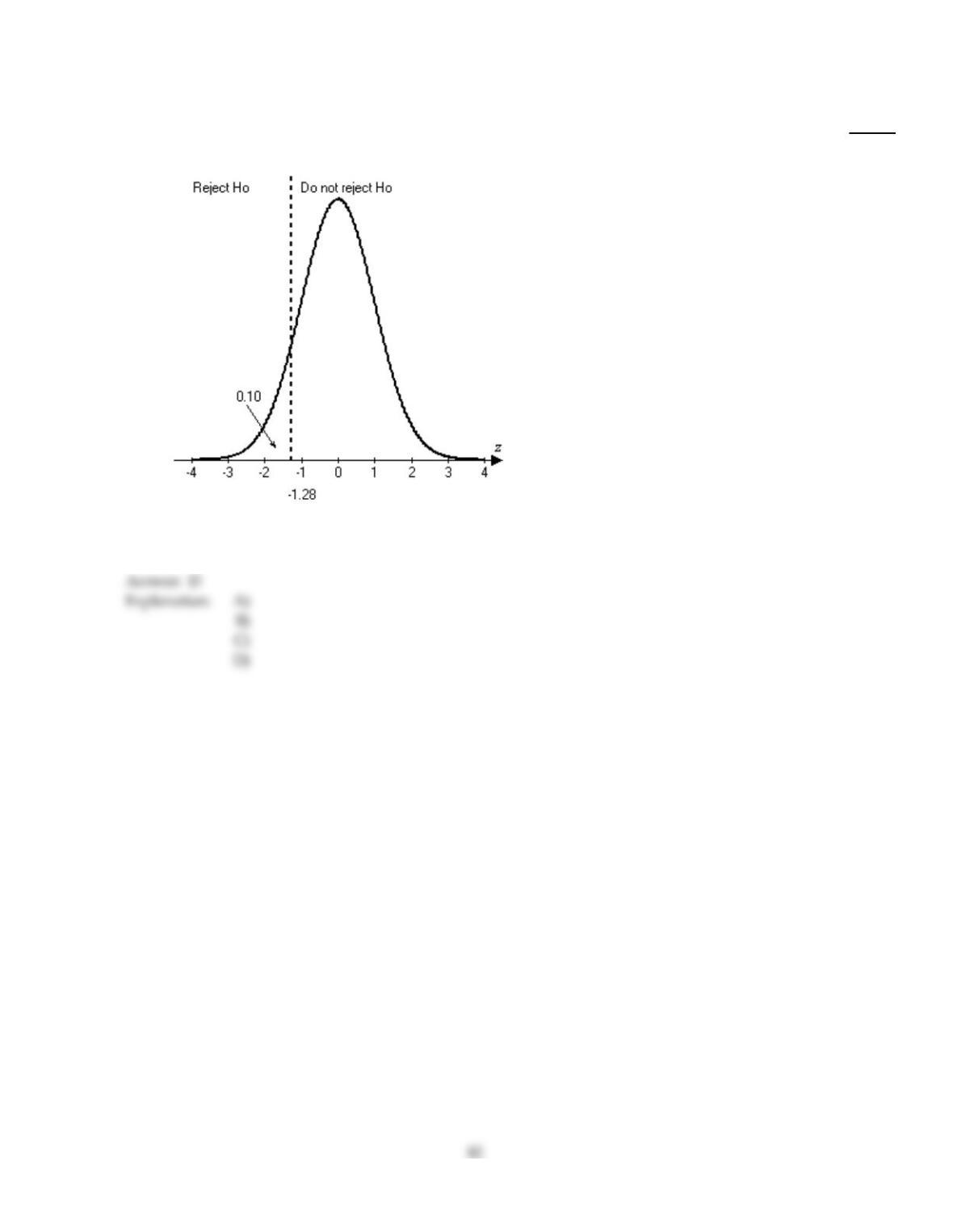
The graph portrays the decision criterion for a one–mean z–test. The curve in the graph is the normal curve for the test
statistic under the assumption that the null hypothesis is true. Use the graph to solve the problem.
182)
A graphical display of the decision criterion follows.
Determine the nonrejection region.
182)
A)
z –1.28
B)
z 0.10
C)
0.10
D)
z –1.28
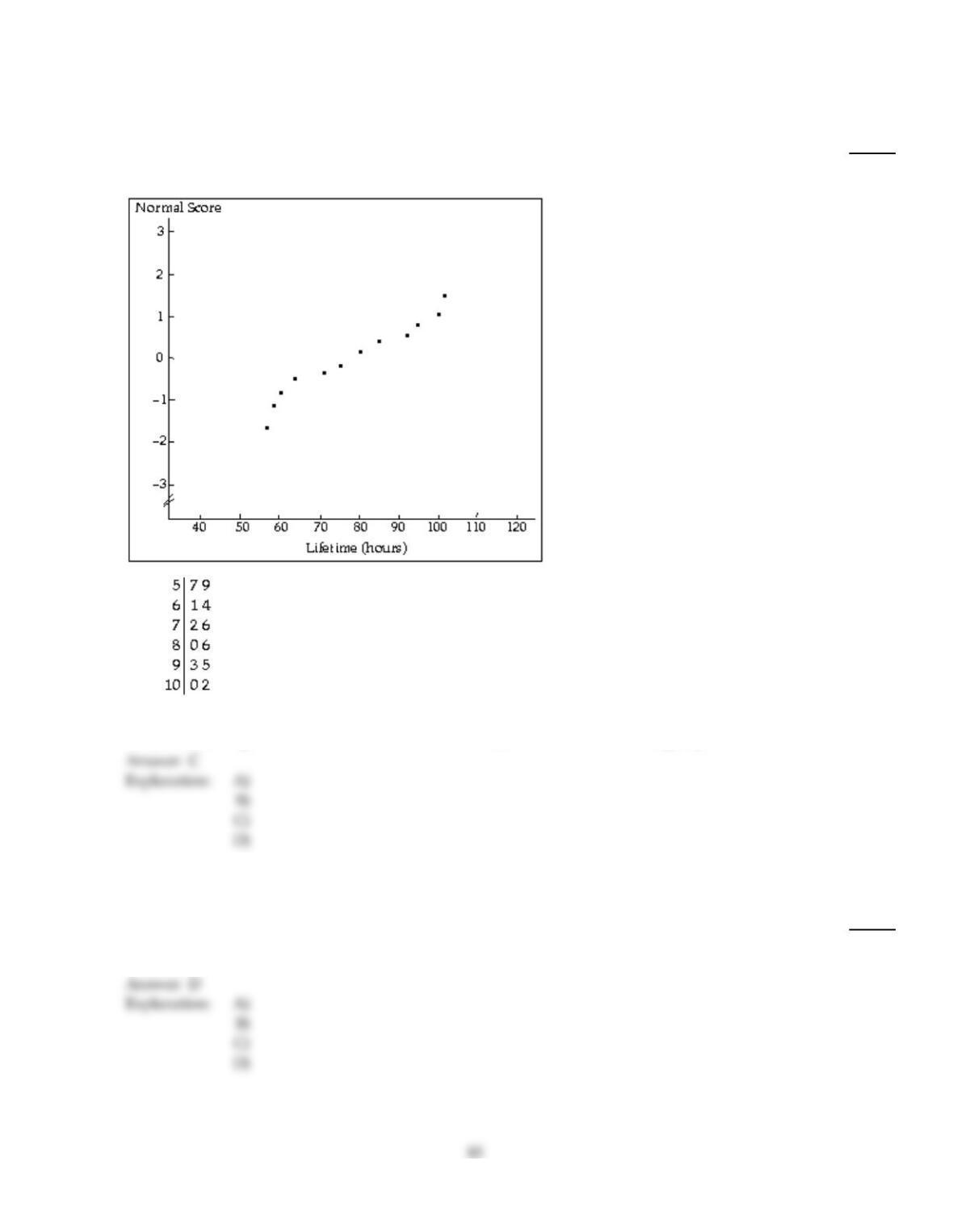
Two graphical displays are given for a set of data. A hypothesis test is to be performed for the mean of the population
from which the data were obtained. Use the graphs to determine whether a z–test, a t–test, a Wilcoxon signed–rank test, or
none of these is appropriate.
183)
A normal probability plot and a stem–and–leaf diagram of the data are given below. is known.
Which procedure is appropriate?
183)
A)
z–test
B)
t–test
C)
Wilcoxon signed–rank test
D)
None of these tests is appropriate.
The value obtained for the test statistic, z, in a one–mean z–test is given. Also given is whether the test is two tailed, left
tailed, or right tailed. Determine the P–value.
184)
A two–tailed test:
z = – 2.16
184)
A)
0.0154
B)
0.9692
C)
0.9846
D)
0.0308
D
C

For the given hypothesis test, determine the probability of a Type II error or the power, as specified.
185)
In 1990, the average duration of long–distance telephone calls originating in one town was
9.4 minutes. A long–distance telephone company wants to perform a hypothesis test to determine
whether the average duration of long–distance phone calls has changed from the 1990 mean of
9.4 minutes. Preliminary data analyses indicate that it is reasonable to apply a z–test. The
hypotheses are
H0: µ= 9.4 minutes
Ha: µ 9.4 minutes.
Assume that = 4.2 minutes, n = 50, and the significance level is 0.05. Find the probability of a
Type II error if in fact µ= 10.0 minutes.
185)
A)
0.8274
B)
0.1726
C)
0.95
D)
0.05
Determine the critical value(s) for a one–mean z–test.
186)
A two–tailed test with =0.03.
186)
A)
±2.17
B)
±2.052
C)
±2.33
D)
±1.953
Provide an appropriate response.
187)
A hypothesis test for a population mean is to be performed at the 5% level of significance. The
population standard deviation is known. The hypotheses are
H0: µ= 80
Ha: µ 80.
A 95% confidence interval for µ is also constructed. True or false: If 80 lies within the 95%
confidence interval, then the null hypothesis will be rejected.
187)
A)
True
B)
False
A sample mean, sample size, and population standard deviation are given. Use the one–mean z–test to perform the
required hypothesis test at the given significance level. Use the critical –value approach.
188)
x=20.5, n = 11 , =7.1, H0: µ= 18.7; Ha: µ
18.7, = 0.01
188)
A)
z=0.84; critical value = ±1.96; do not reject H0
B)
z= – 0.84;critical value = ±2.575; do not reject H0
C)
z=0.84;critical value = ±2.575; do not reject H0
D)
z=0.84;critical value = ±2.575; reject H0
The P–value for a hypothesis test is given. Determine whether the strength of the evidence against the null hypothesis is
weak/none, moderate, strong, or very strong.
189)
P = 0.31
189)
A)
Very strong
B)
Weak or none
C)
Moderate
D)
Strong
Use a table of t–values to estimate the P–value for the specified one–mean t–test.
190)
Two–tailed test, n = 26, t = – 1.149
190)
A)
P > 0.2
B)
P > 0.1
C)
0.1 < P < 0.2
D)
P < 0.2
The significance level and P–value of a hypothesis test are given. Decide whether the null hypothesis should be rejected.
191)
= 0.10, P–value = 0.12
191)
A)
Reject the null hypothesis.
B)
Do not reject the null hypothesis.
Provide an appropriate response.
192)
A hypothesis test for a population mean is to be performed. True or false: For a fixed sample size,
increasing the significance level will decrease the power of the test.
192)
A)
True
B)
False
A hypothesis test is to be performed. Determine the null and alternative hypotheses.
193)
At one school, the average amount of time that tenth–graders spend watching television each week
is 21.6 hours. The principal introduces a campaign to encourage the students to watch less
television. One year later, the principal wants to perform a hypothesis test to determine whether
the average amount of time spent watching television per week has decreased.
193)
A)
H0: µ< 21.6 hours
Ha: µ> 21.6 hours
B)
H0: µ= 21.6 hours
Ha: µ 21.6 hours
C)
H0: µ< 21.6 hours
Ha: µ= 21.6 hours
D)
H0: µ= 21.6 hours
Ha: µ< 21.6 hours
For the given hypothesis test, determine the probability of a Type II error or the power, as specified.
194)
A hypothesis test is to be performed to determine whether the mean waiting time during peak
hours for customers in a grocery store has increased from the previous mean waiting time of
8.3 minutes. Preliminary data analyses indicate that it is reasonable to apply a z–test. The
hypotheses are
H0: µ= 8.3 minutes
Ha: µ> 8.3 minutes.
The population standard deviation is 3.6 minutes. The sample size is 45. The significance level is
0.05. Find the probability of a Type II error if in fact the mean waiting time, µ, is 9.8 minutes.
194)
A)
0.05
B)
0.125
C)
0.875
D)
0.95
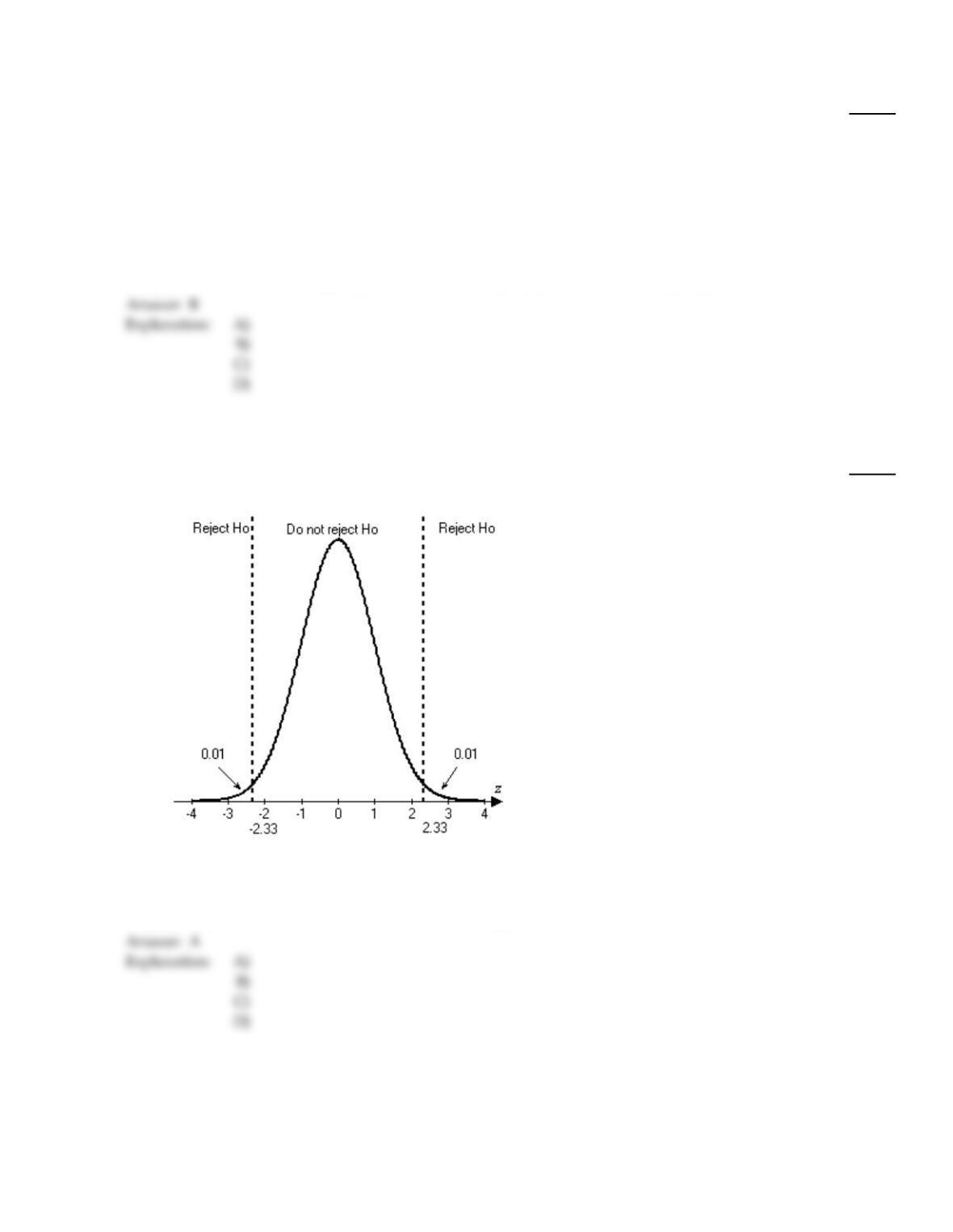
The graph portrays the decision criterion for a one–mean z–test. The curve in the graph is the normal curve for the test
statistic under the assumption that the null hypothesis is true. Use the graph to solve the problem.
195)
A graphical display of the decision criterion follows.
Determine the significance level.
195)
A)
= 0.02
B)
= 0.98
C)
= 0.01
D)
= – 2.33 or = 2.33
Two graphical displays are given for a set of data. A hypothesis test is to be performed for the mean of the population
from which the data were obtained. Use the graphs to determine whether a z–test, a t–test, a Wilcoxon signed–rank test, or
none of these is appropriate.
86
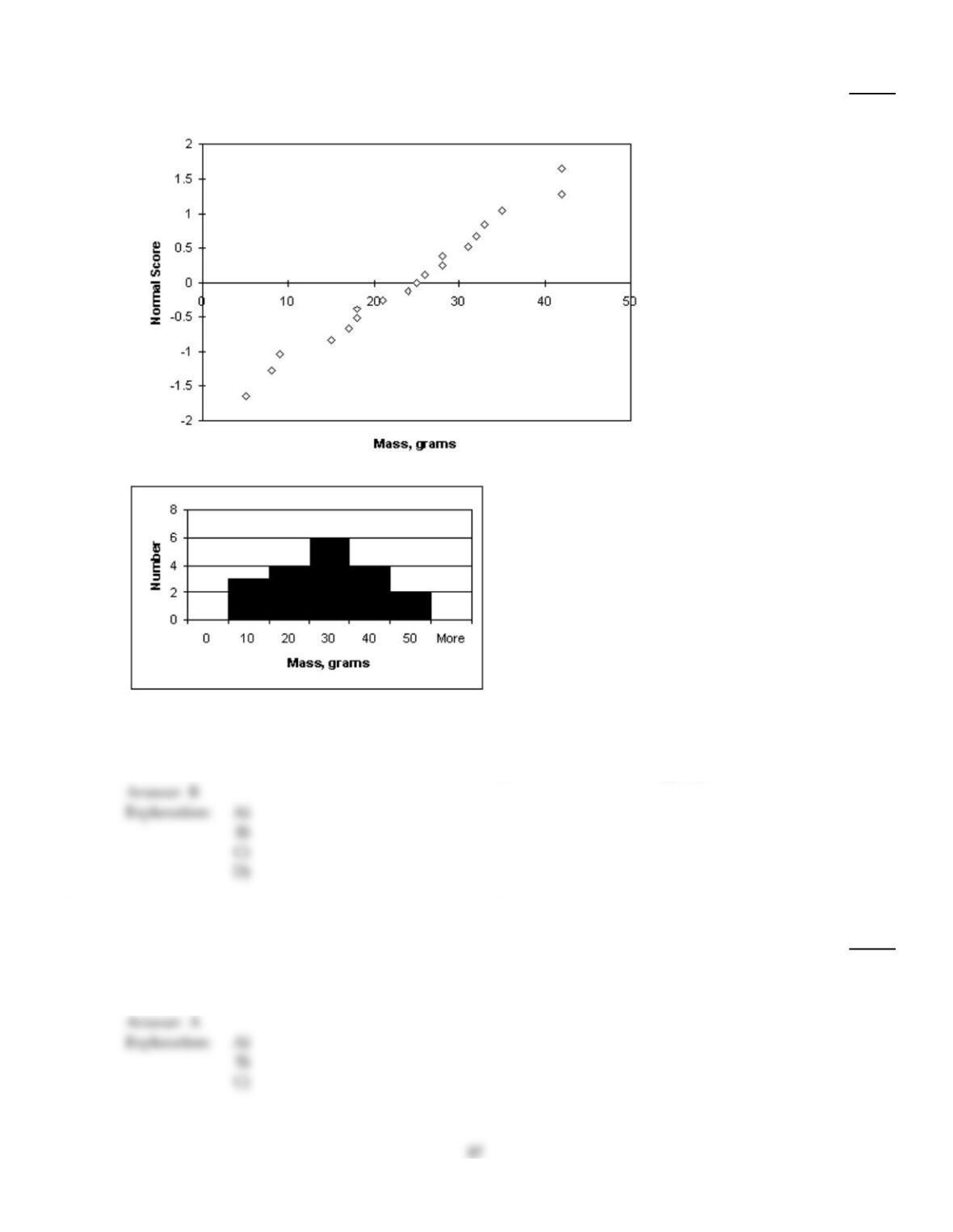
196)
A normal probability plot and a histogram plot of the data are given below. is known. Which
procedure is appropriate?
196)
A)
Wilcoxon signed–rank test
B)
z–test
C)
t–test
D)
None of these tests is appropriate.
Classify the hypothesis test as two–tailed, left–tailed, or right–tailed.
197)
The mean credit card debt among households in one state is $8400. A hypothesis test is to be
performed to decide whether the mean credit card debt for households in the formerly affluent
town of Rich–No–More differs from the mean credit card debt for the state.
197)
A)
Two–tailed
B)
Left–tailed
C)
Right–tailed
A
B

The P–value for a hypothesis test is given. Determine whether the strength of the evidence against the null hypothesis is
weak/none, moderate, strong, or very strong.
198)
P = 0.094
198)
A)
Weak or none
B)
Moderate
C)
Strong
D)
Very strong
Classify the hypothesis test as two–tailed, left–tailed, or right–tailed.
199)
The manufacturer of a refrigerator system for beer kegs produces refrigerators that are supposed to
maintain a true mean temperature, µ, of 49°F, ideal for a certain type of German pilsner. The owner
of the brewery does not agree with the refrigerator manufacturer, and will conduct a hypothesis
test to determine whether the true mean temperature differs from this value.
199)
A)
Two–tailed
B)
Left–tailed
C)
Right–tailed
A sample mean, sample size, and population standard deviation are given. Use the one–mean z–test to perform the
required hypothesis test at the given significance level. Use the P–value approach.
200)
x= 137, n = 20, = 14.2, H0: µ = 132 , Ha: µ 132 , = 0.05
200)
A)
z = 0.35; P–value = 0.7263; do not reject H0.
B)
z = 1.57; P–value = 0.1164; do not reject H0
C)
z = 1.57; P–value = 0.0582; do not reject H0
D)
z = 2.57; P–value = 0.0101; reject H0
201)
x= 41, n = 26, = 6, H0: µ = 44 , Ha: µ 44 , = 0.05
201)
A)
z = – 2.55; P–value = 0.0108; reject H0
B)
z = – 2.55; P–value = 0.0054; do not reject H0
C)
z = – 2.55; P–value = 0.0108; do not reject H0
D)
z = – 2.55; P–value = 0.0054; reject H0
Classify the conclusion of the hypothesis test as a Type I error, a Type II error, or a correct decision.
202)
A man is on trial accused of murder in the first degree. The prosecutor presents evidence that he
hopes will convince the jury to reject the hypothesis that the man is innocent. This situation can be
modeled as a hypothesis test with the following hypotheses:
H0: The defendant is innocent.
Ha: The defendant is guilty.
Suppose that the null hypothesis is rejected; i.e., the defendant is found guilty. Classify that
conclusion as a Type I error, a Type II error, or a correct decision, if in fact the defendant is innocent.
202)
A)
Type II error
B)
Type I error
C)
Correct decision
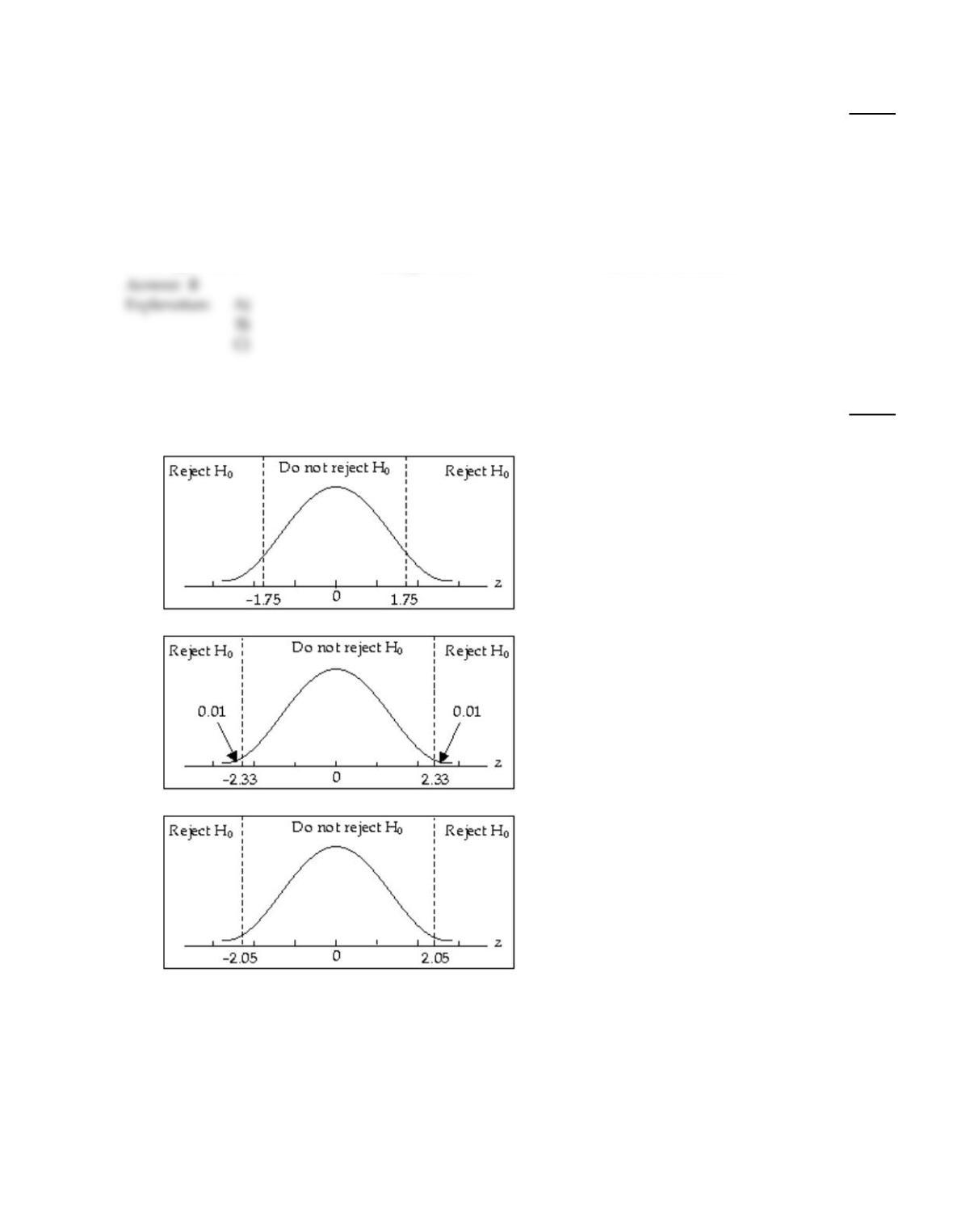
Determine the critical value(s) for a one–mean z–test.
203)
Find the critical value(s) for a two–tailed test with = 0.02 and draw a graph that illustrates your
answer.
203)
A)
–1.75, 1.75
B)
–2.33, 2.33
C)
–2.05, 2.05
89
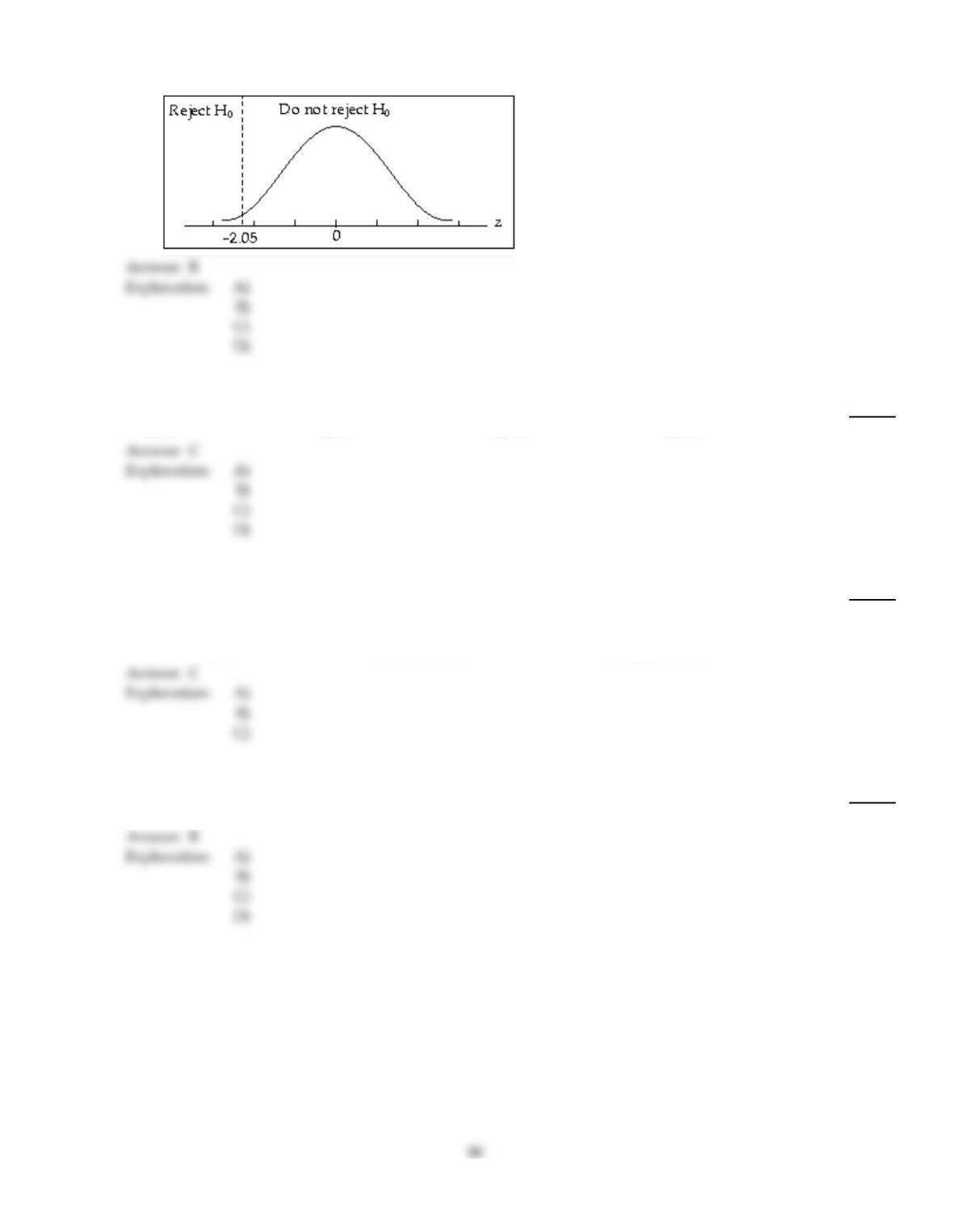
D)
–2.05
Find the critical value(s) for the specified Wilcoxon signed–rank test.
204)
Sample size = 11, left–tailed test, significance level = 0.05
204)
A)
52
B)
17
C)
14
D)
11
Classify the hypothesis test as two–tailed, left–tailed, or right–tailed.
205)
A psychologist has designed a test to measure stress levels in adults. She has determined that
nationwide the mean score on her test is 30. A hypothesis test is to be conducted to determine
whether the mean score for trial lawyers exceeds the national mean score.
205)
A)
Two–tailed
B)
Left–tailed
C)
Right–tailed
Use a table of t–values to estimate the P–value for the specified one–mean t–test.
206)
Two–tailed test, n = 17, t = 2.624
206)
A)
0.02 < P < 0.05
B)
0.01 < P < 0.02
C)
P < 0.01
D)
0.005 < P < 0.01
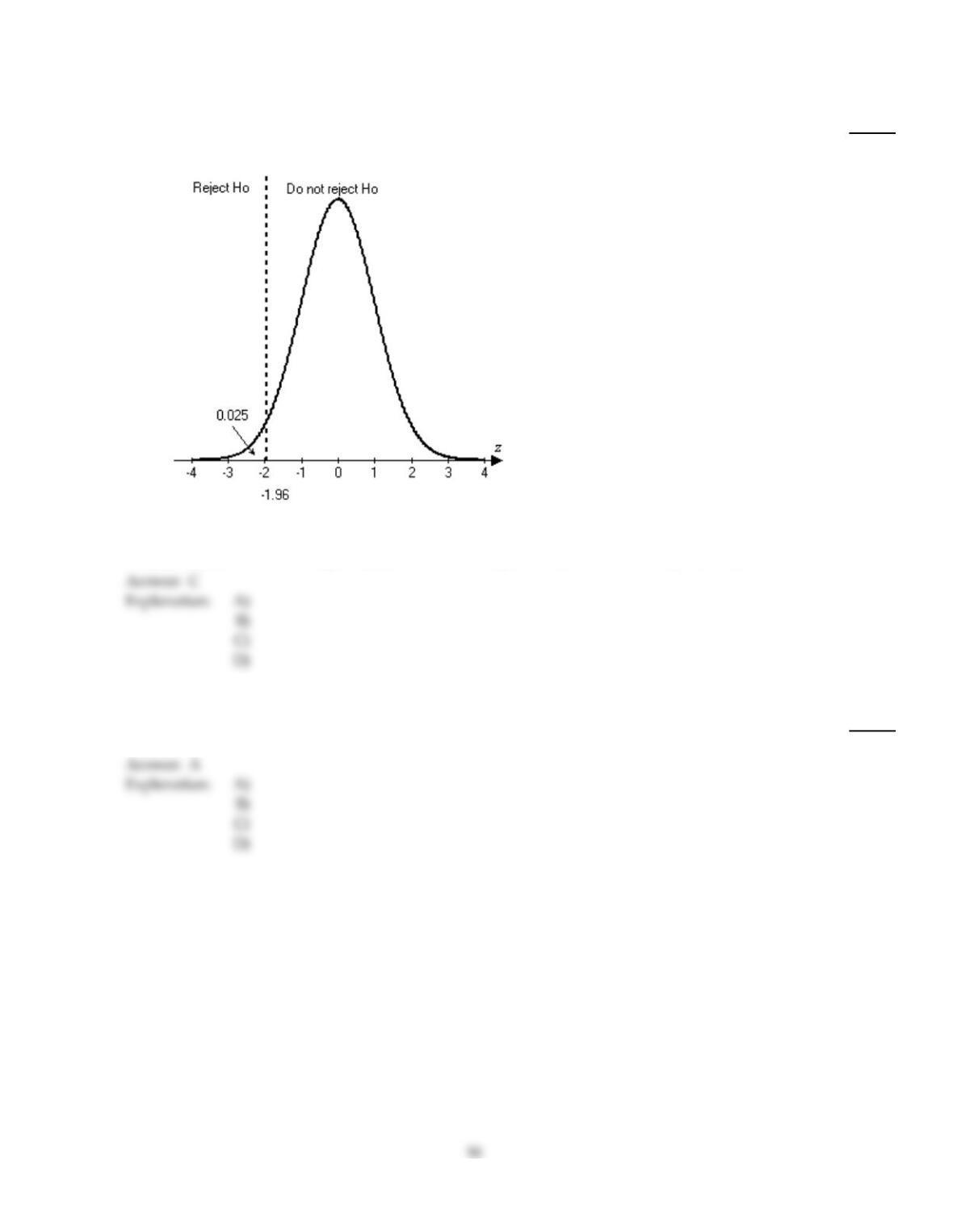
The graph portrays the decision criterion for a one–mean z–test. The curve in the graph is the normal curve for the test
statistic under the assumption that the null hypothesis is true. Use the graph to solve the problem.
207)
A graphical display of the decision criterion follows.
Determine the critical value(s).
207)
A)
= 0.025
B)
z = ±1.96
C)
z = – 1.96
D)
z –1.96
Find the critical value(s) for the specified Wilcoxon signed–rank test.
208)
Sample size = 16, two–tailed test, significance level = 0.01
208)
A)
19, 117
B)
16, 120
C)
20, 117
D)
24, 112

For the given hypothesis test, determine the probability of a Type II error or the power, as specified.
209)
After training intensively for six months, John hopes that his mean time to run 100 meters has
decreased from last year’s mean time of 12.2 seconds. He performs a hypothesis test to determine
whether his mean time has decreased. Preliminary data analyses indicate that it is reasonable to
apply a z–test. The hypotheses are
H0: µ= 12.2 seconds
Ha: µ< 12.2 seconds.
Assume that = 0.35 seconds, n = 30, and the significance level is 0.10. Find the probability of a
Type II error if in fact µ= 12.1 seconds.
209)
A)
0.3897
B)
0.10
C)
0.90
D)
0.6103
For the given hypothesis test, explain the meaning of a Type I error, a Type II error, or a correct decision as specified.
210)
The mean credit card debt among households in one state is $8400. A hypothesis test is to be
performed to decide whether the mean credit card debt for households in the formerly affluent
town of Rich–No–More differs from the mean credit card debt for the state. The hypotheses are
H0: µ= $8400
Ha: µ $8400
where µ is the mean credit card debt for all households in Rich–No–More. Explain the meaning of
a correct decision.
210)
A)
A correct decision would occur if, in fact, µ
$8400, and the results of the sampling do not
lead to rejection of the null hypothesis that µ= $8400
B)
A correct decision would occur if, in fact, µ= $8400, and the results of the sampling do not
lead to rejection of that fact; or if, in fact, µ
$8400 and the results of the sampling lead to that
conclusion.
C)
A correct decision would occur if, in fact, µ= $8400, but the results of the sampling lead to the
conclusion that µ $8400; or if, in fact, µ $8400 and the results of the sampling lead to that
conclusion.
D)
A correct decision would occur if, in fact, µ= $8400, and the results of the sampling do not
lead to rejection of that fact; or if, in fact, µ
$8400 and the results of the sampling do not lead
to rejection of the null hypothesis that µ= $8400.
Use a table of t–values to estimate the P–value for the specified one–mean t–test.
211)
Two–tailed test, n = 21, t = – 2.509
211)
A)
0.01 < P < 0.025
B)
0.05 < P < 0.10
C)
0.005 < P < 0.01
D)
0.02 < P < 0.05

Classify the conclusion of the hypothesis test as a Type I error, a Type II error, or a correct decision.
212)
A health insurer has determined that the “reasonable and customary” fee for a certain medical
procedure is $1200. They suspect that the average fee charged by one particular clinic for this
procedure is higher than $1200. The insurer wants to perform a hypothesis test to determine
whether their suspicion is correct. The hypotheses are:
H0: µ= $1200
Ha: µ> $1200
where µ is the mean amount charged by the clinic for this procedure.
Suppose that the results of the sampling lead to rejection of the null hypothesis. Classify that
conclusion as a Type I error, a Type II error, or a correct decision, if in fact the average fee charged
by the clinic is $1200 .
212)
A)
Type II error
B)
Correct decision
C)
Type I error
Use a table of t–values to estimate the P–value for the specified one–mean t–test.
213)
Right–tailed test, n = 4, t = 3.225
213)
A)
0.005 < P < 0.01
B)
0.05 < P < 0.10
C)
0.01 < P < 0.025
D)
0.025 < P < 0.05
Explanation:
A hypothesis test is to be performed. Determine the null and alternative hypotheses.
214)
A manufacturer claims that the mean amount of juice in its 16 ounce bottles is 16.1 ounces. A
consumer advocacy group wants to perform a hypothesis test to determine whether the mean
amount is actually less than this.
214)
A)
H0: µ= 16.1 ounces
Ha: µ< 16.1 ounces
B)
H0: µ> 16.1 ounces
Ha: µ < 16.1 ounces
C)
H0: µ< 16.1 ounces
Ha: µ= 16.1 ounces
D)
H0: µ= 16.1 ounces
Ha: µ 16.1 ounces
Explanation:
Explanation:
For the given hypothesis test, explain the meaning of a Type I error, a Type II error, or a correct decision as specified.
215)
A man is on trial accused of murder in the first degree. The prosecutor presents evidence that he
hopes will convince the jury to reject the hypothesis that the man is innocent. This situation can be
modeled as a hypothesis test with the following hypotheses:
H0: The defendant is innocent.
Ha: The defendant is guilty.
Explain the meaning of a Type II error.
215)
A)
A Type II error would occur if, in fact, the defendant is innocent but the jury concludes that
he is guilty.
B)
A Type II error would occur if, in fact, the defendant is guilty and the jury rejects the null
hypothesis that he is innocent.
C)
A Type II error would occur if, in fact, the defendant is innocent and the jury fails to reject the
null hypothesis that he is innocent.
D)
A Type II error would occur if, in fact, the defendant is guilty but the jury fails to conclude
that he is guilty.
The significance level and P–value of a hypothesis test are given. Decide whether the null hypothesis should be rejected.
216)
= 0.10, P–value = 0.08
216)
A)
Reject the null hypothesis.
B)
Do not reject the null hypothesis.
Provide an appropriate response.
217)
The P–value for a one–mean t–test is estimated using a t–table as 0.01 < P < 0.025. Based on this
information, state at which significance levels the null hypothesis cannot be rejected.
217)
A)
We cannot reject H0 at any significance level 0.01 or larger.
B)
We cannot reject H0 at any significance level 0.01 or smaller.
C)
We cannot reject H0 at any significance level 0.025 or smaller.
D)
We cannot reject H0 at any significance level 0.025 or larger.
Determine the critical value(s) for a one–mean z–test.
94
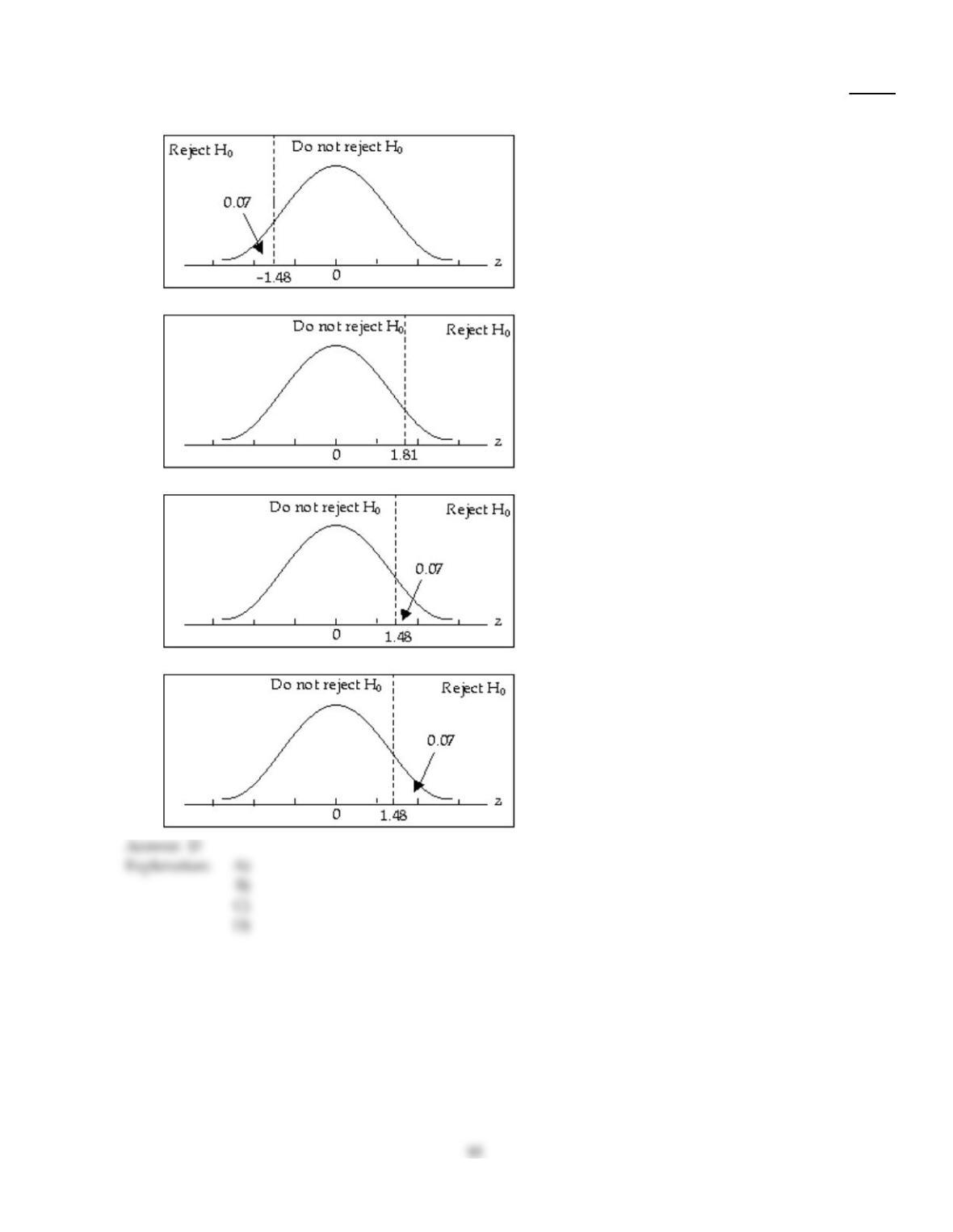
218)
Find the critical value(s) for a right–tailed test with = 0.07 and draw a graph that illustrates your
answer.
218)
A)
–1.48
B)
1.81
C)
1.48
D)
1.48
A z–test is to be performed for a population mean. Express the decision criterion for the hypothesis test in terms of x.
That is, determine for what values of x the null hypothesis would be rejected.
219)
The average diastolic blood pressure of a population of migraine sufferers is 88 mmHg. During a
clinical trial each person in a random sample from the population receives a drug to relieve the
migraines. The researcher is interested in investigating whether the drug also affects blood pressure
and wants to perform a hypothesis test to determine whether the average diastolic blood pressure
for people receiving the drug (µ) differs from 88 mmHg. Preliminary data analyses indicate that it
is reasonable to apply a z–test. The hypotheses are
H0: µ=88 mmHg
Ha: µ88 mmHg.
Assume that =4.9 mmHg, n =114, and the significance level is 0.05. Express the decision criterion
for the hypothesis test in terms of x.
219)
A)
Reject H0 if x>97.604 mmHg or x<78.396 mmHg.
B)
Reject H0 if x>88.75 mmHg or x<87.25 mmHg.
C)
Reject H0 if 87.10 mmHg <x<88.90 mmHg.
D)
Reject H0 if x>88.90 mmHg or x<87.10 mmHg.
The significance level and P–value of a hypothesis test are given. Decide whether the null hypothesis should be rejected.
220)
= 0.01, P–value = 0.003
220)
A)
Reject the null hypothesis.
B)
Do not reject the null hypothesis.
Classify the hypothesis test as two–tailed, left–tailed, or right–tailed.
221)
The recommended dietary allowance (RDA) of vitamin C for women is 75 milligrams per day. A
hypothesis test is to be performed to decide whether adult women are, on average, getting less than
the RDA of 75 milligrams per day.
221)
A)
Two–tailed
B)
Left–tailed
C)
Right–tailed
The P–value for a hypothesis test is given. Determine whether the strength of the evidence against the null hypothesis is
weak/none, moderate, strong, or very strong.
222)
P = 0.13
222)
A)
Very strong
B)
Strong
C)
Moderate
D)
Weak or none
Determine the critical value(s) for a one–mean z–test.
96
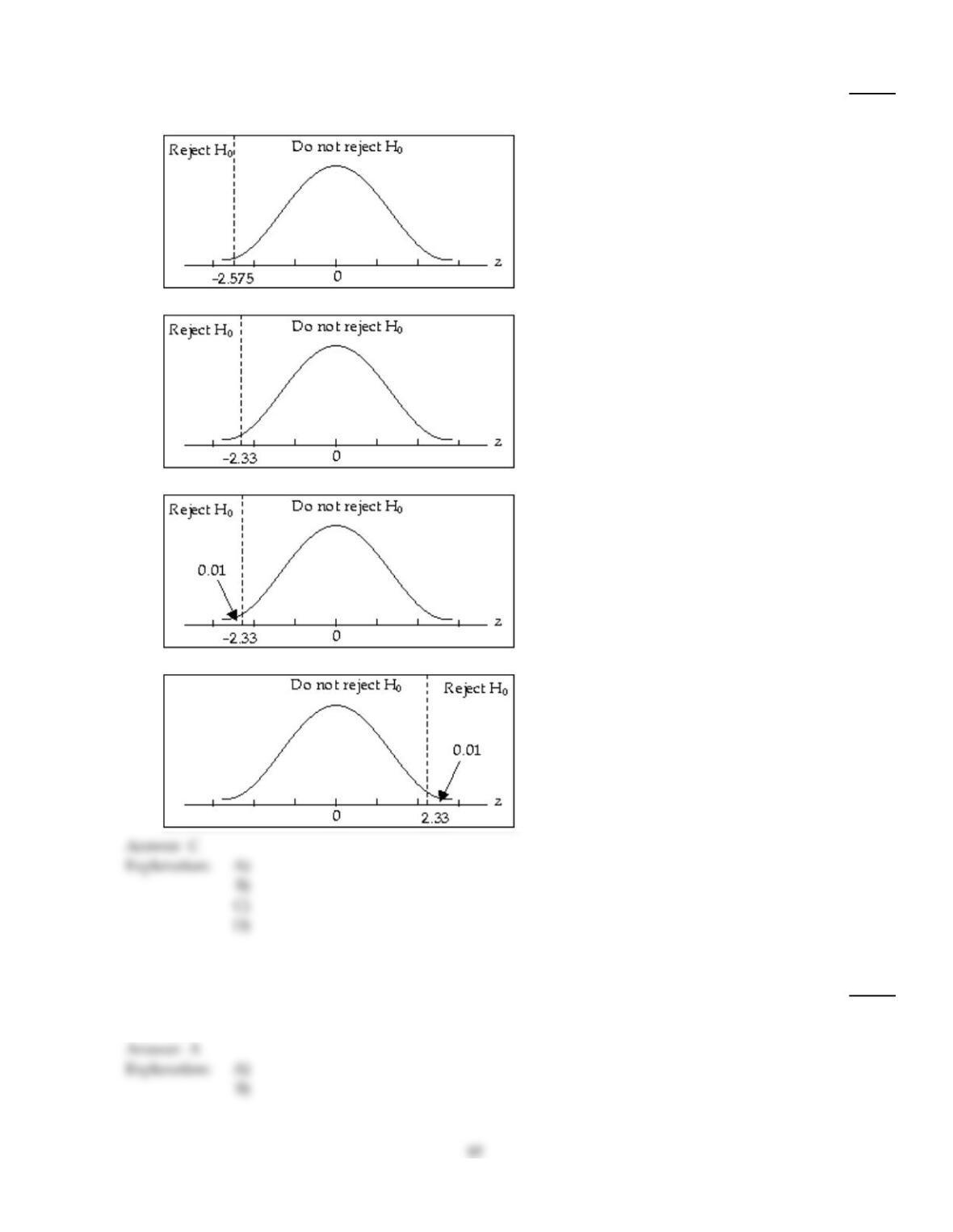
223)
Find the critical value(s) for a left–tailed test with = 0.01 and draw a graph that illustrates your
answer.
223)
A)
–2.575
B)
–2.33
C)
–2.33
D)
2.33
Provide an appropriate response.
224)
A hypothesis test for a population mean is to be performed. True or false: The further the true mean
is from the null–hypothesis mean, the greater the power of the test.
224)
A)
True
B)
False

A sample mean, sample size, and population standard deviation are given. Use the one–mean z–test to perform the
required hypothesis test at the given significance level. Use the P–value approach.
225)
x= 259, n = 15, = 19, H0: µ = 250 , Ha: µ > 250 , = 0.01
225)
A)
z = 1.83; P–value = 0.0672; reject H0.
B)
z = 1.83; P–value = 0.0672; do not reject H0
C)
z = 1.83; P–value = 0.0336; reject H0
D)
z = 1.83; P–value = 0.0336; do not reject H0
For the given hypothesis test, explain the meaning of a Type I error, a Type II error, or a correct decision as specified.
226)
At one school, in 2005, the average amount of time that tenth–graders spent watching television
each week was 21.6 hours. The principal introduced a campaign to encourage the students to
watch less television. One year later, in 2006, the principal performed a hypothesis test to determine
whether the average amount of time spent watching television per week had decreased. The
hypotheses are:
H0: µ= 21.6 hours
Ha: µ< 21.6 hours
where µ is the mean amount of time, in 2006, that tenth–graders spend watching television each
week
Explain the meaning of a correct decision.
226)
A)
A correct decision would occur if, in fact, µ= 21.6 hours, and the results of the sampling do
not lead to rejection of that fact; or if, in fact, µ< 21.6 hours and the results of the sampling do
not lead to rejection of the null hypothesis that µ= 21.6 hours.
B)
A correct decision would occur if, in fact, µ= 21.6 hours, and the results of the sampling lead
to rejection of the null hypothesis; or if, in fact, µ< 21.6 hours and the results of the sampling
lead to that conclusion.
C)
A correct decision would occur if, in fact, µ< 21.6 hours and the results of the sampling do not
lead to rejection of the null hypothesis that µ= 21.6 hours.
D)
A correct decision would occur if, in fact, µ= 21.6 hours, and the results of the sampling do
not lead to rejection of that fact; or if, in fact, µ< 21.6 hours and the results of the sampling
lead to that conclusion.
For the given hypothesis test, determine the probability of a Type II error or the power, as specified.
227)
In 1990, the average math SAT score for students at one school was 472. Five years later, a teacher
wants to perform a hypothesis test to determine whether the average SAT score of students at the
school has changed from the 1990 mean of 472. Preliminary data analyses indicate that it is
reasonable to apply a z–test. The hypotheses are
H0: µ= 472
Ha: µ 472.
Assume that = 74, n = 54, and the significance level is 0.01. Find the power of the test if in fact
µ= 468.
227)
A)
0.9839
B)
0.0100
C)
0.0161
D)
0.0146
The graph portrays the decision criterion for a one–mean z–test. The curve in the graph is the normal curve for the test
statistic under the assumption that the null hypothesis is true. Use the graph to solve the problem.
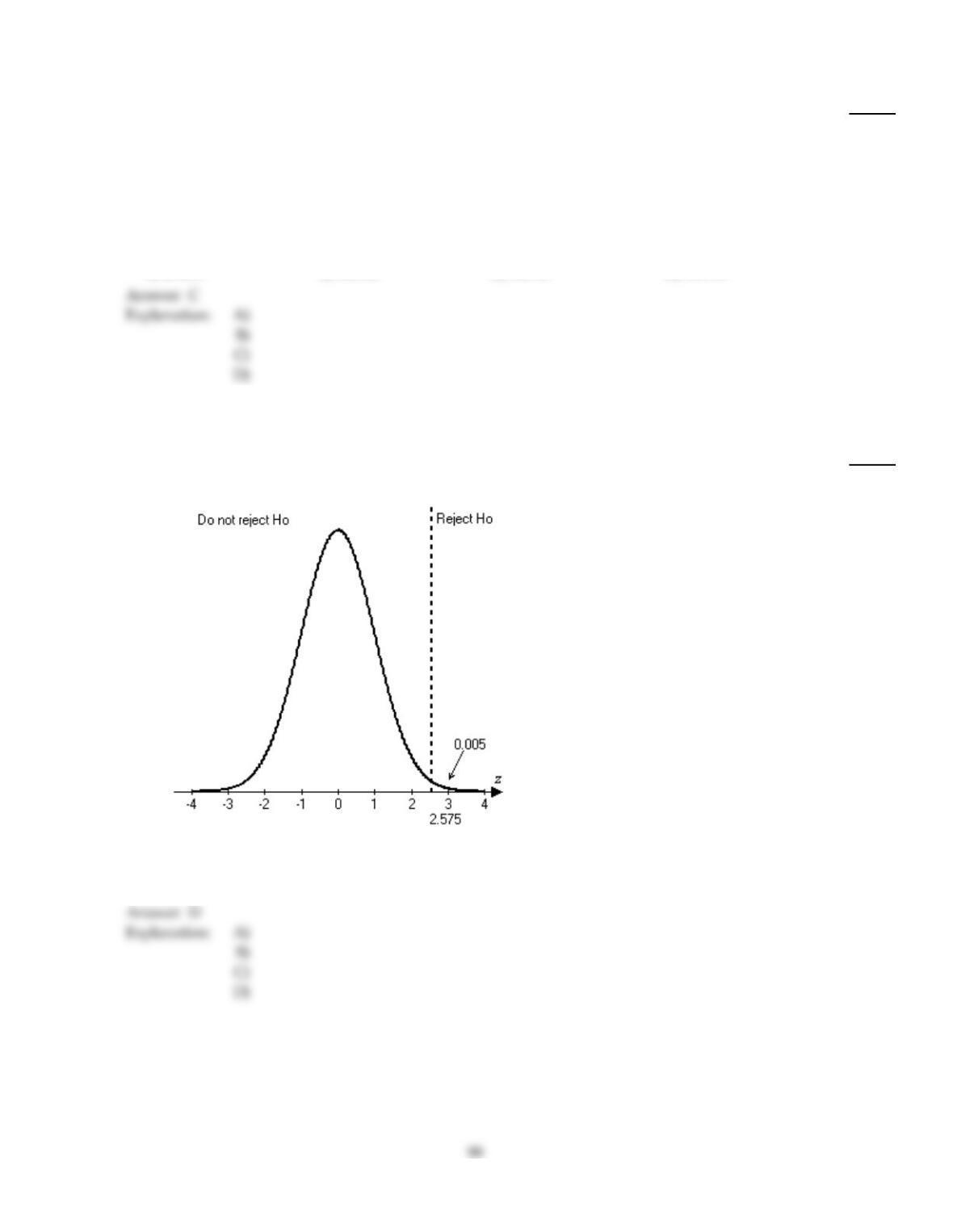
228)
A graphical display of the decision criterion follows.
Determine the rejection region.
228)
A)
z 0.005
B)
z = 2.575
C)
z 2.575
D)
z 2.575

A sample mean, sample size, and population standard deviation are given. Use the one–mean z–test to perform the
required hypothesis test at the given significance level. Use the critical –value approach.
229)
x=54, n =35, = 5.6, H0: µ= 56; Ha: µ< 56, = 0.05
229)
A)
z= – 2.11; critical value = – 1.645; do not reject H0
B)
z= – 2.11; critical value = – 1.96; reject H0
C)
z= – 0.36; critical value = – 1.645; do not reject H0
D)
z= – 2.11; critical value = – 1.645; reject H0
A z–test is to be performed for a population mean. Express the decision criterion for the hypothesis test in terms of x.
That is, determine for what values of x the null hypothesis would be rejected.
230)
A health insurer has determined that the “reasonable and customary” fee for a certain medical
procedure is $1060. They suspect that the average fee charged by one particular clinic for this
procedure is higher than $1060. The insurer wants to perform a hypothesis test to determine
whether their suspicion is correct. Preliminary data analyses indicate that it is reasonable to apply a
z–test. The hypotheses are
H0: µ= $1060
Ha: µ> $1060.
Assume that = $259, n =29, and the significance level is 0.10. Express the decision criterion for the
hypothesis test in terms of x.
230)
A)
Reject H0 if x< $998.44.
B)
Reject H0 if x< $1121.56.
C)
Reject H0 if x> $1121.56.
D)
Reject H0 if x> $1139.12.
Provide an appropriate response.
231)
A hypothesis test for a population mean is to be performed. If the significance level is fixed, how
will increasing the sample size affect the power of the test?
231)
A)
The power will increase.
B)
The power will decrease.
C)
The power will not change.