Chapter 9 – Project Scheduling: PERT/CPM
Activity
Optimistic
Most
Probable
Pessimistic
A
2
5
6
B
1
3
7
C
6
7
10
D
5
12
14
E
3
4
5
F
8
9
12
G
4
6
8
H
3
6
8
I
5
7
12
J
12
13
14
K
1
3
4
a.
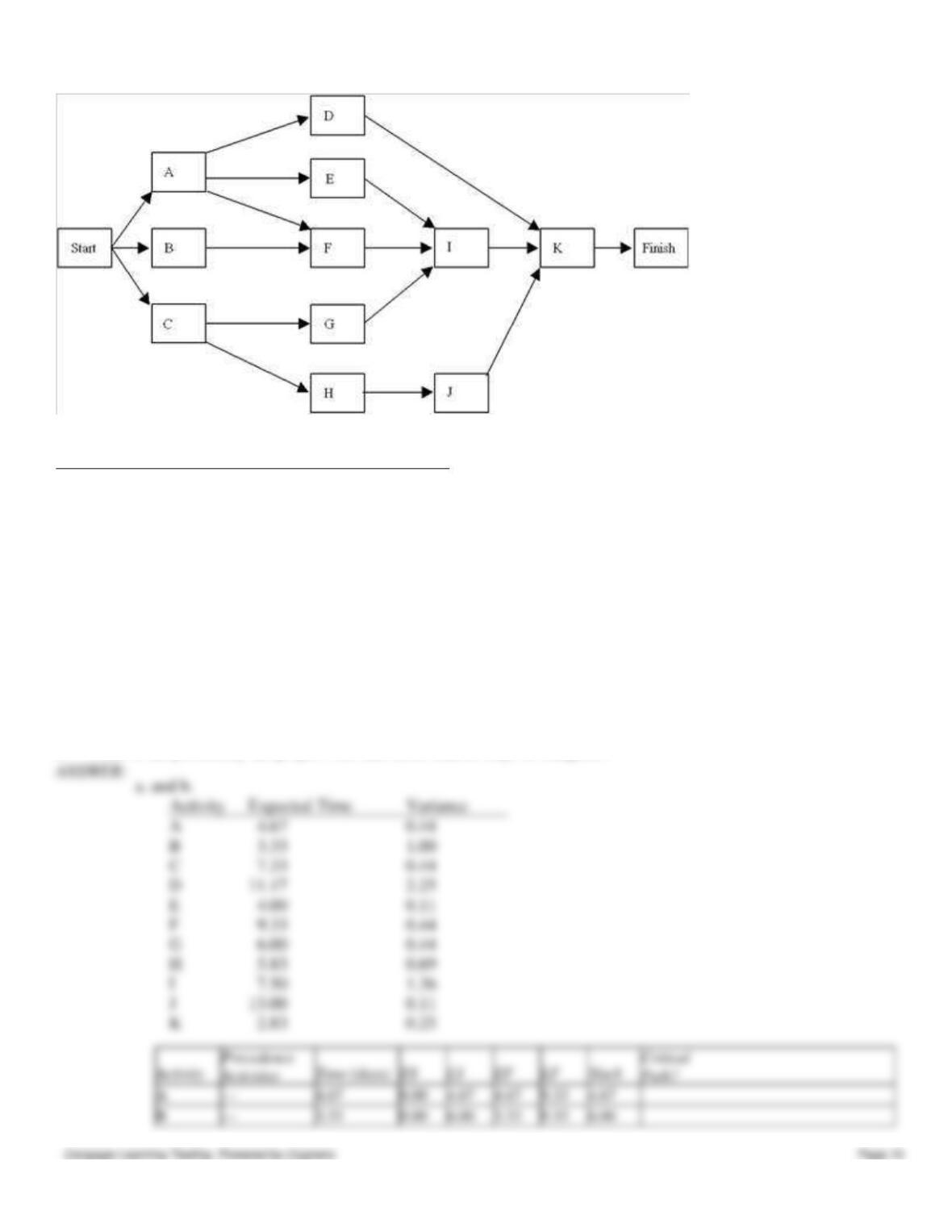
What are the critical path activities?
b.
What is the expected time to complete the project?
c.
What is the probability the project will take more than 28 days to complete?
a. and b.
Expected Time
Chapter 9 – Project Scheduling: PERT/CPM
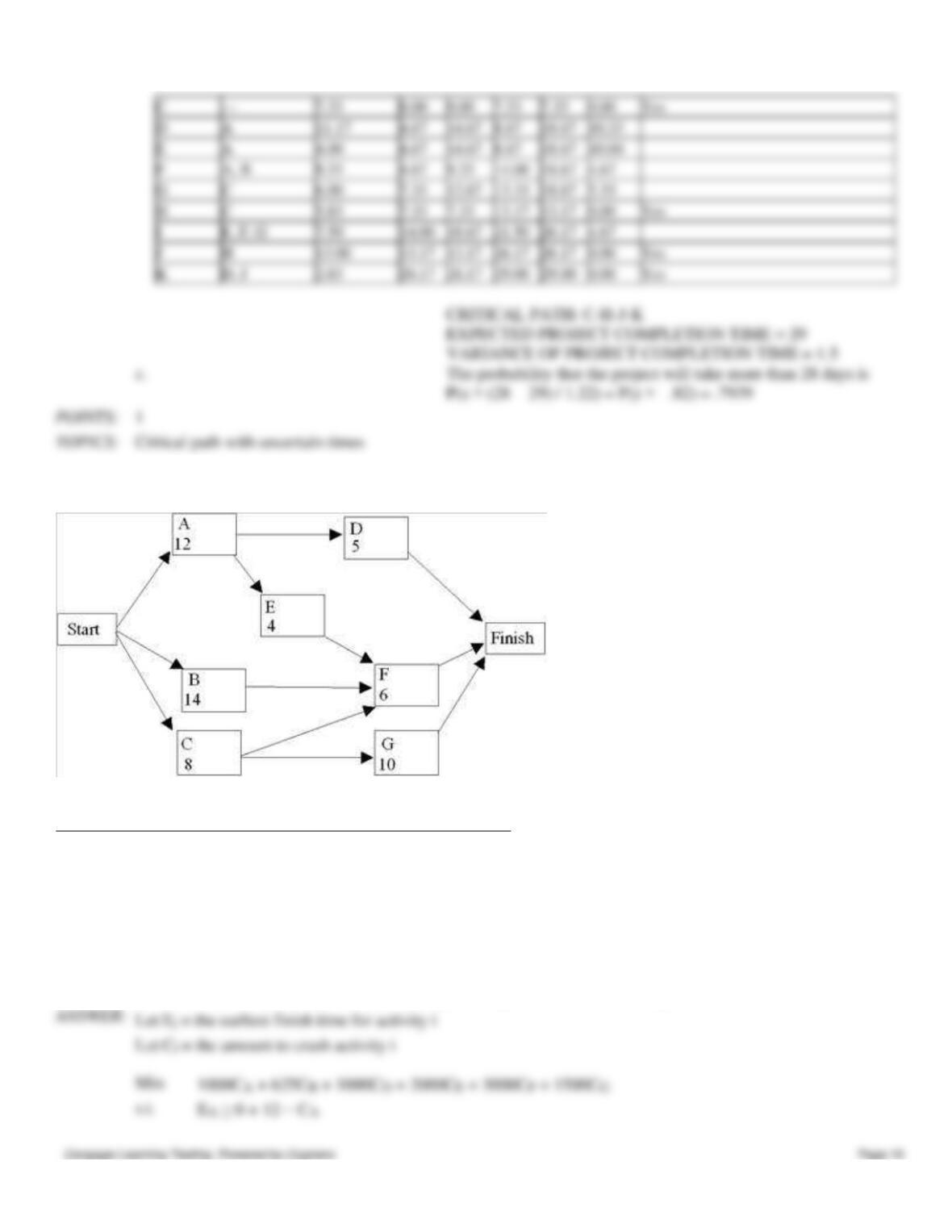
52. The critical path for this network is A – E – F and the project completion time is 22 weeks.
Activity
Normal
Time
Crash
Time
Normal
Cost
Crash
Cost
A
12
8
8,000
12,000
B
14
10
5,000
7,500
C
8
8
10,000
10,000
D
5
3
6,000
8,000
E
4
3
5,000
7,000
F
6
5
9,000
12,000
G
10
8
5,000
8,000
If a deadline of 17 weeks is imposed, give the linear programming model for the crashing decision.
Chapter 9 – Project Scheduling: PERT/CPM
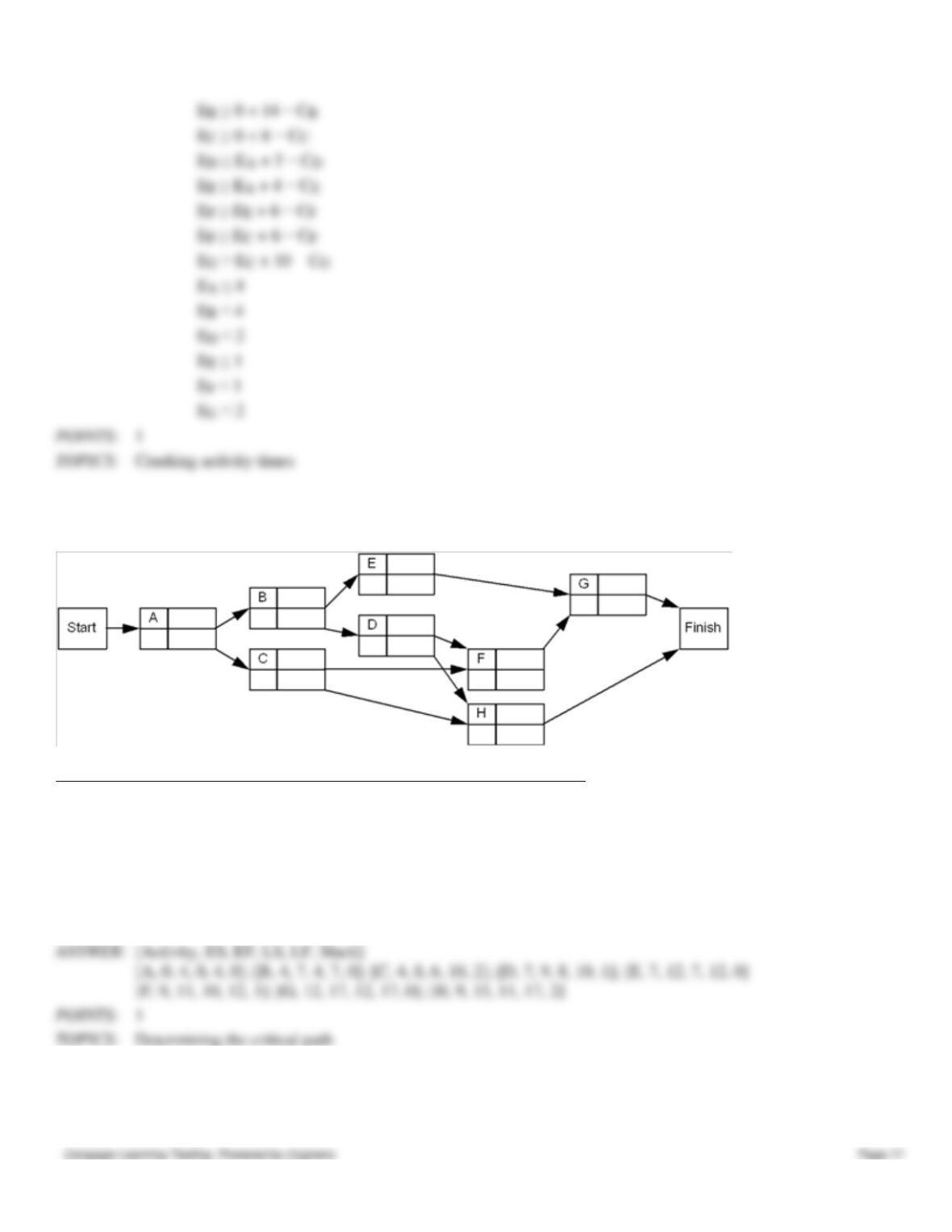
53. For the project represented below, determine the earliest and latest start and finish times for each activity as well as the
expected overall completion time.
Activity
Duration
ES
EF
LS
LF
Slack
A
4
B
3
C
4
D
2
E
5
F
2
G
5
H
6
[F, 9, 11, 10, 12, 1]; [G, 12, 17, 12, 17, 0]; [H, 9, 15, 11, 17, 2]
Determining the critical path
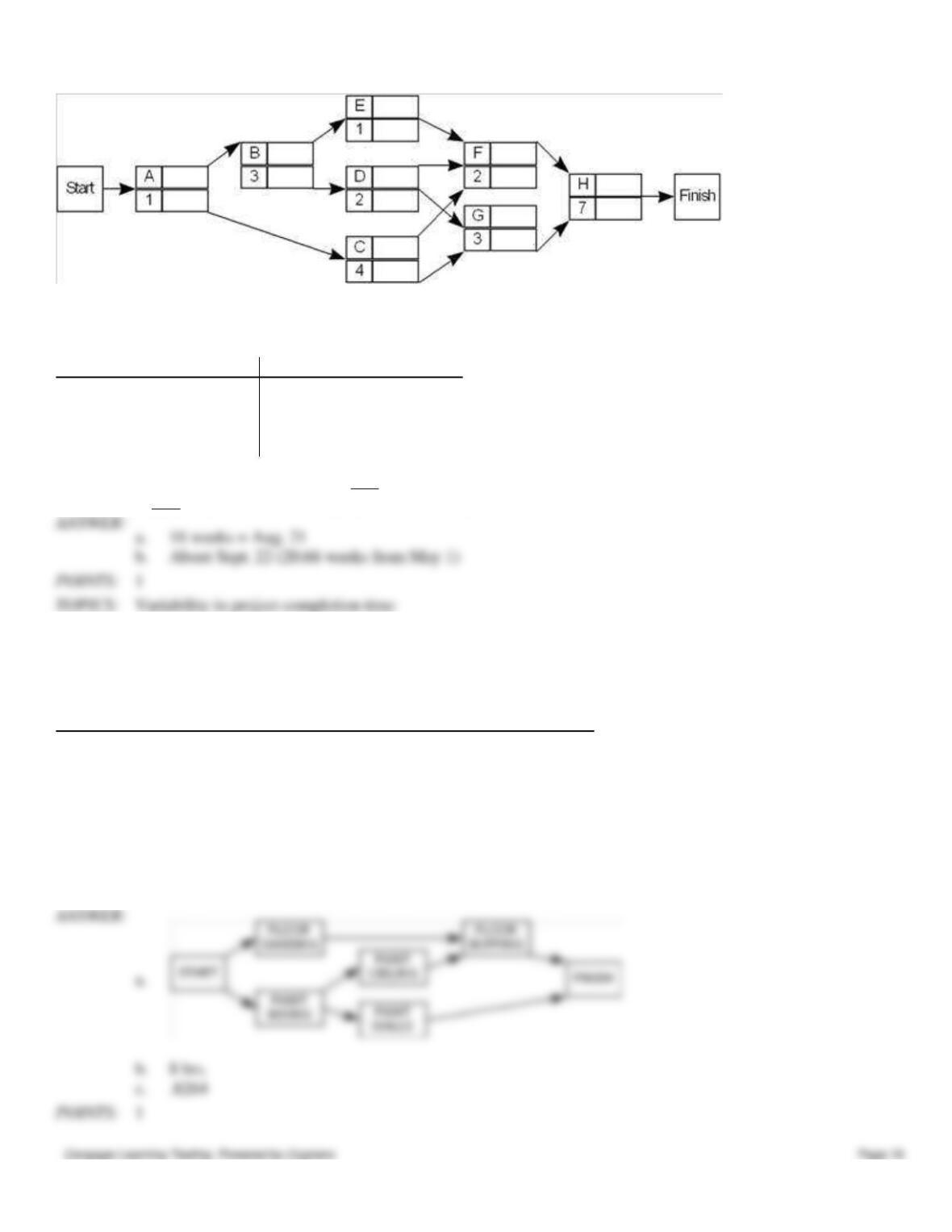
54. Consider the following PERT/CPM network with estimated times in weeks. The project is scheduled to begin on May
1.
Crashing activity times
Chapter 9 – Project Scheduling: PERT/CPM
The three-time estimate approach was used to calculate the expected times and the following table gives the variance for
each activity:
Activity
Variance
Activity
Variance
A
1.1
E
0.3
B
0.5
F
0.6
C
1.2
G
0.6
D
0.8
H
1.0
a.
Give the expected project completion date and the critical path.
b.
By what date are you 99% sure the project will be completed?
a.
16 weeks = Aug. 21
b.
About Sept. 22 (20.66 weeks from May 1)
Variability in project completion time
55. A project consists of five activities. Naturally the paint mixing precedes the painting activities. Also, both ceiling
painting and floor sanding must be done prior to floor buffing.
Optimistic
Most Probable
Pessimistic
Activity
Time (hr)
Time (hr)
Time (hr)
Floor sanding
3
4
5
Floor buffing
1
2
3
Paint mixing
0.5
1
1.5
Wall painting
1
2
9
Ceiling painting
1
5.5
7
a.
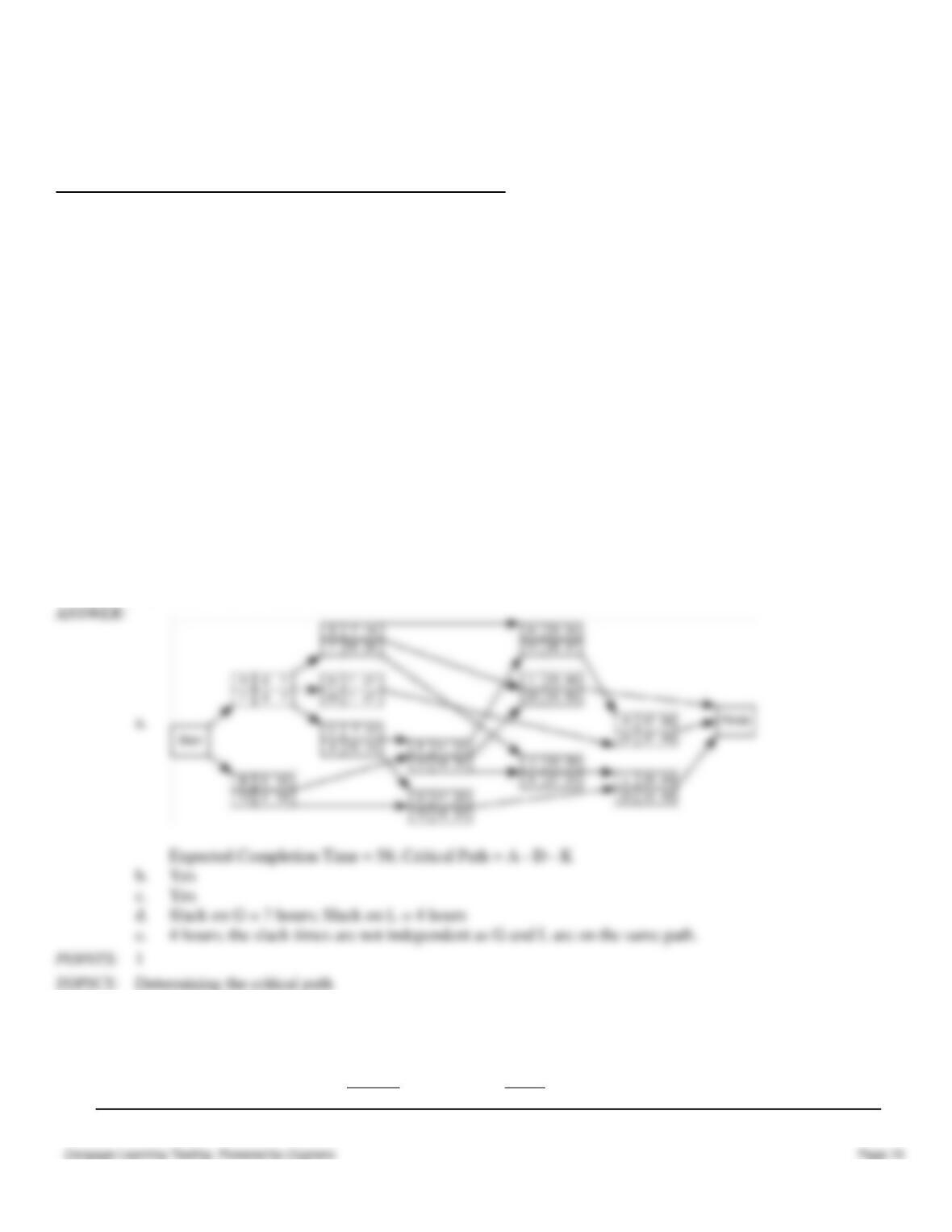
Construct the PERT/CPM network for this problem.
b.
What is the expected completion time of this project?
c.
What is the probability that the project can be completed within 9 hr.?
c.
.8264
Chapter 9 – Project Scheduling: PERT/CPM
TOPICS:
Variability in project completion time
56. Consider a project that has been modeled as follows:
Activity
Immediate Predecessors
Duration (hr)
A
—
7
B
—
10
C
A
4
D
A
30
E
A
7
F
B,C
12
G
B,C
15
H
E,F
11
I
E,F
25
J
E,F
6
K
D,H
21
L
G,J
25
a.
Draw the PERT/CPM network for this project and determine project’s expected completion
time and its critical path.
b.
Can activities E and G be performed simultaneously without delaying the minimum project
completion time?
c.
Can one person perform A, G, and I without delaying the project?
d.
By how much can activities G and L be delayed without delaying the entire project?
e.
How much would the project be delayed if activity G was delayed by 7 hours and activity L
was delayed by 4 hours? Explain.
Expected Completion Time = 58; Critical Path = A – D – K
b.
Yes
c.
Yes
d.
Slack on G = 7 hours; Slack on L = 4 hours
e.
4 hours; the slack times are not independent as G and L are on the same path.
POINTS:
TOPICS:
Determining the critical path
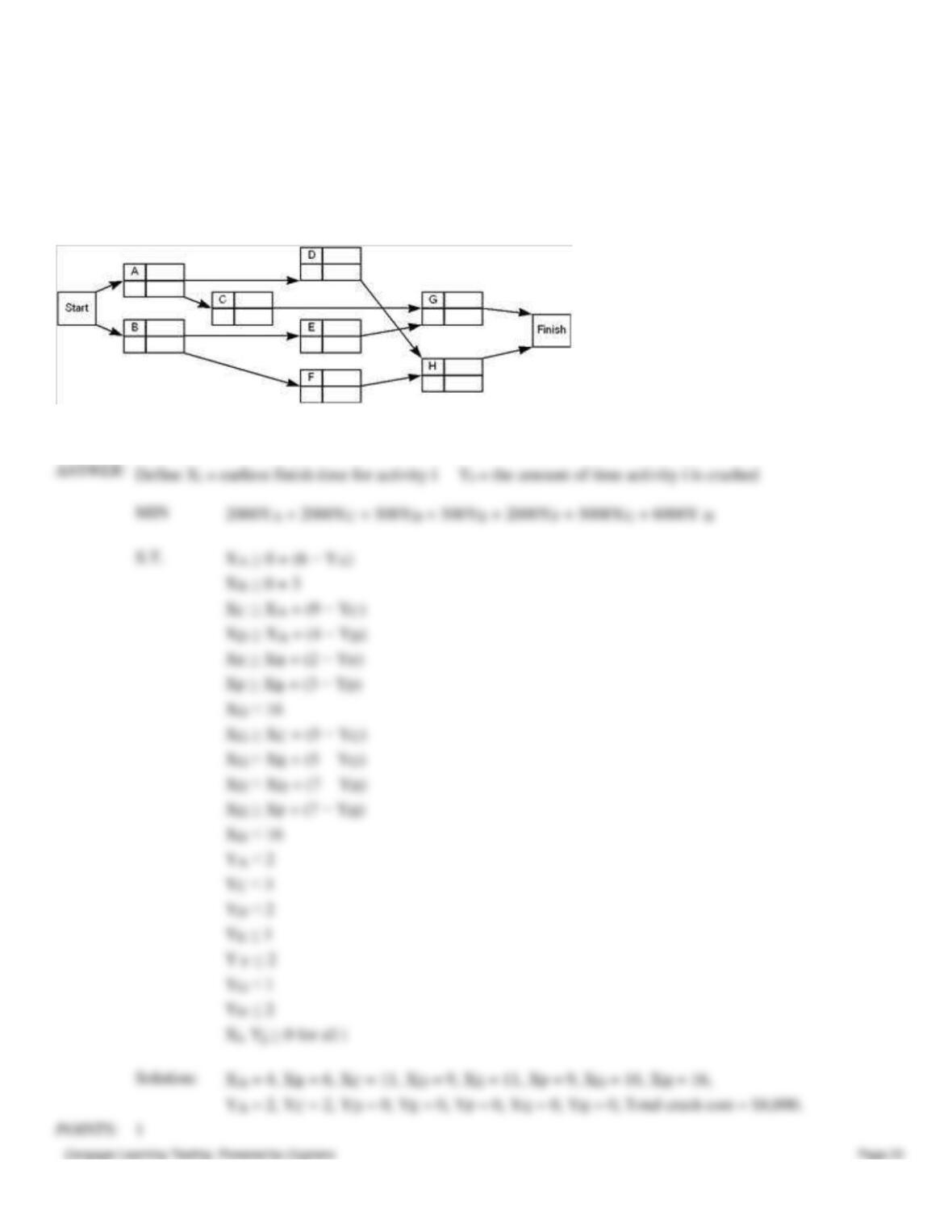
57. Joseph King has ambitions to be mayor of Williston, North Dakota. Joe has determined the breakdown of the steps to
the nomination and has estimated normal and crash costs and times for the campaign as follows (times are in weeks).
Normal
Crash
Immediate
Activity
Time
Cost
Time
Cost
Predecessors
A.
Solicit Volunteers
6
$5,000
4
$ 9,000
—
Chapter 9 – Project Scheduling: PERT/CPM
B.
Initial “Free” Exposure
3
$4,000
3
$ 4,000
—
C.
Raise Money
9
$4,000
6
$10,000
A
D.
Organize Schedule
4
$1,000
2
$ 2,000
A
E.
Hire Advertising Firm
2
$1,500
1
$ 2,000
B
F.
Arrange TV Interview
3
$4,000
1
$ 8,000
B
G.
Advertising Campaign
5
$7,000
4
$12,000
C, E
H.
Personal Campaigning
7
$8,000
5
$20,000
D, F
Joe King is not a wealthy man and would like to organize a 16-week campaign at minimum cost. Write and solve a linear
program to accomplish this task.
Chapter 9 – Project Scheduling: PERT/CPM
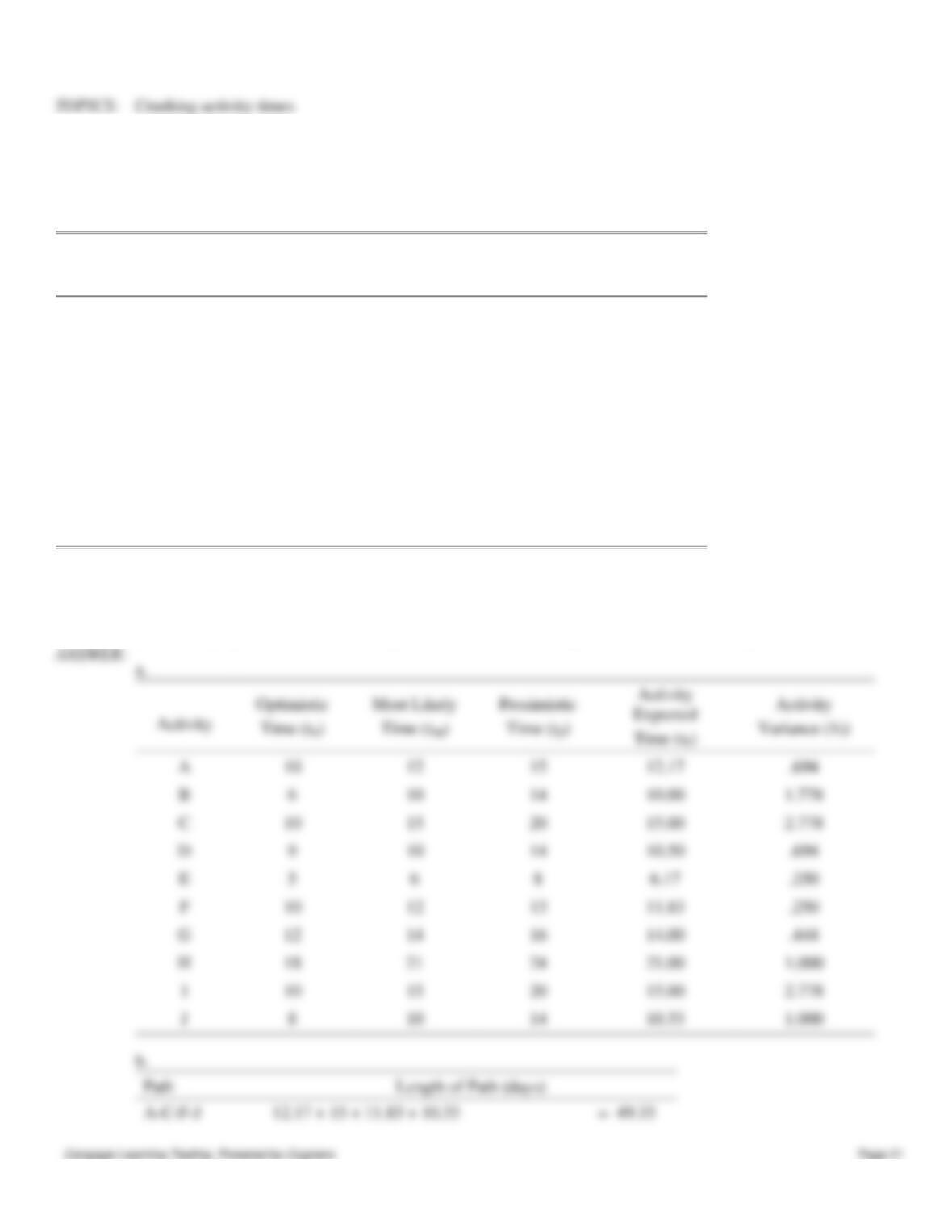
58. Marcy Fetter, a staff analyst at the Los Angeles plant of Computer Products Corporation, is assigned to the team that
is developing the process design for producing an RFID sensor. The corporate planning group in San Jose, California has
contacted her and has asked how confident the design group is about completing the project in 60 days. She has
developed these estimated time durations in days for the project:
Activity
Immediate
Predecessor
Activities
Optimistic
Time (to)
Most Likely
Time (tm)
Pessimistic
Time (tp)
A
—
10
12
15
B
A
6
10
14
C
A
10
15
20
D
A
9
9
18
E
B
5
6
8
F
C,E
10
12
13
G
B
12
14
16
H
B,D
18
21
24
I
B,D
10
15
20
J
F.G.H
8
10
14
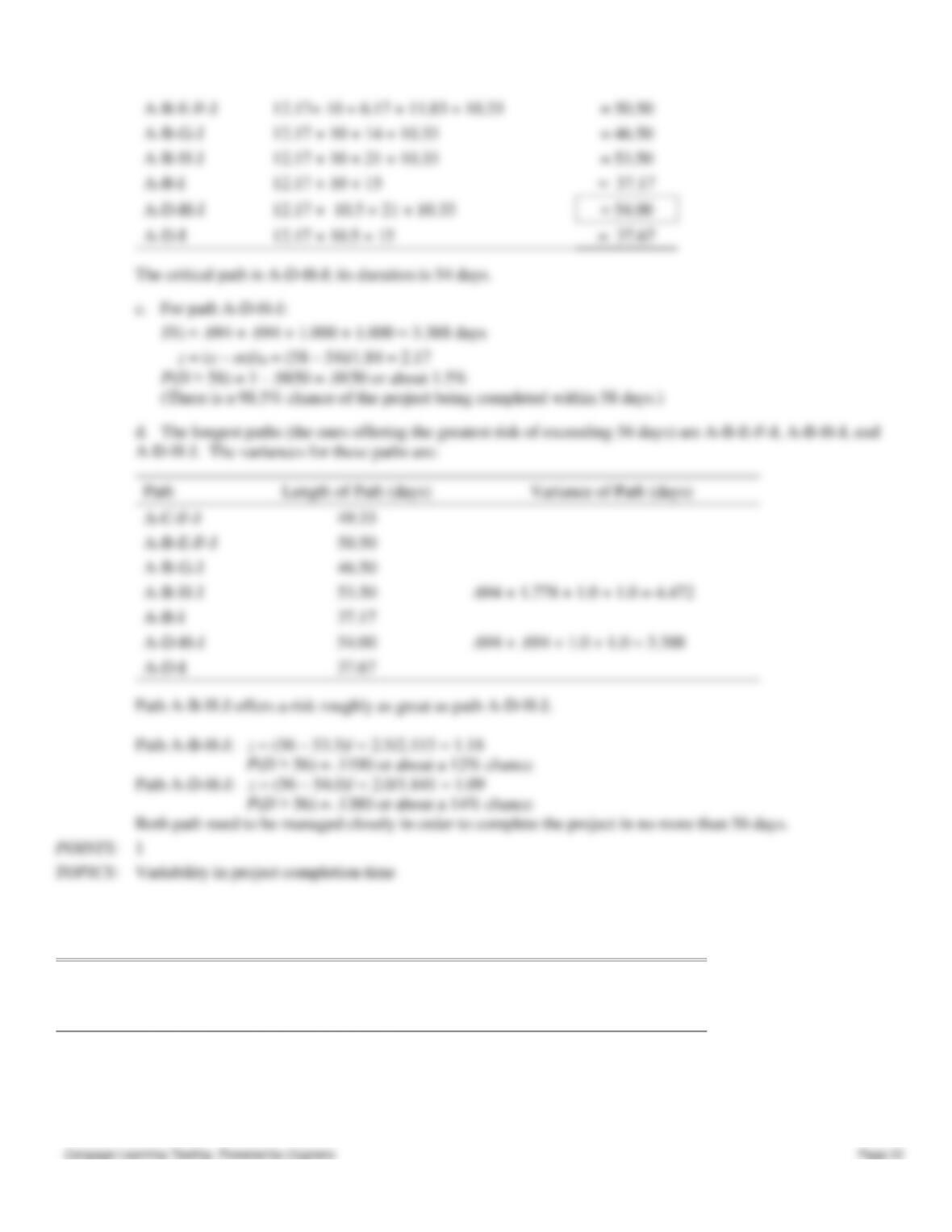
a. Compute the expected time and variance for each activity.
b. Determine the critical path and the expected duration of the project.
c. What is the probability that the project will take longer than 58 days to complete?
d. Which path in the project network offers the greatest risk of overrunning a new deadline of 56 days?
Chapter 9 – Project Scheduling: PERT/CPM
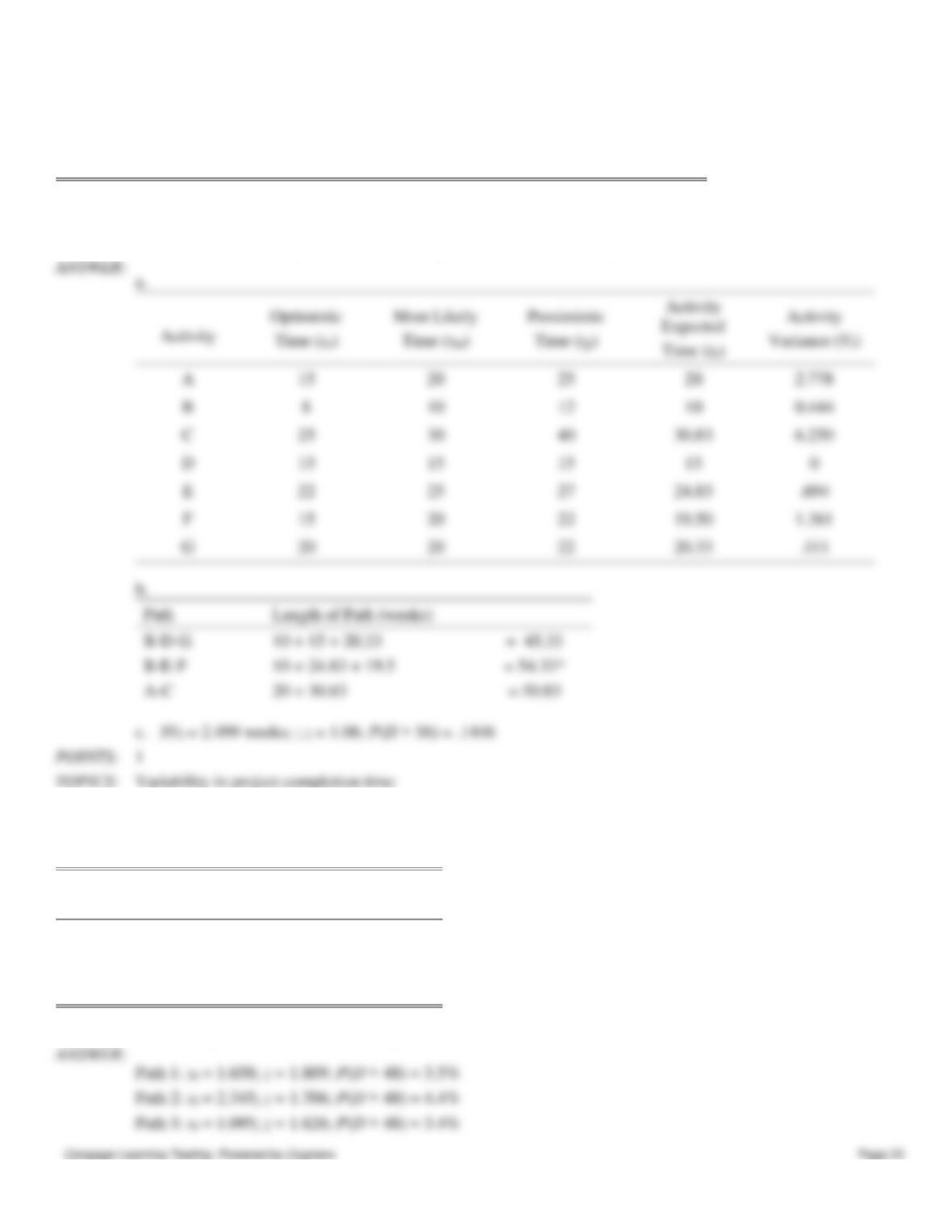
59.
A project has the following activities, precedence relationships, and time estimates in weeks:
Activity
Immediate
Predecessor
Activities
Optimistic
Time (to)
Most Likely
Time (tm)
Pessimistic
Time (tp)
A
—
15
20
25
B
—
8
10
12
C
A
25
30
40
D
B
15
15
15
Chapter 9 – Project Scheduling: PERT/CPM
E
B
22
25
27
F
E
15
20
22
G
D
20
20
22
a. Compute the expected time and variance for each activity.
b. Determine the critical path and the expected duration of the project.
c. What is the probability that the project will take longer than 56 weeks to complete?
60.
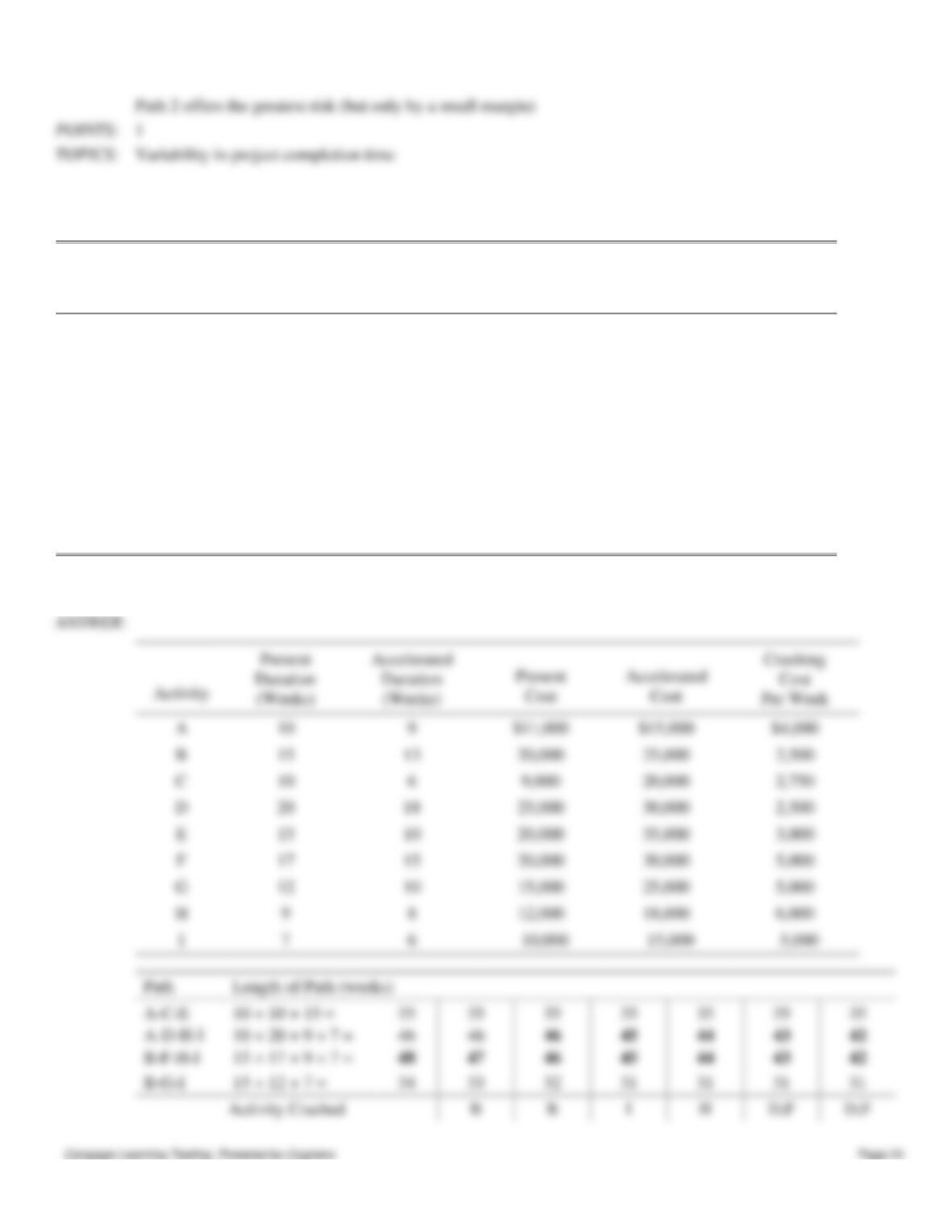
Three paths of a PERT network have these mean durations and variances in weeks:
Path
Mean
Duration
Variance
1
45
2.75
2
44
5.50
3
46
1.20
Which path offers the greatest risk of overrunning a contract deadline of 48 weeks?
Chapter 9 – Project Scheduling: PERT/CPM
61.
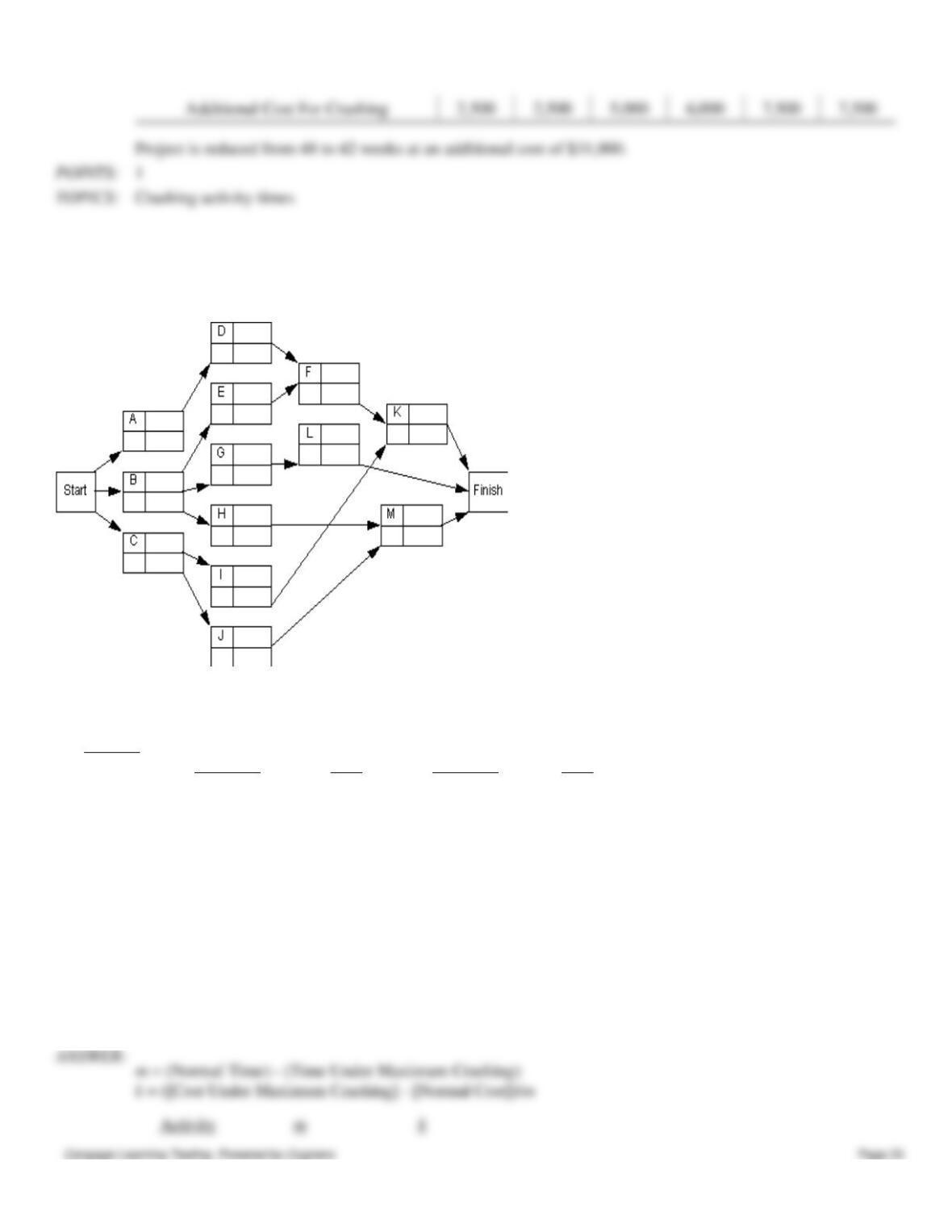
A project has the following activities, durations, costs, and precedence relationships:
Activity
Present Duration
(Weeks)
Accelerated
Duration
(Weeks)
Immediate
Predecessor
Activities
Present
Cost
Accelerated
Cost
A
10
9
—
$11,000
$15,000
B
15
13
—
20,000
25,000
C
10
6
A
9,000
20,000
D
20
18
A
25,000
30,000
E
15
10
C
20,000
35,000
F
17
15
B
20,000
30,000
G
12
10
B
15,000
25,000
H
9
8
D,F
12,000
18,000
I
7
6
G,H
10,000
15,000
Develop a cost-time trade-off analysis. Detail the steps that you would use to accelerate or crash the project to its
minimum duration at the lowest cost. Determine each step’s cost and the duration of the project.
A
D
G
H
Chapter 9 – Project Scheduling: PERT/CPM
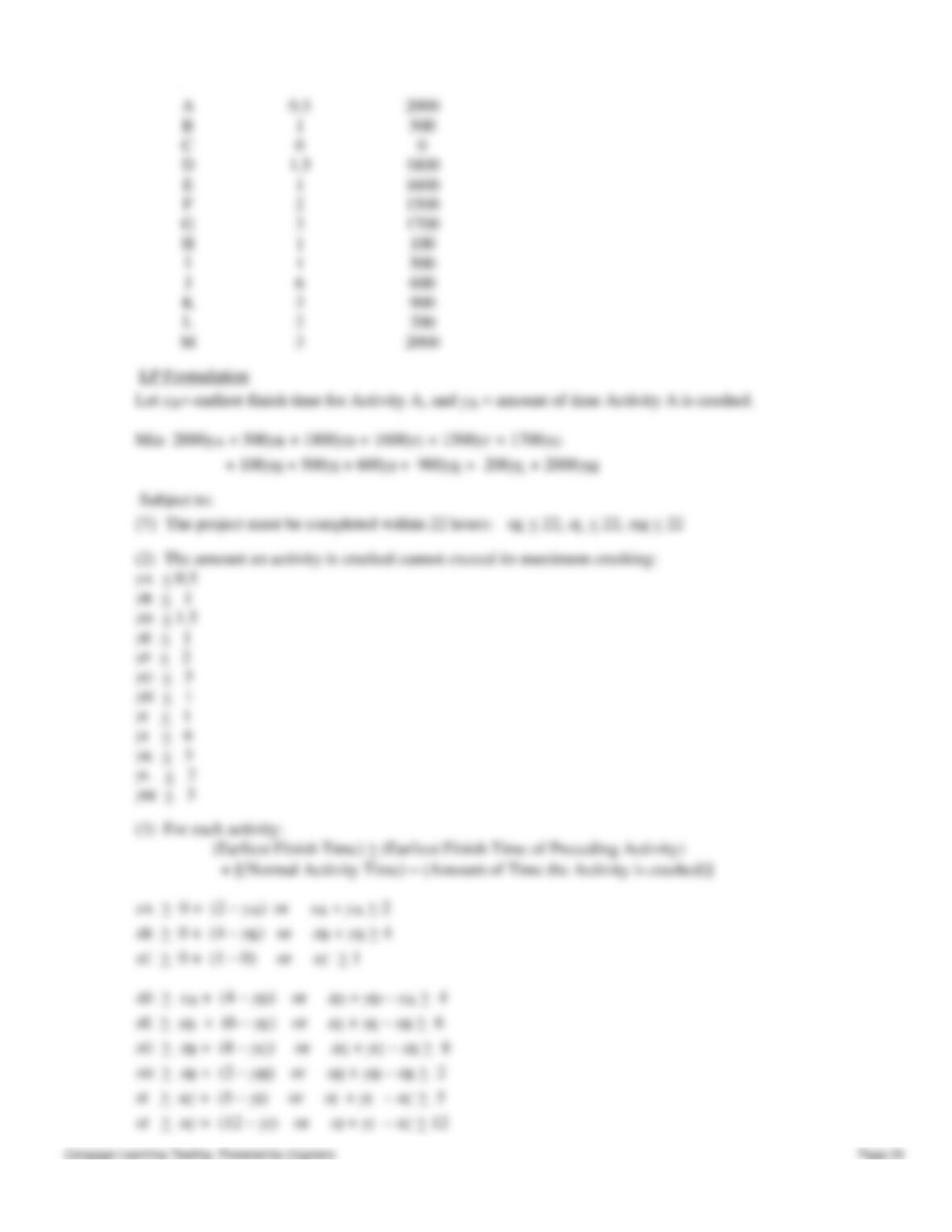
62. National Oil Company (NATOCO) must plan the shutdown of its Houston refinery for routine preventive
maintenance. Each hour of downtime is lost production time and is very costly, so NATOCO wants the maintenance
project completed in 22 hours. The PERT network below shows the precedence relationships of the activities involved in
the project. The table gives the activity times and costs under normal operations and maximum crashing.
NATOCO wants to know the minimum cost of completing the maintenance project within the 22-hour period. Formulate
and solve a linear program that will yield this information.
Activity
Normal
Time (hr)
Normal
Cost
Crash
Time (hr)
Crash
Cost
A
2
$2,000
1.5
$3,000
B
4
3,000
3
3,500
C
1
1,500
1
1,500
D
4
5,300
2.5
8,000
E
6
5,400
5
7,000
F
10
6,000
8
9,000
G
8
4,800
5
9,900
H
2
2,800
1
2,900
I
5
4,500
4
5,000
J
12
6,000
6
9,600
K
7
7,000
4
9,700
L
11
8,800
9
9,200
M
4
1,000
1
7,000
Chapter 9 – Project Scheduling: PERT/CPM

Chapter 9 – Project Scheduling: PERT/CPM
Essay

Chapter 9 – Project Scheduling: PERT/CPM
63. Name at least three managerial situations where answers are provided by project management solutions.
64. Explain how and why all predecessor activities must be considered when finding the earliest start time.
65. Explain how and why all successor activities must be considered when finding the latest finish time.
66. Once the earliest and latest times are calculated, how is the critical path determined?
67. Why should projects be monitored after the critical path is found?
68. Suppose that, after analyzing a project network, the project manager finds the project duration
unacceptable. Discuss the options the manager might have for reducing the duration.