
Chapter 9 – Project Scheduling: PERT/CPM
True / False
1. Critical activities are those that can be delayed without delaying the entire project.
a.
True
b.
False
False
Introduction
2. PERT and CPM are applicable only when there is no dependence among activities.
a.
True
b.
False
False
Introduction
3. A path through a project network must reach every node.
a.
True
b.
False
False
Critical path
4. A critical activity can be part of a noncritical path.
a.
True
b.
False
True
Critical path
5. When activity times are uncertain, an activity’s most likely time is the same as its expected time.
a.
True
b.
False
False
Variability in project completion time
6. The earliest finish time for the final activity is the project duration.
a.
True
b.
False
True
Critical path
7. The length of time an activity can be delayed without affecting the project completion time is the slack.

Chapter 9 – Project Scheduling: PERT/CPM
a.
True
b.
False
True
8. When activity times are uncertain, total project time is normally distributed with mean equal to the sum of the means of
all of the critical activities.
a.
True
b.
False
True
9. Crashing refers to an unanticipated delay in a critical path activity that causes the total time to exceed its limit.
a.
True
b.
False
False
10. Constraints in the LP models for crashing decisions are required to compare the activity‘s earliest finish time with the
earliest finish time of each predecessor.
a.
True
b.
False
True
11. The project manager should monitor the progress of any activity with a large time variance even if the expected time
does not identify the activity as a critical activity.
a.
True
b.
False
True
12. The variance in the project completion time is the sum of the variances of all activities in the project.
a.
True
b.
False
False
13. The latest finish time for an activity is the largest of the latest start times for all activities that immediately follow the
activity.

Chapter 9 – Project Scheduling: PERT/CPM
a.
True
b.
False
False
14. The earliest start time for an activity is equal to the smallest of the earliest finish times for all its immediate
predecessors.
a.
True
b.
False
False
15. The linear programming model for crashing presented in the textbook assumes that any portion of the activity crash
time can be achieved for a corresponding portion of the activity crashing cost.
a.
True
b.
False
True
16. All activities on a critical path have zero slack time.
a.
True
b.
False
True
17. The difference between an activity’s earliest finish time and latest finish time equals the difference between its earliest
start time and latest start time.
a.
True
b.
False
True
18. It is possible to have more than one critical path at a time.
a.
True
b.
False
True
19. Activities require time to complete while events do not.
a.
True

Chapter 9 – Project Scheduling: PERT/CPM
b.
False
True
Critical path
20. Precedence relationships among activities is critical in CPM analysis but not in PERT.
a.
True
b.
False
False
Critical path
21. The normal distribution tends to be a better approximation of the distribution of total time for shorter projects where
the critical path has relatively few activities.
a.
True
b.
False
False
Variability in project completion time
Multiple Choice
22. PERT and CPM
a.
are most valuable when a small number of activities must be scheduled.
b.
have different features and are not applied to the same situation.
c.
do not require a chronological relationship among activities.
d.
have been combined to develop a procedure that uses the best of each.
Introduction
23. Which is not a significant challenge of project scheduling?
a.
deadlines exist.
b.
activities are independent.
c.
many employees could be required.
d.
delays are costly.
Introduction
24. Arcs in a project network indicate
a.
completion times.
b.
precedence relationships.
c.
activities.
d.
the critical path.

Chapter 9 – Project Scheduling: PERT/CPM
Critical path
25. The critical path
a.
is any path that goes from the starting node to the completion node.
b.
is a combination of all paths.
c.
is the shortest path.
d.
is the longest path.
Critical path
26. The earliest start time rule
a.
compares the starting times of all activities for successors of an activity.
b.
compares the finish times for all immediate predecessors of an activity.
c.
determines when the project can begin.
d.
determines when the project must begin.
Critical path
27. Activities following a node
a.
can begin as soon as any activity preceding the node has been completed.
b.
have an earliest start time equal to the largest of the earliest finish times for all activities entering the node.
c.
have a latest start time equal to the largest of the earliest finish times for all activities entering the node.
d.
None of the alternatives is correct.
Critical path
28. Activities G, P, and R are the immediate predecessors for activity W. If the earliest finish times for the three are 12,
15, and 10, then the earliest start time for W
a.
is 10.
b.
is 12.
c.
is 15.
d.
cannot be determined.
Critical path
29. Activities K, M and S immediately follow activity H, and their latest start times are 14, 18, and 11. The latest finish
time for activity H
a.
is 11.
b.
is 14.

Chapter 9 – Project Scheduling: PERT/CPM
c.
is 18.
d.
cannot be determined.
Critical path
30. When activity times are uncertain,
a.
assume they are normally distributed.
b.
calculate the expected time, using (a + 4m + b)/6.
c.
use the most likely time.
d.
calculate the expected time, using (a + m + b)/3.
Uncertain activity times
31. To determine how to crash activity times
a.
normal activity costs and costs under maximum crashing must be known.
b.
shortest times with crashing must be known.
c.
realize that new paths may become critical.
d.
All of the alternatives are true.
Crashing activity times
32. Slack equals
a.
LF − EF.
b.
EF − LF.
c.
EF − LS.
d.
LF − ES.
Determining the critical path
33. Activities with zero slack
a.
can be delayed.
b.
must be completed first.
c.
lie on a critical path.
d.
have no predecessors.
Determining the critical path
34. In deciding which activities to crash, one must
a.
crash all critical activities.
b.
crash largest-duration activities.

Chapter 9 – Project Scheduling: PERT/CPM
c.
crash lowest-cost activities.
d.
crash activities on the critical path(s) only.
Crashing activity times
35. For an activity with more than one immediate predecessor activity, which of the following is used to compute its
earliest finish (EF) time?
a.
the largest EF among the immediate predecessors.
b.
the average EF among the immediate predecessors.
c.
the largest LF among the immediate predecessors.
d.
the difference in EF among the immediate predecessors.
Determining the critical path
36. Which of the following is always true about a critical activity?
a.
LS = EF.
b.
LF = LS.
c.
ES = LS.
d.
EF = ES.
37. For an activity with more than one immediate successor activity, its latest-finish time is equal to the
a.
largest latest-finish time among its immediate successors.
b.
smallest latest-finish time among its immediate successors.
c.
largest latest-start time among its immediate successors.
d.
smallest latest-start time among its immediate successors.
Determining the critical path
38. Which of the following is a general rule for crashing activities?
a.
Crash only non-critical activities.
b.
Crash activities with zero slack.
c.
Crash activities with the greatest number of predecessors.
d.
Crash the path with the fewest activities.
Crashing activity times
39. To calculate an activity’s latest finish time, you should consider its
a.
predecessors’ latest finish times

Chapter 9 – Project Scheduling: PERT/CPM
b.
predecessors’ latest start times
c.
successors’ earliest start times
d.
successors’ latest start times
Earliest/latest start/finish times
40. A critical activity is
a.
an activity that consumes no time but shows precedence between events.
b.
a milestone accomplishment within the project.
c.
an activity with zero slack.
d.
the beginning of an event.
Critical path
41. The main difference between CPM and PERT is
a.
the use of different activity time estimates.
b.
PERT analysis is less expensive to conduct.
c.
PERT lends itself to computerization while CPM networks must be constructed manually.
d.
CPM integrates time and cost performance while PERT is based solely on time performance.
Uncertain activity times
42. In PERT, the activity duration time is equal to the
a.
pessimistic time.
b.
optimistic time.
c.
most likely time.
d.
mean duration.
Uncertain activity times
Subjective Short Answer
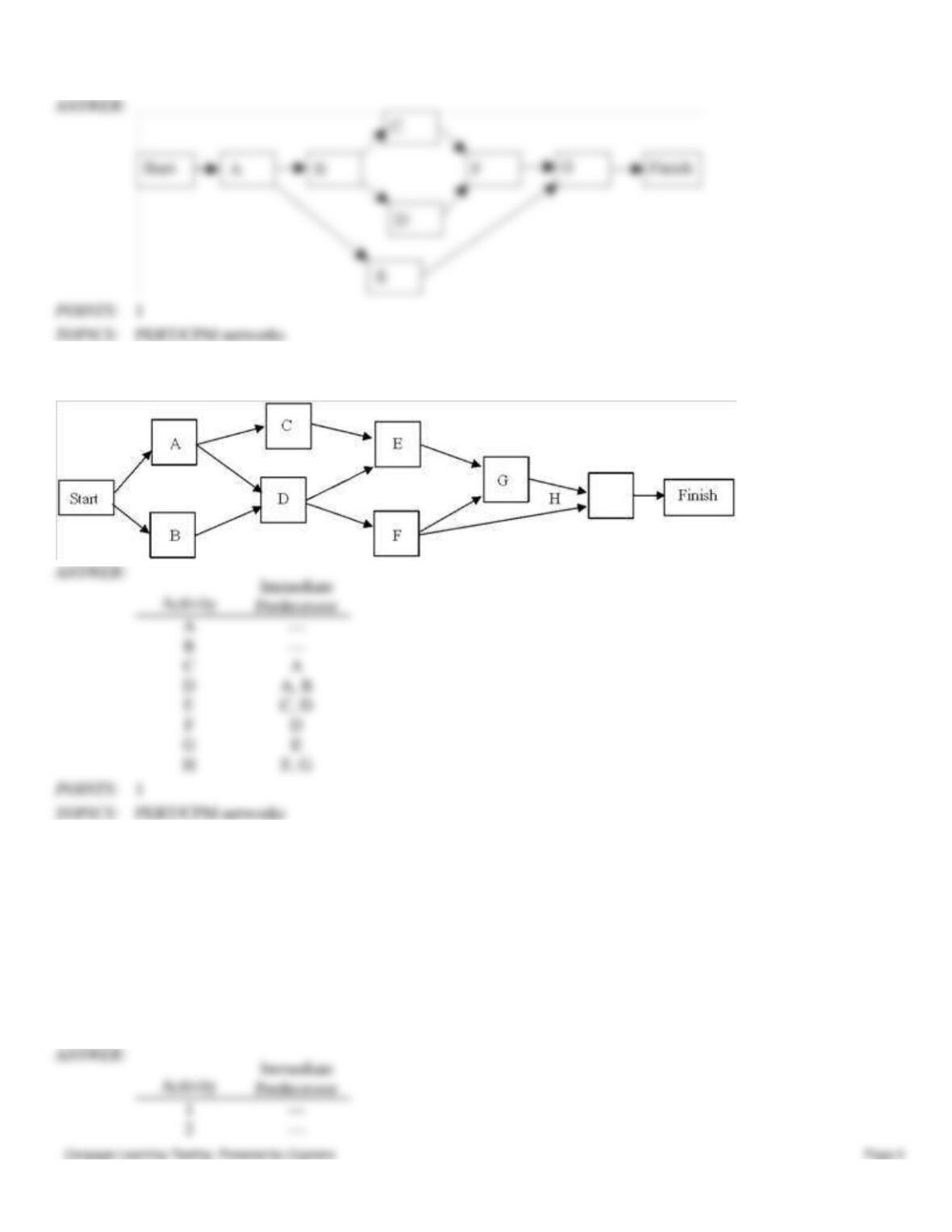
43. From this schedule of activities, draw the PERT/CPM network.
Activity
Immediate
Predecessor
A
—
B
A
C
B
D
B
E
A
F
C, D
G
E, F
Chapter 9 – Project Scheduling: PERT/CPM
PERT/CPM networks
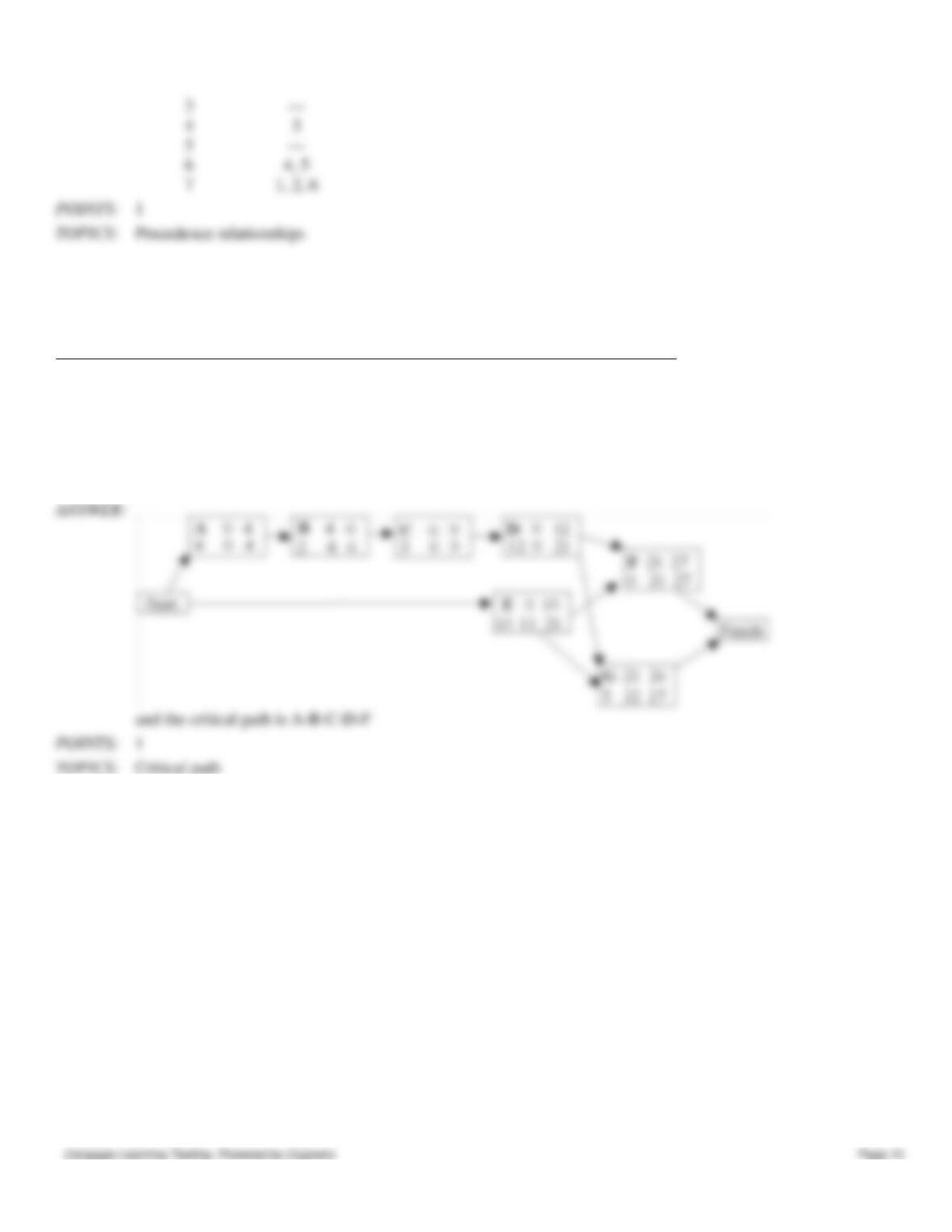
44. From this PERT/CPM network, determine the list of activities and their predecessors.
PERT/CPM networks
45. A cookie recipe gives the following numbered steps.
1.
Preheat oven.
2.
Grease cookie sheets.
3.
Cream shortening and sugar.
4.
Add eggs and flavoring.
5.
Measure and sift dry ingredients.
6.
Add dry ingredients to mixture.
7.
Drop by spoonfuls onto sheets and bake for 10 minutes.
Although the steps are numbered, they do not always reflect immediate precedence relationships. Develop a table that lists
the immediate predecessors for each activity.
Chapter 9 – Project Scheduling: PERT/CPM
46. A senior MIS design class project team has developed the following schedule of activities for their project, using their
best estimate of completion times. Both written and oral reports are required. Draw the project network. Can they
complete the project in the 38 class days remaining until the end of the semester?
Activity
Time
Immediate Predecessor
A.
Find client
4
—
B.
Write prospectus
2
A
C.
Obtain approval from client and professor
3
B
D.
Complete programming
12
C
E.
Do industry background research
10
—
F.
Write final paper
6
D, E
G.
Write oral report
5
D, E
Critical path
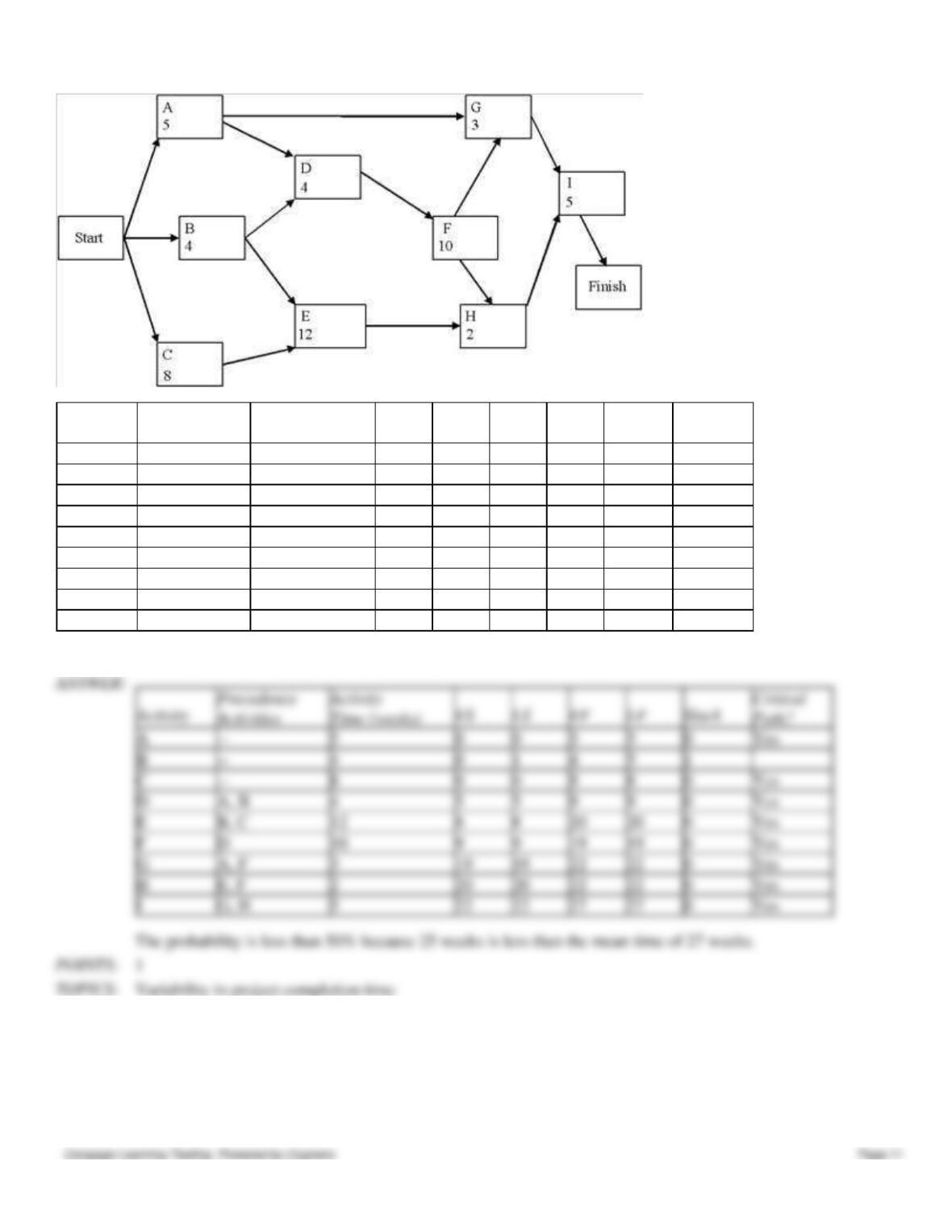
47. A project network is shown below. Use a forward and a backward pass to determine the critical path, and then fill out
the table below. Activity times are in weeks.
Precedence relationships
Chapter 9 – Project Scheduling: PERT/CPM
Activity
Precedence
Activities
Activity
Time (weeks)
ES
LS
EF
LF
Slack
Critical
Path?
A
B
C
D
E
F
G
H
I
Now assume that the times listed are only the expected times instead of being fixed times. Is the probability of being
finished in fewer than 25 weeks more or less than 50%?
Variability in project completion time
48. A project network is shown below. Use a forward and a backward pass to determine the critical path, and then fill out
the table below. Activity times are in weeks.
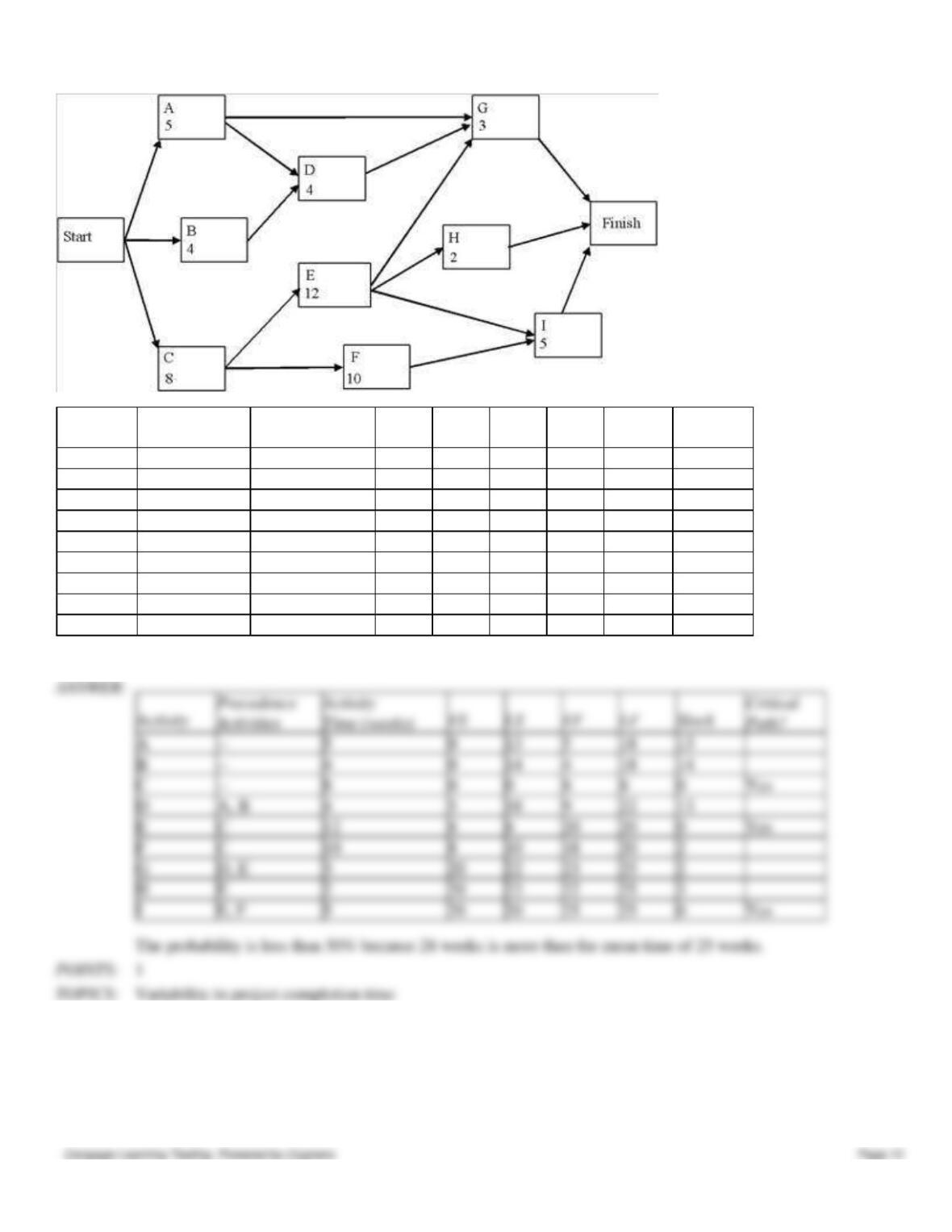
Chapter 9 – Project Scheduling: PERT/CPM
Activity
Precedence
Activities
Activity
Time (weeks)
ES
LS
EF
LF
Slack
Critical
Path?
A
B
C
D
E
F
G
H
I
Now assume that the times listed are only the expected times instead of being fixed times. Is the probability of being
finished in more than 28 weeks more or less than 50%?
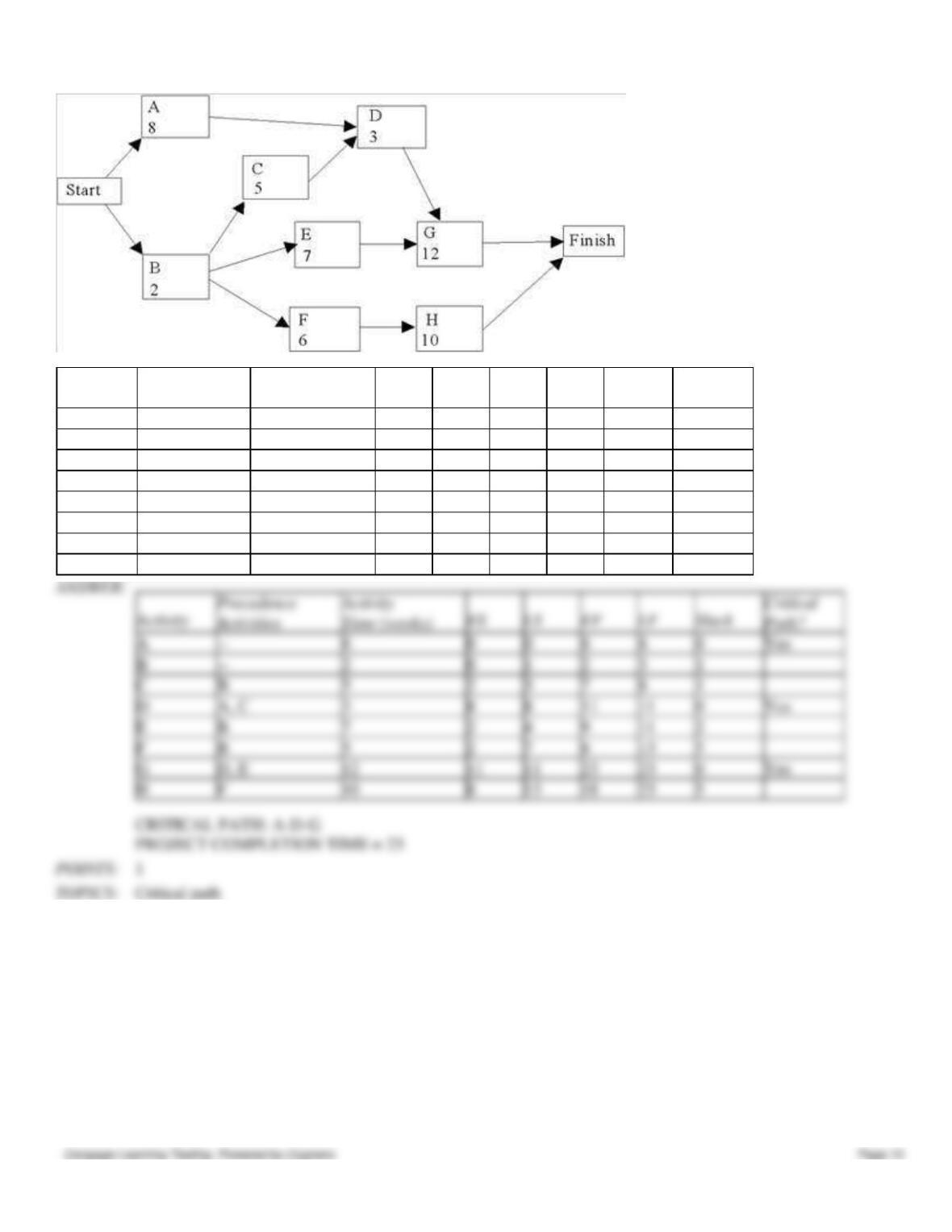
49. Use the following network of related activities with their duration times (weeks) to complete a row for each activity
under the column headings below.
Chapter 9 – Project Scheduling: PERT/CPM
Activity
Immediate
Predecessors
Activity
Time (weeks)
ES
LS
EF
LF
Slack
Critical
Path?
A
B
C
D
E
F
G
H
PROJECT COMPLETION TIME = 23
Critical path
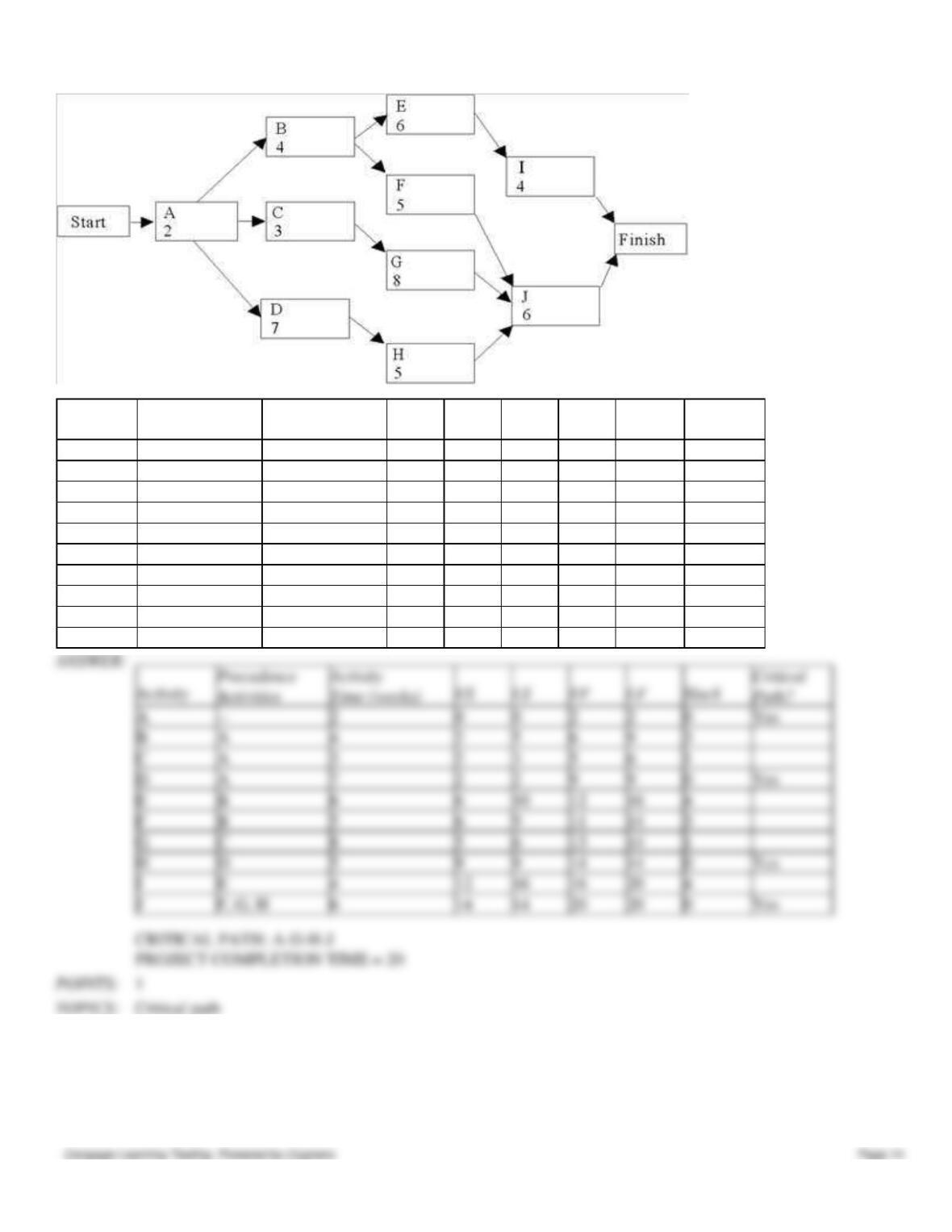
50. Use the following network of related activities with their duration times (weeks) to complete a row for each activity
under the column headings below.
Chapter 9 – Project Scheduling: PERT/CPM
Activity
Immediate
Predecessors
Activity
Time (weeks)
ES
LS
EF
LF
Slack
Critical
Path?
A
B
C
D
E
F
G
H
I
J
PROJECT COMPLETION TIME = 20
Critical path
51. Given the following network with activities and times estimated in days,