
117)
4+2
x
x
4+1
8
A)
x
16
B)
16
C)
16
x
D)
1
118)
5+1
3
4–2
27
A)
216
53
B)
144
53
C)
72
53
D)
108
53
119)
1
7–1
y
7– y
7
A)
1
y
B)
–7
y
C)
–1
y
D)
–y
120)
2
2x3–3
8x
3
4x +3
2x3
A)
8–3x2
6x2+12
B)
8+3x2
6x2+4
C)
8–6x2
6x2+12
D)
2–3x2
2x2–12
121)
1
m+1
z
1
m–1
z
A)
z + m
m
B)
z + m
z – m
C)
z – m
z
D)
z + m
z

122)
1
x2–16
y2
5y –20x
A)
y2+4x
5x2
B)
y +4x
5x2y2
C)
5x –20y2
D)
x +4y
5x2y
123)
x
3y –5
6y3
5
6y3–x
3y
A)
1
B)
–1
C)
2xy2–5
5– 2xy2
D)
2xy2–5
2xy2+5
124)
x + 6 +9
x
x + 8 +15
x
A)
(x + 3)2
x + 5
B)
x2+ 6x + 9
x2+ 8x + 15
C)
x + 3
x + 5
D)
x + 3
x2+ 5x
125)
6
x + 2 +1
x
4
x + 2 +3
x
A)
1
B)
7x +2
7x +6
C)
7x + 2
7x
D)
7x +12
7x +8
Solve the equation.
126)
7
x=6
x+6
A)
1
6
B)
6
13
C)
1
13
D)
6
127)
3
x+7
8= 1
A)
5
4
B)
8
C)
10
D)
24

128)
23
x=8–1
x
A)
4
11
B)
2
C)
3
D)
23
8
129)
x
3–x
8=7
A)
168
5
B)
21
C)
56
D)
24
130)
x +
40
x=14
A)
14, 40
B)
10, 4
C)
-10, -4
D)
40
131)
x
3–3
x= 0
A)
–3, 3
B)
3
C)
–3, 0, 3
D)
No solution
132)
x –2
x +4=
1
5
A)
3
2
B)
– 3
2
C)
7
3
D)
7
2
133)
1
x + 6 =2
x – 1
A)
– 7
B)
– 13
C)
13
3
D)
– 11
134)
x + 3
4–x – 3
7= 1
A)
– 32
3
B)
19
3
C)
– 5
3
D)
5
11
135)
9
x + 5 =6
x
A)
– 10
B)
2
C)
1
10
D)
10

136)
x
x –2–5=2
x –2
A)
–2
B)
– 1
2
C)
No solution
D)
2
137)
3
y=y
8y –45
A)
–15 , 9
B)
15 ,–9
C)
–15 ,–9
D)
15 , 9
138)
2
t=t
7t –24
A)
7, 12
B)
2, 7
C)
8, 6
D)
0, 7
139)
x – 6
x –4=7
4– x
A)
13
B)
1
C)
-1
D)
-13
140)
4
x –1+4
2x –2=6
A)
1
B)
2
C)
0
D)
24
141)
–2 x
3x +3=7 x
6x +6+2x –1
x +1
A)
6
B)
6
23
C)
1
23
D)
– 6
23
142)
7
y + 2 –9
y – 2 =4
y2– 4
A)
63
B)
-18
C)
18
D)
36
143)
–2
m –3–2
m +3=12
m2–9
A)
-3
B)
3
C)
12
D)
7
144)
6
x – 6 =x
x – 6
A)
6
B)
0
C)
No solution
D)
-6

145)
5
10 – x =5– x
x –10
A)
No solution
B)
0
C)
5
D)
10
146)
4
y + 2 –6
y – 2 =14
y2– 4
A)
14
B)
34
C)
-17
D)
17
147)
y + 1
y + 6 –y
y2– 36
=y – 3
y – 6
A)
4
5
B)
1
C)
4
3
D)
3
4
148)
x
x +2–2
x –2=x2+4
x2–4
A)
–2, 2
B)
–2
C)
2
D)
No solution
Solve the problem.
149)
Martha can rake the leaves in her yard in 2 hours. Her younger brother can do the job in 3 hours. How long will
it take them to do the job if they work together?
A)
6
5 hr
B)
6 hr
C)
5
6 hr
D)
3 hr
150)
Frank can type a report in 4 hours and James takes 7 hours. How long will it take the two of them typing
together?
A)
11
28 hr
B)
7 hr
C)
28
3 hr
D)
28
11 hr
151)
A contractor finds that it takes Sam Tockett 9 hours to construct a wall of a certain size. It takes Jim Lowell 6
hours to construct the same wall. How long would it take if they worked together?
A)
5
18 of an hour
B)
33
5 hours
C)
1 hour
D)
15 hours
152)
The Epson Stylus 850 can print Helen’s class project in 18 minutes. The Epson Stylus 500 can print the project in
30 minutes. If the two printers work together, how long would they take to print out the project?
A)
11 1
4 minutes
B)
90 minutes
C)
8 minutes
D)
4
45 of a minute

153)
Chuck and Dana agree to meet in Chicago for the weekend. Chuck travels 330 miles in the same time that Dana
travels 300 miles. If Chuck’s rate of travel is 5 mph more than Dana’s, and they travel the same length of time, at
what speed does Chuck travel?
A)
49 mph
B)
50 mph
C)
61 mph
D)
55 mph
154)
Tom Quig traveled 260 miles east of St. Louis. For most of the trip he averaged 60 mph, but for one period of
time he was slowed to 20 mph due to a major accident. If the total time of travel was 7 hours, how many miles
did he drive at the reduced speed?
A)
100 miles
B)
75 miles
C)
80 miles
D)
90 miles
155)
A man rode a bicycle for 12 miles and then hiked an additional 8 miles. The total time for the trip was 5 hours. If
his rate when he was riding a bicycle was 10 miles per hour faster than his rate walking, what was each rate?
A)
Bike: 12 mph
Hike: 2 mph
B)
Bike: 11.5 mph
Hike: 1.5 mph
C)
Bike: 14.5 mph
Hike: 4.5 mph
D)
Bike: 13 mph
Hike: 3 mph
156)
A loaded moving truck is traveling 25 mph faster than a freight train. In the time it takes the train to travel 90
miles, the truck travels 140 miles. Find the speed of the truck.
A)
14 mph
B)
140 mph
C)
70 mph
D)
25 mph
157)
Fred bicycles 6 km/h slower than Samantha. In the time it takes Fred to bicycle 22 km, Samantha travels 34 km.
How fast does Fred bicycle?
A)
22 km/h
B)
17 km/h
C)
11 km/h
D)
5 km/h
Find the ratio. Simplify, if possible.
158)
If Alison’s company charged $189.99 for 9 hours of work, how much did they charge per hour?
A)
$30.11/hour
B)
$9.00/hour
C)
$23.75/hour
D)
$21.11/hour
159)
David’s paycheck for a week at the video store was $135.43. If he worked 29 hours that week, what was his pay
rate?
A)
$4.63/hour
B)
$4.38/hour
C)
$4.84/hour
D)
$4.67/hour
160)
Mara can type 2040 words in 2
3 hour (40 minutes). How many words per minute can she type?
A)
1360 words/minute
B)
77 words/minute
C)
51 words/minute
D)
34 words/minute
161)
A machine can fill 4626 boxes of cereal in 0.6 hour. How many boxes of cereal can it fill per hour?
A)
7710 boxes/hour
B)
6609 boxes/hour
C)
2776 boxes/hour
D)
4627 boxes/hour

Solve the problem.
162)
Dr. Wong can see 8 patients in 2 hours. At this rate, how long would it take her to see 48 patients?
A)
11 hours
B)
192 hours
C)
12 hours
D)
16 hours
163)
Maria and Charlie can deliver 100 papers in 2 hours. How long would it take them to deliver 105 papers?
A)
210 hours
B)
3.2 hours
C)
1.9 hours
D)
2.1 hours
164)
Sven can type 48 words per minute. How many words would he type in 2
3 hour (40 minutes)?
A)
32 words
B)
1280 words
C)
1920 words
D)
72 words
165)
A machine can fill 4551 cartons of milk in 0.6 hour. How many cartons of milk can it fill per hour?
A)
2731 cartons
B)
6501 cartons
C)
4552 cartons
D)
7585 cartons
166)
In a cake recipe, the ratio of milk to flour is 5
11 . If 4 cups of milk are used, how many cups of flour are used?
A)
20
11 cups
B)
55
4 cups
C)
5
44 cups
D)
44
5 cups
167)
To determine the number of fish in a lake, a park ranger catches 280 fish, tags them, and returns them to the
lake. Later, 108 fish are caught, and it is found that 30 of them are tagged. Estimate the number of fish in the
lake.
A)
78
B)
12
C)
907,200
D)
1008
168)
A quality–control inspector examined 290 calculators and found 14 of them to be defective. At this rate, how
many defective calculators will there be in a batch of 27,840 calculators?
A)
96
B)
4060
C)
7
D)
1344
169)
The ratio of the weight of an object on Mars to the weight of an object on Earth is 0.4 to 1. How much will a
160–pound astronaut weigh on Mars?
A)
40 pounds
B)
64 pounds
C)
400 pounds
D)
250 pounds
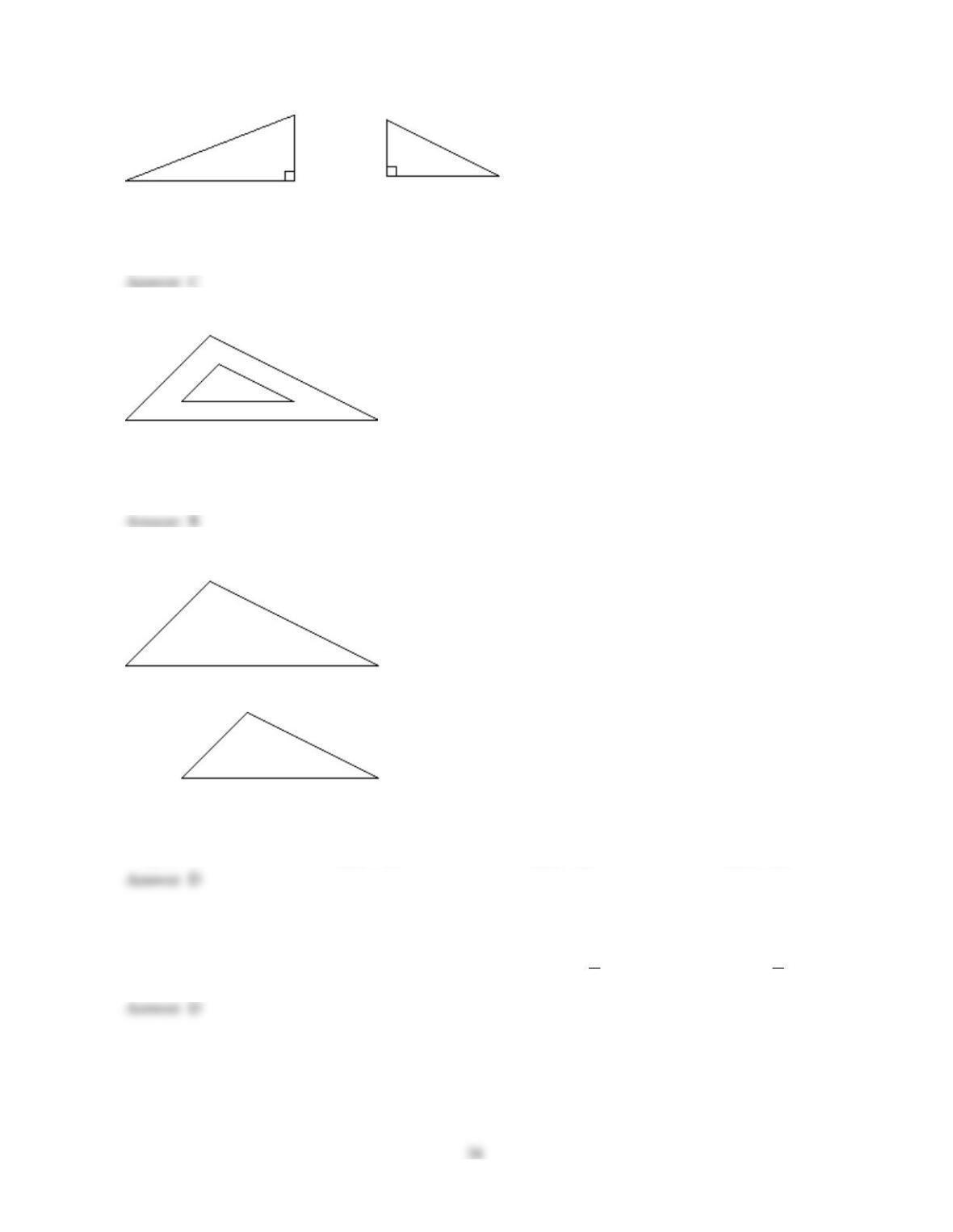
For the pair of similar triangles, find the length of the indicated side.
170)
In the left triangle, the hypotenuse has length 39, and the longer leg has length 36. In the right triangle, the
hypotenuse has length 13, the longer leg has length 12, and the shorter leg has length 5. Find the length, x, of the
shorter leg of the left triangle.
A)
x =5
B)
x =9
C)
x =15
D)
x =20
171)
In the outer triangle, the shortest side has length 12, and the middle side has length 15. In the inner triangle, the
shortest side has length 4, the middle side has length 5, and the longest side has length 6. Find the length, x, of
the longest side of the outer triangle.
A)
x =20
B)
x =18
C)
x =6
D)
x =24
172)
In the upper triangle, the shortest side has length 12, and the middle side has length 18. In the lower triangle,
the shortest side has length 8, the middle side has length 12, and the longest side has length 16. Find the length,
x, of the longest side of the upper triangle.
A)
x =30
B)
x =16
C)
x =23
D)
x =24
Find the equation of variation if the following is true.
173)
Suppose that y varies directly as z and y =40 when z =240.
A)
y = – 2z
B)
y =6z
C)
y = – 1
2z
D)
y =1
6z

174)
Suppose m varies directly as p and m =36 when p =9.
A)
m =45p
B)
m =
1
4p
C)
m =27p
D)
m =4p
175)
Suppose y varies directly as x and y =0.9 when x =0.1.
A)
y =9x
B)
y =1x
C)
y =1
9x
D)
y =0.8x
176)
Suppose p varies directly as q and p = 1 when q =1
11 .
A)
p =12q
B)
p =11q
C)
p =1
11 q
D)
p =10q
177)
Suppose r varies directly as s and r =0.0714 when s = 1.
A)
r =14s
B)
r =0.0714s
C)
r =15s
D)
r =13s
Solve.
178)
The distance D that a spring is stretched by a hanging object varies directly as the weight W of the object. If a
16–kg object stretches a spring 76 cm, find the distance when the weight is 19–kg. Round to the nearest
hundredths when necessary.
A)
4.75 cm
B)
111 cm
C)
90.25 cm
D)
4 cm
179)
The number G of gears a machine can make varies directly as the time T it operates. If it can make 5258 gears in
11 hours, how many gears can it make in 15 hours?
A)
478 gears
B)
0.0314 gears
C)
5284 gears
D)
7170 gears
180)
According to Ohm‘s law, the electric current I, in amperes, in a circuit varies directly as the voltage V. When 7
volts are applied, the current is 2 amperes. What is the current when 6 volts are applied?
A)
15 amperes
B)
3.5 amperes
C)
21 amperes
D)
1.71 amperes
181)
The weight W of an object on the Moon varies directly as the weight E on earth. A person who weighs 156 lb on
earth weighs 31.2 lb on the Moon. How much would a 152–lb person weigh on the Moon?
A)
339.2 lb
B)
760 lb
C)
30.4 lb
D)
0.2 lb
182)
The time T necessary to make an enlargement of a photo negative varies directly as the area A of the
enlargement. If 225 seconds are required to make a 5–by–5 enlargement, find the time required for a 7–by–8
enlargement.
A)
616 sec
B)
504 sec
C)
448 sec
D)
560 sec

183)
The weight of a liquid varies directly as its volume V. If the weight of the liquid in a cubical container 5 cm on a
side is 375 g, find the weight of the liquid in a cubical container 4 cm on a side.
A)
64 g
B)
192 g
C)
12 g
D)
44 g
Find an equation of variation in which y varies inversely as x and the following is true.
184)
y =30, when x =2
A)
y =32
x
B)
y =15
x
C)
y =15x
D)
y =60
x
185)
y =5, when x =19
A)
y =0.26
x
B)
y =95x
C)
y =95
x
D)
y =24
x
186)
y =21, when x =48
A)
y =0.44
x
B)
y =1008x
C)
y =0.44x
D)
y =1008
x
187)
y =0.3, when x =0.4
A)
y =0.7
x
B)
y =0.12
x
C)
y =0.75x
D)
y =0.75
x
188)
y =5.25, when x =0.24
A)
y =21.88
x
B)
y =1.26
x
C)
y =1.66
x
D)
y =21.88x
189)
y =0.5, when x =24
A)
y =12x
B)
y =15
x
C)
y =13
x
D)
y =12
x
Solve.
190)
The pitch P of a musical tone varies inversely as its wavelength W. One tone has a pitch of 394 vibrations per
second and a wavelength of 11.4 ft. Find the wavelength of another tone that has a pitch of 430 vibrations per
second. Round to the nearest hundredths when necessary.
A)
0.1 ft
B)
10.45 ft
C)
14,861.4 ft
D)
1.05 ft
191)
The current I in an electrical conductor varies inversely as the resistance R of the conductor. The current is 2
amperes when the resistance is 564 ohms. What is the current when the resistance is 336 ohms? Round to the
nearest hundredths when necessary.
A)
0.3 amperes
B)
3.36 amperes
C)
0.84 amperes
D)
1.19 amperes

192)
The number of miles per gallon of gasoline that a car averages varies inversely as the average speed the car
travels. A car gets 20 miles per gallon at 60 mph. How many miles per gallon will it get at 66 mph?
A)
22 miles per gallon
B)
0.05 miles per gallon
C)
18.2 miles per gallon
D)
0.06 miles per gallon
193)
The amount of tread left on a tire varies inversely as the number of miles the tire has traveled. A tire that has
traveled 41,000 mi has 9
32 in of tread left. How much tread will be left on a tire that has traveled 82,000 mi?
Express the answer as a fraction in simplest form.
A)
64
9 in.
B)
9
64 in.
C)
107,584
9 in.
D)
9
107,584 in.
194)
The weight that a horizontal beam can support varies inversely as the length of the beam. Suppose that a 5–m
beam can support 280 kg. How many kilograms can a 1–m beam support?
A)
56 kg
B)
0.0007 kg
C)
1400 kg
D)
0.0179 kg
195)
It takes 11 hours for 6 people to paint a house. How long will it take 2 people to do the job?
A)
3.5 hr
B)
29.7 hr
C)
33 hr
D)
3.7 hr
196)
The volume V of a gas varies inversely as the pressure P on it. The volume of a gas is 260 cm3 under a pressure
of 20 kg/cm2. What will be its volume under a pressure of 40 kg/cm2?
A)
130 cm3
B)
494 cm3
C)
520 cm3
D)
137 cm3
197)
The speed of a vehicle is inversely proportional to the time it takes to travel a fixed distance. If a vehicle travels
a fixed distance at 60 miles per hour in 20 minutes, how fast must it travel to cover the same distance in 30
minutes?
A)
40 miles per hour
B)
10 miles per hour
C)
90 miles per hour
D)
1
90 miles per hour
198)
The gravitational attraction A between two masses varies inversely as the square of the distance between them.
The force of attraction is 2.25 lb when the masses are 4 ft apart, what is the attraction when the masses are 6 ft
apart?
A)
2 lb
B)
3 lb
C)
1 lb
D)
4 lb
Find an equation of variation in which the following are true.
199)
y varies directly as the square of x, and y =2.4 when x =4.
A)
y =0.15x2
B)
y =1.72x2
C)
y =0.2x2
D)
y =0.19 x

200)
x varies inversely as y2, and x =10 when y =16.
A)
x =1
-6y2
B)
x =2560y2
C)
x =1
2560y2
D)
x =2560
y2
201)
y varies jointly as x and z, and y =175 when x =5 and z =7
A)
y =175
xz
B)
y =5xz
C)
y =35x
D)
y =7xz
202)
y varies directly as x and inversely as z, and y =18 when x = 2 and z =9.
A)
y =81x
z
B)
y =85 x
z
C)
y =84xz
D)
y =80z
x
203)
y varies jointly as x and w and inversely as z, and y =9
2 when x = 2, w =6, and z =24.
A)
y =6z
xw
B)
y =4xwz
C)
y =6 xw
z2
D)
y =9xw
z
204)
y varies jointly as x and p and inversely as the square of s, and y =9
2 when x = 1, p =9, and s =4.
A)
y =12xp2
s
B)
y =32x2p
s2
C)
y =8xp
s2
D)
y =9xps2
205)
f varies jointly as q2 and h, and f =96 when q =4 and h =3.
A)
f =2q2h
B)
f =1
4608 q2h
C)
f =4608q2h
D)
f =
1
2q2h
206)
y varies jointly as x and z and inversely as the product of w and p, and y =45
80 when x =5, z =9, w =8, and
p =5.
A)
y =2xz
wp
B)
y =wp
2xz
C)
y =2wp
xz
D)
y =xz
2wp
Solve.
207)
The volume V of a given mass of gas varies directly as the temperature T and inversely as the pressure P. If
V =165.0 in.3 when T =110° and P =10 lb/in.2, what is the volume when T =120° and P =10 lb/in.2?
A)
170 in.3
B)
200 in.3
C)
160 in.3
D)
180 in.3

208)
The intensity I of light varies inversely as the square of the distance D from the source. If the intensity of
illumination on a screen 5 ft from a light is 4 foot candles, find the intensity on a screen 20 ft from the light.
Express the answer as a fraction.
A)
4 foot–candles
B)
1
5 foot–candle
C)
1
4 foot–candle
D)
2 foot–candles
209)
The weight of a body above the surface of the earth varies inversely as the square of its distance from the center
of the earth. What is the effect on the weight when the distance is multiplied by 2?
A)
The weight is multiplied by 2.
B)
The weight is divided by 4.
C)
The weight is divided by 2.
D)
The weight is multiplied by 4.
210)
The period of vibration P for a pendulum varies directly as the square root of the length L. If the period of
vibration is 4 sec when the length is 64 inches, what is the period when L =5.0625 inches?
A)
4.25 sec
B)
5 sec
C)
1.125 sec
D)
4.5 sec
211)
The gravitational attraction A between two masses varies inversely as the square of the distance between them.
The force of attraction is 9 lb when the masses are 2 ft apart, what is the attraction when the masses are 6 ft
apart?
A)
1 lb
B)
2 lb
C)
4 lb
D)
3 lb
212)
At a fixed temperature, the resistance R of a wire varies directly as the length l and inversely as the square of its
diameter d. If the resistance is 0.4 ohm when the diameter is 1 mm and the length is 200 cm, what is the
resistance when the diameter is 2 mm and the length is 1620 cm?
A)
1.62 ohm
B)
162 ohm
C)
0.81 ohm
D)
405 ohm
213)
Wind resistance or atmospheric drag tends to slow down moving objects. Atmospheric drag varies jointly as an
object’s surface area A and velocity v. If a car traveling at a speed of 40 mph with a surface area of 37 ft2
experiences a drag of 236.8 N (Newtons), how fast must a car with 48 ft2 of surface area travel in order to
experience a drag force of 529.92 N?
A)
66 mph
B)
69 mph
C)
71 mph
D)
74 mph
214)
The cost of stainless steel tubing varies jointly as the length and the diameter of the tubing. If a 5 foot length
with diameter 2 inches costs $48.00 , how much will a 7 foot length with diameter 5 inches cost?
A)
$168.00
B)
$173.57
C)
$173.30
D)
$165.60
215)
The force needed to keep a car from skidding on a curve varies jointly as the weight of the car and the square of
the car’s speed, and inversely as the radius of the curve. If a force of 3600 pounds is needed to keep an
1800 pound car traveling at 20 mph from skidding on a curve of radius 600 feet, what force would be required
to keep the same car from skidding on a curve of radius 550 feet at 60 mph? Round your answer to the nearest
pound of force?
A)
35,213 pounds
B)
35,345 pounds
C)
35,377 pounds
D)
35,915 pounds

216)
The volume of wood in a tree varies jointly as the height of the tree and the square of the distance around the
tree trunk. If the volume of wood is 15.84 cubic feet when the height is 22 feet and the distance around the trunk
is 3 feet, what is the volume of wood obtained from a tree that is 36 feet tall having a measurement of 4 feet
around the trunk?
A)
38.08 cubic feet
B)
46.08 cubic feet
C)
55.08 cubic feet
D)
50.08 cubic feet
SHORT ANSWER. Write the word or phrase that best completes each statement or answers the question.
Answer the question.
217)
For x 5, the rational expression 8(x –5 )
x –5 is equal to 8. Can the same be said for 8x –5
x –5? Explain why or
why not.
218)
If 1 is substituted for x in the rational expression x –1
x2–1, the result is 0
0. Mathematicians have been known to
say “Any number divided by itself is 1.” Does this mean that this expression is equal to 1 for x =1? Explain
why or why not.
219)
Explain in your own words how to multiply rational expressions. (How would you explain this to a student in
this class who was absent from class?).
220)
Explain in your own words how to divide rational expressions. (How would you explain this to a student in this
class who was absent from class?).
MULTIPLE CHOICE. Choose the one alternative that best completes the statement or answers the question.
221)
If the rational expression 7x3y8
5 p7q represents the area of a rectangle and 5 x 2y6
p6 represents the length of the
rectangle, what rational expression represents the width?
A)
7 x5y14
25 p13q
B)
7 xy2
25 pq
C)
7xy2
10 pq
D)
7 x5y14
p13 q
222)
In the given problem 16 (y – 3 )
4(y – 5 )÷?
(y – 5 )(y + 9 )=4(y + 9 )
(y + 3 ), what must be the polynomial that is represented
by the question mark?
A)
16 (y – 3 )
(y + 3 )(y – 5 )2
B)
(y + 3 )(y + 3 )
C)
(y + 9 )2(y – 5 )2
(y + 3 )(y – 3 )
D)
(y – 3 )(y + 3 )
SHORT ANSWER. Write the word or phrase that best completes each statement or answers the question.
223)
Explain why the least common denominator of two (different) prime numbers is the product of the two
numbers.
224)
Explain why, when one number is a factor of another, the least common denominator of the numbers is the
larger number.
225)
Describe two ways in which multiplying by 1 is used in adding or subtracting using fractional notation.
226)
Without multiplying by the least common denominator and solving, explain why the rational equation
x
x – 3 =3
x – 3 has no solution. (Hint: Examine both numerators and denominators carefully.)