
155)
15x2+ 16x + 4
A)
(3x + 2)(5x + 2)
B)
(15x + 1)(x + 4)
C)
(3x – 2)(5x – 2)
D)
(15x + 2)(x + 2)
156)
75x3+ 70x2– 40x
A)
5(5x2– 2)(3x + 4)
B)
x(5x – 2)(15x + 20)
C)
x(25x – 10)(3x + 4)
D)
5x(5x – 2)(3x + 4)
D
157)
5x3+ 15x2y – 50xy2
A)
5x(x – 2y)(x + 5y)
B)
(x – 2y)(5x2+ 25xy)
C)
5x(x + 2y)(x – 5y)
D)
(5x2+ 10xy)(x – 5y)
A
158)
14x2– 49x – 28
A)
(14x – 7)(x + 4)
B)
7(2x + 1)(x – 4)
C)
(2x – 1)(7x + 28)
D)
7(2x – 1)(x + 4)
B
159)
9x4+ 12x2+ 4
A)
(3x2+ 2)(3x2+ 2)
B)
(9x2+ 2)(x2+ 2)
C)
(3x2– 2)(3x2– 2)
D)
(3x2+ 1)(3x2+ 4)
A
160)
24x2y2+ 57xy – 45
A)
(8xy – 5)(3xy + 9)
B)
(8xy – 5)(3xy – 9)
C)
(8xy + 5)(-3xy + 9)
D)
(8xy + 5)(3xy – 9)
A
161)
25x2y2+ 20xy + 4
A)
(5xy + 2)(5xy – 2)
B)
(5xy – 2)2
C)
Prime
D)
(5xy + 2)2
D
162)
28a3b3+ 67a2b2+ 9ab
A)
(7a2b2+ 1)(4ab + 9)
B)
ab(7ab – 1)(4ab – 9)
C)
(7ab – 1)(4a2b2– 9)
D)
ab(7ab + 1)(4ab + 9)
D
163)
2x3+12x2+7x +42
A)
(2x2– 7)(x – 6)
B)
(2x +7)(2x –7)(x +6)
C)
(x2+7)(2x +6)
D)
(2x2+7)(x +6)
D
164)
20x3+ 24x2– 25x – 30
A)
(20x2– 5)(x + 6)
B)
(4x2+ 5)(5x – 6)
C)
(20x2+ 5)(x – 6)
D)
(4x2– 5)(5x + 6)
D
16
A

165)
12x3– 20x2y + 9xy – 15y2
A)
(4x2+ 3)(3x – 5)
B)
(4x2– 3y)(3x – 5y)
C)
(12x2+ 3y)(x – 5y)
D)
(4x2+ 3y)(3x – 5y)
166)
x3+3x2–4x –12
A)
(x +2)(x –2)(x –3)
B)
(x +2)(x –2)(x +3)
C)
(x2+4)(x –3)
D)
x(x –4)(x +3)
B
167)
3x2+12x – xy –4y
A)
(3x –4)(x + y)
B)
(3x + y)(x –4)
C)
(4x – y)(x +3)
D)
(3x – y)(x +4)
D
168)
8a3– 12a2b + 10ab2– 15b3
A)
(4a2+ 5b2)(2a – 3b)
B)
(4a2+ 5b)(2a – 3b)
C)
(8a2+ 5b2)(a – 3b)
D)
(4a2– 5b2)(2a + 3b)
A
169)
7x2(p +q2) – (p +q2)
A)
(7x2– 1) (p + q)2
B)
(7 –x2) (p +q2)
C)
(p +q2) (7x2– 1)
D)
7x2 (p +q2– 1)
C
170)
(m + n)(x +1) + (m + n)(y +1)
A)
(m + n +2)(x + y)
B)
(m + n +1)(x + y +1)
C)
(m + n)(x + y +2)
D)
(m + n)(2x +2)
C
Solve using the principle of zero products.
171)
(x – 5)(x + 2) = 0
A)
–5, 2
B)
5, 2
C)
5, -5, 2, -2
D)
5, -2
D
172)
(x – 0.5)(x + 0.8) = 0
A)
0.5, 0.8
B)
–0.5, 0.8
C)
0.5, –0.5, 0.8, –0.8
D)
0.5, –0.8
D
173)
x +1
2x –2
5= 0
A)
1, 3
B)
–1
2, 2
5
C)
2, 5
2
D)
1
2, –2
5
B
174)
(7y + 26)(2y + 23) = 0
A)
26
7, 23
2
B)
–
7
19 , –
2
23
C)
19, 21
D)
–
26
7, –
23
2
D
17
D
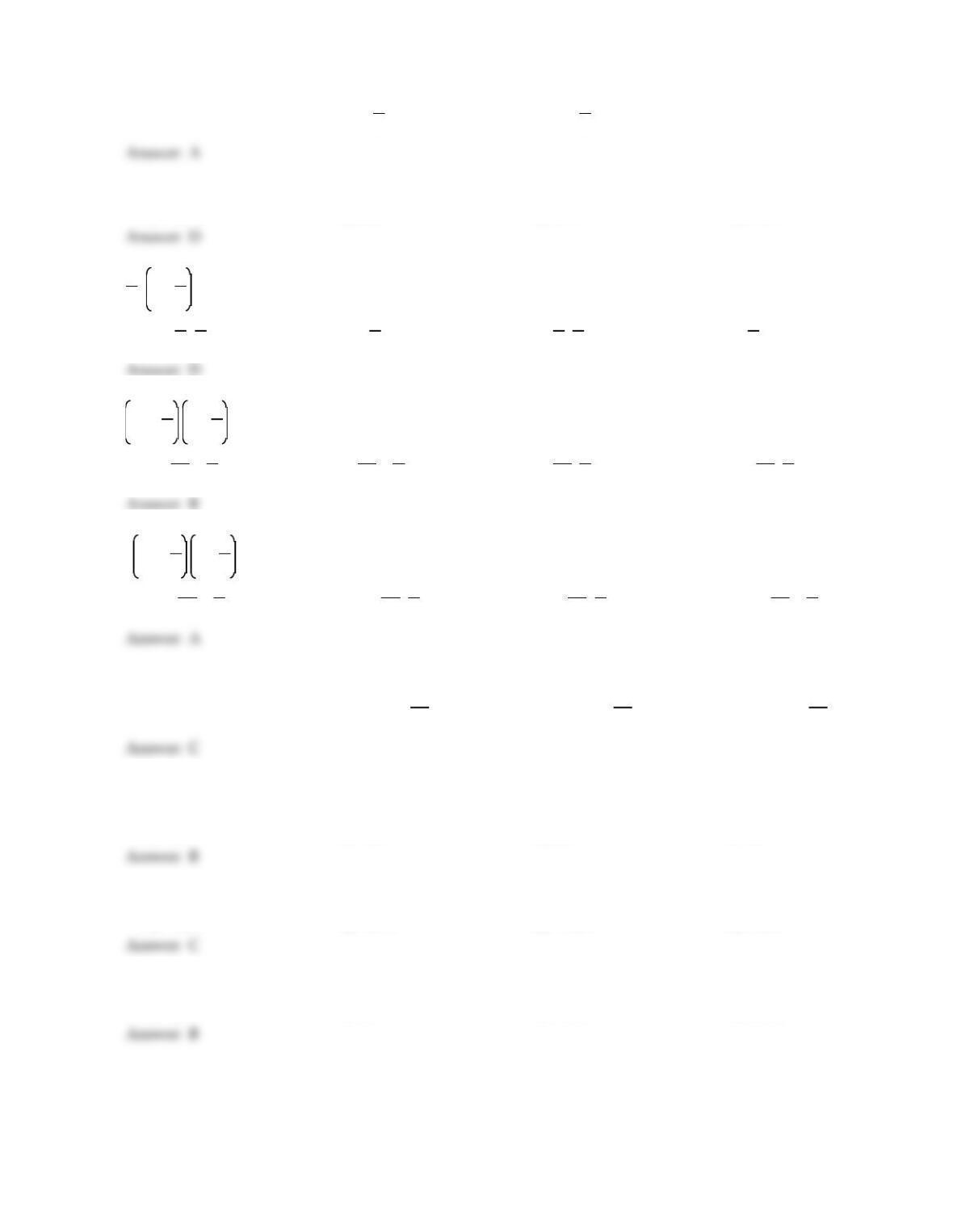
175)
x(4x + 24) = 0
A)
0, -6
B)
0, 1
6
C)
0, –1
6
D)
0, 6
176)
b(b + 16) = 0
A)
–1, -16
B)
16, 0
C)
1, -16
D)
-16, 0
177)
3
8zz –1
6= 0
A)
–3
8, 1
6
B)
–1
6, 0
C)
3
8, 1
6
D)
1
6, 0
178)
3x –1
4x +1
3= 0
A)
– 1
12 , – 1
3
B)
1
12 , – 1
3
C)
1
12 , 1
3
D)
– 1
12 , 1
3
179)
x 5x –1
8x +1
5= 0
A)
0, 1
40 , – 1
5
B)
0, – 1
40 , 1
5
C)
0, 1
40 , 1
5
D)
0, – 1
40 , – 1
5
180)
(x –15)(x +92)(6x +20) = 0
A)
15, –92, –120
B)
–15, 92, 10
3
C)
15, –92, – 10
3
D)
15, –92, – 3
10
Solve by factoring and using the principle of zero products.
181)
x2– x =6
A)
–2, -3
B)
–2, 3
C)
2, 3
D)
1, 6
182)
x2+ 7x – 44 = 0
A)
–11, 1
B)
11, -4
C)
–11, 4
D)
11, 4
183)
5x2– 35x + 50 = 0
A)
–2, -5
B)
2, 5
C)
0, 2, 5
D)
5, 2, 5
18

184)
10y2+ 23y + 12 = 0
A)
4
5, –
3
2
B)
–
4
5, –
3
2
C)
–
2
5, –
1
4
D)
4
5, 3
2
185)
25n2+ 65n = 0
A)
–
13
5
B)
0
C)
–
13
5, 65
D)
–
13
5, 0
186)
25k2=64
A)
8, 0
B)
5
8, –
5
8
C)
8
5, –
8
5
D)
5
8, 0
187)
36d2+ 60d + 25 = 0
A)
5
6, 5
6
B)
–
6
5, –
5
6
C)
–
5
6, –
5
6
D)
6
5, 6
5
188)
6b2+ 23b + 2 =-18
A)
3
4, 2
5
B)
–
3
4, –
5
2
C)
–
4
3, –
5
2
D)
4
3, 5
2
189)
7k2– 62k – 9 = 0
A)
–1
7, 9
B)
–7, 9
C)
1
62 , –1
7
D)
–1
7, 7
190)
x(x –3) =88
A)
–8, 11
B)
8, 11
C)
–8, –11
D)
8, –11
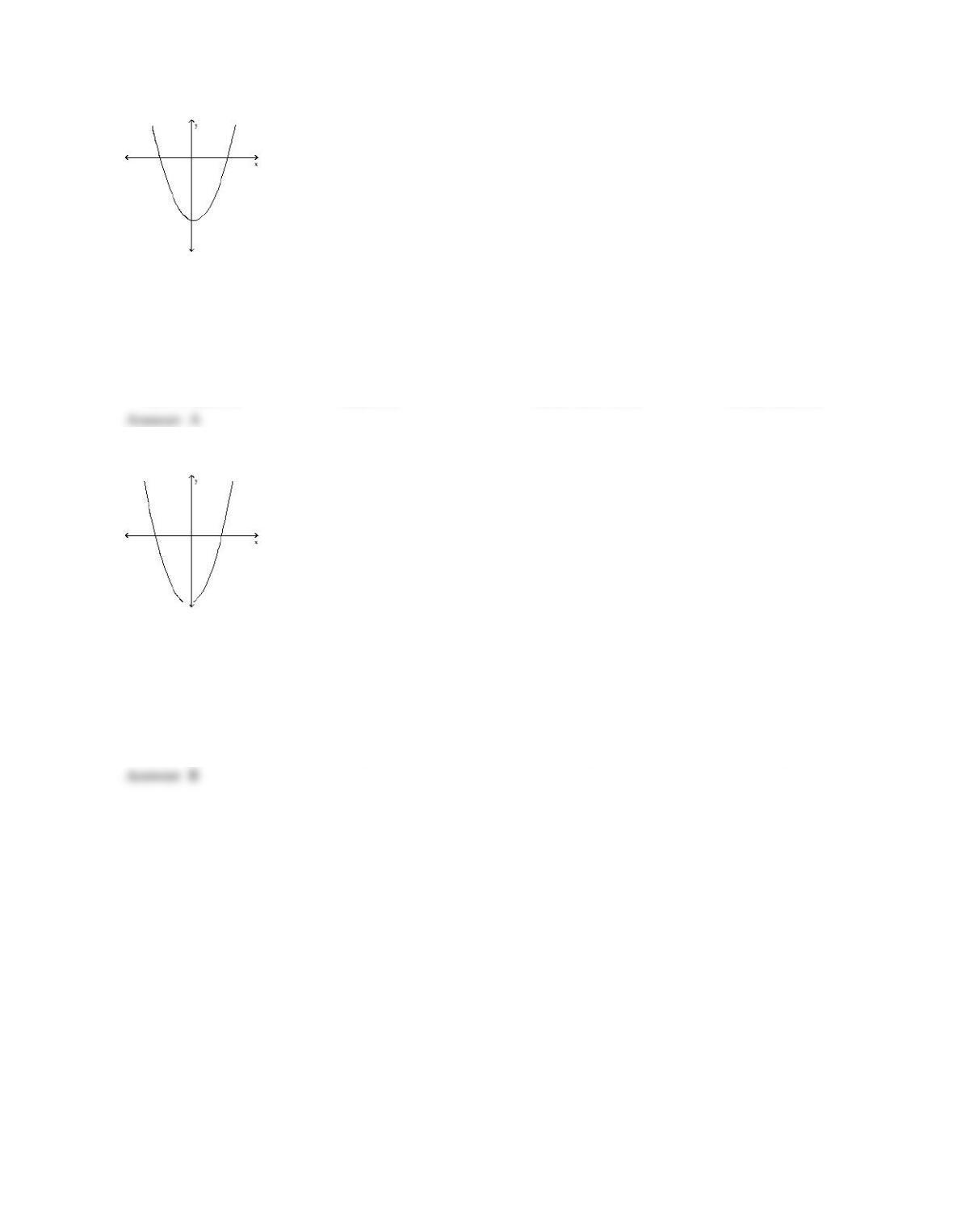
Find the x–intercepts of the graph of the equation. (The grids are intentionally not included.)
191)
y =x2– x – 56
A)
(-7, 0), (8, 0)
B)
(56, 0)
C)
(1, 0), (-56, 0)
D)
(8, 0), (7, 0)
192)
y =x2+ 2x – 120
A)
(22, 0)
B)
(-12, 0), (10, 0)
C)
(12, 0), (-10, 0)
D)
(12, 0), (1, 0)
20
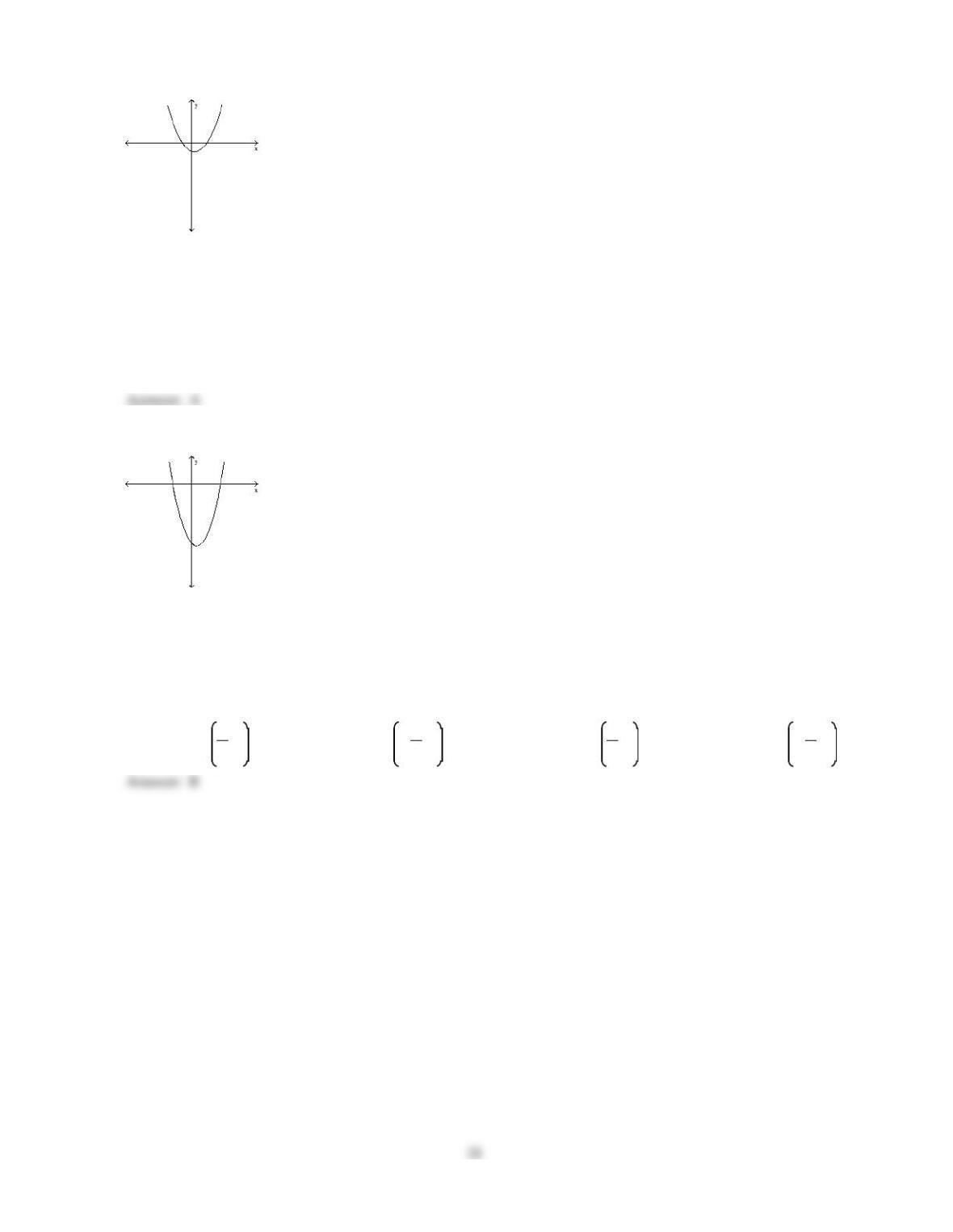
193)
y =x2– 2x – 15
A)
(-3, 0) (5, 0)
B)
(3, 0), (-5, 0)
C)
(8, 0)
D)
(3, 0), (1, 0)
194)
y = 2x2–5x –63
A)
(–6, 0), 9
4, 0
B)
(7 0), –
9
2, 0
C)
(–7, 0), 9
2, 0
D)
(6, 0), –
9
4, 0
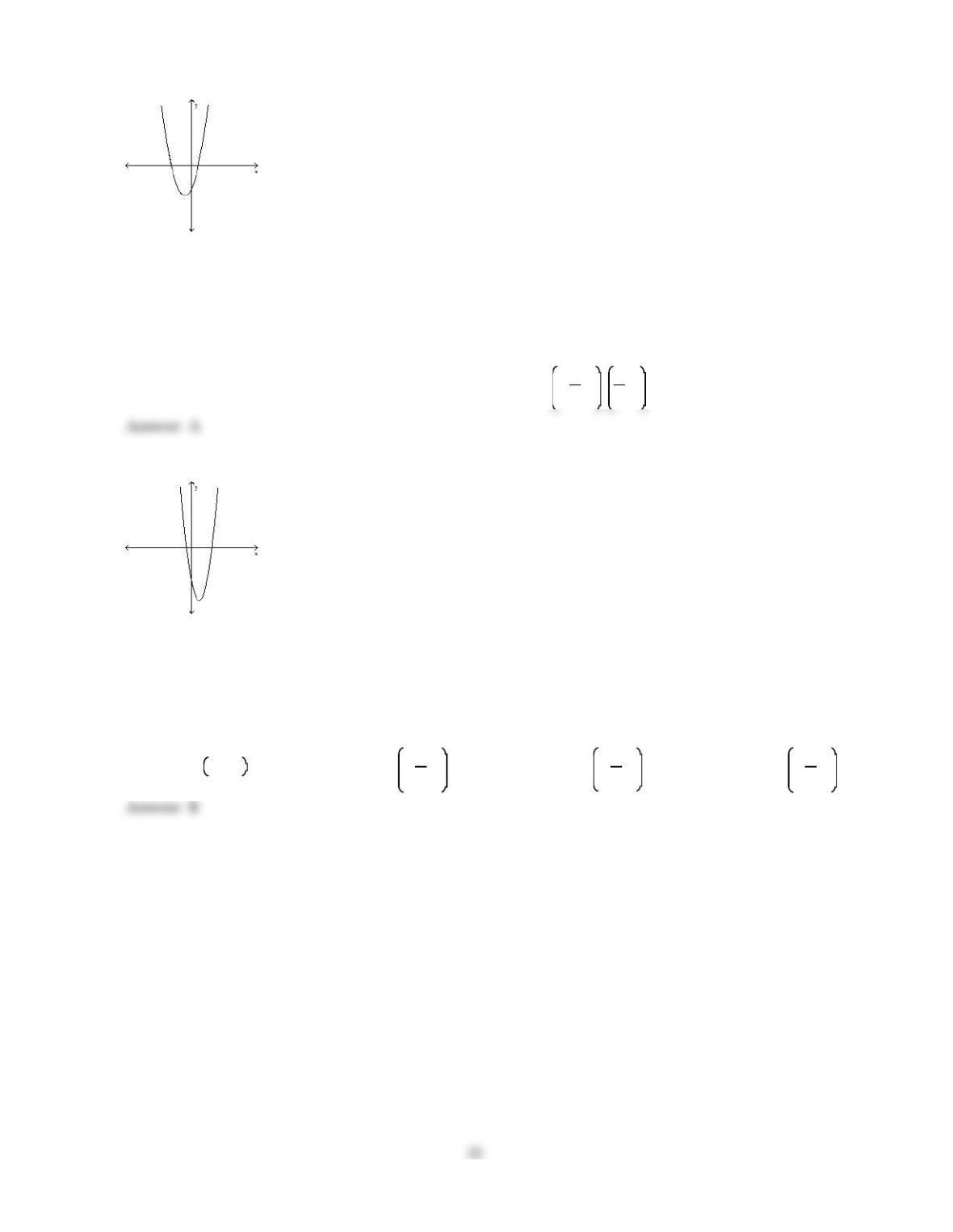
195)
y =x2+4x –12
A)
(–6, 0), (2,0)
B)
(0, –12)
C)
–
7
2, 0 , 3
2, 0
D)
(–7, 0), (3, 0)
196)
y = 2x2–9x –18
A)
(6, 0), –1 , 0
B)
(6, 0), –
3
2, 0
C)
(6, 0), –5
2, 0
D)
(5, 0), –
3
2, 0
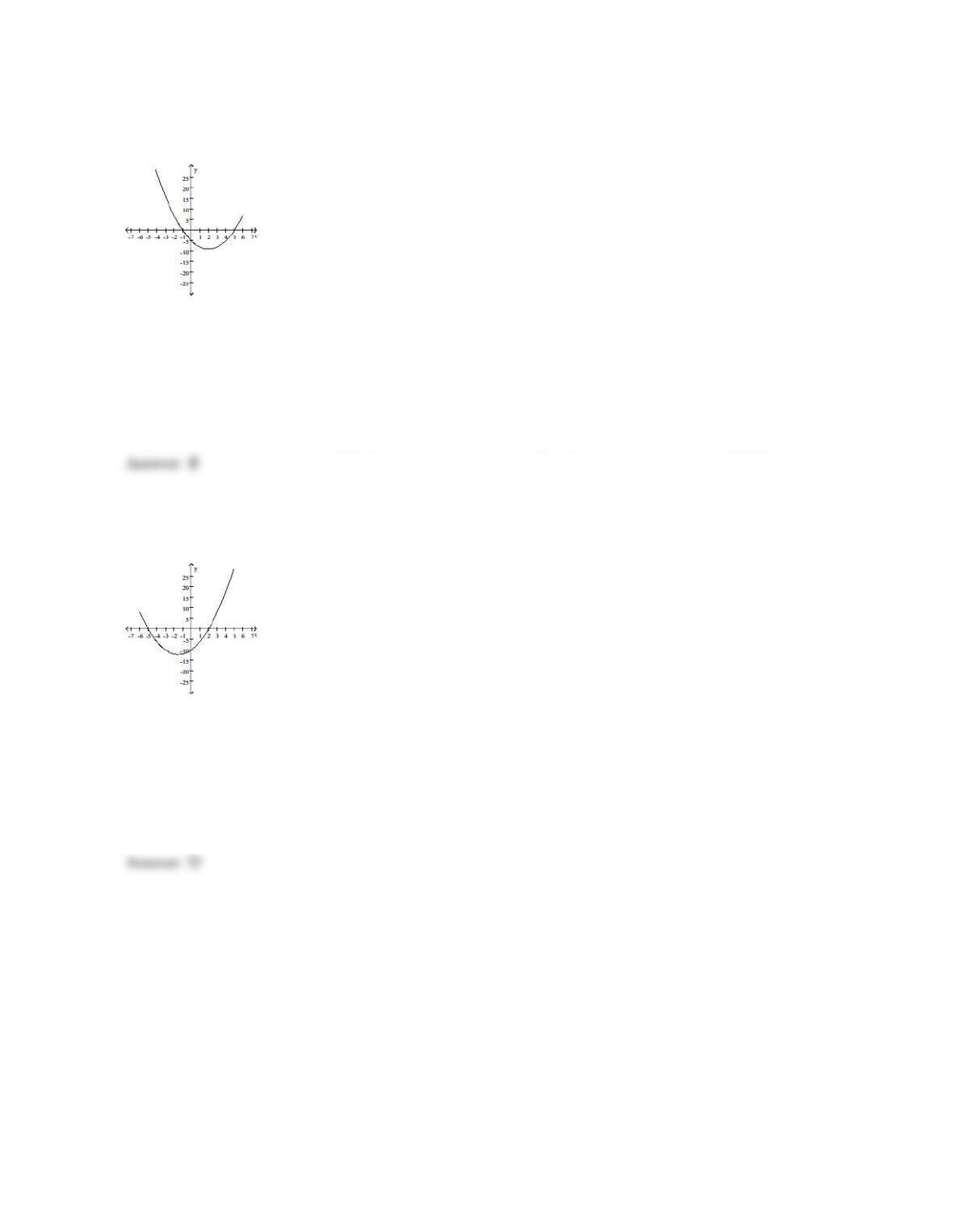
Solve.
197)
Use the following graph to solve x2– 4x – 5 = 0.
y =x2– 4x – 5
A)
-5, -1
B)
-1, 5
C)
-5, 1
D)
5, 1
198)
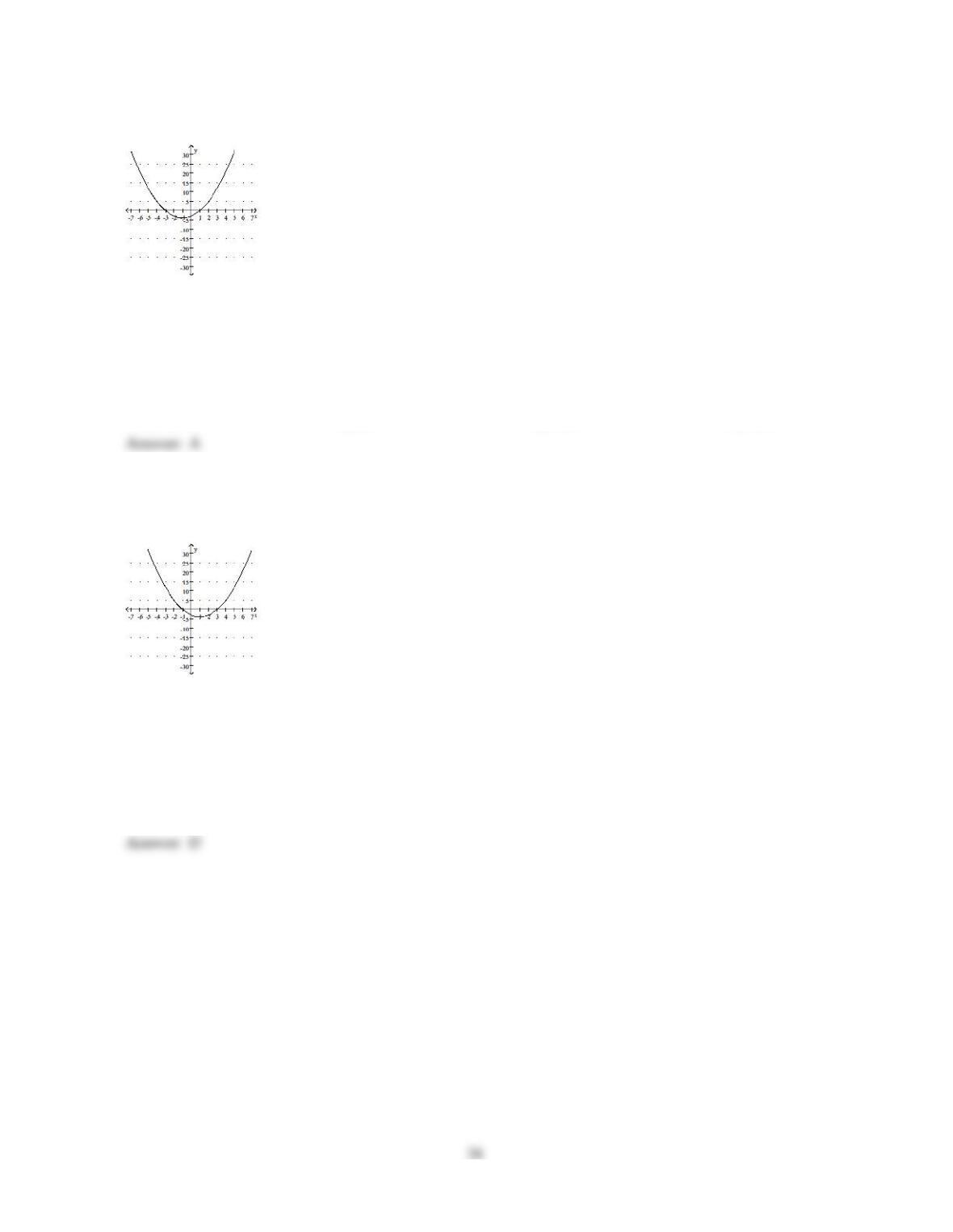
Use the following graph to solve x2+ 3x – 10 = 0.
y =x2+ 3x – 10
A)
2, 5
B)
-5, -2
C)
-2, 5
D)
-5, 2
23
199)
Use the following graph to solve x2+ 2x – 3 = 0.
y =x2+ 2x – 3
A)
-3, 1
B)
3, 1
C)
-1, 3
D)
-3, -1
200)
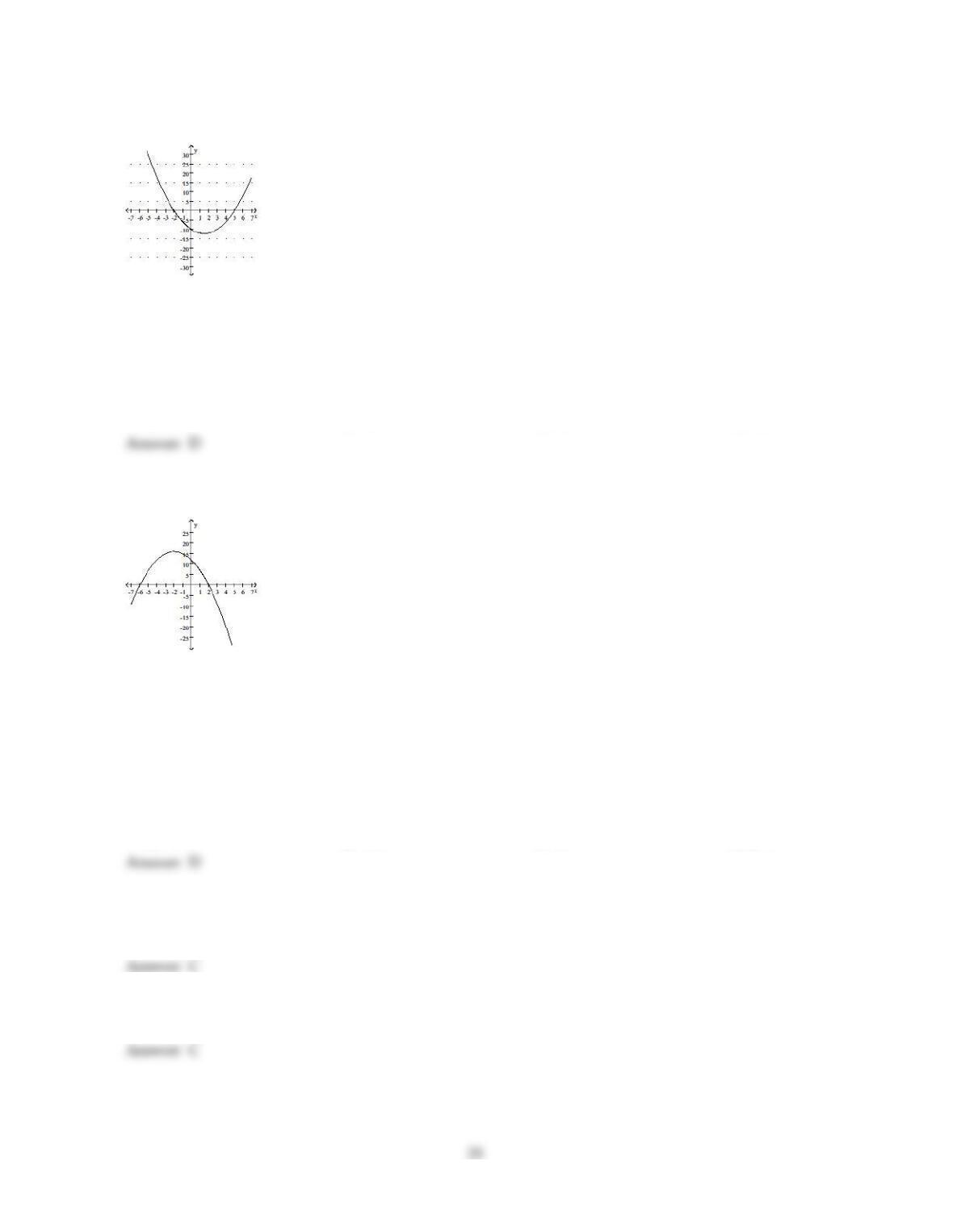
Use the following graph to solve x2– 2x – 3 = 0.
y =x2– 2x – 3
A)
-3, -1
B)
-3, 1
C)
1, 3
D)
-1, 3
201)
Use the following graph to solve x2– 3x – 10 = 0.
y =x2– 3x – 10
A)
5, 2
B)
-5, 2
C)
-5, -2
D)
-2, 5
202)
Use the following graph to solve –x2–4x +12 = 0.
y = – x2–4x +12
A)
-12
B)
-2, 6
C)
12
D)
2, -6
Solve the problem.
203)
The product of two consecutive integers is 71 more than their sum. Find the integers.
A)
8, 9 or -8, -7
B)
-8, -7
C)
9, 10 or -8, -7
D)
9, 10
204)
The product of two consecutive integers is 8 less than 8 times their sum. Find the integers.
A)
0, 1
B)
0, 1 or 16, 17
C)
0, 1 or 15, 16
D)
15, 16
205)
A number is 72 less than its square. Find all such numbers.
A)
–9 and 8
B)
–9 and 9
C)
–8 and 8
D)
–8 and 9
206)
The product of two consecutive odd integers is 143. Find all pairs of integers that satisfy this condition.
A)
–13 and 11
B)
–13 and 11, –11 and 13
C)
–13 and –11, 11 and 13
D)
–13 and 13
207)
The product of two consecutive integers is 55 more than their sum. Find the integers.
A)
8 and 9
B)
7, 8 or -7, -6
C)
-7 and -6
D)
8, 9 or -7, -6
208)
A rectangular garden is three times as long as it is wide. If the area of the garden is 1452 ft2, find the length and
width of the garden.
A)
length: 63 ft; width: 21 ft
B)
length: 66 ft; width: 22 ft
C)
length: 22 ft; width: 22
3 ft
D)
length: 484 ft; width: 3 ft
209)
The height of a triangle is 3 cm more than the length of the base. If the area of the triangle is 119 cm2, find the
height and length of the base.
A)
height: 18 cm; base: 13 cm
B)
height: 16 cm; base: 13 cm
C)
height: 17 cm; base: 14 cm
D)
height: 14 cm; base: 11 cm
210)
The length of a rectangular frame is 3 cm more than the width. The area inside the frame is 130 square cm. Find
the width of the frame.
A)
16 cm
B)
13 cm
C)
10 cm
D)
11 cm
211)
The height of a box is 7 inches. The length is three inches more than the width. Find the width if the volume is
126 cubic inches.
A)
18 in.
B)
7 in.
C)
6 in.
D)
3 in.
212)
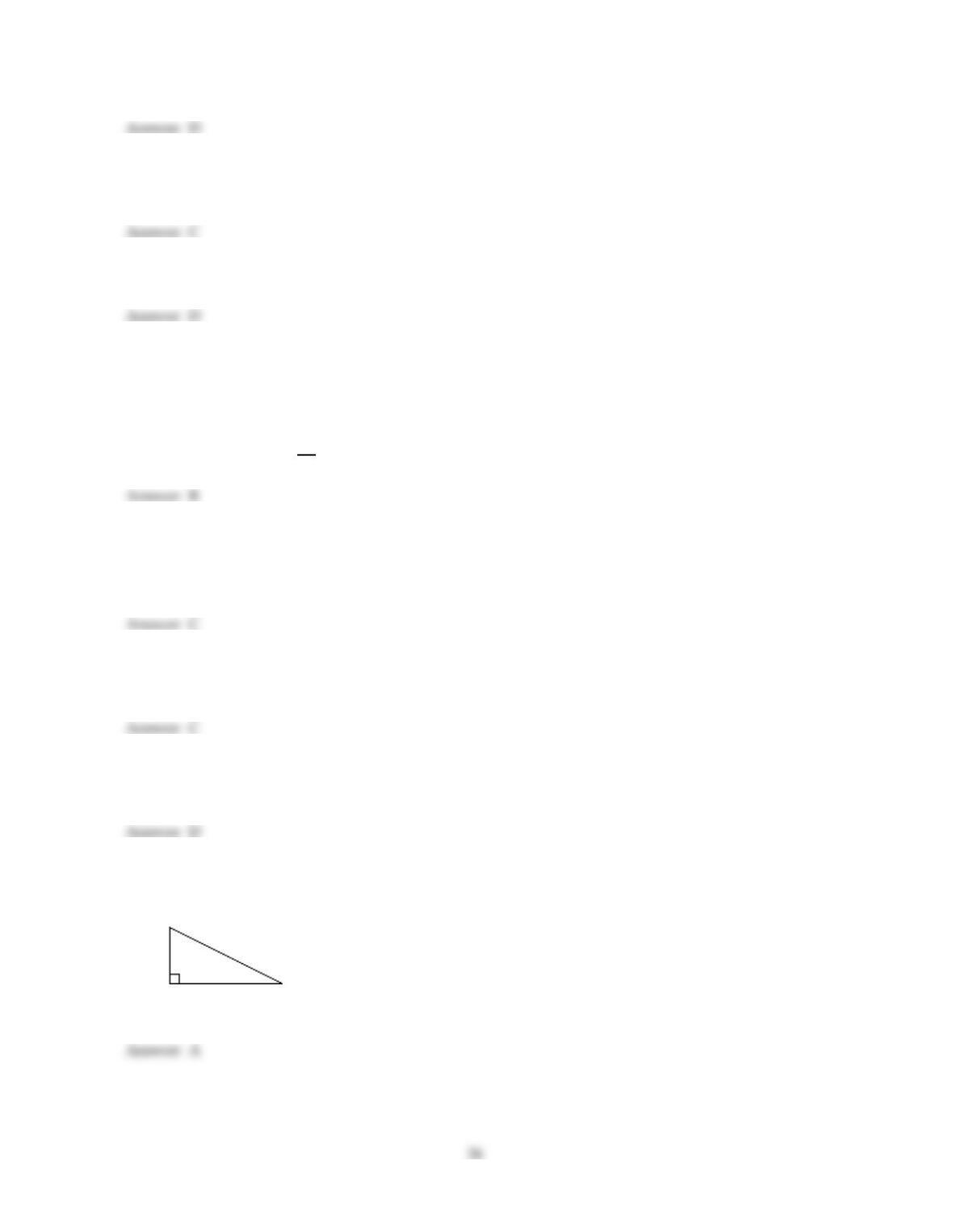
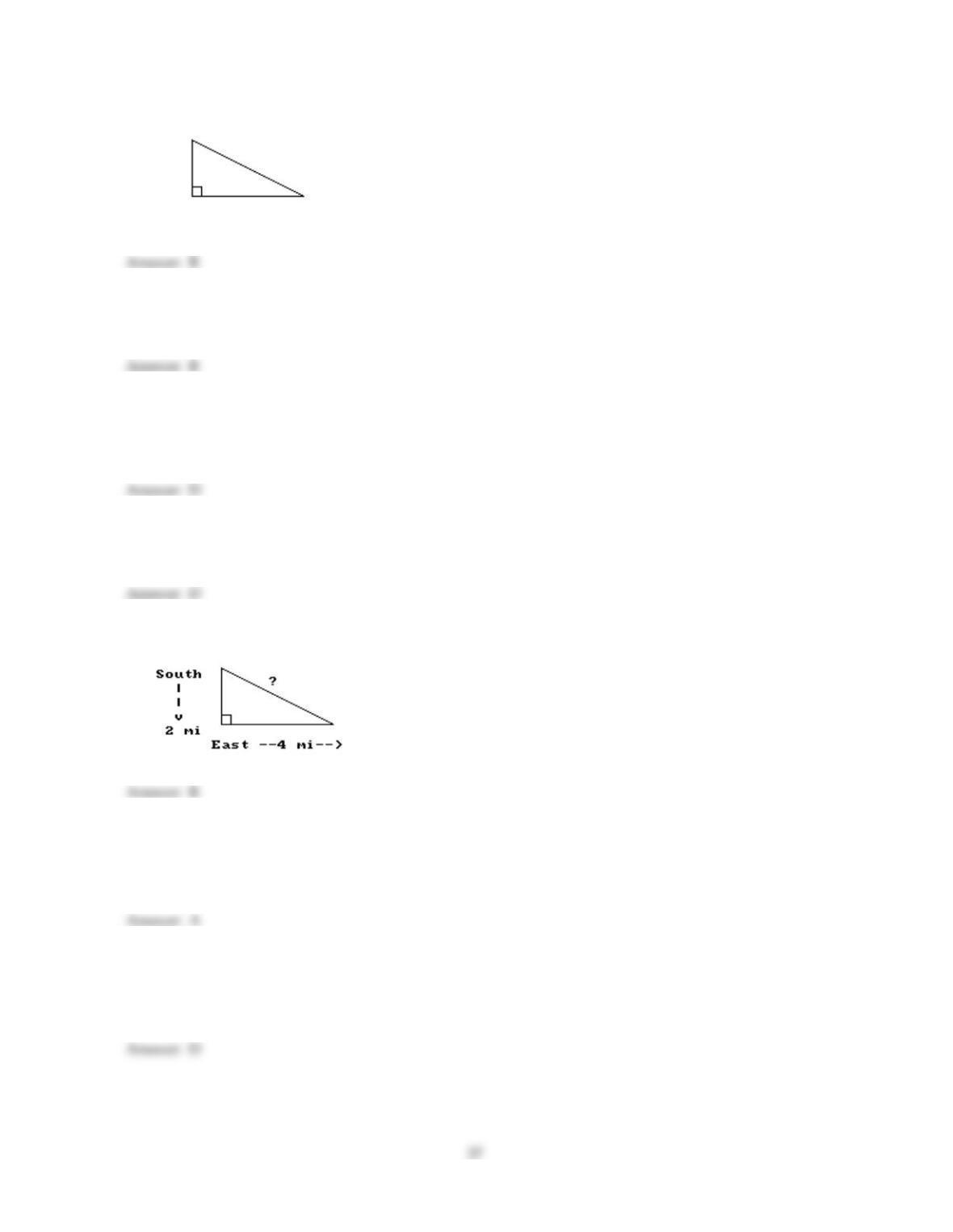
The diagram below shows a rope connecting the top of a pole to the ground. The rope is 26 yd long and touches
the ground 20 yd from the pole. How tall is the pole? Round approximations to the nearest tenth.
?26 yd
20 yd
A)
16.6 yd
B)
23 yd
C)
8.3 yd
D)
138 yd
213)
Below is a diagram of a water slide. The slide is 30 ft long. The ladder leading to the slide is 25 ft long. How far
is it from the end of the slide to the foot of the ladder? Round approximations to the nearest tenth.
25 ft 30 ft
?
A)
8.3 ft
B)
16.6 ft
C)
137.5 ft
D)
27.5 ft
214)
A ladder is resting against a wall. The top of the ladder touches the wall at a height of 12 feet. Find the length of
the ladder if the length is 4 feet more than its distance from the wall.
A)
12 feet
B)
20 feet
C)
24 feet
D)
16 feet
215)
Two cars leave an intersection. One car travels north; the other east. When the car traveling north had gone 12
miles, the distance between the cars was 4 miles more than the distance traveled by the car heading east. How
far had the eastbound car traveled?
A)
24 miles
B)
12 miles
C)
20 miles
D)
16 miles
216)
A lot is in the shape of a right triangle. The shorter leg measures 150 meters. The hypotenuse is 50 meters longer
than the length of the longer leg. How long is the longer leg?
A)
300 meters
B)
150 meters
C)
250 meters
D)
200 meters
217)
A long–distance runner runs 2 miles south and then 4 miles east. How far is the runner from the starting point?
Round to nearest tenth.
A)
1.5 mi
B)
4.5 mi
C)
1.1 mi
D)
2.5 mi
218)
In a sports league of n teams in which each team plays every other team twice, the total number N of games to
be played is given by N =n2– n. What is the total number of games to be played in a football league having 14
teams?
A)
182
B)
196
C)
28
D)
210
219)
In a sports league of n teams in which each team plays every other team twice, the total number N of games to
be played is given by N =n2– n. How many teams are in a softball league if the total number of games played
is 182?
A)
13
B)
15
C)
12
D)
14
220)
Within a group of n people, the number of possible handshakes, N, is given by
N =1
2(n2– n). How many handshakes are possible at a meeting if 12 people are present?
A)
132
B)
60
C)
78
D)
66
221)
Within a group of n people, the number of possible handshakes, N, is given by
N =1
2(n2– n). At a party, everybody shakes hands with every other person. If the total number of handshakes
is 136, how many people are at the party?
A)
19
B)
17
C)
18
D)
16
222)
If an object is thrown upward with an initial velocity of 96 ft/sec, its height after t sec is given by h =96t – 16t2.
Find the number of seconds before the object hits the ground.
A)
6 sec
B)
3 sec
C)
48 sec
D)
80 sec
223)
If an object is dropped, the distance it falls is given by d = 16t2. Find the distance an object would fall in 8
seconds.
A)
512 ft
B)
1024 ft
C)
2048 ft
D)
128 ft
SHORT ANSWER. Write the word or phrase that best completes each statement or answers the question.
Provide an appropriate response.
224)
Explain the difference between a factor and a multiple of a number.
225)
Explain the error in the following:
x2+ 2x – 15 = (x – 5)(x + 3)
x2+ 2x – 15 = (x + 5)(x – 3)
226)
Assuming you have factored out the largest common factor at the outset, why can you reject a possible factor
such as (2x + 2) or (3x – 6) when you are factoring a trinomial?
227)
Explain the error in the following:
x2–y2=(x – y)2
228)
Use the FOIL method to show that (5x + 10)(x – 8) is 5x2– 30x – 80. If you were asked to completely factor
5x2– 30x – 80, why would it be incorrect to give (5x + 10)(x – 8) as your answer?
28
229)
In factoring a trinomial in x as (x+ a)(x+ b), what must be true of a and b, if the coefficient of the last term of the
trinomial is negative?
230)
Why is the answer (x2– 81)(x2+ 81) not the correct answer to the instruction “Factor (x4– 6561) completely”?
231)
A student was trying to solve the problem 8x(3x – 8) = 0. The student knew that he or she should set 3x – 8 = 0
but was confused about whether or not he or she should set 8x = 0, or 8= 0 and x = 0. How would you advise
this student?
232)
How could you solve the equation
(5x + 2)(5x – 4)(6x – 8) = 0? How many equations do you need to solve? What are their solutions?
233)
A student is trying to solve the equation (x + 8)(x – 10) =9. The student has set x + 8 =9 and x – 10 =9 and found
that two solutions x =1, x =19. The student checks his or her results by plugging in his or her solutions into the
original equation and finds that they do not work. How would you advise him or her?
29