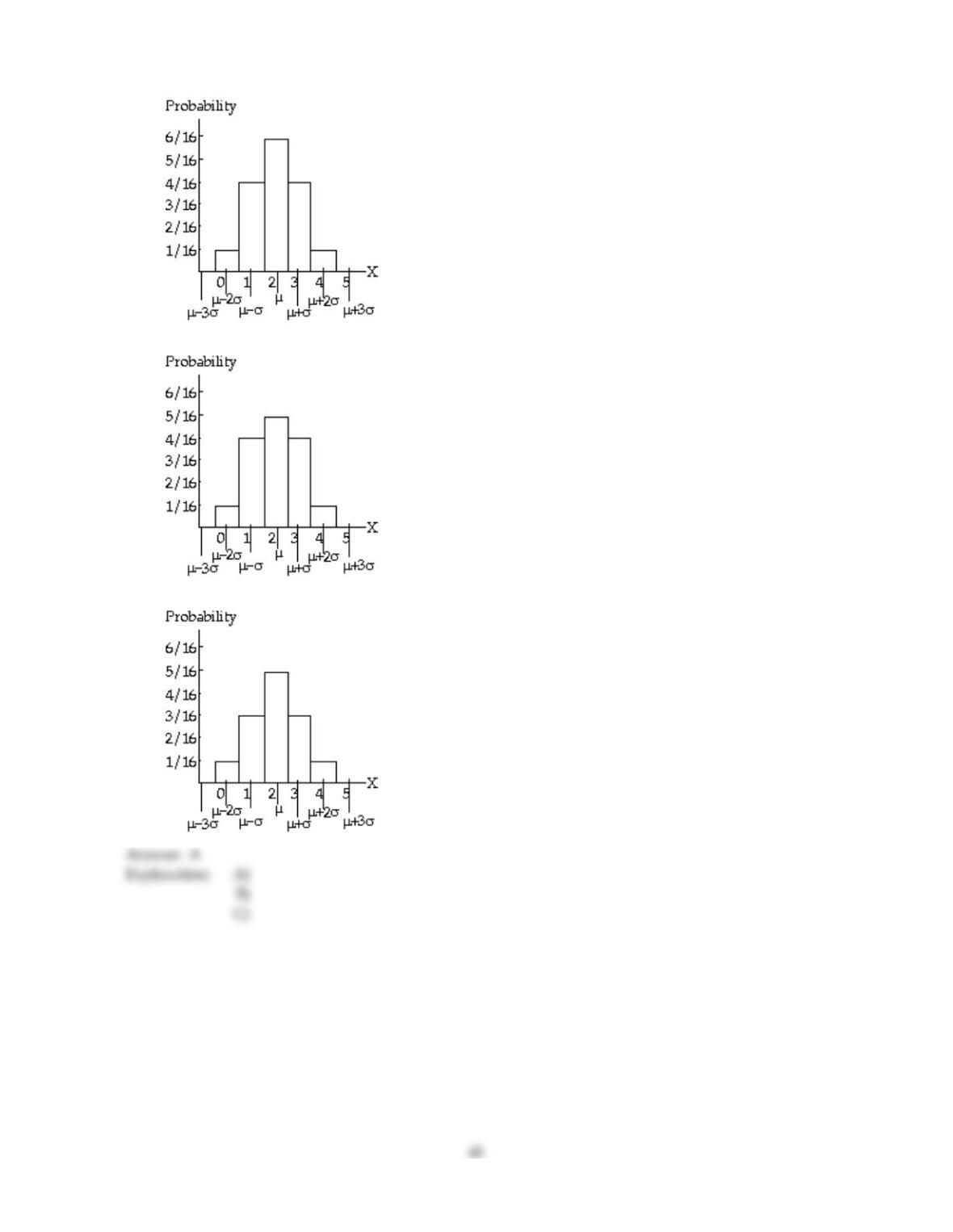
A)
B)
C)
Find the standard deviation of the binomial random variable.
125)
The probability that a radish seed will germinate is 0.7. A gardener plants seeds in batches of 10.
Find the standard deviation for the random variable X, the number of seeds germinating in each
batch.
125)
A)
1.449
B)
1.375
C)
1.358
D)
1.432
Determine the possible values of the random variable.
126)
For a randomly selected student in a particular high school, let Y denote the number of living
grandparents of the student. What are the possible values of the random variable Y?
126)
A)
0, 1, 2, 3, 4
B)
4
C)
1, 2, 3, 4
D)
0, 1, 2
Use random–variable notation to represent the event.
127)
For a randomly selected student in a particular high school, let Y denote the number of living
grandparents of the student. Use random–variable notation to represent the event that the student
obtained has exactly three living grandparents.
127)
A)
{Y < 3}
B)
{Y
3}
C)
{Y = 3}
D)
P{Y = 3}
Find the specified probability distribution of the binomial random variable.
128)
A multiple choice test consists of four questions. Each question has five possible answers of which
only one is correct. A student guesses on every question. Find the probability distribution of X, the
number of questions she answers correctly.
128)
A)
x P(X = x)
0 0
10.2
20.04
30.008
40.0016
B)
x P(X = x)
00.4096
10.4096
20.1536
30.0256
40.0016
C)
x P(X = x)
00.4096
10.4096
20.1024
30.0768
40.0016
D)
x P(X = x)
10.4096
20.1536
30.0256
40.0016
Find the standard deviation of the Poisson random variable. Round to three decimal places.
129)
Suppose X has a Poisson distribution with parameter =19.720. Find the standard deviation of X.
129)
A)
9.860
B)
388.878
C)
4.441
D)
19.720
Find the standard deviation of the binomial random variable.
130)
According to a college survey, 22% of all students work full time. Find the standard deviation for
the random variable X, the number of students who work full time in samples of size 16.
130)
A)
1.66
B)
2.75
C)
1.88
D)
3.52
Find the expected value of the random variable. Round to the nearest cent unless stated otherwise.
131)
Suppose you buy 1 ticket for $1 out of a lottery of 1,000 tickets where the prize for the one winning
ticket is to be $500. What is your expected value?
131)
A)
–$0.50
B)
–$1.00
C)
–$0.40
D)
$0.00
Provide an appropriate response.
132)
Three random variables X, Y, and Z, are described below. In which of these situations would it be
acceptable to use the binomial distribution?
A: A bag contains 4 blue marbles and 8 red marbles. Five marbles are drawn at random with
replacement. The random variable X is the number of blue marbles drawn.
B: A bag contains 4 blue marbles and 8 red marbles. Six marbles are drawn at random without
replacement. The random variable Y is the number of blue marbles drawn.
C: A bag contains 30 blue marbles and 38 red marbles. Three marbles are drawn at random
without replacement. The random variable Z is the number of blue marbles drawn.
132)
A)
A and C
B)
A only
C)
A, B, and C
D)
B and C
Find the specified probability.
133)
The number of loaves of rye bread left on the shelf of a local bakery at closing (denoted by the
random variable X) varies from day to day. Past records show that the probability distribution of X
is as shown in the following table. Find the probability that there will be at least three loaves left
over at the end of any given day.
x 0 1 2 3 4 5 6
P(X = x) 0.20 0.25 0.20 0.15 0.10 0.08 0.02
133)
A)
0.15
B)
0.20
C)
0.65
D)
0.35
Use the Poisson Distribution to find the indicated probability. Round to three decimal places when necessary.
134)
The number of lightning strikes in a year at the top of a particular mountain has a Poisson
distribution with parameter =2.5. Find the probability that in a randomly selected year, the
number of lightning strikes is 3.
134)
A)
0.011
B)
0.363
C)
0.278
D)
0.214
Find the specified probability distribution of the binomial random variable.
135)
43% of the murder trials in one district result in a guilty verdict. Five murder trials are selected at
random from the district. Determine the probability distribution of X, the number of trials among
the five selected in which the defendant is found guilty.
135)
A)
x P(X = x)
00.0602
10.2270
20.3424
30.2583
40.0975
50.0147
B)
x P(X = x)
00.0602
10.2400
20.3424
30.2583
40.0845
50.0147
C)
x P(X = x)
00.0602
10.2270
20.3204
30.2803
40.0975
50.0147
D)
x P(X = x)
10.43
20.1849
30.0795
40.0342
50.0147
Determine the required probability by using the Poisson approximation to the binomial distribution. Round to three
decimal places.
136)
The probability that a car will have a flat tire while driving through a certain tunnel is 0.00006. Use
the Poisson approximation to the binomial distribution to find the probability that among 7000 cars
passing through this tunnel, at most two will have a flat tire.
136)
A)
0.067
B)
0.991
C)
0.933
D)
0.058
Find the standard deviation of the random variable.
137)
The probabilities that a batch of 4 computers will contain 0, 1, 2, 3, and 4 defective computers are
0.4521, 0.3970, 0.1307, 0.0191, and 0.0010, respectively. Round the answer to two decimal places.
137)
A)
0.71
B)
1.05
C)
0.59
D)
0.77
Determine the possible values of the random variable.
138)
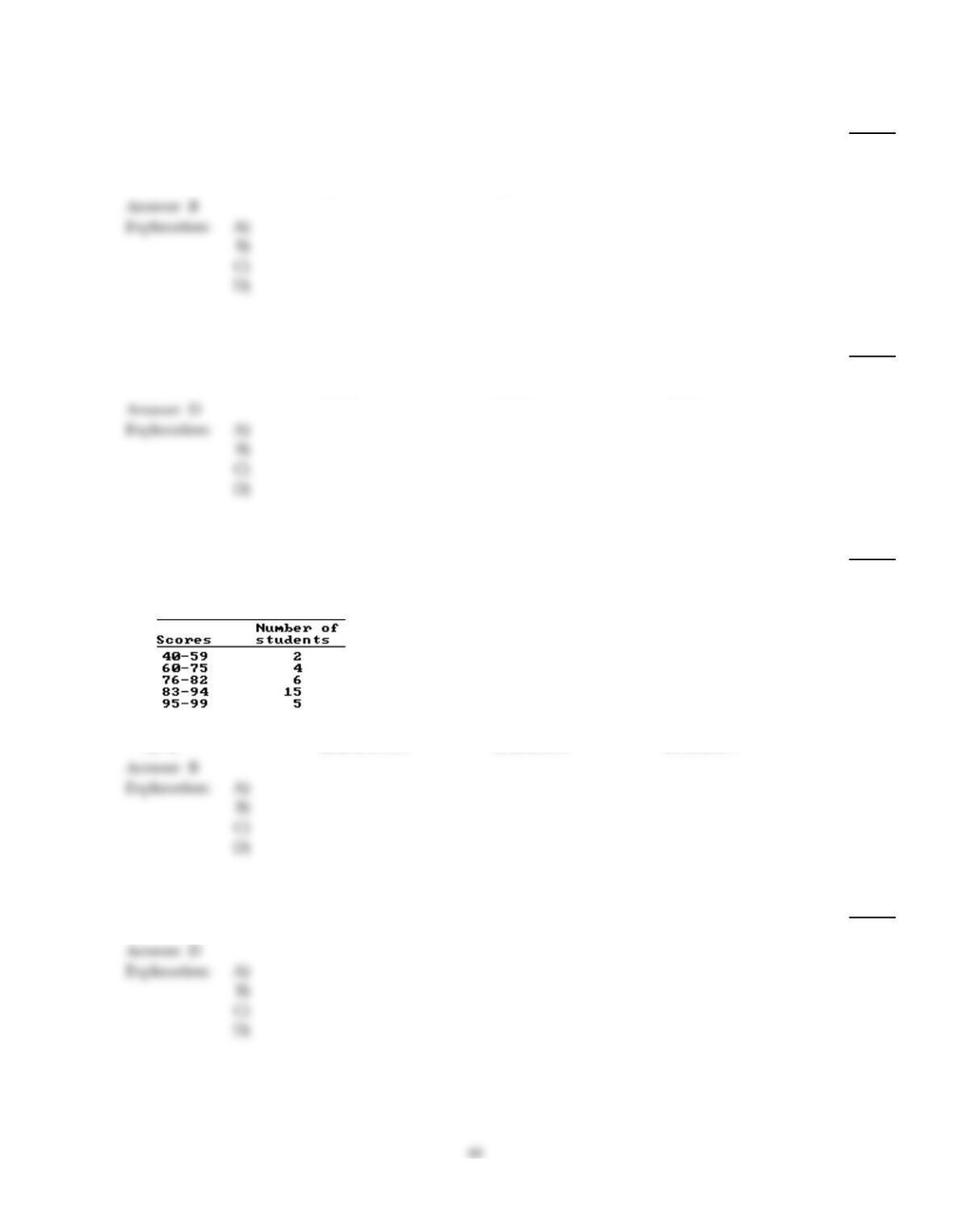
The following frequency distribution analyzes the scores on a math test. For a randomly selected
score between 40 and 99, let Y denote the number of students with that score on the test. What are
the possible values of the random variable Y?
138)
A)
32
B)
2, 4, 6, 15, 5
C)
2, 4, 6, 15
D)
2, 4, 6, 5
Use the Poisson Distribution to find the indicated probability. Round to three decimal places when necessary.
139)
=7; P(X =3)
139)
A)
0.013
B)
0.142
C)
0.065
D)
0.052
Determine the possible values of the random variable.
140)
Suppose that two balanced dice, a red die and a green die, are rolled. Let Y denote the value of
G – R where G represents the number on the green die and R represents the number on the red die.
What are the possible values of the random variable Y?
140)
A)
0, 1, 2, 3, 4, 5
B)
0, 1, 2, 3, 4, 5, 6
C)
–6, –5, –4, –3, –2, –1, 0, 1, 2, 3, 4, 5, 6
D)
–5, –4, –3, –2, –1, 0, 1, 2, 3, 4, 5
Construct a probability histogram for the binomial random variable, X.
141)
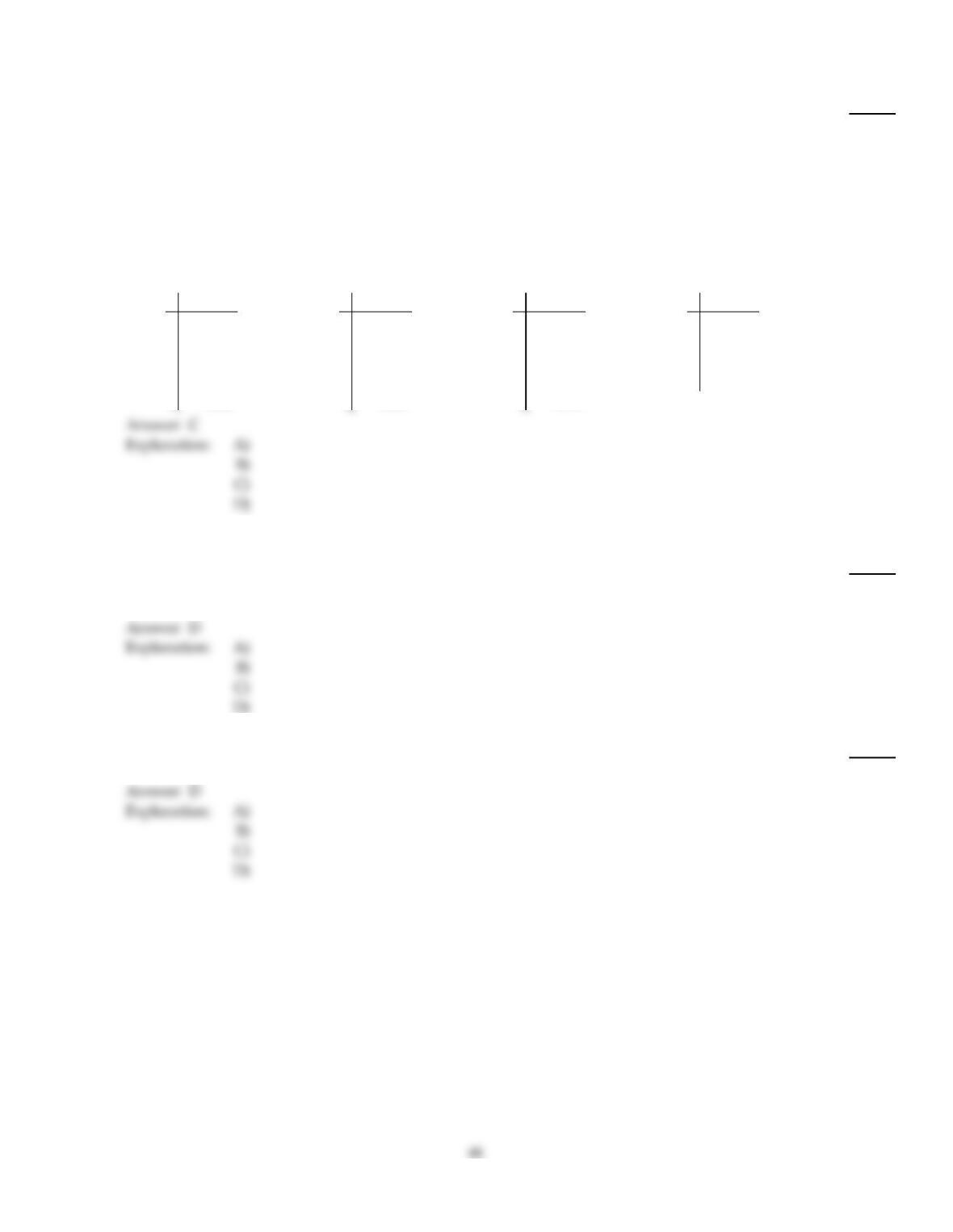
Three coins are tossed. X is the number of tails.
141)
A)
B)
C)
D)
Obtain the probability distribution of the random variable.
142)
When a coin is tossed four times, sixteen equally likely outcomes are possible as shown below:
HHHH HHHT HHTH HHTT
HTHH HTHT HTTH HTTT
THHH THHT THTH THTT
TTHH TTHT TTTH TTTT
Let X denote the total number of tails obtained in the four tosses. Find the probability distribution of
the random variable X. Leave your probabilities in fraction form.
142)
A)
x P(X = x)
01/16
13/16
21/2
33/16
4 1/16
B)
x P(X = x)
01/16
11/8
23/8
31/8
41/16
C)
x P(X = x)
01/16
11/4
23/8
31/4
41/16
D)
x P(X = x)
11/4
27/16
31/4
41/16
Use the Poisson Distribution to find the indicated probability. Round to three decimal places when necessary.
143)
In one town, the number of burglaries in a week has a Poisson distribution with parameter =3.1.
Find the probability that in a randomly selected week the number of burglaries is at least three.
143)
A)
0.224
B)
0.375
C)
0.401
D)
0.599
144)
=0.405; P(X =2)
144)
A)
0.068
B)
0.005
C)
0.123
D)
0.055
Find the specified probability distribution of the binomial random variable.
145)
In one city, 23% of the population is under 25 years of age. Three people are selected at random
from the city. Find the probability distribution of X, the number among the three that are under 25
years of age.
145)
A)
x P(X = x)
10.23
20.0529
30.0122
B)
x P(X = x)
00.4565
10.1364
20.0407
30.0122
C)
x P(X = x)
00.4565
10.4091
20.1222
30.0122
D)
x P(X = x)
00.4565
10.4091
20.1102
30.0242
Find the expected value of the random variable. Round to the nearest cent unless stated otherwise.
146)
A contractor is considering a sale that promises a profit of $33,000 with a probability of 0.7 or a loss
(due to bad weather, strikes, and such) of $6000 with a probability of 0.3. What is the expected
profit? Round the answer to the nearest dollar.
146)
A)
$27,300
B)
$27,000
C)
$23,100
D)
$21,300
D
Use random–variable notation to represent the event.
147)
Suppose a coin is tossed four times. Let X denote the total number of tails obtained in the four
tosses. Use random–variable notation to represent the event that the total number of tails is three.
147)
A)
P{X = 3}
B)
HTTT, THTT, TTHT, TTTH
C)
{X
3}
D)
{X = 3}
D
C
Find the expected value of the random variable. Round to the nearest cent unless stated otherwise.
148)
The probability distribution below describes the number of thunderstorms that a certain town may
experience during the month of August. Let X represent the number of thunderstorms in August.
Number of storms 0 1 2 3
P(X = x) 0.2 0.2 0.4 0.2
What is the expected value of thunderstorms for the town each August? Round the answer to one
decimal place.
148)
A)
1.8
B)
1.5
C)
1.6
D)
2.0
Find the standard deviation of the binomial random variable.
149)
The probability of winning a certain lottery is 1/64,315. For people who play 823 times, find the
standard deviation for the random variable X, the number of wins.
149)
A)
0.1131
B)
3.2452
C)
0.0128
D)
0.1239
Find the indicated probability. Round to four decimal places.
150)
A car insurance company has determined that 5% of all drivers were involved in a car accident last
year. Among the 12 drivers living on one particular street, 3 were involved in a car accident last
year. If 12 drivers are randomly selected, what is the probability of getting 3 or more who were
involved in a car accident last year?
150)
A)
0.0195
B)
0.5599
C)
0.9827
D)
0.0173
Provide an appropriate response.
151)
A bag contains 8 red marbles and 10 green marbles. Anne picks 3 marbles at random, with
replacement, and observes the color of each marble. The number of green marbles, X, is a binomial
random variable. If we let success correspond to getting a green marble, what is the success
probability, p? What is the number of trials?
151)
A)
p =1
10 , n =18
B)
p =5
9, n = 3
C)
p =5
9, n =18
D)
p =1
3, n = 3
Find the standard deviation of the Poisson random variable. Round to three decimal places.
152)
Suppose X has a Poisson distribution with parameter =1.500. Find the standard deviation of X.
152)
A)
2.250
B)
1.000
C)
1.500
D)
1.225
Obtain the probability distribution of the random variable.
153)
When two balanced dice are rolled, 36 equally likely outcomes are possible as shown below.
(1, 1) (1, 2) (1, 3) (1, 4) (1, 5) (1, 6)
(2, 1) (2, 2) (2, 3) (2, 4) (2, 5) (2, 6)
(3, 1) (3, 2) (3, 3) (3, 4) (3, 5) (3, 6)
(4, 1) (4, 2) (4, 3) (4, 4) (4, 5) (4, 6)
(5, 1) (5, 2) (5, 3) (5, 4) (5, 5) (5, 6)
(6, 1) (6, 2) (6, 3) (6, 4) (6, 5) (6, 6)
Let X denote the absolute value of the difference of the two numbers. Find the probability
distribution of X. Give the probabilities as decimals rounded to three decimal places.
153)
A)
x P(X = x)
00.167
10.167
20.167
30.167
40.167
50.167
B)
x P(X = x)
00.167
10.278
20.222
30.167
40.111
50.056
C)
x P(X = x)
10.278
20.222
30.167
40.111
50.056
D)
x P(X = x)
00.167
10.251
20.222
30.167
40.111
50.056
60.027
Provide an appropriate response.
154)
A die is rolled repeatedly until a six appears. The random variable X represents the total number of
rolls preceding the six. What are the possible values of the random variable X?
154)
A)
0, 1, 2, 3, 4, 5, 6
B)
0, 1, 2, 3, 4, …..
C)
1, 2, 3, 4, 5, 6
D)
1, 2, 3, 4, .….
Evaluate the expression.
155)
12!
3!
155)
A)
36,000
B)
79,833,600
C)
2!
D)
4
Find the indicated binomial probability. Round to five decimal places when necessary.
156)
What is the probability that 6 rolls of a fair die will show four exactly 5 times?
156)
A)
0.00077
B)
0.00011
C)
0.00064
D)
0.3349
Calculate the specified probability
157)
Suppose that D is a random variable. Given that P(D >2.4) =0.35, find P(D 2.4).
157)
A)
0
B)
0.65
C)
0.325
D)
0.35
Use random–variable notation to represent the event.
158)
Suppose that two balanced dice are rolled. Let Y denote the sum of the two numbers. Use
random–variable notation to represent the event that the sum of the two numbers is at least 11.
158)
A)
{X+Y
11}
B)
{Y > 11}
C)
{Y
11}
D)
(5, 6), (6, 5), (6,6)
Find the standard deviation of the random variable.
159)
The random variable X is the number of people who have a college degree in a randomly selected
group of four adults from a particular town. Its probability distribution is given in the table. Round
the answer to two decimal places.
x 0 1 2 3 4
P(X = x) 0.4096 0.4096 0.1536 0.0256 0.0016
159)
A)
0.80
B)
1.13
C)
0.64
D)
0.94
Determine the possible values of the random variable.
160)
Suppose that two balanced dice are rolled. Let Y denote the product of the two numbers. What are
the possible values of the random variable Y?
160)
A)
(1, 1), (1, 2), (1, 3), (1, 4), (1, 5), (1, 6), (2, 1), (2, 2), (2, 3), (2, 4), (2, 5), (2, 6), (3, 1), (3, 2), (3, 3), (3,
4), (3, 5), (3, 6), (4, 1), (4, 2), (4, 3), (4, 4), (4, 5), (4, 6), (5, 1), (5, 2), (5, 3), (5, 4), (5, 5), (5, 6), (6, 1),
(6, 2), (6, 3), (6, 4), (6, 5), (6, 6)
B)
1, 2, 3, 4, 5, 6, 8, 9, 10, 12, 15, 16, 18, 20, 24, 25, 30, 36
C)
0, 1, 2, 3, 4, 5, 6, 8, 9, 10, 12, 15, 16, 18, 20, 24, 25, 30, 36
D)
2, 3, 4, 5, 6, 8, 10, 12, 15, 18, 20, 24, 30
Find the indicated binomial probability. Round to five decimal places when necessary.
161)
A cat has a litter of 7 kittens. Find the probability that exactly 4 of the little furballs are female.
Assume that male and female births are equally likely.
161)
A)
0.54688
B)
0.27344
C)
0.00781
D)
2.1875
Find the indicated probability. Round to four decimal places.
162)
A machine has 11 identical components which function independently. The probability that a
component will fail is 0.2. The machine will stop working if more than three components fail. Find
the probability that the machine will be working.
162)
A)
0.7785
B)
0.8389
C)
0.1611
D)
0.2215
Determine the required probability by using the Poisson approximation to the binomial distribution. Round to three
decimal places.
163)
The probability that a call received by a certain switchboard will be a wrong number is 0.01. Use
the Poisson approximation to the binomial distribution to find the probability that among 120 calls
received by the switchboard, there are no wrong numbers.
163)
A)
0.331
B)
0.361
C)
0.699
D)
0.301
51
Answer Key
Testname: C5
Answer Key
Testname: C5
53
Answer Key
Testname: C5
Answer Key
Testname: C5
Answer Key
Testname: C5
Answer Key
Testname: C5