Find the standard deviation of the Poisson random variable. Round to three decimal places.
71)
In one town, the number of burglaries in a week has a Poisson distribution with parameter
=2.700. Let X denote the number of burglaries in the town in a randomly selected week. Find the
standard deviation of X.
71)
A)
7.290
B)
1.350
C)
2.700
D)
1.643
Find the mean of the random variable.
72)
The random variable X is the number of siblings of a student selected at random from a particular
secondary school. Its probability distribution is given in the table. Round the answer to three
decimal places when necessary.
x 0 1 2 3 4 5
P(X = x) 13
48
1
3
1
6
7
48
1
24
1
24
72)
A)
1.479
B)
2.5
C)
1.375
D)
1.75
Provide an appropriate response.
73)
Let the random variable X represent the winnings at one play of a particular game. The expected
value of X is known to be –$0.32. True or false, this means that in the long run, the average amount
lost by the player per play of the game will be 32 cents?
73)
A)
True
B)
False
Use random–variable notation to represent the event.
74)
Suppose that two balanced dice are rolled. Let Y denote the product of the two numbers. Use
random–variable notation to represent the event that the product of the two numbers is greater
than 4.
74)
A)
P{Y > 4}
B)
{XY > 4}
C)
{5, 6}
D)
{Y > 4}
Use the Poisson Distribution to find the indicated probability. Round to three decimal places when necessary.
75)
A naturalist leads whale watch trips every morning in March. The number of whales seen has a
Poisson distribution with parameter =2.0. Find the probability that on a randomly selected trip,
the number of whales seen is 4.
75)
A)
0.09
B)
0.153
C)
0.541
D)
0.361
Use random–variable notation to represent the event.
76)
The following table displays a frequency distribution for the number of siblings for students in one
middle school. For a randomly selected student in the school, let X denote the number of siblings of
the student.
Number of siblings 0 1 2 3 4 5 6 7
Frequency 189 245 102 42 24 13 5 2
Use random–variable notation to represent the event that the student obtained has fewer than two
siblings.
76)
A)
{X
2}
B)
P{X < 2}
C)
{0, 1}
D)
{X < 2}
Provide an appropriate response.
77)
Which of the random variables described below is likely to have a Poisson distribution?
– The random variable X is the number of accidents occurring during a ski season at a particular
ski resort.
–Fifty people are selected at random from among the skiers at a particular resort. The random
variable Y is the number among the fifty who have been involved in a ski accident during the past
ski season.
–One ski resort allows both skiers and snowboarders. Fifty people are selected at random from the
people waiting in line at one of the resort’s chairlifts. The random variable Z is the number of
snowboarders among the fifty.
77)
A)
Y and Z
B)
X only
C)
X, Y, and Z
D)
X and Y
22
Determine the required probability by using the Poisson approximation to the binomial distribution. Round to three
decimal places.
78)
The rate of defects among CD players of a certain brand is 1.6%. Use the Poisson approximation to
the binomial distribution to find the probability that among 220 such CD players received by a
store, there are exactly three defectives.
78)
A)
0.323
B)
0.161
C)
0.430
D)
0.215
Construct the requested histogram.
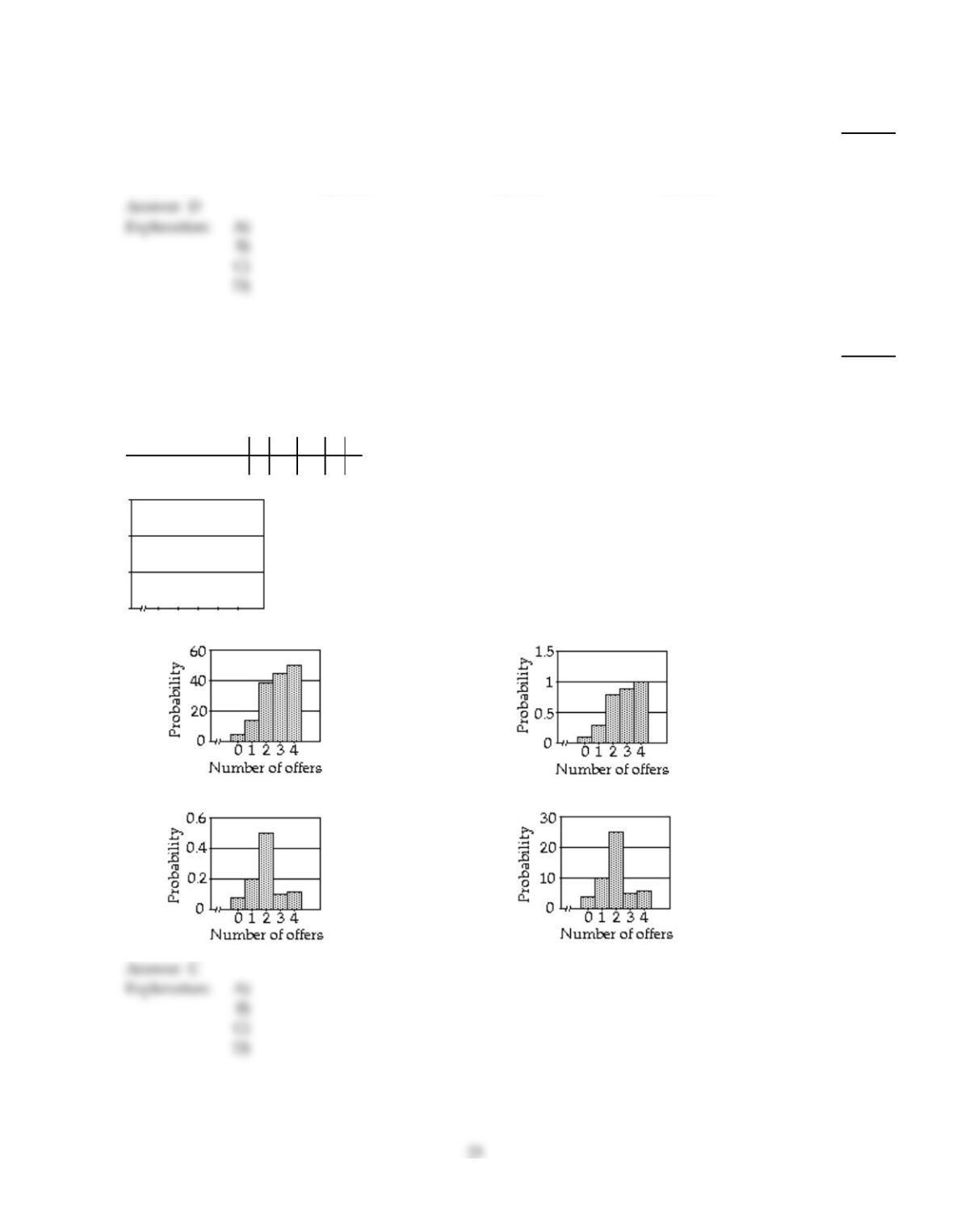
79)
Each person from a group of recently graduated math majors revealed the number of job offers that
he or she had received prior to graduation. The compiled data are represented in the table.
Construct the probability histogram for the number of job offers received by a graduate randomly
selected from this group.
Number of offers 0 1 2 3 4
Frequency 4 10 25 5 6
79)
A)
B)
C)
D)
Obtain the probability distribution of the random variable.
80)
When two balanced dice are rolled, 36 equally likely outcomes are possible as shown below.
(1, 1) (1, 2) (1, 3) (1, 4) (1, 5) (1, 6)
(2, 1) (2, 2) (2, 3) (2, 4) (2, 5) (2, 6)
(3, 1) (3, 2) (3, 3) (3, 4) (3, 5) (3, 6)
(4, 1) (4, 2) (4, 3) (4, 4) (4, 5) (4, 6)
(5, 1) (5, 2) (5, 3) (5, 4) (5, 5) (5, 6)
(6, 1) (6, 2) (6, 3) (6, 4) (6, 5) (6, 6)
Let X denote the smaller of the two numbers. If both dice come up the same number, then X equals
that common value. Find the probability distribution of X. Leave your probabilities in fraction
form.
80)
A)
x P(X = x)
15/18
22/9
31/6
41/9
51/18
6 0
B)
x P(X = x)
11/6
21/6
31/6
41/6
51/6
61/6
C)
x P(X = x)
15/18
21/4
37/36
45/36
51/9
61/36
D)
x P(X = x)
111/36
21/4
37/36
45/36
51/12
61/36
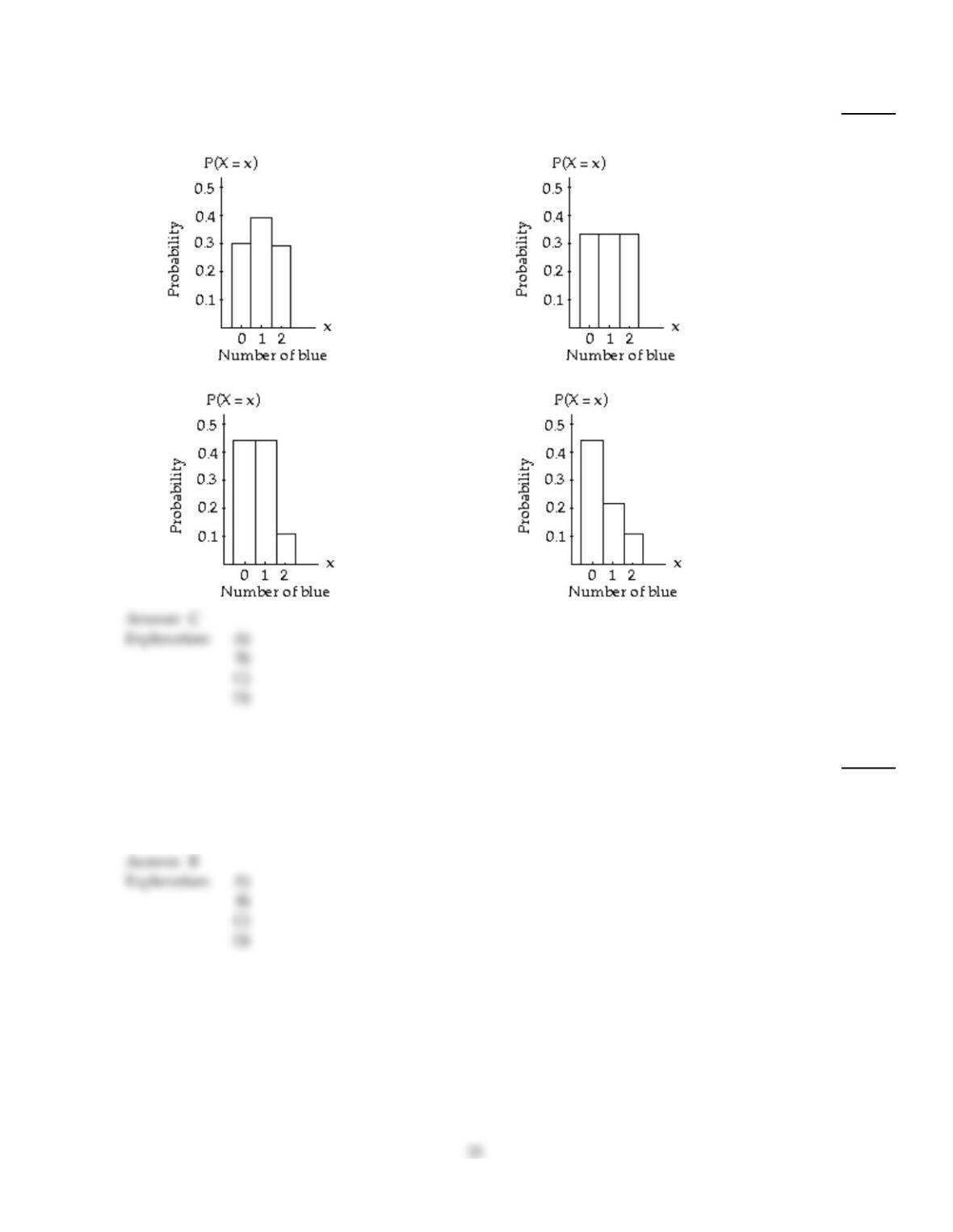
Construct a probability histogram for the binomial random variable, X.
81)
Two balls are drawn at random, with replacement, from a bag containing 4 red balls and 2 blue
balls. X is the number of blue balls drawn.
81)
A)
B)
C)
D)
Find the indicated probability. Round to four decimal places.
82)
The participants in a television quiz show are picked from a large pool of applicants with
approximately equal numbers of men and women. Among the last 10 participants there have been
only 2 women. If participants are picked randomly, what is the probability of getting 2 or fewer
women when 10 people are picked?
82)
A)
0.0107
B)
0.0547
C)
0.0439
D)
0.0537
Determine the possible values of the random variable.
83)
Suppose that two balanced dice are rolled. Let X denote the absolute value of the difference of the
two numbers. What are the possible values of the random variable X?
83)
A)
0, 1, 2, 3, 4, 5, 6
B)
1, 2, 3, 4, 5
C)
–5, –4, –3, –2, –1, 0, 1, 2, 3, 4, 5
D)
0, 1, 2, 3, 4, 5
Find the mean of the binomial random variable. Round to two decimal places when necessary.
84)
On a multiple choice test with 19 questions, each question has four possible answers, one of which
is correct. For students who guess at all answers, find the mean for the random variable X, the
number of correct answers.
84)
A)
6.33
B)
14.25
C)
4.75
D)
9.5
Provide an appropriate response.
85)
True or false, if the random variable X has a Poisson distribution, then the probability distribution
of X can be either right skewed or symmetric?
85)
A)
True
B)
False
Find the specified probability.
86)
Use the special addition rule and the following probability distribution to determine P(6 < X 8).
x 5 6 7 8 9 10 11
P(X = x) 0.05 0.05 0.20 0.15 0.15 0.10 0.30
86)
A)
1.00
B)
0.45
C)
0.35
D)
0.40
Determine the possible values of the random variable.
87)
Suppose a coin is tossed four times. Let X denote the total number of tails obtained in the four
tosses. What are the possible values of the random variable X?
87)
A)
0, 1, 2, 3, 4
B)
HHHH, HHHT, HHTH, HHTT, HTHH, HTHT, HTTH, HTTT, THHH, THHT, THTH, THTT,
TTHH, TTHT, TTTH, TTTT
C)
1, 2, 3
D)
1, 2, 3, 4
Determine the required probability by using the Poisson approximation to the binomial distribution. Round to three
decimal places.
88)
The probability that a car will have a flat tire while driving through a certain tunnel is 0.00005. Use
the Poisson approximation to the binomial distribution to find the probability that among 10,000
cars passing through this tunnel, exactly two will have a flat tire.
88)
A)
0.106
B)
0.121
C)
0.076
D)
0.091
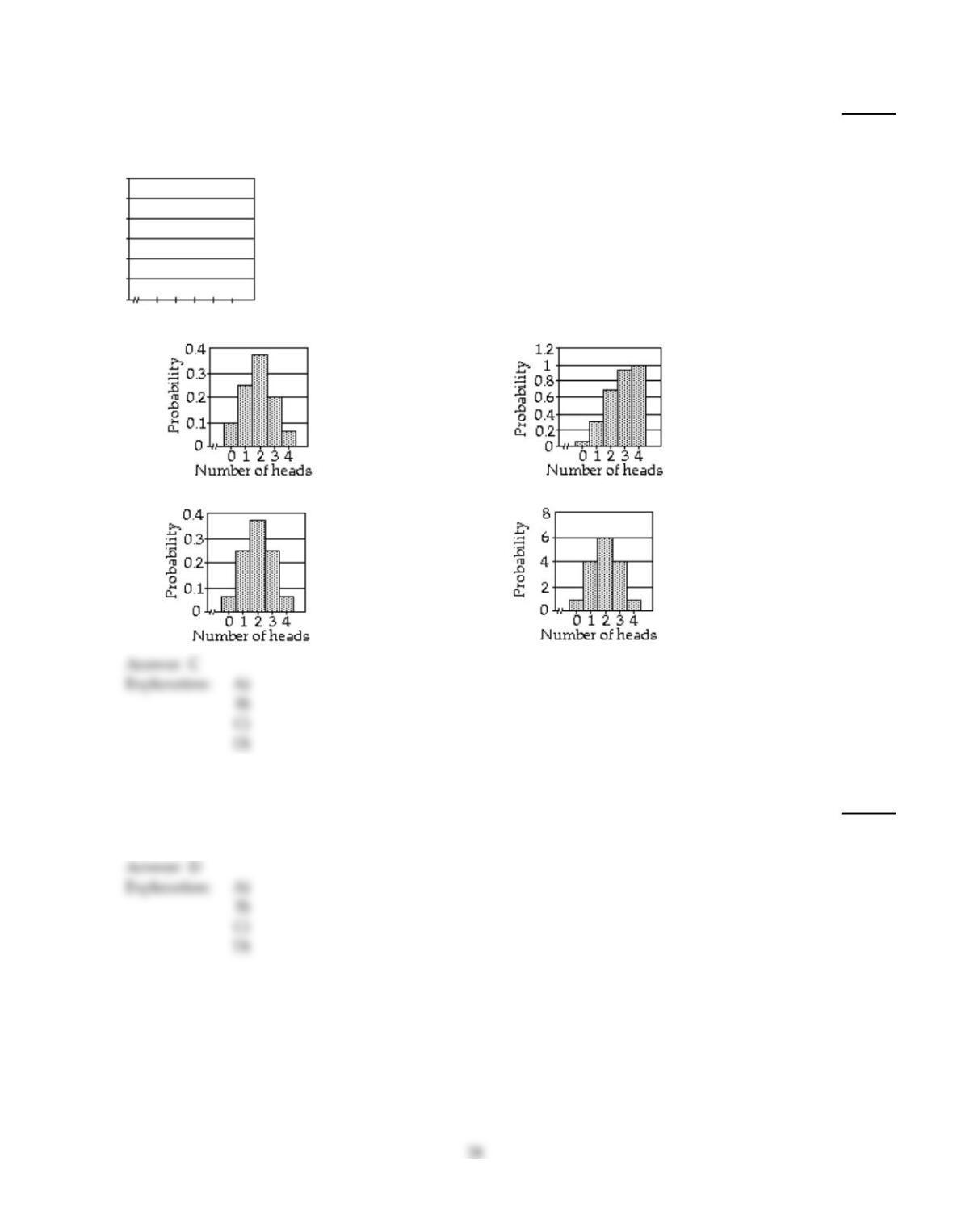
Construct the requested histogram.
89)
If a fair coin is tossed 4 times, there are 16 possible sequences of heads (H) and tails (T). Suppose
the random variable X represents the number of heads in a sequence. Construct the probability
distribution for X.
89)
A)
B)
C)
D)
Find the mean of the binomial random variable. Round to two decimal places when necessary.
90)
The probability that a radish seed will germinate is 0.7. A gardener plants seeds in batches of 7.
Find the mean for the random variable X, the number of seeds germinating in each batch.
90)
A)
4.97
B)
6.3
C)
2.1
D)
4.9
Find the standard deviation of the binomial random variable.
91)
A company manufactures batteries in batches of 19 and there is a 3% rate of defects. Find the
standard deviation for the random variable X, the number of defects per batch.
91)
A)
0.755
B)
0.724
C)
0.741
D)
0.744
Use random–variable notation to represent the event.
92)
Suppose that two balanced dice are rolled. Let X denote the sum of the two numbers. Use
random–variable notation to represent the event that the sum of the two numbers is less than 4.
92)
A)
(1, 1), (1, 2), (2, 1)
B)
{X < 4}
C)
{X
4}
D)
{X+Y < 4}
Evaluate the expression.
93)
19
1
93)
A)
1
B)
19
C)
18
D)
20
Use random–variable notation to represent the event.
94)
Suppose that two balanced dice are rolled. Let Y denote the sum of the two numbers. Use
random–variable notation to represent the event that the sum of the two numbers is at least 3 but
less than 5.
94)
A)
{3 Y < 5}
B)
{3 < Y < 5}
C)
{3 X+Y < 5}
D)
(1, 2), (2, 1), (1, 3), (3, 1), (2, 2)
Evaluate the expression.
95)
9
0
95)
A)
8
B)
1
C)
9
D)
40,320
Use random–variable notation to represent the event.
96)
For a randomly selected student in a particular high school, let Y denote the number of living
grandparents of the student. Use random–variable notation to represent the event that the student
obtained has at least two living grandparents.
96)
A)
P{Y
2}
B)
{Y > 2}
C)
{Y
2}
D)
{2, 3, 4}
Calculate the specified probability
97)
Suppose that A is a random variable. Also suppose that P(T > a) = P(T < – a) = x, and that P(0 < T
a ) = y. Find P(–a
T
0) in terms of x and y.
97)
A)
1 – y
B)
1 – 2x – y
C)
1 – (2x – y)
D)
y
Use the Poisson Distribution to find the indicated probability. Round to three decimal places when necessary.
98)
A computer salesman averages 1.7 sales per week. Use the Poisson distribution to find the
probability that in a randomly selected week the number of computers sold is 1.
98)
A)
0.528
B)
0.342
C)
0.388
D)
0.311
Find the indicated probability. Round to four decimal places.
99)
In one city, the probability that a person will pass his or her driving test on the first attempt is 0.69.
11 people are selected at random from among those taking their driving test for the first time. What
is the probability that among these 11 people, the number passing the test is between 2 and 4
inclusive?
99)
A)
0.0259
B)
0.0290
C)
0.0252
D)
0.0213
100)
Find the probability of at least 2 girls in 6 births. Assume that male and female births are equally
likely and that the births are independent events.
100)
A)
0.2344
B)
0.6563
C)
0.8906
D)
0.1094
Obtain the probability distribution of the random variable.
101)
The following table displays a frequency distribution for the number of living grandparents for
students at a high school. For a randomly selected student in the school, let X denote the number of
living grandparents of the student. Obtain the probability distribution of X.
Number of living grandparents 0 1 2 3 4
Frequency 34 77 141 218 155
101)
A)
Grandparents
x
Probability
P(X = x)
10.130
20.239
30.369
40.262
B)
Grandparents
x
Probability
P(X = x)
00.2
10.2
20.2
30.2
40.2
C)
Grandparents
x
Probability
P(X = x)
00.054
10.123
20.226
30.349
40.248
D)
Grandparents
x
Probability
P(X = x)
00.062
10.139
20.226
30.333
40.240
Find the mean of the random variable.
102)
The random variable X is the number of people who have a college degree in a randomly selected
group of four adults from a particular town. Its probability distribution is given in the table. Round
the answer to two decimal places.
x 0 1 2 3 4
P(X = x) 0.4096 0.4096 0.1536 0.0256 0.0016
102)
A)
2.00
B)
0.70
C)
1.21
D)
0.80
Find the standard deviation of the binomial random variable.
103)
On a multiple choice test with 27 questions, each question has four possible answers, one of which
is correct. For students who guess at all answers, find the standard deviation for the random
variable X, the number of correct answers.
103)
A)
2.163
B)
2.208
C)
2.25
D)
2.205
Use the Poisson Distribution to find the indicated probability. Round to three decimal places when necessary.
104)
The number of calls received by a car towing service in an hour has a Poisson distribution with
parameter =2.37. Find the probability that in a randomly selected hour the number of calls is
between 2 and 4 inclusive.
104)
A)
0.651
B)
0.593
C)
0.470
D)
1.415
Find the specified probability.
105)
Use the special addition rule and the following probability distribution to determine P(X 8).
x 5 6 7 8 9 10 11
P(X = x) 0.05 0.05 0.20 0.15 0.15 0.10 0.30
105)
A)
0.15
B)
0.30
C)
0.45
D)
0.70
Find the standard deviation of the random variable.
106)
The random variable X is the number of siblings of a student selected at random from a particular
secondary school. Its probability distribution is given in the table. Round the answer to three
decimal places when necessary.
x 0 1 2 3 4 5
P(X = x) 13
48
1
3
1
6
1
8
1
16
1
24
106)
A)
1.994
B)
1.384
C)
1.661
D)
0.997
Use the Poisson Distribution to find the indicated probability. Round to three decimal places when necessary.
107)
For a certain type of fabric, the average number of defects in each square foot of fabric is 0.2. Find
the probability that a randomly selected square foot of the fabric will contain more than one defect.
107)
A)
0.982
B)
0.016
C)
0.018
D)
0.836
Find the mean of the random variable.
108)
The random variable X is the number that shows up when a loaded die is rolled. Its probability
distribution is given in the table. Round the answer to two decimal places.
x 1 2 3 4 5 6
P(X = x) 0.15 0.13 0.15 0.12 0.16 0.29
108)
A)
0.17
B)
3.50
C)
3.75
D)
3.88
Provide an appropriate response.
109)
Which of the random variables described below is/are discrete random variables?
The random variable X represents the number of heads when a coin is flipped 20 times.
The random variable Y represents the number of calls received by a car tow service in a year.
The random variable Z represents the weight of a randomly selected student.
109)
A)
X, Y, and Z
B)
Y only
C)
X and Y
D)
X only
Find the specified probability.
110)
A statistics professor has office hours from 9:00 am to 10:00 am each day. The number of students
waiting to see the professor is a random variable, X, with the distribution shown in the table.
x 0 1 2 3 4 5
P(X = x) 0.05 0.10 0.40 0.25 0.15 0.05
The professor gives each student 10 minutes. Determine the probability that a student arriving just
after 9:00 am will have to wait no longer than 10 minutes to see the professor.
110)
A)
0.55
B)
0.10
C)
0.05
D)
0.15
Obtain the probability distribution of the random variable.
111)
When two balanced dice are rolled, 36 equally likely outcomes are possible as shown below.
(1, 1) (1, 2) (1, 3) (1, 4) (1, 5) (1, 6)
(2, 1) (2, 2) (2, 3) (2, 4) (2, 5) (2, 6)
(3, 1) (3, 2) (3, 3) (3, 4) (3, 5) (3, 6)
(4, 1) (4, 2) (4, 3) (4, 4) (4, 5) (4, 6)
(5, 1) (5, 2) (5, 3) (5, 4) (5, 5) (5, 6)
(6, 1) (6, 2) (6, 3) (6, 4) (6, 5) (6, 6)
Let X denote the product of the two numbers. Find the probability distribution of X. Leave your
probabilities in fraction form.
111)
A)
x P(X = x)
11/18
21/18
31/18
41/18
51/18
61/18
81/18
91/18
10 1/18
x P(X = x)
12 1/18
15 1/18
16 1/18
18 1/18
20 1/18
24 1/18
25 1/18
30 1/18
36 1/18
B)
x P(X = x)
21/36
31/18
41/12
51/9
65/36
x P(X = x)
71/6
85/36
91/9
10 1/12
11 1/18
12 1/36
C)
x P(X = x)
21/18
31/18
41/12
51/18
61/9
81/18
x P(X = x)
10 1/12
12 1/9
15 1/12
18 1/12
20 1/12
24 1/12
30 1/18
D)
x P(X = x)
11/36
21/18
31/18
41/12
51/18
61/9
81/18
91/36
10 1/18
x P(X = x)
12 1/9
15 1/18
16 1/36
18 1/18
20 1/18
24 1/18
25 1/36
30 1/18
36 1/36
Use the Poisson Distribution to find the indicated probability. Round to three decimal places when necessary.
112)
=4.0; P(X < 3)
112)
A)
0.22
B)
0.195
C)
0.398
D)
0.238
Find the mean of the Poisson random variable.
113)
Suppose X has a Poisson distribution with parameter =1.8. Find the mean of X.
113)
A)
1.342
B)
3.24
C)
1
D)
1.8
Find the indicated probability. Round to four decimal places.
114)
In a certain college, 33% of the physics majors belong to ethnic minorities. If 10 students are
selected at random from the physics majors, what is the probability that no more than 6 belong to
an ethnic minority?
114)
A)
0.9815
B)
0.0547
C)
0.9130
D)
0.9846
Obtain the probability distribution of the random variable.
115)
The following frequency table contains data on home sale prices in the city of Summerhill for the
month of June. For a randomly selected sale price between $80,000 and $265,900 let X denote the
number of homes that sold for that price. Find the probability distribution of X.
Sale Price (in thousands) Frequency
(No. of homes sold)
80.0 – 110.9
111.0 – 141.9
142.0 – 172.9
173.0 – 203.9
204.0 – 234.9
235.0 – 265.9
2
5
7
10
3
1
115)
A)
Sale Price (in thousands) Probability
(P(X = x)
80.0 – 110.9
111.0 – 141.9
142.0 – 172.9
173.0 – 203.9
204.0 – 234.9
235.0 – 265.9
0.071
0.179
0.250
0.357
0.107
0.036
B)
Sale Price (in thousands) Probability
(P(X = x)
80.0 – 110.9
111.0 – 141.9
142.0 – 172.9
173.0 – 203.9
204.0 – 234.9
235.0 – 265.9
0.071
0.179
0.250
0.357
0.107
0.360
C)
Sale Price (in thousands) Probability
(P(X = x)
80.0 – 110.9
111.0 – 141.9
142.0 – 172.9
173.0 – 203.9
204.0 – 234.9
235.0 – 265.9
0.071
0.179
0.025
0.357
0.107
0.036
D)
Sale Price (in thousands) Probability
(P(X = x)
80.0 – 110.9
111.0 – 141.9
142.0 – 172.9
173.0 – 203.9
204.0 – 234.9
235.0 – 265.9
0.071
0.197
0.250
0.357
0.107
0.036
Use the Poisson Distribution to find the indicated probability. Round to three decimal places when necessary.
116)
=3.3; P(X
2)
116)
A)
0.201
B)
0.641
C)
0.841
D)
0.159
Find the standard deviation of the binomial random variable.
117)
A die is rolled 20 times and the number of twos that come up is tallied. If this experiment is
repeated many times, find the standard deviation for the random variable X, the number of twos.
117)
A)
1.673
B)
1.667
C)
2.24
D)
1.624
Find the mean of the random variable.
118)
The random variable X is the number of houses sold by a realtor in a single month at the Sendsom’s
Real Estate office. Its probability distribution is given in the table. Round the answer to two decimal
places when necessary.
x 0 1 2 3 4 5 6 7
P(X = x) 0.24 0.01 0.12 0.16 0.01 0.14 0.11 0.21
118)
A)
3.6
B)
3.5
C)
3.35
D)
3.4
Find the standard deviation of the random variable.
119)
A police department reports that the probabilities that 0, 1, 2, and 3 burglaries will be reported in a
given day are 0.47, 0.37, 0.15, and 0.01, respectively. Find the standard deviation for the probability
distribution. Round the answer to two decimal places.
119)
A)
0.57
B)
1.03
C)
1.02
D)
0.75
Find the specified probability.
120)
There are only 8 chairs in our whole house. Whenever there is a party some people have no where
to sit. The number of people at our parties (call it the random variable X) changes with each party.
Past records show that the probability distribution of X is as shown in the following table. Find the
probability that everyone will have a place to sit at our next party.
x 5 6 7 8 9 10 >10
P(X = x) 0.05 0.05 0.20 0.15 0.15 0.10 0.30
120)
A)
0.55
B)
0.45
C)
0.15
D)
0.05
Evaluate the expression.
121)
12
4
121)
A)
495
B)
2970
C)
40,320
D)
3
Find the specified probability.
122)
Use the special addition rule and the following probability distribution to determine P(X = 6).
x 5 6 7 8 9 10 11
P(X = x) 0.05 0.05 0.20 0.15 0.15 0.10 0.30
122)
A)
0.95
B)
0.05
C)
0.10
D)
0.90
Find the mean of the Poisson random variable.
123)
In one town, the number of burglaries in a week has a Poisson distribution with parameter =3.2.
Let X denote the number of burglaries in the town in a randomly selected week. Find the mean of
X.
123)
A)
10.24
B)
3.2
C)
1.789
D)
1.6
The probability distribution of a random variable is given along with its mean and standard deviation. Draw a
probability histogram for the random variable; locate the mean and show one, two, and three standard deviation
intervals.
124)
The random variable X is the number of tails when four coins are flipped. Its probability
distribution is as follows.
x 0 1 2 3 4
P(X = x) 1
16
1
4
3
8
1
4
1
16
µ= 2, = 1
124)
39