Find the indicated probability.
150)
If you flip a coin three times, the possible outcomes are HHH, HHT, HTH, HTT, THH, THT, TTH,
TTT. What is the probability that the first two tosses come up the same?
150)
A)
1
2
B)
1
8
C)
1
4
D)
3
8
Provide an appropriate response.
151)
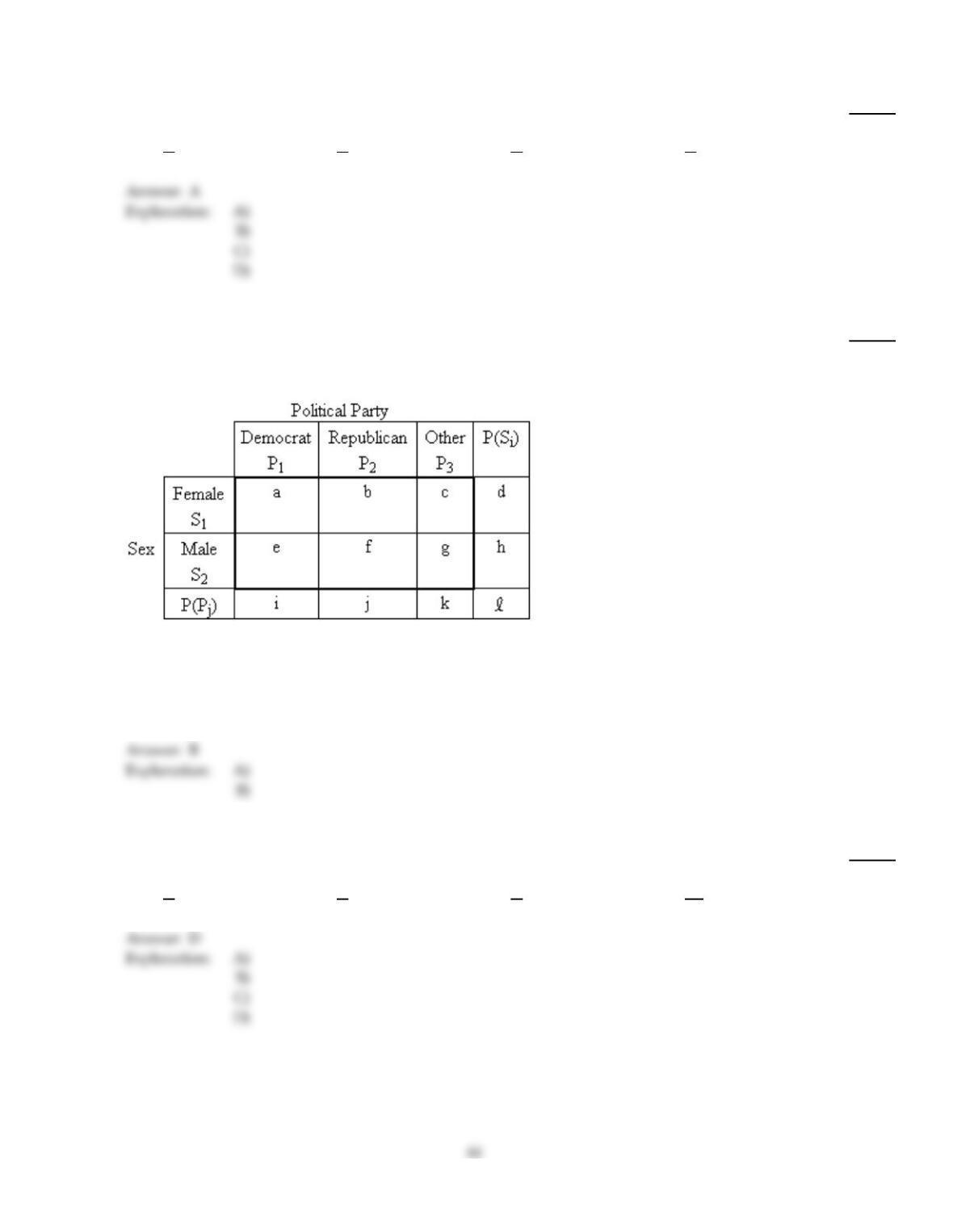
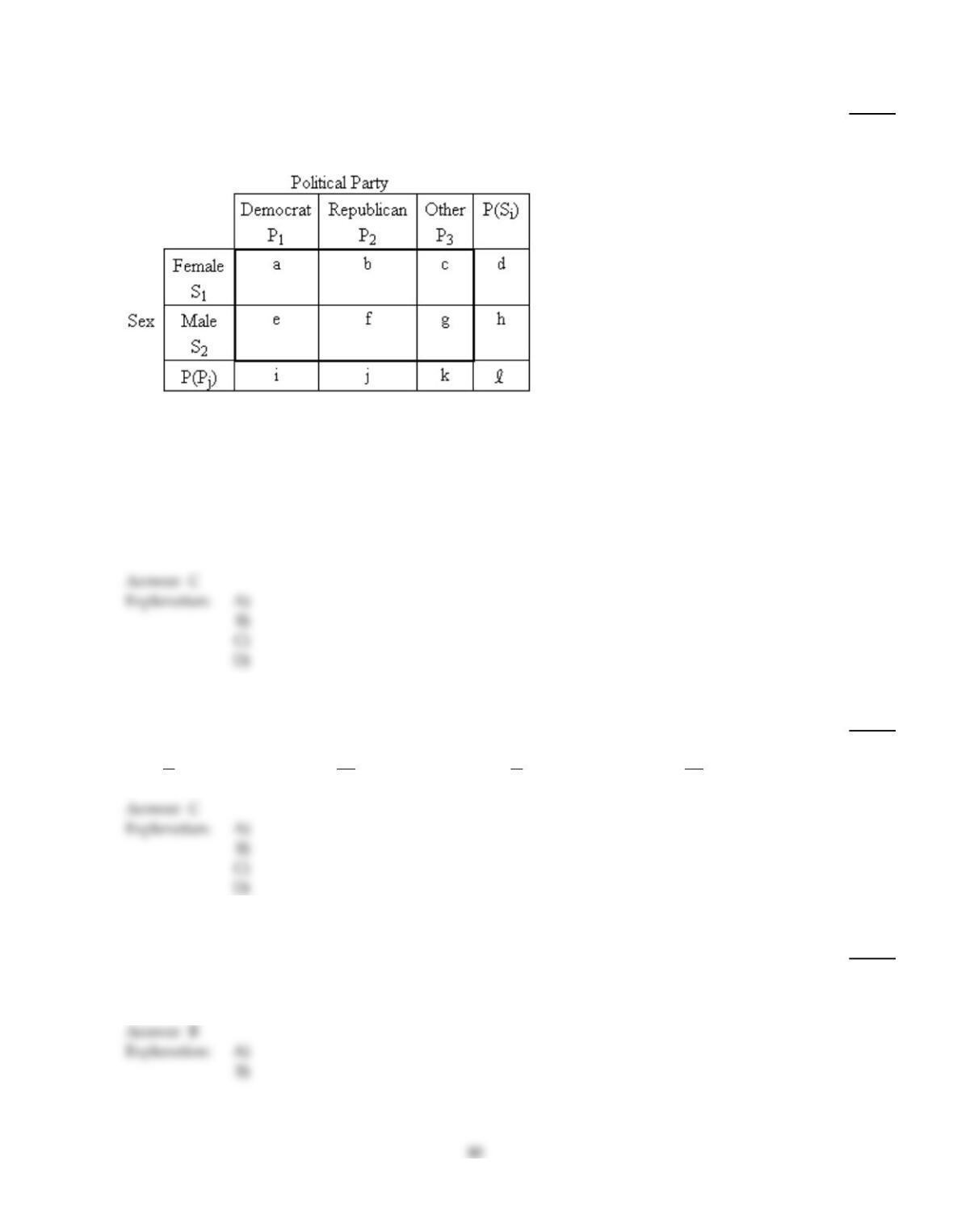
A contingency table provides a joint frequency distribution for the popular votes cast in a
presidential election by sex and political party. A joint probability distribution corresponding to the
contingency table is obtained and can be represented as follows.
The letters a through
are used to represent the probabilities in the different cells so, for example,
the letter f represents P( P2 & S2) and the letter h represents P( S2).
True or false, a + e = 1?
151)
A)
True
B)
False
Find the indicated probability.
152)
A bag contains 4 red marbles, 3 blue marbles, and 7 green marbles. If a marble is randomly selected
from the bag, what is the probability that it is blue?
152)
A)
1
4
B)
1
3
C)
1
7
D)
3
14
Determine whether the events are independent.
153)
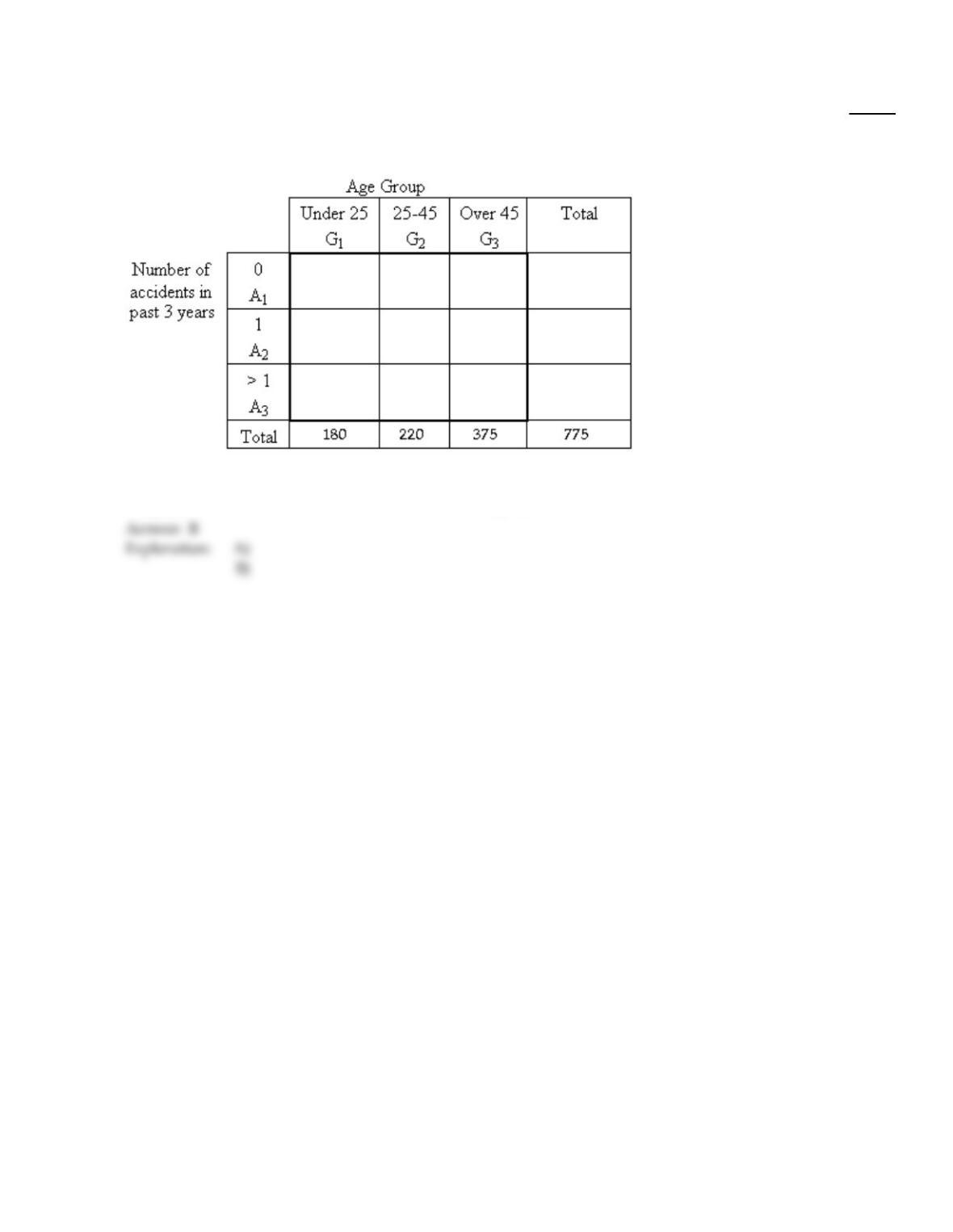
An auto insurance company was interested in investigating accident rates for drivers in different
age groups. The following contingency table was based on a random sample of drivers and
classifies drivers by age group and number of accidents in the past three years.
93 154 300 547
51 50 65 166
36 16 10 62
Suppose that one of the drivers is selected at random. Are the events G1 and A3 independent?
153)
A)
Yes
B)
No
62
154)
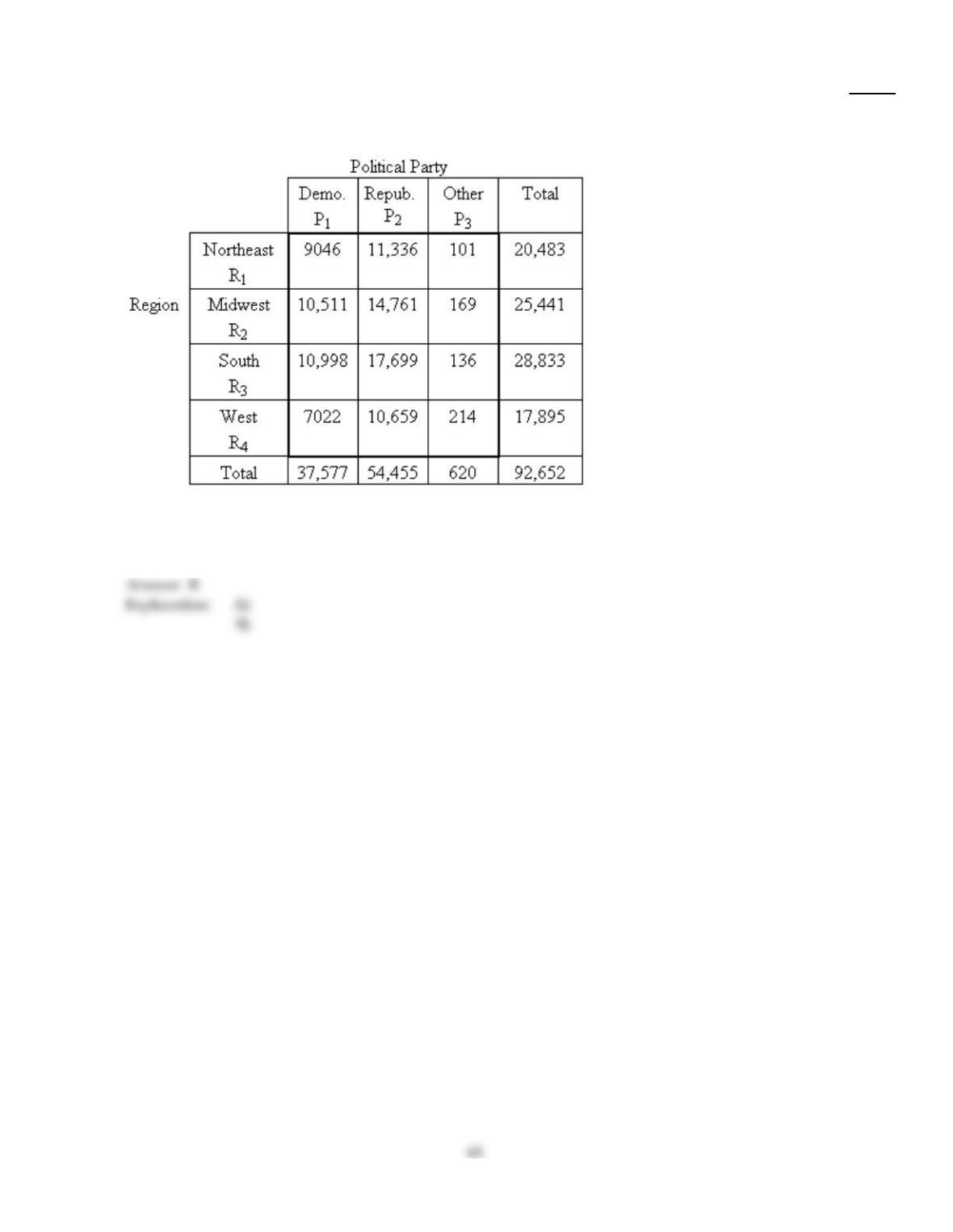
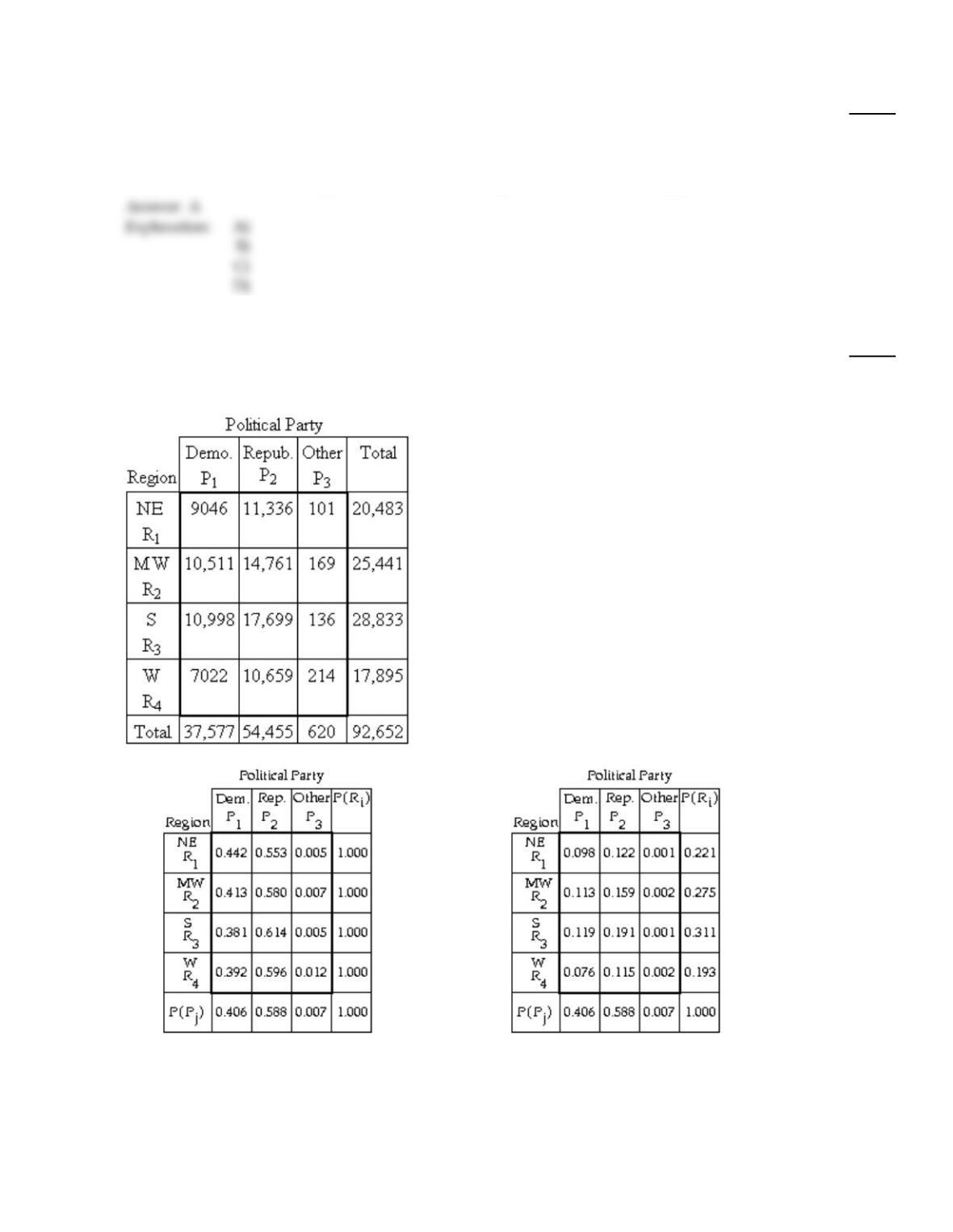
The following contingency table provides a joint frequency distribution for the popular votes cast in
the presidential election by region and political party. Data are in thousands, rounded to the
nearest thousand.
A person who voted in the presidential election is selected at random. Are events P2 and R3
independent?
154)
A)
Yes
B)
No

Find the indicated probability.
155)
A committee of three people is to be formed. The three people will be selected from a list of five
possible committee members. A simple random sample of three people is taken, without
replacement, from the group of five people. If the five people are represented by the letters A, B, C,
D, E, the possible outcomes are as follows.
ABC
ABD
ABE
ACD
ACE
ADE
BCD
BCE
BDE
CDE
Determine the probability that C and D are both included in the sample.
155)
A)
3
10
B)
2
10
C)
2
5
D)
1
10
Determine whether the events are mutually exclusive.
156)
The age distribution of students at a community college is given below.
Age (years) Number of students (f)
Under 21 2890
21–24 2190
25–28 1276
29–32 651
33–36 274
37–40 117
Over 40 185
A student from the community college is selected at random. The events A and B are defined as
follows.
A = event the student is at most 24
B = event the student is at least 33
Are the events A and B mutually exclusive?
156)
A)
Yes
B)
No
Use counting rules to determine the probability.
157)
In a card game, each player is dealt 4 cards from an ordinary deck of 52 playing cards. Determine
the probability of being dealt a hand containing three cards of one denomination and one of
another.
157)
A)
0.0000591
B)
0.0137
C)
0.165
D)
0.00922
Provide an appropriate response.
158)
True or false, an event consists of exactly one of the possible outcomes comprising the sample
space?
158)
A)
True
B)
False
Determine whether the events are mutually exclusive.
159)
When a quarter is tossed four times, 16 outcomes are possible.
HHHH HHHT HHTH HHTT
HTHH HTHT HTTH HTTT
THHH THHT THTH THTT
TTHH TTHT TTTH TTTT
Here, for example, HTTH represents the outcome that the first toss is heads, the next two tosses are
tails, and the fourth toss is heads. The events A and B are defined as follows.
A = event the first two tosses are heads
B = event the first and last tosses are the same
Are the events A and B mutually exclusive?
159)
A)
Yes
B)
No

160)
The age distribution of students at a community college is given below.
Age (years) Number of students (f)
Under 21 2890
21–24 2190
25–28 1276
29–32 651
33–36 274
37–40 117
Over 40 185
A student from the community college is selected at random. The events A and B are defined as
follows.
A = event the student is at most 24
B = event the student is at least 37
Are the events (not A) and B mutually exclusive?
160)
A)
Yes
B)
No
Determine the number of outcomes that comprise the specified event.
161)
The age distribution of students at a community college is given below.
Age (years) Number of students (f)
Under 21 2167
21–25 2180
26–30 1011
31–35 836
Over 35 235
A student from the community college is selected at random. The events A and B are defined as
follows.
A = event the student is between 21 and 35 inclusive
B = event the student is 26 or over
Determine the number of outcomes that comprise the event (A or B).
161)
A)
4262
B)
2082
C)
6109
D)
1847
Determine whether the events are independent.
162)
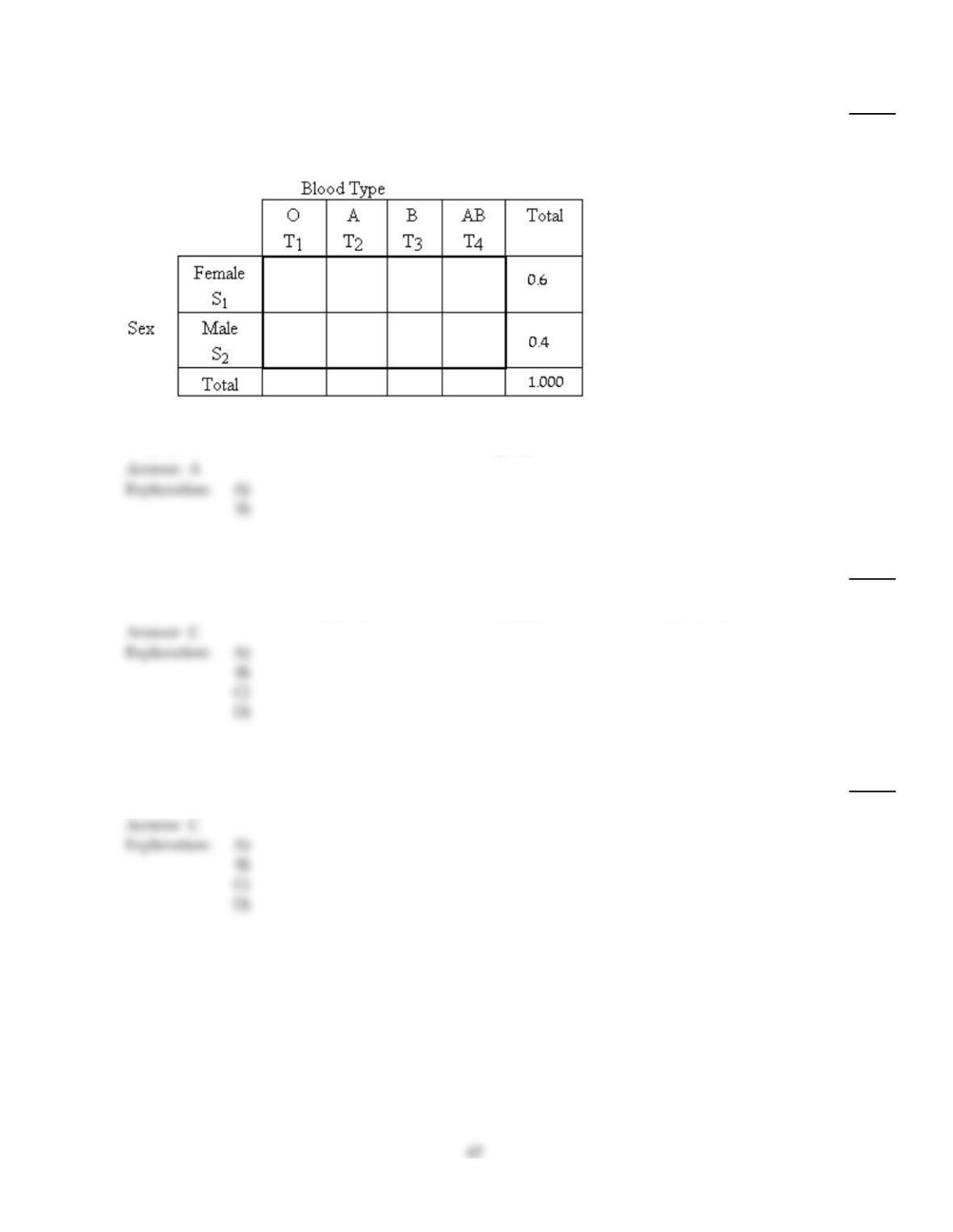
The following contingency table provides a joint probability distribution
for a random sample of patients at a hospital classified by blood type and
sex.
0.2750 0.2375 0.0575 0.0300
0.2000 0.1625 0.0425 0.0200
0.4750 0.4000 0.1000 0.0500
Suppose one of the patients is selected at random. Are the events T4 and S1 independent?
162)
A)
Yes
B)
No
Answer the question.
163)
Suppose you are playing a game of chance. If you bet $2 on a certain event, you will collect $66
(including your $2 bet) if you win. Find the odds used for determining the payoff.
163)
A)
66 to 68
B)
33 to 1
C)
32 to 1
D)
1 to 32
Evaluate the expression.
164)
8C3
164)
A)
112
B)
120
C)
56
D)
3
Use Bayes’s rule to find the indicated probability.
165)
30% of the workers at Motor Works are female, while 32% of the workers at City Bank are female. If
one of these companies is selected at random (assume a 50–50 chance for each), and then a worker
is selected at random, what is the probability that the worker is female, given that the worker
comes from City Bank?
165)
A)
0.16
B)
0.096
C)
0.3
D)
0.15
Construct the joint probability distribution corresponding to the given contingency table.
166)
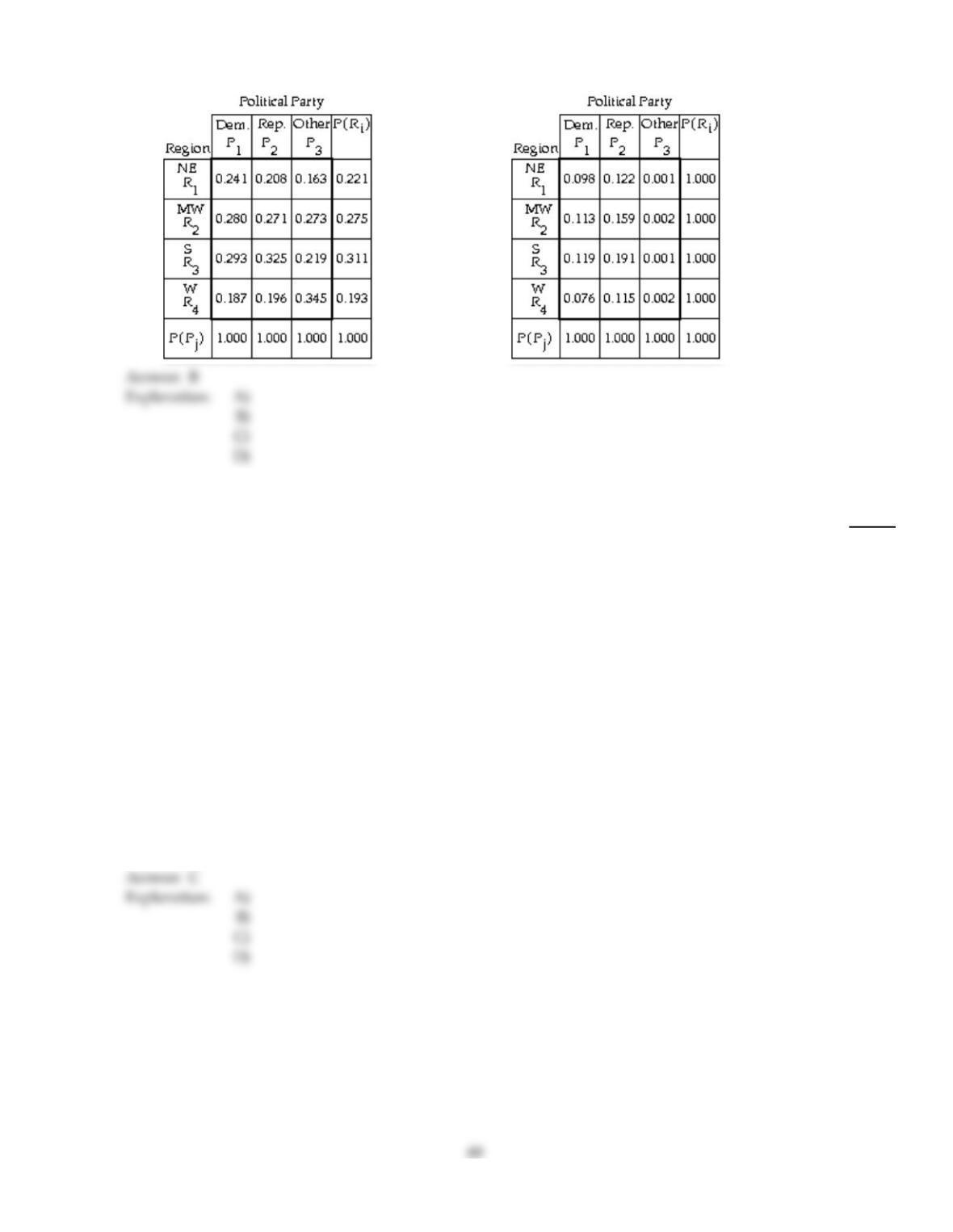
The following contingency table provides a joint frequency distribution for the popular votes cast
in the presidential election by region and political party. Data are in thousands, rounded to the
nearest thousand.
166)
A)
B)
68
C)
D)
List the outcomes comprising the specified event.
167)
When a quarter is tossed four times, 16 outcomes are possible.
HHHH HHHT HHTH HHTT
HTHH HTHT HTTH HTTT
THHH THHT THTH THTT
TTHH TTHT TTTH TTTT
Here, for example, HTTH represents the outcome that the first toss is heads, the next two tosses are
tails, and the fourth toss is heads. The events A and B are defined as follows.
A = event exactly two tails are tossed
B = event the first and last tosses are the same
List the outcomes that comprise the event (A & B).
167)
A)
HHTT, HTHT, HTTH, THHT, THTH, TTHH
B)
HHHH, HHTH, HHTT, HTHH, HTHT, HTTH, THHT, THTH, THTT, TTHH, TTHT, TTTT
C)
HTTH, THHT
D)
HHHH, HHTH, HTHH, HTTH, THHT, THTT, TTHT, TTTT
Provide an appropriate response.
168)
If you obtain values by observing two variables of a population, these values are called ________
data.
168)
A)
Bivariate
B)
Joint probability
C)
Univariate
D)
Marginal
Determine whether the events are independent.
169)
When a coin is tossed three times, eight equally likely outcomes are possible.
HHH HHT HTH HTT
THH THT TTH TTT
Let
A = event the first two tosses are the same
B = event the total number of heads is one.
Are A and B independent events?
169)
A)
Yes
B)
No
List the outcomes comprising the specified event.
170)
When a quarter is tossed four times, 16 outcomes are possible.
HHHH HHHT HHTH HHTT
HTHH HTHT HTTH HTTT
THHH THHT THTH THTT
TTHH TTHT TTTH TTTT
Here, for example, HTTH represents the outcome that the first toss is heads, the next two tosses are
tails, and the fourth toss is heads. The event A is defined as follows.
A = event the first two tosses are heads
List the outcomes that comprise the event (not A).
170)
A)
TTHH, TTHT, TTTH, TTTT
B)
HHHH, HHHT, HHTH, HHTT
C)
THHH, THHT, THTH, THTT, TTHH, TTHT, TTTH, TTTT
D)
HTHH, HTHT, HTTH, HTTT, THHH, THHT, THTH, THTT, TTHH, TTHT, TTTH, TTTT

171)
In a competition, two people will be selected from four finalists to receive the first and second
prizes. The prize winners will be selected by drawing names from a hat. The names of the four
finalists are Jim, George, Helen, and Maggie. The possible outcomes can be represented as follows.
JG JH JM GJ GH GM
HJ HG HM MJ MG MH
Here, for example, HM represents the outcome that Helen receives the first prize and Maggie
receives the second prize. List the outcomes that comprise the following event.
A = event that George wins second prize
171)
A)
JG, HG, MG, GM
B)
JG, HG, MG
C)
JG, HG, MG, GJ, GH, GM
D)
JG, HG
Use counting rules to determine the probability.
172)
A committee of 11 members is voting on a proposal. Each member casts a yea or nay vote. On a
random voting basis, what is the probability that the proposal wins by a vote of 6 to 5?
172)
A)
0.11279
B)
0.11084
C)
0.45117
D)
0.22559
Solve the problem.
173)
A musician plans to perform 4 selections. In how many ways can she arrange the musical
selections?
173)
A)
4
B)
16
C)
120
D)
24
Use counting rules to determine the probability.
174)
In a lottery, the player selects six numbers from the numbers 1–39. There are six winning numbers
(all different) which are selected at random from the numbers 1–39. To win a prize, the ticket must
contain three or more of the winning numbers. If you buy one lottery ticket, determine the
probability that your ticket contains exactly three winning numbers.
174)
A)
0.0390
B)
0.0279
C)
0.0418
D)
0.0334
Find the conditional probability.
175)
The following table contains data from a study of two airlines which fly to Small Town, USA.
Number of flights
which were on time
Number of flights
which were late
Podunk Airlines 33 6
Upstate Airlines 43 5
If one of the 87 flights is randomly selected, find the probability that the flight selected arrived on
time given that it was an Upstate Airlines flight.
175)
A)
0.494
B)
0.145
C)
0.896
D)
None of the above is correct.
List the outcomes comprising the specified event.
176)
In a competition, two people will be selected from four finalists to receive the first and second
prizes. The prize winners will be selected by drawing names from a hat. The names of the four
finalists are Jim, George, Helen, and Maggie. The possible outcomes can be represented as follows.
JG JH JM GJ GH GM
HJ HG HM MJ MG MH
Here, for example, JG represents the outcome that Jim receives the first prize and George receives
the second prize. The events A and B are defined as follows.
A = event that Helen gets first prize
B = event that George gets a prize
List the outcomes that comprise the event (A or B).
176)
A)
JG, JH, GJ, GH, GM, HJ, HG, HM, MG, MH
B)
HG
C)
JG, GJ, GH, GM, HJ, HM, MG
D)
JG, GJ, GH, GM, HJ, HG, HM, MG
Find the indicated probability by using the general addition rule.
177)
Of the 91 people who answered “yes” to a question, 5 were male. Of the 81 people who answered
“no” to the question, 13 were male. If one person is selected at random from the group, what is the
probability that the person answered “yes” or was male?
177)
A)
0.605
B)
0.055
C)
0.634
D)
0.105
Use words or symbols, as indicated, to describe the event.
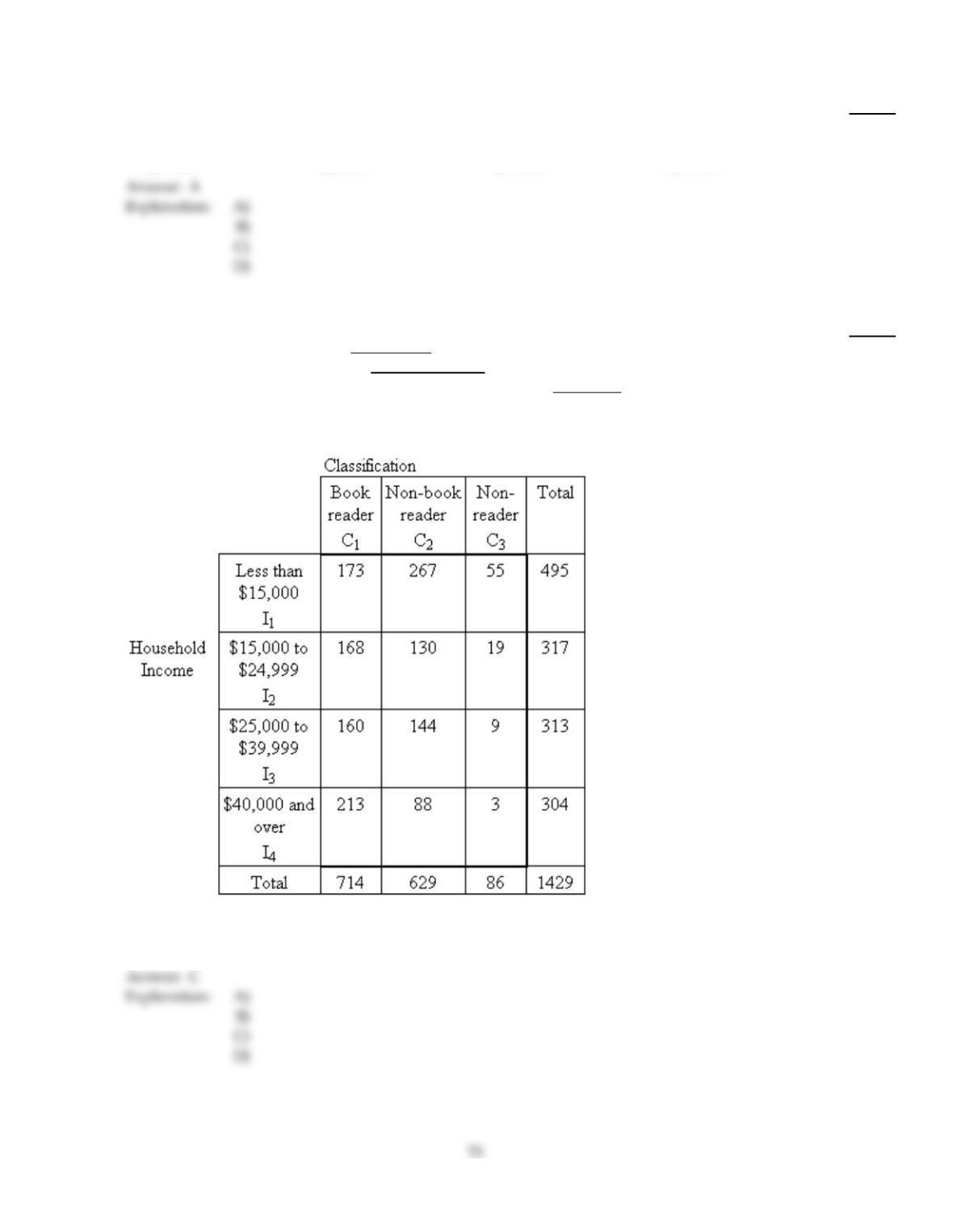
178)
The Book Industry Study Group, Inc., performs sample surveys to obtain information on
characteristics of book readers. A book reader is defined to be one who read one or more books in
the six months prior to the survey; a non–book reader is defined to be one who read newspapers or
magazines but no books in the six months prior to the survey; a nonreader is defined to be one who
did not read a book, newspaper, or magazine in the six months prior to the survey. The following
data were obtained from a random sample of 1429 persons 16 years old and over.
How many people were non–readers or made $25,000 – $39,999?
178)
A)
86
B)
399
C)
390
D)
313

List the outcomes comprising the specified event.
179)
Three board members for a nonprofit organization will be selected from a group of five people. The
board members will be selected by drawing names from a hat. The names of the five possible board
members are Allison, Betty, Charlie, Dave, and Emily. The possible outcomes can be represented as
follows.
ABC ABD ABE ACD ACE
ADE BCD BCE BDE CDE
Here, for example, ABC represents the outcome that Allison, Betty, and Charlie are selected to be on
the board. List the outcomes that comprise the following event.
A = event that Charlie is selected
179)
A)
CDE
B)
ABC, ACD, ACE, BCD, BCE, CDE, BDE
C)
ABC, ACD, ACE, BCD, BCE, CDE
D)
ABC, ACD, ACE, BCD, CDE
Provide an appropriate response.
180)
A person is selected at random from a certain population. Let
A = event the person is left handed
B = event the person is male
C = event the person is female.
True or false, P(A) = P(A and B) + P(A and C)?
180)
A)
True
B)
False
Use the general multiplication rule to find the indicated probability.
181)
You are dealt two cards successively (without replacement) from a shuffled deck of 52 playing
cards. Find the probability that both cards are black.
181)
A)
0.245
B)
0.490
C)
0.255
D)
0.000377

Use the special multiplication rule to find the indicated probability.
182)
A batch consists of 12 defective coils and 88 good ones. Find the probability of getting two good
coils when two coils are randomly selected if the first selection is replaced before the second is
made.
182)
A)
0.7744
B)
0.176
C)
0.7733
D)
0.0144
List the outcomes comprising the specified event.
183)
Three board members for a nonprofit organization will be selected from a group of five people. The
board members will be selected by drawing names from a hat. The names of the five possible board
members are Allison, Bob, Charlie, Dave, and Emily. The possible outcomes can be represented as
follows.
ABC ABD ABE ACD ACE
ADE BCD BCE BDE CDE
Here, for example, ABC represents the outcome that Allison, Bob, and Charlie are selected to be on
the board. The events A and B are defined as follows.
A = event that Dave is selected
B = event that fewer than two men are selected
List the outcomes that comprise the event (A & B).
183)
A)
ABD, ADE, BDE, BCD, ACD, CDE
B)
ABE, ABD, ADE, BDE
C)
ABD, ADE, BDE
D)
ABD, ADE, BDE, ABC, ACE, BCE
Find the conditional probability.
184)
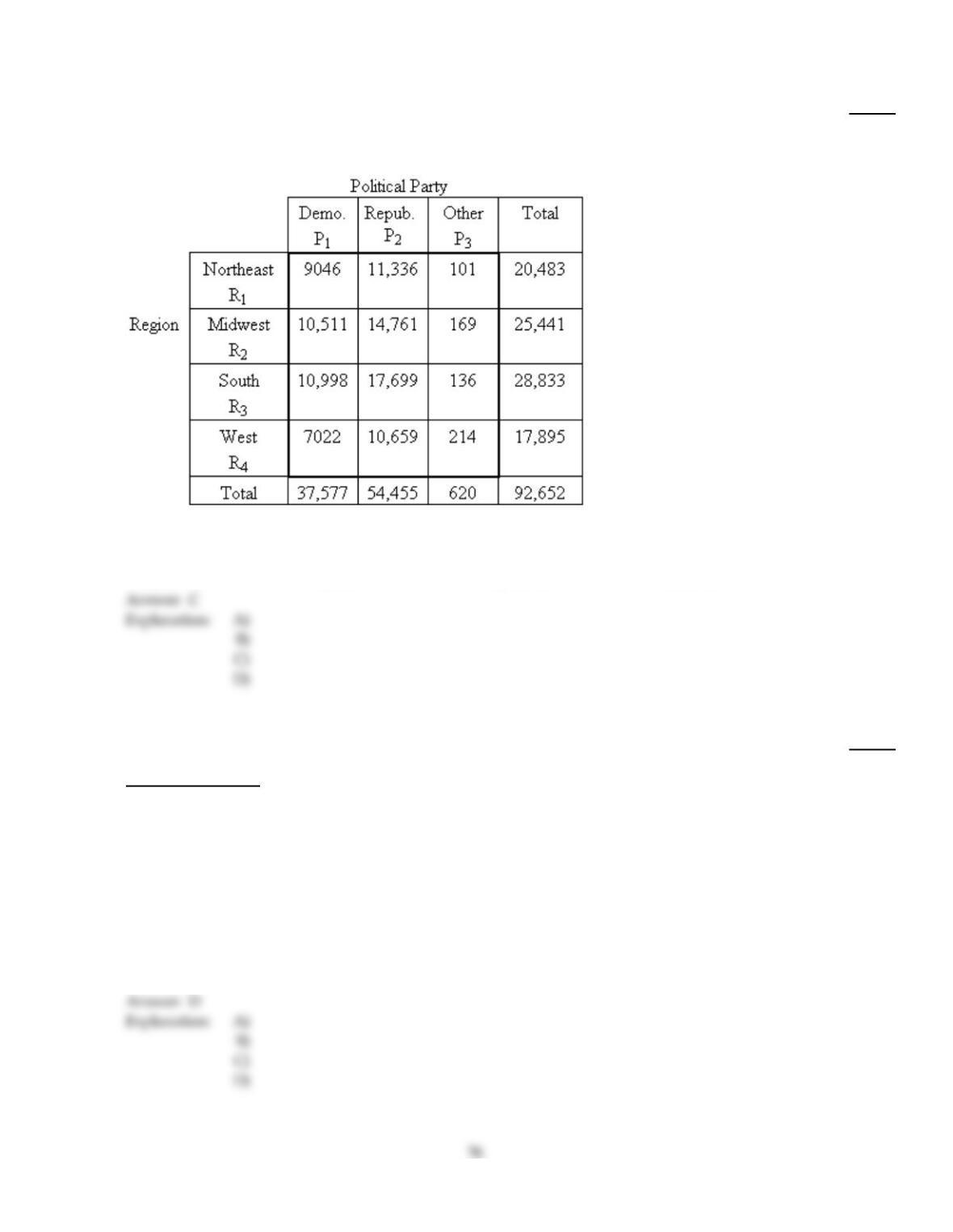
The following contingency table provides a joint frequency distribution for the popular votes cast in
the 1984 presidential election by region and political party. Data are in thousands, rounded to the
nearest thousand.
A person who voted in the 1984 presidential election is selected at random. Compute the
probability that the person selected voted Democrat given that they were in the Northeast.
184)
A)
0.406
B)
0.098
C)
0.442
D)
0.241
Find the indicated probability by using the complementation rule.
185)
A percentage distribution is given below for the size of families in one U.S. city.
Size Percentage
247.3
321.4
419.6
57.2
62.8
7+1.7
A family is selected at random. Find the probability that the size of the family is less than 6. Round
results to three decimal places.
185)
A)
0.983
B)
0.028
C)
0.045
D)
0.955
Find the indicated probability.
186)
If you flip a coin three times, the possible outcomes are HHH HHT HTH HTT THH THT TTH TTT.
What is the probability of getting at least one head?
186)
A)
1
2
B)
1
4
C)
7
8
D)
3
4
Use Bayes’s rule to find the indicated probability.
187)
Among students at one college are 3892 women and 3122 men. The following table provides
relative–frequency distributions for subject major for males and females at the college.
Major Relative frequency Relative frequency
for women for men
Humanities 0.193 0.164
Science 0.293 0.321
Social Science 0.171 0.397
Other 0.343 0.118
A student is selected at random from the college. Determine the probability that the student selected
is female given that he or she is a Humanities major.
187)
A)
0.605
B)
0.193
C)
0.107
D)
0.595

Determine the number of outcomes that comprise the specified event.
188)
The number of hours needed by sixth grade students to complete a research project was recorded
with the following results.
Hours Number of students (f)
423
528
620
712
810
9 4
10+7
A student is selected at random. The events A and B are defined as follows.
A = the event the student took at most 8 hours
B = the event the student took at least 8 hours
Determine the number of outcomes that comprise the event (A & B).
188)
A)
21
B)
116
C)
10
D)
104

Describe the specified event in words.
189)
The number of hours needed by sixth grade students to complete a research project was recorded
with the following results.
Hours Number of students (f)
415
511
619
7 6
8 9
916
10 2
A student is selected at random. The event A is defined as follows.
A = the event the student took between 5 and
9 hours inclusive
B = the event the student took at least 8 hours
Describe the event (A & B) in words.
189)
A)
The event the student took between 5 and 8 hours inclusive
B)
The event the student at least 5 hours
C)
The event the student took more than 8 hours and less than 9 hours
D)
The event the student took between 8 and 9 hours inclusive
Provide an appropriate response.
190)
A contingency table provides a joint frequency distribution for the popular votes cast in a
presidential election by sex and political party. A joint probability distribution corresponding to the
contingency table is obtained and can be represented as follows.
The letters a through
are used to represent the probabilities in the different cells so, for example,
the letter f represents P( P2 & S2) and the letter h represents P( S2).
Suppose that of the women who voted, 42% voted Democrat. Express this fact in conditional
probability notation.
190)
A)
P( P1 & S1) = 0.42
B)
P( P1or S1) = 0.42
C)
P( P1|S 1) = 0.42
D)
P( S1|P 1) = 0.42
Find the indicated probability by using the special addition rule.
191)
Two 6–sided dice are rolled. What is the probability that the sum of the numbers on the dice is 6 or
9?
191)
A)
3
2
B)
1
54
C)
1
4
D)
5
12
Provide an appropriate response.
192)
An experiment consists of randomly selecting a card from a deck of 52. Three events A, B, and C are
defined for this experiment. True or false, if no outcome is common to the three events then the
events are mutually exclusive?
192)
A)
True
B)
False