Chapter 4 – Linear Programming Applications in Marketing, Finance, and Operations Management
True / False
1. Media selection problems can maximize exposure quality and use number of customers reached as a constraint, or
maximize the number of customers reached and use exposure quality as a constraint.
a.
True
b.
False
True
Media selection
2. Revenue management methodology was originally developed for the banking industry.
a.
True
b.
False
False
Revenue management
3. Portfolio selection problems should acknowledge both risk and return.
a.
True
b.
False
True
Portfolio selection
4. If an LP problem is not correctly formulated, the computer software will indicate it is infeasible when trying to solve it.
a.
True
b.
False
False
Computer solution
5. It is improper to combine manufacturing costs and overtime costs in the same objective function.
a.
True
b.
False
False
Make-or–buy decision
6. Production constraints frequently take the form:
beginning inventory + sales − production = ending inventory
a.
True
b.
False
False
Production scheduling
Chapter 4 – Linear Programming Applications in Marketing, Finance, and Operations Management
7. If a real-world problem is correctly formulated, it is not possible to have alternative optimal solutions.
a.
True
b.
False
False
8. To properly interpret dual prices, one must know how costs were allocated in the objective function.
a.
True
b.
False
True
Make-or–buy decision
9. A company makes two products from steel; one requires 2 tons of steel and the other requires 3 tons. There are 100 tons
of steel available daily. A constraint on daily production could be written as: 2x1 + 3x2 ≤ 100.
a.
True
b.
False
True
10. Double-subscript notation for decision variables should be avoided unless the number of decision variables exceeds
nine.
a.
True
b.
False
False
11. Using minutes as the unit of measurement on the left-hand side of a constraint and using hours on the right-hand side
is acceptable since both are a measure of time.
a.
True
b.
False
False
General
12. Compared to the problems in the textbook, real-world problems generally require more variables and constraints.
a.
True
b.
False
True
General
Chapter 4 – Linear Programming Applications in Marketing, Finance, and Operations Management
13. For the multiperiod production scheduling problem in the textbook, period n − 1’s ending inventory variable was also
used as period n‘s beginning inventory variable.
a.
True
b.
False
True
14. A company makes two products, A and B. A sells for $100 and B sells for $90. The variable production costs are $30
per unit for A and $25 for B. The company’s objective could be written as: MAX 190x1 − 55x2.
a.
True
b.
False
False
15. The primary limitation of linear programming’s applicability is the requirement that all decision variables be
nonnegative.
a.
True
b.
False
False
General
16. A decision maker would be wise to not deviate from the optimal solution found by an LP model because it is the best
solution.
a.
True
b.
False
False
General
17. Data collection for large-scale LP models can be more time-consuming than either the formulation of the model or the
development of the computer solution.
a.
True
b.
False
True
18. The media selection model presented in the textbook involves maximizing the number of potential customers reached
subject to a minimum total exposure quality rating.
a.
True
b.
False
False
Chapter 4 – Linear Programming Applications in Marketing, Finance, and Operations Management
19. The marketing research model presented in the textbook involves minimizing total interview cost subject to interview
quota guidelines.
a.
True
b.
False
True
Marketing research
20. A marketing research firm must determine how many daytime interviews (D) and evening interviews (E) to conduct.
At least 40% of the interviews must be in the evening. A correct modeling of this constraint is: -0.4D + 0.6E > 0.
a.
True
b.
False
True
Marketing research
Multiple Choice
21. Media selection problems usually determine
a.
how many times to use each media source.
b.
the coverage provided by each media source.
c.
the cost of each advertising exposure.
d.
the relative value of each medium.
a
Media selection
22. To study consumer characteristics, attitudes, and preferences, a company would engage in
a.
client satisfaction processing.
b.
marketing research.
c.
capital budgeting.
d.
production planning.
Marketing research
23. A marketing research application uses the variable HD to represent the number of homeowners interviewed during the
day. The objective function minimizes the cost of interviewing this and other categories and there is a constraint that HD
≥ 100. The solution indicates that interviewing another homeowner during the day will increase costs by 10.00. What do
you know?
a.
the objective function coefficient of HD is 10.
b.
the dual price for the HD constraint is 10.
c.
the objective function coefficient of HD is −10.
d.
the dual price for the HD constraint is −10.
Media selection
Chapter 4 – Linear Programming Applications in Marketing, Finance, and Operations Management
Marketing research
24. The dual price for a constraint that compares funds used with funds available is .058. This means that
a.
the cost of additional funds is 5.8%.
b.
if more funds can be obtained at a rate of 5.5%, some should be.
c.
no more funds are needed.
d.
the objective was to minimize.
Portfolio selection
25. Let M be the number of units to make and B be the number of units to buy. If it costs $2 to make a unit and $3 to buy
a unit and 4000 units are needed, the objective function is
a.
Max 2M + 3B
b.
Min 4000 (M + B)
c.
Max 8000M + 12000B
d.
Min 2M + 3B
26. If Pij = the production of product i in period j, then to indicate that the limit on production of the company’s three
products in period 2 is 400,
a.
P21 + P22 + P23 ≤ 400
b.
P12 + P22 + P32 ≤ 400
c.
P32 ≤ 400
d.
P23 ≤ 400
Production scheduling
27. Let Pij = the production of product i in period j. To specify that production of product 1 in period 3 and in period 4
differs by no more than 100 units,
a.
P13 − P14 ≤ 100; P14 − P13 ≤ 100
b.
P13 − P14 ≤ 100; P13 − P14 ≥ 100
c.
P13 − P14 ≤ 100; P14 − P13 ≥ 100
d.
P13 − P14 ≥ 100; P14 − P13 ≥ 100
Production scheduling
Chapter 4 – Linear Programming Applications in Marketing, Finance, and Operations Management
28. Let A, B, and C be the amounts invested in companies A, B, and C. If no more than 50% of the total investment can
be in company B, then
a.
B ≤ 5
b.
A − .5B + C ≤ 0
c.
.5A − B − .5C ≤ 0
d.
−.5A + .5B − .5C ≤ 0
Portfolio selection
29. Department 3 has 2500 hours. Transfers are allowed to departments 2 and 4, and from departments 1 and 2. If Ai
measures the labor hours allocated to department i and Tij the hours transferred from department i to department j, then
a.
T13 + T23 − T32 − T34 − A3 = 2500
b.
T31 + T32 − T23 − T43 + A3 = 2500
c.
A3 + T13 + T23 − T32 − T34 = 2500
d.
A3 − T13 − T23 + T32 + T34 = 2500
Workforce assignment
30. Modern revenue management systems maximize revenue potential for an organization by helping to manage
a.
pricing strategies.
b.
reservation policies.
c.
short-term supply decisions.
d.
All of the alternatives are correct.
Revenue management
31. Blending problems arise whenever a manager must decide how to
a.
mix several different asset types in one investment strategy.
b.
mix two or more resources to produce one or more products.
c.
combine the results of two or more research studies into one.
d.
allocate workers with different skill levels to various work shifts.
Blending problems
32. In a production scheduling LP, the demand requirement constraint for a time period takes the form
a.
beginning inventory + production + ending inventory > demand.
b.
beginning inventory − production + ending inventory = demand.
c.
beginning inventory + production − ending inventory = demand.
d.
beginning inventory − production − ending inventory > demand.
Chapter 4 – Linear Programming Applications in Marketing, Finance, and Operations Management
c
Production scheduling problems
33. A mutual fund manager must decide how much money to invest in Atlantic Oil (A) and how much to invest in Pacific
Oil (P). At least 60% of the money invested in the two oil companies must be in Pacific Oil. A correct modeling of this
constraint is
a.
0.4A + 0.6P > 0.
b.
-0.4A + 0.6P > 0.
c.
0.6A + 0.4P > 0.
d.
-0.6A + 0.4P > 0.
Portfolio selection
34. The production scheduling problem modeled in the textbook involves capacity constraints on all of the following
types of resources except
a.
material.
b.
labor.
c.
machine.
d.
storage.
a
Production scheduling
35. Which of the operations management applications modeled in the text has an objective function that minimizes the
sum of manufacturing costs, purchasing costs, and overtime costs?
a.
make-or–buy decision
b.
blending
c.
production scheduling
d.
workforce assignment
a
Operations management applications
Subjective Short Answer
36. A&C Distributors is a company that represents many outdoor products companies and schedules deliveries to discount
stores, garden centers, and hardware stores. Currently, scheduling needs to be done for two lawn sprinklers, the Water
Wave and Spring Shower models. Requirements for shipment to a warehouse for a national chain of garden centers are
shown below.
Month
Shipping
Capacity
Product
Minimum
Requirement
Unit Cost
to Ship
Per Unit
Inventory Cost
March
8000
Water Wave
3000
.30
.06
Spring Shower
1800
.25
.05
April
7000
Water Wave
4000
.40
.09
Chapter 4 – Linear Programming Applications in Marketing, Finance, and Operations Management
Spring Shower
4000
.30
.06
May
6000
Water Wave
5000
.50
.12
Spring Shower
2000
.35
.07
Let Sij be the number of units of sprinkler i shipped in month j, where i = 1 or 2, and j = 1, 2, or 3. Let Wij be the number
of sprinklers that are at the warehouse at the end of a month, in excess of the minimum requirement.
a
Write the portion of the objective function that minimizes shipping costs.
b.
An inventory cost is assessed against this ending inventory. Give the portion of the objective
function that represents inventory cost.
c.
There will be three constraints that guarantee, for each month, that the total number of
sprinklers shipped will not exceed the shipping capacity. Write these three constraints.
d.
There are six constraints that work with inventory and the number of units shipped, making
sure that enough sprinklers are shipped to meet the minimum requirements. Write these six
constraints.
Production scheduling
37. An ad campaign for a new snack chip will be conducted in a limited geographical area and can use TV time, radio
time, and newspaper ads. Information about each medium is shown below.
Medium
Cost Per Ad
# Reached
Exposure Quality
TV
500
10000
30
Radio
200
3000
40
Newspaper
400
5000
25
If the number of TV ads cannot exceed the number of radio ads by more than 4, and if the advertising budget is $10000,
develop the model that will maximize the number reached and achieve an exposure quality if at least 1000.
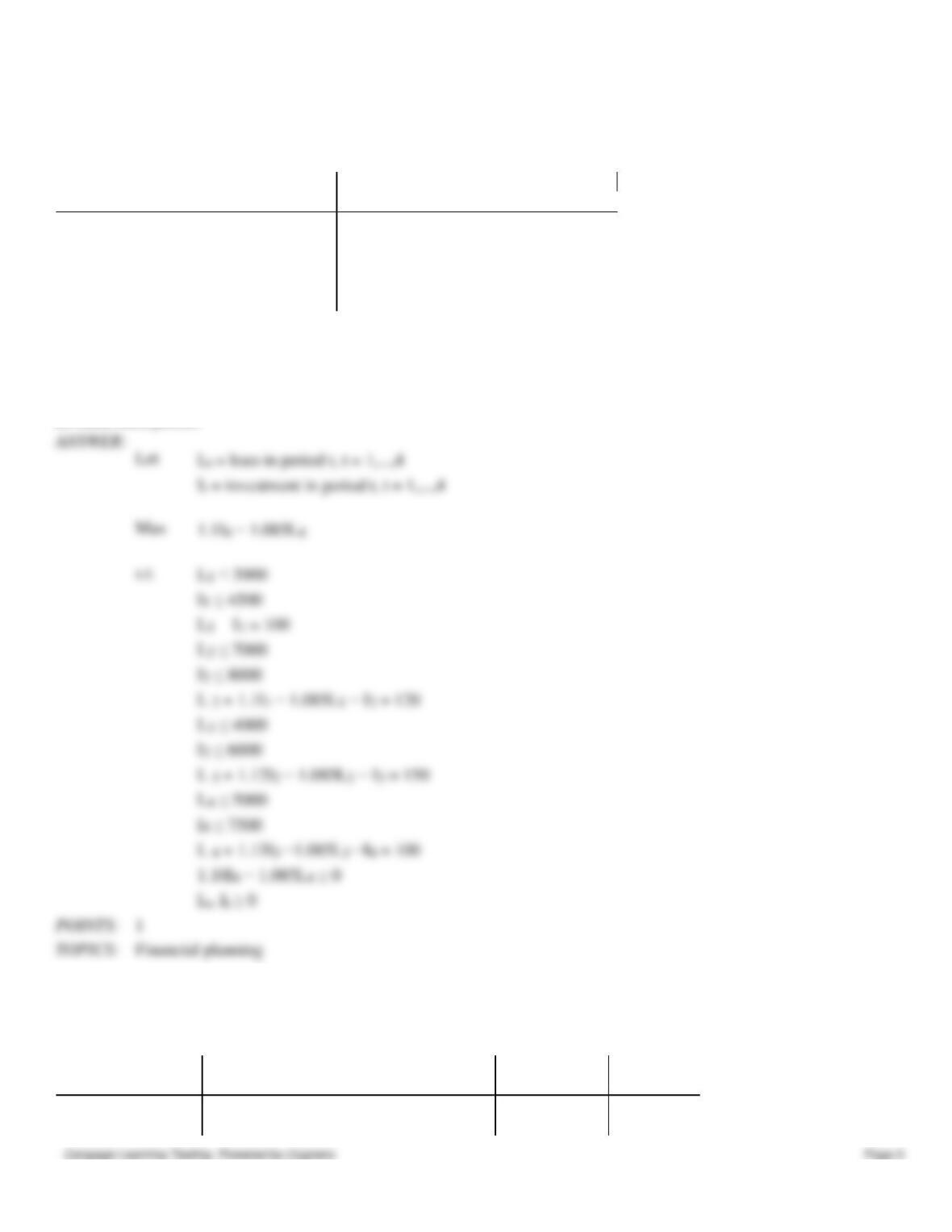
Max
10000T + 3000R + 5000N
s.t.
500T + 200R + 400N ≤ 10000
30T + 40R + 25N ≥ 1000
T − R ≤ 4
T, R, N ≥ 0
Chapter 4 – Linear Programming Applications in Marketing, Finance, and Operations Management
TOPICS:
Media selection
38. Information on a prospective investment for Wells Financial Services is given below.
Period
1
2
3
4
Loan Funds Available
3000
7000
4000
5000
Investment Income
(% of previous period’s investment)
110%
112%
113%
Maximum Investment
4500
8000
6000
7500
Payroll Payment
100
120
150
100
In each period, funds available for investment come from two sources: loan funds and income from the previous period’s
investment. Expenses, or cash outflows, in each period must include repayment of the previous period’s loan plus 8.5%
interest, and the current payroll payment. In addition, to end the planning horizon, investment income from period 4 (at
110% of the investment) must be sufficient to cover the loan plus interest from period 4. The difference in these two
quantities represents net income, and is to be maximized. How much should be borrowed and how much should be
invested each period?
POINTS:
1
TOPICS:
Financial planning
39. Tots Toys makes a plastic tricycle that is composed of three major components: a handlebar-front wheel-pedal
assembly, a seat and frame unit, and rear wheels. The company has orders for 12,000 of these tricycles. Current schedules
yield the following information.
Requirements
Cost to
Cost to
Component
Plastic
Time
Space
Manufacture
Purchase
Front
3
10
2
8
12
Seat/Frame
4
6
2
6
9
Chapter 4 – Linear Programming Applications in Marketing, Finance, and Operations Management
Rear wheel (each)
.5
2
.1
1
3
Available
50000
160000
30000
The company obviously does not have the resources available to manufacture everything needed for the completion of
12000 tricycles so has gathered purchase information for each component. Develop a linear programming model to tell
the company how many of each component should be manufactured and how many should be purchased in order to
provide 12000 fully completed tricycles at the minimum cost.
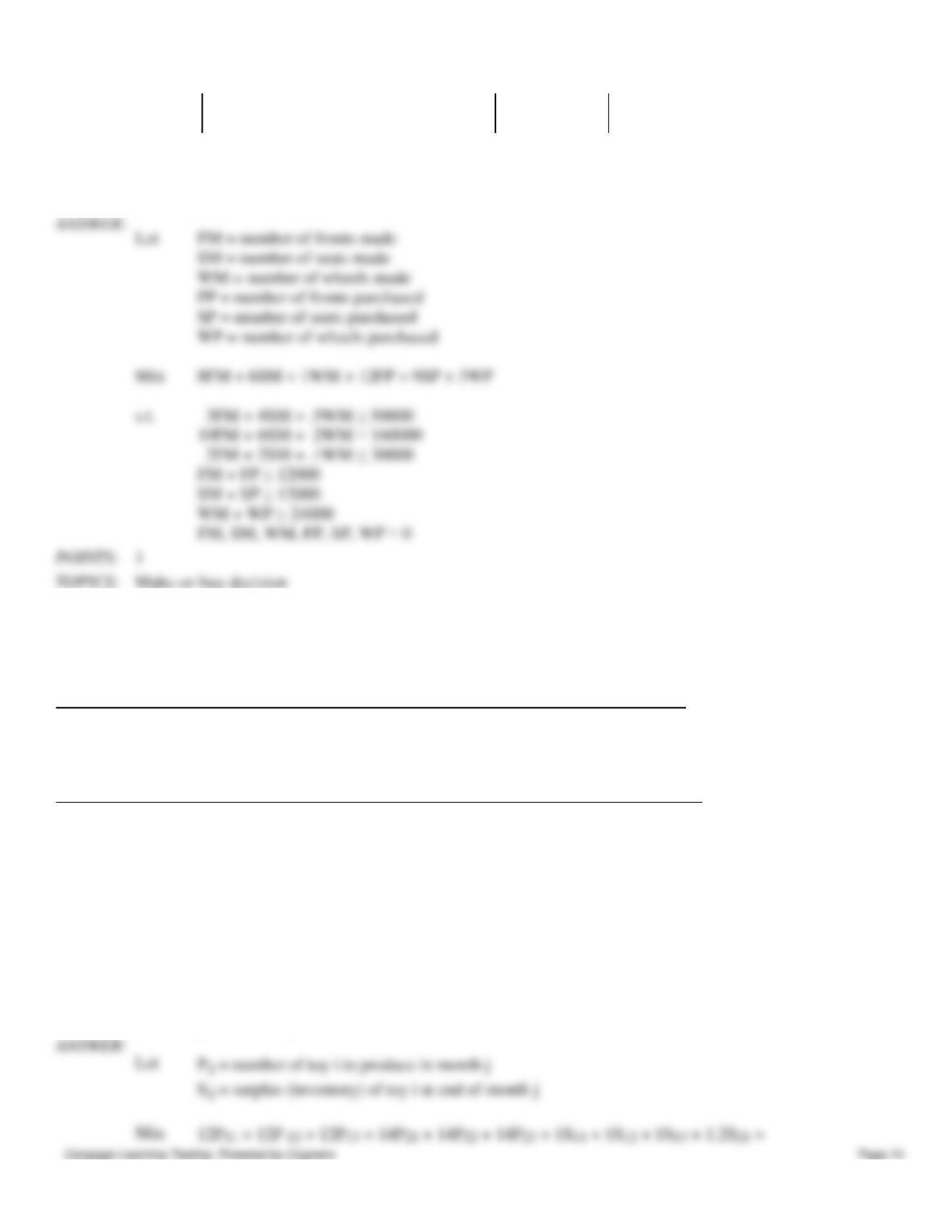
Let
Min
8FM + 6SM + 1WM + 12FP + 9SP + 3WP
s.t.
3FM + 4SM + .5WM ≤ 50000
10FM + 6SM + 2WM ≤ 160000
2FM + 2SM + .1WM ≤ 30000
1
Make-or–buy decision
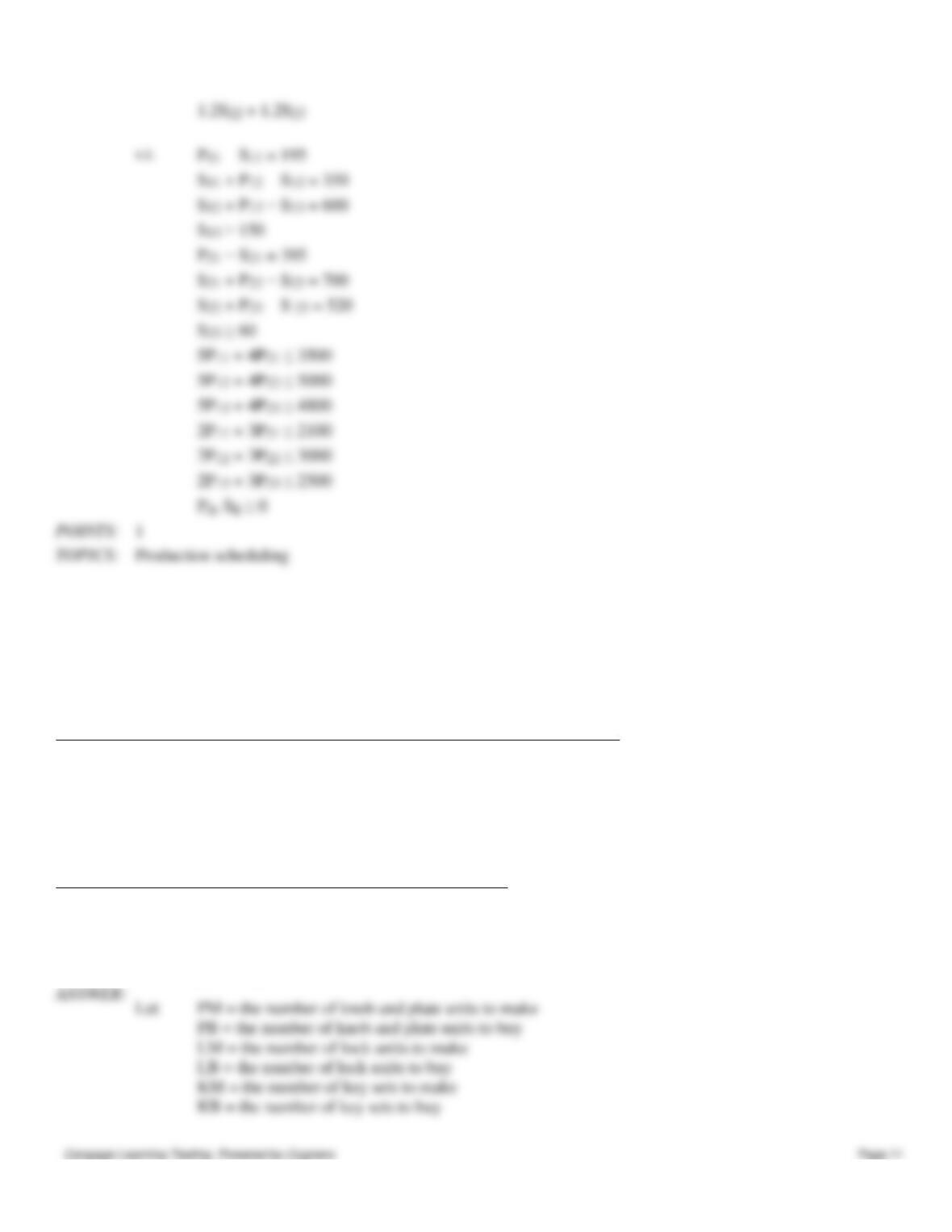
40. The Tots Toys Company is trying to schedule production of two very popular toys for the next three months: a rocking
horse and a scooter. Information about both toys is given below.
Begin. Invty.
Required
Required
Production
Production
Toy
June 1
Plastic
Time
Cost
Cost
Rocking Horse
25
5
2
12
1
Scooter
55
4
3
14
1.2
Plastic
Time
Monthly Demand
Monthly Demand
Summer Schedule
Available
Available
Horse
Scooter
June
3500
2100
220
450
July
5000
3000
350
700
August
4800
2500
600
520
Develop a model that would tell the company how many of each toy to produce during each month. You are to minimize
total cost. Inventory cost will be levied on any items in inventory on June 30, July 31, or August 31 after demand for the
month has been satisfied. Your model should make use of the relationship
Beginning Inventory + Production − Demand = Ending Inventory
for each month. The company wants to end the summer with 150 rocking horses and 60 scooters as beginning inventory
for Sept. 1. Don’t forget to define your decision variables.
Chapter 4 – Linear Programming Applications in Marketing, Finance, and Operations Management
41. Larkin Industries manufactures several lines of decorative and functional metal items. The most recent order has been
for 1200 door lock units for an apartment complex developer. The sales and production departments must work together
to determine delivery schedules. Each lock unit consists of three components: the knob and face plate, the actual lock
itself, and a set of two keys. Although the processes used in the manufacture of the three components vary, there are three
areas where the production manager is concerned about the availability of resources. These three areas, their usage by the
three components, and their availability are detailed in the table.
Resource
Knob and Plate
Lock
Key (each)
Available
Brass Alloy
12
5
1
15000 units
Machining
18
20
10
36000 minutes
Finishing
15
5
1
12000 minutes
A quick look at the amounts available confirms that Larkin does not have the resources to fill this contract. A
subcontractor, who can make an unlimited number of each of the three components, quotes the prices below.
Component
Subcontractor Cost
Larkin Cost
Knob and Plate
10.00
6.00
Lock
9.00
4.00
Keys (set of 2)
1.00
.50
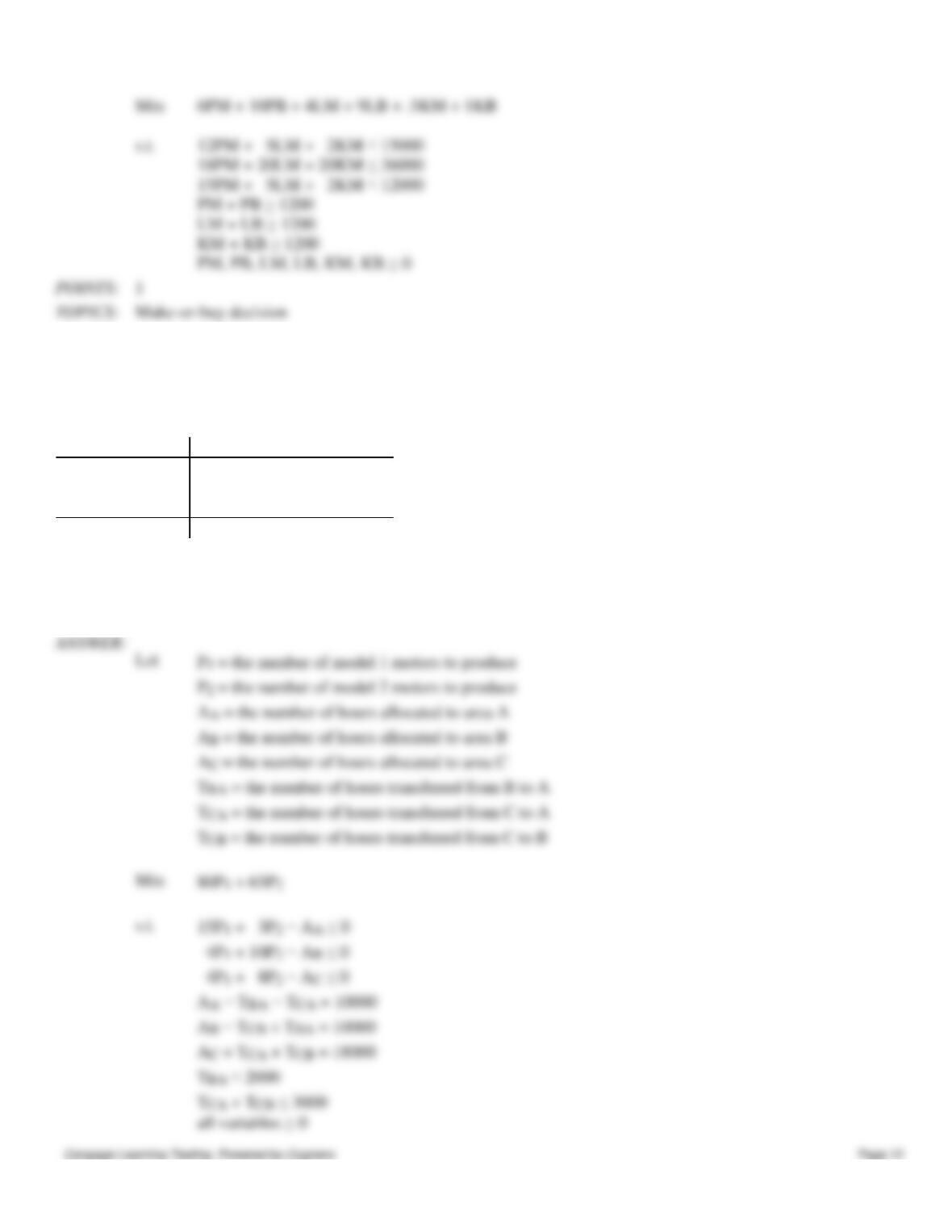
Develop a linear programming model that would tell Larkin how to fill the order for 1200 lock sets at the minimum cost.
Chapter 4 – Linear Programming Applications in Marketing, Finance, and Operations Management
42. G and P Manufacturing would like to minimize the labor cost of producing dishwasher motors for a major appliance
manufacturer. Although two models of motors exist, the finished models are indistinguishable from one another; their cost
difference is due to a different production sequence. The time in hours required for each model in each production area is
tabled here, along with the labor cost.
Model 1
Model 2
Area A
15
3
Area B
4
10
Area C
4
8
Cost
80
65
Currently labor assignments provide for 10,000 hours in each of Areas A and B and 18000 hours in Area C. If 2000 hours
are available to be transferred from area B to Area A, 3000 hours are available to be transferred from area C to either
Areas A or B, develop the linear programming model whose solution would tell G&P how many of each model to
produce and how to allocate the workforce.
Chapter 4 – Linear Programming Applications in Marketing, Finance, and Operations Management
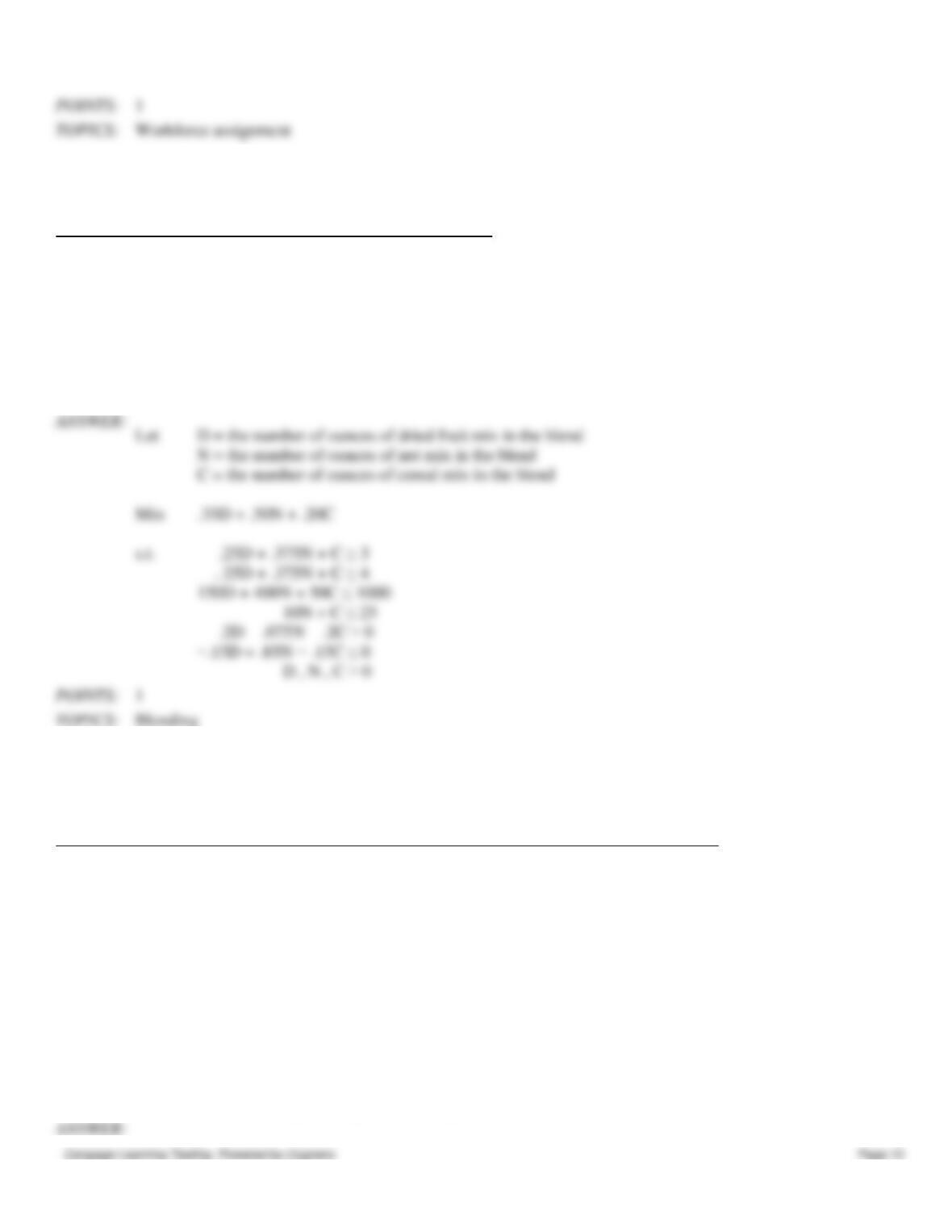
43. FarmFresh Foods manufactures a snack mix called TrailTime by blending three ingredients: a dried fruit mixture, a
nut mixture, and a cereal mixture. Information about the three ingredients (per ounce) is shown below.
Ingredient
Cost
Volume
Fat Grams
Calories
Dried Fruit
.35
1/4 cup
0
150
Nut Mix
.50
3/8 cup
10
400
Cereal Mix
.20
1 cup
1
50
The company needs to develop a linear programming model whose solution would tell them how many ounces of each
mix to put into the TrailTime blend. TrailTime is packaged in boxes that will hold between three and four cups. The blend
should contain no more than 1000 calories and no more than 25 grams of fat. Dried fruit must be at least 20% of the
volume of the mixture, and nuts must be no more than 15% of the weight of the mixture. Develop a model that meets
these restrictions and minimizes the cost of the blend.
D = the number of ounces of dried fruit mix in the blend
N = the number of ounces of nut mix in the blend
C = the number of ounces of cereal mix in the blend
.35D + .50N + .20C
44. The Meredith Ribbon Company produces paper and fabric decorative ribbon which it sells to paper products
companies and craft stores. The demand for ribbon is seasonal. Information about projected demand and production for a
particular type of ribbon is given.
Demand (yards)
Production Cost Per Yard
Production Capacity (yards)
Quarter 1
10,000
.03
30,000
Quarter 2
18,000
.04
20,000
Quarter 3
16,000
.06
20,000
Quarter 4
30,000
.08
15,000
An inventory holding cost of $.005 is levied on every yard of ribbon carried over from one quarter to the next.
a.
Define the decision variables needed to model this problem.
b.
The objective is to minimize total cost, the sum of production and inventory holding cost.
Give the objection function.
c.
Write the production capacity constraints.
d.
Write the constraints that balance inventory, production, and demand for each quarter.
Assume there is no beginning inventory in quarter 1.
e.
To attempt to balance the production and avoid large changes in the workforce, production in
period 1 must be within 5000 yards of production in period 2. Write this constraint.
Workforce assignment