Exam
Name___________________________________
MULTIPLE CHOICE. Choose the one alternative that best completes the statement or answers the question.
Provide an appropriate response.
1)
Consider the following counting problem. A pool of possible jurors consists of 11 men and 13
women. How many different juries consisting of 5 women and 7 men are possible?
To solve this problem, which of the following rules would you use?
1)
A)
The combinations rule only
B)
Both the permutations rule and the basic counting rule
C)
The basic counting rule only
D)
Both the combinations rule and the basic counting rule
2)
Consider the following counting problem. Allison is trying to decide which three of her eight new
books to take on vacation with her. How many different ways can she choose the three books?
To solve this problem which of the following rules would you use?
2)
A)
The combinations rule only
B)
The basic counting rule only
C)
Both the permutations rule and the basic counting rule
D)
The permutations rule only
3)
Suppose that S and T are mutually exclusive events. Which of the following statements is true?
3)
A)
S and T may or may not be independent.
B)
S and T must also be independent.
C)
S and T cannot possibly be independent.
4)
Consider the following counting problem. How many different sequences of 3 letters can be formed
using the letters a, b, c, d, e if repetition is allowed?
To solve this problem which of the following rules would you use?
4)
A)
The combinations rule only
B)
The basic counting rule only
C)
Both the permutations rule and the basic counting rule
D)
The permutations rule only
5)
Consider the following counting problem. Eight women and seven men are waiting in line at a
movie theater. How many ways are there to arrange these 15 people amongst themselves such that
the eight women occupy the first eight places and the seven men the last seven places?
To solve this problem, which of the following rules would you use?
5)
A)
Both the permutations rule and the basic counting rule
B)
The basic counting rule only
C)
The permutations rule only
D)
Both the combinations rule and the basic counting rule
SHORT ANSWER. Write the word or phrase that best completes each statement or answers the question.
6)
On an exam question asking for a probability, Sue had an answer of 13
8. Explain how she
knew that this result was incorrect.
6)
7)
Define mutually exclusive events and independent events. Give an example of each.
7)
8)
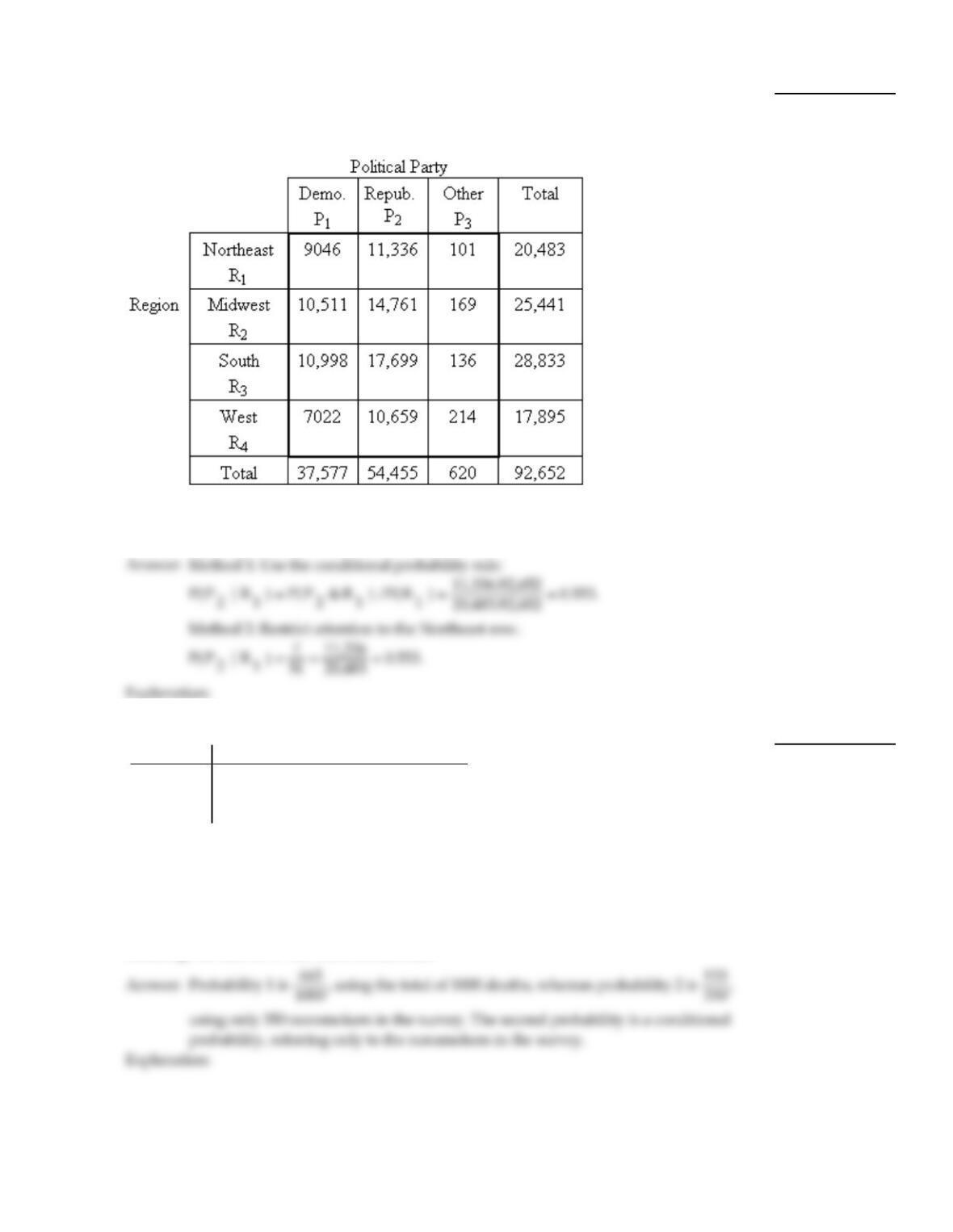
The following contingency table provides a joint frequency distribution for the popular
votes cast in the presidential election by region and political party. Data are in thousands,
rounded to the nearest thousand.
Suppose a person who voted in the presidential election is selected at random. Describe
two different ways of computing the conditional probability P( P2|R 1).
8)
9)
Cause of Death
Cancer Heart Disease Other Total
Smoker 135 310 205 650
Nonsmoker 55 155 140 350
Total 190 465 345 1000
Discuss the methods for finding the following two probabilities and explain the important
differences in the computations.
1) If one person is randomly selected, find the probability that he or she died of heart
disease.
2) If one person is randomly selected, find the probability that he or she died of heart
disease given that he or she was a nonsmoker.
9)
3
10)
Suppose that you roll a die and record the number that comes up and then flip a coin and
record whether it comes up heads or tails. One possible outcome can be represented as 2H
(a two on the die followed by heads). Make a list of all the possible outcomes. What is the
probability that you get tails and an even number? What assumption are you making
when you find this probability?
10)
11)
Describe an event whose probability of occurring is 1 and explain what that probability
means. Describe an event whose probability of occurring is 0 and explain what that
probability means.
11)
12)
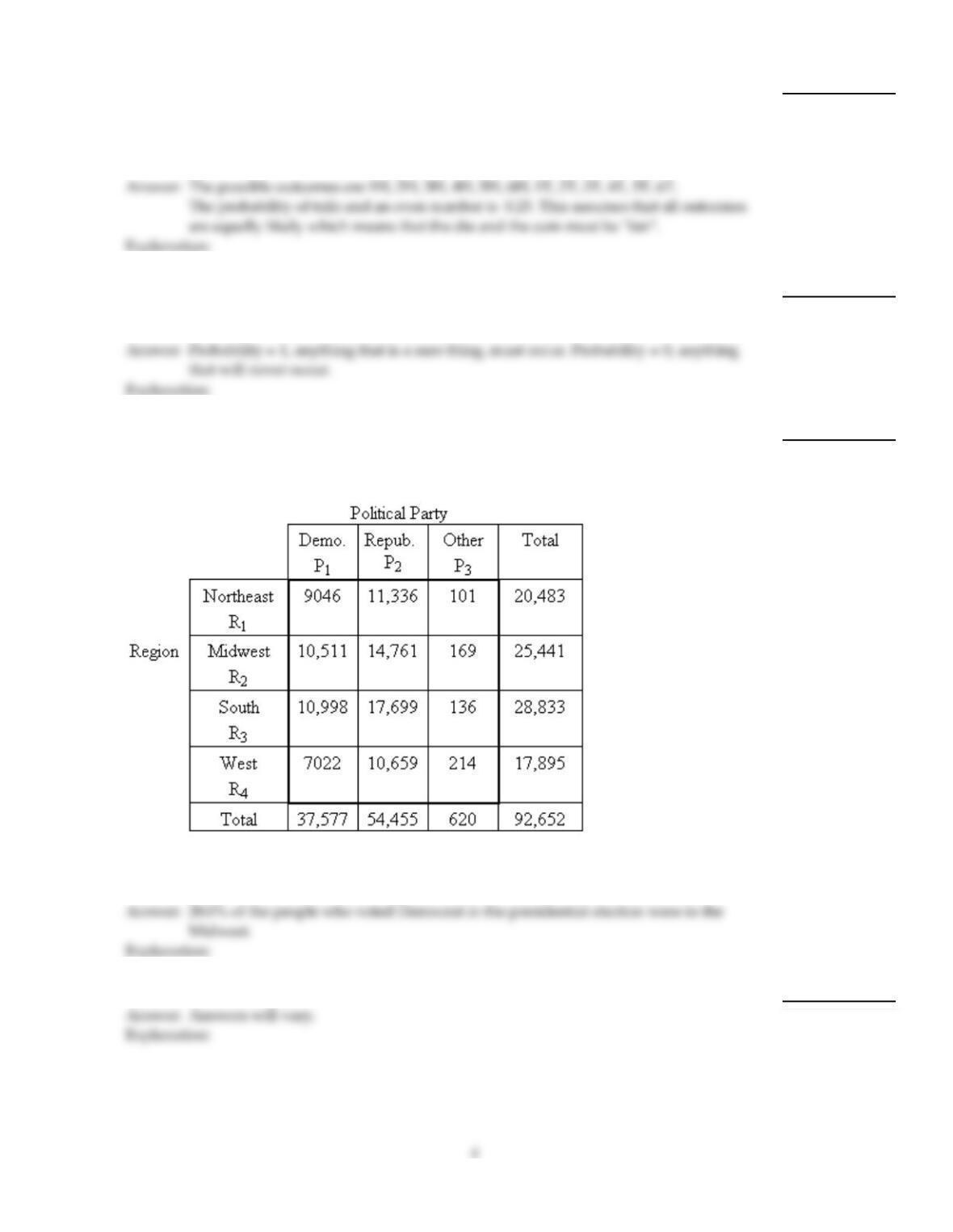
The following contingency table provides a joint frequency distribution for the popular
votes cast in the presidential election by region and political party. Data are in thousands,
rounded to the nearest thousand.
If a person who voted in the presidential election is selected at random,
P( R2|P 1) = 0.280. Interpret this probability in terms of percentages.
12)
13)
Construct a Venn diagram representing the event ((A & B) or C).
13)
14)
A card is selected randomly from a standard deck of 52 cards. Let
A = event that the card is an ace.
Give examples of events B, C, and D such that A and B are independent, A and C are
dependent but not mutually exclusive, and A and D are mutually exclusive.
14)
15)
Give an example of a collection of events that are both mutually exclusive and exhaustive
15)
16)
Suppose that in an election for governor of Oregon there are five candidates of whom two
are women. A statistics student reasons as follows. The probability that a woman will win
the election is equal to f
N which is 2
5. What is wrong with his reasoning?
16)
17)
Discuss the range of possible values for probabilities. Give examples to support each.
17)
18)
Two cards are selected at random from a standard deck of 52 cards. Let
A = event the first card is a queen
B = event the second card is a queen.
(a) If the first card is replaced before the second one is drawn, are events A and B
independent? Which rule could you use to find P(A & B)?
(b) If the first card is not replaced before the second one is drawn, are events A and B
independent? Which rule could you use to find P(A & B)?
18)
19)
Explain why an event and its complement are always mutually exclusive and exhaustive.
19)
20)
Suppose a student is taking a 5–response multiple choice exam; that is, the choices are A, B,
C, D, and E, with only one of the responses correct. Describe the complement method for
determining the probability of getting at least one of the questions correct on the
15–question exam. Why would the complement method be the method of choice for this
problem?
20)
21)
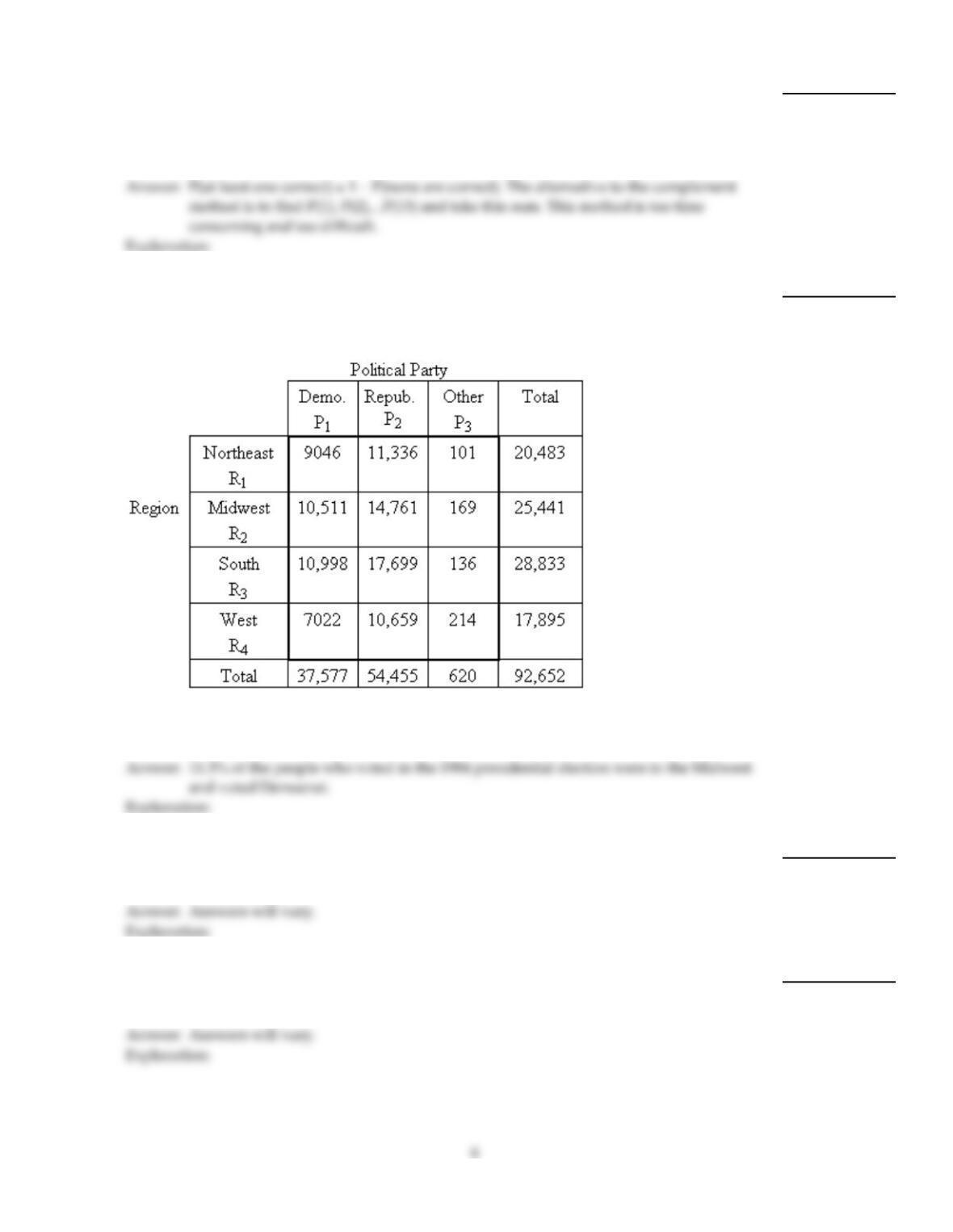
The following contingency table provides a joint frequency distribution for the popular
votes cast in the 1984 presidential election by region and political party. Data are in
thousands, rounded to the nearest thousand.
If a person who voted in the 1984 presidential election is selected at random,
P( R2& P1) = 0.113. Interpret this probability in terms of percentages.
21)
22)
Construct a Venn diagram portraying four events A, B, C, and D such that the collection of
events A, B, and C is mutually exclusive, the collection of events A, B, and D is mutually
exclusive, but the collection of events A, B, C, and D is not mutually exclusive.
22)
23)
Construct a Venn diagram portraying three events A, B, and C such that A and B are
mutually exclusive, B and C are mutually exclusive, but the collection of events A, B, and C
is not mutually exclusive.
23)
24)
Suppose that a class of 30 students is assigned to write an essay.
1) Suppose 4 essays are randomly chosen to appear on the class bulletin board. How many
different groups of 4 are possible?
2) Suppose 4 essays are randomly chosen for awards of $10, $7, $5, and $3. How many
different groups of 4 are possible?
Explain the significant differences between problems 1 and 2.
24)
25)
Consider the following formulas: (n)r=n!
(n–r)! and
n
r=n!
(n–r)!r! .
Given the same values for n and r in each formula, which is the smaller value, P or C? How
does this relate to the concept of counting the number of outcomes based on whether or not
order is a criterion?
25)
26)
Discuss the differences, both in applications and in the formulas, for combinations and
permutations. Give an example of each.
26)
27)
What important question must you answer before computing an “or” probability? How
does the answer influence your computation?
27)
28)
Interpret the following probability statement using the frequentist interpretation of
probability. The probability is 0.83 that this particular type of surgery will be successful.
28)
29)
Interpret the symbol P(B|A) and explain what is meant by the expression. What do we
know if P(B|A) is not the same as P(B)?
29)
30)
Construct a Venn diagram representing the event ((not A) or B).
30)
31)
An experiment consists of randomly selecting a card from a deck of 52. The event A is
defined as follows.
A = event the card selected is a diamond
Give an example of an event B for this experiment such that the events A and B are
mutually exclusive.
31)
32)
An experiment consists of randomly selecting a card from a deck of 52. The event A is
defined as follows.
A = event the card selected is a diamond
Give an example of a pair of events B and C for this experiment such that the events A and
B are mutually exclusive but the collection of events A, B, and C is not mutually exclusive.
32)
33)
If P(A) = 0.25, P(B) = 0.8, and P(A & B) = 0.23, are A and B independent events? How can
you tell?
33)
34)
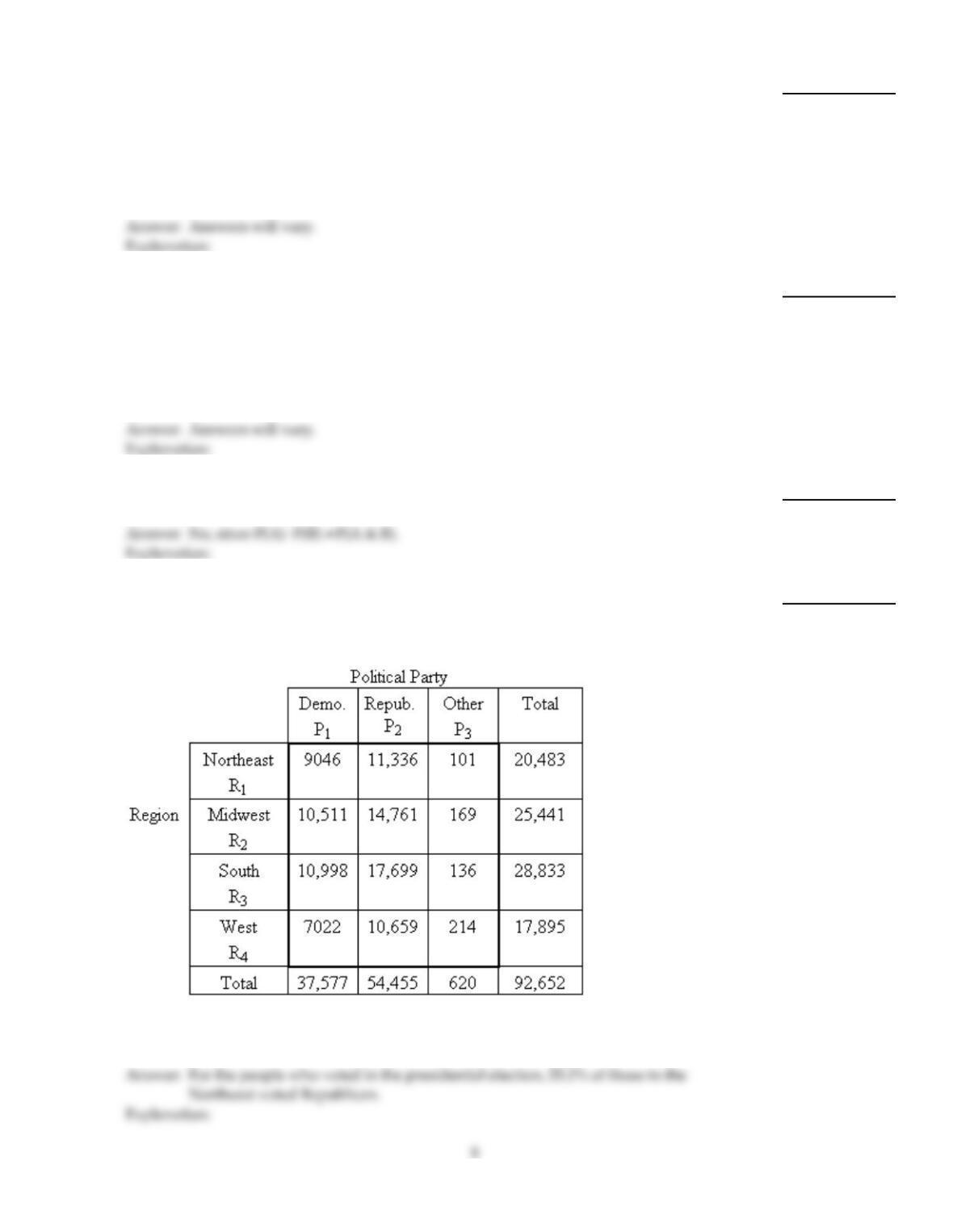
The following contingency table provides a joint frequency distribution for the popular
votes cast in the presidential election by region and political party. Data are in thousands,
rounded to the nearest thousand.
If a person who voted in the presidential election is selected at random,
P( P2|R 1) = 0.553. Interpret this probability in terms of percentages.
34)
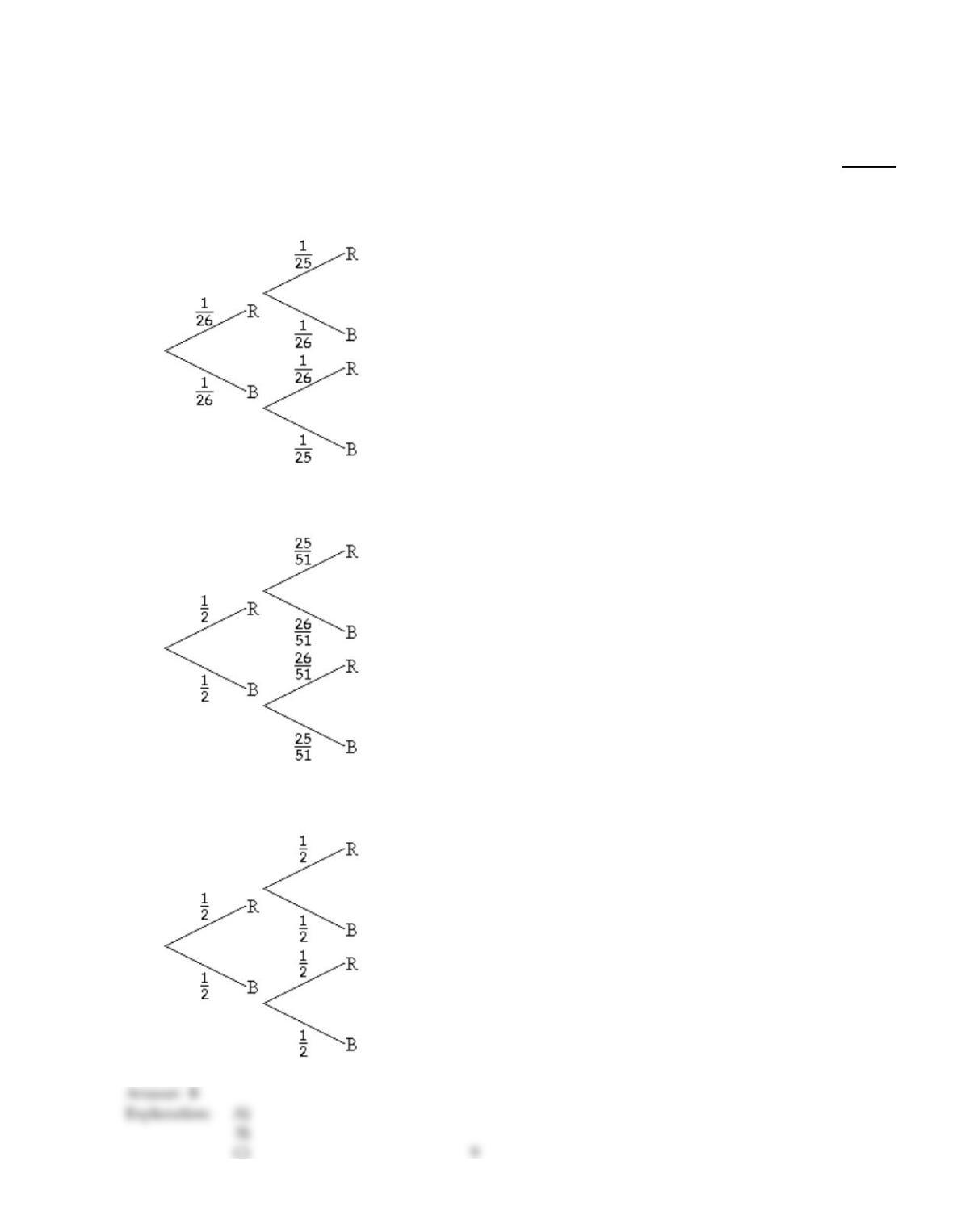
MULTIPLE CHOICE. Choose the one alternative that best completes the statement or answers the question.
Draw a tree diagram to represent the problem. At the end of each branch use symbols to represent the event that the
branch corresponds to and give the probability of the event.
35)
Two cards are selected randomly without replacement from a standard deck of 52 cards. The color
of each card (red or black) is recorded. Draw a tree diagram for this problem.
35)
A)
Event Probability
(R & R) 0.25
(R & B) 0.25
(B & R) 0.25
(B & B) 0.25
B)
Event Probability
(R & R) 0.245
(R & B) 0.255
(B & R) 0.255
(B & B) 0.245
C)
Event Probability
(R & R) 0.25
(R & B) 0.25
(B & R) 0.25
(B & B) 0.25
C)
Determine the number of outcomes that comprise the specified event.
36)
The number of hours needed by sixth grade students to complete a research project was recorded
with the following results.
Hours Number of students (f)
419
528
617
713
8 9
9 7
10+7
A student is selected at random. The event A is defined as follows.
A = the event the student took between 5 and
9 hours inclusive
Determine the number of outcomes that comprise the event (not A).
36)
A)
26
B)
7
C)
61
D)
35
Find the indicated probability by using the special addition rule.
37)
A percentage distribution is given below for the size of families in one U.S. city.
Size Percentage
251.6
322.8
414.0
57.0
63.1
7+1.5
A family is selected at random. Find the probability that the size of the family is at most 3. Round
approximations to three decimal places.
37)
A)
0.256
B)
0.744
C)
0.516
D)
0.228
C)
C)
Use the rule of total probability to find the indicated probability.
38)
Two shipments of components were received by a factory and stored in two separate bins.
Shipment I has 5% of its contents defective, while shipment II has 3% of its contents defective. If it
is equally likely an employee will go to either bin and select a component randomly, what is the
probability a selected component is defective?
38)
A)
4
B)
0.08
C)
0.04
D)
8
Find the indicated probability.
39)
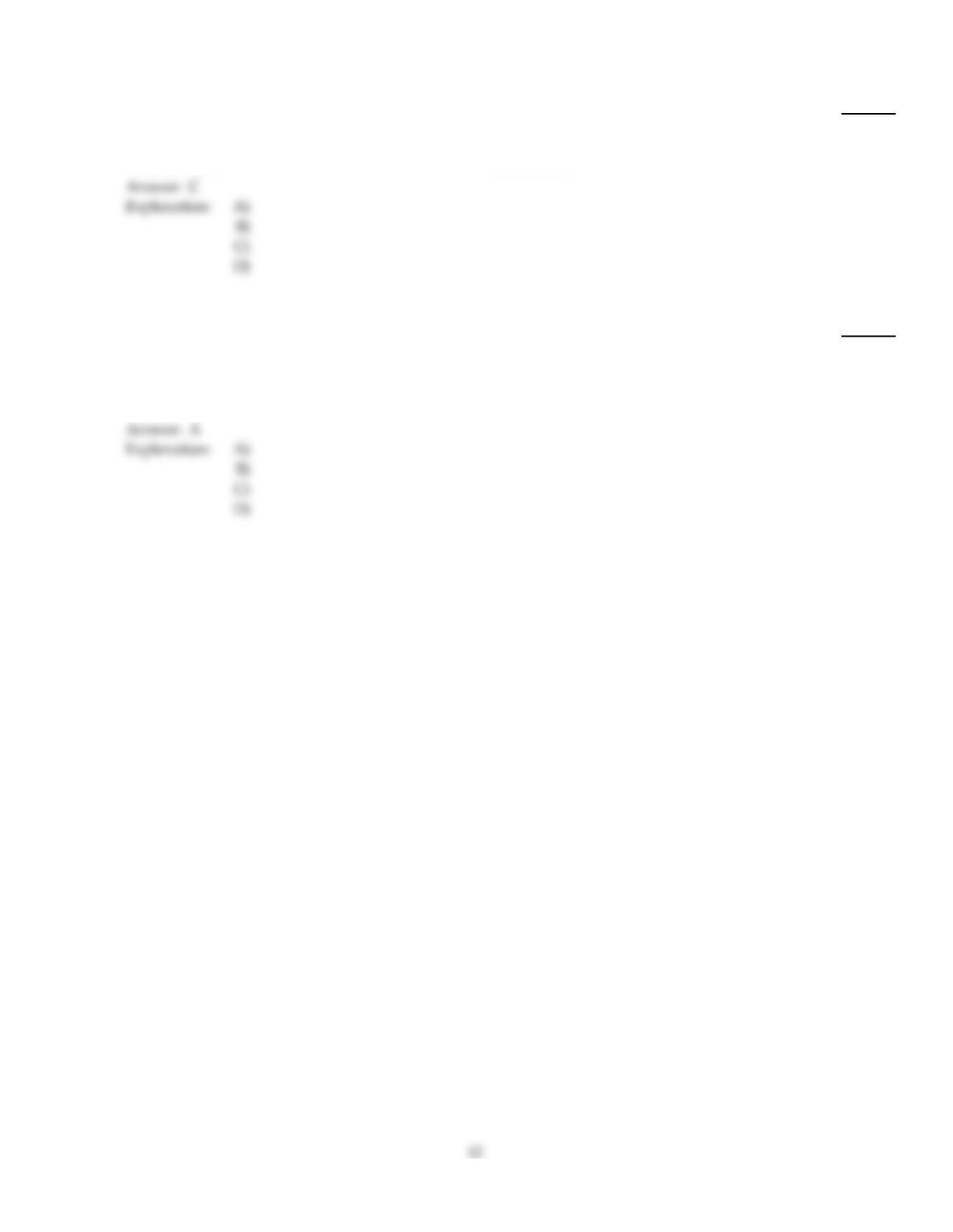
The following contingency table provides a joint frequency distribution for a group of retired
people by career and age at retirement.
11 49 80 48 188
11 41 84 42 178
61 179 297 189 726
Suppose one of these people is selected at random. Compute the probability that the person selected
was a store clerk.
39)
A)
0.251
B)
0.025
C)
0.099
D)
0.295
Solve the problem.
40)
A pool of possible jurors consists of 10 men and 16 women. How many different juries consisting of
5 men and 7 women are possible?
40)
A)
9,657,700
B)
2.905979328e+11
C)
2,882,880
D)
3,628,800
Use the rule of total probability to find the indicated probability.
41)
In one town, 4% of 18–29 year olds own a house, as do 21% of 30–50 year olds and 55% of those
over 50. According to a recent census taken in the town, 28.9% of adults in the town are 18–29 years
old, 39.4% are 30–50 years old, and 31.7% are over 50. What is the probability of an adult owning a
house in this town?
41)
A)
0.269
B)
0.027
C)
0.186
D)
0.267
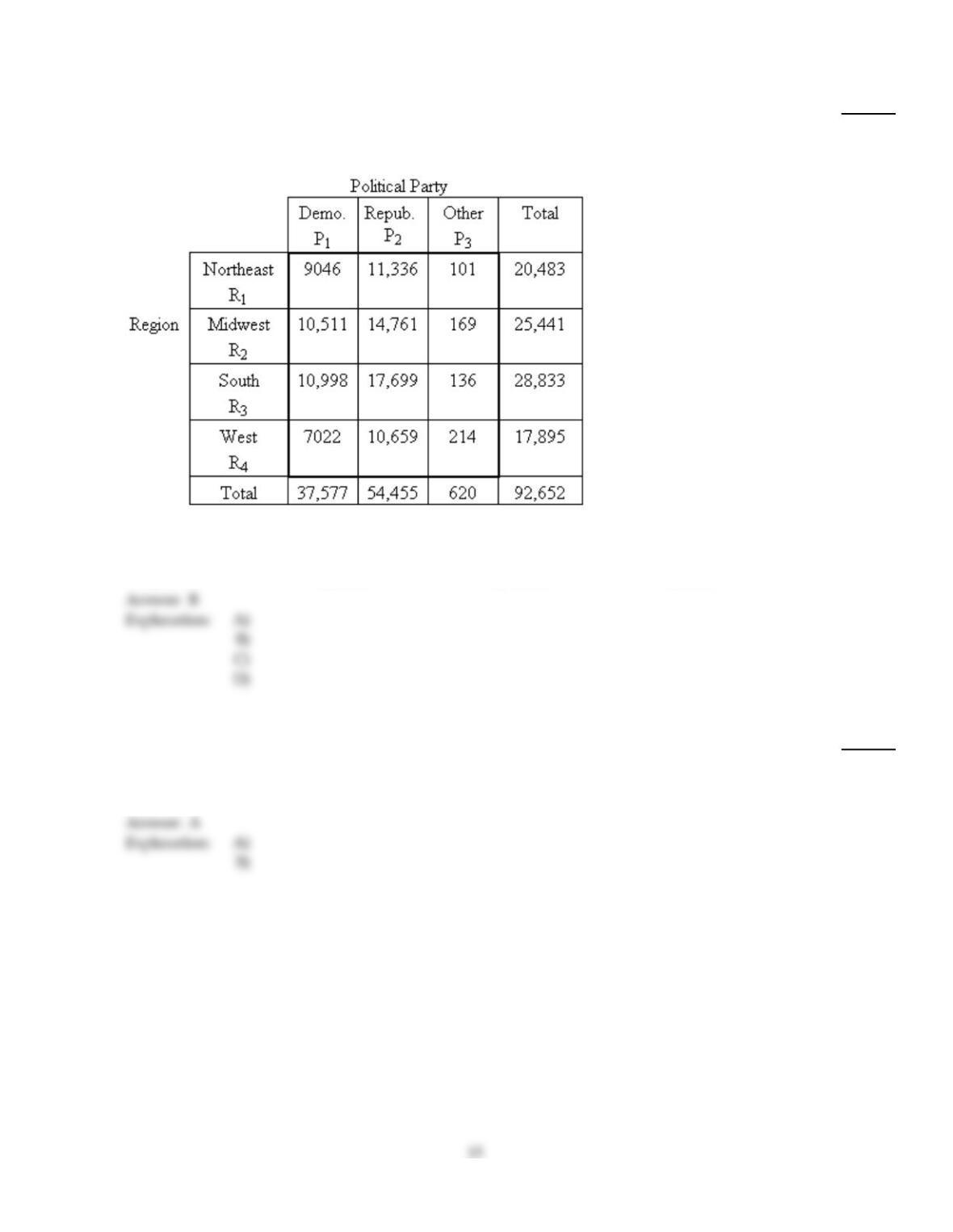
Find the conditional probability.
42)
The following contingency table provides a joint frequency distribution for the popular votes cast in
the 1984 presidential election by region and political party. Data are in thousands, rounded to the
nearest thousand.
A person who voted in the 1984 presidential election is selected at random. Compute the
probability that the person selected was in the West given that they voted “Other”.
42)
A)
0.193
B)
0.345
C)
0.002
D)
0.012
Provide an appropriate response.
43)
A coin is flipped twice. True or false, the unconditional probability of getting tails on the second
flip is the same as the conditional probability of getting tails on the second flip given that the first
flip came up heads?
43)
A)
True
B)
False
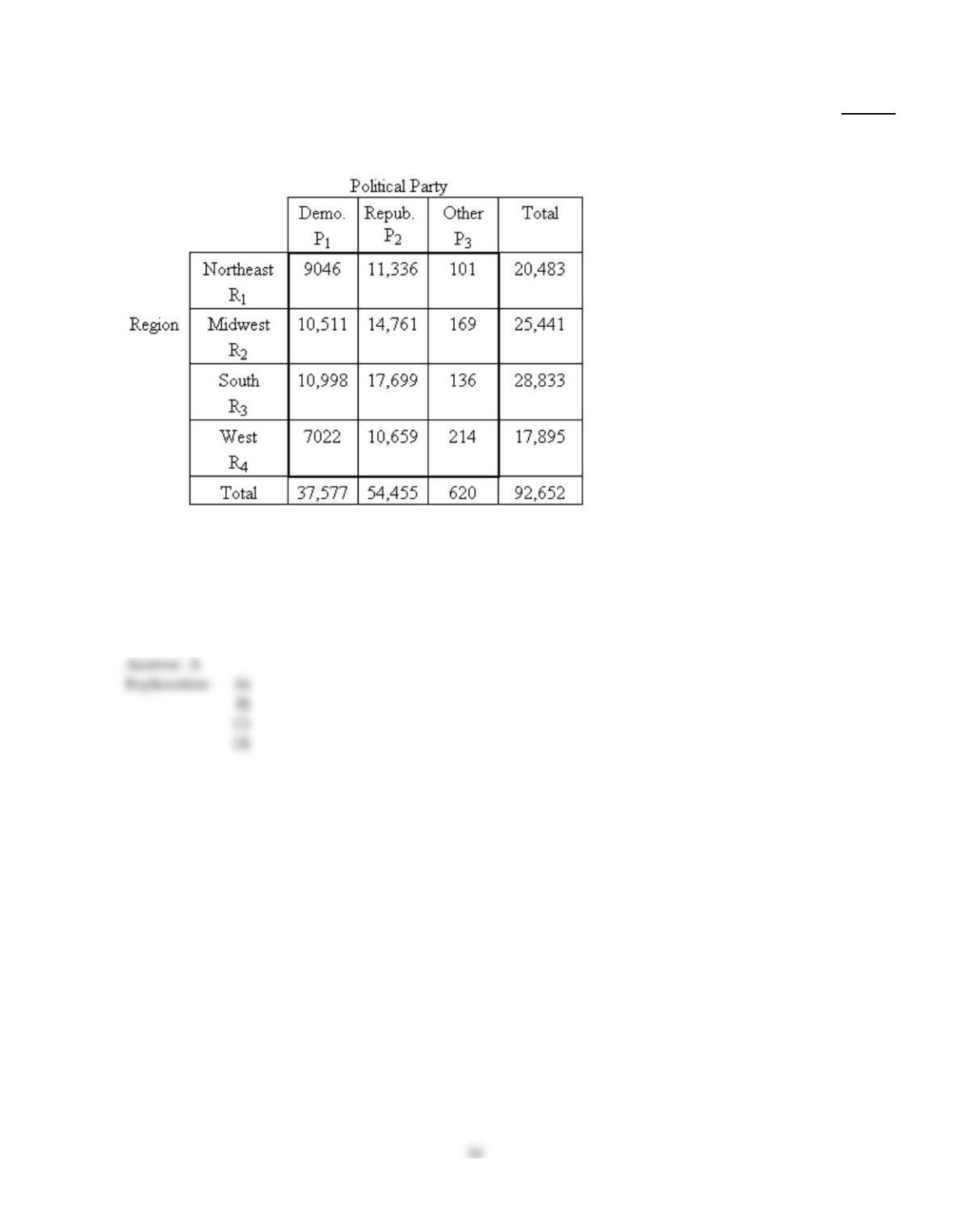
Use words or symbols, as indicated, to describe the event.
44)
The following contingency table provides a joint frequency distribution for the popular votes cast
in the presidential election by region and political party. Data are in thousands, rounded to the
nearest thousand.
Suppose a person who voted in the presidential election is selected at random. Describe in words
the event ( R 4& P1).
44)
A)
The person selected voted Democrat and was in the West.
B)
The person selected voted Democrat.
C)
The person selected was in the West.
D)
The person selected voted Democrat and was in the Northeast.
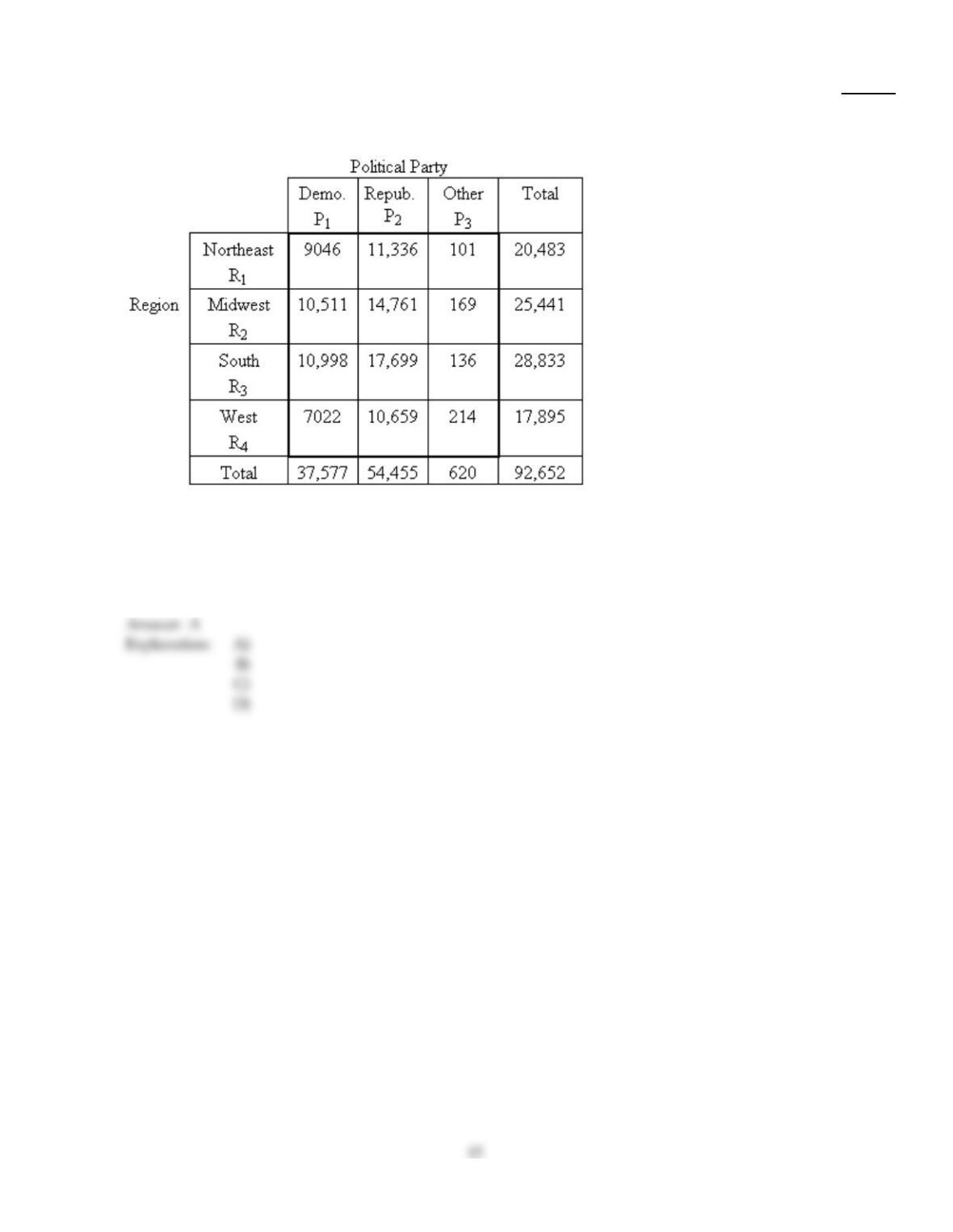
45)
The following contingency table provides a joint frequency distribution for the popular votes cast
in the presidential election by region and political party. Data are in thousands, rounded to the
nearest thousand.
Suppose a person who voted in the presidential election is selected at random. Use the letters in the
margins of the contingency table to represent the following event.
The person selected was in the Midwest.
45)
A)
R2
B)
(R 2or P2)
C)
(R 2& P 2)
D)
P2
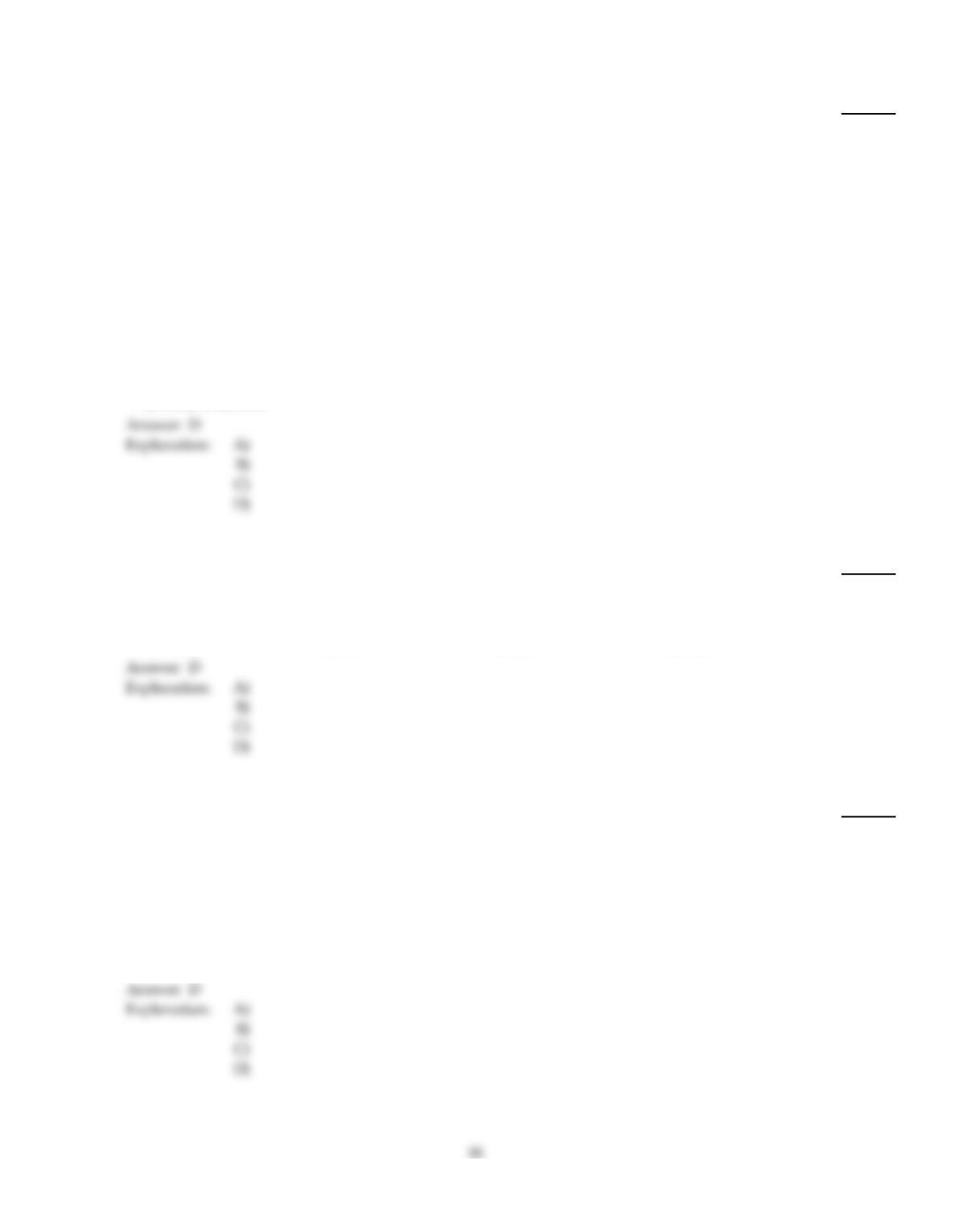
List the outcomes comprising the specified event.
46)
Three board members for a nonprofit organization will be selected from a group of five people. The
board members will be selected by drawing names from a hat. The names of the five possible board
members are Allison, Betty, Charlie, Dave, and Emily. The possible outcomes can be represented as
follows.
ABC ABD ABE ACD ACE
ADE BCD BCE BDE CDE
Here, for example, ABC represents the outcome that Allison, Betty, and Charlie are selected to be on
the board. List the outcomes that comprise the following event.
A = event that Betty and Emily are selected
46)
A)
ABE, BCE
B)
BE
C)
ABC, ABD, ABE, ACE, ADE, BCD, BCE, BDE, CDE
D)
ABE, BCE, BDE
Use the rule of total probability to find the indicated probability.
47)
Two stores sell a certain product. Store A has 38% of the sales, 1% of which are of defective items,
and store B has 62% of the sales, 4% of which are of defective items. The difference in defective
rates is due to different levels of pre–sale checking of the product. A person receives one of this
product as a gift. What is the probability it is defective?
47)
A)
0.025
B)
0.39
C)
0.015
D)
0.029
Provide an appropriate response.
48)
A person is selected at random from a certain population. Let
A = event the person is left–handed
B = event the person is male.
In terms of probability notation, the percentage of males in the population can be expressed as P(B).
Use probability notation to express the percentage of people in the population that are left–handed
males.
48)
A)
P(B|A)
B)
P(A or B)
C)
P(A|B)
D)
P(A & B)
Solve the problem.
49)
There are 12 members on a board of directors. If they must elect a chairperson, a secretary, and a
treasurer, how many different slates of candidates are possible?
49)
A)
1728
B)
1320
C)
479,001,600
D)
220
Use the general multiplication rule to find the indicated probability.
50)
The table below describes the smoking habits of a group of asthma sufferers.
Nonsmoker
Light
smoker
Heavy
smoker Total
Men 310 49 39 398
Women 309 40 44 393
Total 619 89 83 791
If two different people are randomly selected from the 791 subjects, find the probability that they
are both heavy smokers.
50)
A)
0.01089
B)
0.002431
C)
0.0001452
D)
0.01101
Use the rule of total probability to find the indicated probability.
51)
38% of the workers at Motor Works are female, while 39% of the workers at City Bank are female. If
one of these companies is selected at random (assume a 50–50 chance for each), and then a worker
is selected at random, what is the probability that the worker will be female?
51)
A)
0.39
B)
0.38
C)
0.01
D)
0.385
Use Bayes’s rule to find the indicated probability.
52)
Two shipments of components were received by a factory and stored in two separate bins.
Shipment I has 2% of its contents defective, while shipment II has 5% of its contents defective. If it is
equally likely an employee will go to either bin and select a component randomly, what is the
probability that a defective component came from shipment II?
52)
A)
0.333
B)
0.5
C)
0.714
D)
0.25
Determine the number of outcomes that comprise the specified event.
53)
The number of hours needed by sixth grade students to complete a research project was recorded
with the following results.
Hours Number of students (f)
416
517
624
7 9
811
9 8
10+7
A student is selected at random. The event A is defined as follows.
A = the event the student took more than 7 hours
Determine the number of outcomes that comprise the event (not A).
53)
A)
66
B)
26
C)
57
D)
35
Find the indicated probability.
54)
In a poll, respondents were asked whether they had ever been in a car accident. 414 respondents
indicated that they had been in a car accident and 169 respondents said that they had not been in a
car accident. If one of these respondents is randomly selected, what is the probability of getting
someone who has been in a car accident?
54)
A)
2.45
B)
0.71
C)
0.29
D)
0.002
Describe the specified event in words.
55)
The number of hours needed by sixth grade students to complete a research project was recorded
with the following results.
Hours Number of students (f)
415
511
619
7 6
8 9
916
10 2
A student is selected at random. The event A is defined as follows.
A = the event the student took at least 7 hours
Describe the event (not A) in words.
55)
A)
The event the student took less than 7 hours
B)
The event the student did not take 7 hours
C)
The event the student took at most 7 hours
D)
The event the student took more than 7 hours
Find the indicated probability.
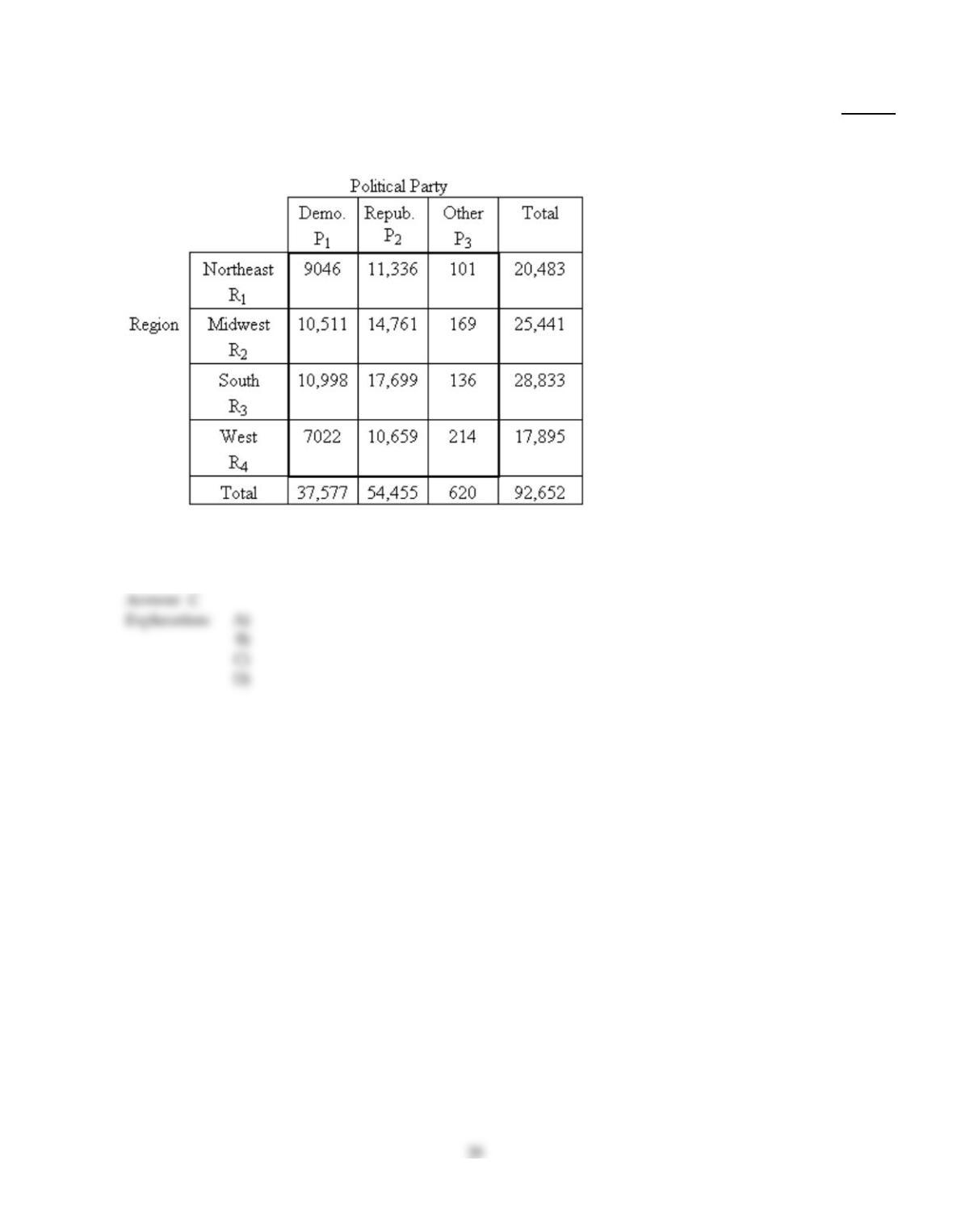
56)
The following contingency table provides a joint frequency distribution for the popular votes cast
in the presidential election by region and political party. Data are in thousands, rounded to the
nearest thousand.
A person who voted in the presidential election is selected at random. Compute the probability that
the person selected voted Democrat.
56)
A)
0.241
B)
0.442
C)
0.406
D)
0.098