
List the outcomes comprising the specified event.
193)
When a quarter is tossed four times, 16 outcomes are possible.
HHHH HHHT HHTH HHTT
HTHH HTHT HTTH HTTT
THHH THHT THTH THTT
TTHH TTHT TTTH TTTT
Here, for example, HTTH represents the outcome that the first toss is heads, the next two tosses are
tails, and the fourth toss is heads. List the outcomes that comprise the following event.
A = event the last toss is heads
193)
A)
HHHH, HHTH, HTHH, THHH, TTHH, TTTH
B)
HHTH, HTHH, HTTH, THHH, THTH, TTHH, TTTH
C)
HHHH, HHTH, HTHH, HTTH, THHH, THTH, TTHH, TTTH
D)
HHHH, HHTH, HTHH, HTTH, THHH, THTH, TTHH, TTTH, HHHT
Find the indicated probability.
194)
A sample of 4 different calculators is randomly selected from a group containing 13 that are
defective and 39 that have no defects. What is the probability that at least one of the calculators is
defective?
194)
A)
0.304
B)
0.130
C)
0.684
D)
0.696
195)
A sample space consists of 138 separate events that are equally likely. What is the probability of
each?
195)
A)
0
B)
1
C)
1
138
D)
138
Find the conditional probability.
196)
The following table contains data from a study of two airlines which fly to Small Town, USA.
Number of flights
which were on time
Number of flights
which were late
Podunk Airlines 33 6
Upstate Airlines 43 5
If one of the 87 flights is randomly selected, find the probability that the flight selected is an Upstate
Airlines flight given that it was late.
196)
A)
0.455
B)
0.057
C)
0.104
D)
None of the above is correct.
Use Bayes’s rule to find the indicated probability.
197)
Two stores sell a certain product. Store A has 40% of the sales, 4% of which are of defective items,
and store B has 60% of the sales, 3% of which are of defective items. The difference in defective
rates is due to different levels of pre–sale checking of the product. A person receives a defective
item of this product as a gift. What is the probability it came from store B?
197)
A)
0.4571
B)
0.5143
C)
0.4706
D)
0.5294
Find the indicated probability.
198)
A study conducted at a certain college shows that 57% of the school’s graduates find a job in their
chosen field within a year after graduation. Find the probability that among 7 randomly selected
graduates, at least one finds a job in his or her chosen field within a year of graduating.
198)
A)
0.980
B)
0.143
C)
0.570
D)
0.997
Find the indicated probability by using the complementation rule.
199)
Based on meteorological records, the probability that it will snow in a certain town on January 1st is
0.339. Find the probability that in a given year it will not snow on January 1st in that town.
199)
A)
0.661
B)
2.950
C)
0.513
D)
1.339

Determine the number of outcomes that comprise the specified event.
200)
The age distribution of students at a community college is given below.
Age (years) Number of students (f)
Under 21 2043
21–25 2049
26–30 1117
31–35 896
Over 35 200
A student from the community college is selected at random. The events A and B are defined as
follows.
A = event the student is under 21
B = event the student is over 35
Determine the number of outcomes that comprise the event (A & B).
200)
A)
2043
B)
4062
C)
0
D)
2243
Find the indicated probability.
201)
If a person is randomly selected, find the probability that his or her birthday is in May. Ignore leap
years.
201)
A)
1
12
B)
1
365
C)
31
365
D)
1
31
Use counting rules to determine the probability.
202)
A student takes a true–false test consisting of 10 questions. Assuming that the student guesses at
each question, find the probability that the student answers exactly 8 questions correctly.
202)
A)
0.0176
B)
0.0352
C)
0.0439
D)
0.0264
Use the general multiplication rule to find the indicated probability.
203)
Two cards are selected without replacement from a standard deck of 52 cards. What is the
probability that both cards are the same color (i.e., either both black or both red)?
203)
A)
0.500
B)
0.490
C)
0.250
D)
0.245
Provide an appropriate response.
204)
Students at a local university were asked if they knew about Bayes’s Rule. Assume the following:
B1= event the student did not know about Bayes’s Rule.
B2= event the student did know about Bayes’s Rule.
S = event the student was in a statistics class.
Of those who knew about Bayes’s Rule, let S1= event the student was in a statistics class. Of those
who did not know about Bayes’s Rule, let S2= event the student was in a statistics class. Using
probability notation, describe the posterior probability that a student would know about Bayes’s
Rule if we already knew they were in a statistics class.
204)
A)
P(B2)
B)
P(B2|S1)
C)
P(B2|S)
D)
P(B2|S2)
List the outcomes comprising the specified event.
205)
Three board members for a nonprofit organization will be selected from a group of five people. The
board members will be selected by drawing names from a hat. The names of the five possible board
members are Allison, Betty, Charlie, Dave, and Emily. The possible outcomes can be represented as
follows.
ABC ABD ABE ACD ACE
ADE BCD BCE BDE CDE
Here, for example, ABC represents the outcome that Allison, Betty, and Charlie are selected to be on
the board. The events A and B are defined as follows.
A = event that Dave is selected
B = event that Allison is selected
List the outcomes that comprise the event (A or B).
205)
A)
ABC, ABD, ABE, ACD, ACE, ADE, BCD, BDE
B)
ABC, ABE, ACE, BCD, BDE, CDE
C)
ABD, ACD, ADE
D)
ABC, ABD, ABE, ACD, ACE, ADE, BCD, BDE, CDE
Use words or symbols, as indicated, to describe the event.
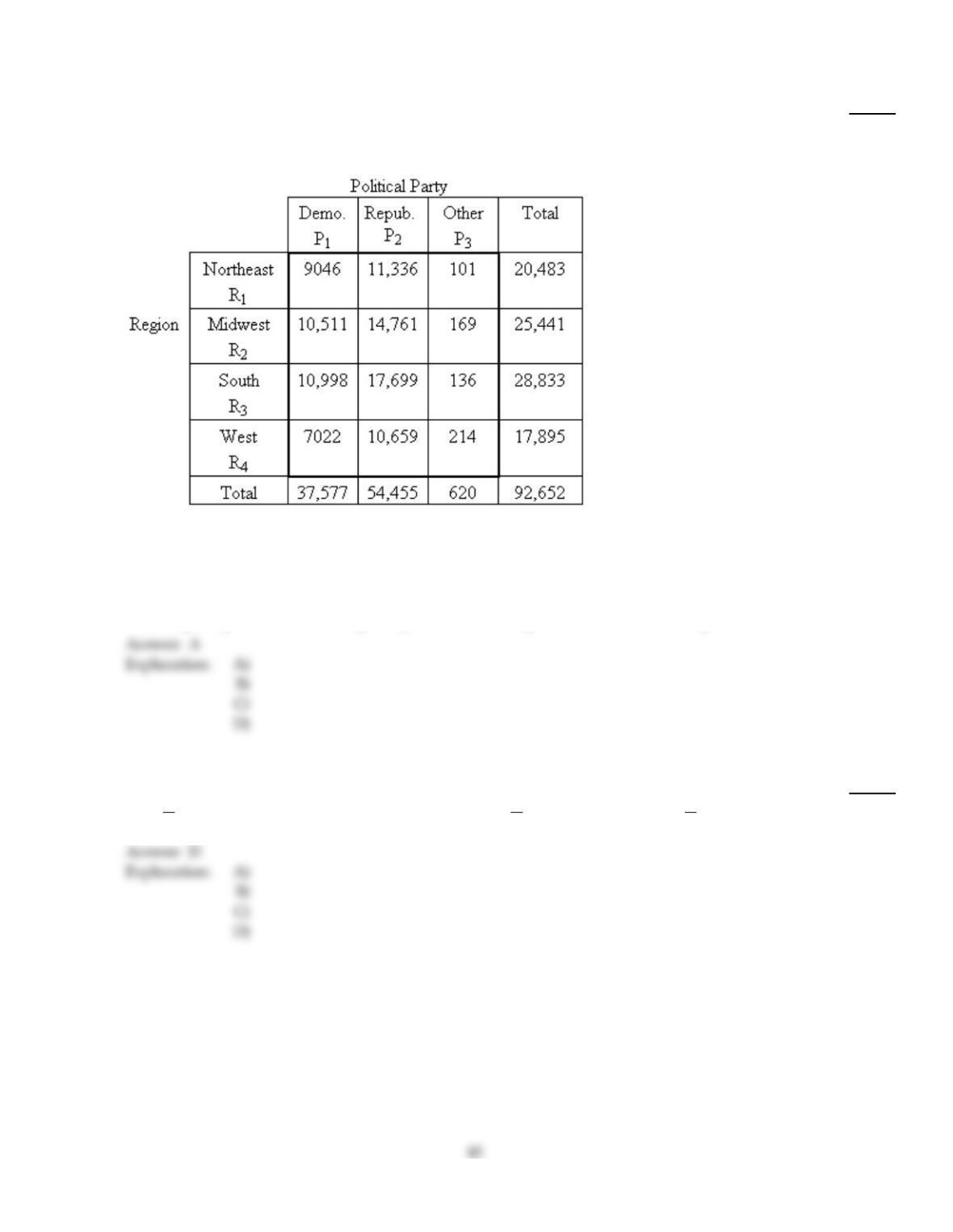
206)
The following contingency table provides a joint frequency distribution for the popular votes cast
in the presidential election by region and political party. Data are in thousands, rounded to the
nearest thousand.
Suppose a person who voted in the presidential election is selected at random. Use the letters in the
margins of the contingency table to represent the following event.
The person selected was in the Northeast and voted “Other”.
206)
A)
(R 1& P 3)
B)
(R 1or P3)
C)
P3
D)
R1
Find the indicated probability.
207)
A 6–sided die is rolled. What is the probability of rolling a number less than 5?
207)
A)
1
6
B)
4
C)
5
6
D)
2
3

208)
On a multiple choice test, each question has 3 possible answers. If you make a random guess on the
first question, what is the probability that you are correct?
208)
A)
3
B)
1
C)
1
3
D)
0
Find the indicated probability by using the general addition rule.
209)
The manager of a bank recorded the amount of time each customer spent waiting in line during
peak business hours one Monday. The frequency table below summarizes the results.
Waiting Time
(minutes)
Number of
Customers
0–311
4–7 9
8–11 15
12–15 7
16–19 8
20–23 3
24–27 1
If we randomly select one of the times represented in the table, what is the probability that it is at
least 12 minutes or between 8 and 15 minutes?
209)
A)
0.13
B)
0.759
C)
0.63
D)
0.667
Use the special multiplication rule to find the indicated probability.
210)
Find the probability of correctly answering the first 5 questions on a multiple choice test if random
guesses are made and each question has 3 possible answers.
210)
A)
1.667
B)
0.6
C)
0.008
D)
0.004
Find the conditional probability.
211)
If two cards are drawn without replacement from a deck, find the probability that the second card
is red, given that the first card was a heart.
211)
A)
0.235
B)
0.490
C)
0.510
D)
0.957
Use the general multiplication rule to find the indicated probability.
212)
The table below describes the smoking habits of a group of asthma sufferers.
Nonsmoker
Light
smoker
Heavy
smoker Total
Men 376 49 31 456
Women 359 46 46 451
Total 735 95 77 907
If two different people are randomly selected from the 907 subjects, find the probability that they
are both women.
212)
A)
0.2470
B)
0.1567
C)
0.2473
D)
0.000004916
Determine whether the events are independent.
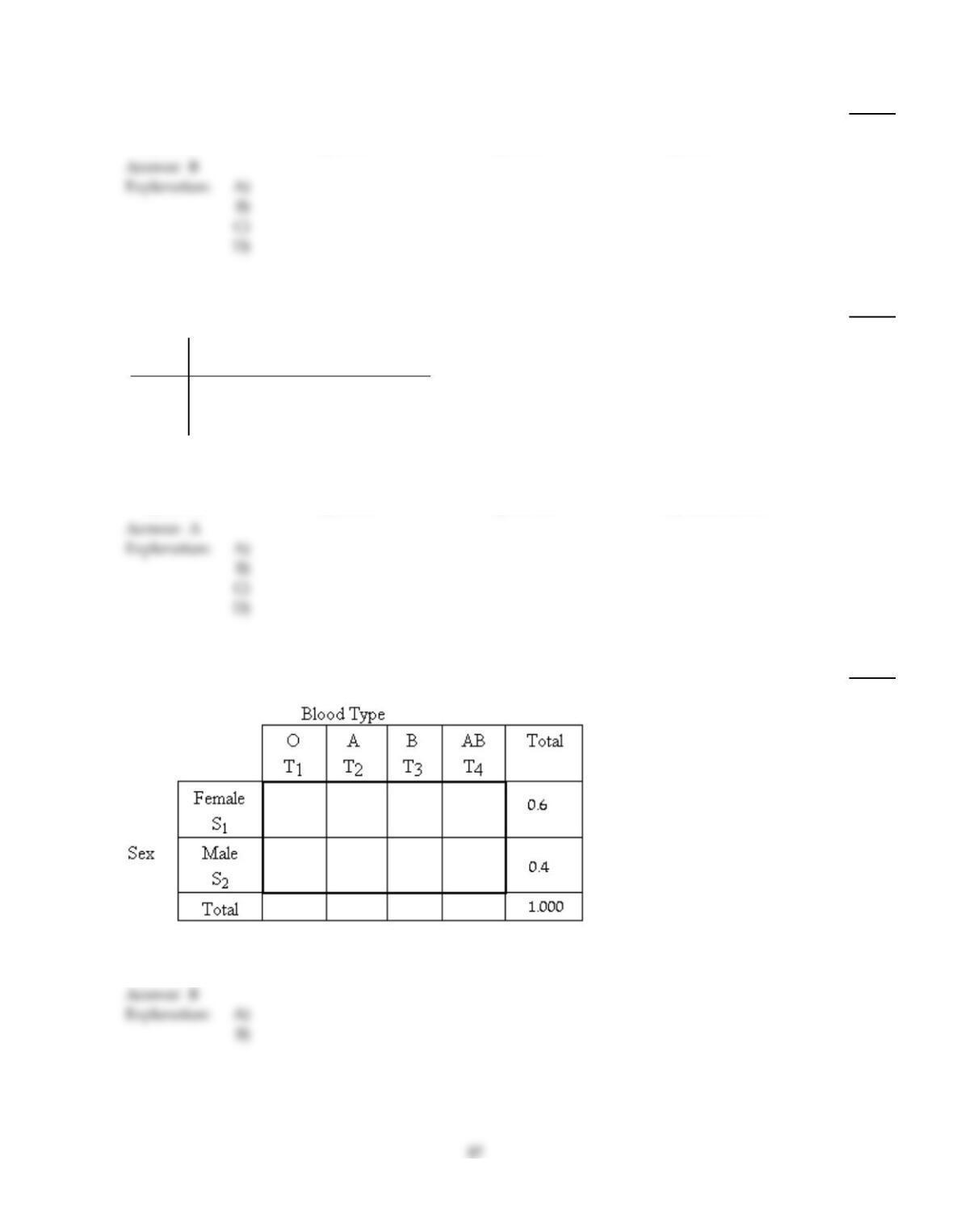
213)
The following contingency table provides a joint probability distribution for a random sample of
patients at a hospital classified by blood type and sex.
0.2600 0.2350 0.0600 0.0450
0.1825 0.1675 0.0350 0.0150
0.4425 0.4025 0.0950 0.0600
Suppose one of the patients is selected at random. Are the events T1 and S2 independent?
213)
A)
Yes
B)
No
Draw a Venn diagram and shade the described events.
214)
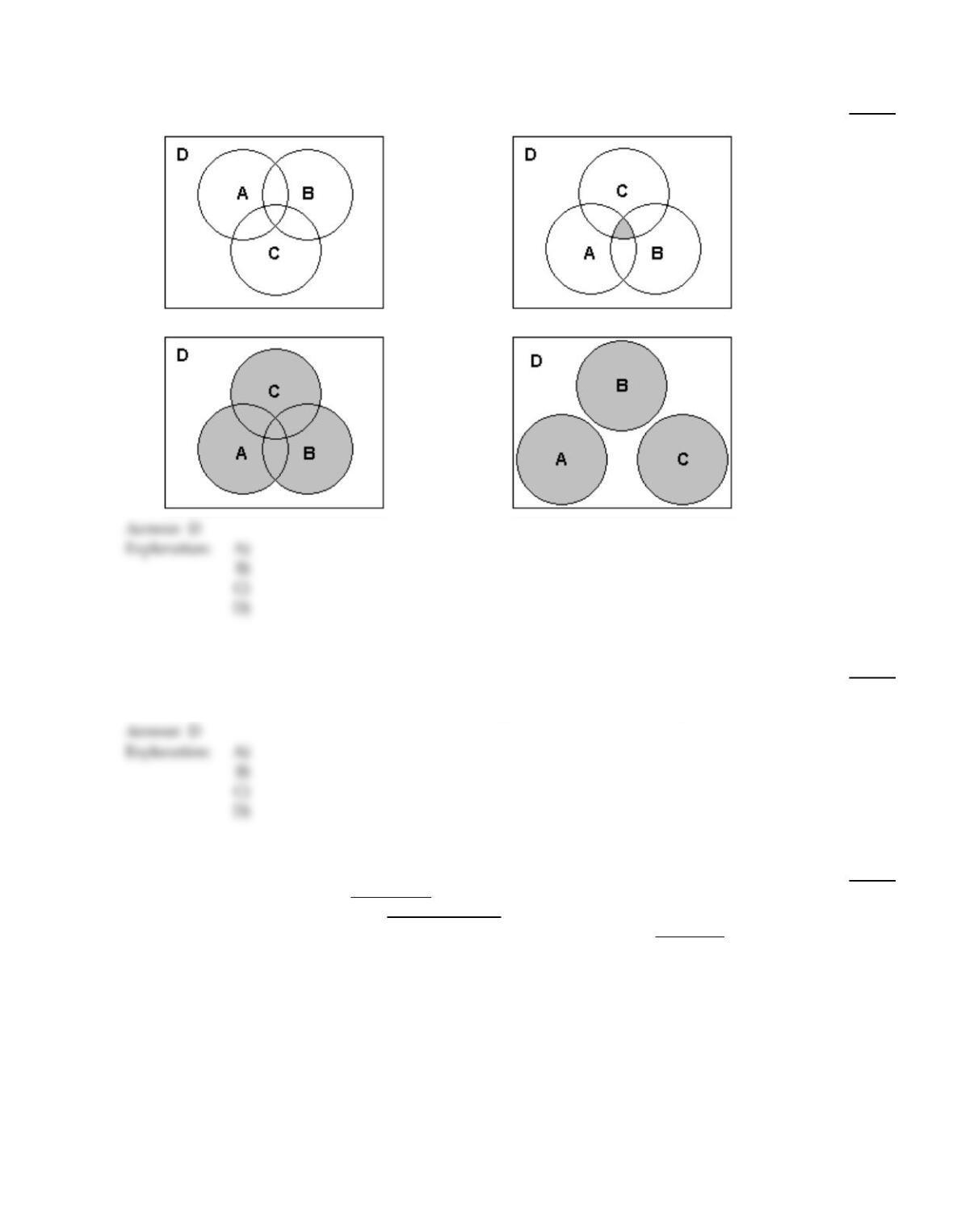
From a finite sample, events A, B, and C are mutually exclusive. Shade the collection A or B or C.
214)
A)
B)
C)
D)
Use the special multiplication rule to find the indicated probability.
215)
A basketball player hits three–point shots 45% of the time. If she takes 4 shots during a game, what
is the probability that she misses the first shot and hits the last three shots?
215)
A)
0.041
B)
0.501
C)
0.41
D)
0.05
Find the indicated probability.
216)
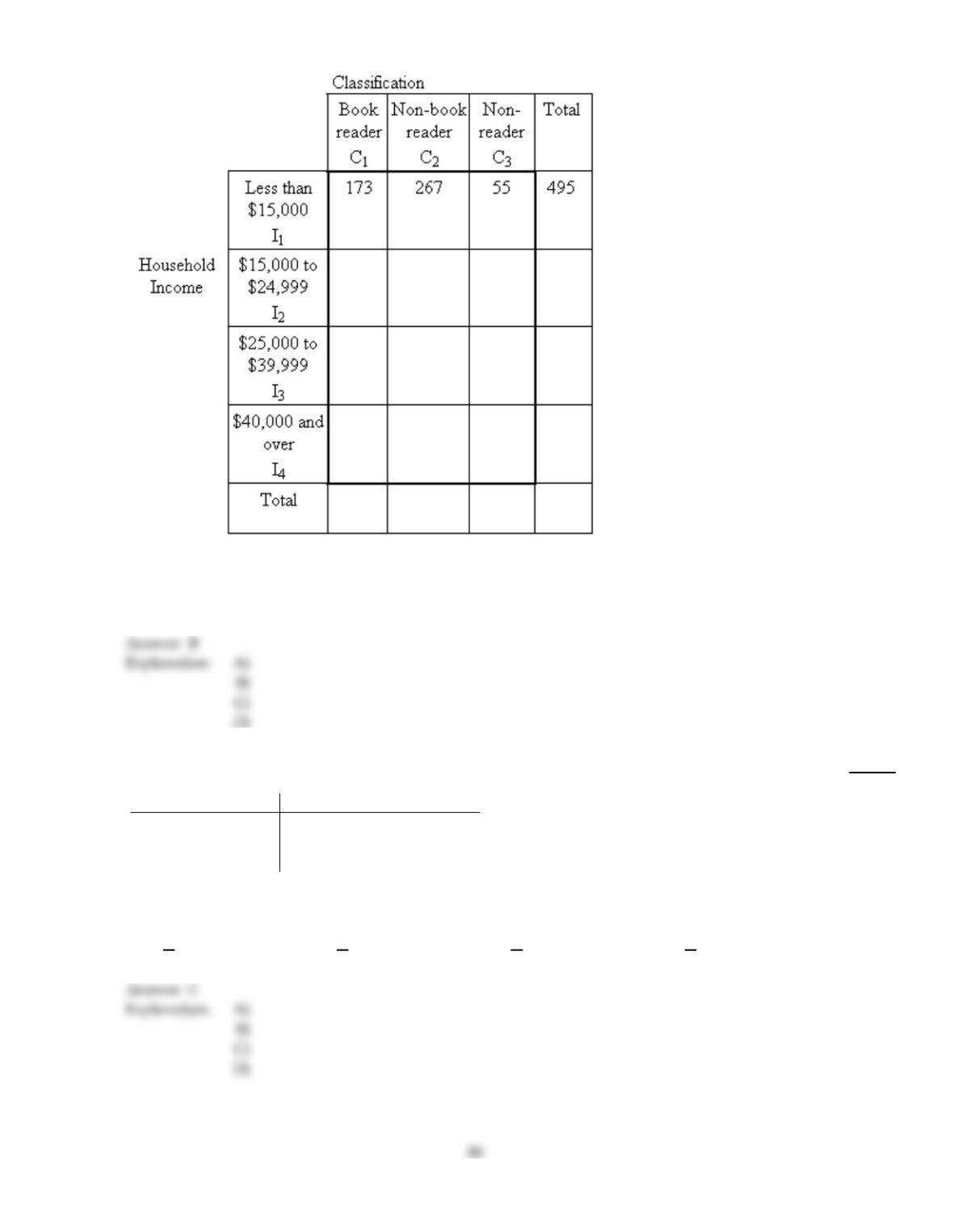
The Book Industry Study Group, Inc., performs sample surveys to obtain information on
characteristics of book readers. A book reader is defined to be one who read one or more books
in the six months prior to the survey; a non–book reader is defined to be one who read
newspapers or magazines but no books in the six months prior to the survey; a nonreader is
defined to be one who did not read a book, newspaper, or magazine in the six months prior to
the survey.
The following data were obtained from a random sample of people 16 years old and over.
216)
88
131 131 25 287
163 146 10 319
211 89 8308
678 633 98 1409
Suppose one of these people is selected at random. Compute the probability that the person is a
nonreader.
A)
0.111
B)
0.070
C)
0.039
D)
0.561
217)
The table below shows the soft drink preferences of people in three age groups.
cola root beer lemon–lime
under 21 years of age 40 25 20
between 21 and 40 35 20 30
over 40 years of age 20 30 35
If one of the 255 subjects is randomly selected, find the probability that the person is over 40 years of
age.
217)
A)
2
5
B)
1
2
C)
1
3
D)
3
5
List the outcome(s) of the stated event.
218)
The odds against winning in a horse race are shown in the following table.
Horse #1 #2 #3 #4 #5 #6 #7
Odds 514 420 914 20
Based on these odds, which horses comprise: A = event one of the top two favorites wins the race?
218)
A)
Horse #3
B)
Horses #1 and #2
C)
Horses #1 and #3
D)
Horses #4 and #7
List the outcomes comprising the specified event.
219)
When a quarter is tossed four times, 16 outcomes are possible.
HHHH HHHT HHTH HHTT
HTHH HTHT HTTH HTTT
THHH THHT THTH THTT
TTHH TTHT TTTH TTTT
Here, for example, HTTH represents the outcome that the first toss is heads, the next two tosses are
tails, and the fourth toss is heads. List the outcomes that comprise the following event.
A = event the first three tosses come up the same
219)
A)
HHH, TTT
B)
HHHT, TTTH, HTTT, THHH
C)
HHHT, TTTH
D)
HHHH, HHHT, TTTH, TTTT
D)
Use the special multiplication rule to find the indicated probability.
220)
When a pair of dice is rolled there are 36 different possible outcomes: 1–1, 1–2, … 6–6. If a pair of
dice is rolled 5 times, what is the probability of getting a sum of 7 every time?
220)
A)
0.00027796
B)
0.0286
C)
0.0001286
D)
0.0000595
D)
D)
Find the indicated probability by using the general addition rule.
221)
A lottery game has balls numbered 1 through 19. What is the probability of selecting an even
numbered ball or the number 12 ball?
221)
A)
9
B)
12
19
C)
19
12
D)
9
19
Provide an appropriate response.
222)
Which (if any) of the following statements is/are true?
A: If two events are dependent, then they must be mutually exclusive
B: If two events are mutually exclusive, then they must be dependent
222)
A)
B only
B)
A only
C)
Both statements are true.
D)
Neither statement is true.
Use counting rules to determine the probability.
223)
A batch of 100 calculators contains 5 defective calculators. If 6 calculators are selected at random
from this batch, determine the probability that exactly two of those selected are defective.
223)
A)
0.0267
B)
0.0174
C)
0.0217
D)
0.0347
Use words or symbols, as indicated, to describe the event.
224)
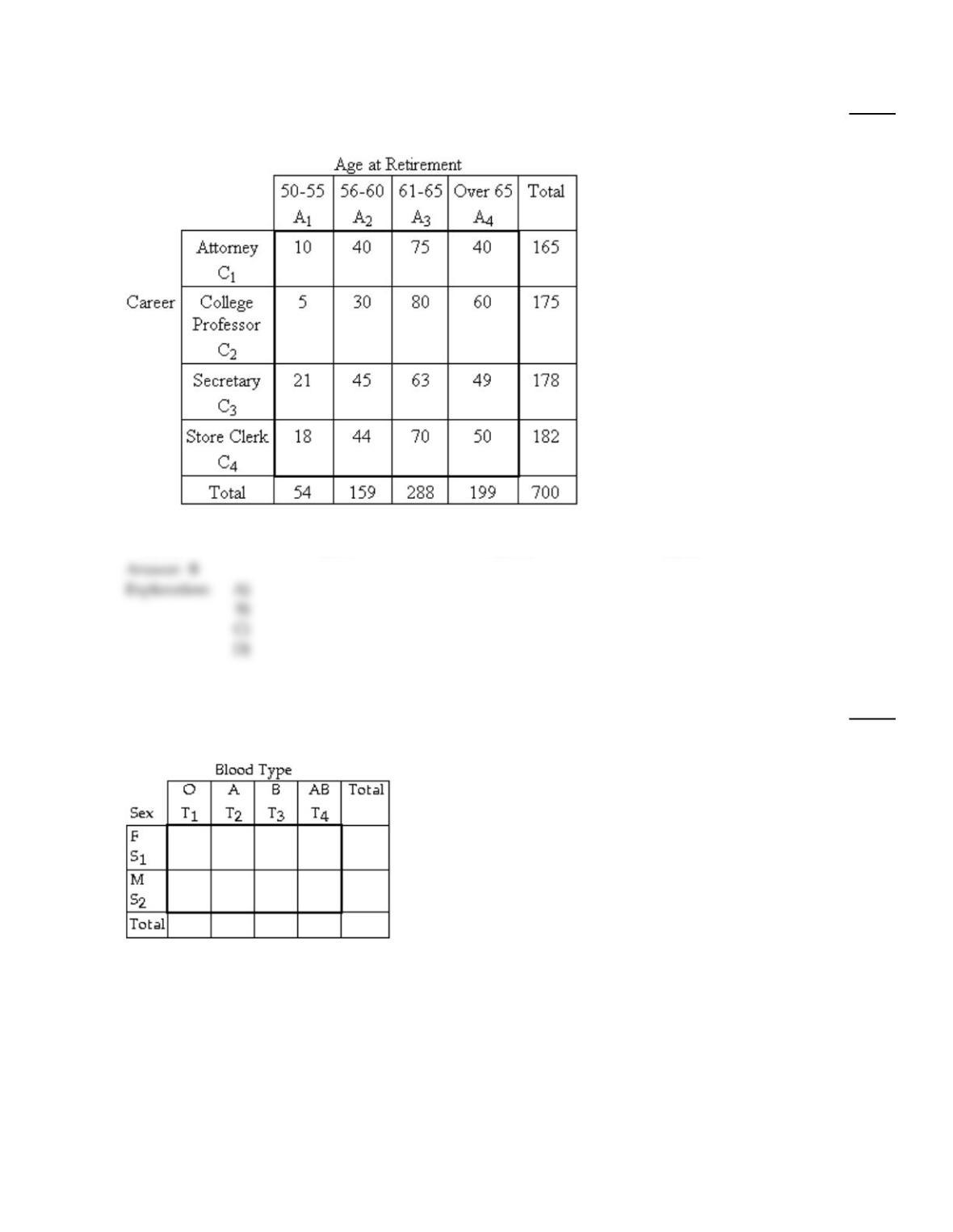
The following contingency table provides a joint frequency distribution for a group of retired
people by age at retirement and career.
How many of these people were secretaries and 61–65 years old when they retired?
224)
A)
288
B)
63
C)
178
D)
21
Construct the joint probability distribution corresponding to the given contingency table.
225)
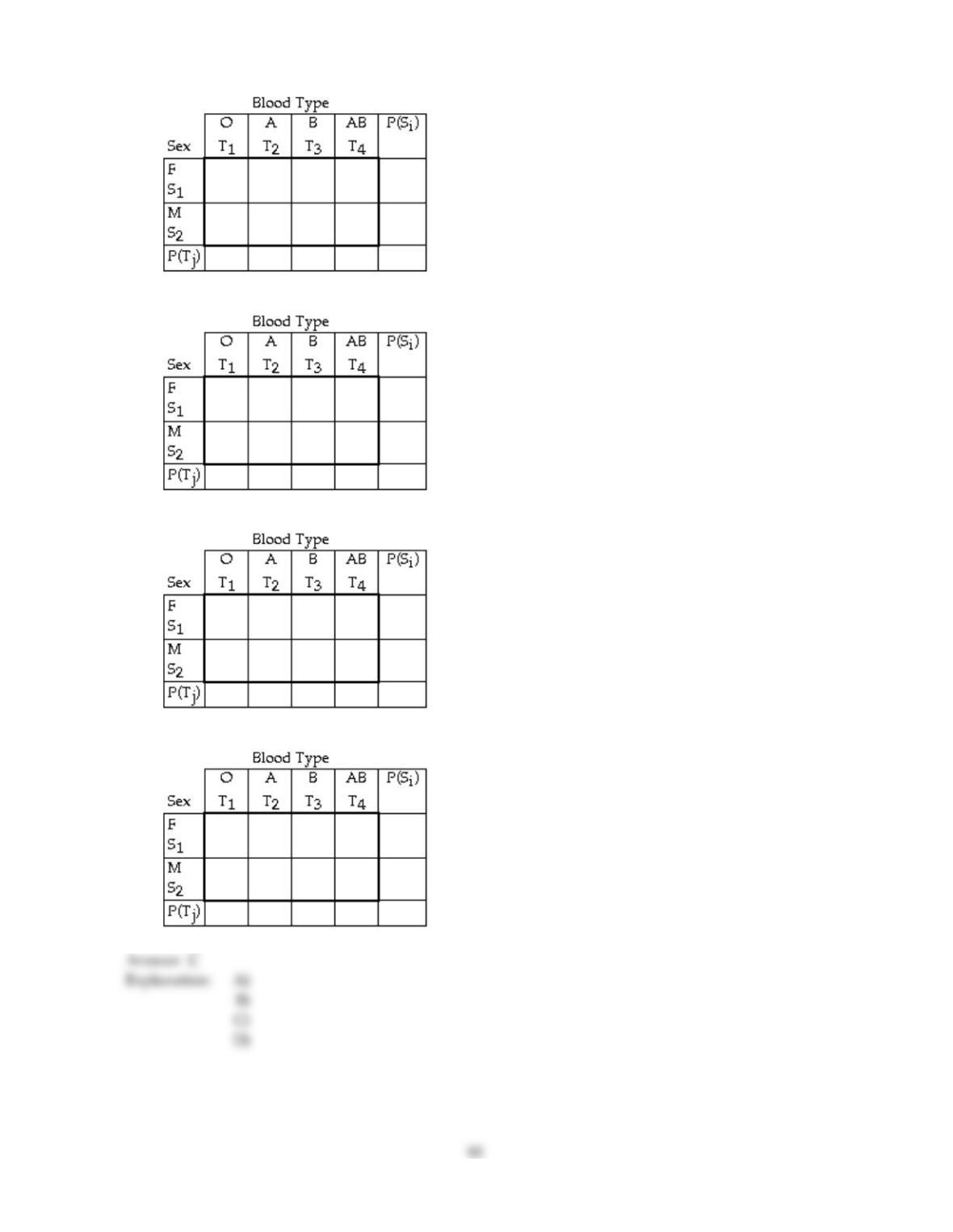
The contingency table below provides a joint frequency distribution for a random sample of
patients at a hospital classified by blood type and sex.
102 93 23 7225
75 66 18 6165
177 159 41 13 390
225)
92
A)
0.262 0.238 0.059 0.018 1.000
0.192 0.169 0.046 0.015 1.000
1.000 1.000 1.000 1.000 1.000
B)
0.576 0.585 0.561 0.538 0.577
0.424 0.415 0.439 0.462 0.423
1.000 1.000 1.000 1.000 1.000
C)
0.262 0.238 0.059 0.018 0.577
0.192 0.169 0.046 0.015 0.423
0.454 0.408 0.105 0.033 1.000
D)
0.453 0.413 0.102 0.031 1.000
0.455 0.400 0.109 0.036 1.000
0.454 0.408 0.105 0.033 1.000
Find the conditional probability.
226)
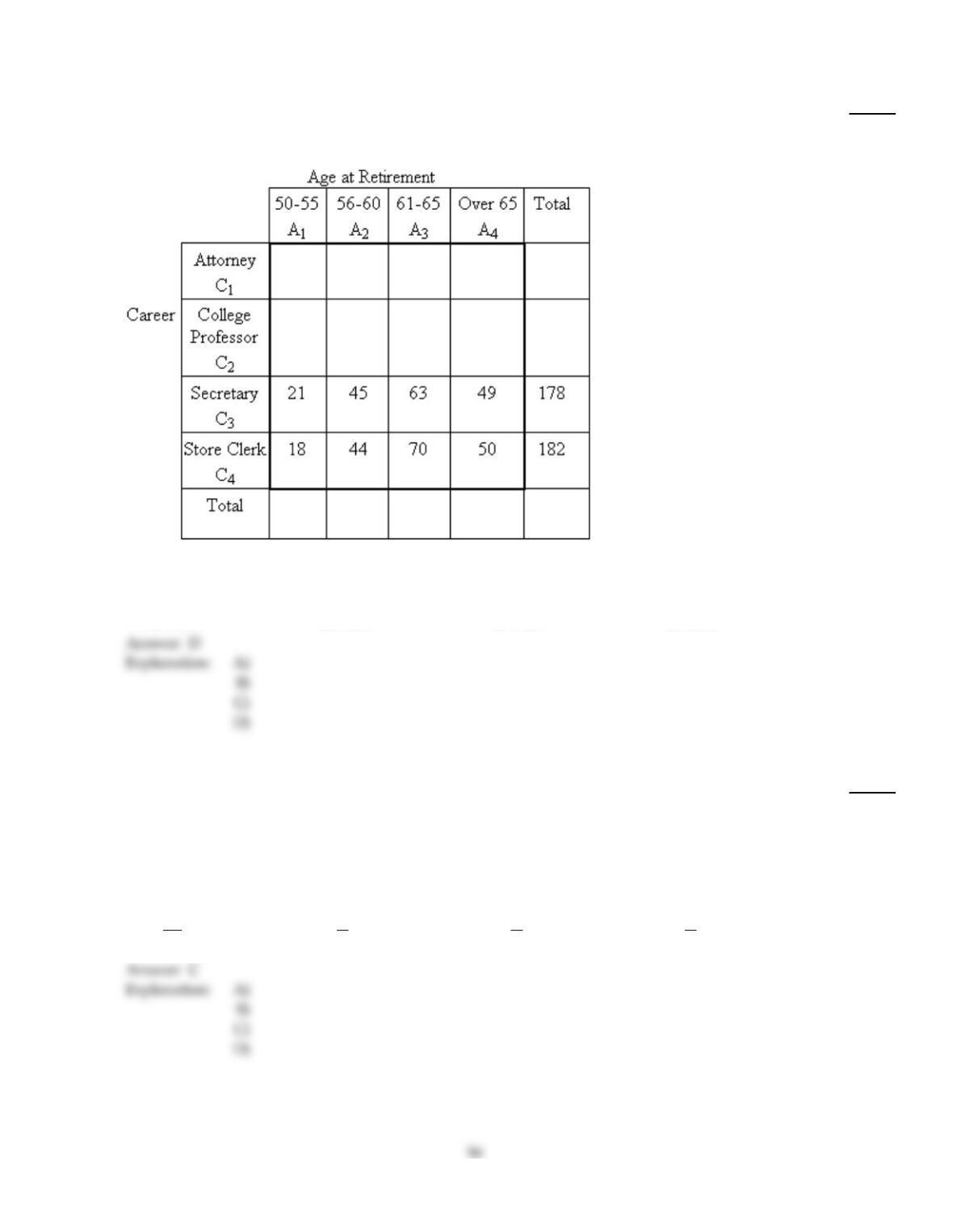
The following contingency table provides a joint frequency
distribution for a group of retired people by career and age
at retirement.
842 80 30 160
10 37 71 40 158
57 168 284 169 678
Suppose one of these people is selected at random. Compute the probability that the person selected
was a college professor given that his or her age of retirement was between 56 and 60.
226)
A)
0.055
B)
0.233
C)
0.234
D)
0.220
Find the indicated probability.
227)
A bag contains four chips of different colors, including red, blue, green, and yellow. A chip is
selected at random from the bag and then replaced in the bag. A second chip is then selected at
random. Make a list of the possible outcomes (for example RB represents the outcome red chip
followed by blue chip) and use your list to determine the probability that the two chips selected are
the same color.
(Hint: There are 16 possible outcomes.)
227)
A)
1
16
B)
1
8
C)
1
4
D)
1
2

Find the conditional probability.
228)
The table below describes the smoking habits of a group of asthma sufferers.
Nonsmoker
Light
smoker
Heavy
smoker Total
Men 380 70 82 532
Women 325 87 60 472
Total 705 157 142 1004
If one of the 1004 subjects is randomly selected, find the probability that the person chosen is a
nonsmoker given that the person is a woman.
228)
A)
0.461
B)
0.689
C)
0.47
D)
0.324
229)
The age distribution of students at a community college is given below.
Age (years) Number of students (f)
Under 21 420
21–25 405
26–30 217
31–35 52
Over 35 24
1118
A student from the community college is selected at random. Find the conditional probability that
the student is at most 35 given that he or she is at least 26.
229)
A)
0.246
B)
0.918
C)
0.177
D)
0.241
Draw a Venn diagram and shade the described events.
230)
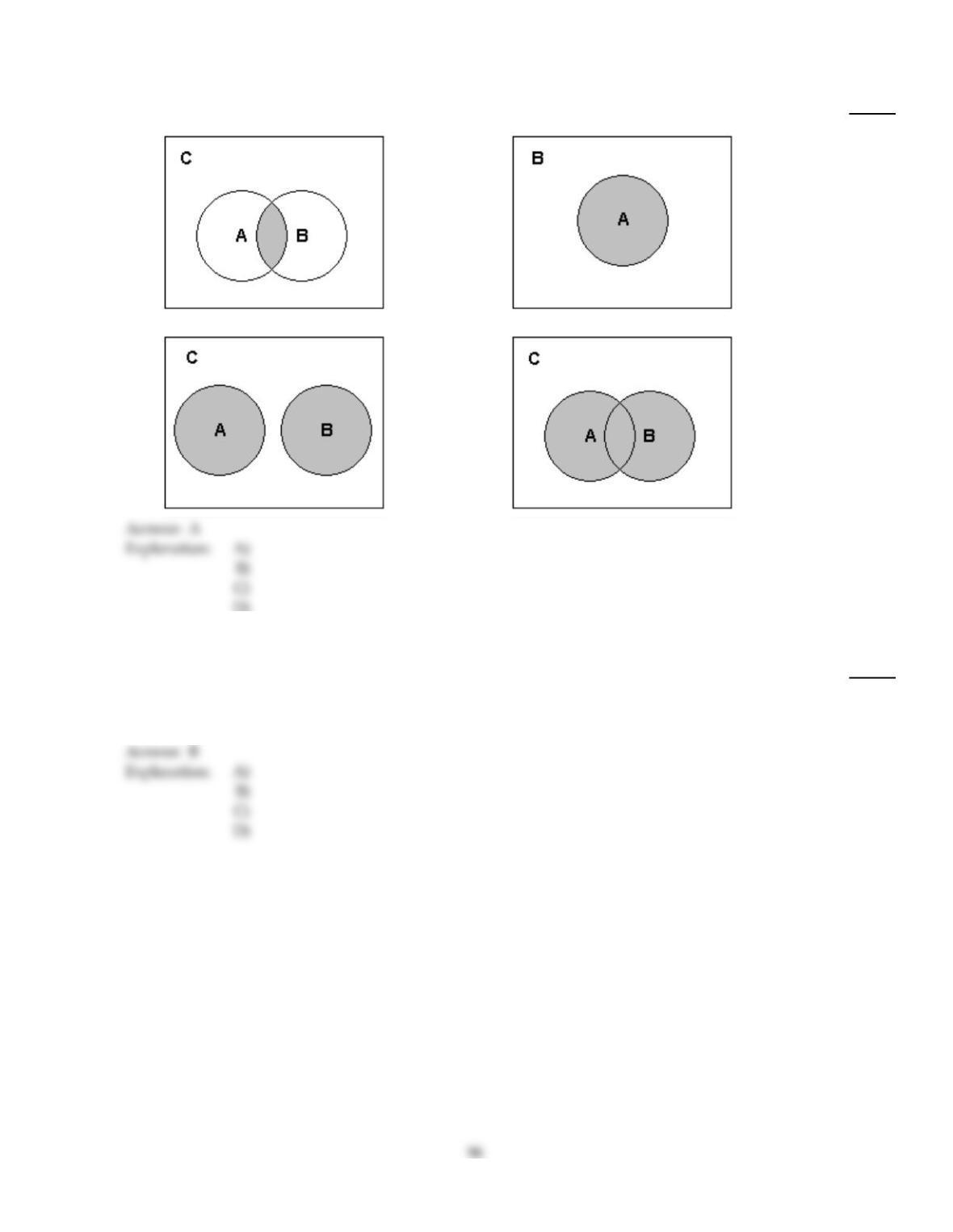
From a finite sample, events A and B are non–mutually exclusive. Shade the collection A and B.
230)
A)
B)
C)
D)
D)
Solve the problem.
231)
A pollster wants to minimize the effect the order of the questions has on a person’s response to a
survey. How many different surveys are required to cover all possible arrangements if there are 6
questions on the survey?
231)
A)
6
B)
720
C)
120
D)
36
D)
Determine whether the events are mutually exclusive.
232)
Three board members for a nonprofit organization will be selected from a group of five people. The
board members will be selected by drawing names from a hat. The names of the five possible board
members are Allison, Betty, Charlie, Dave, and Emily. The possible outcomes can be represented as
follows.
ABC ABD ABE ACD ACE
ADE BCD BCE BDE CDE
Here, for example, ABC represents the outcome that Allison, Betty, and Charlie are selected to be on
the board. The events A, B, and C are defined as follows.
A = event that Dave and Allison are both selected
B = event that more than one man is selected
C = event that fewer than two women are selected
Is the collection of events A, B, and C mutually exclusive?
232)
A)
Yes
B)
No
Use counting rules to determine the probability.
233)
Determine the probability that in a class of 15 students, at least two students have the same
birthday. Assume that there are always 365 days in a year and that birth rates are constant
throughout the year. (Hint: First determine the probability that no two students have the same
birthday and then apply the complementation rule.)
233)
A)
0.253
B)
0.333
C)
0.293
D)
0.747
Solve the problem.
234)
A poker hand consists of 5 cards dealt from an ordinary deck of 52 playing cards. How many
different hands are there consisting of four cards of one suit and one card of another suit?
234)
A)
37,180
B)
715
C)
111,540
D)
9295

Find the indicated probability.
235)
In a batch of 8000 clock radios 8% are defective. A sample of 11 clock radios is randomly selected
without replacement from the 8,000 and tested. The entire batch will be rejected if at least one of
those tested is defective. What is the probability that the entire batch will be rejected?
235)
A)
0.600
B)
0.0800
C)
0.0909
D)
0.400
List the outcomes comprising the specified event.
236)
Three board members for a nonprofit organization will be selected from a group of five people. The
board members will be selected by drawing names from a hat. The names of the five possible board
members are Allison, Bob, Charlie, Dave, and Emily. The possible outcomes can be represented as
follows.
ABC ABD ABE ACD ACE
ADE BCD BCE BDE CDE
Here, for example, ABC represents the outcome that Allison, Bob, and Charlie are selected to be on
the board. The event A is defined as follows.
A = event that Bob and Dave are both selected
List the outcomes that comprise the event (not A).
236)
A)
ACE
B)
ABD, BCD, BDE
C)
ABC, ABE, ACE, ADE, BCE, CDE
D)
ABC, ABE, ACD, ACE, ADE, BCE, CDE

Determine whether the events are mutually exclusive.
237)
The number of hours needed by sixth grade students to complete a research project was recorded
with the following results.
Hours Number of students (f)
415
511
619
7 6
8 9
916
10 2
A student is selected at random. The events A and B are defined as follows.
A = event the student took at most 6 hours
B = event the student took at least 6 hours
Are the events A and B mutually exclusive?
237)
A)
Yes
B)
No
Find the conditional probability.
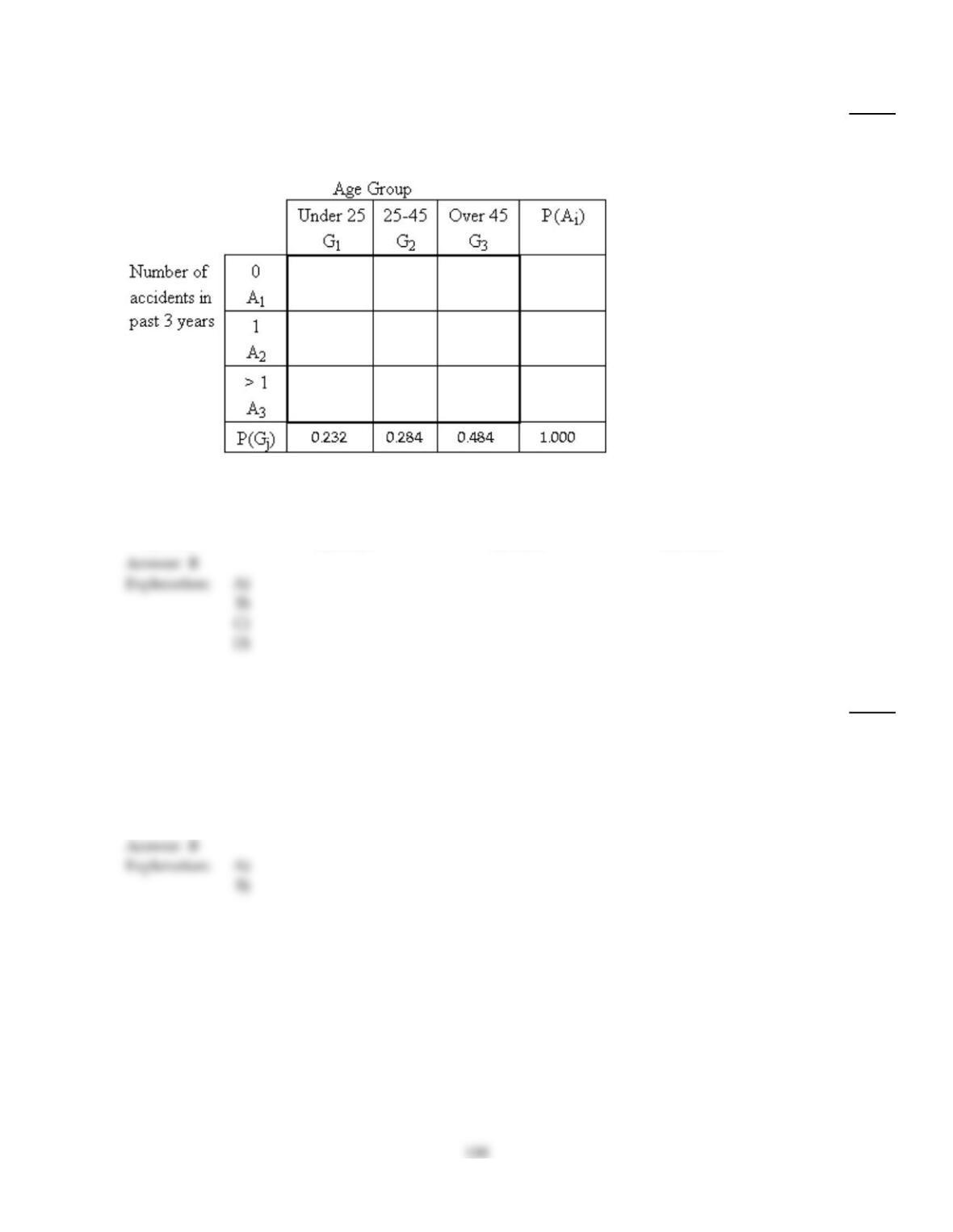
238)
An auto insurance company was interested in investigating accident rates for drivers in different
age groups. The following contingency table was based on a random sample of drivers and
provides a joint probability distribution for drivers by age group and accident rate.
0.123 0.203 0.387 0.712
0.086 0.068 0.079 0.234
0.023 0.013 0.018 0.054
Suppose one of these people is selected at random. Compute the probability that the person is aged
over 45 given that in the past three years they have had no accidents.
238)
A)
0.800
B)
0.543
C)
0.387
D)
0.484
Determine whether the events are independent.
239)
When a balanced die is rolled twice, 36 equally likely outcomes are possible. Let
A = event the sum of the two rolls is 8
B = event the first roll comes up 3.
Are A and B independent events?
239)
A)
Yes
B)
No