136
Chapter 16: Developing Concepts of Fractions and Decimals
MULTIPLE CHOICE. Choose the one alternative that best completes the statement or
answers the question.
1) What is it advisable to do when you are exploring decimal numbers?
A) 10 to one multiplicative relationship.
B) Rules for placement of the decimal.
C) Role of the decimal point.
D) How to read a decimal fraction.
2) What is an early method to use to help students see the connection between fractions and
decimals fractions?
A) Show them how to use a calculator to divide the fraction numerator by the denominator to
find the decimal.
B) Be sure to use precise language when speaking about decimals, such as “point seven two.”
C) Show them how to round decimal numbers to the closest whole number.
D) Show them how to use base-ten models to build models of base-ten fractions.
3) The 10-to-1 relationship extends in two directions. There is never a smallest piece or a largest
piece. Complete the statement, “The symmetry is around…”
A) The decimal point.
B) The ones place.
C) The operation being conducted.
D) The relationship between the adjacent pieces.
4) The following decimals are equivalent 0.06 and 0.060. What does one of them show that the
other does not show?
A) More place value.
B) More hundreds.
C) More level of precision.
D) Closer to one.
5) Using precise language can support students’ understanding of the relationship between
fractions and decimal fractions. All of the following are true statements EXCEPT:
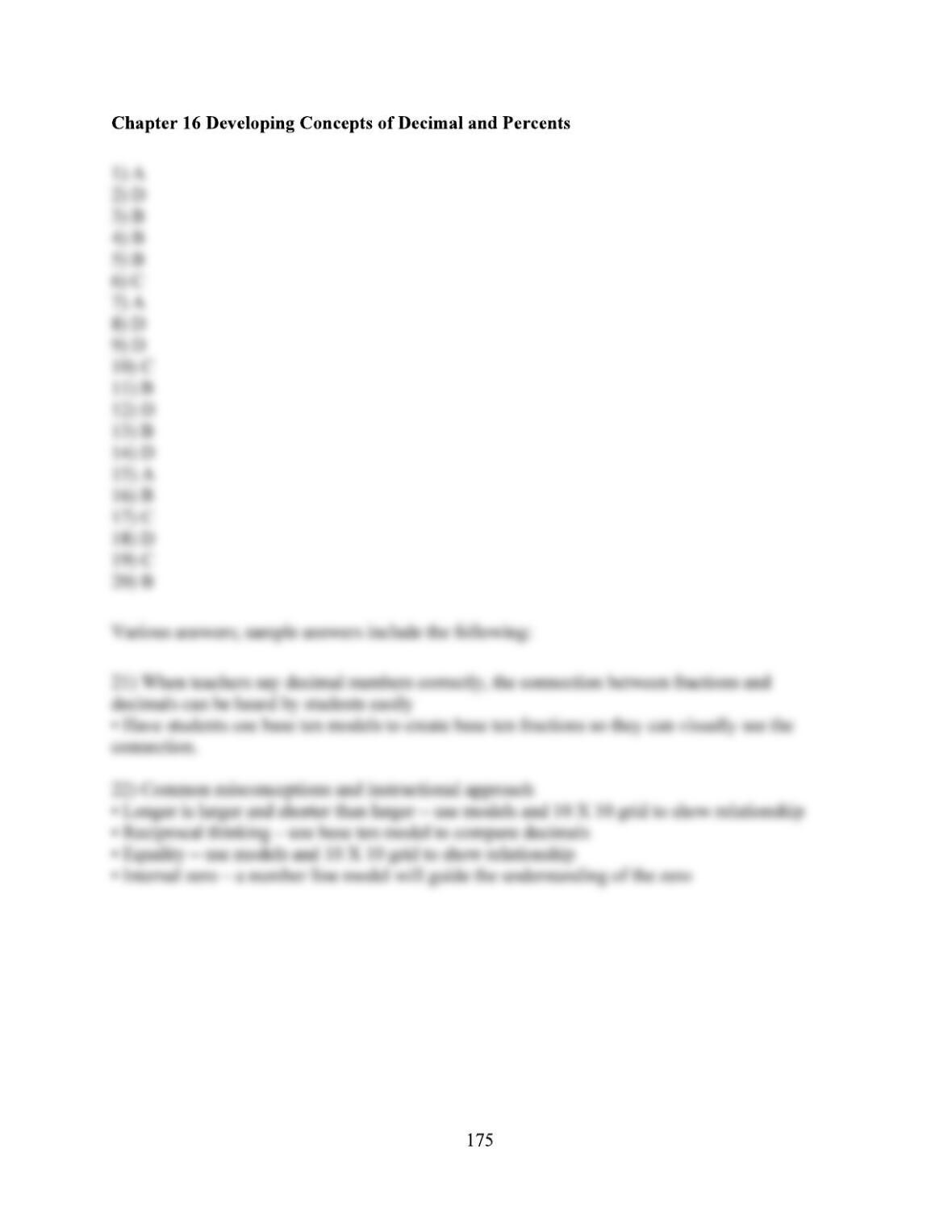
A) 0.75 = .
B) Five and two-tenths is the same as five point two.
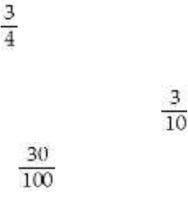
C) Six and three-tenths = 6 .
D) 7. 03 = 7 .
6) What is the most common model used for decimal fractions?
A) Rational number wheel.
B) Base ten strips and squares.
137
C) 10 × 10 grids.
D) Number line.
7) A common set model for decimal fraction is money. Identify the true statement below.
A) Money is a two-place system.
B) One-tenth a dime proportionately compares to a dollar.
C) Money should be an initial model for decimal fractions.
D) Money is a proportional model.
8) All of the statements below are true of this decimal fraction 5.13 EXCEPT:
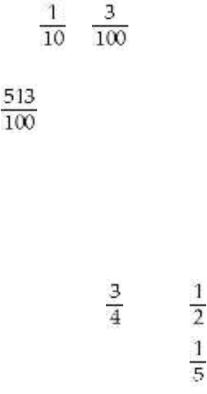
A) 5 + + .
B) Five and thirteen-hundredths.
C) .
D) Five wholes, 3 tenths and 1 hundredth.
9) Approximation with compatible fractions is one method to help students with number sense
with decimal fractions. All of the statements are true of 7.3962 EXCEPT:
A) Closer to 7 than 8.
B) Closer to 7 than 7 .
C) Closer to 7.3 than 7 .
D) Closer to 7.4 than 7.5.
10) There are several common errors and misconceptions associated with comparing and
ordering decimals. Identify the statement below that represents the error with internal zero.
A) Students say 0.375 is greater than 0.97.
B) Students see 0.58 less than 0.078.
C) Students select 0 as larger than 0.36
D) Students see 0.4 as not close to 0.375
11) Understanding that when decimals are rounded to two places (2.30 and 2.32) there is always
another number in between. What is the place in between called?
A) Place value.
B) Density.
C) Relationships.
D) Equality.
12) Instruction on decimal computation has been dominated by rules. Identify the statement that
is not rule based.
A) Line up the decimal points.
B) Count the decimal places.
C) Shift the decimal point in the divisor.
D) Apply decimal notation to properties of operations.
138
13) Decimal multiplication tends to be poorly understood. What is it that students need to be able
to do?
A) Discover the method by being given a series of multiplication problems with factors that have
the same digits, but decimals in different places.
B) Discover it on their own with models, drawings and strategies.
C) Be shown how to estimate after they are shown the algorithm.
D) Use the repeated addition strategy that works for whole number.
14) The estimation questions below would help solve this problem EXCEPT:
– A farmer fills each jug with 3.7 liters of cider. If you buy 4 jugs, how many liters of cider is
that?
A) Is it more than 12 liters?
B) What is the most it could be?
C) What is double 3.7 liters?
D) Is it more than 7 × 4?
15) Understanding where to put the decimal is an issue with multiplication and division of
decimals. What method below supports a fuller understanding?
A) Rewrite decimals in their fractional equivalents.
B) Rewrite decimals as whole numbers, compute and count place value.
C) Rewrite decimals to the nearest tenths or hundredths.
D) Rewrite decimals on 10 by 10 grids.
16) What is a method teachers might use to assess the level of their students understanding of the
decimal point placement?
A) Ask them to show all computations.
B) Ask them to show a model or drawing.
C) Ask them to explain or write a rationale.
D) Ask them to use a calculator to show the computation.
17) What is it that students can understand if they can express fractions and decimals to the
hundredths place?
A) Place value.
B) Computation of decimals.
C) Percents.
D) Density of decimals.
18) The main link between fractions, decimals and percents are
A) Expanded notation.
B) Terminology.
C) Equivalency.
D) Physical models.
19) The following are guidelines for instruction on percents EXCEPT:
A) Use terms part, whole and percent.
B) Use models, drawings and contexts to explain their solutions.
139
C) Use calculators.
D) Use mental computation.
20) Estimation of many percent problems can be done with familiar numbers. Identify the idea
that would not support estimation.
A) Substitute a close percent that is easy to work with.
B) Use a calculator to get an exact answer.
C) Select numbers that are compatible with the percent to work with.
D) Convert the problem to one that is simpler.
ESSAY. Write your answer in the space provided or on a separate sheet of paper.
21) Name two methods that could help students develop the connection between fractions and
decimals. Then describe how these methods develop conceptual understanding.
22) Identify two common misconceptions and an instructional approach that would redirect
student understanding.