132
Chapter 15: Developing Strategies for Fraction Computation
MULTIPLE CHOICE. Choose the one alternative that best completes the statement or
answers the question.
1) To guide students to develop a problem-based number sense approach for operations with
fractions all of the following are recommended EXCEPT:
A) Address common misconceptions regarding computational procedures.
B) Estimating and invented methods play a big role in the development.
C) Explore each operation with a single model.
D) Use contextual tasks.
2) Identify the problem that solving with a linear model would not be the best method.
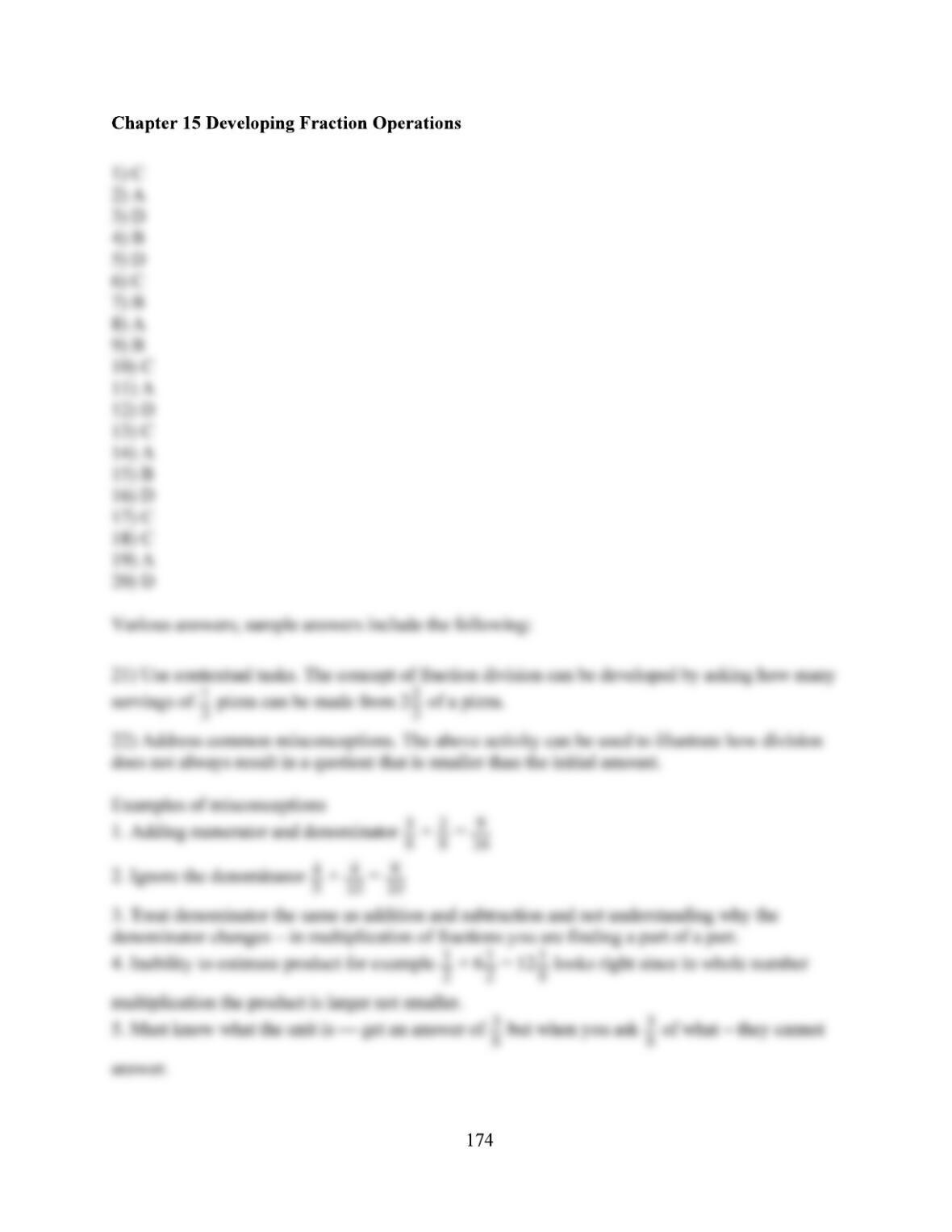
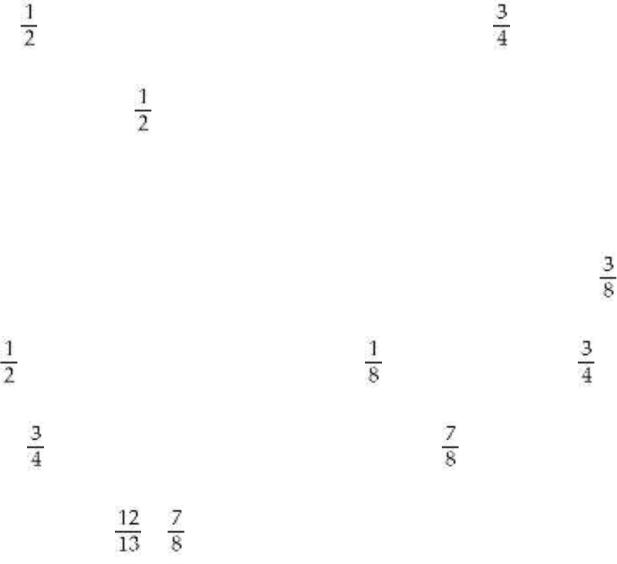
A) Half a pizza is left from the 2 pizzas Molly ordered. How much pizza was eaten?
B) Mary needs 3 feet of wood to build her fence. She only has 2 feet. How much more wood
does she need?
C) Millie is at mile marker 2 . Rob is at mile marker 1. How far behind is Rob?
D) What is the total length of these two Cuisenaire rods placed end to end?
3) Adding and subtraction fractions should begin with students using prior knowledge of
equivalent fractions. Identify the problem that may be more challenging to solve mentally.
A) Luke ordered 3 pizzas. But before his guests arrive he got hungry and ate of one pizza.
What was left for the party?
B) Linda ran 1 miles on Friday. Saturday she ran 2 miles and Sunday 2 . How many miles
did she run over the weekend?
C) Lois gathered pounds of walnuts and Charles gathered pounds. Who gathered the most?
How much more?
D) Estimate the answer to + .
4) Different models are used to help illustrate fractions. Identify the model that can be confusing
when you are learning to add fractions.
A) Area.
B) Set.
C) Linear.
D) Length.
133
5) Linear models are best represented by what manipulative?
A) Pattern Blocks.
B) Circular pieces.
C) Ruler.
D) Number line.
6) Identify the manipulative used with linear models that you can decide what to use as the
“whole.”
A) Circular pieces.
B) Number Line.
C) Cuisenaire Rods.
D) Ruler.
7) All of the statements below are examples of estimation or invented strategies for adding and
subtracting fractions EXCEPT:
A) Decide whether fractions are closest to 0, , or 1.
B) Look for ways different fraction parts are related.
C) Decide how big the fraction is based on the unit.
D) Look for the size of the denominator.
8) Complete the statement, “Developing the algorithm for adding and subtracting fractions
should…”
A) Be done side by side with visuals and situations.
B) Be done with specific procedures.
C) Be done with units that are challenging to combine.
D) Be done mentally without paper and pencil.
9) What statement is true about adding and subtracting with unlike denominators?
A) Should be introduced at first with tasks that require both fractions to be changed.
B) Is sometimes possible for students, especially if they have a good conceptual understanding of
the relationships between certain fractional parts and a visual tool, such as a number line.
C) Is a concept understood especially well by students if the teacher compares different
denominators to “apples and oranges.”
D) Should initially be introduced without a model or drawing.
10) Students are able to solve adding and subtracting fractions without finding a common
denominator using invented strategies. The problems below would work with the invented
strategies EXCEPT:
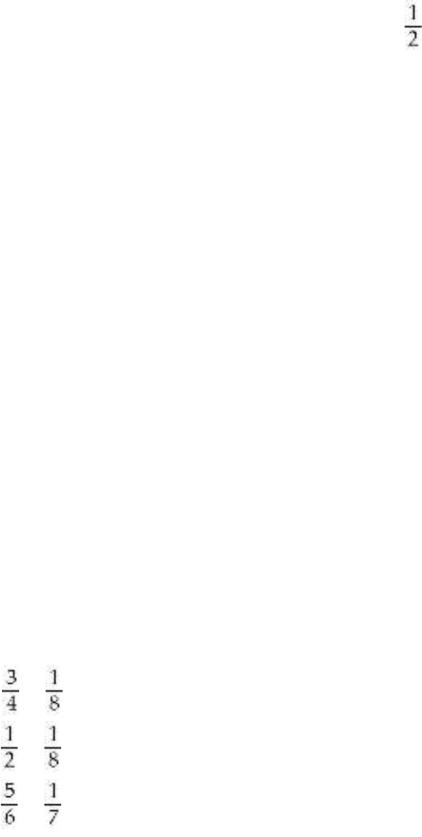
A) +
B) +
C) +

134
D) +
11) What is helpful when subtracting mixed number fractions?
A) Deal with the whole numbers first and then work with the fractions.
B) Always trade one of the whole number parts into equivalent parts.
C) Avoid this method until the student fully understands subtraction of numbers less than one.
D) Teach only the algorithm that keeps the whole number separate from the fractional part.
12) Common misconceptions occur because students tend to overgeneralize what they know
about whole number operations. Identify the misconception that is not relative to fraction
operations.
A) Adding both numerator and denominator.
B) Not identifying the common denominator.
C) Difficulty with common multiples.
D) Use of invert and multiply.
13) All of the activities below guide students to understand the algorithm for fraction
multiplication EXCEPT:
A) Multiply a fraction by a whole number.
B) Multiply a whole number by a fraction.
C) Subdividing the whole number.
D) Fraction of a fraction- no subdivisions.
14) This model is exceptionally good at modeling fraction multiplication. It works when
partitioning is challenging and provides a visual of the size of the result.
A) Area model.
B) Linear model.
C) Set model.
D) Circular model.
15) What is one of the methods for finding the product of fractional problems when one of the
numbers is mixed number?
A) Change to improper fraction.
B) Compute partial products.
C) Linear modeling.
D) Associative property.
16) Each the statements below are examples of misconceptions students have when learning to
multiply fractions EXCEPT:
A) Treating denominators the same as addition and subtraction.
B) Matching multiplication situations with multiplication situations.
C) Estimating the size of the answer incorrectly.
D) Multiplying the denominator and not numerator.
17) It is recommended that division of fractions be taught with a developmental progression that
focuses on four types of problems. Which statement below is not part of the progression?
135
A) A fraction divided by a fraction.
B) A whole number divided by a fraction.
C) A whole number divided by a mixed number.
D) A whole number divided by a whole number.
18) A(n) ________ interpretation is a good method to explore division because students can
draw illustrations to show the model.
A) Area.
B) Set.
C) Measurement.
D) Linear.
19) Estimation and invented strategies are important with division of fractions. If you posed the
problem ÷ 4 you would ask all of the questions EXCEPT:
A) Will the answer be greater than 4?
B) Will the answer be greater than one?
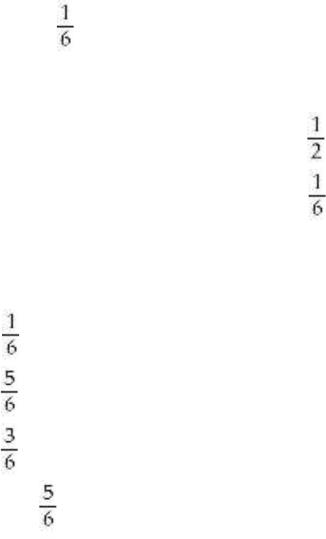
C) Will the answer be greater than ?
D) Will the answer be greater than ?
20) Based on students experience with whole number division they think that when dividing by a
fraction the answer should be smaller. This would be true for all of the following problems
EXCEPT:
A) ÷ 3
B) ÷ 3
C) ÷ 3
D) 3 ÷
ESSAY. Write your answer in the space provided or on a separate sheet of paper.
21) Name two of the major guidelines to consider when developing computational strategies for
fractions. Describe an instructional sequence that would support each guideline.
22) Identify and discuss misconceptions that students bring from whole number operations to
their learning of fraction operations.