128
Chapter 14: Developing Fraction Concepts
MULTIPLE CHOICE. Choose the one alternative that best completes the statement or
answers the question.
1) The part-whole construct is the concept most associated with fractions, but other important
constructs they represent include all of the following EXCEPT:
A) Measure.
B) Reciprocity.
C) Division.
D) Ratio.
2) All of the following are fraction constructs EXCEPT:
A) Part-whole.
B) Measurement.
C) Iteration.
D) Division.
3) Fraction misconceptions come about for all of the following reasons. The statements below
can be fraction misconceptions EXCEPT:
A) Many meanings of fractions.
B) Fractions written in a unique way.
C) Students overgeneralize their whole-number knowledge.
D) Teachers present fractions late in the school year.
4) Models provide an effective visual for students and help them explore fractions. Identify the
statement that is the definition of the length model.
A) Location of a point in relation to 0 and other values.
B) Part of area covered as it relates to the whole unit.
C) Count of objects in the subset as it relates to defined whole.
D) A unit or length involving fractional amounts.
5) The following visuals/manipulatives support the development of fractions using the area
model EXCEPT:
A) Pattern blocks.
B) Tangrams.
C) Cuisenaire rods.
D) Geoboards.
6) A ________ is a significantly more sophisticated length model than other models.
A) Number line.
B) Cuisenaire rods.
C) Measurement tools.
D) Folded paper strips.
7) What is a common misconception with fraction set models?
129
A) There are not many real-world uses.
B) Knowing the size of the subset rather than the number of equal sets.
C) Knowing the number of equal sets rather than the size of subsets.
D) There are not many manipulatives to model the collections.
8) Complete this statement, “Comparing two fractions with any representation can be made only
if you know the…”
A) Size of the whole.
B) Parts all the same size.
C) Fractional parts are parts of the same size whole.
D) Relationship between part and whole.
9) What is the definition of the process of partitioning?
A) Equal shares.
B) Equal-sized parts.
C) Equivalent fractions.
D) Subset of the whole.
10) Locating a fractional value on a number line can be challenging but is important for students
to do. All of the statements below are common errors that students make when working with the
number line EXCEPT:
A) Use incorrect notation.
B) Change the unit.
C) Use incorrect subsets.
D) Count the tick marks rather than the space.
11) Counting precedes whole-number learning of addition and subtraction. What is another term
for counting fraction parts?
A) Equalizing.
B) Iterating.
C) Partitioning.
D) Sectioning.
12) The term improper fraction is used to describe fractions greater than one. Identify the
statement that is true about the term improper fraction.
A) Is a clear term, as it helps students realize that there is something unacceptable about the
format.
B) Should be taught separately from proper fractions.
C) Are best connected to mixed numbers through the standard algorithm.
D) Should be introduced to students in a relevant context.
13) What does a strong understanding of fractional computation rely on?
A) Estimating with fractions.
B) Iteration skills.
C) Whole number knowledge.
D) Fraction equivalence.
130
14) All of the models listed below support the understanding of fraction equivalence EXCEPT:
A) Graph of slope.
B) Shapes created on dot paper.
C) Plastic, circular area models.
D) Clock faces.
15) The way we write fractions is a convention with a top and bottom number with a bar in
between. Posing questions can help students make sense of the symbols. All of the questions
would support that sense making EXCEPT:
A) What does the denominator in a fraction tell us?
B) What does the equal symbol mean with fractions?
C) What might a fraction equal to one look like?
D) How do know if a fraction is greater than, less than 1?
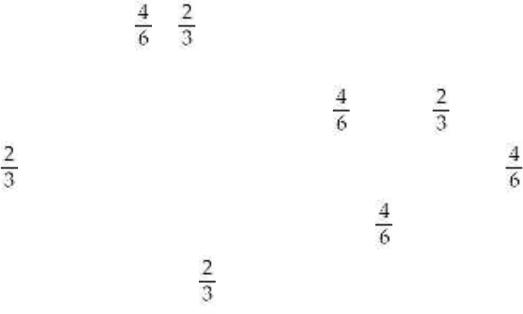
16) How do you know that = ? Identify the statement below that demonstrates a conceptual
understanding.
A) They are the same because you can simplify and get .
B) Start with and multiply the top and bottom by 2 and you get .
C) If you have 6 items and you take 4 that would be . You can make 6 groups into 3 groups and
4 into 2 groups and that would be .
D) If you multiply 4 × 3 and 6 × 2 they’re both 12.
17) What does it mean to write fractions in simplest term?
A) Finding equivalent numerators.
B) Finding equivalent denominators.
C) Finding multipliers and divisors.
D) Finding equivalent fractions with no common whole number factors.
18) Comparing fractions involves the knowledge of the inverse relationship between number of
parts and size of parts. The following activities support the relationship EXCEPT:
A) Iterating.
B) Equivalent fraction algorithm.
C) Estimating.
D) Partitioning.
19) Estimating with fractions means that students have number sense about the relative size of
fractions. All of the activities below would guide this number sense EXCEPT:
A) Comparing fractions to benchmark numbers.
B) Find out the fractional part of the class are wearing glasses.
C) Collect survey data and find out what fractions of the class choose each item.
D) Use paper folding to identify equivalence.
131
20) Teaching considerations for fraction concepts include all of the following EXCEPT:
A) Iterating and partitioning.
B) Procedural algorithm for equivalence.
C) Emphasis on number sense and fractional meaning.
D) Link fractions to key benchmarks.
ESSAY. Write your answer in the space provided or on a separate sheet of paper.
21) Researchers have described a number of reasons that students have a tendency to struggle
with fraction concepts. Name two of these reasons, and describe a method a teacher might use to
address each.
22) Equivalent fraction models are important for students to have in several contexts. Identify
two models and an example of how they can be used for teaching equivalence.