
Chapter 14 – Multicriteria Decisions
True / False
1. Objectives in multicriteria problems seldom conflict.
a.
True
b.
False
False
1
Introduction
2. Target values will never be met precisely in a goal programming problem.
a.
True
b.
False
False
1
GP: graphical solution procedure
3. Goal equations consist of a function that defines goal achievement and deviation variables that measure the distance
from the target.
a.
True
b.
False
True
1
GP: developing the constraints and the goal equations
4. There can only be one goal at each priority level.
a.
True
b.
False
False
1
GP: developing an objective function with preemptive priorities
5. To solve a goal programming problem with preemptive priorities, successive linear programming programs, with an
adjustment to the objective function and an additional constraint, must be solved.
a.
True
b.
False
True
1
GP: developing an objective function with preemptive priorities
6. If a problem has multiple goals at different priority levels, then usually they can all be achieved.
a.
True
b.
False
False
1
GP: computer solution

Chapter 14 – Multicriteria Decisions
7. For a scoring model, the decision maker evaluates each decision alternative using equally weighted criteria.
a.
True
b.
False
False
1
8. If airline A is moderately preferred to airline B, at a value of 3, then airline B is compared to airline A at a value of −3.
a.
True
b.
False
False
1
9. An item’s priority reveals how it compares to its competitors on a specific criterion.
a.
True
b.
False
True
1
10. The priority matrix shows the priority for each item on each criterion.
a.
True
b.
False
True
1
11. One limitation of a scoring model is that it uses arbitrary weights that do not necessarily reflect the preferences of the
individual decision maker.
a.
True
b.
False
False
1
12. A consistency ratio greater than 0.10 indicates inconsistency in the pair-wise comparisons.
a.
True
b.
False
True
1
13. Calculating the priority of each criterion in terms of its contribution to the overall goal is known as developing the
hierarchy.
a.
True

Chapter 14 – Multicriteria Decisions
b.
False
False
1
Synthesization
14. The goal programming approach can be used when an analyst is confronted with an infeasible solution to an ordinary
linear program.
a.
True
b.
False
True
1
Goal programming
15. A problem involving only one priority level is not considered a goal programming problem.
a.
True
b.
False
False
1
Goal programming
16. AHP allows a decision maker to express personal preferences about the various aspects of a multicriteria problem.
a.
True
b.
False
True
1
Analytic hierarchy process
Multiple Choice
17. A decision with more than one objective
a.
cannot have an optimal solution.
b.
requires the decision maker to place the objectives in some order of importance.
c.
depends on the probability of satisfying each objective.
d.
should be decomposed into a separate model for each objective.
b
1
Introduction
18. Variables that indicate the distance a target is from the level achieved are called
a.
goal variables.
b.
target variables.
c.
deviation variables.
d.
preemptive variables.
c
1

Chapter 14 – Multicriteria Decisions
19. Preemptive priorities in goal programming
a.
show the target values for the problem.
b.
prevent sacrifice of a goal to satisfy a lower level one.
c.
force the problem to be a standard linear program.
d.
limit deviations to d− only.
b
1
GP: preemptive priorities
20. Deviation variables that occur in the objective function indicate
a.
the targets.
b.
the priorities.
c.
only the areas that are of concern.
d.
the difference between all actual and target values.
1
GP: objective function
21. The variable d– measures
a.
the amount over the target and is similar to a slack.
b.
the amount under the target and is similar to a slack.
c.
the amount over the target and is similar to a surplus.
d.
the amount under the target and is similar to a surplus.
b
1
GP: deviation variables
22. The constraint 5x1 + 3x2 ≤ 150 is modified to become a goal equation, and priority one is to avoid overutilization.
Which of the following is appropriate?
a.
Min P1d1− ; 5x1 + 3x2 + d1− − d1+ = 150
b.
Min P1d1+ ; 5x1 + 3x2 + d1− − d1+ = 150
c.
Min P1d1+ ; 5x1 + 3x2 + d1+ = 150
d.
Min P1d1+ ; 5x1 + 3x2 − d1+ = 150
b
1
GP: developing the constraints and the goal equations
23. The goal programming problem with the objective function min P1(d1+) +P2(d2−) is initially solved by the computer
and the objective function value is 0. What constraint should be added for the second problem?
a.
d1+ = 0
b.
d1+ + d2− = 0
GP: deviation variables

Chapter 14 – Multicriteria Decisions
c.
−d1+ + d2− = 0
d.
d1+ ≤ 0
1
GP: developing the constraints and the goal equations
24. A required step in the analytic hierarchy process is to determine
a.
the goals to be satisfied.
b.
the expected value of the criteria.
c.
the relative importance of a set of features based on a criterion.
d.
how many hierarchies to use.
1
AHP: developing the hierarchy
25. Pair-wise comparisons are used to
a.
compare criteria in terms of the overall goal.
b.
compare choices on each criterion.
c.
both a and b are true.
d.
neither a nor b is true.
1
AHP: pair-wise comparisons
26. The overall priorities for decision alternatives
a.
are the sum of the products of the criterion priority times the priority of the decision alternative with respect to
that criterion.
b.
sum to 1.
c.
indicate what choice is preferred, but do not force that choice to be made.
d.
each of the above is true.
d
1
AHP: developing an overall priority ranking
27. The steps of the scoring model include all of the following EXCEPT:
a.
list the decision-making criteria and assign a weight to each.
b.
develop a pair-wise comparison matrix for each criterion.
c.
rate how well each decision alternative satisfies each criterion.
d.
compute the total score for each decision alternative.
b
1
28. Goal programming with preemptive priorities never permits trade-offs between

Chapter 14 – Multicriteria Decisions
a.
goals with the same priority level and the same weights.
b.
goals with different priority levels.
c.
goals with the same priority level and different weights.
d.
any goals.
b
1
Goal programming
29. Inconsistency in the pair-wise judgments is indicated by a consistency ratio that is
a.
less than zero
b.
greater than 0.10
c.
greater than 0.50
d.
greater than 1.00
b
1
AHP: Consistency
30. When using a linear programming approach to solving a goal programming problem, a linear program must be solved
for each
a.
goal.
b.
pair of deviation variables.
c.
priority level.
d.
pair-wise comparison.
1
Goal programming
31. Computing the consistency ratio for a criterion’s pair-wise comparison matrix is the next step after
a.
developing the criterion’s pair-wise comparison matrix.
b.
converting the criterion’s pair-wise comparison matrix to a normalized matrix.
c.
developing the criterion’s priority vector.
d.
developing the overall priority vector.
c
1
AHP: Consistency
Subjective Short Answer
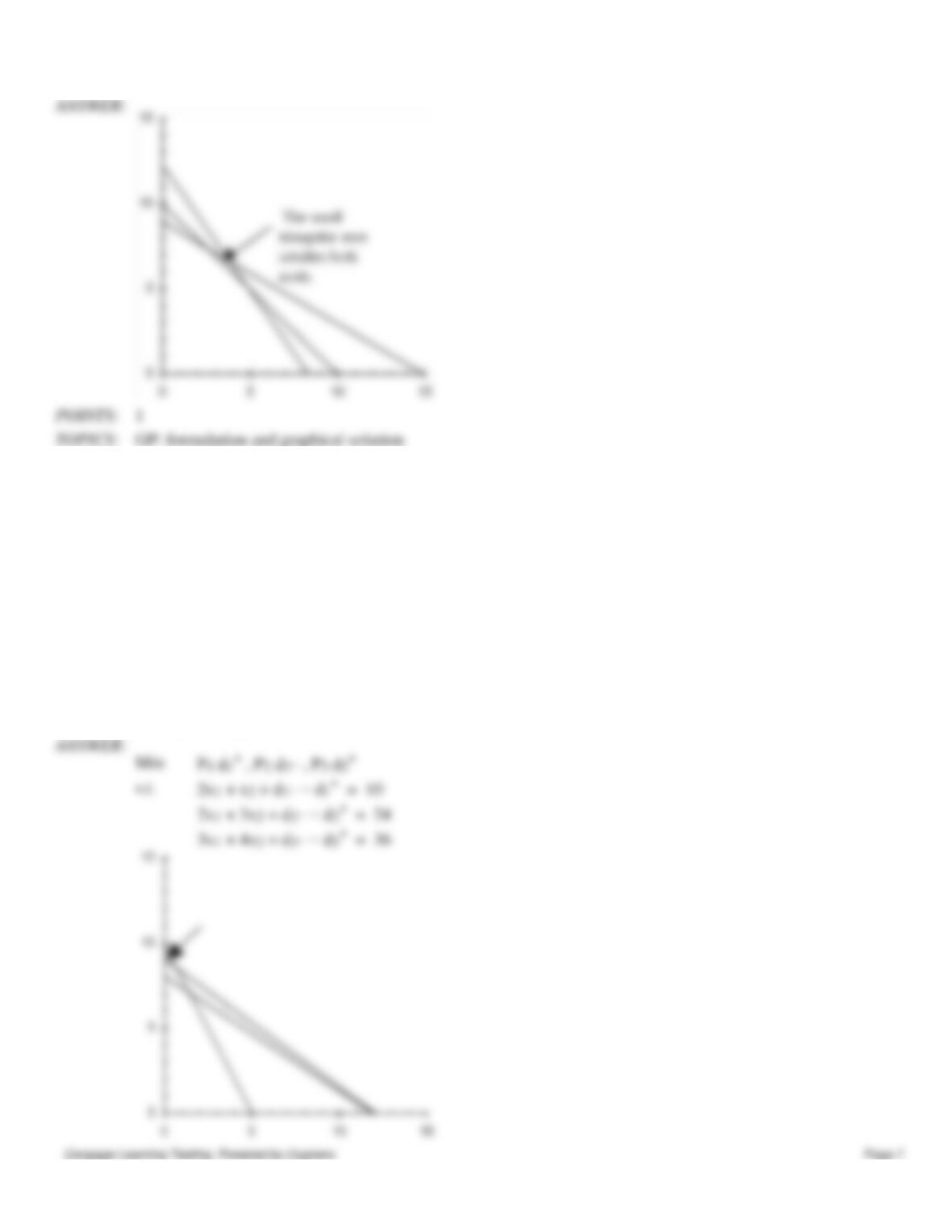
32. Solve the following problem graphically:
Min
P1(d1+) + P2(d2−)
s.t.
3x1 + 5x2 ≤ 45
3x1 + 2x2 − d1+ + d1− = 24
x1 + x2 − d2+ + d2− = 10
x1, x2, d1−, d1+, d2−, d2+ ≥ 0
Chapter 14 – Multicriteria Decisions
GP: formulation and graphical solution
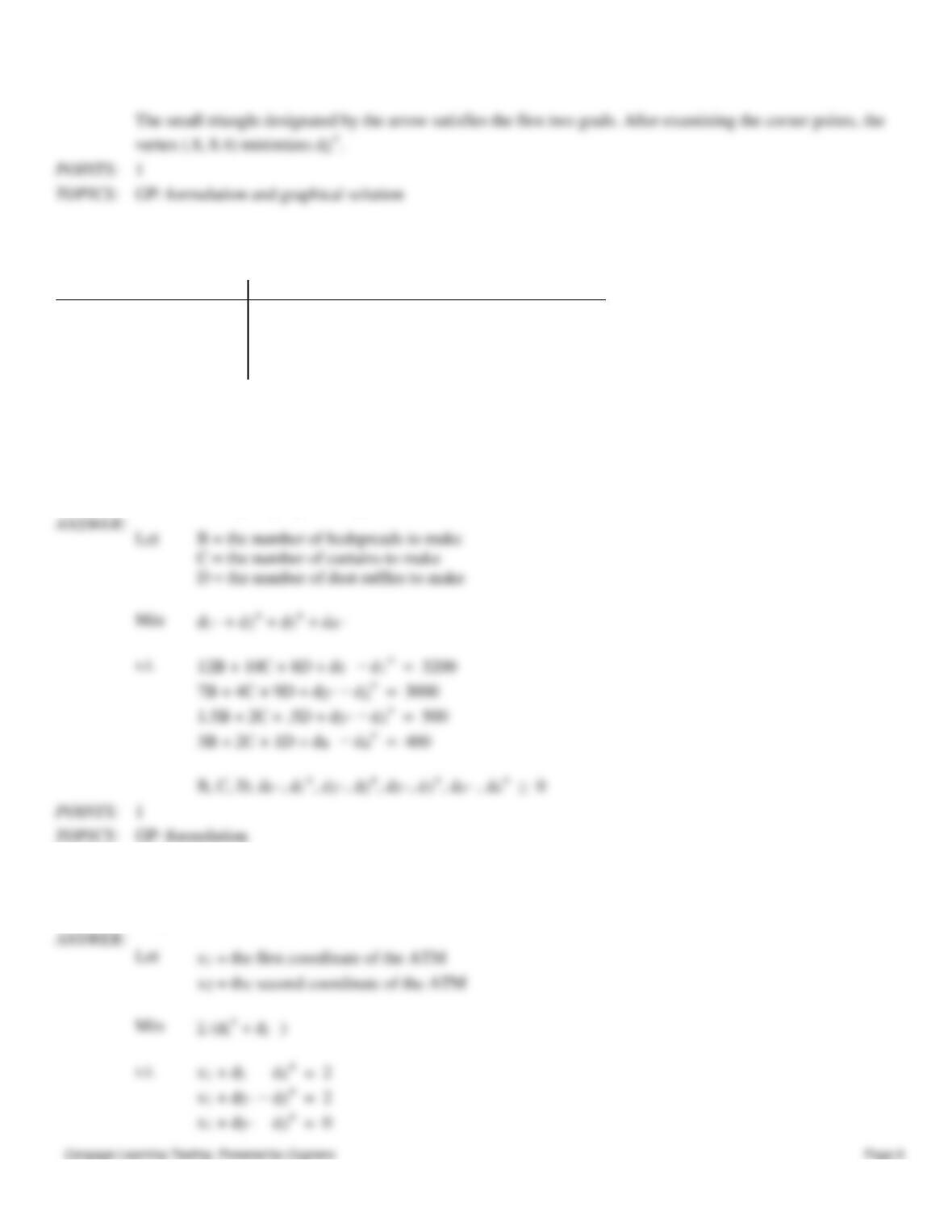
33. The Lofton Company has developed the following linear programming problem
Max
x1 + x2
s.t.
2x1 + x2 ≤ 10
2x1 + 3x2 ≤ 24
3x1 + 4x2 ≥ 36
but finds it is infeasible. In revision, Lofton drops the original objective and establishes the three goals
Goal 1:
Don’t exceed 10 in constraint 1.
Goal 2:
Don’t fall short of 36 in constraint 3.
Goal 3:
Don’t exceed 24 in constraint 2.
Give the goal programming model and solve it graphically.
Min
s.t.
Chapter 14 – Multicriteria Decisions
34. Durham Designs manufactures home furnishings for department stores. Planning is underway for the production of
items in the “Wildflower” fabric pattern during the next production period.
Bedspread
Curtains
Dust Ruffle
Fabric required (yds)
7
4
9
Time required (hrs)
1.5
2
.5
Packaging material
3
2
1
Profit
12
10
8
Inventory of the Wildflower fabric is 3000 yards. Five hundred hours of production time have been scheduled. Four
hundred units of packaging material are available. Each of these values can be adjusted through overtime or extra
purchases.
Durham would like to achieve a profit of $3200, avoid purchasing more fabric or packaging material, and use all of the
hours scheduled. Give the goal programming model.
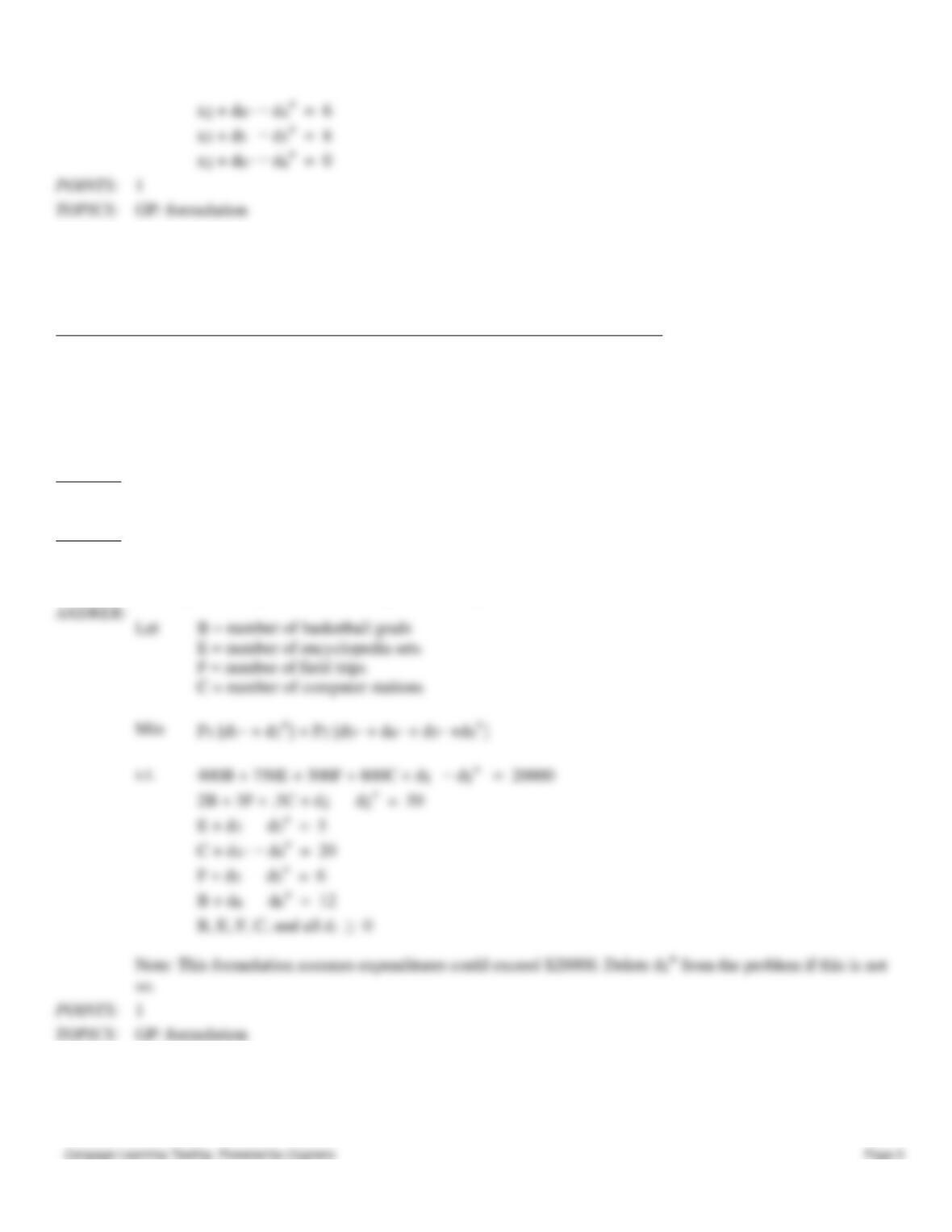
35. An ATM is to be located in a campus union building so that it minimizes the distance from the food court, the gift
shop, and the theater. They are located at coordinates (2,2), (0,6) and (8,0). Develop a goal programming model to use to
locate the best place for the ATM.
Chapter 14 – Multicriteria Decisions
36. As treasurer of the school PTA, you chair the committee to decide how the $20,000 raised by candy sales will be
spent. Four kinds of projects have been proposed, and facts on each are shown below.
Project
Number
Requested
Unit Cost
Volunteers Needed
(Person-days, each)
Basketball goals
12
$400
2
Encyclopedia sets
5
750
0
Field trips
6
300
3
Computer Stations
20
800
.5
Develop a goal programming model that would represent these goals and priorities.
Priority 1
Goal 1
Spend the entire $20,000.
Goal 2
Do not use more than 50 person-days of volunteer time
Priority 2
Goal 3
Provide at least as many encyclopedias and computers as requested.
Goal 4
Provide at least as many field trips as requested.
Goal 5
Do not provide any more basketball goals than requested.
B = number of basketball goals
E = number of encyclopedia sets
F = number of field trips
C = number of computer stations
P1 [d1− + d2+] + P2 [d3− + d4− + d5− +d6+]
GP: formulation
37. The goal programming problem below was solved with the Management Scientist.
Min
P1(d1−) + P2(d2+) + P3(d3−)

Chapter 14 – Multicriteria Decisions
s.t.
72x1 + 38x2 + 23x3 ≤ 20,000
.72x1 − .76x2 − .23x3 + d1− − d1+ = 0
x3 + d2− − d2+ = 150
38x2 + d3− − d3+ = 2000
x1, x2, x3, d1−, d 1+, d2−, d2+, d3−, d3+ ≥ 0
Partial output from three successive linear programming problems is given. For each problem, give the original objective
function expression and its value, and list any constraints needed beyond those that were in the original problem.
a.
Objective Function Value = 0.000
Variable
Value
Reduced Cost
D1MINUS
0.000
1.000
X1
52.632
0.000
X2
0.000
0.000
X3
150.000
0.000
D1PLUS
3.395
0.000
D2MINUS
0.000
0.000
D2PLUS
0.000
0.000
D3MINUS
0.000
0.000
D3PLUS
0.000
0.000
b.
Objective Function Value = 0.000
Variable
Value
Reduced Cost
D2PLUS
0.000
1.000
X1
52.632
0.000
X2
0.000
0.000
X3
150.000
0.000
D1MINUS
0.000
0.000
D1PLUS
3.395
0.000
D2MINUS
0.000
0.000
D3MINUS
0.000
0.000
D3PLUS
0.000
0.000
c.
Objective Function Value = 0.000
Variable
Value
Reduced Cost
D3MINUS
0.000
1.000
X1
52.632
0.000
X2
0.000
0.000
X3
150.000
0.000
D1MINUS
0.000
0.000
D1PLUS
3.395
0.000
D2MINUS
0.000
0.000
D2PLUS
0.000
0.000
D3PLUS
0.000
0.000
a.
Min d1minus, Z = 0
b.
Min d2plus, Z = 0, the constraint d1minus = 0 was included.
1
GP: computer solution

Chapter 14 – Multicriteria Decisions
38. Rosie’s Ribs is in need of an office management software package. After considerable research, Rosie has narrowed
her choice to one of three packages: N-able, VersaSuite, and SoftTrack. She has determined her decision-making criteria,
assigned a weight to each criterion, and rated how well each alternative satisfies each criterion.
Decision Alternatives
Criterion
Weight
N-Able
VersaSuite
SoftTrack
Ease of use
4
3
5
8
Report generation
3
8
7
6
Functional integration
5
5
8
6
On-line help
3
8
6
4
Entry error-checking
2
8
3
4
Price
4
4
7
5
Support cost
3
6
5
7
Using a scoring model, determine the recommended software package for Rosie’s.
N-Able = 135, VersaSuite = 148, SoftTrack = 141
1
Scoring models
39. A consumer group is using AHP to compare four used car models. Part of the pair-wise comparison matrix for “repair
frequency” is shown below.
a.
Complete the matrix.
b.
Does it seem to be consistent?
Repair Frequency
Model A
Model B
Model C
Model D
Model A
1
5
1/6
Model B
1/5
1
1/2
Model C
1/4
1/3
1
Model D
1/4
1
The matrix is not consistent. A to B is 5, B to C is 3, C to D is 4, yet D to A is 6.
1
AHP: Consistency
40. A computer company looking for a new location for a plant has determined three criteria to use to rate cities. Pair-wise
comparisons are given.
Recreation
Opportunities
Proximity to
University
Cost of
Living
Recreation opportunities
1
1/3
1/5
Proximity to university
3
1
1/4
Cost of living
5
4
1
Determine priorities for the three relative to the overall location goal.
Priorities
1
AHP: synthesis

Chapter 14 – Multicriteria Decisions
41. In an AHP problem, the priorities for three criteria are
Criterion 1
.1722
Criterion 2
.1901
Criterion 3
.6377
The priority matrix is
Criterion 1
Criterion 2
Criterion 3
Choice 1
.425
.292
.850
Choice 2
.330
.251
.105
Choice 3
.245
.457
.045
Compute the overall priority for each choice.
States 1 and 2 (recover and die) are the absorbing states.
The probability that a person with symptom 2 will recover is .633.
1
AHP: developing overall priorities
42. Like many high school seniors, Anne has several universities to consider when making her final college choice. To
assist in her decision, she has decided to use AHP to develop a ranking for school R, school P, and school M. The schools
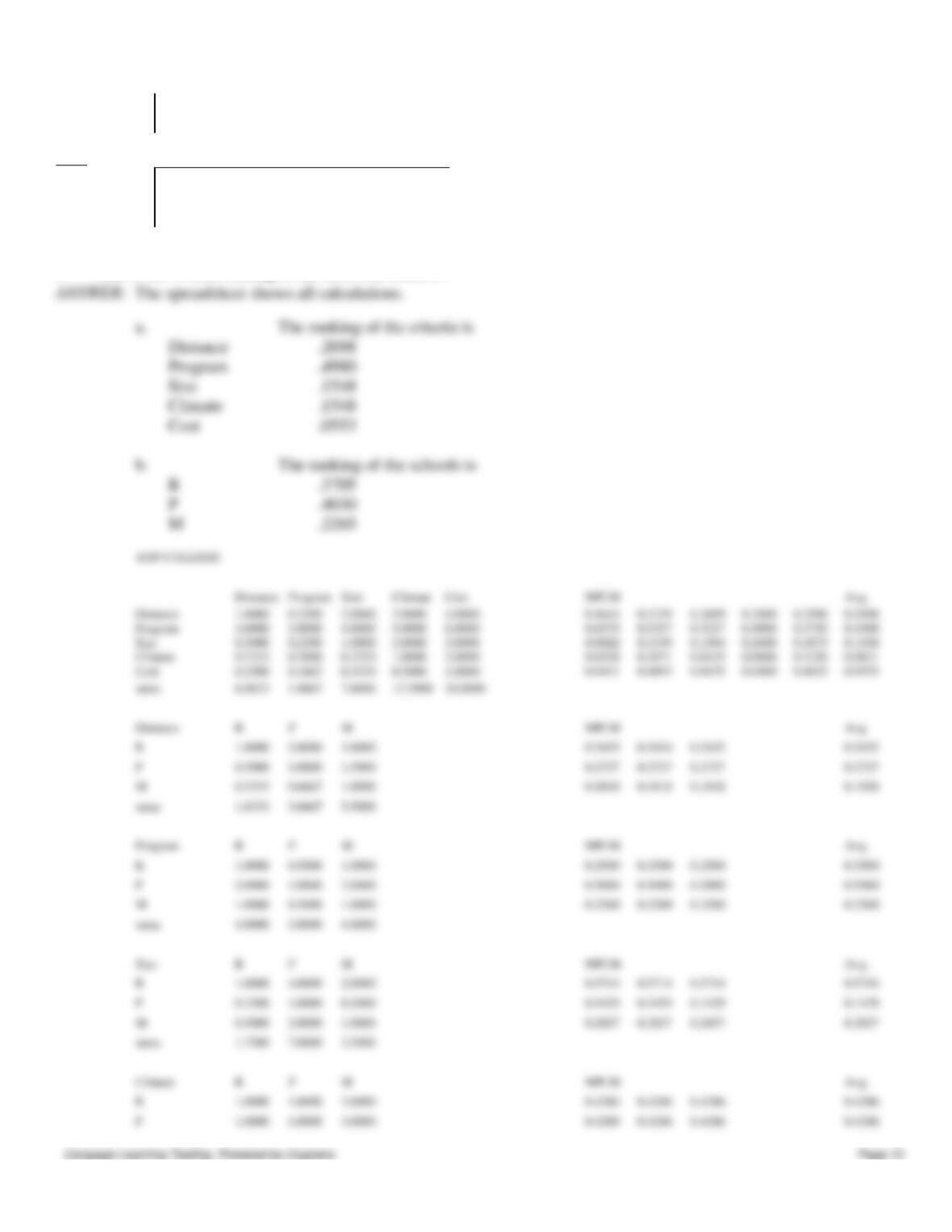
will be evaluated on five criteria, and Anne’s pair-wise comparison matrix for the criteria is shown below.
Distance
Program
Size
Campus Climate
Cost
Distance
1
1/4
2
3
4
Program
4
1
4
5
6
Size
1/2
1/4
1
3
3
Climate
1/3
1/5
1/3
1
2
Cost
1/4
1/6
1/3
1/2
1
The universities’ pair-wise comparisons on the criteria are shown below.
Distance
R
P
M
R
1
2
3
P
1/2
1
3/2
M
1/3
2/3
1
Programs
R
P
M
R
1
1/2
1
P
2
1
2
M
1
1/2
1
Size
R
P
M
R
1
4
2
P
1/4
1
1/2
M
1/2
2
1
Climate
R
P
M
R
1
1
3
Chapter 14 – Multicriteria Decisions
P
1
1
3
M
1/3
1/3
1
Cost
R
P
M
R
1
1/5
1
P
5
1
5
M
1
1/5
1
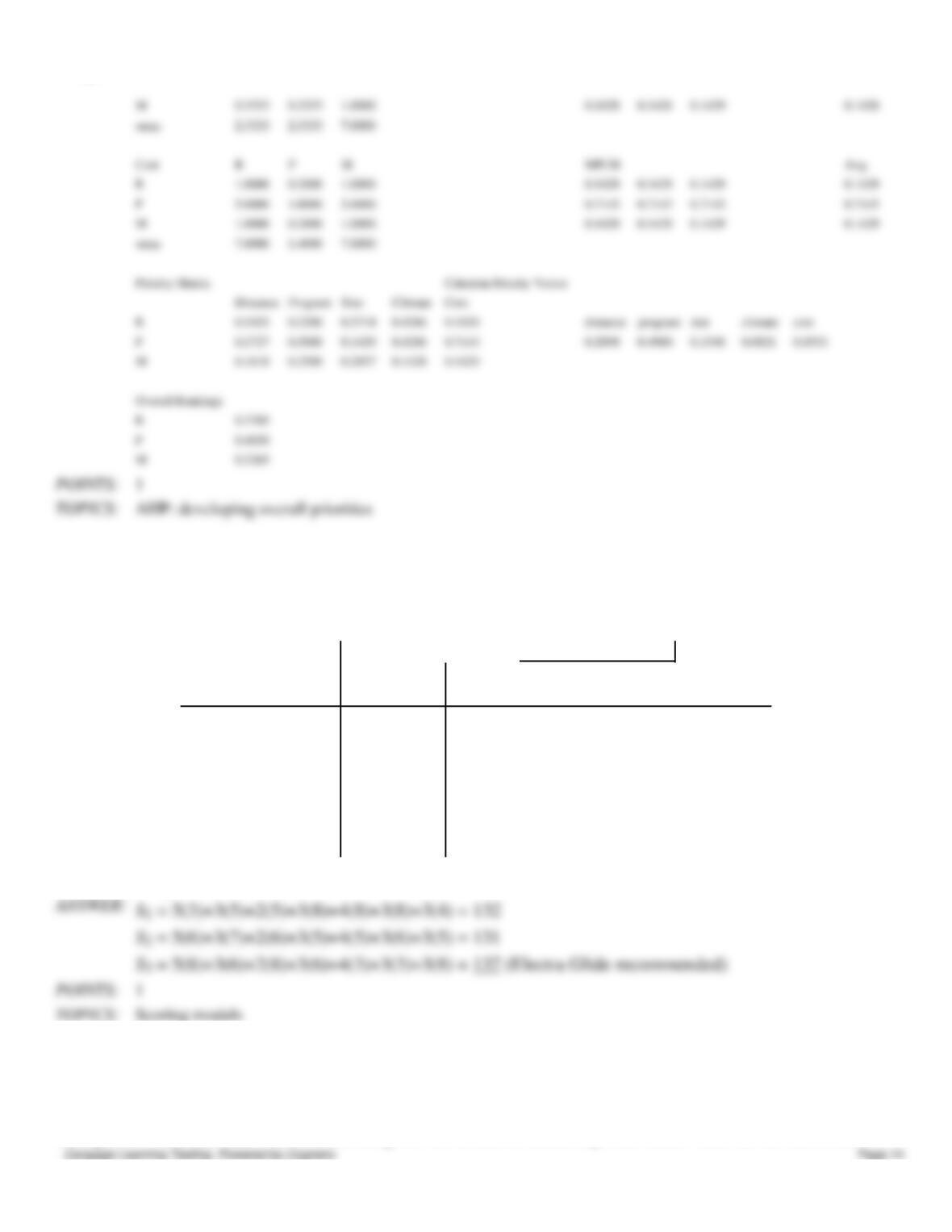
a.
What is the overall ranking of the five criteria?
b.
What is the overall ranking of the three universities?
a.
The ranking of the criteria is
Distance
Program
Size
Climate
Cost
b.
The ranking of the schools is
R
P
M
Chapter 14 – Multicriteria Decisions
43. John Harris is interested in purchasing a new Harley-Davidson motorcycle. He has narrowed his choice to
one of three models: Sportster Classic, Heritage Softtail, and Electra Glide. After much consideration, John has
determined his decision-making criteria, assigned a weight to each criterion, and rated how well each decision
alternative satisfies each criterion.
Decision Alternative
Criterion
Weight
Sportster
Classic
Heritage
Softtail
Electra
Glide
Wind protection
5
3
6
8
Fuel tank capacity
3
5
7
6
Passenger comfort
2
5
6
8
Seat height
3
8
5
6
Acceleration
4
8
5
3
Vehicle weight
3
8
6
3
Storage capacity
3
4
5
8
Using a scoring model, determine the recommended motorcycle model for John.
Scoring models
44. The campaign headquarters of Jerry Black, a candidate for the Board of Supervisors, has 100 volunteers. With one
week to go in the election, there are three major strategies remaining: media advertising, door–to–door canvassing, and
telephone campaigning. It is estimated that each phone call will take approximately four minutes and each door–to–door
personal contact will average seven minutes. These times include time between contacts for breaks, transportation,
dialing, etc. Volunteers who work on advertising will not be able to handle any other duties. Each ad will utilize the
AHP: developing overall priorities
Chapter 14 – Multicriteria Decisions
talents of three workers for the entire week.
Volunteers are expected to work 12 hours per day during the final seven days of the campaign. At a minimum, Jerry
Black feels he needs 30,000 phone contacts, 20,000 personal contacts, and three advertisements during the last week.
However, he would like to see 50,000 phone contacts and 50,000 personal contacts made and five advertisements
developed. It is felt that advertising is 50 times as important as personal contacts, which in turn is twice as important as
phone contacts.
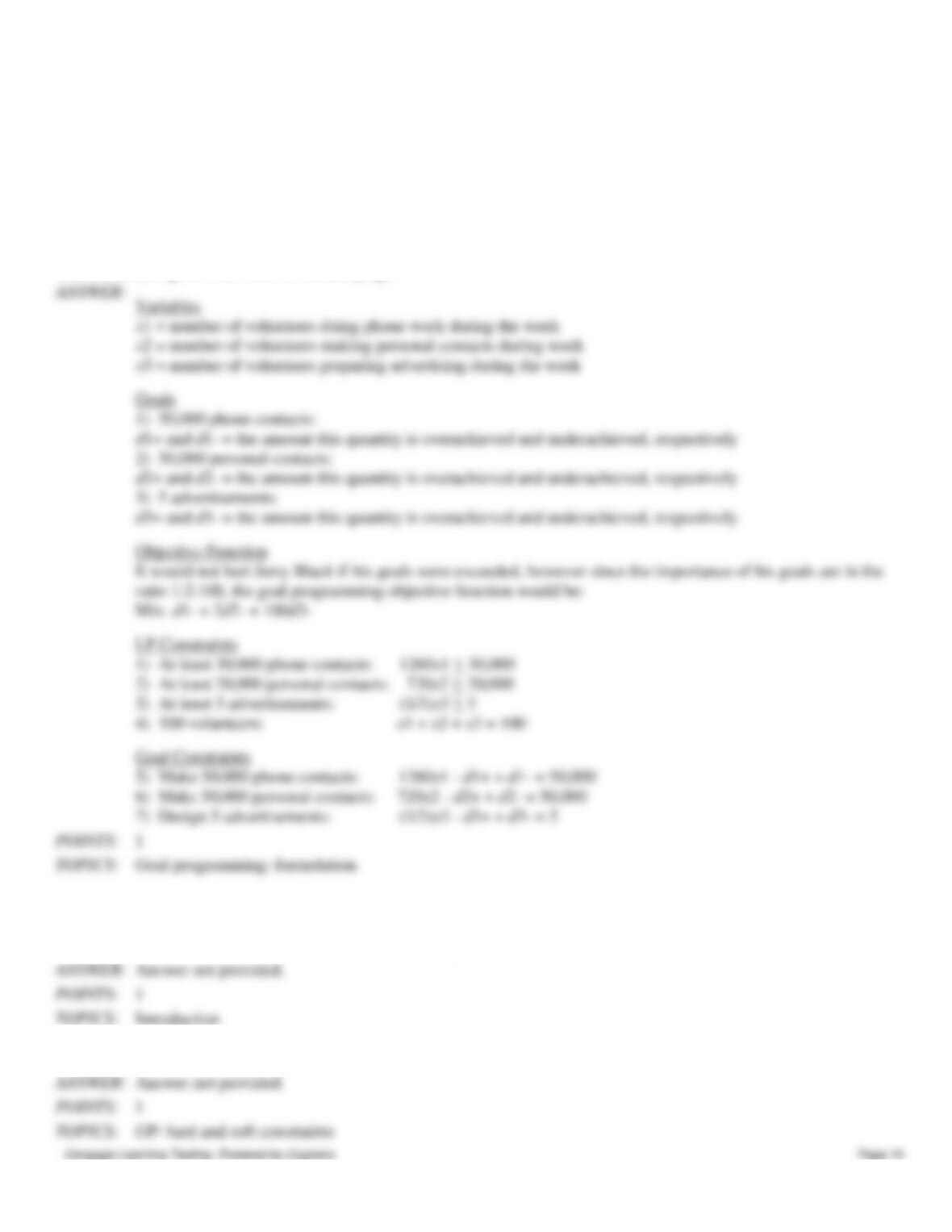
Formulate this goal programming problem with a single weighted priority to determine how the work should be
distributed during the final week of the campaign.
Essay
45. Why are multicriteria problems of special interest to quantitative analysts?
Introduction
46. Explain the difference between hard and soft constraints in a goal programming problem.

Chapter 14 – Multicriteria Decisions
47. Explain why goal programming could be a good approach to use after a linear programming problem is found to be
infeasible.
48. How can you be sure your rankings in AHP are consistent?
49. Should the decision maker always accept the alternatives with the highest AHP rating? Explain.
50. Explain the structure of a hierarchy diagram used in the analytic hierarchy process as a graphical representation of
the problem.