Exam
Name___________________________________
MULTIPLE CHOICE. Choose the one alternative that best completes the statement or answers the question.
Graph.
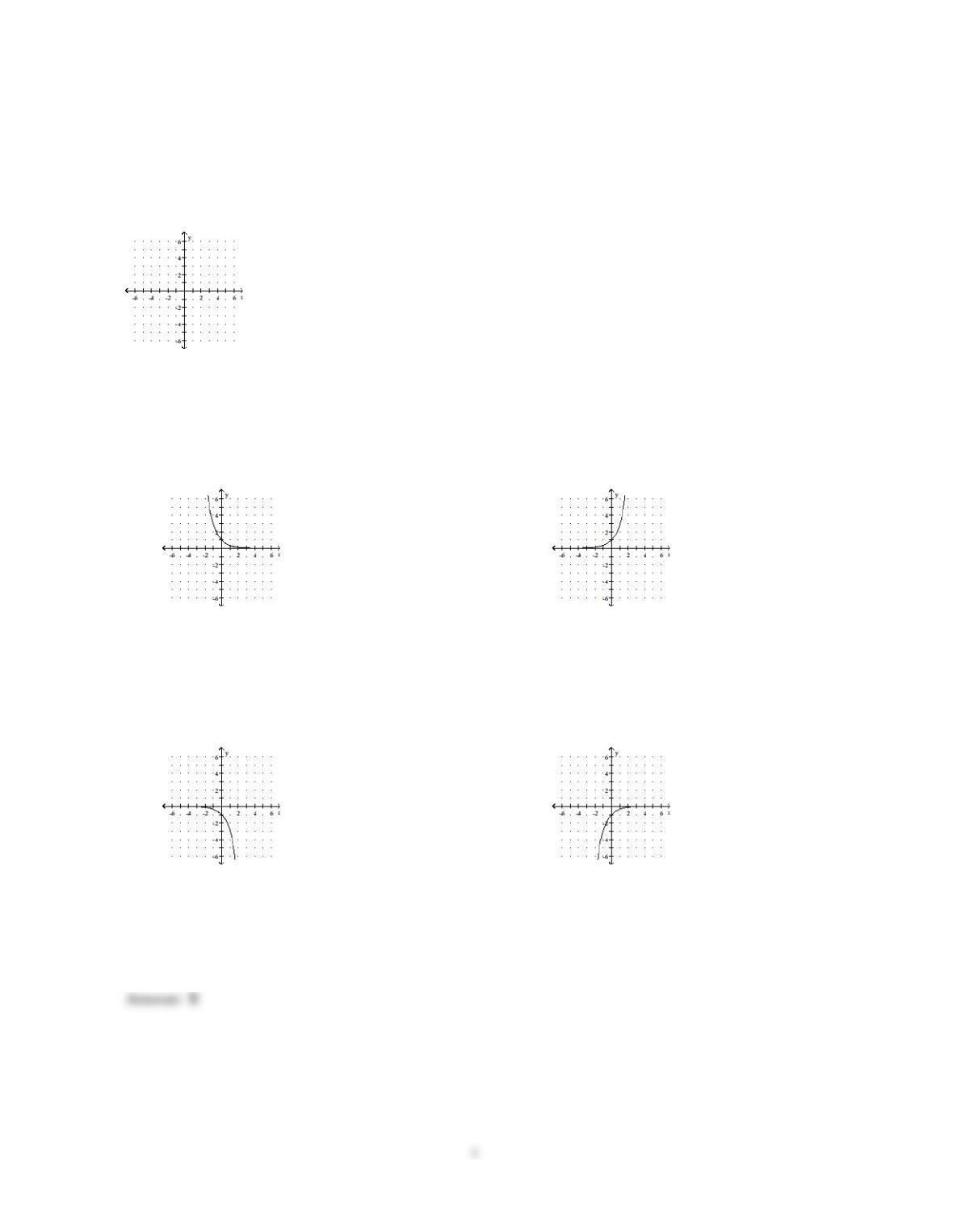
1)
f(x) =3x
A)
B)
C)
D)
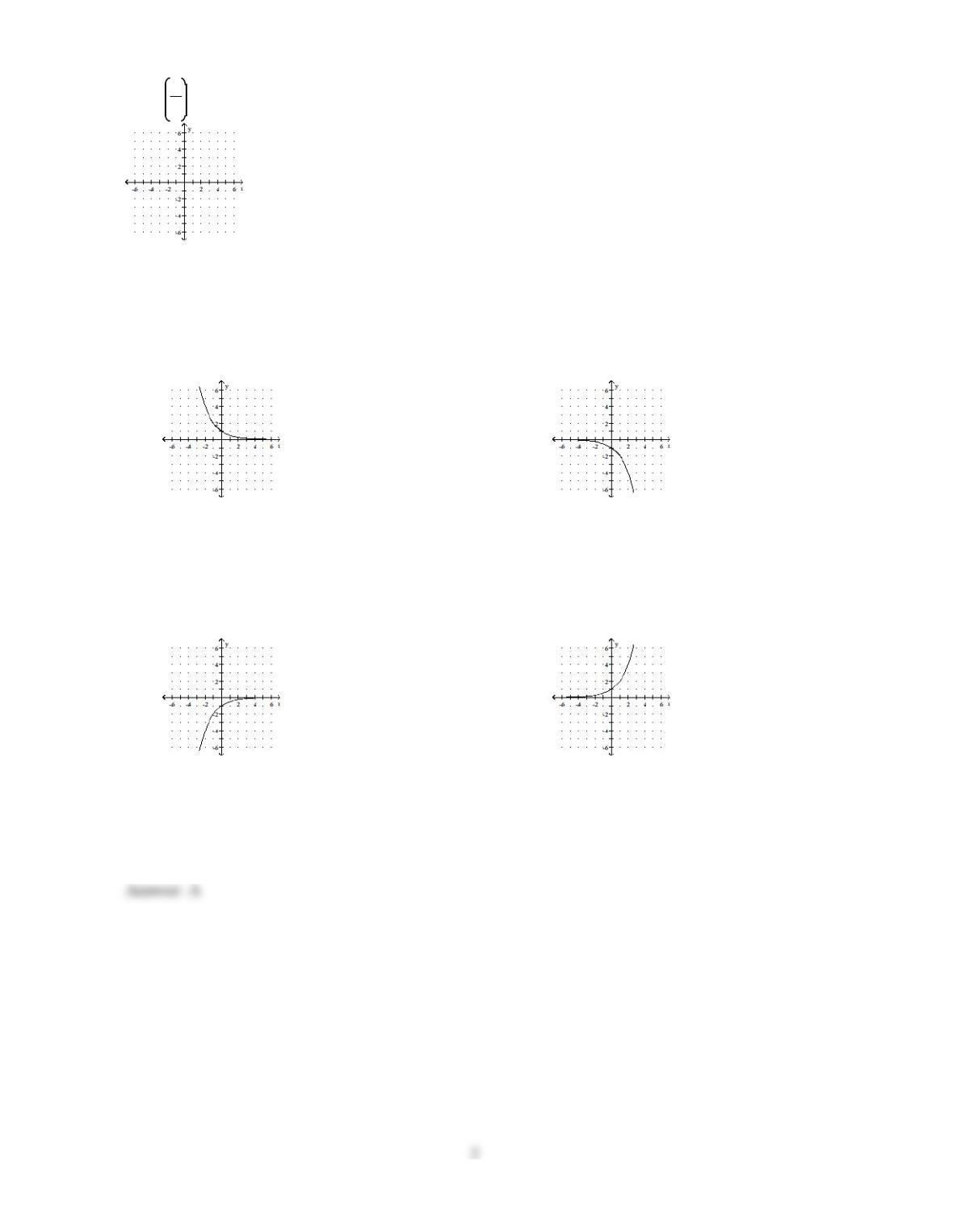
2)
f(x) =1
2
x
A)
B)
C)
D)
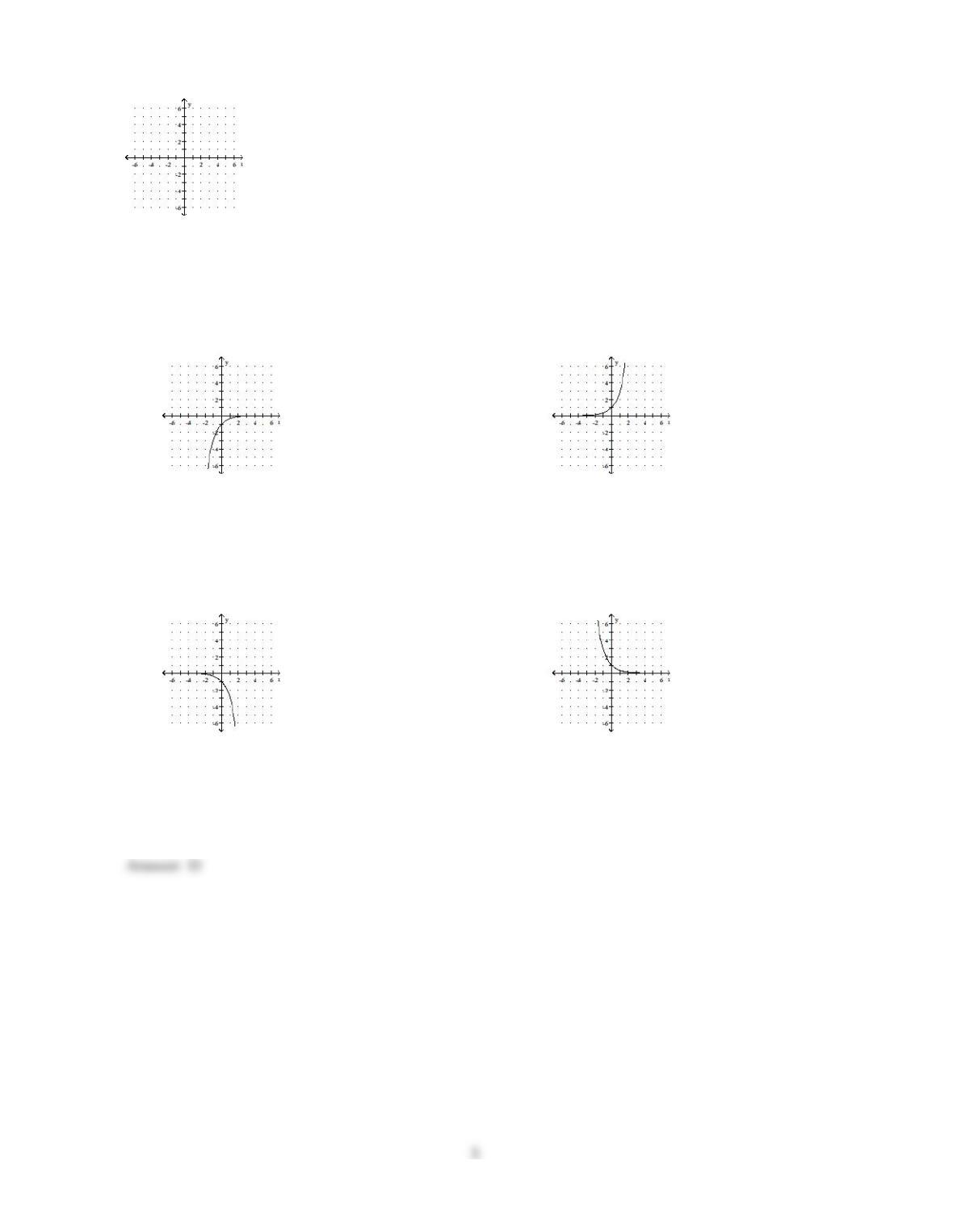
3)
f(x) =3–x
A)
B)
C)
D)
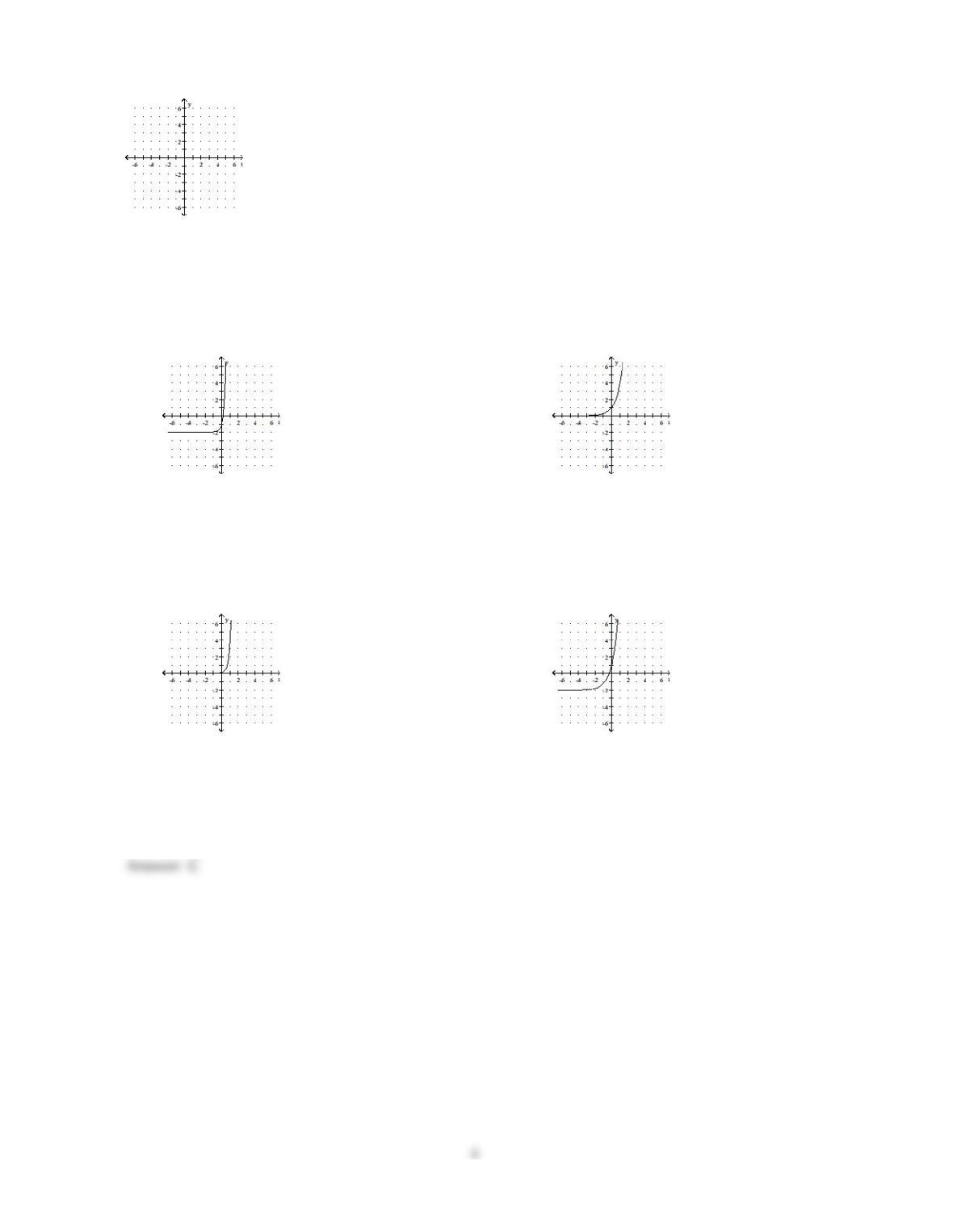
4)
f(x) =43x – 2
A)
B)
C)
D)
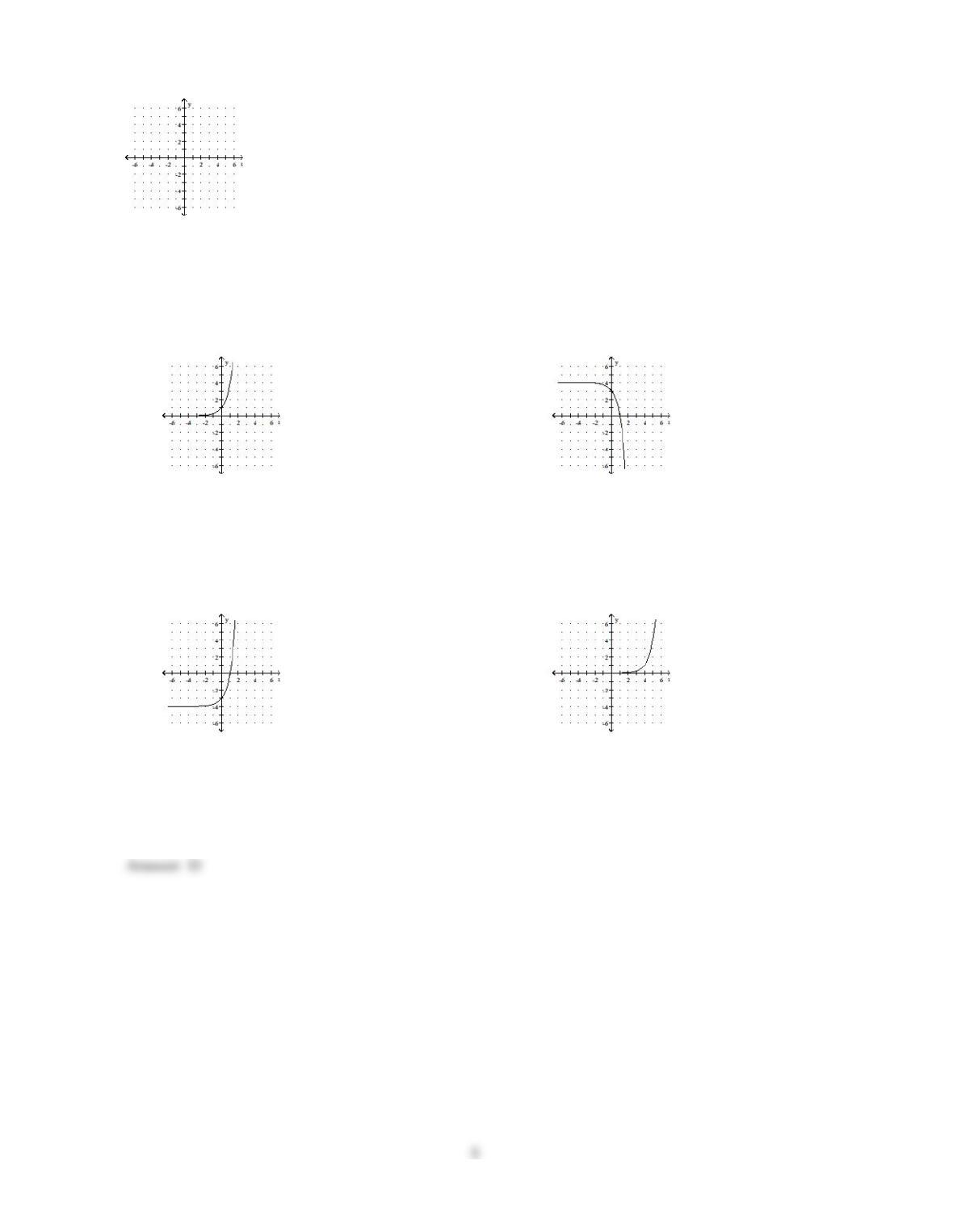
5)
f(x) =4x – 4
A)
B)
C)
D)
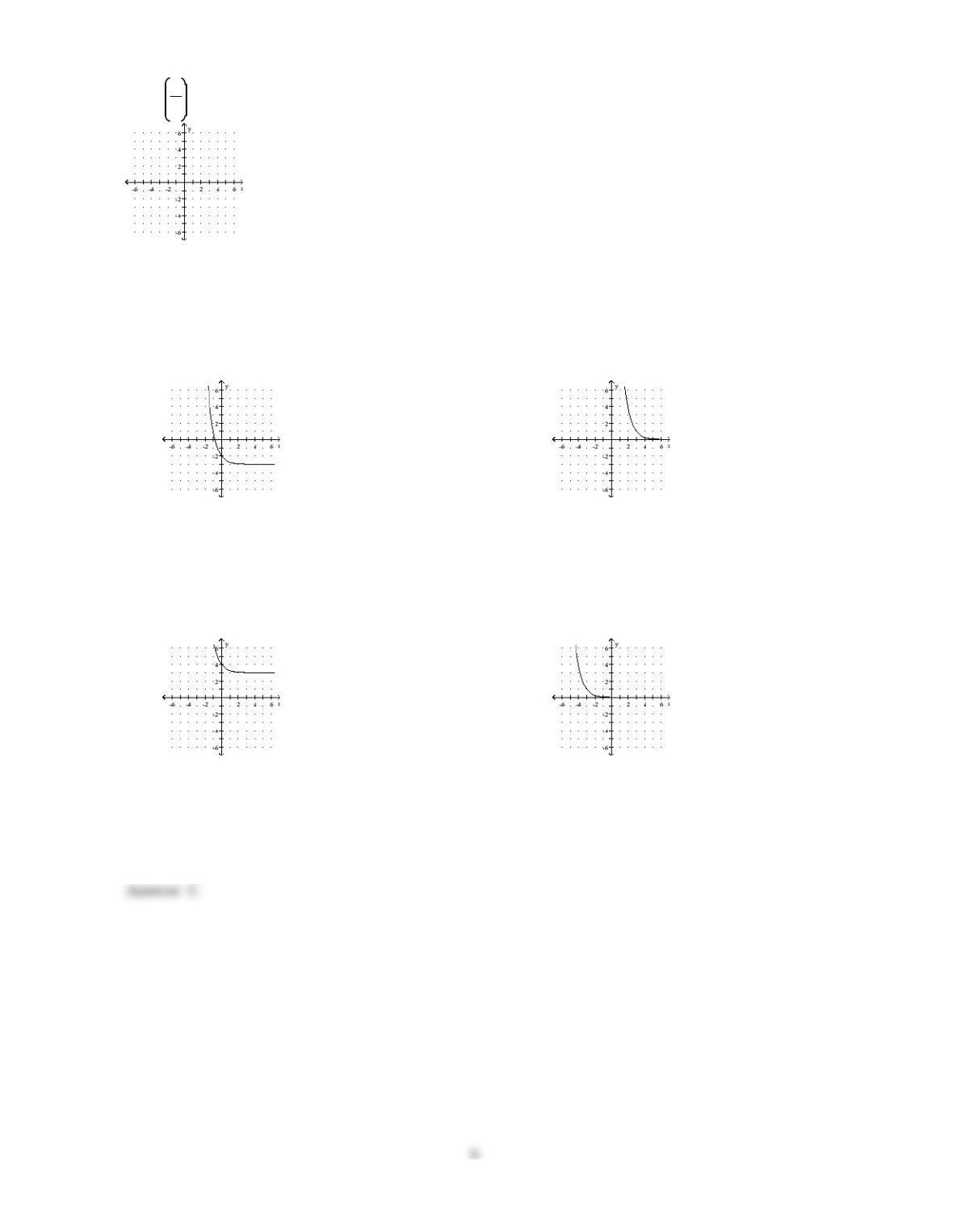
6)
f(x) =1
4
x + 3
A)
B)
C)
D)
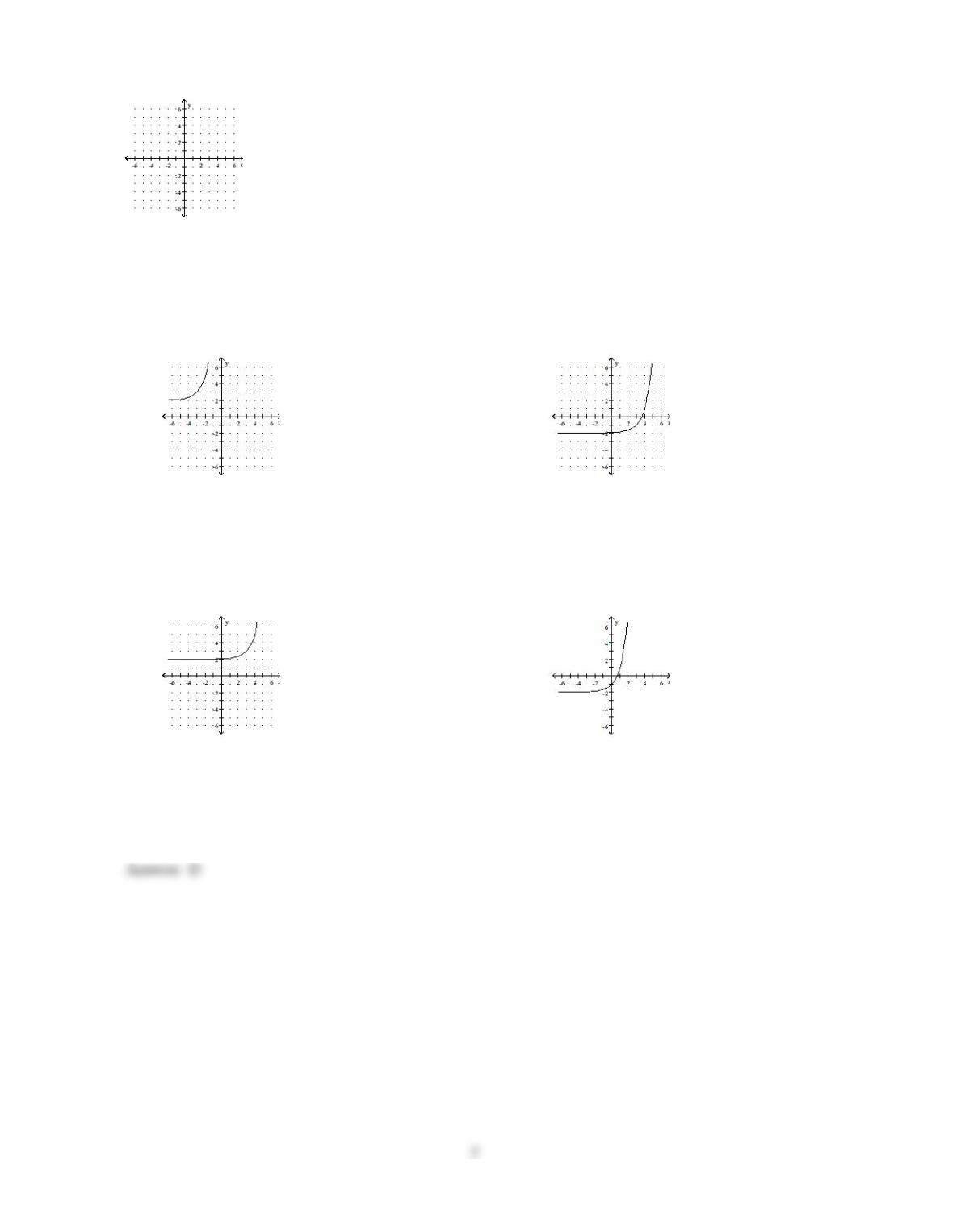
7)
f(x) =3x– 2
A)
B)
C)
D)
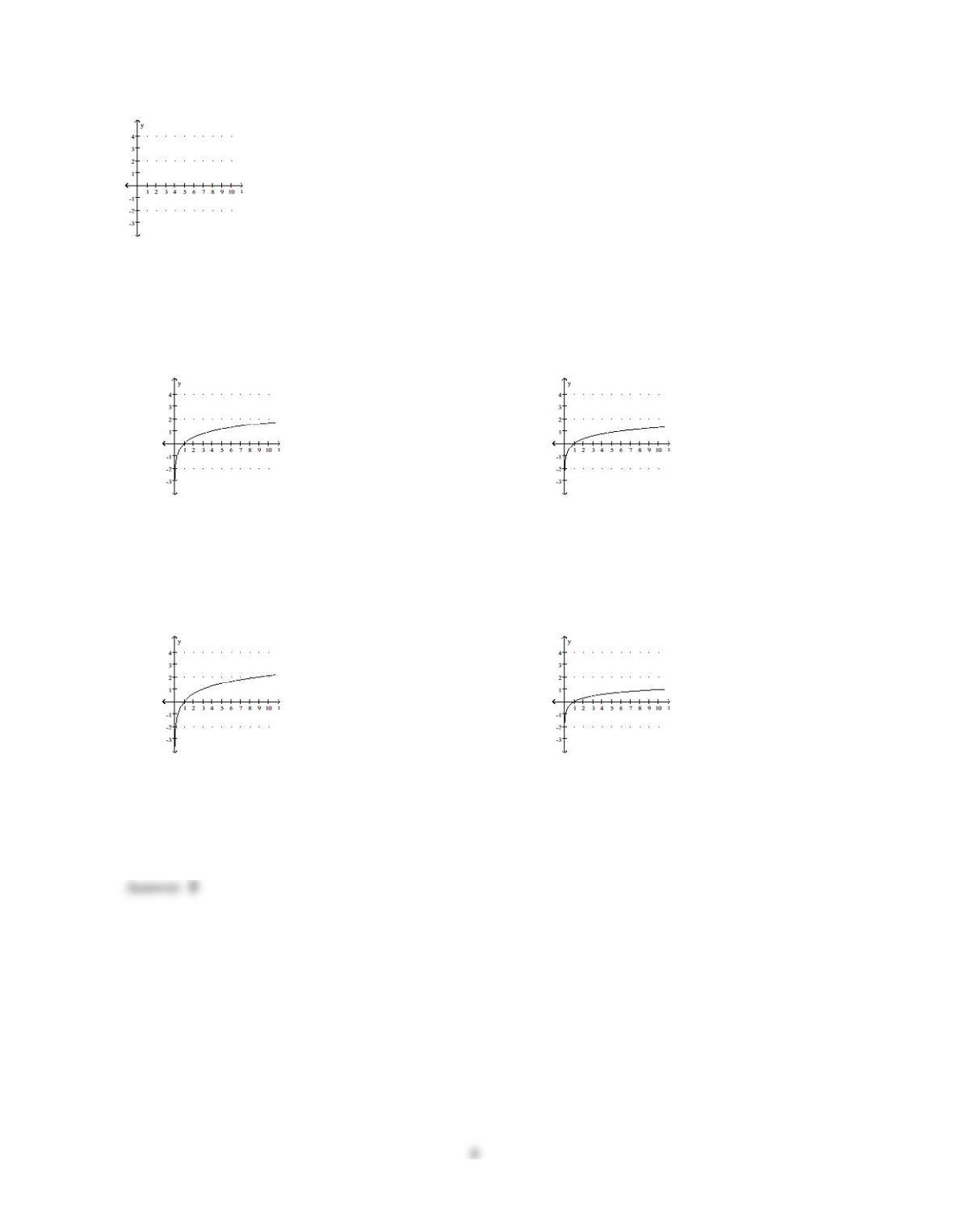
8)
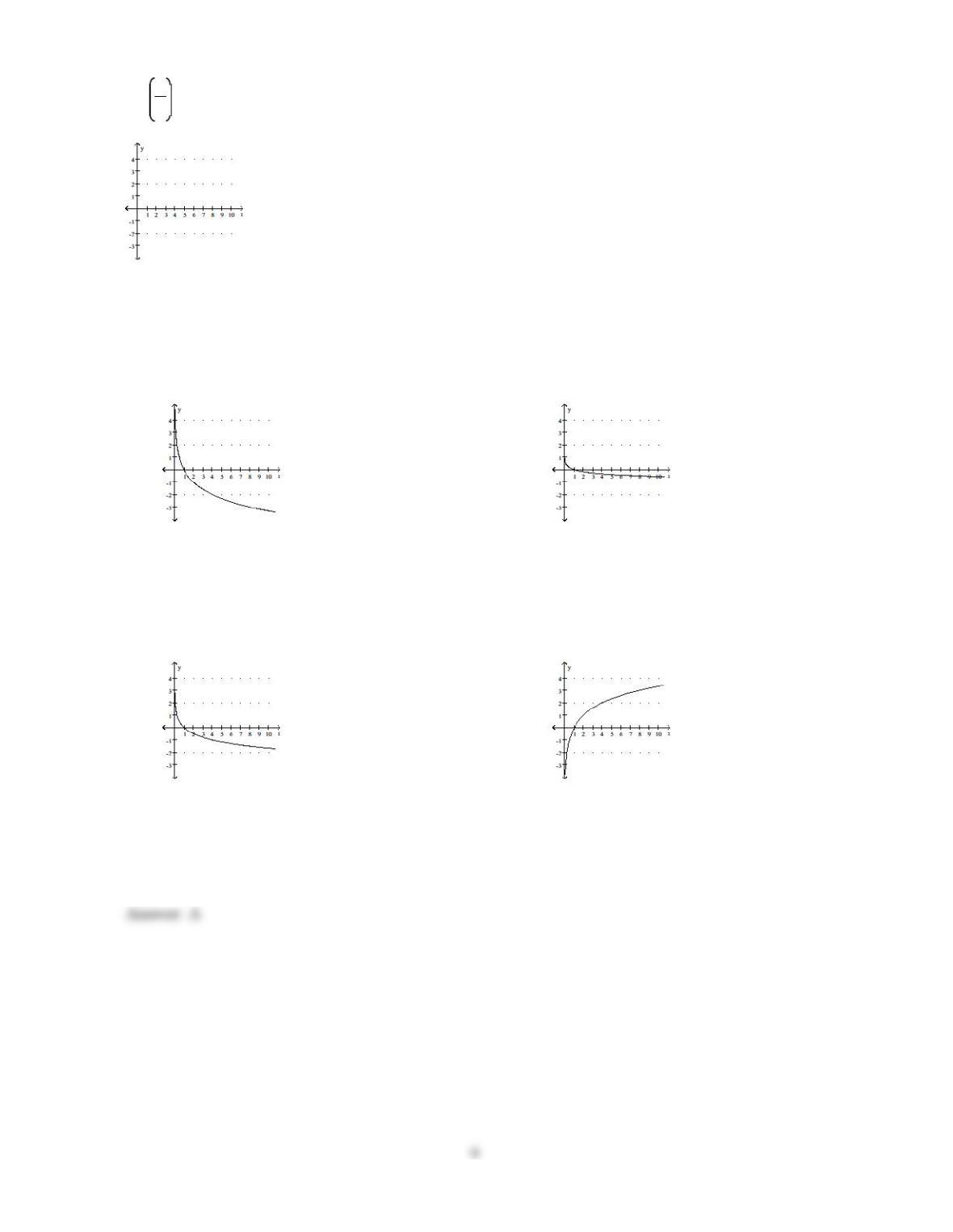
x =6y
A)
B)
C)
D)
9)
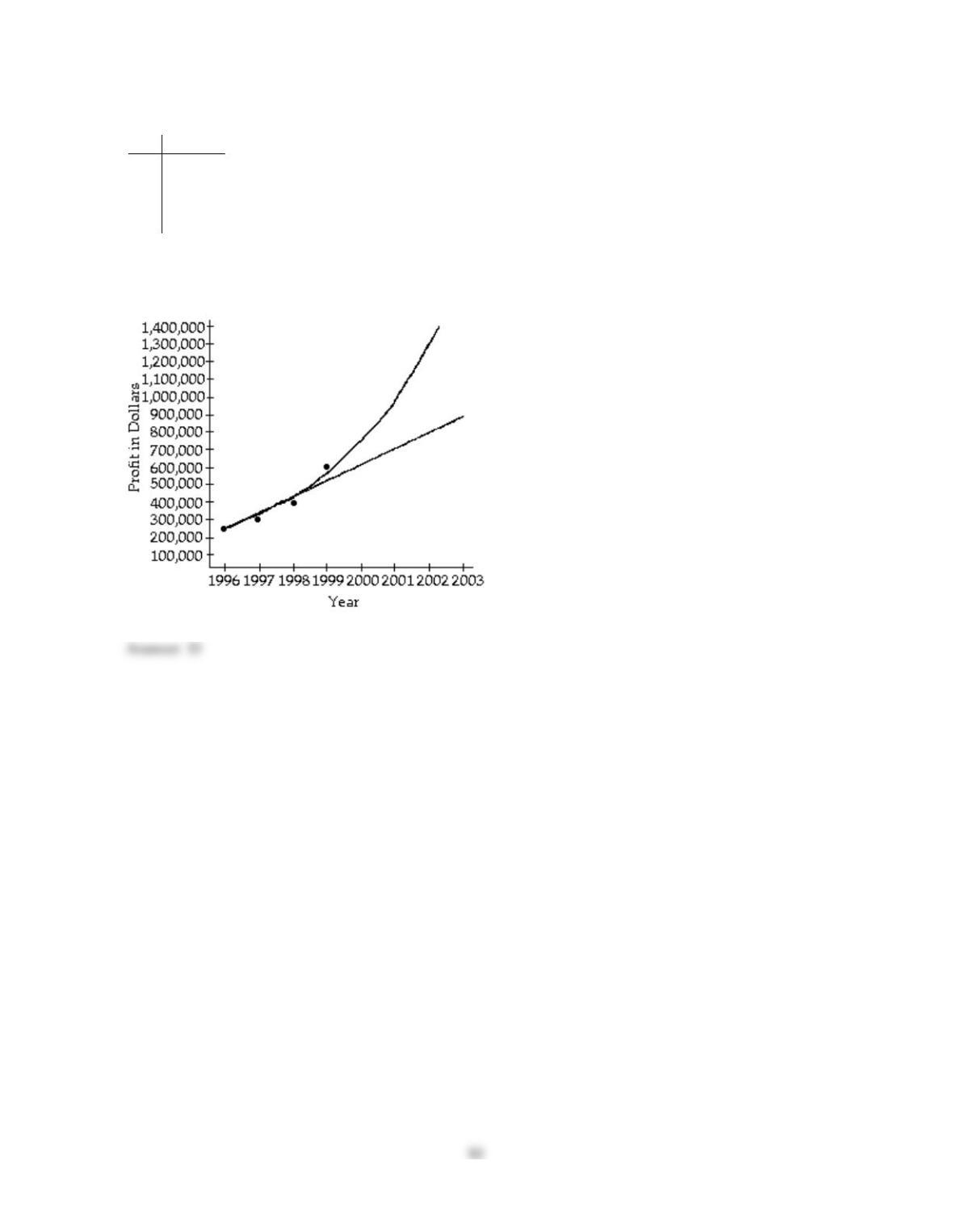
x =1
2
y
A)
B)
C)
D)
Solve the problem.
10)
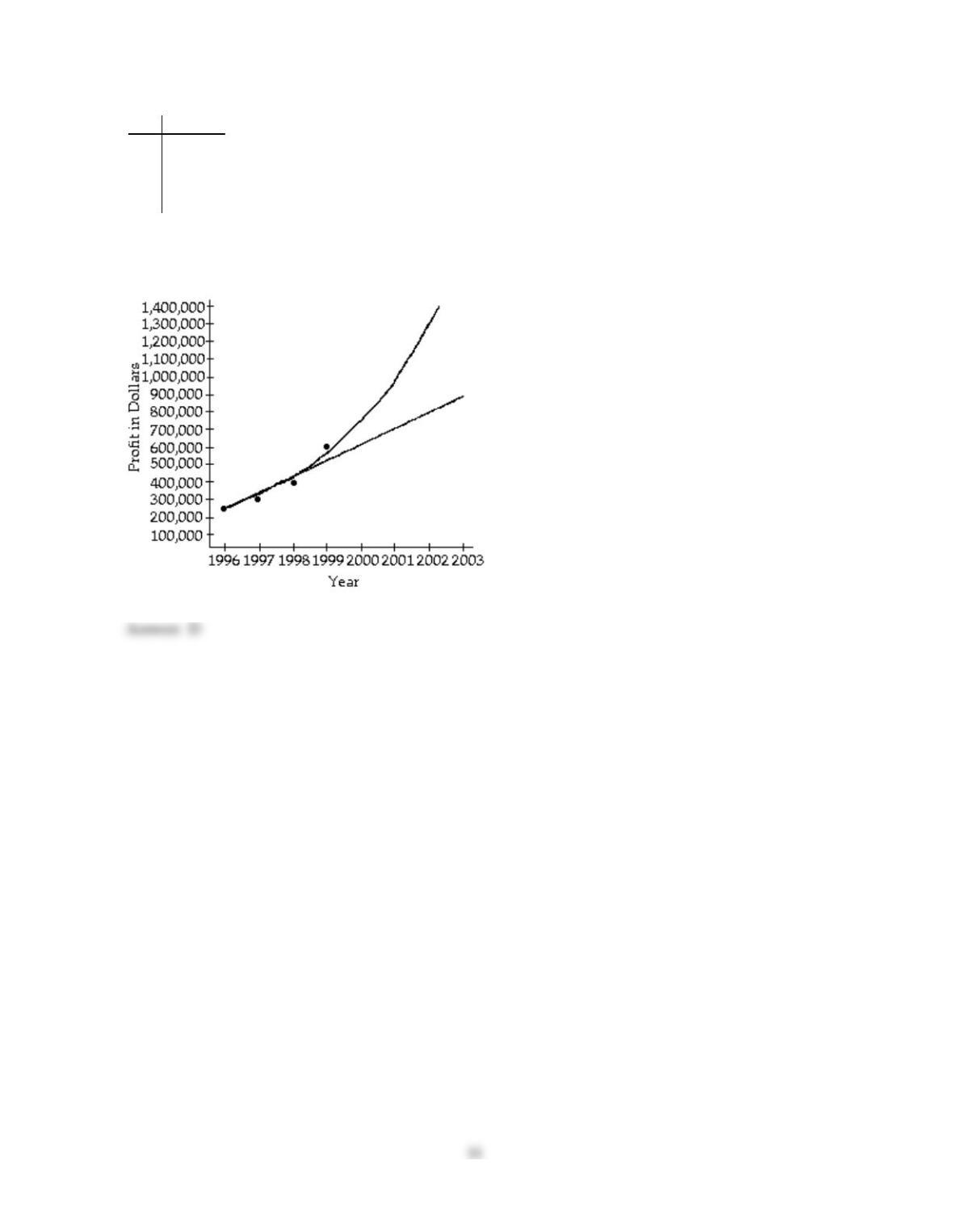
An accountant tabulated a firm’s profits for four recent years in the following table:
Year Profits
1996 $250,000
1997 $300,000
1998 $400,000
1999 $600,000
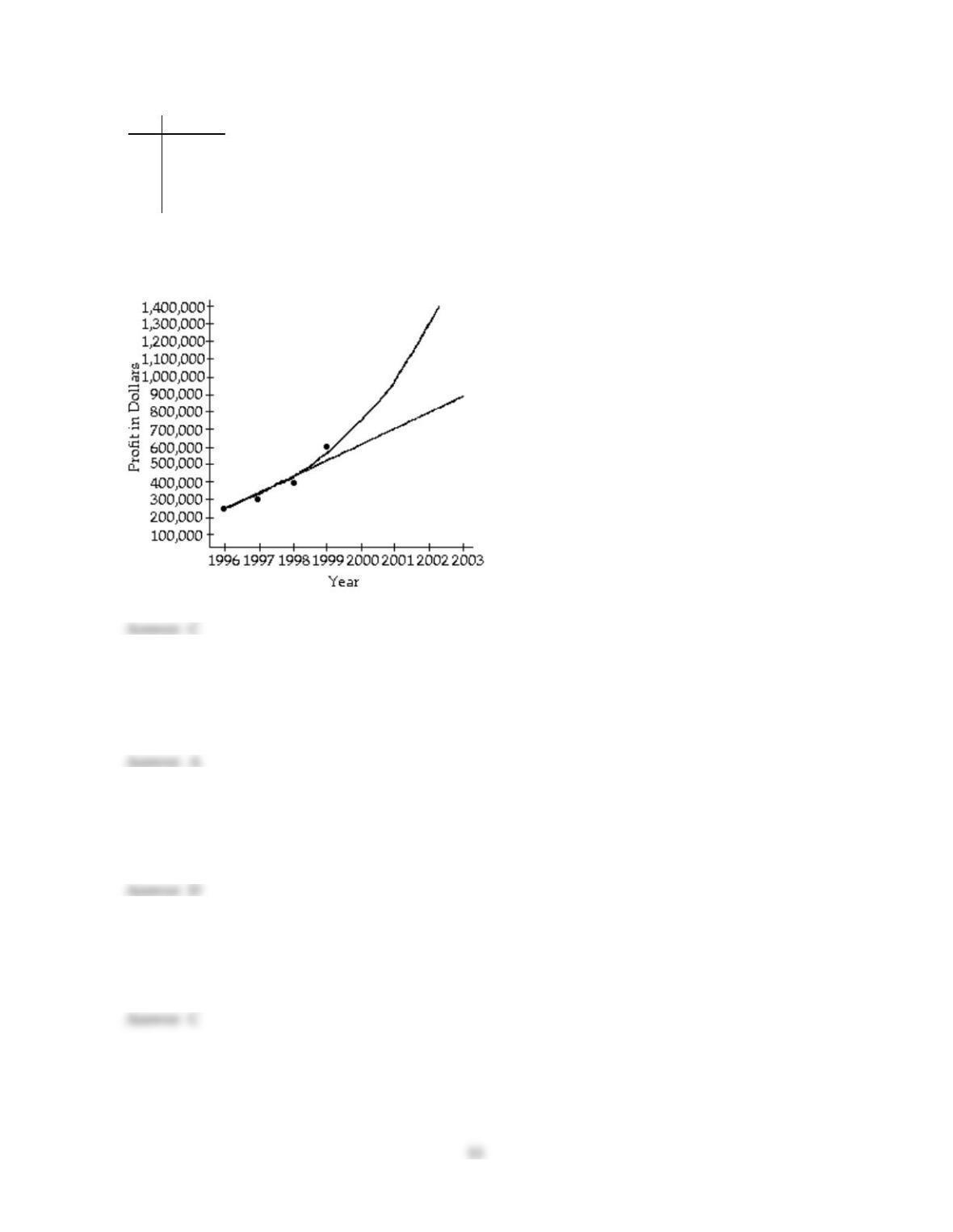
The accountant then fit both a linear graph and an exponential curve (seen below) to the data, in order to
estimate future profits. Use the linear graph to estimate the profits in the year 2001.
A)
About $500,000
B)
About $800,000
C)
About $900,000
D)
About $700,000
11)
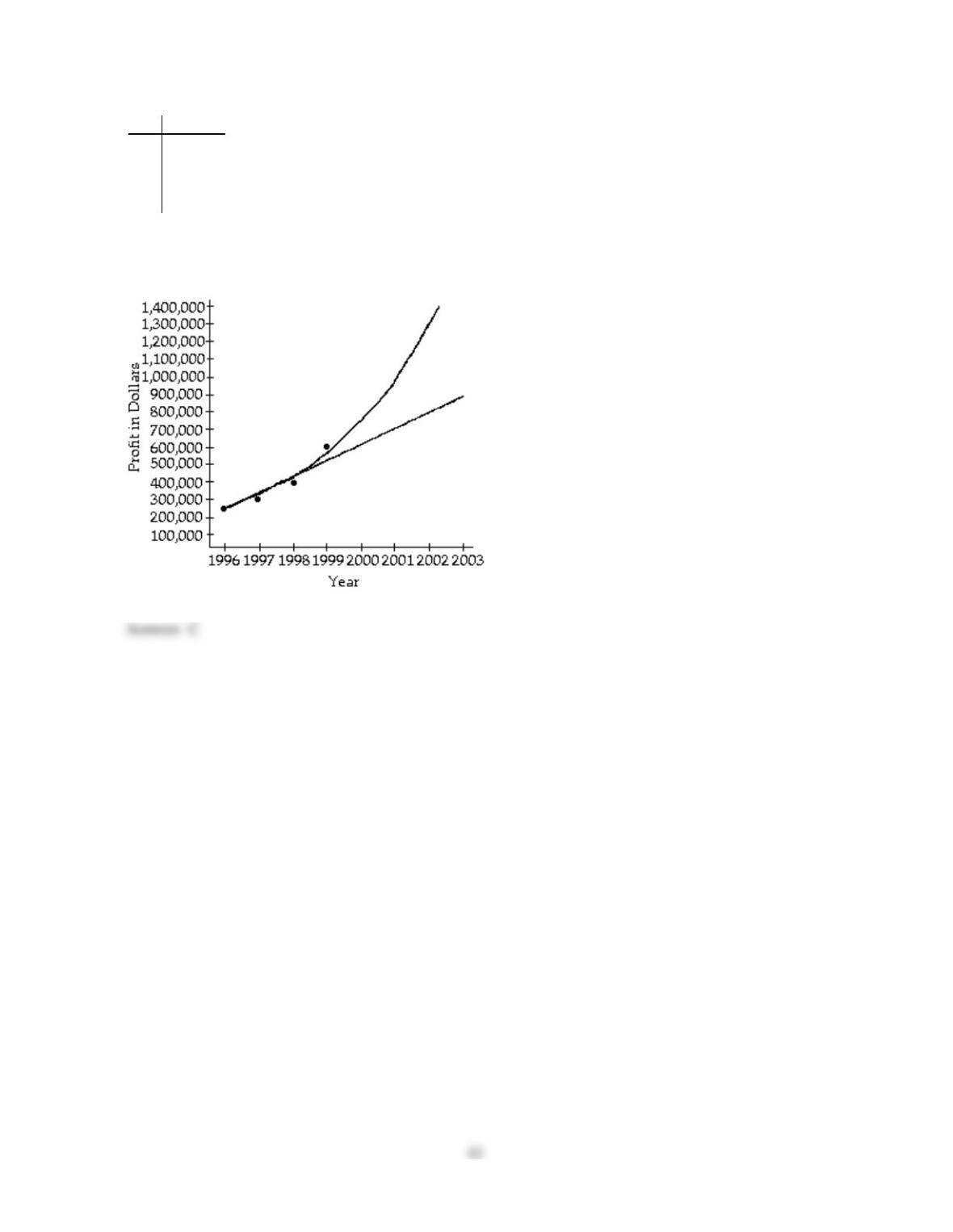
An accountant tabulated a firm’s profits for four recent years in the following table:
Year Profits
1996 $250,000
1997 $300,000
1998 $400,000
1999 $600,000
The accountant then fit both a linear graph and an exponential curve (seen below) to the data, in order to
estimate future profits. Use the exponential graph to estimate the profits in the year 2002.
A)
About $1,000,000
B)
About $1,700,000
C)
About $750,000
D)
About $1,300,000
12)
An accountant tabulated a firm’s profits for four recent years in the following table:
Year Profits
1996 $250,000
1997 $300,000
1998 $400,000
1999 $600,000
The accountant then fit both a linear graph and an exponential curve (seen below) to the data, in order to
estimate future profits. Use the linear graph to estimate the profits in the year 2002.
A)
About $500,000
B)
About $900,000
C)
About $800,000
D)
About $1,000,000
13)
An accountant tabulated a firm’s profits for four recent years in the following table:
Year Profits
1996 $250,000
1997 $300,000
1998 $400,000
1999 $600,000
The accountant then fit both a linear graph and an exponential curve (seen below) to the data, in order to
estimate future profits. Use the exponential graph to estimate the profits in the year 2001.
A)
About $1,300,000
B)
About $300,000
C)
About $1,000,000
D)
About $750,000
14)
Suppose that $90,000 is invested at 4% interest, compounded annually. Find a function A for the amount in the
account after t years.
A)
A(t) = $90,000(1.04)t
B)
A(t) = $90,000(0.04)t
C)
A(t) = $90,0000.04t
D)
A(t) = $90,0001.04t
15)
The amount of particulate matter left in solution during a filtering process decreases by the equation
P(n) =600(0.5)0.8n, where n is the number of filtering steps. Find the amounts left for n = 0 and n = 5. (Round to
the nearest whole number.)
A)
1200 ; 38
B)
600; 19
C)
600; 9600
D)
600; 38
16)
The number of dislocated electric impulses per cubic inch in a transformer increases when lightning strikes by
D(x) =4700(5)x, where x is the time in milliseconds of the lightning strike. Find the number of dislocated
impulses at x = 0 and x =3 .
A)
4700 ; 14,687,500
B)
4700 ; 70,500
C)
4700 ; 587,500
D)
23,500 ; 587,500
17)
The number of bacteria growing in an incubation culture increases with time according to B(x) =5300(2)x,
where x is time in days. Find the number of bacteria when x = 0 and x =5 .
A)
10,600 ; 169,600
B)
5300 ; 21,200
C)
5300 ; 169,600
D)
5300 ; 53,000
18)
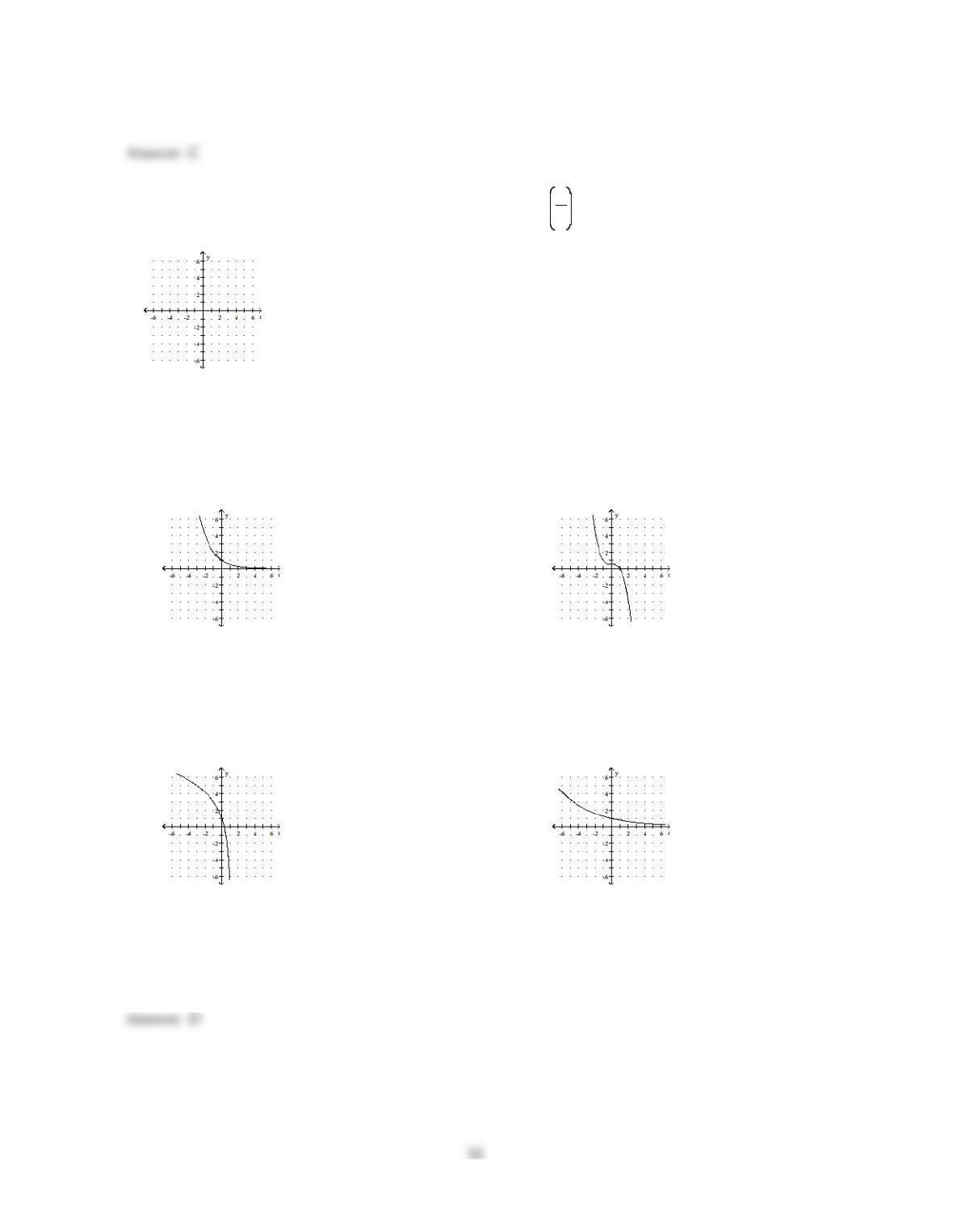
The half–life of Antimony 111 is 2.9 hours. If the formula P(t) =1
2
t/2.9 gives the percent (as a decimal)
remaining after time t (in hours), sketch P versus t.
A)
B)
C)
D)

19)
A computer is purchased for $4700. Its value each year is about 78% of the value the preceding year. Its value, in
dollars, after t years is given by the exponential function V(t) =4700(0.78)t. Find the value of the computer after
7 years.
A)
$643.95
B)
$502.28
C)
$825.58
D)
$25,662.00
20)
The half–life of a certain radioactive substance is 22 years. Suppose that at time t = 0, there are 24 g of the
substance. Then after t years, the number of grams of the substance remaining will be:
N(t) =24 1
2
t/44
How many grams of the substance will remain after 242 years? Round to the nearest hundredth when
necessary.
A)
0.53 g
B)
0.07 g
C)
0.27 g
D)
0.13 g
Find the requested composition of functions.
21)
Given f(x) =4x + 9 and g(x) =2x – 1, find f
g(x).
A)
8x + 8
B)
8x + 5
C)
8x + 17
D)
8x + 13
22)
Given f(x) =-2x + 8 and g(x) =4x + 7, find g
f(x).
A)
-8x + 39
B)
x – 39
C)
x + 39
D)
-8x + 22
23)
Given f(x) =x – 9
7 and g(x) =7x + 9, find g
f(x).
A)
x
B)
x + 18
C)
x –9
7
D)
7x + 54
24)
Given f(x) =5
x and g(x) =2x3, find g
f(x).
A)
2x3
125
B)
250
x3
C)
5
2x3
D)
2x3
5
25)
Given f(x) =6x2–4 and g(x) =5
x, find f
g(x).
A)
150
x–4
B)
150
x2–4
C)
30x –20
x
D)
5
6x2–4
26)
Given f(x) =2
x2 and g(x) = x –3, find g
f(x).
A)
-1
x2
B)
2
x2–3
C)
2
(x –3)2
D)
2
x2–3

27)
Given f(x) =x2+9 and g(x) =x2–9, find f
g(x).
A)
x4–18x2+72
B)
x4–18x2+90
C)
x4+18x2+72
D)
x4+18x2+90
Find f(x) and g(x) such that h(x) = (f
g)(x).
28)
h(x) =1
x2– 8
A)
f(x) =
1
x2, g(x) = – 1
8
B)
f(x) =1
8, g(x) = x2– 8
C)
f(x) =
1
x2, g(x) = x – 8
D)
f(x) =1
x, g(x) = x2– 8
29)
h(x) =
5x + 4
A)
f(x) = x, g(x) =5x + 4
B)
f(x) =–x
, g(x) =5x – 4
C)
f(x) =
x
, g(x) =5x + 4
D)
f(x) = –
x
, g(x) =5x + 4
30)
h(x) =1
x2+ 6
A)
f(x) =
1
x2, g(x) =6
B)
f(x) =1
x, g(x) =1
x+ 6
C)
f(x) = x, g(x) =1
x+ 6
D)
f(x) = x + 6, g(x) =
1
x2
31)
h(x) =8
5x + 4
A)
f(x) =8
x, g(x) =5x + 4
B)
f(x) =8, g(x) =5+ 4
C)
f(x) =8
x, g(x) =5x + 4
D)
f(x) =5x + 4, g(x) =8
32)
h(x) = (-8x – 9)6
A)
f(x) =-8x – 9, g(x) = x6
B)
f(x) = (-8x)6, g(x) =-9
C)
f(x) = x6, g(x) =-8x – 9
D)
f(x) =-8x6, g(x) = x – 9
33)
h(x) =-81x2+ 71
A)
f(x) =-81x + 71, g(x) = x2
B)
f(x) =x, g(x) =-81x2+ 71
C)
f(x) =-81x2, g(x) =71
D)
f(x) =-81x2+ 71, g(x) =x
16
34)
h(x) =6(3x +8)2–9
A)
f(x) =(6x –9)2, g(x) =3x +8
B)
f(x) =6x2–9, g(x) =(3x +8)2
C)
f(x) =3x +8, g(x) =6x2–9
D)
f(x) =6x2–9, g(x) =3x +8
35)
h(x) =x5–3
x5+2
A)
f(x) =x5+2, g(x) =x5–3
B)
f(x) =x5, g(x) =x –3
x +2
C)
f(x) =1
x5+2, g(x) =x5–3
D)
f(x) =x –3
x +2, g(x) =x5
36)
h(x) =( x –7)2
A)
f(x) =x2, g(x) =x–7
B)
f(x) =x–7, g(x) =x2
C)
f(x) =x2, g(x) = x –7
D)
f(x) =x, g(x) =(x –7)2
Find the inverse of the relation.
37)
{(10, -3), (-4, 20), (12, -20)}
A)
{(-3, 10), (20, -4), (-20, 12)}
B)
{(10, 20), (10, -4), (-20, 12)}
C)
{(-3, 10), (12, -4), (-20, 20)}
38)
{(2, 9), (-2, -9), (4, -7), (-4, 7)}
A)
{(9, 2), (-9, -2), (-7, -2), (7, -4)}
B)
{(9, 2), (2, -2), (-7, 4), (7, -4)}
C)
{(9, 2), (-9, -2), (-7, 4), (7, -4)}
39)
{(6, -6), (6, -5), (4, -4), (2, -3)}
A)
{(-6, 6), (-5, 6), (-4, 4), (-3, 2)}
B)
{(-5, -6), (-6, 4), (6, 6), (-5, -4)}
C)
{(-5, -6), (-3, 4), (6, 4), (-5, -4)}
40)
{(-6, 2), (–2, 6), (9, -2), (-9, 2)}
A)
{(2, -6), (6, –2), (-2, 9), (2, -9)}
B)
{(2, 9), (9, –2), (2, -6), (-2, -9)}
C)
{(2, 9), (6, –2), (2, –2), (-2, -9)}
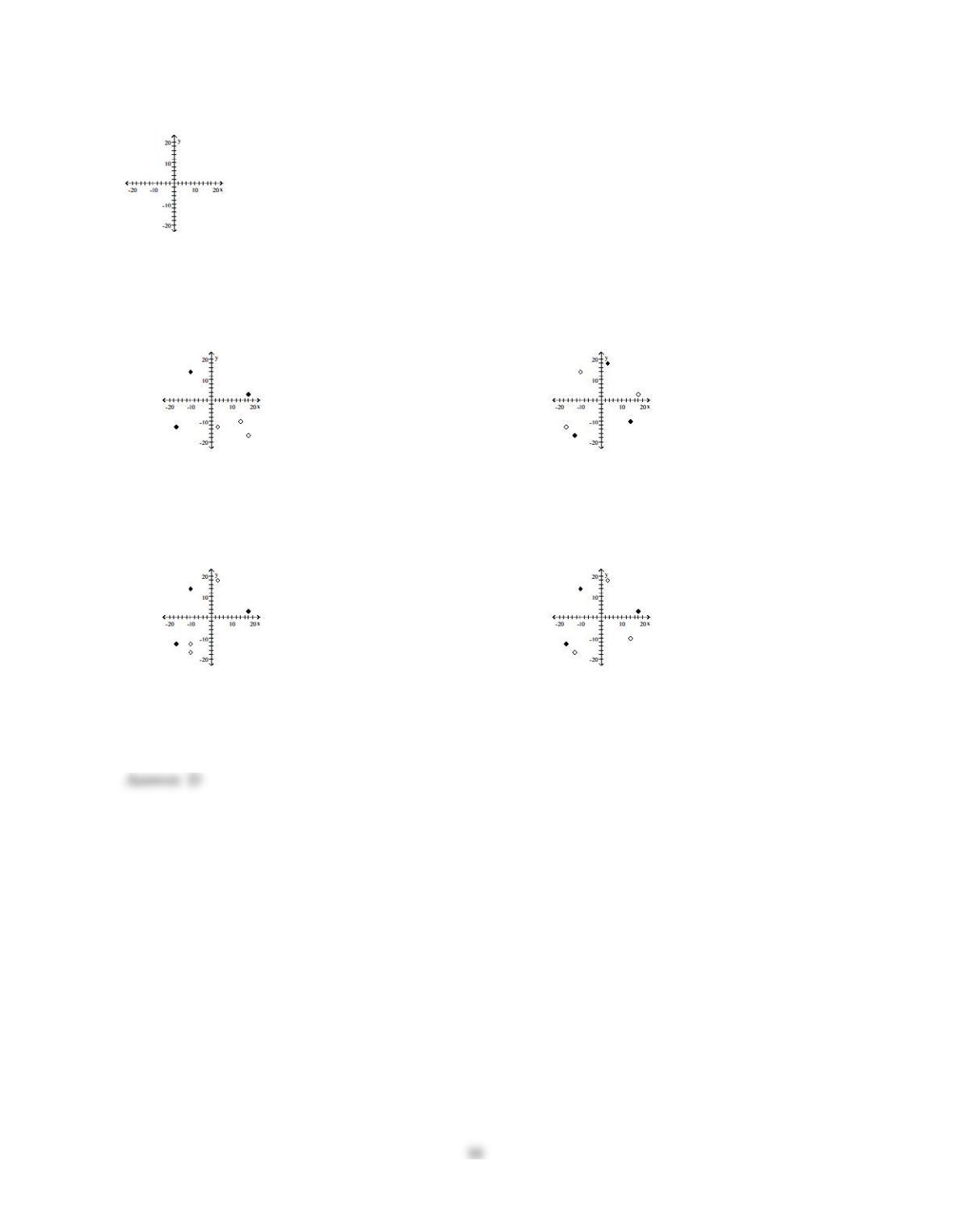
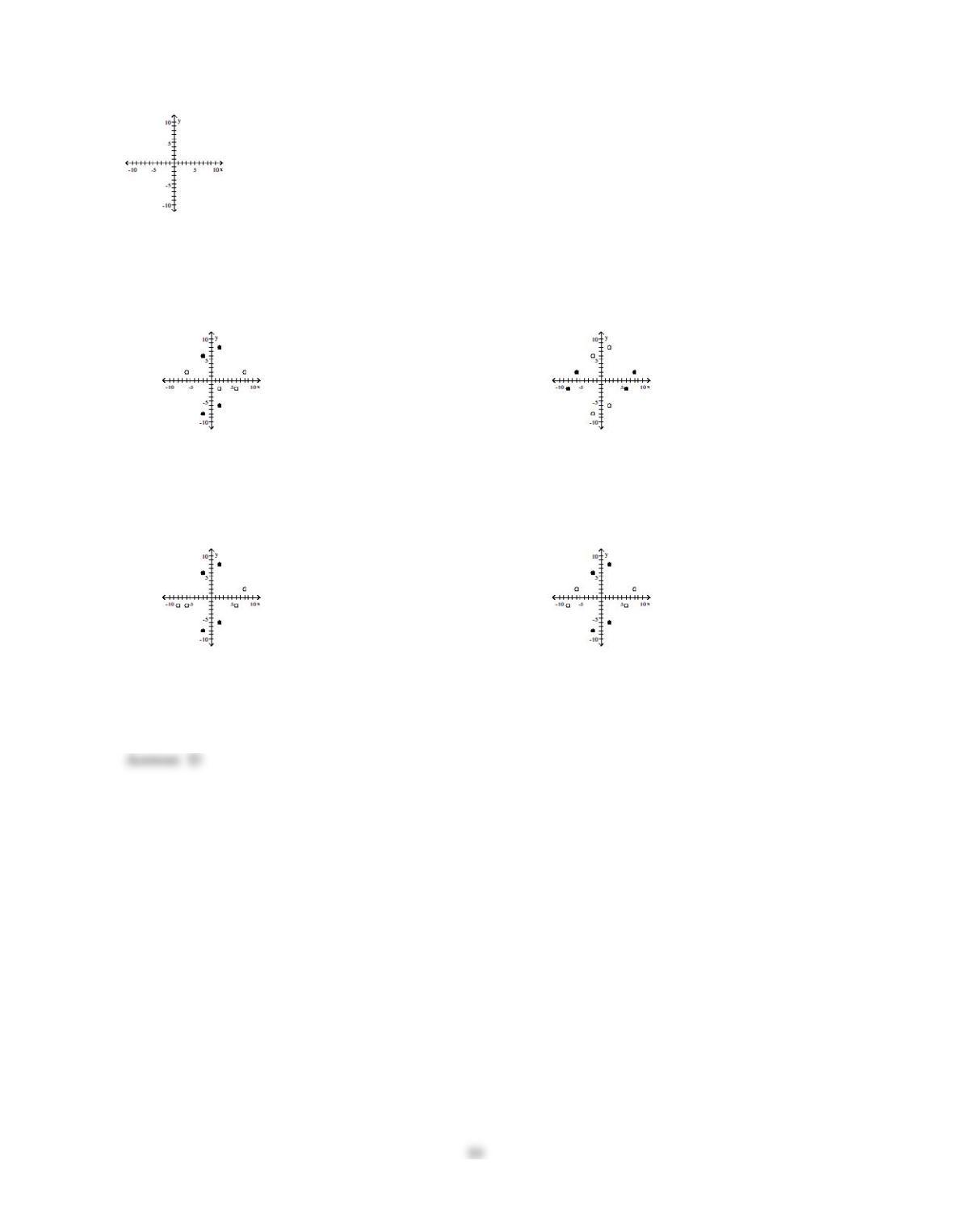
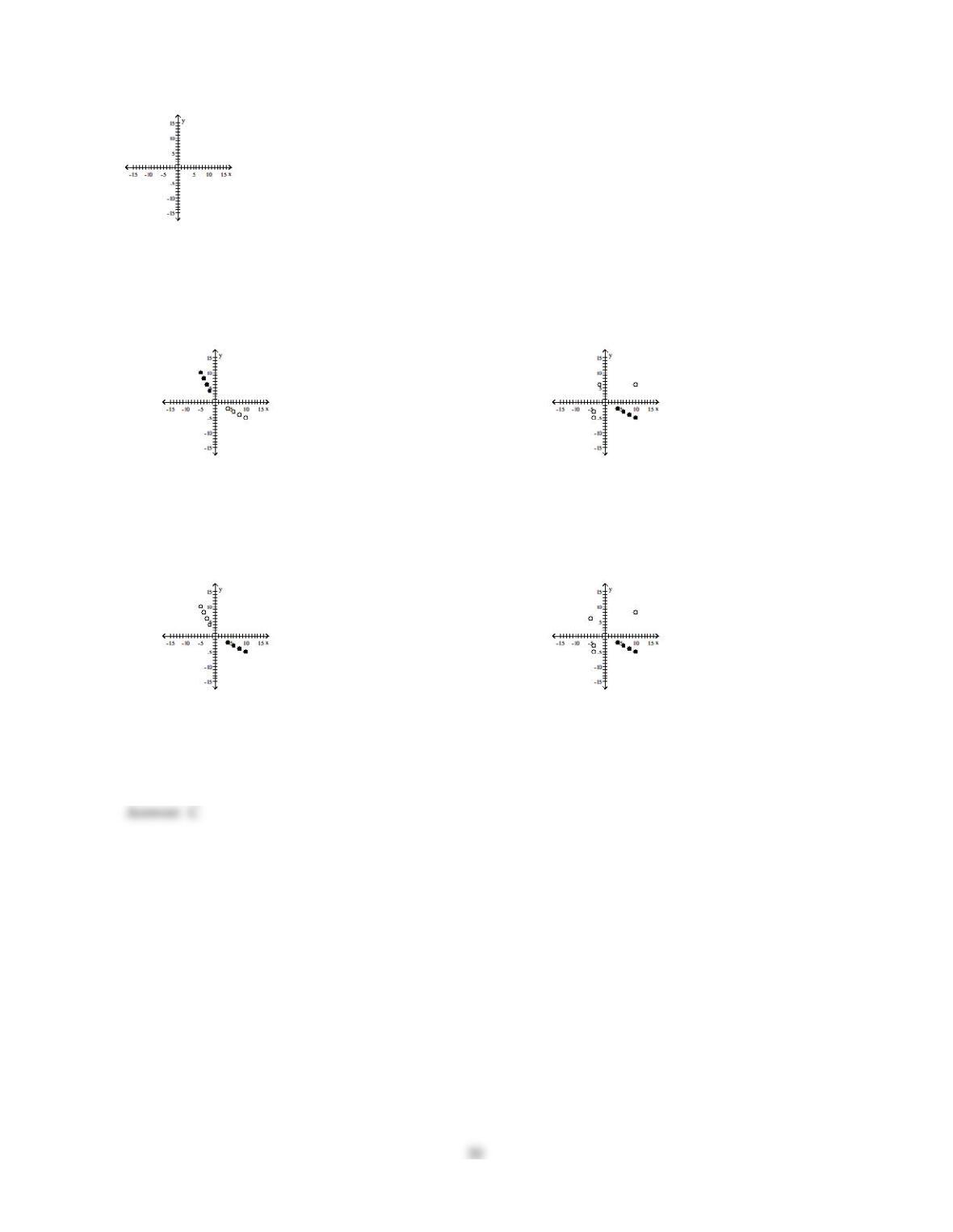
Graph the relation using solid circles and the inverse using open circles.
41)
{(-10, 14), (-17, -13), (18, 3)}
A)
B)
C)
D)
42)
{(2, 8), (-2, -8), (2, -6), (-2, 6)}
A)
B)
C)
D)
43)
{(10, -5), (8, -4), (6, -3), (4, -2)}
A)
B)
C)
D)