Provide an appropriate response.
68)
^
You are planning to use a sample proportion p to estimate a population proportion, p.
A sample size of 100 and a confidence level of 95% yielded a margin of error of 0.025. Which of the
following will result in a larger margin of error?
A: Increasing the sample size while keeping the same confidence level
B: Decreasing the sample size while keeping the same confidence level
C: Increasing the confidence level while keeping the same sample size
D: Decreasing the confidence level while keeping the same sample size
68)
A)
A and C
B)
B and C
C)
A and D
D)
B and D
69)
^ ^ ^
^
Suppose that you wish to estimate a population proportion and want to determine a sample size
that will ensure a given margin of error for a 95% confidence interval. Suppose further that an
educated guess is not available for p and that 0.25 is used for the value of p (1–p) when
determining the sample size. True or false, if the observed value of p is not equal to 0.5, then the
sample size will be larger than necessary?
69)
A)
True
B)
False
Use the two–proportions z–interval procedure to obtain the required confidence interval for the difference between two
population proportions. Assume that independent simple random samples have been selected from the two populations.
70)
The U.S. Department of Labor and Statistics wanted to compare the results of an unemployment
program for the past two months in the U.S. Two months ago, 7420 people out of a random sample
of 143,000 were unemployed. Last month, 7242 people out of a random sample of 142,000 were
unemployed. Construct a 99% confidence interval for the difference between the unemployment
rates two months ago and last month.
70)
A)
–0.0012 to 0.0030
B)
–0.0010 to 0.0028
C)
–0.0007 to 0.0025
D)
–0.0005 to 0.0022
Find the P–value for the indicated hypothesis test.
71)
An article in a journal reports that 34% of American fathers take no responsibility for child care. A
researcher claims that the figure is higher for fathers in the town of Littleton. A random sample of
225 fathers from Littleton, yielded 97 who did not help with child care. Find the P–value for a test
of the researcher’s claim.
71)
A)
0.0038
B)
0.0015
C)
0.0019
D)
0.0529
Use the two–proportions z–interval procedure to obtain the required confidence interval for the difference between two
population proportions. Assume that independent simple random samples have been selected from the two populations.
72)
In a random sample of 500 people aged 20–24, 22% were smokers. In a random sample of 450
people aged 25–29, 14% were smokers. Construct a 95% confidence interval for the difference
between the proportions of 20–24 year olds and 25–29 year olds who are smokers.
72)
A)
0.048 to 0.112
B)
0.025 to 0.135
C)
0.035 to 0.125
D)
0.032 to 0.128
^
Find the required sample size without making a guess for the observed value of p.
73)
A pollster wishes to estimate the proportion of U.S. voters that oppose capital punishment. Obtain
a sample size that will ensure a margin of error of at most 0.08 for a 99% confidence interval.
73)
A)
1037
B)
259
C)
260
D)
21
Use the one–proportion z–test to perform the specified hypothesis test. Use the critical–value approach.
74)
x =19, n = 100, H0: p =0.15, Ha: p 0.15, = 0.01
74)
A)
z =0.694; critical values = ±2.33; reject H0
B)
z =1.120; critical values = ±2.33; do not reject H0
C)
z =0.694; critical values = ±2.575; do not reject H0
D)
z =1.120; critical values = ±2.575; do not reject H0
Provide an appropriate response.
75)
^
^
Suppose that you wish to estimate a population proportion and want to determine a sample size
that will ensure a given margin of error for a 95% confidence interval. Suppose further that an
educated guess of 0.3 is used for p when determining the sample size. What values of the observed
value of p will yield a larger margin of error than the one specified?
75)
A)
^
p< 0.3
B)
^
0.3 <p< 0.5
C)
^
p> 0.3
D)
^
0.3 <p< 0.7
76)
A population proportion is to be estimated and a 95% degree of confidence is desired. In general, if
one wishes to decrease the margin of error by a factor of 2 (for example from E =0.02 to 0.01), how
will the necessary sample size change?
76)
A)
It will increase by a factor of 4
B)
It will increase by a factor of 2
C)
It will decrease by a factor of 2
D)
It will decrease by a factor of 4
The number of successes and the sample size are given for a simple random sample from a population. Use the
one–proportion z–interval procedure to find the required confidence interval.
77)
n =194, x =122; 95% level
77)
A)
0.575 to 0.683
B)
0.561 to 0.697
C)
0.574 to 0.684
D)
0.560 to 0.698
^
Find the required sample size without making a guess for the observed value of p.
78)
A computer manufacturer wishes to estimate what proportion of their laptop computers are
defective. Obtain a sample size that will ensure a margin of error of at most 2.8 percentage points
for a 99% confidence interval.
78)
A)
2115
B)
529
C)
60
D)
8458
Use the one–proportion z–test to perform the specified hypothesis test. Use the critical–value approach.
79)
x =36, n =152, H0: p = 0.11, Ha: p 0.11, = 0.05
79)
A)
z = 1.36; critical values = ±1.96; do not reject H0
B)
z =5.00.; critical values = ±1.645; reject H0
C)
z =5.00.; critical values = ±1.96; reject H0
D)
z = 1.36.; critical values = ±1.645; do not reject H0
Assume that you wish to estimate a population proportion, p. For the given margin of error and confidence level,
determine the sample size required.
80)
A researcher wishes to estimate the proportion of people within a certain population who are HIV
positive. Obtain a sample size that will ensure a margin of error of at most 4.3 percentage points
for a 95% confidence interval. Assume that it is reasonable to presume that the percentage of those
sampled who are HIV positive will be between 3% and 7%.
80)
A)
136
B)
61
C)
520
D)
146
The numbers of successes and the sample sizes are given for independent simple random samples from two populations.
Decide whether using the two–proportions z–procedures is appropriate.
81)
x1= 25, n1=80, x2= 14, n2=40
81)
A)
Not appropriate
B)
Appropriate
^
A hypothesis test is to be performed for a population proportion. For the given sample data and null hypothesis, compute
the value of the test statistic, z =
p–p0
p0(1 –p0)/n
82)
A drug company claims that over 80% of all physicians recommend their drug. 1200 physicians
were asked if they recommend the drug to their patients. 36% said yes. H0: p =0.8.
82)
A)
–34.294
B)
–49.536
C)
–38.105
D)
–76.210
Find the P–value for the indicated hypothesis test.
83)
Find the P–value for a test of the claim that more than 50% of adults that follow a particular diet
will experience increased energy. Of 100 randomly selected subjects who followed the diet, 47
noticed an increase in their energy level.
83)
A)
0.2257
B)
0.2743
C)
0.7257
D)
0.5486
Use the one–proportion z–test to perform the specified hypothesis test. Use the critical–value approach.
84)
x =630, n =1000, H0: p = 0.5, Ha: p > 0.5, = 0.05
84)
A)
z =6.167; critical value = 1.96; do not reject H0
B)
z =8.222; critical value = 1.645; reject H0
C)
z =6.167; critical value = 1.645; reject H0
D)
z =8.222; critical value = 1.96; reject H0
A two–proportions z–test is to be performed. The null hypothesis is H0: p1=p2 . For the given sample data compute the
value of the test statistic.
85)
A report on the nightly news broadcast stated that 10 out of 121 households with pet dogs were
burglarized and 23 out of 198 without pet dogs were burglarized.
85)
A)
z = – 1.622
B)
z = – 0.002
C)
z = – 0.382
D)
z = – 0.954
The number of successes and the sample size are given for a simple random sample from a population. Decide whether
using the one–proportion z–interval procedure is appropriate.
86)
x =36, n =40
86)
A)
Appropriate
B)
Not appropriate
Provide an appropriate response.
87)
A researcher wants to obtain a confidence interval for the difference between the proportions of
women and men who approve of the mayor’s performance. Obtain a common sample size that will
ensure a margin of error of at most 0.05 for a 95% confidence interval, if you can reasonably
presume that at most 47% of men and between 55% and 60% of women approve of the mayor’s
performance.
87)
A)
769
B)
753
C)
752
D)
764
Use the two–proportions z–interval procedure to obtain the required confidence interval for the difference between two
population proportions. Assume that independent simple random samples have been selected from the two populations.
88)
A state university found that it retained 25 students out of 352 in 2003 and 26 students out of 334 in
2004. Construct a 90% confidence interval for the difference in the proportions of students retained
in 2003 and 2004.
88)
A)
–0.0461 to 0.0325
B)
–0.0398 to 0.0262
C)
–0.0585 to 0.0449
D)
–0.0535 to 0.0398
Find the indicated margin of error.
89)
In a sample of 1342 patients who underwent a certain type of surgery, 210 experienced
complications.
Find the margin of error for the 99% confidence interval used to estimate the percentage of all
patients undergoing this surgery who experience complications. Give your answer as a percentage.
89)
A)
2.81%
B)
1.59%
C)
2.55%
D)
0.992%
90)
In a clinical test with 2097 subjects, 1191 showed improvement from the treatment. Find the margin
of error for the 95% confidence interval used to estimate the population proportion.
90)
A)
0.0237
B)
0.0212
C)
0.0286
D)
0.0180
^
The number of successes and the sample size are given for a simple random sample from a population. Determine the
sample proportion, p.
91)
x =141, n = 200
91)
A)
^
p=0.665
B)
^
p=0.716
C)
^
p=0.696
D)
^
p=0.705
Assume that you wish to estimate a population proportion, p. For the given margin of error and confidence level,
determine the sample size required.
92)
You wish to estimate the proportion of shoppers that use credit cards. Obtain a sample size that
will ensure a margin of error of at most 0.01 for a 95% confidence interval. It is deemed reasonable
to presume that of those sampled, the percentage using credit cards will be at least 70%.
92)
A)
8068
B)
26,891
C)
13,925
D)
7261
^
The number of successes and the sample size are given for a simple random sample from a population. Determine the
sample proportion, p.
93)
x =13, n = 16
93)
A)
^
p=0.8225
B)
^
p=0.813
C)
^
p=0.7125
D)
^
p=0.8125
The number of successes and the sample size are given for a simple random sample from a population. Decide whether
using the one–proportion z–test is appropriate.
94)
x = 7, n = 260, H0: p = 0.04, Ha: p 0.04
94)
A)
Not appropriate
B)
Appropriate
Use the one–proportion z–interval procedure to find the required confidence interval.
95)
A study involves 660 randomly selected deaths, with 30 of them caused by accidents. Construct a
98% confidence interval for the percentage of all deaths that are caused by accidents.
95)
A)
2.96% to 6.13%
B)
2.66% to 6.43%
C)
3.21% to 5.88%
D)
2.45% to 6.64%
^
The number of successes and the sample size are given for a simple random sample from a population. Determine the
sample proportion, p.
96)
x =17, n = 40
96)
A)
^
p=0.435
B)
^
p=0.325
C)
^
p=0.385
D)
^
p=0.425
^
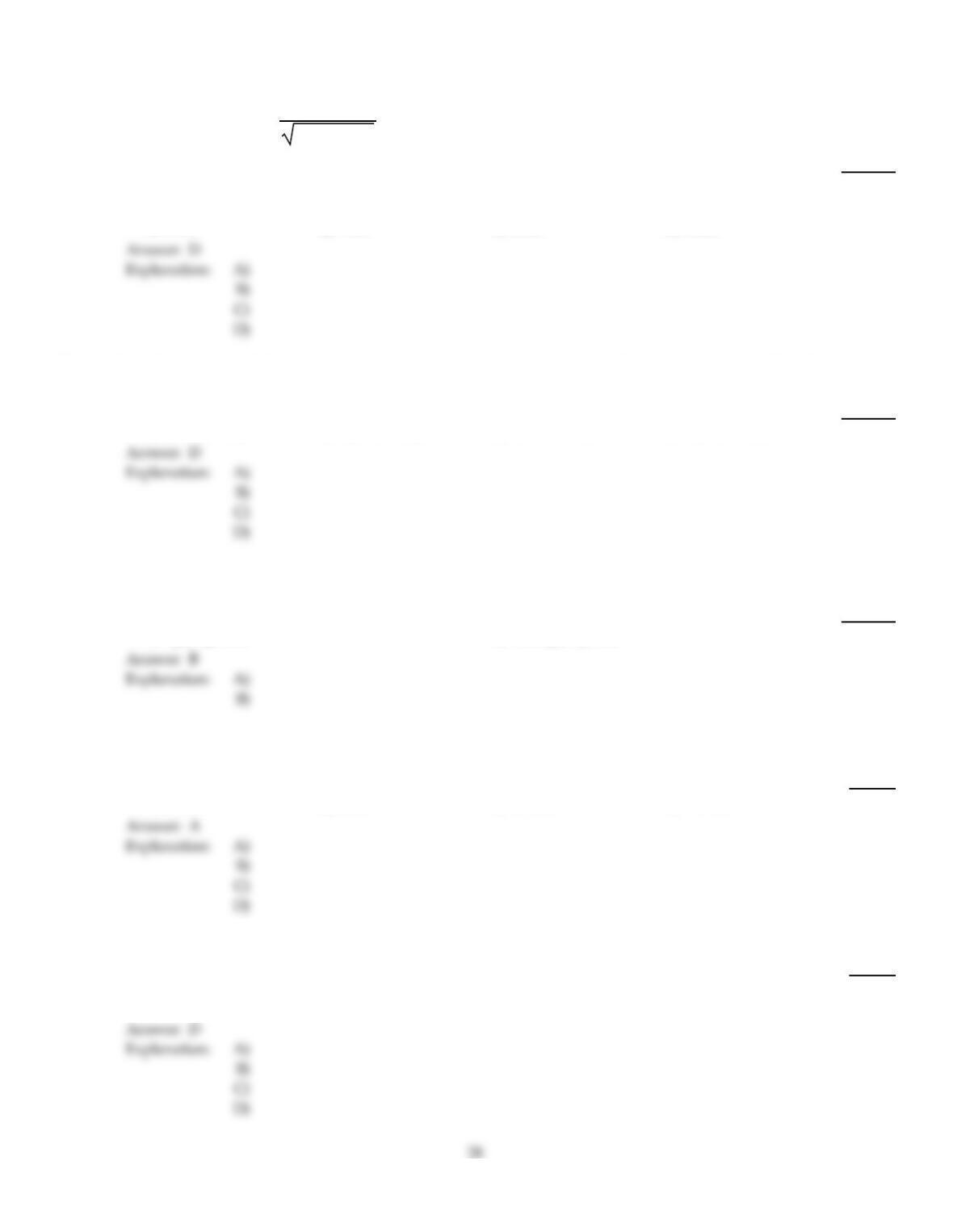
A hypothesis test is to be performed for a population proportion. For the given sample data and null hypothesis, compute
the value of the test statistic, z =
p–p0
p0(1 –p0)/n
97)
A radio show producer believes that a new proposed format would be preferred by only 15% of
their current listeners. In a random sample of 100 current listeners, 20% favored the new format.
The null hypothesis is H0: p =0.15.
97)
A)
0.868
B)
1.848
C)
4.340
D)
1.400
The number of successes and the sample size are given for a simple random sample from a population. Use the
one–proportion z–interval procedure to find the required confidence interval.
98)
n =101, x =36; 88% level
98)
A)
0.278 to 0.434
B)
0.281 to 0.431
C)
0.277 to 0.435
D)
0.282 to 0.430
The numbers of successes and the sample sizes are given for independent simple random samples from two populations.
Decide whether using the two–proportions z–procedures is appropriate.
99)
x1= 97, n1= 100, x2= 13, n2= 20
99)
A)
Appropriate
B)
Not appropriate
A two–proportions z–test is to be performed using the P–value approach. Use the given sample data to find the P–value
for the hypothesis test.
100)
p1= 30%, n1 = 60, p2= 25%, n2= 40; H0: p1=p2, Ha: p1p2 , = 0.05
100)
A)
0.5824
B)
0.6030
C)
0.2912
D)
0.1812
Use the one–proportion plus–four z–interval procedure to find the required confidence interval.
101)
Of 92 adults selected randomly from one town, 68 have health insurance. Find a 90% confidence
interval for the proportion of all adults in the town who have health insurance.
101)
A)
0.612 to 0.846
B)
0.624 to 0.835
C)
0.640 to 0.818
D)
0.655 to 0.804
Provide an appropriate response.
102)
^
^
^ ^
Suppose that in one town 12% of women and 8% of men are vegetarians. Let p1denote the
proportion of vegetarians among a sample of 200 women selected randomly from the town. Let p2
denote the proportion of vegetarians among a sample of 100 men selected randomly from the town.
What is the distribution of p1–p2and what are its mean and standard deviation? Assume that
the two samples are independent.
102)
A)
^ ^
p1–p2is exactly normally distributed with a mean of 0.4 and a standard deviation of
0.00127.
B)
^ ^
p1–p2is exactly normally distributed with a mean of 0.4 and a standard deviation of 0.0356.
C)
^ ^
p1–p2is approximately normally distributed with a mean of 0.04 and a standard deviation
of 0.0356.
D)
^ ^
p1–p2is approximately normally distributed with a mean of 0.04 and a standard deviation
of 0.00127.
103)
Determine whether the following statement regarding a hypothesis test for two population
proportions is true or false:
However small the difference between two population proportions, for sufficiently large sample
sizes, the null hypothesis of equal population proportions is likely to be rejected.
103)
A)
True
B)
False
Use the one–proportion z–interval procedure to find the required confidence interval.
104)
Of 87 adults selected randomly from one town, 70 have health insurance. Find a 90% confidence
interval for the proportion of all adults in the town who have health insurance.
104)
A)
0.735 to 0.875
B)
0.695 to 0.914
C)
0.706 to 0.904
D)
0.721 to 0.888
The numbers of successes and the sample sizes are given for independent simple random samples from two populations.
Use the two–proportions plus–four z–interval procedure to obtain the specified confidence interval.
105)
x1=28, n1=60, x2=33, n2=68; 95% confidence interval
105)
A)
0.265 to 0.670
B)
–0.189 to 0.153
C)
–0.221 to 0.670
D)
0.297 to 0.638
Assume that you wish to estimate a population proportion, p. For the given margin of error and confidence level,
determine the sample size required.
106)
A researcher wants to determine what proportion of adults in one town regularly buy organic food.
Obtain a sample size that will ensure a margin of error of at most 0.09 for a 90% confidence
interval. In previous years, the proportion has been 0.22.
106)
A)
58
B)
51
C)
5
D)
174
^
A hypothesis test is to be performed for a population proportion. For the given sample data and null hypothesis, compute
the value of the test statistic, z =
p–p0
p0(1 –p0)/n
107)
In a school district with 10,000 high school students, 1400 students completed a special class
designed to improve their math skills. 826 of these scored better than the district–wide median on a
standardized math exam. Does the special class have some value? The hypotheses are H0: p = 0.5,
Ha: p > 0.5, where p is the proportion of all those taking the special class who score better than the
district–wide median.
107)
A)
10.776
B)
5.051
C)
6.735
D)
14.144
Use the two–proportion plus–four z–interval procedure to find the required confidence interval.
108)
A survey of randomly selected college students found that 59 of the 91 freshmen and 82 of the 116
sophomores surveyed had purchased used textbooks in the past year. Construct a 98% confidence
interval for the difference in the proportions of college freshmen and sophomores who purchased
used textbooks.
108)
A)
–0.210 to 0.093
B)
0.518 to 0.773
C)
–0.186 to 0.773
D)
0.495 to 0.796
The numbers of successes and the sample sizes are given for independent simple random samples from two populations.
Use the two–proportions z–test to conduct the required hypothesis test. Use the critical–value approach.
109)
x1=10, n1=40, x2=8, n2=40, right–tailed test, = 0.01
109)
A)
z =0.54; critical value = 2.575; do not reject H0
B)
z =1.02; critical value = 2.33; reject H0
C)
z =0.54; critical value = 2.33; do not reject H0
D)
z =1.02; critical value = 2.575; do not reject H0
Find the indicated margin of error.
110)
Out of 360 trials, 140 turned out positive. Find the margin of error for the 90% confidence interval
used to estimate the population proportion.
110)
A)
0.0423
B)
0.0504
C)
0.0529
D)
0.0454
Provide an appropriate response.
111)
Based on a set of sample data, a researcher constructs a 95% confidence interval for p1–p2 and
also performs a two–proportions z–test to test the hypothesis H0: p1=p2. The confidence interval
is from 0.05 to 0.08. True or false, at the 5% significance level, the null hypothesis p1=p2 would be
rejected?
111)
A)
True
B)
False
^
Find the required sample size without making a guess for the observed value of p.
112)
A manufacturer of kitchen utensils wishes to estimate the proportion of left handed people in the
population. Obtain a sample size that will ensure a margin of error of at most 0.041 for a 96%
confidence interval.
112)
A)
26
B)
626
C)
2501
D)
13
31
The numbers of successes and the sample sizes are given for independent simple random samples from two populations.
Decide whether using the two–proportions z–procedures is appropriate.
113)
x1=16, n1= 30, x2= 18, n2= 30
113)
A)
Appropriate
B)
Not appropriate
Use the one–proportion z–interval procedure to find the required confidence interval.
114)
When 294 college students are randomly selected and surveyed, it is found that 115 own a car. Find
a 99% confidence interval for the proportion of all college students who own a car.
114)
A)
0.335 to 0.447
B)
0.318 to 0.464
C)
0.325 to 0.457
D)
0.344 to 0.438
The number of successes and the sample size are given for a simple random sample from a population. Decide whether
using the one–proportion z–interval procedure is appropriate.
115)
x =44, n =45
115)
A)
Not appropriate
B)
Appropriate
Provide an appropriate response.
116)
^
^
You wish to estimate a population proportion, p, and want to determine the sample size required
for a given margin of error and confidence level. In A, B, C, D below, a likely range is given for the
observed value of the sample proportion, p . Based on the given range, identify the educated guess
that should be used for the observed value of p in calculating the required sample size. For which
of the ranges did you identify the value 0.4?
A. 0.1 to 0.4
B. 0.4 to 0.45
C. At least 0.4
D. At most 0.4
116)
A)
B and C
B)
B and D
C)
A and C
D)
A and D
The number of successes and the sample size are given for a simple random sample from a population. Decide whether
using the one–proportion z–interval procedure is appropriate.
117)
x =7, n = 250
117)
A)
Appropriate
B)
Not appropriate
Use the one–proportion plus–four z–interval procedure to find the required confidence interval.
118)
When 262 college students are randomly selected and surveyed, it is found that 117 own a car. Find
a 99% confidence interval for the proportion of all college students who own a car.
118)
A)
0.397 to 0.498
B)
0.388 to 0.507
C)
0.369 to 0.526
D)
0.376 to 0.518
Provide an appropriate response.
119)
^
You are planning to use a sample proportion p to estimate a population proportion, p. True or
false, the sample proportion for a sample of size 100 is more likely to lie within 0.01 of the
population proportion than the sample proportion for a sample of size 200?
119)
A)
True
B)
False
The numbers of successes and the sample sizes are given for independent simple random samples from two populations.
Use the two–proportions z–interval procedure to obtain the specified confidence interval.
120)
x1=65, n1=121 , x2=80, n2=129; 98% confidence interval
120)
A)
0.415 to 0.659
B)
–0.205 to 0.659
C)
0.392 to 0.682
D)
–0.228 to 0.062
The number of successes and the sample size are given for a simple random sample from a population. Use the
one–proportion plus–four z–interval procedure to find the required confidence interval.
121)
n =169, x =103; 95% level
121)
A)
0.549 to 0.665
B)
0.534 to 0.680
C)
0.533 to 0.681
D)
0.548 to 0.666
^
The number of successes and the sample size are given for a simple random sample from a population. Determine the
sample proportion, p.
122)
x =4, n = 20
122)
A)
^
p=0.2
B)
^
p=0.3
C)
^
p=0.25
D)
^
p=0.1
The numbers of successes and the sample sizes are given for independent simple random samples from two populations.
Use the two–proportions z–test to conduct the required hypothesis test. Use the critical–value approach.
123)
x1=8, n1=20, x2=15, n2=20, two–tailed test, = 0.10
123)
A)
z = – 1.79; critical values = ±1.645; do not reject H0
B)
z = – 2.24; critical values = ±1.28; reject H0
C)
z = – 1.79; critical values = ±1.28; do not reject H0
D)
z = – 2.24; critical values = ±1.645; reject H0
The number of successes and the sample size are given for a simple random sample from a population. Decide whether
using the one–proportion z–interval procedure is appropriate.
124)
x =34, n =40
124)
A)
Not appropriate
B)
Appropriate
Provide an appropriate response.
125)
^
^
Suppose that the proportion of left handers in a certain population is 10%. Let p represent the
proportion of left handers in a random sample from this population. What is the distribution of p
for samples of size 100?
125)
A)
Exactly normal with a mean of 0.1 and a standard deviation of 0.03
B)
Approximately normal with a mean of 0.1 and a standard deviation of 0.03
C)
Approximately normal with a mean of 0.1 and a standard deviation of 0.0009
D)
Exactly normal with a mean of 0.1 and a standard deviation of 0.0009
Find the P–value for the indicated hypothesis test.
126)
A manufacturer claims that fewer than 6% of its fax machines are defective. In a random sample of
100 such fax machines, 5% are defective. Find the P–value for a test of the manufacturer’s claim.
126)
A)
0.3264
B)
0.3372
C)
0.6744
D)
0.1591
The number of successes and the sample size are given for a simple random sample from a population. Use the
one–proportion z–interval procedure to find the required confidence interval.
127)
x =18, n =40, 99% level
127)
A)
0.247 to 0.653
B)
0.28 to 0.62
C)
0.267 to 0.633
D)
0.296 to 0.604
^
Find the required sample size without making a guess for the observed value of p.
128)
A researcher wishes to estimate the proportion of fish in a certain lake that are inedible due to
pollution of the lake. Obtain a sample size that will ensure a margin of error of at most 0.06 for a
97% confidence interval.
128)
A)
10
B)
151
C)
328
D)
327
C
The number of successes and the sample size are given for a simple random sample from a population. Decide whether
using the one–proportion z–test is appropriate.
129)
x = 28, n =60, H0: p = 0.94, Ha: p < 0.94
129)
A)
Not appropriate
B)
Appropriate
A
The numbers of successes and the sample sizes are given for independent simple random samples from two populations.
Decide whether using the two–proportions z–procedures is appropriate.
130)
x1= 13, n1= 50, x2=3, n2= 20
130)
A)
Not appropriate
B)
Appropriate
A
Provide an appropriate response.
131)
According to a magazine article, 34% of married men in the U.S. are dissatisfied with their
marriage. Identify the specified attribute.
131)
A)
Being married
B)
Being dissatisfied with one‘s marriage
C)
Being a married man
D)
Being male
B
A
The number of successes and the sample size are given for a simple random sample from a population. Decide whether
using the one–proportion z–interval procedure is appropriate.
132)
x =15, n = 120
132)
A)
Appropriate
B)
Not appropriate
133)
x =9, n =160
133)
A)
Not appropriate
B)
Appropriate
The number of successes and the sample size are given for a simple random sample from a population. Use the
one–proportion z–interval procedure to find the required confidence interval.
134)
x =20, n =50, 90% level
134)
A)
0.274 to 0.526
B)
0.286 to 0.514
C)
0.311 to 0.489
D)
0.264 to 0.536
The number of successes and the sample size are given for a simple random sample from a population. Decide whether
using the one–proportion z–test is appropriate.
135)
x = 15, n =40, H0: p = 0.9, Ha: p 0.9
135)
A)
Appropriate
B)
Not appropriate
136)
x = 6, n =15, H0: p = 0.5, Ha: p > 0.5
136)
A)
Not appropriate
B)
Appropriate
Provide an appropriate response.
137)
^
^
You wish to estimate a population proportion, p, and want to determine the sample size required
for a given margin of error and confidence level. In A, B, C, D below, a likely range is given for the
observed value of the sample proportion, p . Based on the given range, identify the educated guess
that should be used for the observed value of p in calculating the required sample size. For which
of the ranges did you identify the value 0.5?
A. 0.1 to 0.4
B. 0.3 to 0.6
C. At least 0.7
D. At most 0.7
137)
A)
B and C
B)
A and D
C)
B and D
D)
A and C
The number of successes and the sample size are given for a simple random sample from a population. Decide whether
using the one–proportion z–interval procedure is appropriate.
138)
x =2, n =50
138)
A)
Appropriate
B)
Not appropriate
A two–proportions z–test is to be performed. The null hypothesis is H0: p1=p2 . For the given sample data compute the
value of the test statistic.
139)
A random sampling of sixty pitchers from the National League and fifty–two pitchers from the
American League showed that 15 National and 12 American League pitchers had E.R.A’s below 3.5.
139)
A)
z =74.226
B)
z =6.110
C)
z =0.308
D)
z =0.237
The number of successes and the sample size are given for a simple random sample from a population. Decide whether
using the one–proportion z–test is appropriate.
140)
x = 25, n =60, H0: p = 0.3, Ha: p 0.3
140)
A)
Not appropriate
B)
Appropriate
The number of successes and the sample size are given for a simple random sample from a population. Decide whether
using the one–proportion z–interval procedure is appropriate.
141)
x =14, n = 30
141)
A)
Not appropriate
B)
Appropriate
Find the indicated margin of error.
142)
In a survey of 4200 T.V. viewers, 1680 said they watch network news programs. Find the margin of
error for the 99% confidence interval used to estimate the population proportion.
142)
A)
0.0170
B)
0.0148
C)
0.0194
D)
0.0111
The numbers of successes and the sample sizes are given for independent simple random samples from two populations.
Decide whether using the two–proportions z–procedures is appropriate.
143)
x1= 58, n1= 60, x2= 45, n2= 50
143)
A)
Appropriate
B)
Not appropriate
^
Find the required sample size without making a guess for the observed value of p.
144)
Suppose the federal government needs to estimate the proportion of students receiving federal
loans that default on those loans. Obtain a sample size that will ensure a margin of error of at most
0.006 for a 92% confidence interval.
144)
A)
85,070
B)
340,278
C)
12,153
D)
21,268
The numbers of successes and the sample sizes are given for independent simple random samples from two populations.
Use the two–proportions z–interval procedure to obtain the specified confidence interval.
145)
x1=15, n1=48 , x2=18, n2=53; 90% confidence interval
145)
A)
–0.181 to 0.126
B)
0.159 to 0.466
C)
0.130 to 0.495
D)
0.129 to 0.495
^
A hypothesis test is to be performed for a population proportion. For the given sample data and null hypothesis, compute
the value of the test statistic, z =
p–p0
p0(1 –p0)/n
146)
Out of 79 observations, 62% were successes. H0: p =0.4.
146)
A)
3.991
B)
1.291
C)
1.723
D)
0.012
The numbers of successes and the sample sizes are given for independent simple random samples from two populations.
Use the two–proportions plus–four z–interval procedure to obtain the specified confidence interval.
147)
x1=10, n1=38, x2=21, n2=42; 90% confidence interval
147)
A)
0.104 to 0.446
B)
–0.395 to –0.055
C)
0.073 to 0.477
D)
0.071 to 0.477
Find the indicated margin of error.
148)
In a survey of 6600 T.V. viewers, 30% said they watch network news programs. Find the margin of
error for the 95% confidence interval used to estimate the population proportion. Give your answer
as a percentage.
148)
A)
1.11%
B)
1.28%
C)
1.46%
D)
0.833%
Provide an appropriate response.
149)
A newspaper article citing the results of a poll states: “In theory, the results of such a poll, in 99
cases out of 100 should differ by no more than 2 percentage points in either direction from what
would have been obtained by interviewing all voters in the United States.” Find the sample size
suggested by this statement.
149)
A)
165
B)
2402
C)
3394
D)
4145
The numbers of successes and the sample sizes are given for independent simple random samples from two populations.
Use the two–proportions z–test to conduct the required hypothesis test. Use the critical–value approach.
150)
x1=10, n1=40, x2=12, n2=40, two–tailed test, = 0.05
150)
A)
z = – 0.5; critical values = ±1.96; reject H0
B)
z = – 0.5; critical values = ±1.96; do not reject H0
C)
z = – 0.55; critical values = ±1.96; do not reject H0
D)
z = – 0.55; critical values = ±1.96; reject H0
The numbers of successes and the sample sizes are given for independent simple random samples from two populations.
Decide whether using the two–proportions z–procedures is appropriate.
151)
x1= 45, n1= 50, x2=20, n2= 24
151)
A)
Not appropriate
B)
Appropriate
A two–proportions z–test is to be performed using the P–value approach. Use the given sample data to find the P–value
for the hypothesis test.
152)
x1= 20, n1 = 50, x2= 15, n2= 75; H0: p1=p2, Ha: p1>p2 , = 0.05
152)
A)
0.0146
B)
0.0073
C)
0.0032
D)
0.1201
^
The number of successes and the sample size are given for a simple random sample from a population. Determine the
sample proportion, p.
153)
x =13, n = 25
153)
A)
^
p=0.44
B)
^
p=0.32
C)
^
p=0.58
D)
^
p=0.52
The number of successes and the sample size are given for a simple random sample from a population. Use the
one–proportion plus–four z–interval procedure to find the required confidence interval.
154)
n =150, x =84; 90% level
154)
A)
0.495 to 0.621
B)
0.496 to 0.620
C)
0.491 to 0.625
D)
0.492 to 0.624