A two–proportions z–test is to be performed using the P–value approach. Use the given sample data to find the P–value
for the hypothesis test.
155)
x1= 5, n1 = 50, x2= 7, n2= 50; H0: p1=p2, Ha: p1<p2 , = 0.01
155)
A)
0.2691
B)
0.1836
C)
0.0072
D)
0.0613
A two–proportions z–test is to be performed. The null hypothesis is H0: p1=p2 . For the given sample data compute the
value of the test statistic.
156)
x1=68, n1 =144, x2=60, n2=139
156)
A)
z =0.460
B)
z =0.479
C)
z =0.889
D)
z =0.684
Use the one–proportion z–interval procedure to find the required confidence interval.
157)
Of 343 randomly selected medical students, 21 said that they planned to work in a rural
community. Find a 95% confidence interval for the proportion of all medical students who plan to
work in a rural community.
157)
A)
0.0279 to 0.0946
B)
0.0311 to 0.0914
C)
0.0359 to 0.0866
D)
0.0399 to 0.0825
The numbers of successes and the sample sizes are given for independent simple random samples from two populations.
Decide whether using the two–proportions z–procedures is appropriate.
158)
x1= 6, n1=13, x2= 5, n2= 30
158)
A)
Appropriate
B)
Not appropriate
^
Find the required sample size without making a guess for the observed value of p.
159)
A researcher wishes to estimate the proportion of all drivers who exceed the speed limit on a
certain stretch of road where accidents frequently happen. Obtain a sample size that will ensure a
margin of error of at most 0.023 for a 95% confidence interval.
159)
A)
42
B)
927
C)
22
D)
1816
The numbers of successes and the sample sizes are given for independent simple random samples from two populations.
Use the two–proportions z–interval procedure to obtain the specified confidence interval.
160)
x1=35, n1=72 , x2=37, n2=83; 95% confidence interval
160)
A)
–0.147 to 0.673
B)
–0.117 to 0.198
C)
0.299 to 0.673
D)
0.329 to 0.643
Use the one–proportion z–interval procedure to find the required confidence interval.
161)
A survey of 300 union members in New York State reveals that 112 favor the Republican candidate
for governor. Construct the 98% confidence interval for the proportion of all New York State union
members who favor the Republican candidate.
161)
A)
0.316 to 0.430
B)
0.304 to 0.442
C)
0.308 to 0.438
D)
0.301 to 0.445
162)
Of 100 patients selected at random from a clinic, 33 were found to have high blood pressure.
Construct a 95% confidence interval for the percentage of all patients at this clinic that have high
blood pressure.
162)
A)
20.9% to 45.1%
B)
25.2% to 40.8%
C)
23.8% to 42.2%
D)
22.0% to 44.0%
Find the indicated margin of error.
163)
In a survey of 280 adults over 50, 75% said they were taking vitamin supplements. Find the margin
of error for the 99% confidence interval used to estimate the population proportion. Give your
answer as a percentage.
163)
A)
13.3%
B)
18.6%
C)
5.07%
D)
6.66%
E)
10.1%
Find the P–value for the indicated hypothesis test.
164)
A medical school claims that more than 28% of its students plan to go into general practice. It is
found that among a random sample of 130 of the school’s students, 39% of them plan to go into
general practice. Find the P–value for a test of the school’s claim.
164)
A)
0.1635
B)
0.9974
C)
0.0052
D)
0.0026
165)
An airline claims that the no–show rate for passengers booked on its flights is less than 6%. Of 380
randomly selected reservations, 18 were no–shows. Find the P–value for a test of the airline’s claim.
165)
A)
0.1230
B)
0.0746
C)
0.2984
D)
0.1492
Provide an appropriate response.
166)
^
^ ^
In the context of a two–proportions z–test, which of the following statements about the pooled
sample proportion, pp, is/are true?
A. It estimates the common value of p1 and p2 under the assumption that the null hypothesis is
true.
B. It is a parameter.
C. It is obtained by averaging the two sample proportions p1 and p2.
D. It is equal to the proportion of successes in both samples combined.
166)
A)
B and C
B)
A and D
C)
A and C
D)
B and D
^
The number of successes and the sample size are given for a simple random sample from a population. Determine the
sample proportion, p.
167)
x =61, n = 100
167)
A)
^
p=0.061
B)
^
p=6.1
C)
^
p=0.5
D)
^
p=0.61
A two–proportions z–test is to be performed using the P–value approach. Use the given sample data to find the P–value
for the hypothesis test.
168)
x1= 41, n1 = 100, x2= 35, n2= 140; H0: p1=p2, Ha: p1>p2 , = 0.10
168)
A)
0.4211
B)
0.0512
C)
0.0086
D)
0.0043
Find the indicated margin of error.
169)
In a survey of 9500 adults from one town, 40% said they had tried some form of alternative
medicine. Find the margin of error for the 95% confidence interval used to estimate the population
proportion.
169)
A)
0.0113
B)
0.00985
C)
0.0129
D)
0.00739
Provide an appropriate response.
170)
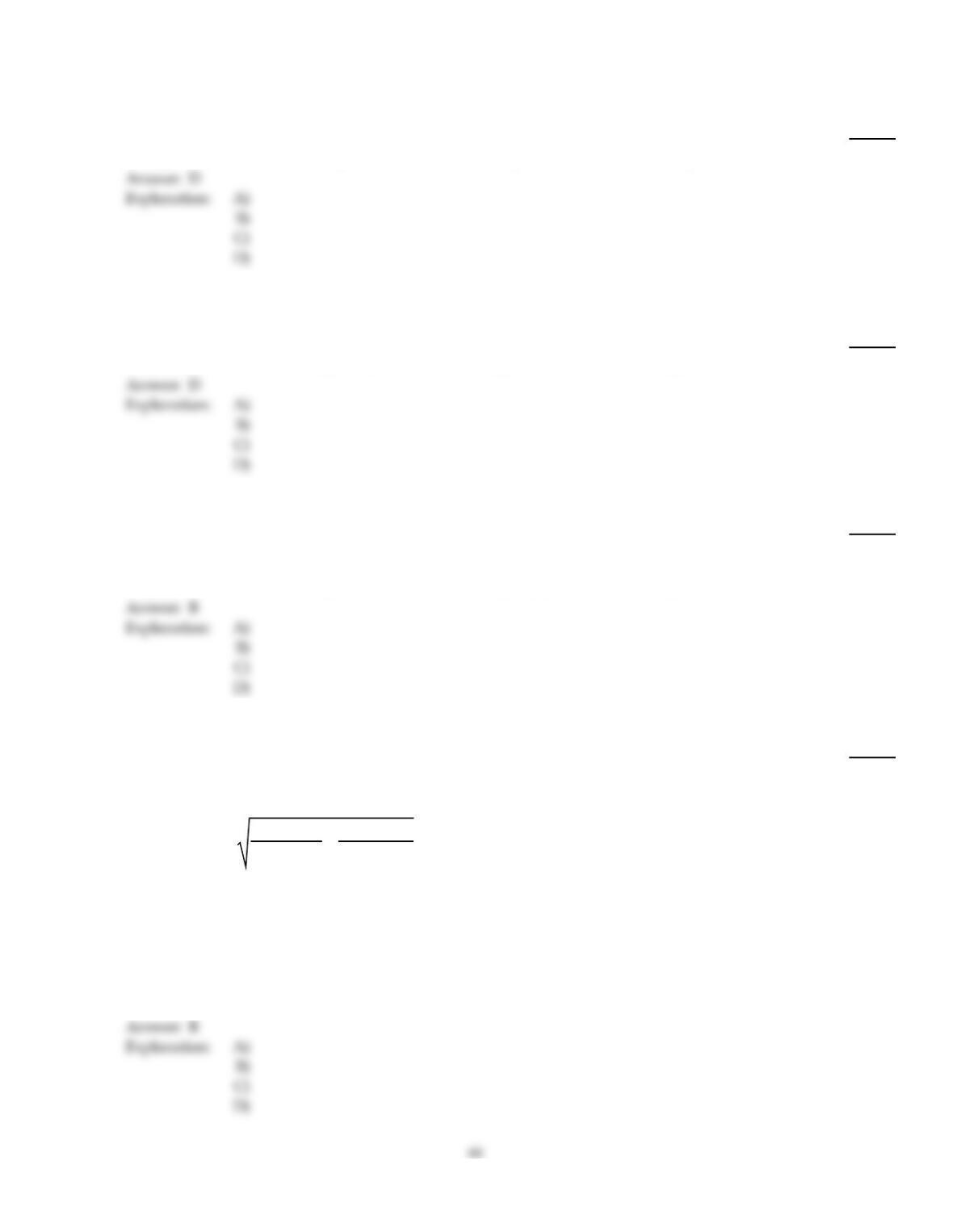
The common sample size, n, needed to estimate the difference between two population proportions
to within a margin of error E with a confidence level of 1 – can be found as follows: in the
expression
E =z/2
p1(1 –p1)
n1
+p2(1 –p2)
n2
replace n1 and n2 by n (assuming both samples have the same size) and replace each of p1 and p2
by 0.5 (assuming their values are not known). Then solve for n.
Suppose that you want to estimate the difference between the proportions of men and women who
plan to vote in the next presidential election. Obtain a common sample size that will ensure a
margin of error of at most 0.03 for a 99% confidence interval
170)
A)
2135
B)
3684
C)
1842
D)
111
The number of successes and the sample size are given for a simple random sample from a population. Use the
one–proportion z–interval procedure to find the required confidence interval.
171)
n =96, x =42; 98% level
171)
A)
0.339 to 0.537
B)
0.319 to 0.557
C)
0.338 to 0.538
D)
0.320 to 0.556
A two–proportions z–test is to be performed using the P–value approach. Use the given sample data to find the P–value
for the hypothesis test.
172)
x1= 11, n1 = 200, x2= 8, n2= 100; H0: p1=p2, Ha: p1p2 , = 0.01
172)
A)
0.3844
B)
0.1011
C)
0.4010
D)
0.2005
Assume that you wish to estimate a population proportion, p. For the given margin of error and confidence level,
determine the sample size required.
173)
You wish to estimate the proportion of all voters in California who plan to vote in favor of a certain
ballot measure. Obtain a sample size that will ensure a margin of error of at most 0.015 for a 99%
confidence interval. Assume that it is reasonable to presume that of the voters sampled, the
percentage in favor of the measure will be between 11% and 27%.
173)
A)
2886
B)
3366
C)
5809
D)
7368
The numbers of successes and the sample sizes are given for independent simple random samples from two populations.
Use the two–proportions z–test to conduct the required hypothesis test. Use the critical–value approach.
174)
x1=6, n1=30, x2=16, n2=20, left–tailed test, = 0.05
174)
A)
z = – 4.19; critical value = – 1.96; reject H0
B)
z = – 3.35; critical value = – 1.645; reject H0
C)
z = – 4.19; critical value = – 1.645; reject H0
D)
z = – 3.35; critical value = – 1.96; do not reject H0
Find the P–value for the indicated hypothesis test.
175)
A random sample of 140 forty–year–old men contains 25% smokers. Find the P–value for a
hypothesis test to determine whether the percentage of forty–year–old men that smoke differs from
22%.
175)
A)
0.1401
B)
0.3898
C)
0.4010
D)
0.1949
Use the one–proportion z–interval procedure to find the required confidence interval.
176)
In a sample of 1165 patients who underwent a certain type of surgery, 17% experienced
complications. Find a 99% confidence interval for the proportion of all those undergoing this
surgery who experience complications.
176)
A)
0.1523 to 0.1877
B)
0.1417 to 0.1983
C)
0.1590 to 0.1810
D)
0.1323 to 0.2077
^
A hypothesis test is to be performed for a population proportion. For the given sample data and null hypothesis, compute
the value of the test statistic, z =
p–p0
p0(1 –p0)/n
177)
397 people were asked if they were satisfied with their jobs. 33% said that they were. H0: p =0.34.
177)
A)
2.612
B)
4.125
C)
–0.421
D)
–0.021
Use the two–proportion plus–four z–interval procedure to find the required confidence interval.
178)
A survey of randomly chosen adults found that 27 of the 72 women and 35 of the 79 men follow
regular exercise programs. Construct a 95% confidence interval for the difference in the
proportions of women and men who have regular exercise programs.
178)
A)
–0.250 to 0.562
B)
–0.221 to 0.089
C)
0.195 to 0.562
D)
0.224 to 0.533
Use the two–proportions z–interval procedure to obtain the required confidence interval for the difference between two
population proportions. Assume that independent simple random samples have been selected from the two populations.
179)
In a random sample of 53 Democrats from one city, 11 approved of the mayor’s performance. In a
random sample of 57 Republicans from the city, 21 approved of the mayor’s performance. Find a
90% confidence interval for the difference between the proportions of Democrats and Republicans
who approve of the mayor’s performance.
179)
A)
0.067 to 0.348
B)
0.040 to 0.374
C)
–0.300 to –0.021
D)
0.041 to 0.374
The numbers of successes and the sample sizes are given for independent simple random samples from two populations.
Use the two–proportions plus–four z–interval procedure to obtain the specified confidence interval.
180)
x1=23, n1=28, x2=10, n2=18; 98% confidence interval
180)
A)
–0.121 to 0.621
B)
–0.060 to 0.560
C)
0.033 to 0.467
D)
0.002 to 0.498
Use the two–proportions z–interval procedure to obtain the required confidence interval for the difference between two
population proportions. Assume that independent simple random samples have been selected from the two populations.
181)
The weight loss franchise home office wanted to compare the results of two centers. Of 200
randomly selected participants from center A, 152 lost at least 10 pounds. Of 140 randomly selected
participants from center B, 109 lost at least 10 pounds. Construct a 98% confidence interval for the
difference between the proportions of participants at center A and participants at center B who lost
at least 10 pounds.
181)
A)
–0.1264 to 0.0893
B)
–0.1378 to 0.1007
C)
–0.1093 to 0.0722
D)
–0.0947 to 0.0576
The number of successes and the sample size are given for a simple random sample from a population. Use the
one–proportion plus–four z–interval procedure to find the required confidence interval.
182)
n =56, x =22; 95% level
182)
A)
0.292 to 0.508
B)
0.276 to 0.524
C)
0.296 to 0.504
D)
0.272 to 0.528
The numbers of successes and the sample sizes are given for independent simple random samples from two populations.
Decide whether using the two–proportions z–procedures is appropriate.
183)
x1= 28, n1= 40, x2= 24, n2= 30
183)
A)
Not appropriate
B)
Appropriate
^
The number of successes and the sample size are given for a simple random sample from a population. Determine the
sample proportion, p.
184)
x =41, n = 125
184)
A)
^
p=0.328
B)
^
p=0.348
C)
^
p=0.428
D)
^
p=0.278
Use the two–proportions z–interval procedure to obtain the required confidence interval for the difference between two
population proportions. Assume that independent simple random samples have been selected from the two populations.
185)
A marketing survey involves product recognition in New York and California. Of 558 New Yorkers
surveyed, 193 recognized the product while 196 out of 614 Californians recognized the product.
Construct a 99% confidence interval for the difference between the proportions of New Yorkers and
Californians who recognize the product.
185)
A)
–0.0034 to 0.0566
B)
0.0247 to 0.0286
C)
–0.0443 to 0.0976
D)
–0.0442 to 0.0975
The number of successes and the sample size are given for a simple random sample from a population. Decide whether
using the one–proportion z–test is appropriate.
186)
x = 3, n =70, H0: p = 0.03, Ha: p > 0.03
186)
A)
Not appropriate
B)
Appropriate
The numbers of successes and the sample sizes are given for independent simple random samples from two populations.
Use the two–proportions plus–four z–interval procedure to obtain the specified confidence interval.
187)
x1=23, n1=38, x2=29, n2=38; 90% confidence interval
187)
A)
–0.337 to 0.037
B)
–0.269 to –0.031
C)
–0.303 to 0.003
D)
–0.320 to 0.020
Use the one–proportion z–test to perform the specified hypothesis test. Use the critical–value approach.
188)
x =6, n =83, H0: p = 0.08, Ha: p
0.08, = 0.10
188)
A)
z = – 0.41; critical values = ±1.28; do not reject H0
B)
z = – 0.26; critical values = ±1.28; do not reject H0
C)
z = 1.87; critical values = ±1.645; reject H0
D)
z = – 0.26; critical values = ±1.645; do not reject H0
Use the two–proportions z–interval procedure to obtain the required confidence interval for the difference between two
population proportions. Assume that independent simple random samples have been selected from the two populations.
189)
In a random sample of 300 women, 66% favored stricter gun control legislation. In a random
sample of 200 men, 57% favored stricter gun control legislation. Construct a 98% confidence
interval for the difference between the proportions of women and men who favor stricter gun
control legislation.
189)
A)
–0.025 to 0.205
B)
–0.001 to 0.181
C)
0.003 to 0.177
D)
–0.014 to 0.194
The number of successes and the sample size are given for a simple random sample from a population. Use the
one–proportion z–interval procedure to find the required confidence interval.
190)
n =139, x =100; 90% level
190)
A)
0.655 to 0.783
B)
0.656 to 0.782
C)
0.660 to 0.778
D)
0.658 to 0.780
The numbers of successes and the sample sizes are given for independent simple random samples from two populations.
Use the two–proportions z–interval procedure to obtain the specified confidence interval.
191)
x1=24, n1=80, x2=11, n2=20. 90% confidence interval
191)
A)
–0.451 to –0.049
B)
–0.391 to –0.109
C)
–0.411 to –0.089
D)
–0.512 to 0.012
The number of successes and the sample size are given for a simple random sample from a population. Decide whether
using the one–proportion z–test is appropriate.
192)
x = 60, n =150, H0: p = 0.2, Ha: p < 0.2
192)
A)
Appropriate
B)
Not appropriate
Assume that you wish to estimate a population proportion, p. For the given margin of error and confidence level,
determine the sample size required.
193)
The inhabitants of one town would like to have a factory closed down due to the pollution that it
causes. A researcher wants to determine the proportion of children living in the vicinity of this
factory that suffer from asthma. Obtain a sample size that will ensure a margin of error of at most
0.006 for a 99% confidence interval. From a previous study, an estimate of the proportion of
children suffering from asthma amongst those living in the vicinity of this factory, is 0.136.
193)
A)
12,539
B)
21,642
C)
19,478
D)
130
Use the two–proportions z–interval procedure to obtain the required confidence interval for the difference between two
population proportions. Assume that independent simple random samples have been selected from the two populations.
194)
A survey of students at one college found that 67 of 108 randomly selected freshmen and 82 of 124
randomly selected sophomores lived off campus. Find a 98% confidence interval for the difference
between the proportions of freshmen and sophomores at this college who live off campus.
194)
A)
0.474 to 0.767
B)
0.497 to 0.744
C)
–0.165 to 0.744
D)
–0.188 to 0.106
Use the one–proportion z–test to perform the specified hypothesis test. Use the critical–value approach.
195)
x =145, n =165 , H0: p = 0.92, Ha: p < 0.92, = 0.10
195)
A)
z = – 1.95; critical value = – 1.28; reject H0
B)
z = – 1.54; critical value = – 1.28; do not reject H0
C)
z = – 1.95; critical value = – 1.645; reject H0
D)
z = – 1.54; critical value = – 1.645; do not reject H0
^
Find the required sample size without making a guess for the observed value of p.
196)
A researcher wishes to estimate the proportion of likely voters that will vote for the incumbent.
Obtain a sample size that will ensure a margin of error of at most 3 percentage points for a 95%
confidence interval.
196)
A)
267
B)
33
C)
4269
D)
1068
197)
A public health researcher wishes to estimate the proportion of adults in the U.S. that have high
blood pressure. Obtain a sample size that will ensure a margin of error of at most 0.002 for a 92%
confidence interval.
197)
A)
191,407
B)
219
C)
383
D)
765,626
Use the one–proportion z–test to perform the specified hypothesis test. Use the critical–value approach.
198)
x =610, n =1500, H0: p = 0.40, Ha: p > 0.40, = 0.01
198)
A)
z =0.53; critical value = 2.33; do not reject H0
B)
z = 0.62; critical value = 2.575; reject H0
C)
z = 0.62; critical value = 2.33; do not reject H0
D)
z =0.53; critical value = 2.575; do not reject H0
Find the P–value for the indicated hypothesis test.
199)
In a sample of 47 adults selected randomly from one town, it is found that 9 of them have been
exposed to a particular strain of the flu. Find the P–value for a hypothesis test to determine
whether the proportion of all adults in the town that have been exposed to this strain of the flu
differs from 8%.
199)
A)
0.0524
B)
0.0262
C)
0.0048
D)
0.0024
Assume that you wish to estimate a population proportion, p. For the given margin of error and confidence level,
determine the sample size required.
200)
You wish to estimate the proportion of adults that have ever used alternative medicine. Obtain a
sample size that will ensure a margin of error of at most 0.01 for a 95% confidence interval. It is
deemed reasonable to presume that of those sampled, the proportion that have used alternative
medicine will be at least 0.70.
200)
A)
7260
B)
8067
C)
26,891
D)
13,924
The numbers of successes and the sample sizes are given for independent simple random samples from two populations.
Use the two–proportions plus–four z–interval procedure to obtain the specified confidence interval.
201)
x1=55, n1=101, x2=64, n2=115; 98% confidence interval
201)
A)
0.412 to 0.675
B)
–0.168 to 0.144
C)
–0.144 to 0.675
D)
0.387 to 0.700
^
A hypothesis test is to be performed for a population proportion. For the given sample data and null hypothesis, compute
the value of the test statistic, z =
p–p0
p0(1 –p0)/n
202)
A research group wants to determine whether the proportion of car accidents caused by drivers
using cell phones has changed from the previous value of 13%. They obtained 10,000 auto accident
reports and found that 12% were caused by drivers using cell phones. The hypotheses are
H0: p = 0.13, Ha: p 0.13, where p is the proportion of car accidents caused by drivers using cell
phones.
202)
A)
–5.948
B)
–1.011
C)
–2.974
D)
–4.134
Find the P–value for the indicated hypothesis test.
203)
A nationwide study of American homeowners revealed that 65% have one or more lawn mowers.
A lawn equipment manufacturer, located in Omaha, feels the estimate is too low for households in
Omaha. Find the P–value for a test of the claim that the proportion with lawn mowers in Omaha is
higher than 65%. Among 497 randomly selected homes in Omaha, 340 had one or more lawn
mowers.
203)
A)
0.0252
B)
0.1118
C)
0.0505
D)
0.0559