Exam
Name___________________________________
MULTIPLE CHOICE. Choose the one alternative that best completes the statement or answers the question.
Solve.
1)
log3x = –2
1)
A)
1
9
B)
1
8
C)
–6
D)
1
Solve the problem.
2)
The loudness of a sound can be approximated by the formula d = 10 log10 I
I0, where d is the
number of decibels. The higher the value of d, the louder the sound. Find the number of decibels
when I =100 and I0= 1.
2)
A)
12 decibels
B)
20 decibels
C)
100 decibels
D)
2 decibels
Write the logarithmic equation in its equivalent exponential form.
3)
log1/81
64 =2
3)
A)
28=64
B)
1
82=1
64
C)
81/64 =2
D)
1
64 2=8
Write the expression as the sum or difference of logarithms.
4)
logb
4x9b5
y7
4)
A)
9
4logb x +5
4–7
4logb y
B)
9
4logb x +5
4–7logb y
C)
9
4logb x + 5 – 7logb y
D)
1
4(logb x9+logb b5–logb y7)
Evaluate the function for the given value. Round to the nearest thousandth.
5)
f(x) =ex; f(4.6)
5)
A)
1.526
B)
109.947
C)
0.471
D)
99.484
Solve.
6)
1
64 =4–x
6)
A)
1
3
B)
3
C)
1
16
D)
–3
Write the exponential equation in its equivalent logarithmic form.
7)
10–3=0.001
7)
A)
log10 –3=0.001
B)
log3–3= 0.10
C)
log10 0.001 = –3
D)
log30.10 = –3
1

Evaluate.
8)
ln 3e4
8)
A)
–4
3
B)
4
3
C)
3
4
D)
–3
4
Solve.
9)
log (x + 3) = 1 – log x
9)
A)
2
B)
–5, 2
C)
–2, 5
D)
–2
Solve . Round the answer to three decimal places.
10)
2x=10
10)
A)
0.301
B)
1.609
C)
5.000
D)
3.322
Solve.
11)
47+ 3x=1
16
11)
A)
1
4
B)
3
C)
–3
D)
4
Write the expression as the sum or difference of logarithms.
12)
logbm7p3
n2
12)
A)
logb m7+logb p3+logb n2
B)
7logb m + 3logb p – 2logb n
C)
m7p3– n2
D)
7logb m + 3logb p +2logb n
Write the expression as a single logarithm.
13)
–logqr+6logqq
13)
A)
logqq6
r
B)
logq6q
r
C)
logq (q6–r)
D)
logqq6÷logar
Use a calculator to approximate the logarithm to four decimal places.
14)
log 153
14)
A)
2.1847
B)
2.1875
C)
2.1818
D)
5.0304
Solve.
15)
log4 (x – 8) +log4 (x – 8) = 1
15)
A)
–65, 65
B)
10
C)
65
D)
–10, 10
Evaluate.
16)
log24
16)
A)
2
B)
2· ln2
C)
–2
D)
1
2
Graph the function.
2
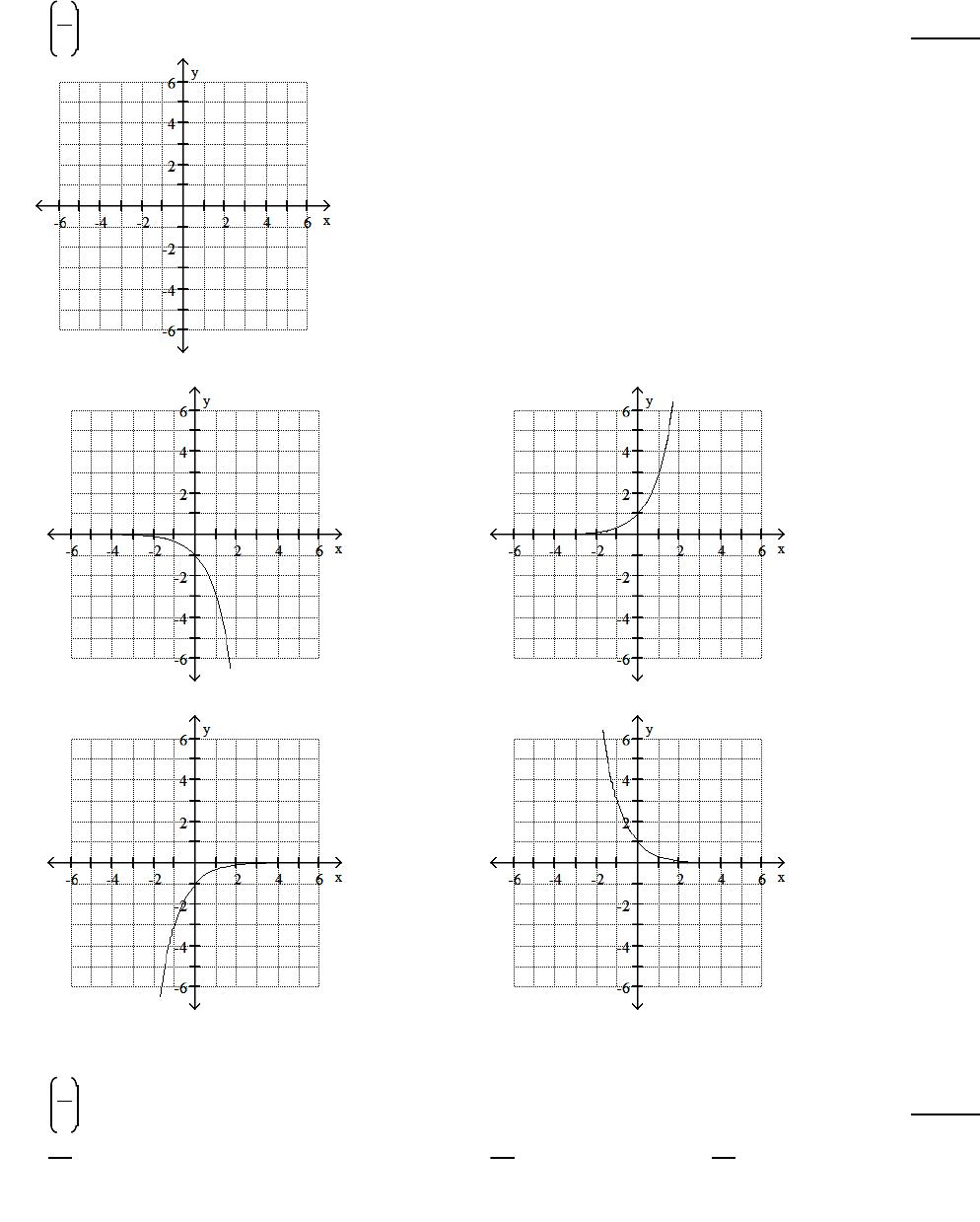
17)
f(x) =1
3 x
17)
A)
B)
C)
D)
Evaluate the function for the given value.
18)
f(x) =1
6x, x =2
18)
A)
1
12
B)
36
C)
1
36
D)
1
64
3
Solve.
19)
1000x –9=100,000x
19)
A)
–27
2
B)
–27
4
C)
27
2
D)
27
8
Evaluate.
20)
loga a–6
20)
A)
a–6
B)
–6loga a
C)
–6
D)
1
Solve . Round the answer to three decimal places.
21)
4x=2
9
21)
A)
–2.085
B)
0.228
C)
2.085
D)
–1.085
Solve.
22)
log25 5= x
22)
A)
1
2
B)
–1
2
C)
–2
D)
2
23)
log2(4x –7) =2
23)
A)
–11
9
B)
1
7
C)
7
D)
11
4
Write the logarithmic equation as an exponential equation.
24)
log10 1
100 = –2
24)
A)
10–2=1
100
B)
1
100 2=10
C)
10100 =2
D)
210 =1
100
Solve.
25)
logx125=3
25)
A)
3, –3
B)
5, –5
C)
3
D)
5
Solve the problem.
26)
A motorized scooter is purchased for $4700. Its value each year is about 77% of the value the
preceding year. Its value, in dollars, after t years is given by the exponential function V(t) =4700
(0.77)t. Find the value of the scooter after 7 years.
26)
A)
$580.80
B)
$754.28
C)
$447.21
D)
$25,333.00
Write the exponential equation in its equivalent logarithmic form.
27)
23=8
27)
A)
log23=8
B)
log38=2
C)
log82=3
D)
log28=3
Evaluate.
28)
log 100
28)
A)
1
B)
3
C)
2
D)
–2
4
Solve.
29)
log4(x – 4) +log4(x – 10) =2
29)
A)
12, 2
B)
13
C)
2
D)
12
Provide an appropriate response.
30)
Evaluate the function for the given value.
f(x) =2x +3+7; f(2)
30)
A)
15
B)
11
C)
39
D)
8
Use a calculator to approximate the logarithm to four decimal places.
31)
log10050
31)
A)
3.912
B)
0.8495
C)
4.6052
D)
1.1772
Evaluate the function for the given value.
32)
f(x) =31–x; f(3)
32)
A)
9
B)
1
6
C)
–6
D)
1
9
Evaluate.
33)
10log 13
33)
A)
log 13
B)
1
13
C)
13
D)
1013
Solve.
34)
log8 x +log87=5
34)
A)
40
7
B)
5
7
C)
32768
7
D)
32,761
Evaluate.
35)
log64 8
35)
A)
1
2
B)
2
C)
–2
D)
–1
2
Write the expression as a single logarithm.
36)
log213 –log26
36)
A)
log413
6
B)
log26
13
C)
log213
6
D)
log2 (7)
Solve.
37)
256
81 x + 1=3
4 x – 1
37)
A)
–3
10
B)
3
5
C)
–3
5
D)
–6
5
5
Write the exponential equation in its equivalent logarithmic form.
38)
1
5
2=1
25
38)
A)
log1/52=1
25
B)
log21
25 =1
5
C)
log1/25 1
5=2
D)
log1/51
25 =2
Provide an appropriate response.
39)
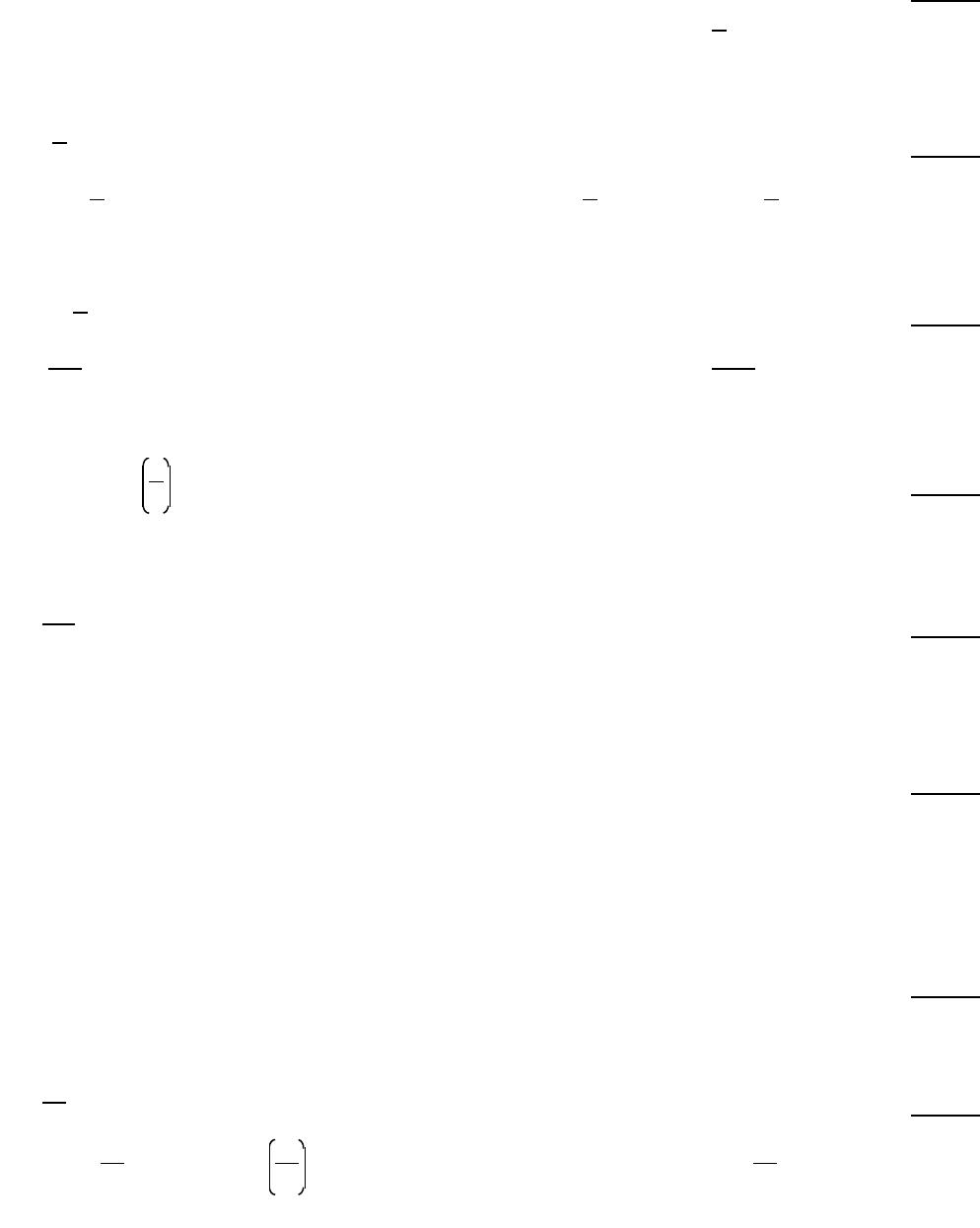
Graph: g(x) =log5x
39)
A)
B)
C)
D)
Write the exponential equation in its equivalent logarithmic form.
40)
73=343
40)
A)
log3343=7
B)
log7343=3
C)
log343 7=3
D)
log73=343
6
Provide an appropriate response.
41)
Evaluate: log5 1
41)
A)
5
B)
0
C)
1
D)
1
5
Write the exponential equation in its equivalent logarithmic form.
42)
3–2=1
9
42)
A)
log31
9= –2
B)
log1/93= –2
C)
log3(–2 )=1
9
D)
log–21
9=3
Solve.
43)
logx7=1
3
43)
A)
1
343
B)
343
C)
2187
D)
1
2187
Evaluate the function for the given value. Round to the nearest thousandth.
44)
f(x) =e(2x – 3); f 1
4
44)
A)
12.182
B)
0.000
C)
0.082
D)
33.115
Write the expression as the sum or difference of logarithms.
45)
logbm2
n9
45)
A)
9logb n –2logb m
B)
2logb m – 9logb n
C)
logb (2m – 9n)
D)
2logb m +9logb n
46)
log48x8
46)
A)
log48+log4 x8
B)
log48–8log4 x
C)
3(log48+log4 x)
D)
log48+8log4 x
Determine whether the function is a polynomial function, a rational function, a radical function, or an exponential
function.
47)
f(x) =4x +2
47)
A)
Polynomial
B)
Rational
C)
Radical
D)
Exponential
Write the logarithmic equation in its equivalent exponential form.
48)
log81
64 = –2
48)
A)
8–2=1
64
B)
1
64 2=8
C)
864 =2
D)
28=1
64
7
Use a calculator to approximate the logarithm to four decimal places.
49)
log35
49)
A)
0.6826
B)
2.9300
C)
1.4650
D)
–1.4650
Evaluate.
50)
7log7 a
50)
A)
1
B)
a7
C)
a
D)
7loga a
Write the logarithmic equation as an exponential equation.
51)
log24 724 =1
7
51)
A)
241/7=24 7
B)
1
247=724
C)
1
247=24 7
D)
241/7=724
Write the expression as a single logarithm.
52)
logb5+ 1
52)
A)
logb6
b
B)
logb5
C)
logb5b
D)
logb (6+ b)
Solve.
53)
Two bacteria are placed in a petri dish. The population will triple every day. The formula for the
number of bacteria in the dish on day t is N(t) =2(3)t, where t is the number of days after the two
bacteria are placed in the dish. How many bacteria are in the dish five days after the two bacteria
are placed in the dish?
53)
A)
10 bacteria
B)
486 bacteria
C)
30 bacteria
D)
250 bacteria
Write the expression as a single logarithm.
54)
log43x+3log4 x –log4x2
54)
A)
4log4 x
B)
2
3log4 x
C)
8log4 x
D)
4
3log4 x
Evaluate.
55)
ln 1
e5
55)
A)
5e
B)
–5
C)
5
D)
–e5
Solve the problem.
56)
How long will it take for the population of a certain country to double if its annual growth rate is
2.4%? Round to the nearest year. Use the exponential growth model P(t) =P0ekt.
56)
A)
83 yr
B)
1 yr
C)
29 yr
D)
13 yr
8
Provide an appropriate response.
57)
Write the expression as the sum or difference of logarithms: log3x4
3y4
57)
A)
4log3 x +4log3 y
B)
4log3 x –4log3 y
C)
4log3 x +4log3 y – 1
D)
4log3 x –4log3 y – 1
Graph the function.
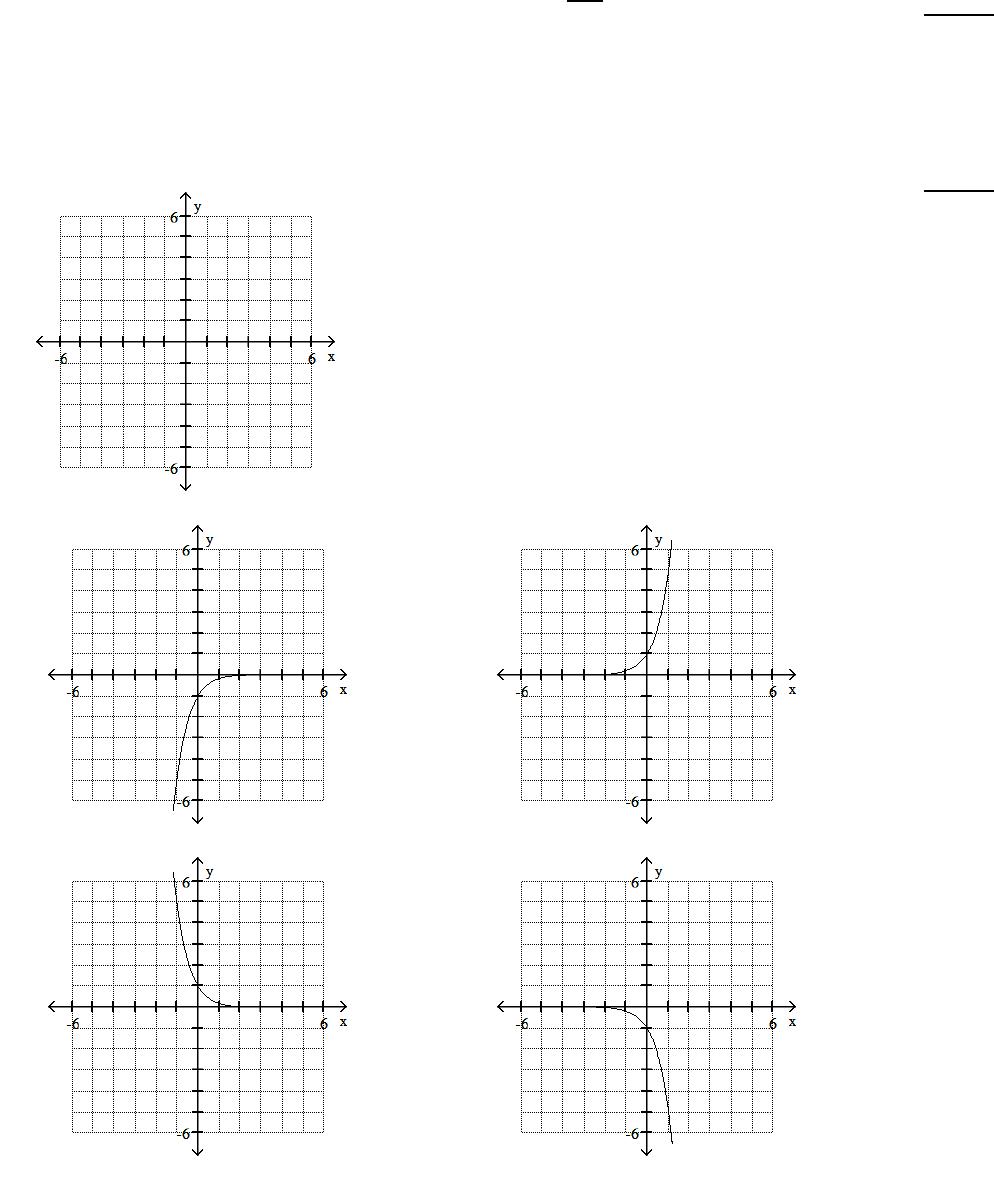
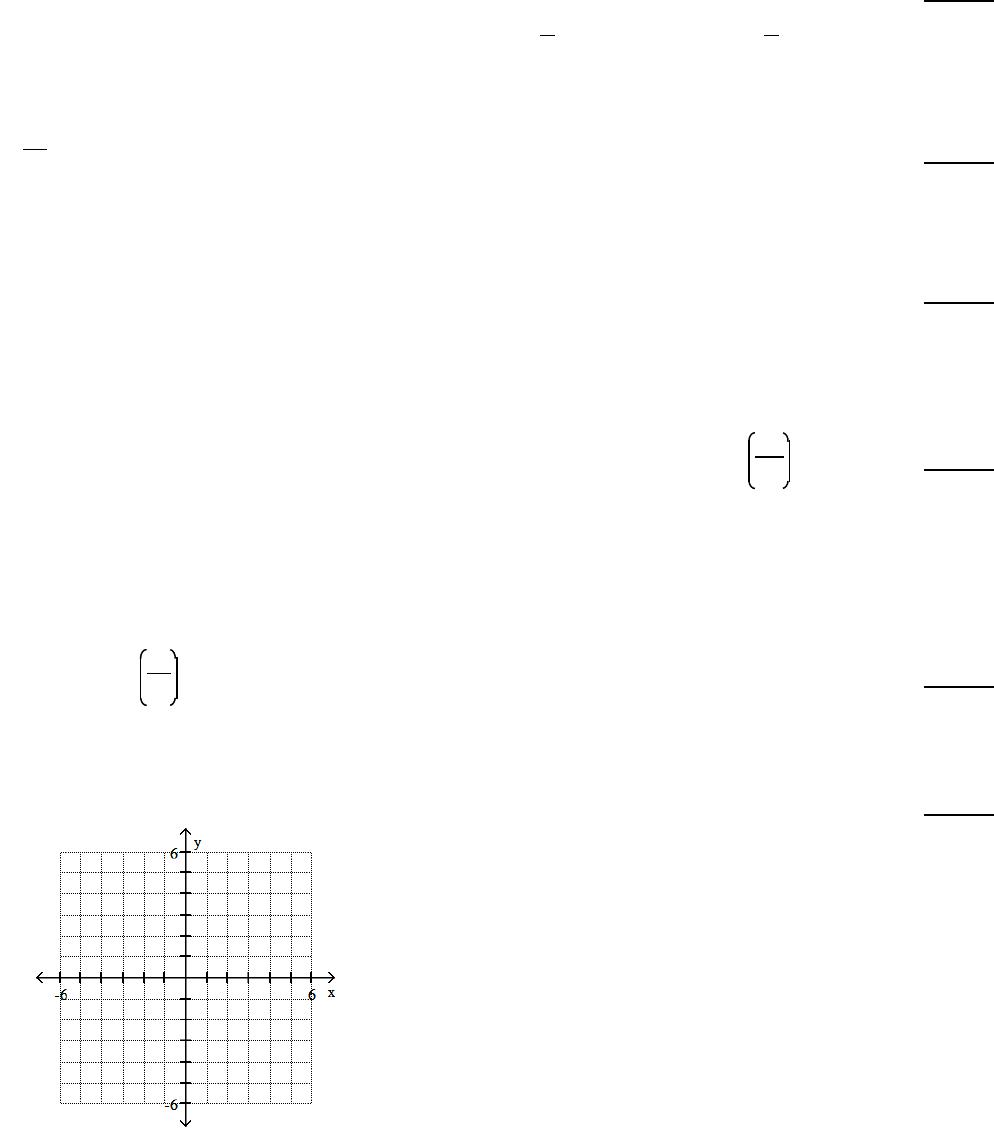
58)
y =5–x
58)
A)
B)
C)
D)
9
Write the expression as a single logarithm.
59)
1 –logb7
59)
A)
logb7b
B)
logb (b –3)
C)
logb3
b
D)
logbb
3
Provide an appropriate response.
60)
ln 1
e9
60)
A)
0.0001
B)
9
C)
8103.084
D)
–9
Write the exponential equation in its equivalent logarithmic form.
61)
105=100,000
61)
A)
log510 =100,000
B)
log10 5=100,000
C)
log5100,000 = 10
D)
log10 100,000 =5
Solve.
62)
The height in feet of males in a certain ethnic group is approximated by H =2.7 + 2 log t
1.2 where
t is the boy’s age and 1
t
18. Use the properties of logarithms to write the expression on the right
side of the equation so that it does not contain the logarithm of a quotient.
62)
A)
H =2.7 + 2log t – log 1.2
B)
H =2.7 + 2(log t + log 1.2)
C)
H =2.7 + 2log t + log 1.2
D)
H =2.7 + 2(log t – log 1.2)
Provide an appropriate response.
63)
Evaluate: log51
25
63)
A)
–2
B)
2
C)
–5
D)
5
Graph the function.
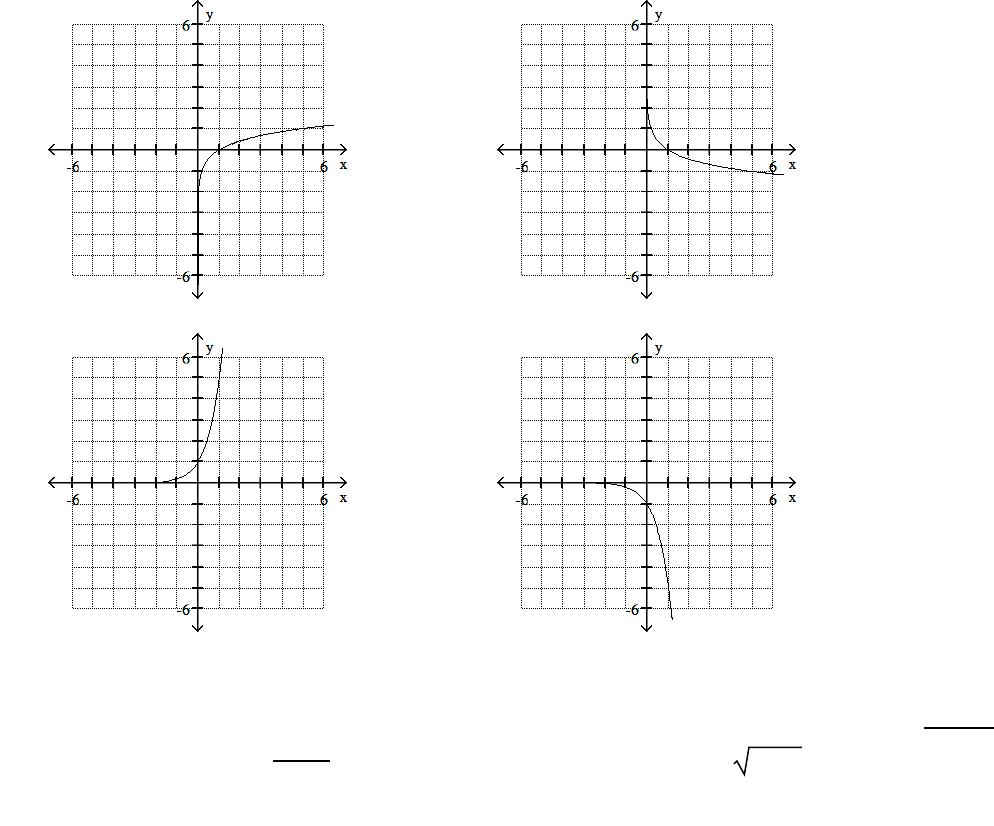
64)
f(x) =log5x
64)
10
A)
B)
C)
D)
Use the power property to rewrite the expression.
65)
log4710
65)
A)
10 + log47
B)
log47
10
C)
10log47
D)
10 log47
11
Graph the function.
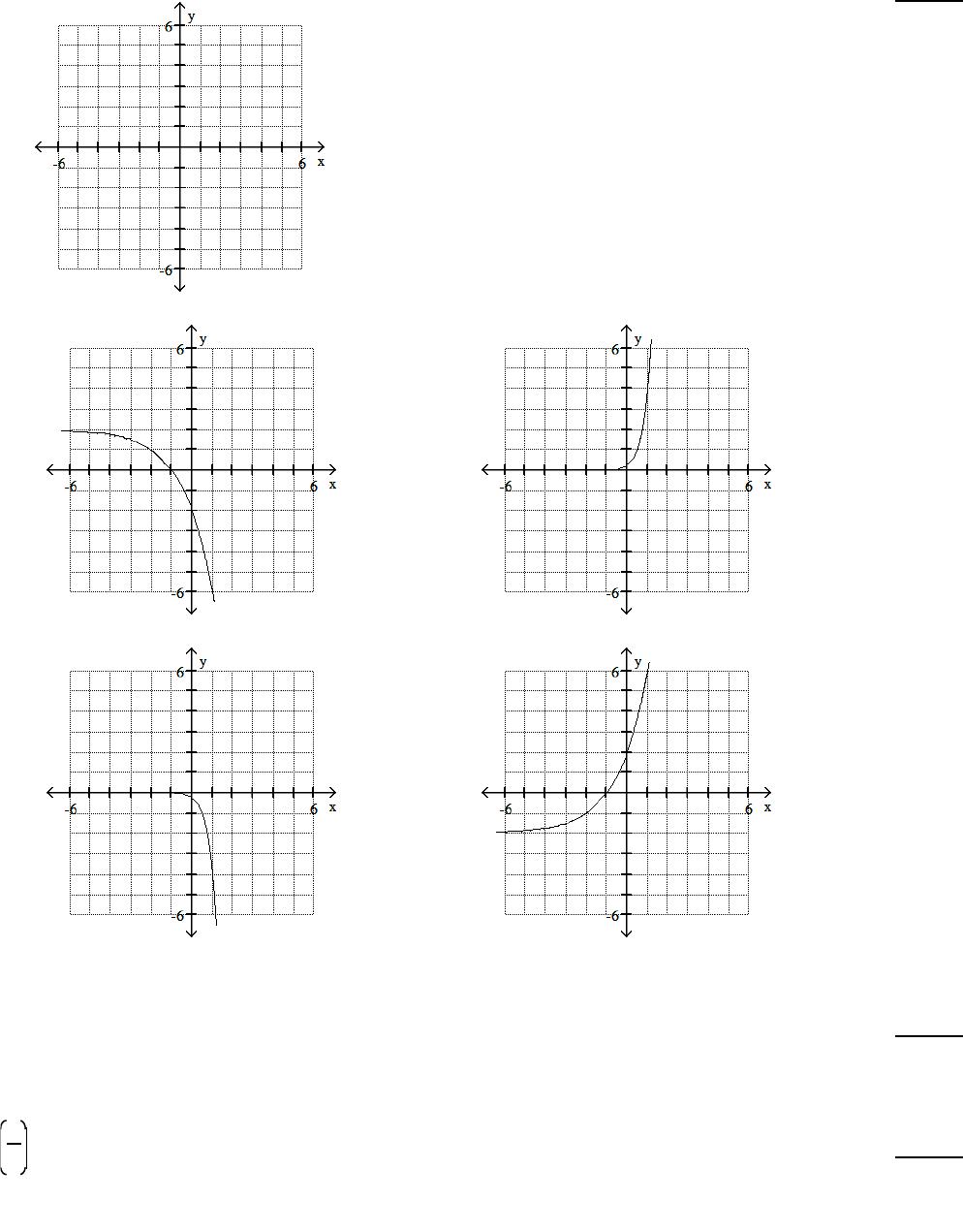
66)
y =24x – 2
66)
A)
B)
C)
D)
Provide an appropriate response.
67)
Evaluate: 7log7 x
67)
A)
x
B)
1
C)
0
D)
7
Solve . Round the answer to three decimal places.
68)
1
4x=24
68)
A)
–0.436
B)
–6.000
C)
2.292
D)
–2.292
12

Use a calculator to approximate the logarithm to four decimal places.
69)
log 7
5
69)
A)
0.3365
B)
0.1461
C)
–0.1461
D)
0.1462
Solve.
70)
log1/3243= x
70)
A)
–5
B)
–1
5
C)
5
D)
1
5
Write the expression as the sum or difference of logarithms.
71)
log3 (81·10)
71)
A)
–4+log310
B)
4+log310
C)
4–log310
D)
81 +log310
Write the logarithmic equation in its equivalent exponential form.
72)
log7343=3
72)
A)
7343=3
B)
73=343
C)
37=343
D)
3433=7
Evaluate.
73)
log44
73)
A)
1
B)
0
C)
4
D)
–1
Write the expression as the sum or difference of logarithms.
74)
logn xy
74)
A)
lognx –logny
B)
lognx +logny
C)
log1x –log1 y
D)
logxn +logxy
75)
logtx(y –6)
75)
A)
logt x +logt (y –6)
B)
logt (xy –6x)
C)
logt x –logt (y –6)
D)
logtx
y –6
76)
log6q
r
76)
A)
log6q·log6r
B)
log6q+log6r
C)
log6q–log6r
D)
log6q÷log6r
Use the power property to rewrite the expression.
77)
logx3y
77)
A)
3+logx y
B)
1
3logx y
C)
logxy
3
D)
3logx y
13
Use a calculator to approximate the logarithm to four decimal places.
78)
log 2.25
78)
A)
0.3324
B)
0.3711
C)
0.3522
D)
0.8109
Solve.
79)
log5 (x +3) +log5 (x –3) =2
79)
A)
34
B)
47
5
C)
34
D)
25
2
Write the logarithmic equation in its equivalent exponential form.
80)
log26 826 =1
8
80)
A)
261/8=826
B)
1
268=26 8
C)
261/8=26 8
D)
1
268=826
Use a calculator to approximate the logarithm to four decimal places.
81)
ln 9
5
81)
A)
0.5879
B)
0.5878
C)
0.5877
D)
0.2553
Evaluate.
82)
log667/8
82)
A)
15
8
B)
–1
8
C)
8
7
D)
7
8
Graph the function.
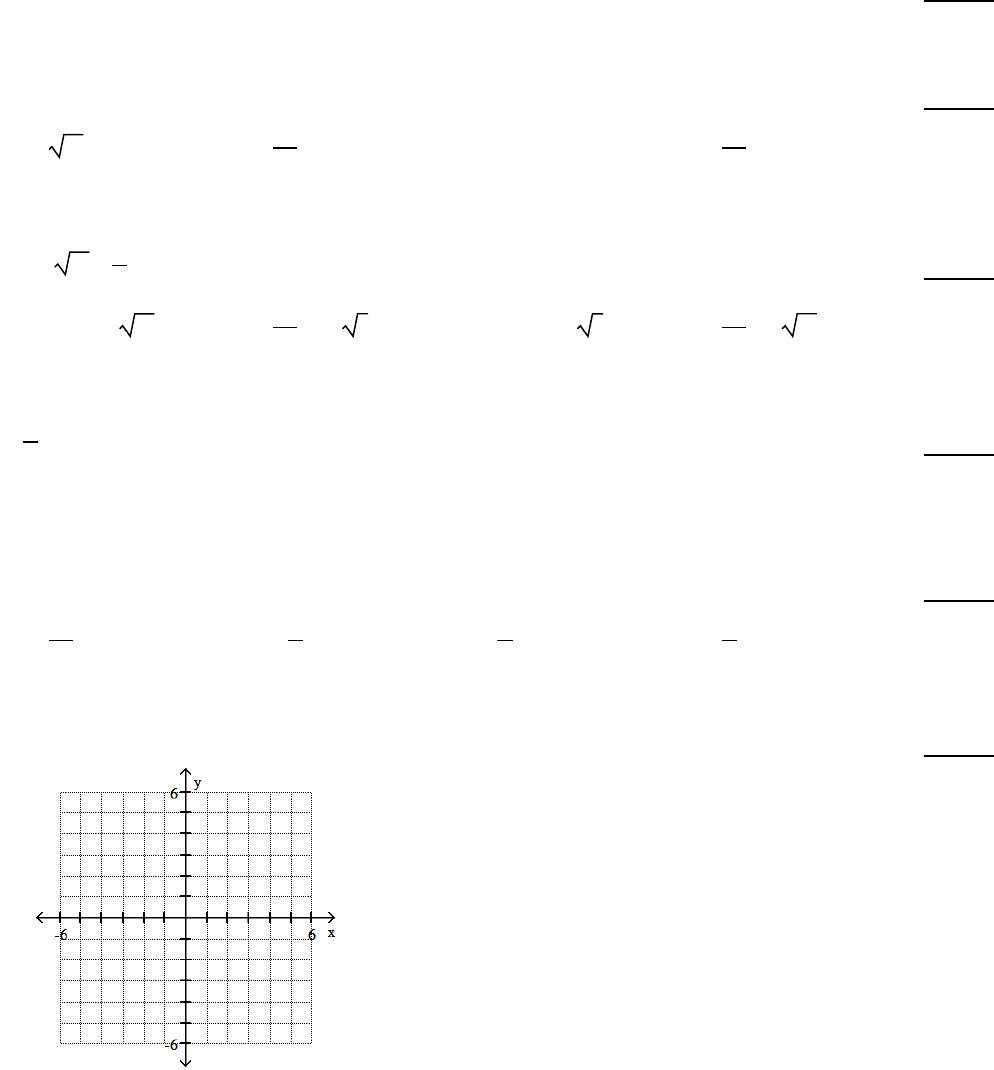
83)
f(x) =log1/8x
83)
14
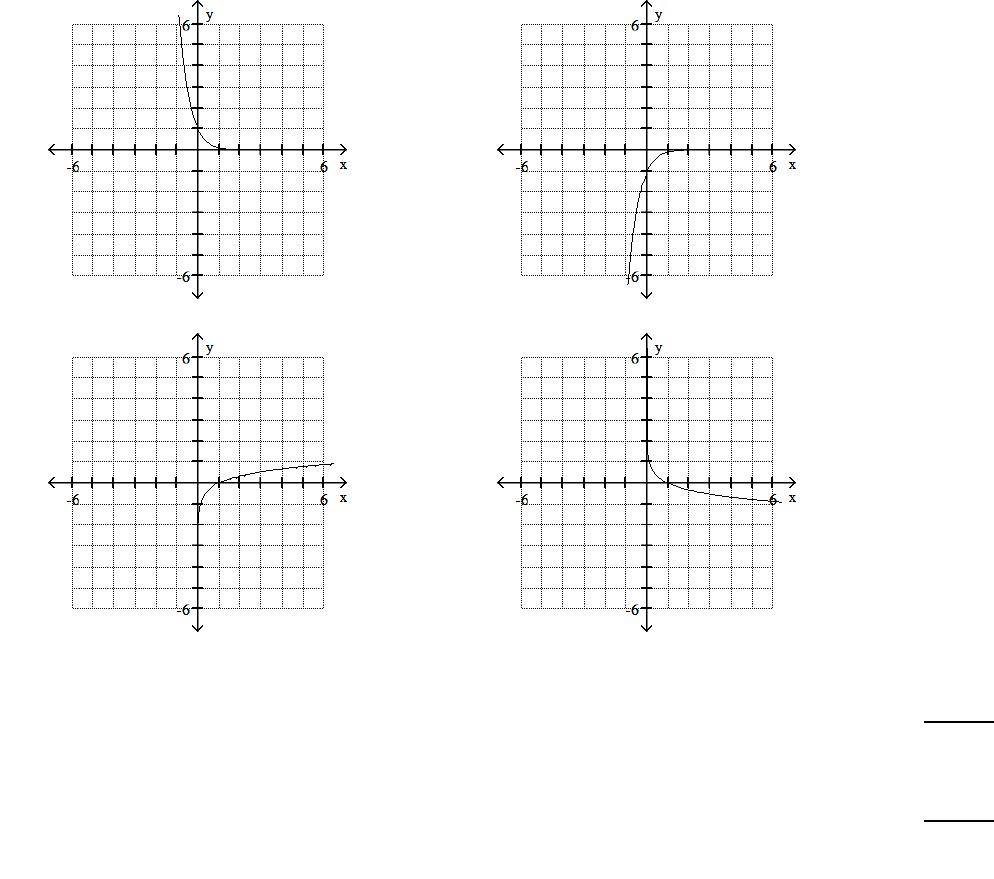
A)
B)
C)
D)
Solve.
84)
log5x =3
84)
A)
125
B)
8
C)
243
D)
15
85)
46–2x =16
85)
A)
–2
B)
2
C)
3
D)
4
15
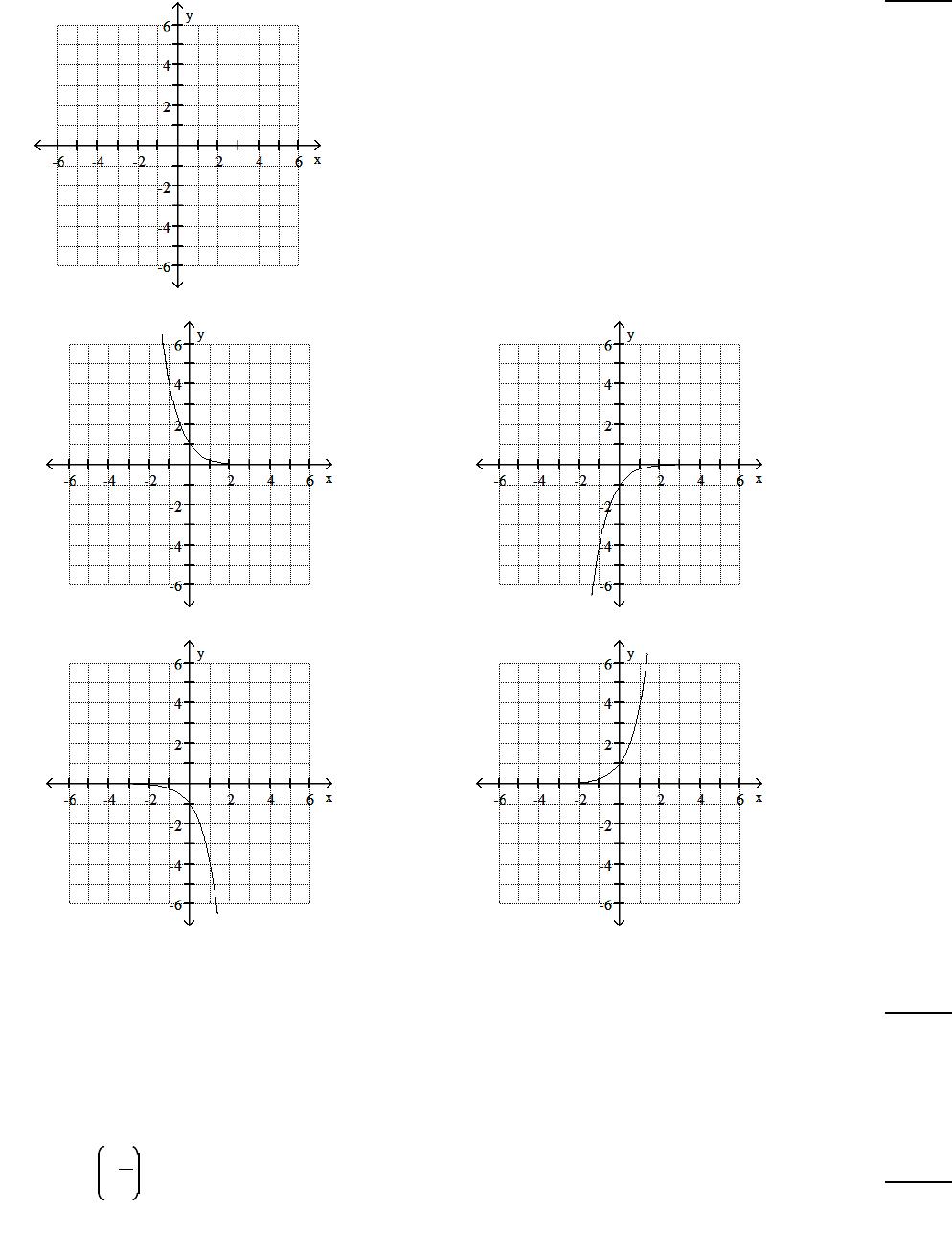
Graph the function.
86)
f(x) =4x
86)
A)
B)
C)
D)
Solve the problem.
87)
How long will it take a sample of radioactive substance to decay to half of its original amount, if it
decays according to the function A(t) =600e–0.163t, where t is the time in years? Round to the
nearest hundredth.
87)
A)
97.80 yr
B)
4.25 yr
C)
43.50 yr
D)
39.24 yr
Evaluate the function for the given value. Round to the nearest thousandth.
88)
f(x) =e3x; f –1
2
88)
A)
4.482
B)
0.002
C)
0.453
D)
0.223
16
Write the expression as the sum or difference of logarithms.
89)
logrr+7
r+2
89)
A)
logr7–logr2
B)
logr (r+7 ) +logr (r+2 )
C)
2 logrr+logr7–logr2
D)
logr (r+7 ) –logr (r+2 )
Solve.
90)
logx36 =2
90)
A)
1
64
B)
–6
C)
64
D)
6
Write the expression as a single logarithm.
91)
log47+log4 (x –8)
91)
A)
log8 (7x –56)
B)
log8 (7x –15)
C)
log4 (7x –56)
D)
log4 (7x –15)
Evaluate.
92)
log1/81 1
3
92)
A)
3· ln4
B)
–4
C)
4
D)
1
4
93)
log 0.01
93)
A)
3
B)
–3
C)
2
D)
–2
Evaluate the function for the given value. Round to the nearest thousandth.
94)
f(x) =e(2x +1); f –3
2
94)
A)
2.718
B)
0.144
C)
0.135
D)
0.130
Solve.
95)
log1/381 = x
95)
A)
4
B)
1
4
C)
–1
4
D)
–4
Solve . Round the answer to three decimal places.
96)
82x =7.5
96)
A)
1.398
B)
0.727
C)
0.363
D)
0.484
Provide an appropriate response.
17
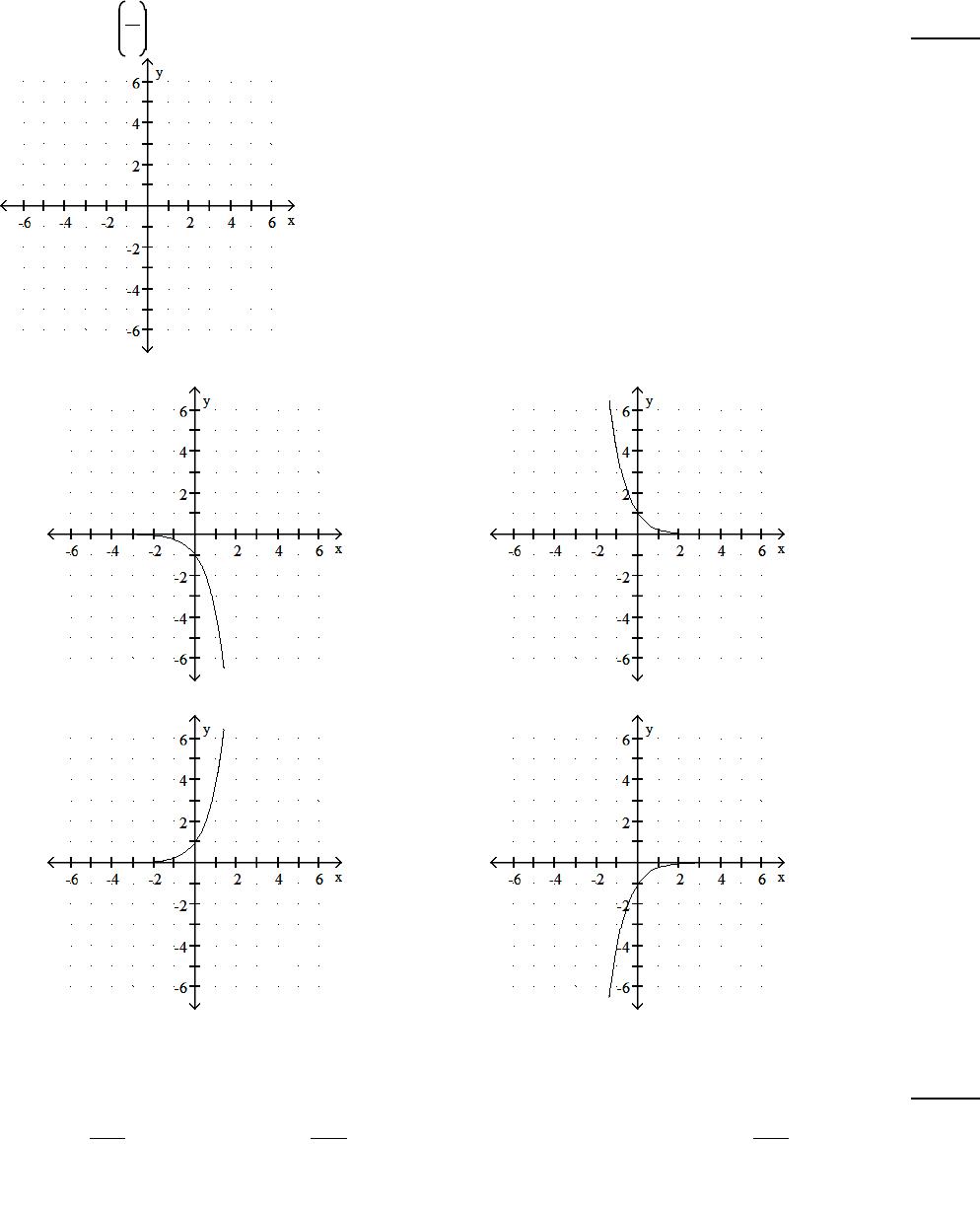
97)
Graph: f(x) =1
4–x
97)
A)
B)
C)
D)
Write the expression as a single logarithm.
98)
logxx–logxy+2logxz
98)
A)
logxxz2
y
B)
logx2xz
y
C)
logxxz2y
D)
logxx
z2y
18
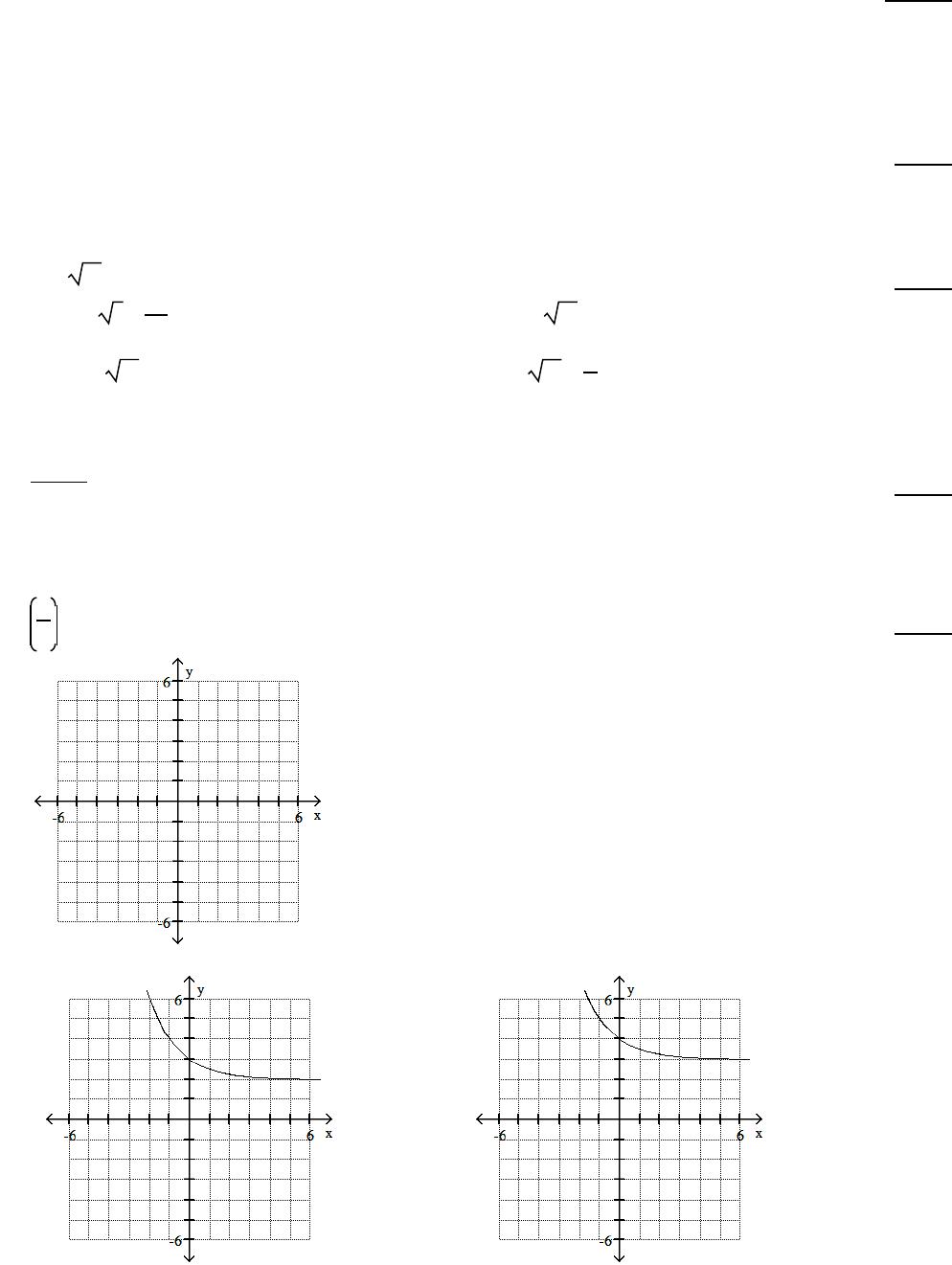
Write the expression as the sum or difference of logarithms.
99)
log26x
99)
A)
log26+log2 x
B)
log26–log2 x
C)
log16–log1 x
D)
log16+log1 x
Provide an appropriate response.
100)
Evaluate: log336
100)
A)
3
B)
6
C)
1
D)
0
Write the exponential equation in its equivalent logarithmic form.
101)
161/6=616
101)
A)
log616 6=1
16
B)
log1/16 616 =6
C)
log1/6616 =16
D)
log16 616 =1
6
Evaluate.
102)
log 1
10,000
102)
A)
4
B)
–4
C)
–5
D)
5
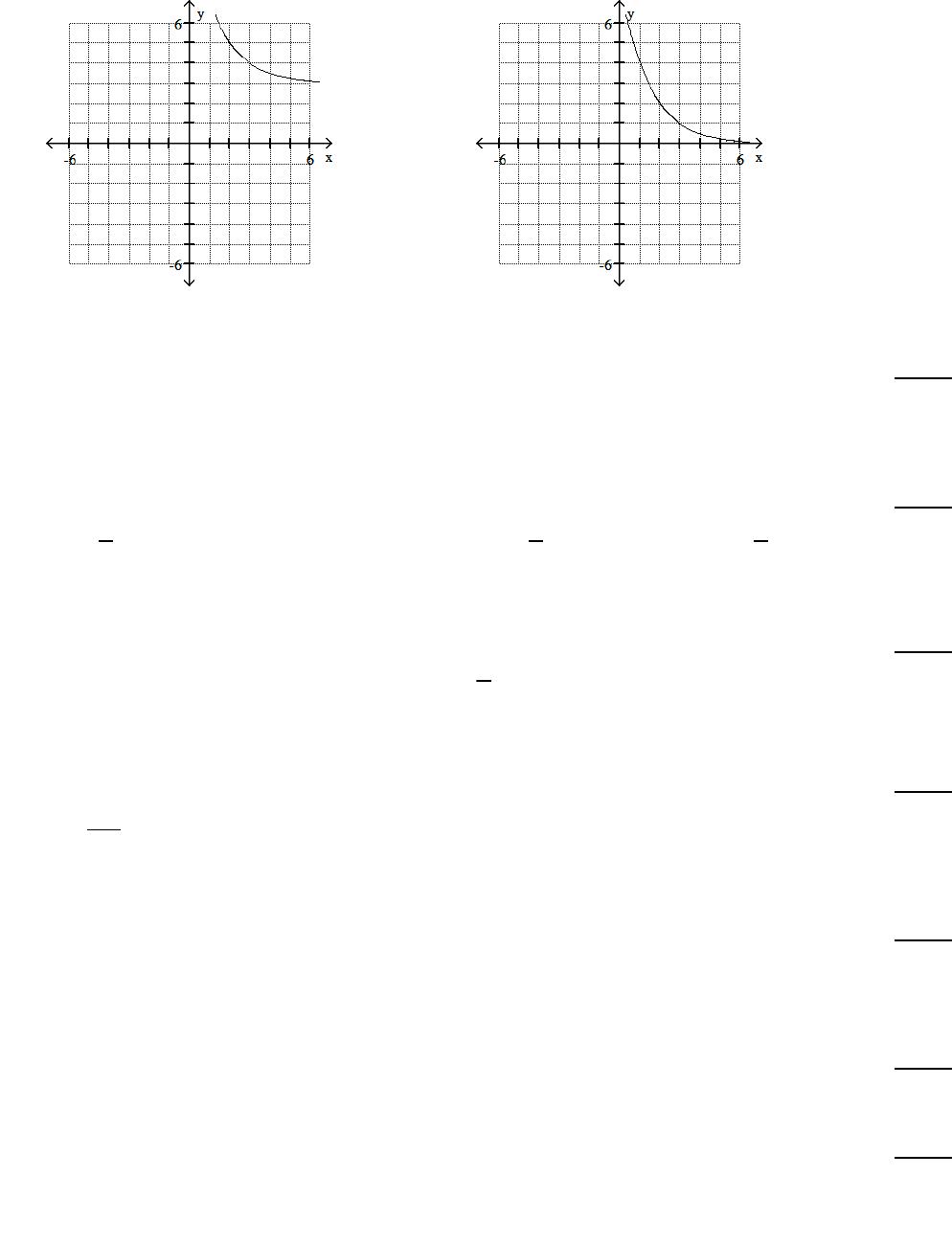
Graph the function.
103)
y =1
2x+ 3
103)
A)
B)
19
C)
D)
Use the power property to rewrite the expression.
104)
log8y9
104)
A)
8log9y9
B)
9log8 y
C)
8log9 y
D)
9log8y9
Write the expression as a single logarithm.
105)
logbz–logbb
105)
A)
logbb
z
B)
logbz– b
C)
logbz
b
D)
log2b z
b
Evaluate.
106)
log1/381
106)
A)
–3· ln (4)
B)
–4
C)
1
4
D)
4
Write the expression as a single logarithm.
107)
4log710 –2log75
107)
A)
log71
400
B)
log79975
C)
log7400
D)
log710,025
Solve the problem.
108)
Sun Woo Kim invested $2000 at 7% compounded monthly. How much will be in the account in 5
years? Round to the nearest cent.
108)
A)
$2835.25
B)
$2059.02
C)
$2805.10
D)
$115,892.85
Provide an appropriate response.
109)
Evaluate, rounding to four decimal places: log395.65
109)
A)
31.8833
B)
4.1513
C)
1.9807
D)
0.2409
110)
Evaluate the function for the given value. Round to four decimal places.
f(x) =ex +3; f(4)
110)
A)
2.7183
B)
1096.6332
C)
57.5981
D)
0.3679
20
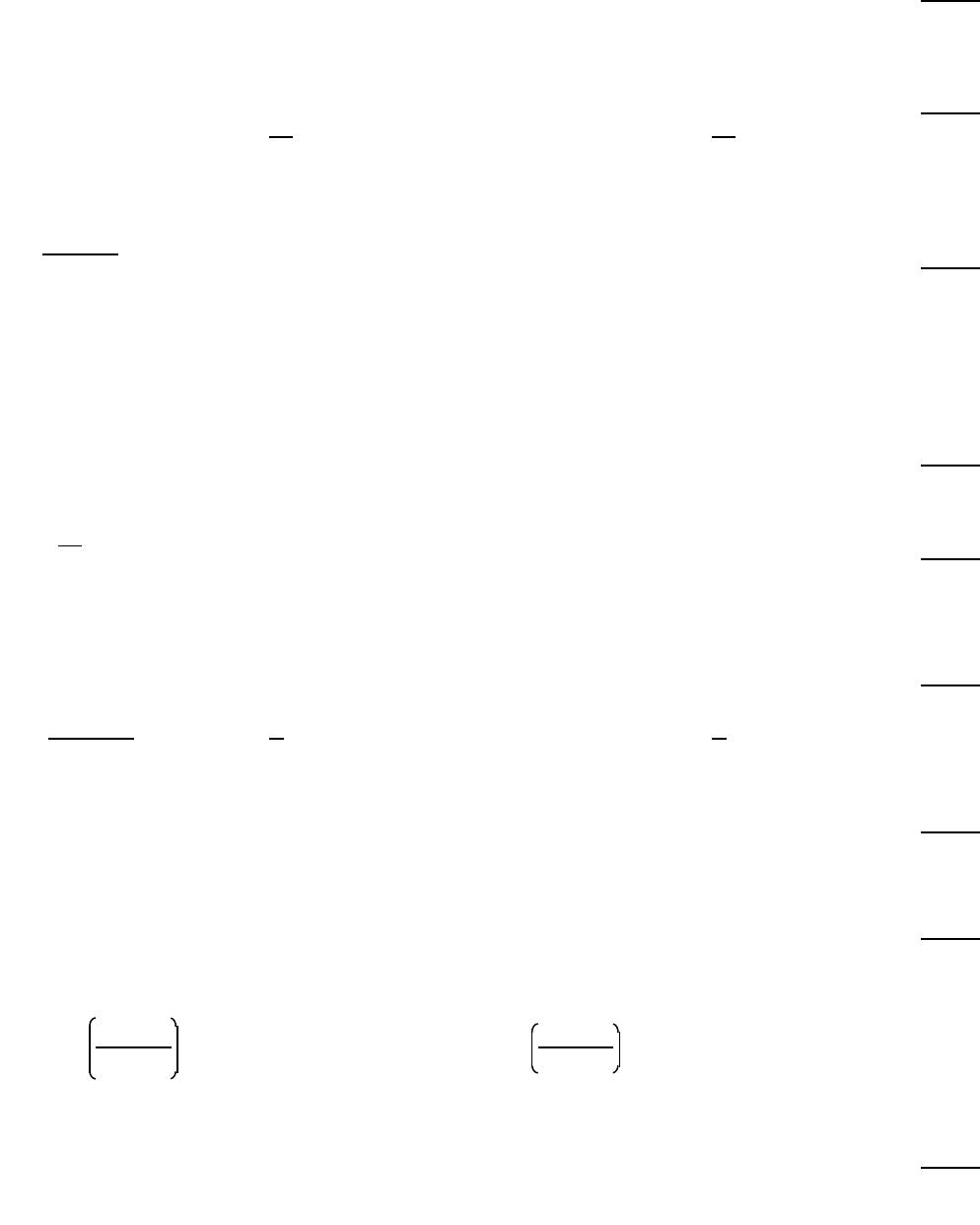
Evaluate.
111)
log 10x
111)
A)
log x
B)
x
C)
10
D)
1
Evaluate the function for the given value.
112)
f(x) =12 +2x; f(–3)
112)
A)
3
B)
95
8
C)
21
D)
97
8
Write the expression as the sum or difference of logarithms.
113)
logbm2
(m – n)5
113)
A)
m2– (m – n)5
B)
2logb m +5logb (m – n)
C)
2logb m – 5logb (m – n)
D)
logb m2+logb (m – n)5
Evaluate.
114)
9log921
114)
A)
22
B)
9
C)
21
D)
20
115)
log1/81
64
115)
A)
8
B)
–8
C)
–2
D)
2
Solve.
116)
log2 (7x –3) =1
116)
A)
log21+3
7
B)
5
7
C)
–2
D)
5
4
117)
83x =5x + 1 (Round to the nearest thousandth.)
117)
A)
0.348
B)
1.774
C)
0.774
D)
3.424
Provide an appropriate response.
118)
Write the expression as a single logarithm: 6logb (x –10) –11 logb x
118)
A)
logb (x11(x –10)6)
B)
logb (66x(x –10))
C)
logb(x –10)6
x11
D)
logb6(x –10)
11x
Use a calculator to approximate the logarithm to four decimal places.
119)
ln 139
119)
A)
51.2915
B)
0.2020
C)
2.1430
D)
4.9345
21

Solve . Round the answer to three decimal places.
120)
e0.094x=19
120)
A)
0.277
B)
0.032
C)
31.324
D)
2.944
Write the expression as the sum or difference of logarithms.
121)
log82
3
121)
A)
log82+log83
B)
log42–log43
C)
log83–log82
D)
log82–log83
122)
log10 x
1000
122)
A)
log10 x+3
B)
log10 x–1000
C)
3–log10 x
D)
log10 x–3
Solve.
123)
log27 x =1
3
123)
A)
3
B)
1
3
C)
–1
3
D)
–3
Solve the problem.
124)
Coyotes are one of the few species of North American animals with an expanding range. The future
population of coyotes in a region of Mississippi can be modeled by the equation
P =55 +16 · ln(13t + 1), where t is time in years. Use the equation to determine approximately how
long it will take the population to reach 160. Round to the nearest year.
124)
A)
59 yr
B)
54 yr
C)
57 yr
D)
62 yr
Write the expression as a single logarithm.
125)
log66+log612
125)
A)
log672
B)
log12 18
C)
log618
D)
log12 72
Evaluate.
126)
xlogx7
126)
A)
1
B)
x
C)
7
D)
7logx 7
Write the expression as a single logarithm.
127)
log8 (x–p) –log8 (x+p)
127)
A)
log8x–p
x+p
B)
log8 (–2p)
C)
log8x+p
x–p
D)
log8 (x–p)(x+p)
Solve . Round the answer to three decimal places.
128)
2x–1=16
128)
A)
3.079
B)
5.000
C)
3.000
D)
9.000
22
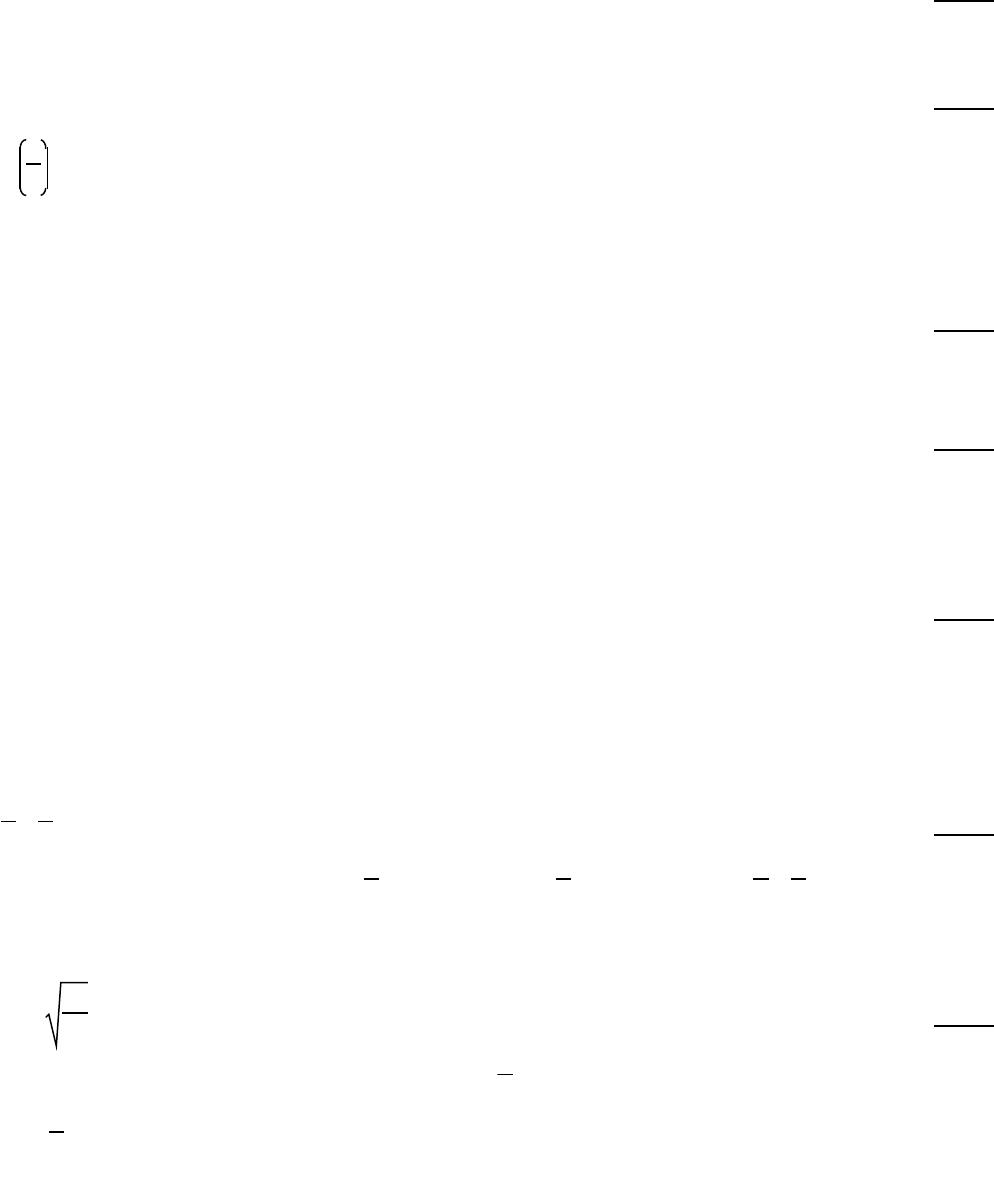
129)
2.5x=0.0074
129)
A)
–5.354
B)
–0.889
C)
2.448
D)
14.749
Solve the problem.
130)
The half–life of a certain radioactive substance is 15 years. Suppose that at time t = 0 , there are 30 g
of the substance. Then after t years, the number of grams of the substance remaining will be N(t) =
30 1
2t/30. How many grams of the substance will remain after 120 years? Round to the nearest
tenth.
130)
A)
0.9 g
B)
0.5 g
C)
1.9 g
D)
0.2 g
Use a calculator to approximate the logarithm to four decimal places.
131)
log90.447
131)
A)
20.1342
B)
–0.3665
C)
–0.3497
D)
–2.7288
Solve the problem.
132)
The number of bacteria growing in an incubation culture increases with time according to
B(x) =4500(4)x, where x is time in days. Find the number of bacteria after 5 days. What was the
initial number of bacteria in the incubation culture?
132)
A)
90,000; 4500
B)
4,608,000; 18,000
C)
1,152,000; 4500
D)
4,608,000; 4500
133)
The hydrogen potential, pH, of a substance is defined by pH = –log10 [H+], where the hydrogen
ion concentration, [H+], is measured in moles per liter. Find the hydrogen ion concentration of a
solution whose pH is 7.2.
133)
A)
0.8573325 moles per liter
B)
6.31 × 10⁻⁸moles per liter
C)
–0.8573325 moles per liter
D)
1.58 × 10⁷moles per liter
Write the exponential equation in its equivalent logarithmic form.
134)
1
3=1
3
134)
A)
log1/3 1 = 0
B)
log1/3 1 =1
3
C)
log1/31
3= 1
D)
log 1
3=1
3
Write the expression as the sum or difference of logarithms.
135)
logb3 x2
y9
135)
A)
logb x –3logb y
B)
1
3logb x2–logb y9
C)
2
3logb x –3logb y
D)
2logb x – 9logby
23

Evaluate.
136)
log64 1
8
136)
A)
8
B)
–1
2
C)
–8
D)
1
2
Solve the problem.
137)
The population of a particular city is increasing at a rate proportional to its size. It follows the
function P(t) = 1 + ke0.09t where k is a constant and t is the time in years. If the current population
is 30,000, in how many years is the population expected to be 75,000? Round to the nearest year.
137)
A)
4 yr
B)
6 yr
C)
72 yr
D)
10 yr
Solve.
138)
The loudness of a sound can be approximated by the formula d = 10 log I
I0, where d is the number
of decibels. The higher the value of d, the louder the sound. Find the number of decibels when
I =10,000 and I0= 1.
138)
A)
40 decibels
B)
14 decibels
C)
4 decibels
D)
10,000 decibels
Use the power property to rewrite the expression.
139)
log6y–7
139)
A)
7log6 y
B)
6log7y–7
C)
–6log7 y
D)
–7log6 y
24
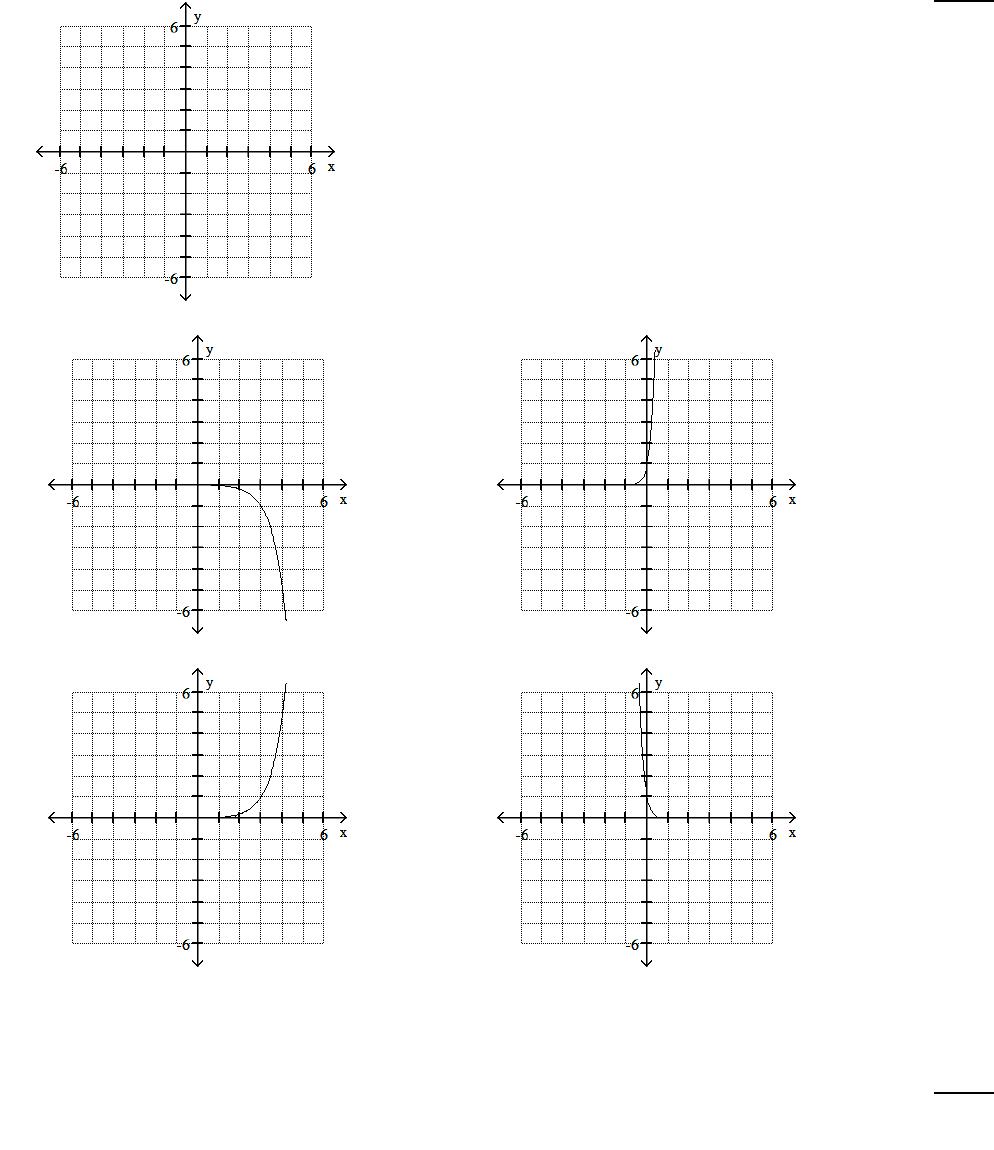
Graph the function.
140)
y =5x – 3
140)
A)
B)
C)
D)
Determine whether the function is a polynomial function, a rational function, a radical function, or an exponential
function.
141)
f(x) =4x–2+16
141)
A)
Polynomial
B)
Rational
C)
Radical
D)
Exponential
25
Write the expression as the sum or difference of logarithms.
142)
log14 32x
142)
A)
1
2log14 32 +1
2log14 x
B)
1
2log14 10 +log14 x
C)
log710 x
D)
1
2log14 10
Solve the problem.
143)
What is the intensity in watt/m2 of a noise measured at 70 decibels? D = 10 log10(S/S0), where S0 is
10–12 watt/m2. Round to two decimal places when necessary.
143)
A)
1.1 × 10¹⁵ watt/m2
B)
1× 10⁻⁴ watt/m2
C)
7× 10⁻¹⁰ watt/m2
D)
1× 10⁻⁵ watt/m2
Write the exponential equation in its equivalent logarithmic form.
144)
1
2
–2=4
144)
A)
log41
2= –2
B)
log(–2) 4=1
2
C)
log1/2(–2) =4
D)
log1/24= –2
Write the expression as a single logarithm.
145)
6log2 (2x + 8) + 3log2(4x – 6)
145)
A)
log2 [(2x + 8)6+(4x – 6)3]
B)
18log2 (2x + 8)(4x – 6)
C)
log2(2x + 8)6
(4x – 6)3
D)
log2(2x + 8)6(4x – 6)3
Use a calculator to approximate the logarithm to four decimal places.
146)
log20050
146)
A)
5.2983
B)
1.3544
C)
3.912
D)
0.7384
Evaluate.
147)
log10 10
147)
A)
1
B)
3
C)
0
D)
–1
Solve.
148)
1
3x=81
148)
A)
–1
4
B)
1
4
C)
4
D)
–4
Determine whether the function is a polynomial function, a rational function, a radical function, or an exponential
function.
149)
f(x) =0.7x6– 8.6
149)
A)
Polynomial
B)
Rational
C)
Radical
D)
Exponential
26
Solve the problem.
150)
The level of a sound in decibels (db) is determined by the formula
sound level = 10 · log(I ×1012) db, where I is the intensity of the sound in watts per square meter.
What is the intensity of a noise measured at 83 db? Express the answer in scientific notation,
rounded to two decimal places.
150)
A)
4.02 × 10¹⁵ watt/m2
B)
8.30 × 10⁻¹⁰ watt/m2
C)
2.00 × 10⁻⁴ watt/m2
D)
2.00 × 10⁻³ watt/m2
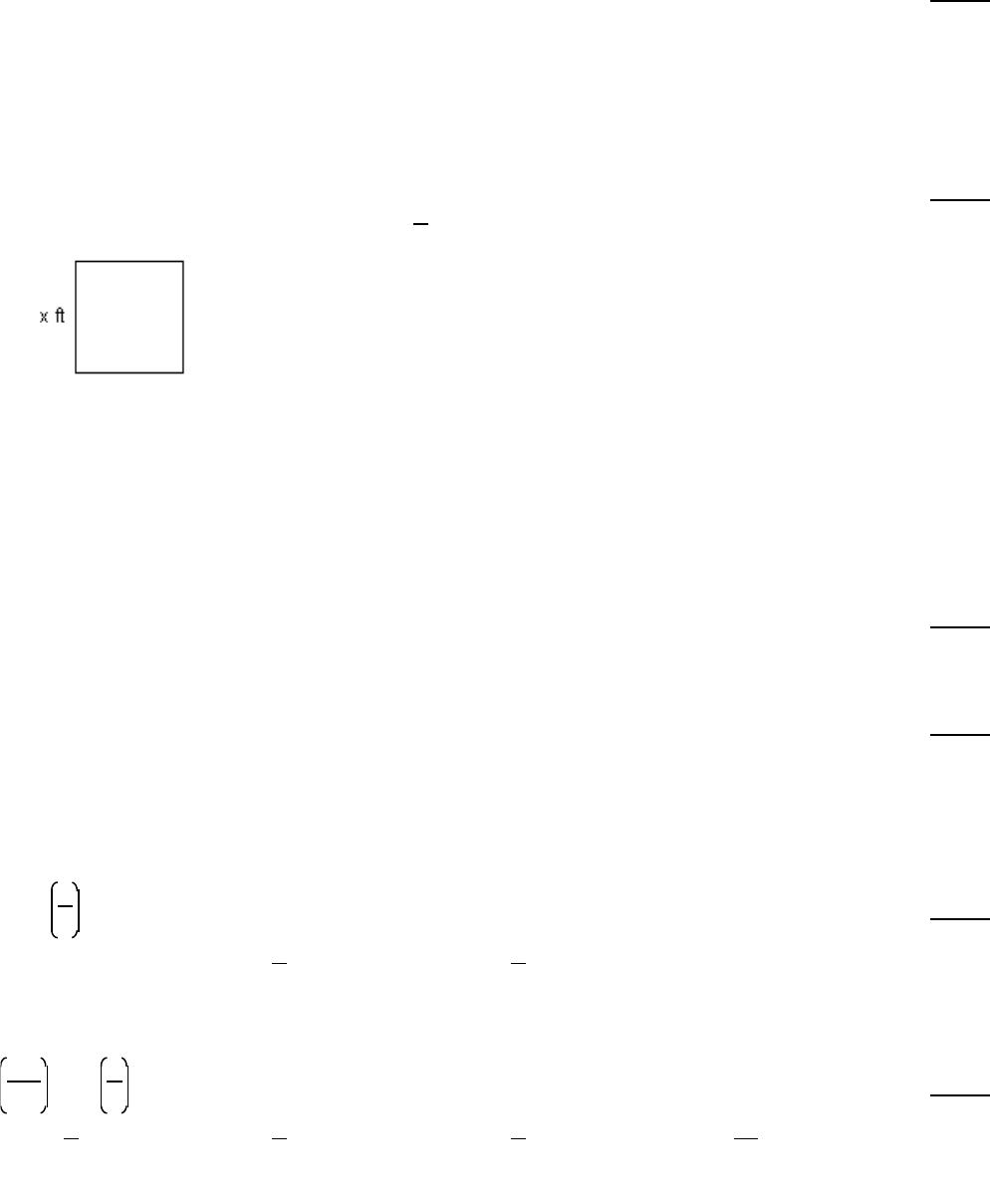
151)
The length of the side of the fence surrounding the square garden shown in the following diagram
can be found by solving the equation log25 x =1
2. What does the base in the equation represent?
151)
A)
The area enclosed by the fence
B)
The square of the length of the side of the fence
C)
The perimeter surrounded by the fence
D)
The volume of the garden
Determine whether the function is a polynomial function, a rational function, a radical function, or an exponential
function.
152)
f(x) =e2x
152)
A)
Polynomial
B)
Rational
C)
Radical
D)
Exponential
Solve the problem.
153)
The volume of space in a landfill, measured in meters cubed, decreases with time as given by the
function F(t) =300 – 50 log5(4t + 1), where t is measured in years. How much space is left when t =
6?
153)
A)
220 m3
B)
200 m3
C)
400 m3
D)
110 m3
Evaluate the function for the given value.
154)
f(x) =1
5x; f(–1)
154)
A)
5
B)
1
5
C)
–1
5
D)
–5
Solve.
155)
625
16 x+1=2
5 x–1
155)
A)
–6
5
B)
3
5
C)
–3
5
D)
–3
10
27
Determine whether the function is a polynomial function, a rational function, a radical function, or an exponential
function.
156)
f(x) =2x1/2
156)
A)
Polynomial
B)
Rational
C)
Radical
D)
Exponential
Provide an appropriate response.
157)
Write the expression as the sum or difference of logarithms: log5(25x)
157)
A)
2+log5 x
B)
2log5 x
C)
10 +log5 x
D)
2x
Determine whether the function is a polynomial function, a rational function, a radical function, or an exponential
function.
158)
f(x) =1
327x
158)
A)
Polynomial
B)
Rational
C)
Radical
D)
Exponential
Solve.
159)
4x=1
256
159)
A)
4
B)
1
64
C)
–4
D)
1
4
160)
5x=125
160)
A)
3
B)
4
C)
2
D)
25
Evaluate.
161)
log50.01
161)
A)
5–2
B)
–2
5
C)
–2
D)
–10
Write the logarithmic equation in its equivalent exponential form.
162)
log1/7343= –3
162)
A)
1
7
–3=343
B)
7343= –3
C)
(–3)1/7=343
D)
343 –3=1
7
Write the expression as the sum or difference of logarithms.
163)
logx x7 y4
163)
A)
7logx x + 4logx y
B)
(7logx x)(4logx y)
C)
4logx x –7logx y
D)
7logx x –4logx y
Solve . Round the answer to three decimal places.
164)
43x–2=15
164)
A)
1.917
B)
1.107
C)
–0.016
D)
1.318
28
Write the exponential equation in its equivalent logarithmic form.
165)
2–2=1
4
165)
A)
log1/42= –2
B)
log2(–2 )=1
4
C)
log–21
4=2
D)
log21
4= –2
Evaluate the function for the given value.
166)
f(x) =41+ 2x ; f(2)
166)
A)
256
B)
–2
C)
8
D)
1024
Provide an appropriate response.
167)
Write the expression as a single logarithm: (logmm–logmn) +4logmk
167)
A)
logmmk4n
B)
logmmk4
n
C)
logmm
k4n
D)
logm4mk
n
Write the expression as a single logarithm.
168)
1
3[logw (x2–16) –logw (x –4)]
168)
A)
logw3x +4
B)
logw (x2–16)
logw (x –4)
C)
logw3(x2–16)(x –4)
D)
logw1
3(x2–16) – (x –4)
Solve.
169)
256x=4
169)
A)
–4
B)
4
C)
–1
4
D)
1
4
Solve the problem.
170)
Suppose f(x) =30.2 +1.3 log(x + 1) models salinity of ocean water to depths of 1000 meters at a
certain latitude. x is the depth in meters and f(x) is the salinity in grams of salt per kilogram of
seawater (expressed as parts per thousand or ppt). Approximate the salinity, to the nearest
hundredth, when the depth is 140 meters.
170)
A)
63.61 ppt
B)
–27.41 ppt
C)
32.99 ppt
D)
66.21 ppt
Evaluate.
171)
log91
171)
A)
0
B)
9
C)
1
D)
–1
Solve the problem.
172)
In chemistry, the pH of a substance can be determined using the formula pH = –log [H+], where [
H+] represents the hydrogen ion concentration. Determine the pH of the solution which has a
hydrogen concentration of 7.0 × 10⁻¹². Round to the nearest tenth.
172)
A)
–12.8
B)
11.2
C)
11.6
D)
12.8
29
173)
The annual depreciation rate r (0 < r < 1) of a car purchased for P dollars and worth A dollars after t
years can be modeled by the following formula: log (1 – r) =1
t log A
P. Find the depreciation rate of
a car that is purchased for $30,000 and is sold 4 years later for $16,000. Express the answer as a
percent and round to the nearest whole percent.
173)
A)
15%
B)
85%
C)
–15%
D)
–85%
Provide an appropriate response.
174)
Evaluate: log66
174)
A)
2
B)
–2
C)
1
2
D)
–1
2
Solve.
175)
logx6
5=1
175)
A)
1
B)
6
5
C)
6
D)
5
6
Write the expression as a single logarithm.
176)
1
5(4log8x –2log8z)
176)
A)
log85 x4
z2
B)
5log8x4
z2
C)
log85 z4
x2
D)
log854x
2z
Solve the problem.
177)
The number of books in a small library increases according to the function B =4800e0.05t, where t is
measured in years. How many books will the library have after 10 years?
177)
A)
15,179
B)
3327
C)
7914
D)
1445
Use a calculator to approximate the logarithm to four decimal places.
178)
log 0.0701
178)
A)
–1.1543
B)
–1.1605
C)
–1.1481
D)
–2.6578
Write the expression as the sum or difference of logarithms.
179)
log5x9 y2
4
179)
A)
9log5 x – 2log5 y –log54
B)
9log5 x + 2log5 y –log54
C)
(9log5 x)(2log5 y) –log54
D)
9log5 x + 2log5 y +log54
Evaluate the function for the given value.
180)
f(x) =6x; f(2)
180)
A)
46,656
B)
12
C)
36
D)
64
Evaluate.
181)
ln e5
181)
A)
5ln e
B)
e5
C)
5
D)
5e
30

Solve.
182)
logx81 = –4
182)
A)
3
B)
1
3
C)
–1
3
D)
–3
Solve the problem.
183)
An economist predicts that the buying power B(x) of a dollar x years from now will be given by the
formula B(x) =0.6x. How much will today’s dollar be worth in 3 years? Round to the nearest cent.
183)
A)
$1.80
B)
$0.86
C)
$1.93
D)
$0.22
Write the exponential equation in its equivalent logarithmic form.
184)
84/3 =16
184)
A)
log48=4
3
B)
log16 8=4
3
C)
log316
log48=8
D)
log816 =4
3
Solve.
185)
The formula for the pH of a solution is given by the logarithmic equation pH = –log [H+], where [
H+] is the concentration of hydrogen ions. The concentration of hydrogen ions of a specific solution
is 10–7. Calculate the pH of this solution.
185)
A)
6.6
B)
–7.8
C)
–7
D)
7
Write the expression as a single logarithm.
186)
2logbx–2
3logby+1
6logbw– 6logbz
186)
A)
logbx2w1/6
y2/3 z6
B)
logbx2z6
w1/6y2/3
C)
logb (2 x –2
3y+1
6w– 6 z )
D)
logbx2y2/3
w1/6z6
Solve . Round the answer to three decimal places.
187)
100–x=13
187)
A)
–0.557
B)
0.596
C)
0.557
D)
–0.596
Evaluate.
188)
log81
64
188)
A)
8
B)
–2
C)
2
D)
–8
Solve.
189)
5x=25
189)
A)
2
B)
1
C)
5
D)
0
Use a calculator to approximate the logarithm to four decimal places.
190)
ln 0.981
190)
A)
0.0192
B)
–0.0083
C)
0.0083
D)
–0.0192
31
Solve.
191)
log125625= x
191)
A)
3
4
B)
4
3
C)
–4
3
D)
–3
4
Evaluate.
192)
ln e2x
192)
A)
e2x
B)
2xln e
C)
2x
D)
x
Solve . Round the answer to three decimal places.
193)
e–0.12t=0.22
193)
A)
–10.096
B)
–17.782
C)
9.219
D)
12.618
Write the expression as a single logarithm.
194)
logat+ logas
194)
A)
logat
s
B)
logat· logas
C)
loga (t+ s)
D)
logat s
Solve the problem.
195)
The population of a particular city is increasing at a rate proportional to its size. It follows the
function P(t) = 1 + ke0.06t where k is a constant and t is the time in years. If the current population
is 16,000, in how many years is the population expected to be 40,000? Round to the nearest year.
195)
A)
15 yr
B)
8 yr
C)
7 yr
D)
92 yr
196)
A certain noise has an intensity I of 5.35 ×10⁻⁴. Given that decibel level D is related to intensity by
D = 10 log I
I0, where I0 is 10–12, determine the decibel level of the noise. Round to the nearest
decibel.
196)
A)
201 decibels
B)
77 decibels
C)
9 decibels
D)
87 decibels
Graph the function.
197)
f(x) = –log2x
197)
32
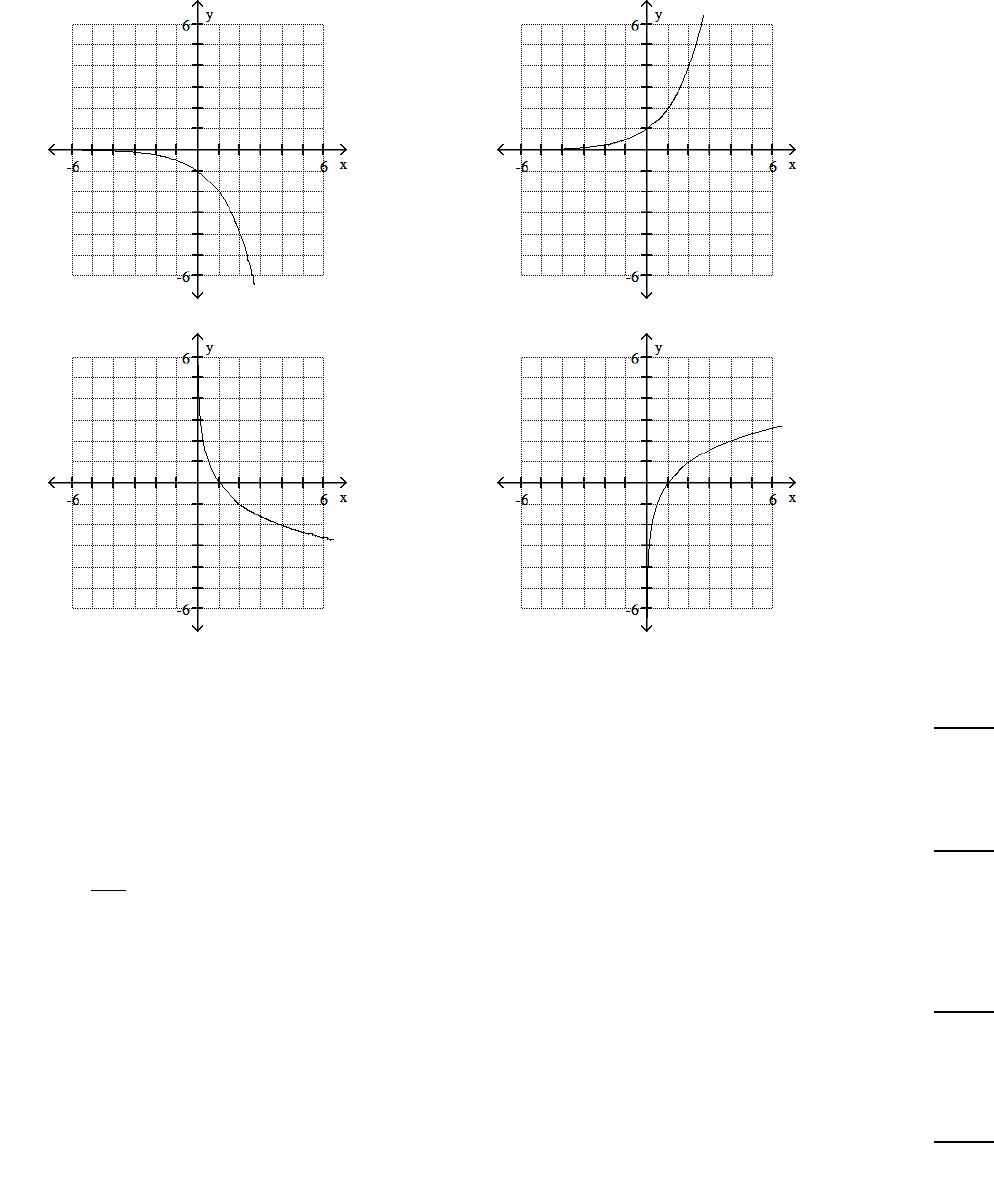
A)
B)
C)
D)
Solve.
198)
log3 (x2– 208) =4
198)
A)
–17, 17
B)
–18, 18
C)
17
D)
18
Write the expression as a single logarithm.
199)
4log65+log62
199)
A)
log6625
2
B)
log61250
C)
log6627
D)
log62048
Evaluate.
200)
log5515
200)
A)
15
B)
14
C)
16
D)
5
Evaluate the function for the given value. Round to the nearest thousandth.
201)
f(x) = –ex; f(2)
201)
A)
–0.693
B)
–7.389
C)
5.437
D)
–8.166
33

Solve.
202)
The height in feet of males in a certain ethnic group is approximated by H =2.6 + 2 log (0.84t)
where t is the boy’s age and 1 t
18. Use the properties of logarithms to write the expression on
the right side of the equation so that it does not contain the logarithm of a product.
202)
A)
H =2.6 + 2 log 0.84 + log t
B)
H =2.6 + 2(log 0.84 – log t)
C)
H =2.6 + 2(log 0.84 + log t)
D)
H =2.6 + 2 log 0.84 – log t
203)
Suppose the number of Quickie hamburgers (in millions) served yearly can be modeled by
f(x) =37.9e0.14x. Approximate how many years it takes for the number of hamburgers served to
reach 101 million. Round to the nearest year.
203)
A)
9 yr
B)
8 yr
C)
7 yr
D)
6 yr
Write the logarithmic equation in its equivalent exponential form.
204)
log1255=1
3
204)
A)
1253=1
5
B)
1251/5=3
C)
31/5=125
D)
1251/3=5
34
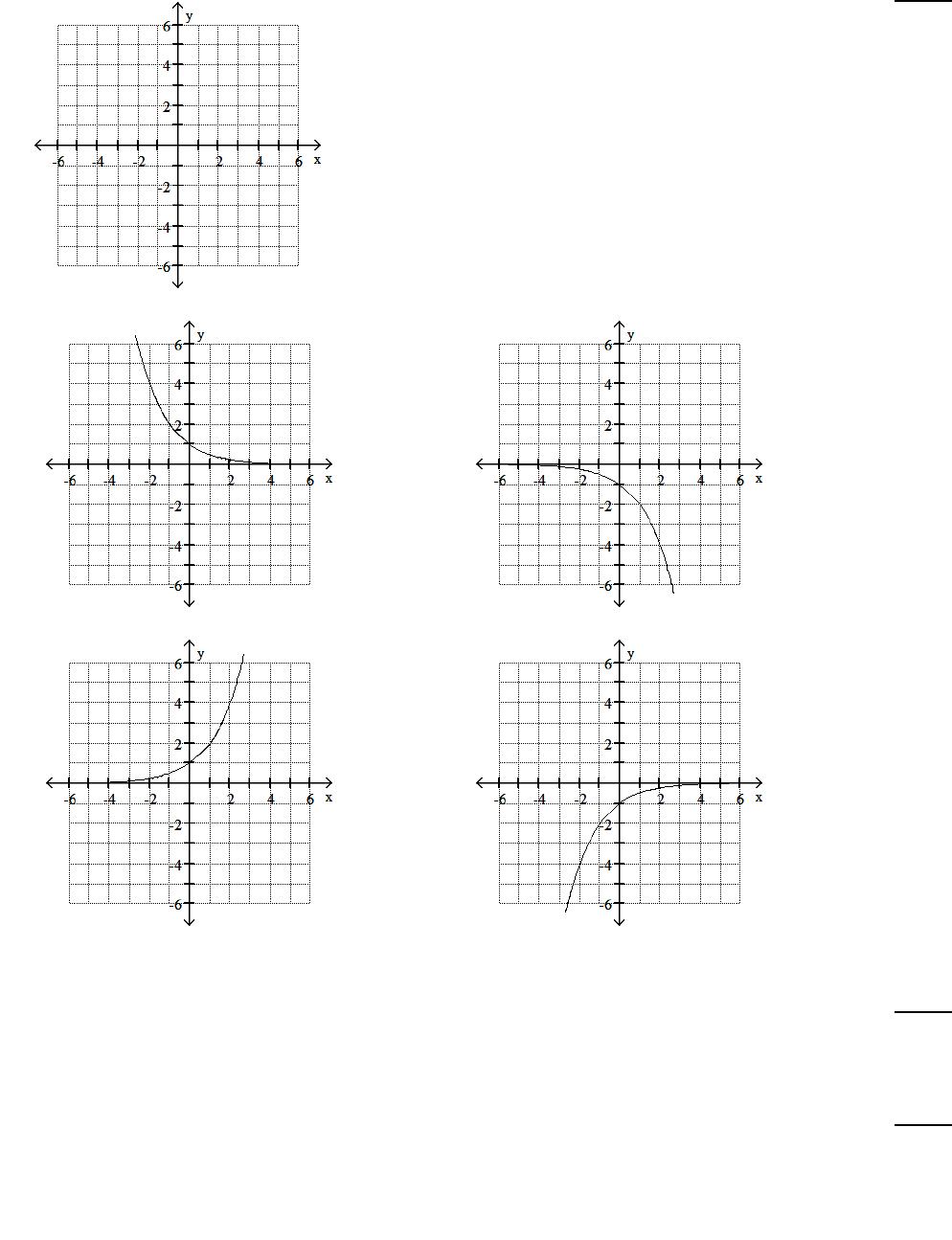
Graph the function.
205)
f(x) = –2x
205)
A)
B)
C)
D)
Use a calculator to approximate the logarithm to four decimal places.
206)
log421.95
206)
A)
5.4875
B)
0.4488
C)
1.3414
D)
2.2281
Solve the problem.
207)
The number of visitors to a tourist attraction (for the first few years after its opening) can be
approximated by V(x) = 50 + 10 log2x, where x represents the number of months after the
opening of the attraction. Find the number of visitors 32 months after the opening of the attraction.
207)
A)
82 visitors
B)
55 visitors
C)
370 visitors
D)
100 visitors
35

Write the exponential equation in its equivalent logarithmic form.
208)
321/5 =2
208)
A)
log52
log132 =32
B)
log32 2=1
5
C)
log232 =1
5
D)
log132 =1
5
36
Answer Key
Testname: C11
37
Answer Key
Testname: C11
Answer Key
Testname: C11
Answer Key
Testname: C11
40

Answer Key
Testname: C11
41