
185)
f(x) =4x2+ 12x + 7
A)
-3 ±2
8, 0 , (0, -7)
B)
-3 ±1
2, 0 , (0, -7)
C)
-12 ±2
2, 0 , (0, 7)
D)
-3 ±2
2, 0 , (0, 7)
186)
f(x) =4x2+ 12x + 7
A)
-3 ±2
8, 0 , (0, -7)
B)
-3 ±2
2, 0 , (0, 7)
C)
-12 ±2
2, 0 , (0, 7)
D)
-3 ±1
2, 0 , (0, -7)
187)
f(x) = x2– 5x + 19
A)
5±101
2, 0 , (0, -19)
B)
5±101
2, 0 , (0, 19)
C)
No x–intercepts, (0, 19)
D)
No x–intercepts, (0, -19)
188)
f(x) = – x2– 5x – 9
A)
5±61
2, 0 , (0, -9)
B)
No x–intercepts, (0, -9)
C)
No x–intercepts, (0, 9)
D)
5±61
2, 0 , (0, 9)
189)
f(x) =12x2+ 9x + 20
A)
No x–intercepts, (0, -20)
B)
-9 ±1041
2, 0 , (0, -20)
C)
-9 ±1041
2, 0 , (0, 20)
D)
No x–intercepts, (0, 20)
Solve.
190)
Which of the pairs of numbers whose sum is 90 has the largest product?
A)
39 and 51
B)
45 and 45
C)
44 and 46
D)
35 and 55
191)
The length and width of a rectangle have a sum of 82. What dimensions give the maximum area?
A)
Length 41 and width 41
B)
Length 31 and width 51
C)
Length 40 and width 42
D)
Length 32 and width 50
192)
What is the maximum product of two positive numbers whose sum is 82?
A)
20.5
B)
41
C)
1681
D)
3362

193)
What is the minimum product of two numbers whose difference is 4?
A)
-8
B)
-2
C)
-4
D)
-1
194)
A gardener is fencing off a rectangular area with a fixed perimeter of 96 ft. What is the maximum area?
A)
6 ft2
B)
576 ft2
C)
24 ft2
D)
2304 ft2
B
195)
A projectile is thrown upward so that its distance, in feet, above the ground after t seconds is h =-14t2+ 420t.
What is its maximum height?
A)
141,330 ft
B)
3150 ft
C)
9675 ft
D)
5684 ft
B
196)
A projectile is thrown upward so that its distance above the ground after t seconds is h =-15t2+ 390t. After how
many seconds does it reach its maximum height?
A)
19.5 sec
B)
6 sec
C)
26 sec
D)
13 sec
D
197)
John owns a hotdog stand. He has found that his profit is represented by the equation P = – x2+ 76x + 80, with P
being the profit in dollars, and x the number of hotdogs sold. How many hotdogs must he sell to earn the most
profit?
A)
38 hotdogs
B)
42 hotdogs
C)
21 hotdogs
D)
39 hotdogs
A
198)
Bob owns a watch repair shop. He has found that the cost of operating his shop is given by c =3x2– 186x + 53,
where c is the cost in dollars, and x is the number of watches repaired. How many watches must he repair to
have the lowest cost?
A)
30 watches
B)
53 watches
C)
26 watches
D)
31 watches
D
199)
The number of mosquitoes M(x), in millions, in a certain area depends on the June rainfall x, in inches:
M(x) =18x – x2. What rainfall produces the maximum number of mosquitoes?
A)
0 inches
B)
18 inches
C)
324 inches
D)
9 inches
D
C
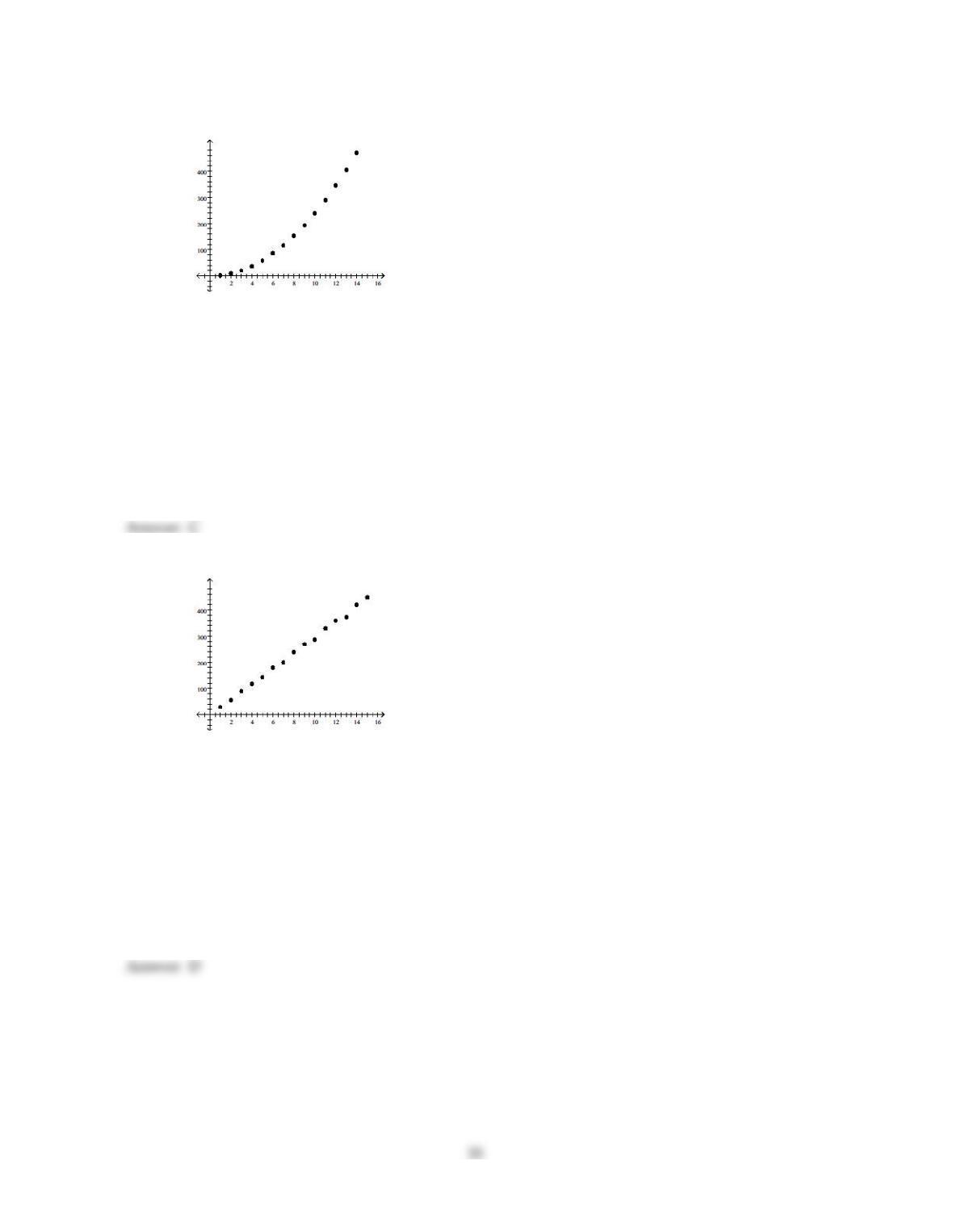
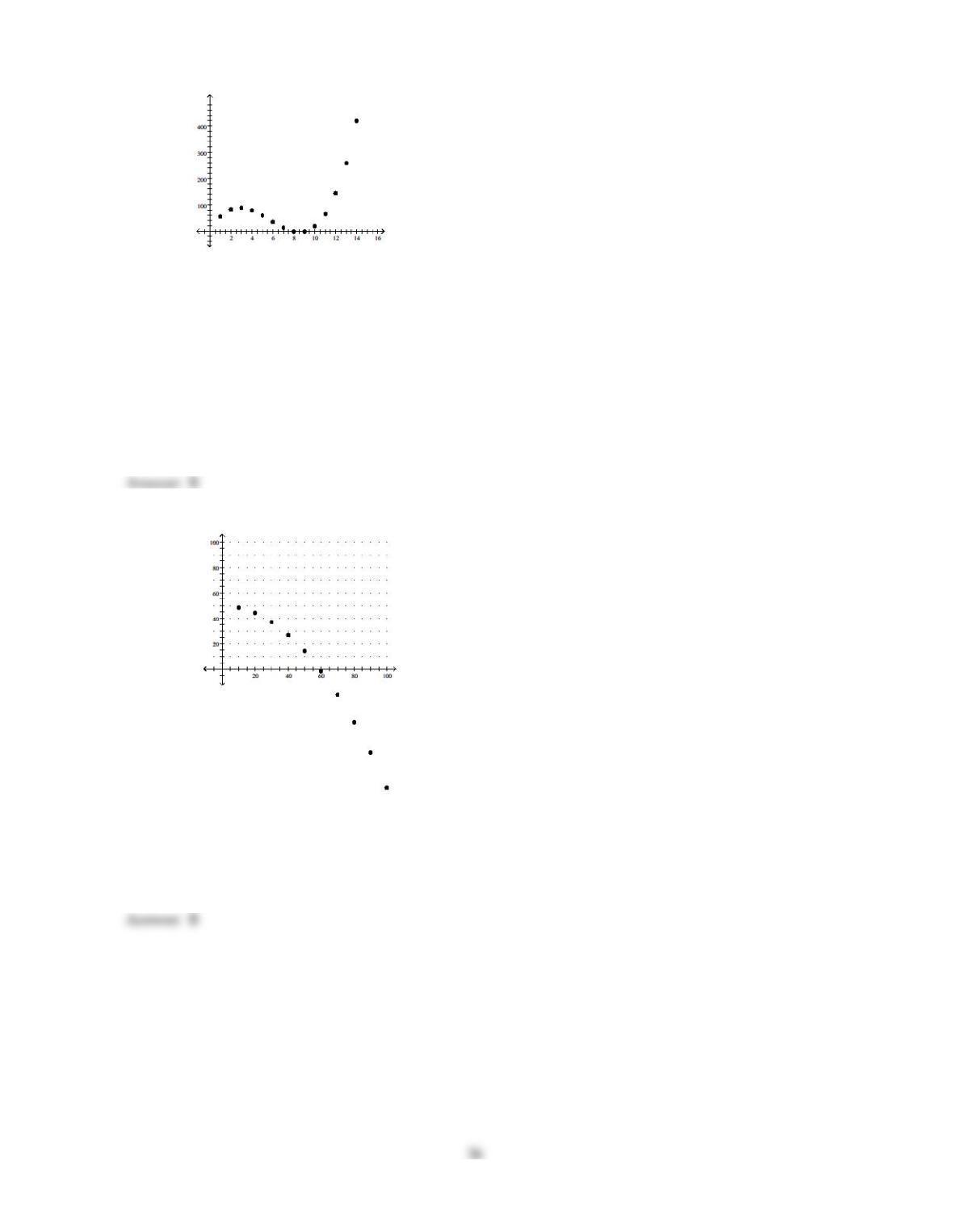
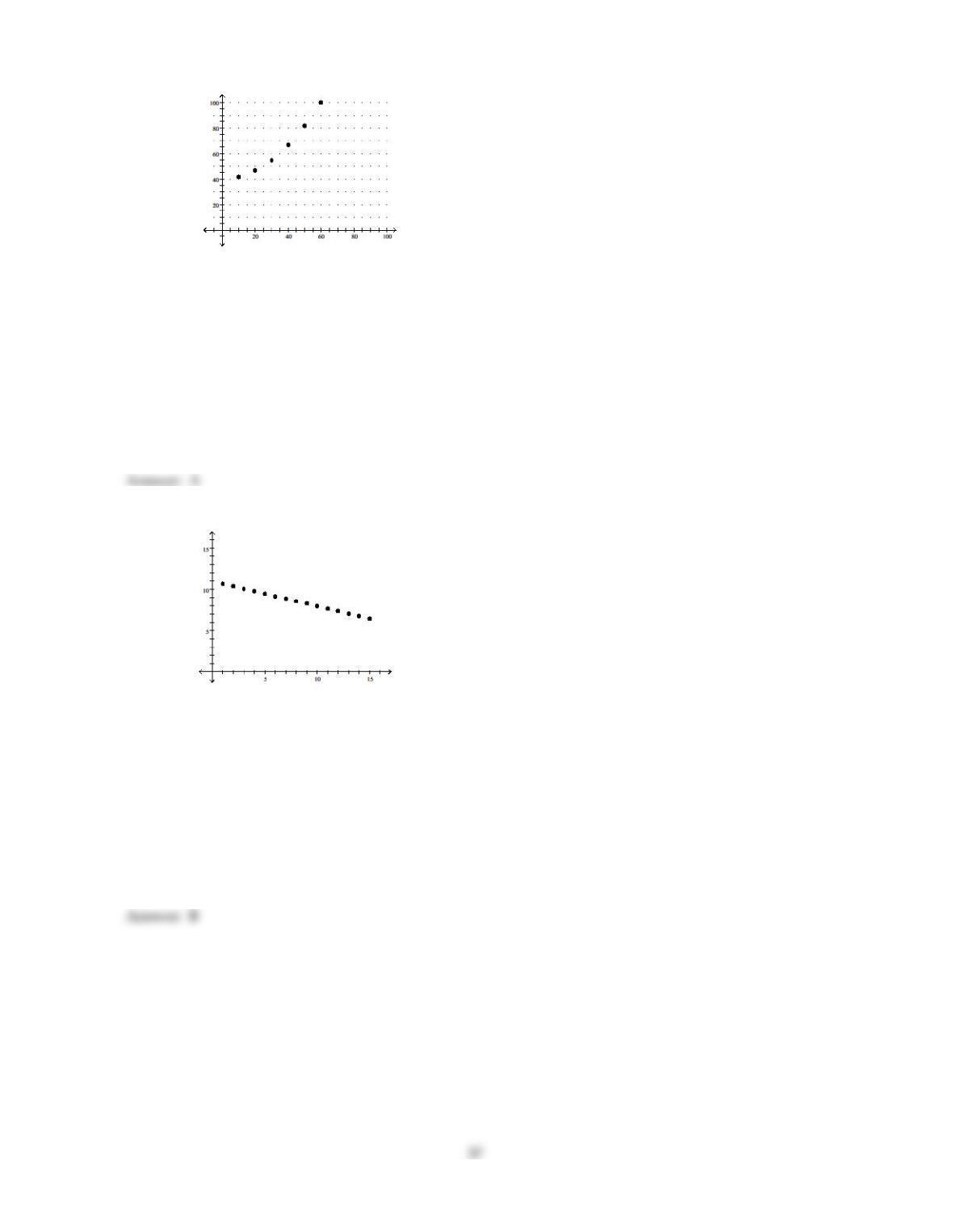
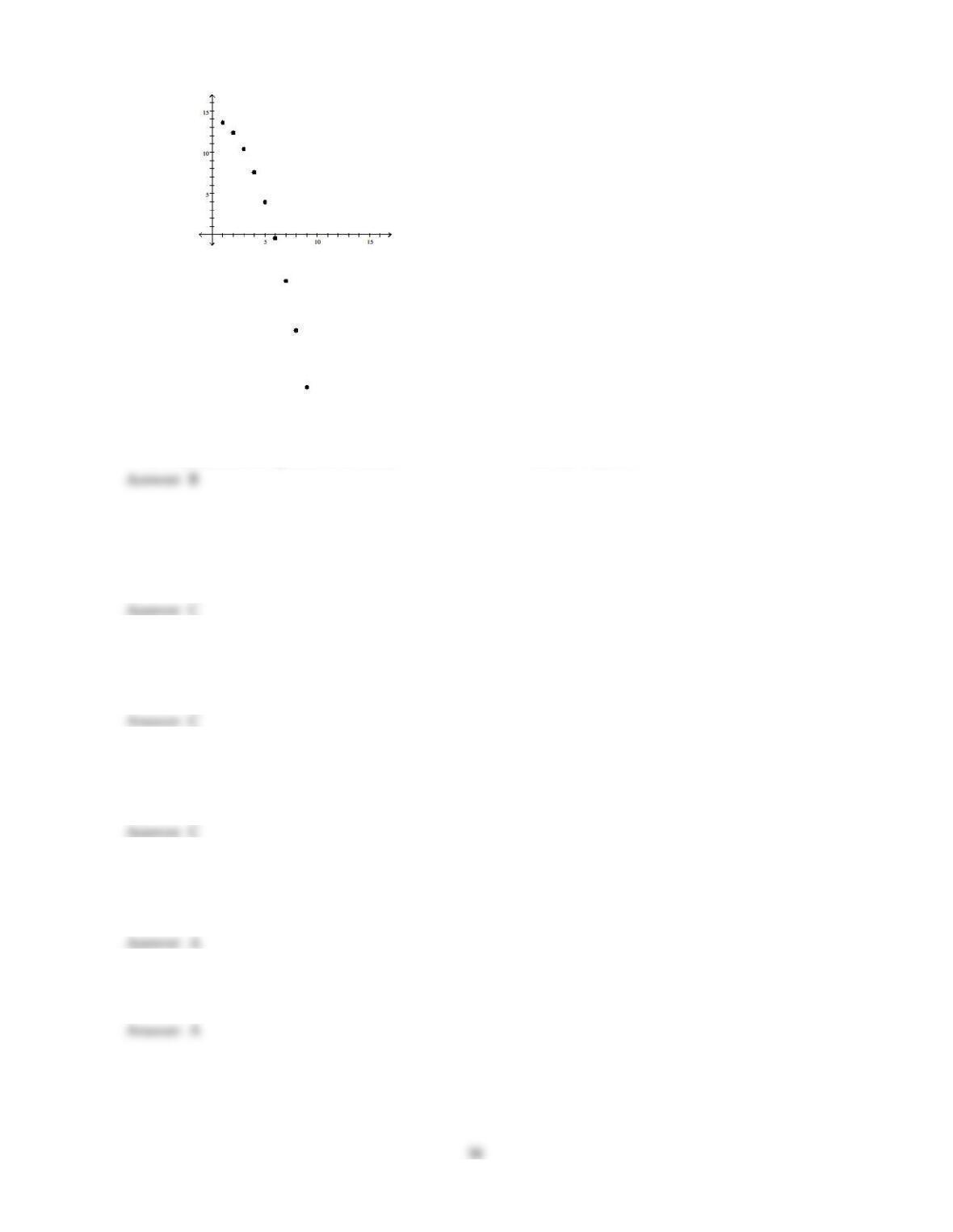
Determine which of the following four functions might be used as a model for the data: linear: f(x) = mx +
b; quadratic:
f(x) = ax2+
bx +
c, a > 0; quadratic: f(x) = ax2+
bx +
c, a < 0; polynomial, not quadratic or linear.
200)
IA Robotics
Growth of
revenue in
millions
Year
A)
f(x) = ax2+ bx + c, a < 0
B)
Polynomial, not quadratic or linear
C)
f(x) = ax2+ bx + c, a > 0
D)
f(x) = mx + b
201)
IA Robotics
Growth of
revenue in
millions
Year
A)
f(x) = ax2+ bx + c, a < 0
B)
Polynomial, not quadratic or linear
C)
f(x) = ax2+ bx + c, a > 0
D)
f(x) = mx + b
202)
IA Robotics
Growth of
revenue in
millions
Year
A)
f(x) = ax2+ bx + c, a < 0
B)
Polynomial, not quadratic or linear
C)
f(x) = mx + b
D)
f(x) = ax2+ bx + c, a > 0
203)
Acme Computer Products
Marginal
revenue
in
$/connector
Number of connectors produced
A)
Polynomial, not quadratic or linear
B)
f(x) = ax2+ bx + c, a < 0
C)
f(x) = ax2+ bx + c, a > 0
D)
f(x) = mx + b
204)
Acme Computer Products
Marginal
revenue
in
$/connector
Number of connectors produced
A)
f(x) = ax2+ bx + c, a > 0
B)
Polynomial, not quadratic or linear
C)
f(x) = mx + b
D)
f(x) = ax2+ bx + c, a < 0
205)
Unidentified Flying Object
Altitude in
thousands
of feet
Linear distance in miles
A)
f(x) = ax2+ bx + c, a < 0
B)
f(x) = mx + b
C)
Polynomial, not quadratic or linear
D)
f(x) = ax2+ bx + c, a > 0
206)
Unidentified Flying Object
Altitude in
thousands
of feet
Linear distance in miles
A)
f(x) = ax2+ bx + c, a > 0
B)
f(x) = ax2+ bx + c, a < 0
C)
Polynomial, not quadratic or linear
D)
f(x) = mx + b
Find the quadratic function that fits the set of data points.
207)
(-3, -4), (-2, -6), (-6, -22)
A)
f(x) =-2x2+ 12x + 22
B)
f(x) =-2x2+ 3x – 4
C)
f(x) =-2x2– 12x – 22
D)
f(x) =2x2+ 12x – 4
C
208)
(5, 5), (6, 8), (-10, 680)
A)
f(x) =-3x2– 30x + 5
B)
f(x) =6x2 – 30x + 80
C)
f(x) =3x2– 30x + 80
D)
f(x) =3x2– 5x + 5
C
209)
(-3, -2), (-4, 0) (-10, 96)
A)
f(x) =-4x2– 12x + 100
B)
f(x) =-2x2+ 12x + 2
C)
f(x) =2x2+ 12x + 16
D)
f(x) =2x2+ 3x + 2
C
210)
(5, 5), (6, 8), (4, 8)
A)
f(x) =3x2– 30x + 80
B)
f(x) =3x2– 5x + 5
C)
f(x) =6x2– 30x – 80
D)
f(x) =-3x2– 30x + 5
A
211)
(-2, 5), (6, -59), (-9, -44)
A)
f(x) =–x2– 4x + 1
B)
f(x) =x2+ 4x + 5
C)
f(x) =6x2– 4x – 1
D)
f(x) =–x2+ 2x + 5
A
B

212)
(2, -3), (-4, 105), (-1, 24)
A)
f(x) =3x2– 2x – 3
B)
f(x) =3x2– 12x + 9
C)
f(x) =-3x2+ 12x – 3
D)
f(x) =-4x2– 12x – 9
213)
(-3, 3), (1, 51), (7, 303)
A)
f(x) =3x2+ 18x + 30
B)
f(x) =-3x2+ 18x + 3
C)
f(x) =x2–18x + 30
D)
f(x) =3x2+ 3x + 3
A
Solve the problem.
214)
Find a quadratic function that fits the following data.
TRAVEL SPEED
(in kilometers
per hour)
NUMBER OF DAYTIME ACCIDENTS
(for every 200 million
kilometers driven)
50 90
80 150
100 180
A)
A(x) =– 1
100 x2+ 33
10 x – 50
B)
A(x) =– 1
50 x2+ 33
10 x – 30
C)
A(x) =
1
100 x2+ 33
10 x + 50
D)
A(x) =– 1
100 x2+ 33
5x – 40
A
215)
The quadratic function A(x) =
1
20 x2– 11
2x +250 fits the following data. Use the function to estimate the number
of daytime accidents that occur at 70 km/h.
TRAVEL SPEED
(in kilometers
per hour)
NUMBER OF DAYTIME ACCIDENTS
(for every 200 million
kilometers driven)
60 100
80 130
100 200
A)
-131.5 per 200,000,000 kilometers driven
B)
565 per 200,000,000 kilometers driven
C)
-140 per 200,000,000 kilometers driven
D)
110 per 200,000,000 kilometers driven
D
B

216)
Use a quadratic function to estimate the number of daytime accidents that occur at 70 km/h.
TRAVEL SPEED
(in kilometers
per hour)
NUMBER OF DAYTIME ACCIDENTS
(for every 200 million
kilometers driven)
60 100
80 120
100 210
A)
958.75 per 200,000,000 kilometers driven
B)
-321.375 per 200,000,000 kilometers driven
C)
-358.75 per 200,000,000 kilometers driven
D)
101.25 per 200,000,000 kilometers driven
Solve. Provide answers in interval notation.
217)
(x – 2)(x + 5) > 0
A)
(-5,
)
B)
(–
, -5) (2,
)
C)
(–
, -2) (5,
)
D)
(-5, 2)
Answer:
B
218)
(x + 2)(x – 7) < 0
A)
(-2, 7)
B)
(7,
)
C)
( , -2) (7,
)
D)
( , -2)
Answer:
A
219)
(x + 4)(x – 5)
0
A)
( , -4] [5,
)
B)
(-4, 5)
C)
[-4, 5]
D)
( , -4) (5,
)
Answer:
C
220)
16 –x2 0
A)
( , –4] [4,
)
B)
[–4, 4]
C)
(–4, 4)
D)
[0, 4]
Answer:
B
221)
100 –x2 0
A)
( , –10] [10,
)
B)
[10,
)
C)
(–10,10)
D)
[–10,10]
Answer:
A
222)
x2– 8x + 12 > 0
A)
(–
, 2) (6,
)
B)
(–
, 2)
C)
(6,
)
D)
(2, 6)
Answer:
A
223)
x2– 4x – 21 < 0
A)
(-3, 7)
B)
(–
, -3)
C)
(–
, -3) (7,
)
D)
(7,
)
Answer:
A
224)
x2– 4x – 5 0
A)
[5,
)
B)
(–
, -1] [5,
)
C)
(–
, -1]
D)
[-1, 5]
Answer:
D
225)
x2+ 8x + 7
0
A)
[-7, -1]
B)
(–
, -7]
C)
[-1,
)
D)
(–
, -7] [-1,
)
40
Answer:
D

226)
x2+ 18x + 81 < 0
A)
No solution
B)
( ,
)
C)
(–9,
)
D)
( , –9)
227)
x2– 14x + 49 0
A)
[7,
)
B)
No solution
C)
( , 7]
D)
( ,
)
228)
x2– 2x 3
A)
(–
, -3] [1,
)
B)
(-3, 1)
C)
[-1, 3]
D)
[-3, 1]
229)
(a + 9)(a – 3)(a – 5) > 0
A)
(5,
)
B)
(–
, -9) (3, 5)
C)
(–
, 3)
D)
(-9, 3) (5,
)
230)
(b + 8)(b + 7)(b – 4) < 0
A)
(–
, -8) (-7, 4)
B)
(-8, -7) (4,
)
C)
(–
, -7)
D)
(4,
)
231)
(c – 4)(c – 6)(c – 7) > 0
A)
(7,
)
B)
(–
, 4) (6, 7)
C)
(–
, 6)
D)
(4, 6) (7,
)
232)
(x +6)(x –4)(x +3) > 0
A)
(–
, –6) (3, 4)
B)
(–6, –3) (4,
)
C)
(–6, –4) (3,
)
D)
(–
, 4) (3, 6)
233)
(x –5)(x –6)(x +4) < 0
A)
(–5, –4) (6,
)
B)
(–6, –5) (4,
)
C)
(–
, –5) (4, 6)
D)
(–
, –4) (5, 6)
234)
1
x – 2 > 0
A)
[-2,
]
B)
(–
, -2)
C)
(-2, –
)
D)
(2,
)
235)
-4
-4x – 7 > 0
A)
–
, 7
4
B)
(0,
)
C)
–7
4,
D)
–
, –4
7
236)
2x + 3
x – 3
0
A)
–3, 3
2
B)
–
,–3
2 [3,
)
C)
(–
, –3) 3
2,
D)
–3
2, 3

237)
x – 7
x + 8 0
A)
(–7, 8]
B)
[–7, 8]
C)
(–8, 7]
D)
[–8, 7]
238)
(x – 3)(x + 7)
x – 4
0
A)
(–
, –7) (3, 4)
B)
[–7, 3] (4,
)
C)
(–
, –7] [3, 4)
D)
[3, 4)
239)
-7x + 2
2x2+ 6
> 0
A)
–
, –7
2
B)
(–
, 0)
C)
–
, 2
7
D)
–2
7,
240)
5x + 6
2x2+ 6
> 0
A)
(0,
)
B)
– 6
5,
C)
–
, – 5
6
D)
–
, – 6
5
241)
4x
-2x + 9 19
A)
–
, 57
14
57
14 ,
B)
57
14 , 9
2
C)
–
, 0
9
2,
D)
0, 9
2
242)
x + 8
x + 1 <3
A)
B)
(–
, -1)
5
2,
C)
-1, 5
2
D)
–
, 5
2 (1,
)
243)
71
x
A)
0, 1
7
B)
0, 7
C)
–
, 0 7,
D)
–
, 0 1
7,
SHORT ANSWER. Write the word or phrase that best completes each statement or answers the question.
Provide an appropriate response.
244)
Write a quadratic equation that is most easily solved using the principle of square roots. Explain why the
principle of zero products would not work as easily on the equation you wrote.
245)
Given the solutions of a quadratic equation, is it possible to reconstruct the original equation? Why or why not?
246)
Explain in your own words a sequence of steps that can be used to solve any quadratic equation in the most
efficient way.
247)
When using the quadratic formula, why is it necessary only to examine the discriminant to determine if the
equation has real–number solutions?
248)
Explain without plotting points, why the graph of y = (x + 3)2 looks like the graph of y = x2 translated three
units to the left.
249)
Explain why y = ax2+ bx + c and y = – ax2– bx – c have the same x–intercepts.
250)
Compare the graphs of y = a(x – h)2+ k and y = – a(x – h)2+ k. What restrictions, if any, must be placed on a, h,
and k if both graphs are to have the same x–intercepts?
251)
Suppose the graph of a quadratic equation has two x–intercepts. How could you use the intercepts to find the
vertex of the graph?
252)
Explain how a quadratic inequality can be solved by examining a parabola that opens upward.