
Preliminary data analyses indicate that you can reasonably use nonpooled t–procedures on the given data. Apply a
nonpooled t–test to perform the required hypothesis test, using either the critical–value approach or the P–value approach
as indicated.
77)
A researcher was interested in comparing the GPAs of students at two different colleges.
Independent simple random samples of 8 students from college A and 13 students from
college B yielded the following GPAs.
College A College B
3.7 3.8 2.8
3.2 3.2 4.0
3.0 3.0 3.6
2.5 3.9 2.6
2.7 3.8 4.0
3.6 2.5 3.6
2.8 3.9
3.4
At the 10% significance level, do the data provide sufficient evidence to conclude that the
mean GPA of students at college A differs from the mean GPA of students at college B? Use
the critical–value approach.
(Note: x1= 3.1125, x2= 3.4385, s1= 0.4357, s2= 0.5485.)
77)
Provide an appropriate response.
78)
A researcher wishes to compare the incomes of men and women. She selects a random
sample of 80 married women. She records the weekly income of each of these women.
Using the husbands of these women as the sample of men, she also records the weekly
income of each man. She obtains the following summary statistics.
Women Men
x1= 520 x2= 590
s1= 220 s2= 240
n1= 80 n2= 80
Incomes are known to be normally distributed for both populations (women and men).
Furthermore, the two population standard deviations are known to be equal. Is it
reasonable to use the pooled t–test on these data? Explain your answer.
78)

79)
Suppose that you want to perform a hypothesis test based on independent simple random
samples to compare the means of two populations. Several procedures are available,
namely, the pooled t–test, the nonpooled t–test, and the Mann–Whitney test. Give
circumstances for which the Mann–Whitney test would be the most appropriate
procedure. Be sure to comment on the sizes of the samples, the distributions of the variable
under consideration on the populations, and the relative shapes of the distributions.
79)
MULTIPLE CHOICE. Choose the one alternative that best completes the statement or answers the question.
Solve the problem.
80)
A variable of two populations has a mean of 8.9 and a standard deviation of 3.7 for one of the
populations and a mean of 7.9 and a standard deviation of 4.3 for the other population. For
independent samples of sizes 3 and 8, respectively, find the mean of x1–x2.
80)
A)
5.2
B)
–401.50
C)
–1
D)
1
Summary statistics are given for independent simple random samples from two populations. Use the pooled t–test to
conduct the required hypothesis test.
81)
x1=15, s1=7, n1= 12, x2=12.5, s2=8, n2= 15
Perform a right–tailed hypothesis test using a significance level of = 0.05.
81)
A)
Test statistic: t =0.852
Critical value = 2.060
P–value > 0.10
Do not reject H0
B)
Test statistic: t =0.852
Critical value = 1.708
P–value > 0.10
Do not reject H0
C)
Test statistic: t =7.839
Critical value = 1.708
P–value < 0.0050.005
Reject H0
D)
Test statistic: t =7.839
Critical value = 2.060
P–value < 0.0050.005
Reject H0

Use the Mann–Whitney Table to find the critical values. For a left–tailed or two–tailed test, you will also need the relation
M1–A=n1(n1+n2+
1) –MA.
82)
n1= 6, n2= 10, significance level = 0.10, right–tailed test
82)
A)
64
B)
106
C)
98
D)
67
Provide an appropriate response.
83)
A researcher wants to use a paired sample to determine whether the mean number of hours spent
exercising per week for married men differs from the mean number of hours spent exercising per
week for married women. Identify the pairs for the proposed hypothesis test.
83)
A)
Hours of exercise per week for each woman together with hours of exercise per week of her
husband
B)
Married men and married women
C)
A married person together with the numbers of hours per week that they exercise
D)
Married couples
84)
Suppose that you want to perform a hypothesis test to compare the means of two populations
using a paired sample. In which of the situations below is it acceptable to use the paired Wilcoxon
signed–rank test?
A: The distribution of the paired–difference variable is skewed to the right.
B: The paired–difference variable is normally distributed.
C: The paired–difference variable is not normally distributed, but it has a symmetric distribution.
84)
A)
B
B)
A and C
C)
B and C
D)
C
85)
Suppose that you want to perform a hypothesis test based on independent simple random samples
to compare the means of two populations. Further suppose that either the variable under
consideration is normally distributed on each of the two populations or the sample sizes are large.
True or false? If the population standard deviations are equal, then, on average, the pooled t–test is
slightly more powerful than the nonpooled t–test.
85)
A)
True
B)
False

Classify the proposed hypothesis test as Two tailed, Left tailed, or Right tailed.
86)
A researcher wants to perform a hypothesis test to determine whether the mean credit card debt for
credit card holders aged 18–35 is greater than the mean credit card debt for credit card holders aged
over 35.
86)
A)
Two tailed
B)
Left tailed
C)
Right tailed
Provide an appropriate response.
87)
True or false? In the context of the pooled t–test for two population means, the pooled sample
standard deviation, sp, always lies between the two sample standard deviations, s1 and s2.
87)
A)
True
B)
False
Determine the null and alternative hypotheses for the proposed hypothesis test.
88)
A researcher is interested in determining whether men who have completed a postgraduate degree
(master’s or Phd) have greater earning potential than those who have completed a Bachelor’s
degree only. She will perform a hypothesis test to determine whether the mean salary of men who
have completed a postgraduate degree is greater than the mean salary of men with a Bachelor’s
degree only.
88)
A)
Let µ1 denote the mean salary of men with a postgraduate degree and let µ2 denote the mean
salary of men with a Bachelor’s degree only. The null and alternative hypotheses are
H0: µ1=µ2 and Ha: µ1>µ2.
B)
Let µ1 denote the mean salary of men with a postgraduate degree and let µ2 denote the mean
salary of men with a Bachelor’s degree only. The null and alternative hypotheses are
H0: µ1>µ2 and Ha: µ1<µ2.
C)
Let µ1 denote the mean salary of men with a postgraduate degree and let µ2 denote the mean
salary of men with a Bachelor’s degree only. The null and alternative hypotheses are
H0: µ1=µ2 and Ha: µ1<µ2.
D)
Let x1 denote the mean salary of men with a postgraduate degree and let x2 denote the mean
salary of men with a Bachelor’s degree only. The null and alternative hypotheses are
H0: x1=x2 and Ha: x1>x2.
Use the paired t–interval procedure to obtain the required confidence interval. You may assume that the conditions for
using the procedure are satisfied.
89)
Using the sample paired data below, determine a 90% confidence interval for the difference
between the mean of x and the mean of y.
x5.6 6.9 4.5 3.9 6.5
y5.3 5.7 4.1 4.6 4.2
89)
A)
–0.07 to 1.47
B)
–0.37 to 1.77
C)
–0.31 to 1.71
D)
0.22 to 7.48
Provide an appropriate response.
90)
A nutritionist wants to investigate whether her new diet will be effective in helping women aged
30–40 to lose weight. She will use a paired sample to determine whether the mean weight of
women before going on this diet is greater than the mean weight of women after being on this diet
for two months. Identify the paired–difference variable for the proposed hypothesis test.
90)
A)
Difference between weight of a woman aged 30–40 before going on this diet and weight of
same woman after being on this diet for two months.
B)
Difference between weight of a woman aged 30–40 after being on this diet for two months
and weight of her husband after being on this diet for two months.
C)
Difference between mean weight of women aged 30–40 who are not on this diet and mean
weight of women aged 30–40 who have been on this diet for two months.
D)
Difference between weight of a randomly selected woman aged 30–40 who is not on this diet
and weight of a randomly selected woman aged 30–40 who has been on this diet for two
months.
Solve the problem.
91)
A pharmaceutical company wants to determine whether its new antianxiety medication has any
effect on resting pulse rate. They will use a paired sample to determine whether the mean resting
pulse rate for adults not taking the antianxiety medication differs from the mean resting pulse rate
for adults who are taking the antianxiety medication. Identify the two populations for the proposed
hypothesis test.
91)
A)
Adults suffering from anxiety and adults not suffering from anxiety
B)
Adults who suffer side effects from the antianxiety medication and adults who do not suffer
side effects from the antianxiety medication
C)
Adults not taking the antianxiety medication and adults taking the antianxiety medication
D)
Adults with high resting pulse rate and adults with low resting pulse rate

Provide an appropriate response.
92)
A researcher was interested in comparing the resting pulse rates of people who exercise regularly
and people who do not exercise regularly. Independent simple random samples were obtained of
16 people aged 30–40 who do not exercise regularly and 12 people aged 30–40 who do exercise
regularly. The resting pulse rate (in beats per minute) of each person was recorded. The summary
statistics were as follows.
Do Not Exercise Do Exercise
x1=73.4 x2=69.6
s1=10.3 s2=8.3
n1= 16 n2= 12
The researcher used a pooled t–interval procedure to obtain a 90% confidence interval for the
difference between the mean pulse rate of people who do not exercise regularly and the mean pulse
rate of people who exercise regularly. The 90% confidence interval was found to be
–2.39 to 9.99 beats per minute . Interpret this confidence interval.
92)
A)
There is a 90% chance that the difference between the mean pulse rate of people who do not
exercise regularly and the mean pulse rate of people who exercise regularly will lie between
–2.39 and 9.99 beats per minute .
B)
We can be 90% confident that the difference between the mean pulse rate of people who do
not exercise regularly and the mean pulse rate of people who exercise regularly is
somewhere between –2.39 and 9.99 beats per minute .
C)
There is a 90% chance that the difference between the sample mean pulse rate of people who
do not exercise regularly and the sample mean pulse rate of people who exercise regularly
will lie between –2.39 and 9.99 beats per minute .
D)
We can be 90% confident that the difference between the sample mean pulse rate of people
who do not exercise regularly and the sample mean pulse rate of people who exercise
regularly is somewhere between –2.39 and 9.99 beats per minute .
93)
A company which designs sports shoes has made an improvement to their popular running shoe.
They hope that athletes wearing the new running shoe will be able to run faster over short
distances. They will use a paired sample to determine whether the mean time to run 100 meters for
sprinters wearing the new running shoe is less than the mean time to run the 100 meters for
sprinters wearing the old running shoe. Identify the pairs for the proposed hypothesis test.
93)
A)
Each pair consists of a sprinter wearing the old running shoe and the same sprinter wearing
the new running shoe.
B)
Each pair consists of a sprinter wearing the new running shoe and the same sprinter after a
training period.
C)
Each pair consists of a randomly selected sprinter wearing the old running shoe and a
randomly selected sprinter wearing the new running shoe.
D)
Each pair consists of a sprinter wearing the new running shoe and his or her time to run the
100 meters.
Apply the pooled t–interval procedure to obtain the required confidence interval. You may assume that the assumptions
for using the procedure are satisfied.
94)
A paint manufacturer wanted to compare the drying times of two different types of paint.
Independent simple random samples of 11 cans of type A and 9 cans of type B were selected and
applied to similar surfaces. The drying times, in hours, were recorded. The summary statistics are
as follows.
Type A Type B
x1=70.4 x2=67.8
s1=3.2 s2=3.5
n1= 11 n2= 9
Determine a 99% confidence interval for the difference between the mean drying time of type A
and the mean drying time of type B.
94)
A)
–0.40 to 5.60 hours
B)
–2.40 to 7.60 hours
C)
–1.72 to 6.92 hours
D)
–1.23 to 6.43 hours
Provide an appropriate response.
95)
Suppose that x is a variable on each of two populations. Independent samples of sizes n1 and n2,
respectively, are selected from the two populations. True or false? The mean of all possible
differences between the two sample means equals the difference between the two population
means, regardless of the distributions of the variable on the two populations.
95)
A)
True
B)
False

Apply the nonpooled t–interval procedure to obtain the required confidence interval. You may assume that the
assumptions for using the procedure are satisfied.
96)
A researcher was interested in comparing the amount of time spent watching television by women
and by men. Independent simple random samples of 14 women and 17 men were selected, and
each person was asked how many hours he or she had watched television during the previous
week. The summary statistics are as follows.
Women Men
x1=12.3 x2=13.5
s1= 3.9 s2= 5.2
n1= 14 n2= 17
Determine a 99% confidence interval for the difference, µ1–µ2, between the mean television
watching times for women and men.
96)
A)
–5.72 to 3.32 hours
B)
–5.84 to 3.44 hours
C)
–5.34 to 2.94 hours
D)
–5.24 to 2.84 hours
Use the paired t–interval procedure to obtain the required confidence interval. You may assume that the conditions for
using the procedure are satisfied.
97)
A test of writing ability is given to a random sample of students before and after completing a
formal writing course. The results are shown below.
Before 70 80 92 99 93 97 76 63 68 71 74
After 69 79 90 96 91 95 75 64 62 64 76
Determine a 99% confidence interval for the difference between the mean score before and after
completing the writing course.
97)
A)
–0.1 to 4.1
B)
–0.5 to 4.5
C)
1.2 to 2.8
D)
–0.2 to 4.2

Solve the problem.
98)
A researcher wants to perform a hypothesis test to determine whether the mean credit card debt for
credit card holders aged 18–35 is greater than the mean credit card debt for credit card holders aged
over 35. Identify the variable for the proposed hypothesis test.
98)
A)
Mean credit card debt
B)
Difference between mean credit card debt for credit card holders aged 18–35 and mean credit
card debt for credit card holders aged over 35
C)
Credit card debt
D)
Age
Provide an appropriate response.
99)
A pharmaceutical company wants to determine whether its new antianxiety medication has any
effect on resting pulse rate. They will use a paired sample to determine whether the mean resting
pulse rate for adults not taking the antianxiety medication differs from the mean resting pulse rate
for adults who are taking the antianxiety medication. Identify the pairs for the proposed hypothesis
test.
99)
A)
Each pair consists of an adult who is on the antianxiety medication and their resting pulse
rate
B)
Each pair consists of the mean resting pulse rate of adults not on the antianxiety medication
and the mean resting pulse rate of adults on the antianxiety medication
C)
Each pair consists of an adult not on the antianxiety medication and the same person on the
antianxiety medication
D)
Each pair consists of a randomly selected adult who is not on the antianxiety medication and
a randomly selected adult who is on the antianxiety medication

Apply the pooled t–interval procedure to obtain the required confidence interval. You may assume that the assumptions
for using the procedure are satisfied.
100)
A researcher was interested in comparing the GPAs of students at two different colleges.
Independent simple random samples of 8 students from college A and 13 students from college B
yielded the following GPAs.
College A College B
3.7 3.8 2.8
3.2 3.2 4.0
3.0 3.0 3.6
2.5 3.9 2.6
2.7 3.8 4.0
3.6 2.5 3.6
2.8 3.9
3.4
Determine a 95% confidence interval for the difference between the mean GPA of college A students
and the mean GPA of college B students.
(Note: x1= 3.1125, x2= 3.4385, s1= 0.4357, s2= 0.5485.)
100)
A)
–0.72 to 0.07
B)
–0.81 to 0.15
C)
–0.65 to –0.01
D)
–0.91 to 0.25
Provide an appropriate response.
101)
Suppose that you want to perform a hypothesis test to compare the means of two populations
using independent simple random samples. Suppose that preliminary data analyses of the samples
suggest that the two distributions of the variable under consideration are normal with the same
standard deviation. Should you use the pooled t–test, the nonpooled t–test, the Mann–Whitney test,
or none of these tests?
101)
A)
Mann–Whitney test
B)
nonpooled t–test
C)
pooled t–test
D)
none of these tests
Explanation:
Explanation:
Use the paired t–interval procedure to obtain the required confidence interval. You may assume that the conditions for
using the procedure are satisfied.
102)
The table below shows the weight, in pounds, of 9 subjects before and after following a particular
diet for two months.
Subject Before After
A 168 163
B 180 172
C 157 161
D 132 119
E 202 183
F 124 126
G 190 180
H 210 195
I 171 163
Determine a 99% confidence interval for the weight loss that would be obtained, on average, by
following the diet for two months.
102)
A)
0.3 to 15.7 lb
B)
0.8 to 15.2lb
C)
–0.1to 16.1 lb
D)
–0.4 to 16.4 lb
Solve the problem.
103)
A researcher is interested in comparing the resting pulse rate of women who exercise regularly and
women who do not exercise regularly. She wants to perform a hypothesis test to determine
whether the mean resting pulse rate of women who exercise at least 6 hours per week is less than
the mean resting pulse rate of women who exercise less than 6 hours per week. Identify the
variable for the proposed hypothesis test.
103)
A)
Difference between mean resting pulse rate of women who exercise regularly and mean
resting pulse rate of women who do not exercise regularly
B)
Mean resting pulse rate
C)
Hours of exercise per week
D)
Resting pulse rate
104)
A researcher wants to use a paired sample to determine whether the mean number of hours spent
exercising per week for married men differs from the mean number of hours spent exercising per
week for married women. Identify the two populations for the proposed hypothesis test.
104)
A)
Married men and married women
B)
Married people and single people
C)
Men and women
D)
Married people who exercise and married people who don‘t exercise
A type of sampling (independent or paired), sample size(s), and a figure showing the results of preliminary data analyses
on the sample(s) are provided. The intent is to employ the sample data to perform a hypothesis test to compare the means
of the two populations from which the data were obtained. Use the information provided to decide which procedure
should be applied.
105)
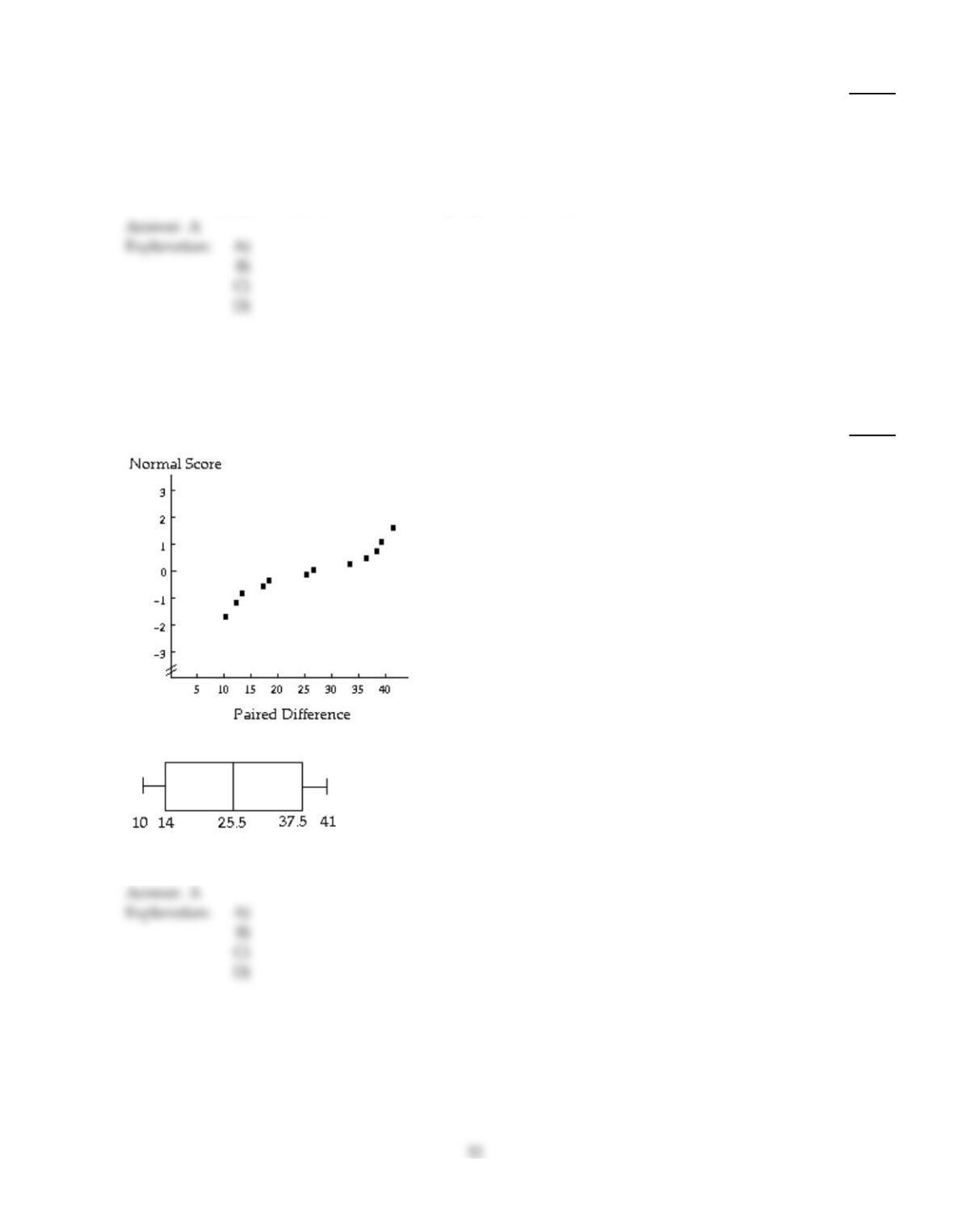
Paired; n = 12. A normal probability plot and a boxplot for the paired differences are given below.
105)
A)
Paired Wilcoxon signed–rank test
B)
Pooled t–test
C)
Mann–Whitney test
D)
Paired t–test
Explanation:
Explanation:

Solve the problem.
106)
The forced vital capacity (FVC) is often used by physicians to assess a person’s ability to move air in
and out of their lungs. It is the maximum amount of air that can be exhaled after a deep breath. A
researcher wants to perform a hypothesis test to determine whether the mean forced vital capacity
for adults who are smokers is less than the mean forced vital capacity for adults who are former
smokers. He will use a paired sample to determine whether forced vital capacity increases, on
average, when adults stop smoking. Identify the variable for the proposed hypothesis test.
106)
A)
Number of cigarettes smoked per day
B)
Forced vital capacity
C)
Amount of time since person stopped smoking
D)
Difference between mean forced vital capacity of smokers and mean forced vital capacity of
former smokers
Summary statistics are given for independent simple random samples from two populations. Use the pooled t–test to
conduct the required hypothesis test.
107)
x1=11.1, s1=4.5, n1= 14, x2=17.2, s2=4.9, n2= 17
Perform a two–tailed hypothesis test using a significance level of = 0.05.
107)
A)
Test statistic: t = – 3.577
Critical value = ±2.045
Reject H0
B)
Test statistic: t = – 1.841
Critical value = ±1.699
Reject H0
C)
Test statistic: t = – 3.577
Critical value = ±1.699
Do not reject H0
D)
Test statistic: t = – 1.841
Critical value = ±2.045
Do not reject H0
Summary statistics are given for independent simple random samples from two populations. Use the pooled t–interval
procedure to obtain the specified confidence interval.
108)
x1=12.7, s1=4.4, n1= 14, x2=17.8, s2=4.4, n2= 17
Determine a 95% confidence interval.
108)
A)
–8.47 to –1.73
B)
–7.80 to –2.40
C)
–8.62 to –1.58
D)
–8.35 to –1.85

Solve the problem.
109)
A researcher is interested in determining whether men who have completed a postgraduate degree
(master’s or Phd) have greater earning potential than those who have completed a Bachelor’s
degree only. She will perform a hypothesis test to determine whether the mean salary of men who
have completed a postgraduate degree is greater than the mean salary of men with a Bachelor’s
degree only. Identify the two populations for the proposed hypothesis test.
109)
A)
Men with a high salary and men with a low salary
B)
Men with a Bachelor’s degree only and men who have completed a postgraduate degree
C)
Salaries of men with a Bachelor’s degree only and salaries of men who have completed a
postgraduate degree
D)
Adults with a Bachelor’s degree only and adults who have completed a postgraduate degree
110)
A researcher is interested in comparing the resting pulse rate of women who exercise regularly and
women who do not exercise regularly. She wants to perform a hypothesis test to determine
whether the mean resting pulse rate of women who exercise at least 6 hours per week is less than
the mean resting pulse rate of women who exercise less than 6 hours per week. Identify the two
populations for the proposed hypothesis test.
110)
A)
Women with a high resting pulse rate and women with a low resting pulse rate
B)
Adults who exercise at least 6 hours per week and adults who exercise less than 6 hours per
week
C)
Women who exercise at least 6 hours per week and women who exercise less than 6 hours per
week
D)
Resting pulse rates for women who exercise at least 6 hours per week and resting pulse rates
for women who exercise less than 6 hours per week
Provide an appropriate response.
111)
Suppose that you want to perform a hypothesis test to compare the means of two populations
using a paired sample. True or false? If the paired–difference variable has a symmetric distribution
but is not normally distributed, the paired Wilcoxon signed–rank test will result in a larger
probability of a Type II error than the paired t–test.
111)
A)
True
B)
False
Use the Mann–Whitney Table to find the critical values. For a left–tailed or two–tailed test, you will also need the relation
M1–A=n1(n1+n2+
1) –MA.
112)
n1= 7, n2= 9, significance level = 0.05, right–tailed test
112)
A)
93
B)
78
C)
89
D)
76
Summary statistics are given for independent simple random samples from two populations. Use the nonpooled t–test to
conduct the required hypothesis test.
113)
x1=12.5, s1= 3.9, n1= 14, x2=13.7, s2= 5.2, n2= 17
Perform a left–tailed hypothesis test using a significance level of = 0.05.
113)
A)
Test statistic: t = – 2.211
Critical value = – 1.701
Reject H0
B)
Test statistic: t = – 0.733
Critical value = – 1.699
Do not reject H0
C)
Test statistic: t = – 2.211
Critical value = – 1.699
Reject H0
D)
Test statistic: t = – 0.733
Critical value = – 1.701
Do not reject H0
Apply the pooled t–interval procedure to obtain the required confidence interval. You may assume that the assumptions
for using the procedure are satisfied.
114)
A researcher was interested in comparing the resting pulse rates of people who exercise regularly
and people who do not exercise regularly. Independent simple random samples were obtained of
16 people aged 30–40 who do not exercise regularly and 12 people aged 30–40 who do exercise
regularly. The resting pulse rate (in beats per minute) of each person was recorded. The summary
statistics are as follows.
Do Not Exercise Do Exercise
x1=72.0 x2=68.1
s1=10.0 s2=8.5
n1= 16 n2= 12
Determine a 90% confidence interval for the difference between the mean pulse rate of people who
do not exercise regularly and the mean pulse rate of people who exercise regularly.
114)
A)
–2.22 to 10.02 beats per minute
B)
–2.86 to 10.66 beats per minute
C)
–0.82 to 8.62 beats per minute
D)
–0.05 to 7.85 beats per minute

Solve the problem.
115)
A variable of two populations has a mean of 44 and a standard deviation of 11 for one of the
populations and a mean of 26 and a standard deviation of 7 for the other population. For
independent samples of sizes 8 and 17 , respectively, find the standard deviation of x1–x2. Round
your answer to the nearest hundredth.
115)
A)
1.34
B)
3.50
C)
18.01
D)
4.24
Provide an appropriate response.
116)
Suppose that you want to perform a hypothesis test to compare the means of two populations
using a paired sample. Preliminary data analyses of the sample of paired differences suggest that
the distribution of the paired–difference variable is highly skewed to the left . Given that the
sample size is 40, should you use a paired t–test, a paired Wilcoxon signed–rank test, or neither of
these tests?
116)
A)
Paired Wilcoxon signed–rank test
B)
Paired t–test
C)
Neither of these tests
117)
Suppose that you want to perform a hypothesis test to compare the means of two populations
using a paired sample. Preliminary data analyses of the sample of paired differences suggest that
the distribution of the paired–difference variable is highly skewed to the right . Given that the
sample size is 14, should you use a paired t–test, a paired Wilcoxon signed–rank test, or neither of
these tests?
117)
A)
Paired Wilcoxon signed–rank test
B)
Paired t–test
C)
Neither of these tests
Classify the proposed hypothesis test as Two tailed, Left tailed, or Right tailed.
118)
A researcher is interested in comparing the resting pulse rate of women who exercise regularly and
women who do not exercise regularly. She wants to perform a hypothesis test to determine
whether the mean resting pulse rate of women who exercise at least 6 hours per week is less than
the mean resting pulse rate of women who exercise less than 6 hours per week.
118)
A)
Two tailed
B)
Left tailed
C)
Right tailed

Summary statistics are given for independent simple random samples from two populations. Use the nonpooled
t–interval procedure to obtain the specified confidence interval.
119)
x1=76.4, s1= 4.5, n1= 11, x2=66.8, s2= 5.1, n2= 9
98% confidence interval
119)
A)
4.12 to 15.08
B)
4.05 to 15.15
C)
3.98 to 15.22
D)
4.28 to 14.92
Classify the proposed hypothesis test as Two tailed, Left tailed, or Right tailed.
120)
The forced vital capacity (FVC) is often used by physicians to assess a person’s ability to move air in
and out of their lungs. It is the maximum amount of air that can be exhaled after a deep breath. A
researcher wants to perform a hypothesis test to determine whether the mean forced vital capacity
for women is less than the mean forced vital capacity for men.
120)
A)
Two tailed
B)
Left tailed
C)
Right tailed
Solve the problem.
121)
The forced vital capacity (FVC) is often used by physicians to assess a person’s ability to move air in
and out of their lungs. It is the maximum amount of air that can be exhaled after a deep breath. A
researcher wants to perform a hypothesis test to determine whether the mean forced vital capacity
for women is less than the mean forced vital capacity for men. Identify the variable for the
proposed hypothesis test.
121)
A)
Forced vital capacity
B)
Difference between mean forced vital capacity for women and mean forced vital capacity for
men
C)
Gender
D)
Mean forced vital capacity
Provide an appropriate response.
122)
Suppose that you want to perform a nonpooled t–test based on independent simple random
samples to compare the means of two populations . Further suppose that the variable under
consideration is normally distributed on each of the two populations. Given the summary statistics
below, what degrees of freedom would you use to obtain the critical value?
Sample 1 Sample 2
s12= 16.8 s22= 19.3
n1= 14 n2= 12
122)
A)
25
B)
22
C)
23
D)
24
Solve the problem.
123)
A researcher is interested in determining whether men who have completed a postgraduate degree
(master’s or Phd) have greater earning potential than those who have completed a Bachelor’s
degree only. She will perform a hypothesis test to determine whether the mean salary of men who
have completed a postgraduate degree is greater than the mean salary of men with a Bachelor’s
degree only. Identify the variable for the proposed hypothesis test.
123)
A)
Salary
B)
Difference between mean salary of men with a Bachelor’s degree only and mean salary of
men who have completed a postgraduate degree
C)
Highest level of education completed
D)
Mean salary
Classify the proposed hypothesis test as Two tailed, Left tailed, or Right tailed.
124)
A pharmaceutical company wants to determine whether its new antianxiety medication has any
effect on resting pulse rate. They will use a paired sample to determine whether the mean resting
pulse rate for adults not taking the antianxiety medication differs from the mean resting pulse rate
for adults who are taking the antianxiety medication.
124)
A)
Two tailed
B)
Left tailed
C)
Right tailed

Use the paired t–interval procedure to obtain the required confidence interval. You may assume that the conditions for
using the procedure are satisfied.
125)
A test of abstract reasoning is given to a random sample of students before and after completing a
formal logic course. The results are shown below.
Before After
74 71
81 86
85 82
67 75
92 95
71 66
61 67
78 81
64 71
80 88
Determine a 95% confidence interval for the difference between the mean score after completing the
course and the mean score before completing the course.
125)
A)
–0.9 to 6.7
B)
–0.6 to 6.4
C)
–1.2 to 7.0
D)
–0.3 to 6.1
Summary statistics are given for independent simple random samples from two populations. Use the nonpooled
t–interval procedure to obtain the specified confidence interval.
126)
x1=72.4, s1= 10.9, n1= 16, x2=69.9, s2= 8.2, n2= 12
95% confidence interval
126)
A)
–6.47 to 11.47
B)
–3.92 to 8.92
C)
–4.94 to 9.94
D)
–5.23 to 10.23

Summary statistics are given for independent simple random samples from two populations. Use the nonpooled t–test to
conduct the required hypothesis test.
127)
x1=75.3, s1= 4.5, n1= 11, x2=65.5, s2= 5.1, n2= 9
Perform a two–tailed hypothesis test using a significance level of = 0.01.
127)
A)
Test statistic: t = 2.646
Critical values = ±2.878
Do not reject H0
B)
Test statistic: t = 2.646
Critical values = ±2.921
Do not reject H0
C)
Test statistic: t =4.506
Critical values = ±2.921
Reject H0
D)
Test statistic: t =4.506
Critical values = ±2.878
Reject H0
Determine the null and alternative hypotheses for the proposed hypothesis test.
128)
The forced vital capacity (FVC) is often used by physicians to assess a person’s ability to move air in
and out of their lungs. It is the maximum amount of air that can be exhaled after a deep breath. A
researcher wants to perform a hypothesis test to determine whether the mean forced vital capacity
for women is less than the mean forced vital capacity for men.
128)
A)
Let x1 denote the mean forced vital capacity for women and let x2 denote the mean forced
vital capacity for men. The null and alternative hypotheses are H0: x1=x2 and
Ha: x1<x2.
B)
Let µ1 denote the mean forced vital capacity for women and let µ2 denote the mean forced
vital capacity for men. The null and alternative hypotheses are H0: µ1<µ2 and Ha: µ1>µ2.
C)
Let µ1 denote the mean forced vital capacity for women and let µ2 denote the mean forced
vital capacity for men. The null and alternative hypotheses are H0: µ1=µ2 and Ha: µ1>µ2.
D)
Let µ1 denote the mean forced vital capacity for women and let µ2 denote the mean forced
vital capacity for men. The null and alternative hypotheses are H0: µ1=µ2 and Ha: µ1<µ2.
Summary statistics are given for independent simple random samples from two populations. Use the pooled t–interval
procedure to obtain the specified confidence interval.
129)
x1=70.9, s1=3.8, n1= 11, x2=67.4, s2=3.3, n2= 9
Determine a 99% confidence interval.
129)
A)
–1.88 to 8.88
B)
–1.14 to 8.14
C)
–0.61 to 7.61
D)
0.27 to 6.73