Exam
Name___________________________________
MULTIPLE CHOICE. Choose the one alternative that best completes the statement or answers the question.
Write a quadratic equation having the given numbers as solutions.
1)
4
5, – 8
1)
A)
5x2+ 36x – 32 = 0
B)
5x2– 36x – 32 = 0
C)
5x2– 32x + 5 = 0
D)
5x2+ 5x – 32 = 0
Use a grapher to find the vertex, rounding to the nearest hundredth when necessary.
2)
f(x) =x2+ x –1
2)
A)
(–0.5, –1)
B)
(–0.5, –1.25)
C)
(0.5, –1.25)
D)
(0.5, –0.75)
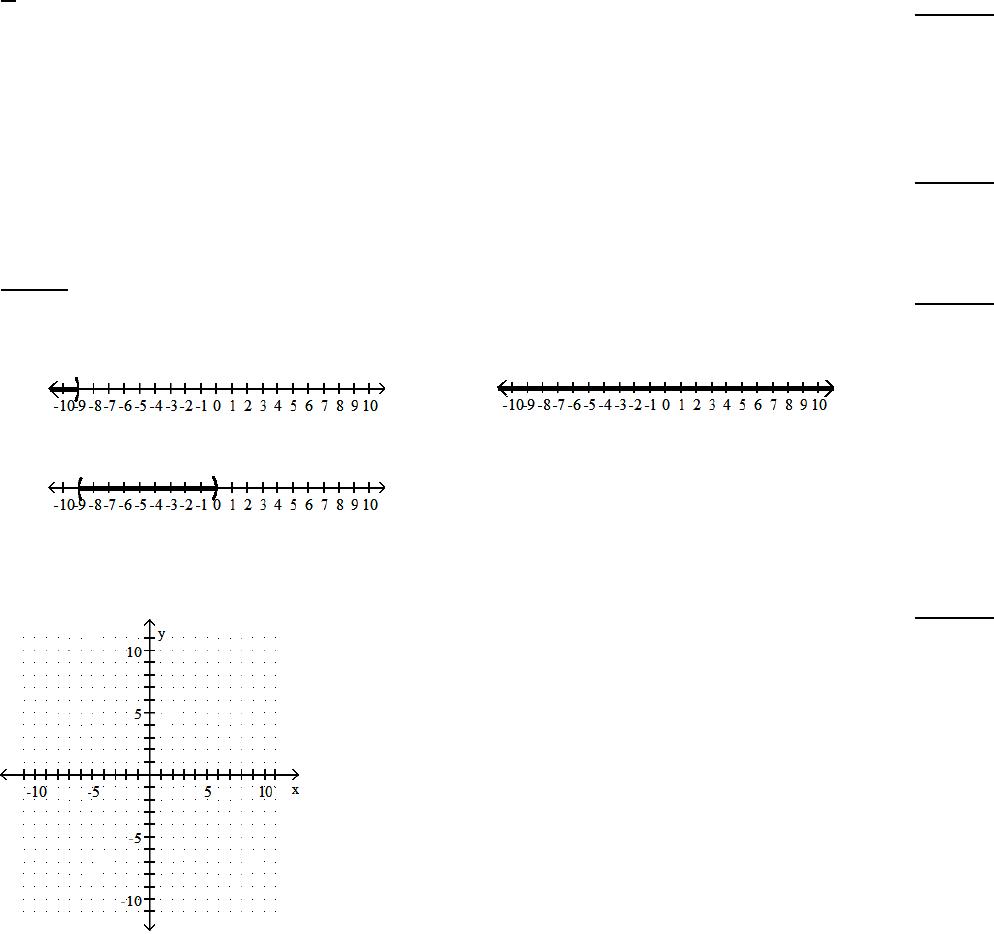
Solve. Then graph the solution.
3)
6
(x + 9)2< 0
3)
A)
(–
, –9)
B)
(–
,
)
C)
(–9, 0)
D)
Identify the vertex, the equation of the axis of symmetry, and the x– and y–intercepts of the graph. Then graph.
4)
f(x) = –x2– 2x +8
4)
1
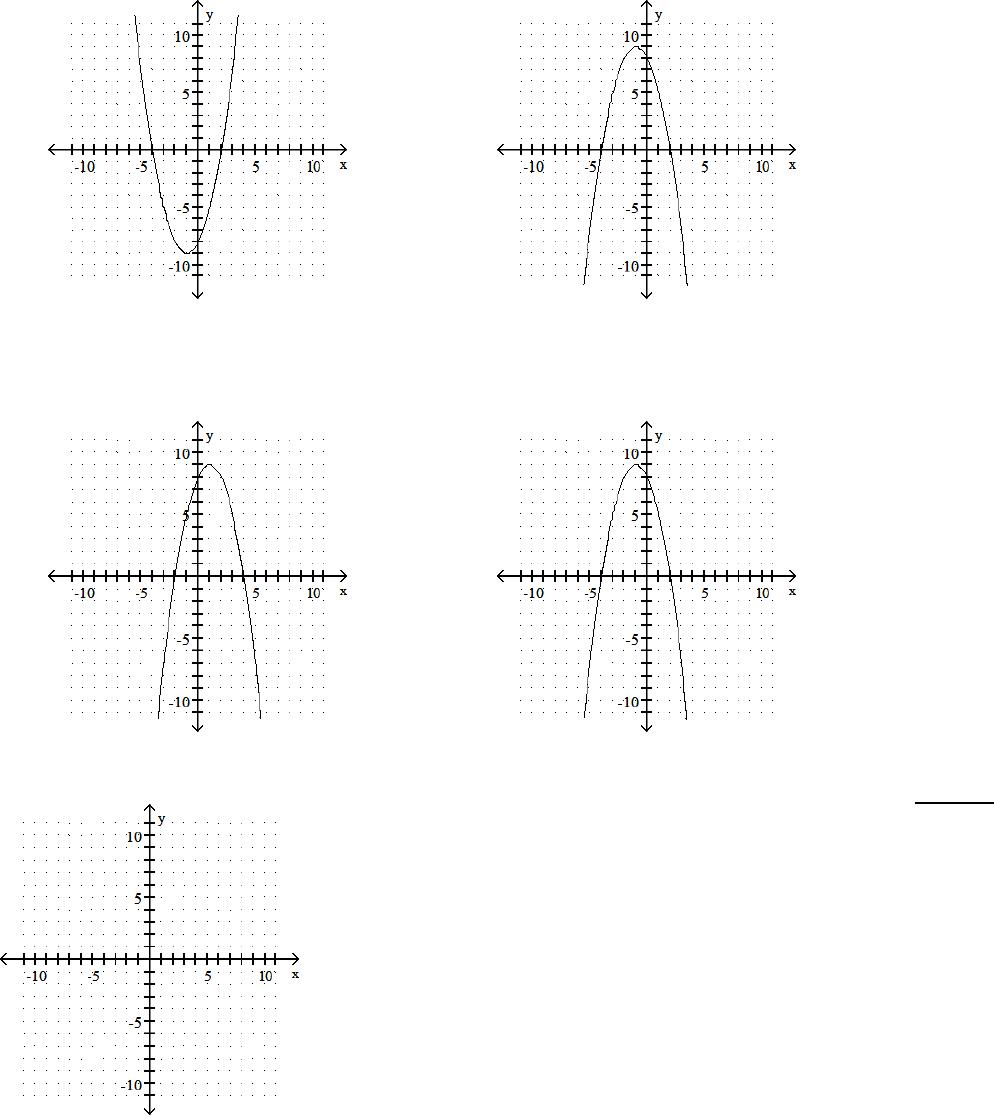
A)
Vertex: (– 1, – 9);
axis of symmetry: x = – 1;
x–intercepts: (–4, 0), (2, 0);
y–intercept: (0, 8)
B)
Vertex: (– 1, 9);
axis of symmetry: x = – 1;
x–intercepts: (–2, 0), (4, 0);
y–intercept: (0, 8)
C)
Vertex: (1, 9);
axis of symmetry: x =1;
x–intercepts: (–2, 0), (4, 0);
y–intercept: (0, 8)
D)
Vertex: (– 1, 9);
axis of symmetry: x = – 1;
x–intercepts: (–4, 0), (2, 0);
y–intercept: (0, 8)
5)
f(x) =x2+7x +10
5)
2
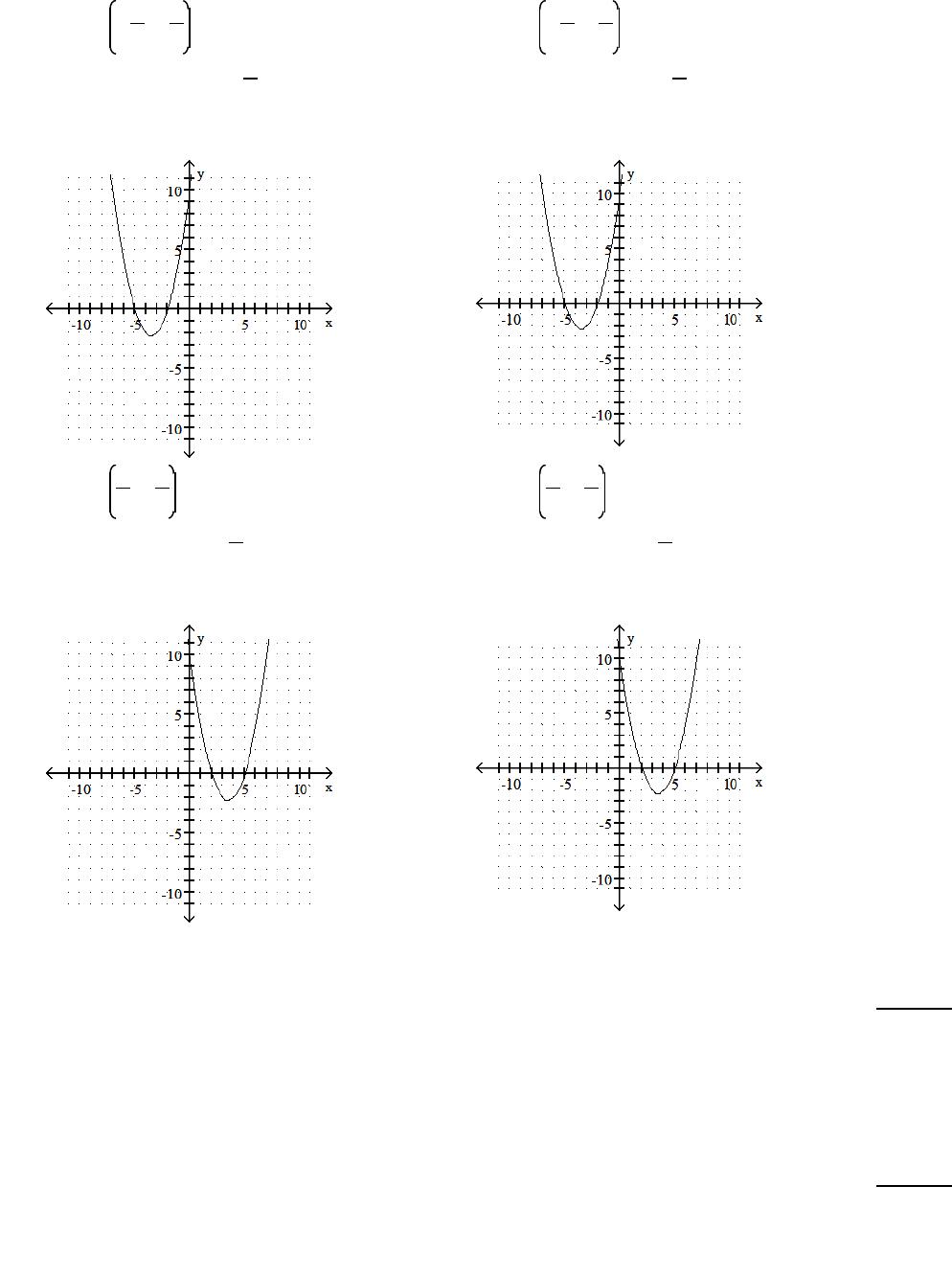
A)
Vertex: –7
2, –9
4;
axis of symmetry: x = – 7
2;
x–intercepts: (–2, 0), (–5, 0);
y–intercept: (0, 10)
B)
Vertex: –7
2, –9
4;
axis of symmetry: x = – 7
2;
x–intercepts: (2, 0), (5, 0);
y–intercept: (0, 10)
C)
Vertex: 7
2, –9
4;
axis of symmetry: x =7
2;
x–intercepts: (2, 0), (5, 0);
y–intercept: (0, 10)
D)
Vertex: 7
2, –9
4 ;
axis of symmetry: x =7
2;
x–intercepts: (–2, 0), (–5, 0);
y–intercept: (0, 10)
Solve the problem. Round your answer to the nearest tenth, if necessary.
6)
A man rode a bicycle for 12 mi and then hiked an additional 8 mi. The total time for the trip was 5
hr. If his rate when he was riding a bicycle was 10 mph faster than his rate walking, what was each
rate?
6)
A)
Bike: 13 mph; hike: 3 mph
B)
Bike: 11.5 mph; hike: 1.5 mph
C)
Bike: 12 mph; hike: 2 mph
D)
Bike: 14.5 mph; hike: 4.5 mph
Write a quadratic equation having the given numbers as solutions.
7)
7, only solution
7)
A)
x2+7x +49 = 0
B)
x2–49 = 0
C)
x2–14x +49 = 0
D)
x2+14x +49 = 0
3
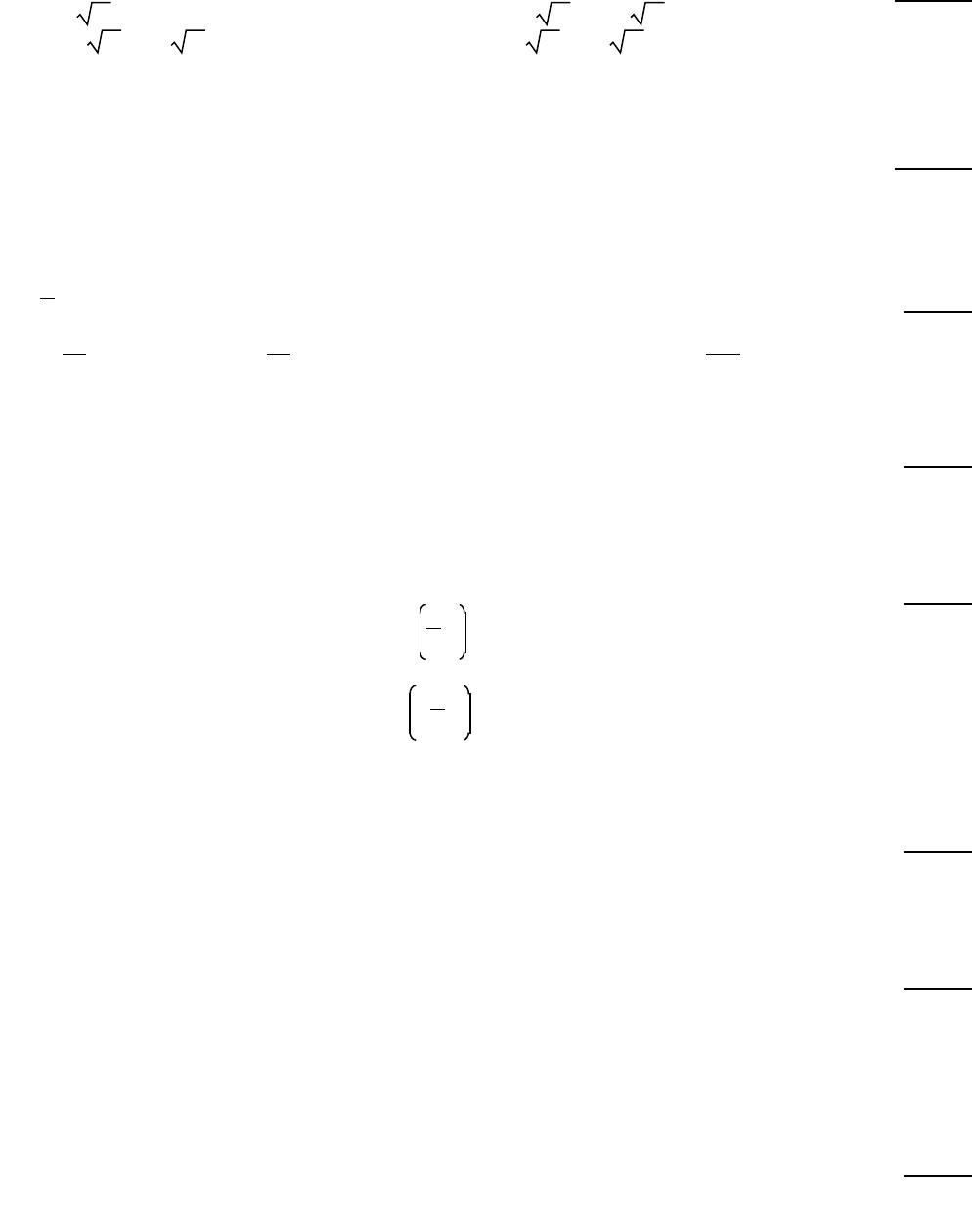
Given f(x) and g(x), find all values of x for which f(x) = g(x).
8)
f(x) = x2 and g(x) =9– 4x
8)
A)
2+13
B)
–2+113, –2–113
C)
–1+13, –1–13
D)
–2+13, –2–13
Graph the function on a grapher. Then use the grapher to find the x– and y–intercepts. Round to the nearest hundredth if
necessary.
9)
f(x) = –5.07x2+ 2.53x – 5.56
9)
A)
(–5.56, 0), no y–intercepts
B)
(–0.83, 0), (1.33, 0), (0, –5.56)
C)
(–0.83, 0), (0, –5.56)
D)
No x–intercepts, (0, –5.56)
Find the constant term to be added to the expression to form a perfect square trinomial.
10)
x2–5
6x
10)
A)
–25
36
B)
25
36
C)
0
D)
25
144
Solve the problem.
11)
A rug is to fit in a room so that a border of consistent width is left on all four sides. If the room is
12 feet by 24 feet and the area of the rug is 160 square feet, how wide will the border be?
11)
A)
4 ft
B)
3 ft
C)
2 ft
D)
4.5 ft
Find the y–intercepts and any x–intercepts.
12)
f(x) =2x2+5x –12
12)
A)
y–intercept (0, –12), x–intercepts (–4, 0) and 3
2, 0
B)
y–intercept (0, –12), x–intercept (–4, 0)
C)
y–intercept (0, –12), x–intercepts (4, 0) and –3
2, 0
D)
y–intercept (0, –12), no x–intercepts
Solve the problem.
13)
Use the formula A = P(1 + r)2 to find what the rate of interest is if a principal amount of $5500
grows to $6655.00 in 2 years, if interest is compounded annually.
13)
A)
11%
B)
10%
C)
12%
D)
8%
Determine the domain and range of the function.
14)
g(x) =5x2+ 40x + 73
14)
A)
Domain: ( ,
)
Range: [–7,
)
B)
Domain: (–
, –4]
Range: [–7,
)
C)
Domain: [–7,
)
Range: ( ,
)
D)
Domain: ( ,
)
Range: (–
, –4]
Find the axis of symmetry of the function.
15)
f(x) =3x2– 12x + 13
15)
A)
x = –2
B)
x =2
C)
x =1
D)
x = –1
4
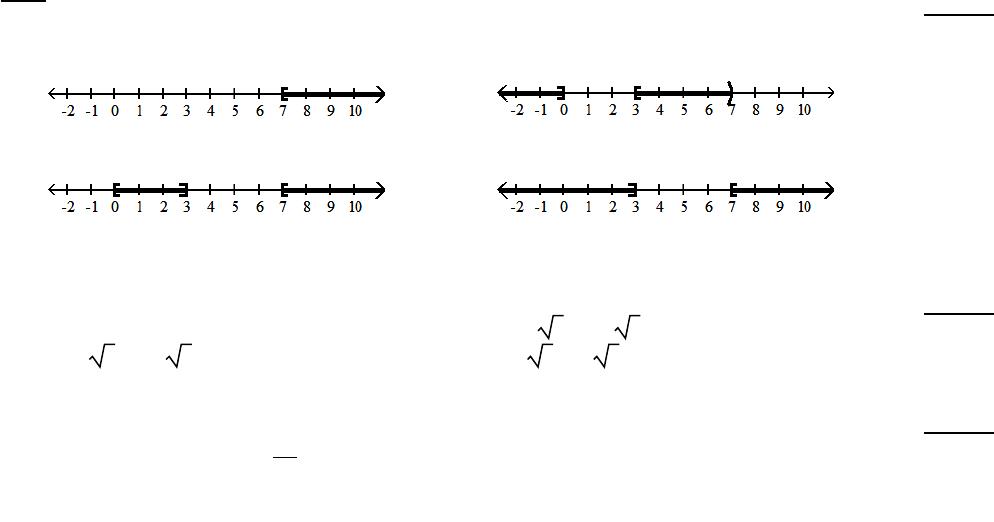
Solve. Then graph the solution.
16)
8x
7– x 2x
16)
A)
[7,
)
B)
(–
, 0] [3, 7)
C)
[0, 3] [7,
)
D)
(–
, 3] [7,
)
Solve by using the square root property.
17)
(x + 4)2– 7 = 0
17)
A)
3, 11
B)
–2+7, –2–7
C)
–4+7, –4–7
D)
4+7, 4–7
18)
x2=81
18)
A)
9
B)
81
2
C)
10, –10
D)
9, –9
5
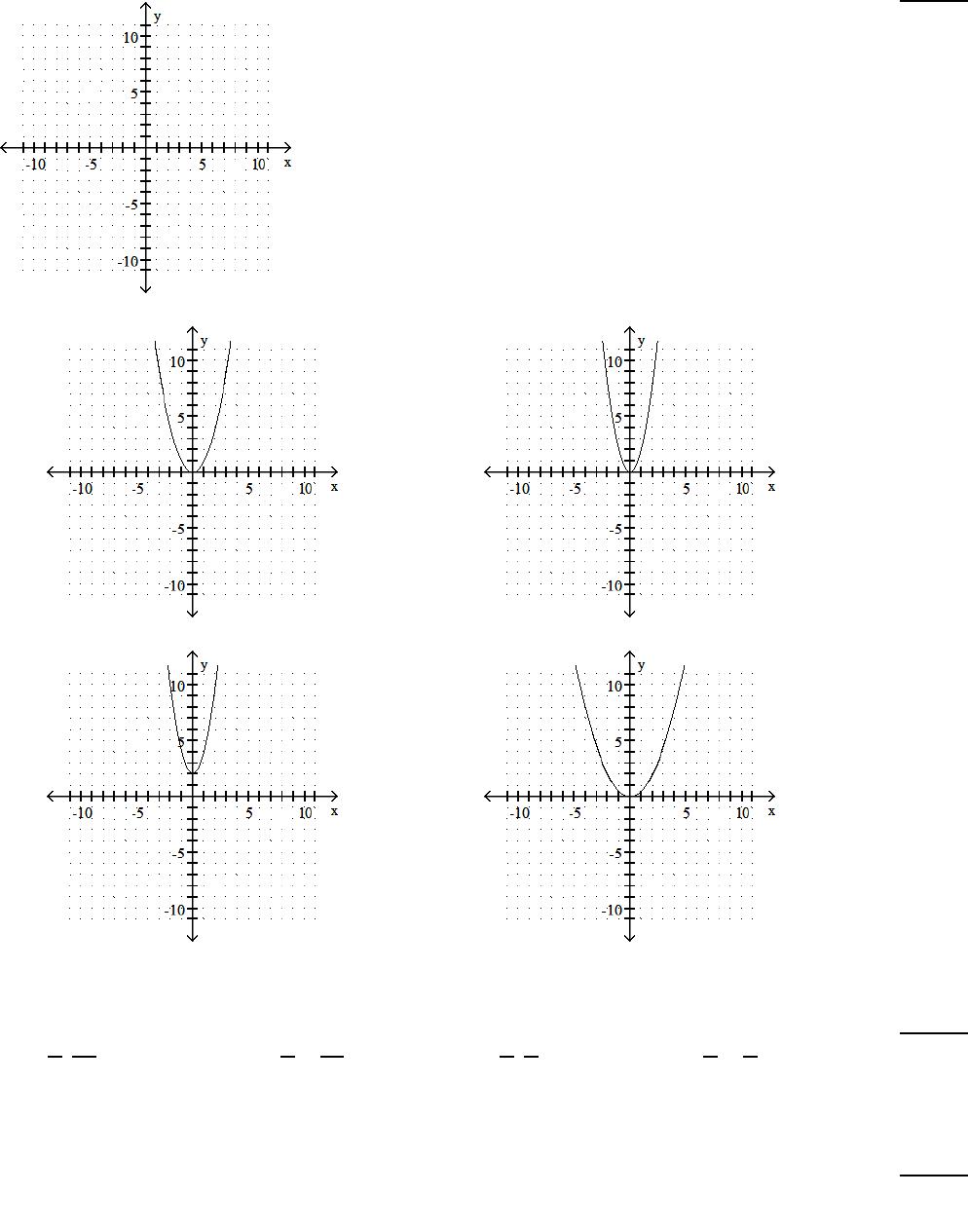
Graph the equation.
19)
h(x) =2x2
19)
A)
B)
C)
D)
Solve the equation.
20)
(4m – 4)2– 8(4m – 4) + 7 = 0
20)
A)
5
4, 11
4
B)
–5
4, –11
4
C)
–3
4, 3
4
D)
3
4, –3
4
Use a grapher to find the vertex, rounding to the nearest hundredth when necessary.
21)
f(x) =0.4x2+ 2.6x – 3.9
21)
A)
(3.25, 0.33)
B)
(3.25, –8.12)
C)
(–1.3, –5.59)
D)
(–3.25, –8.12)
6
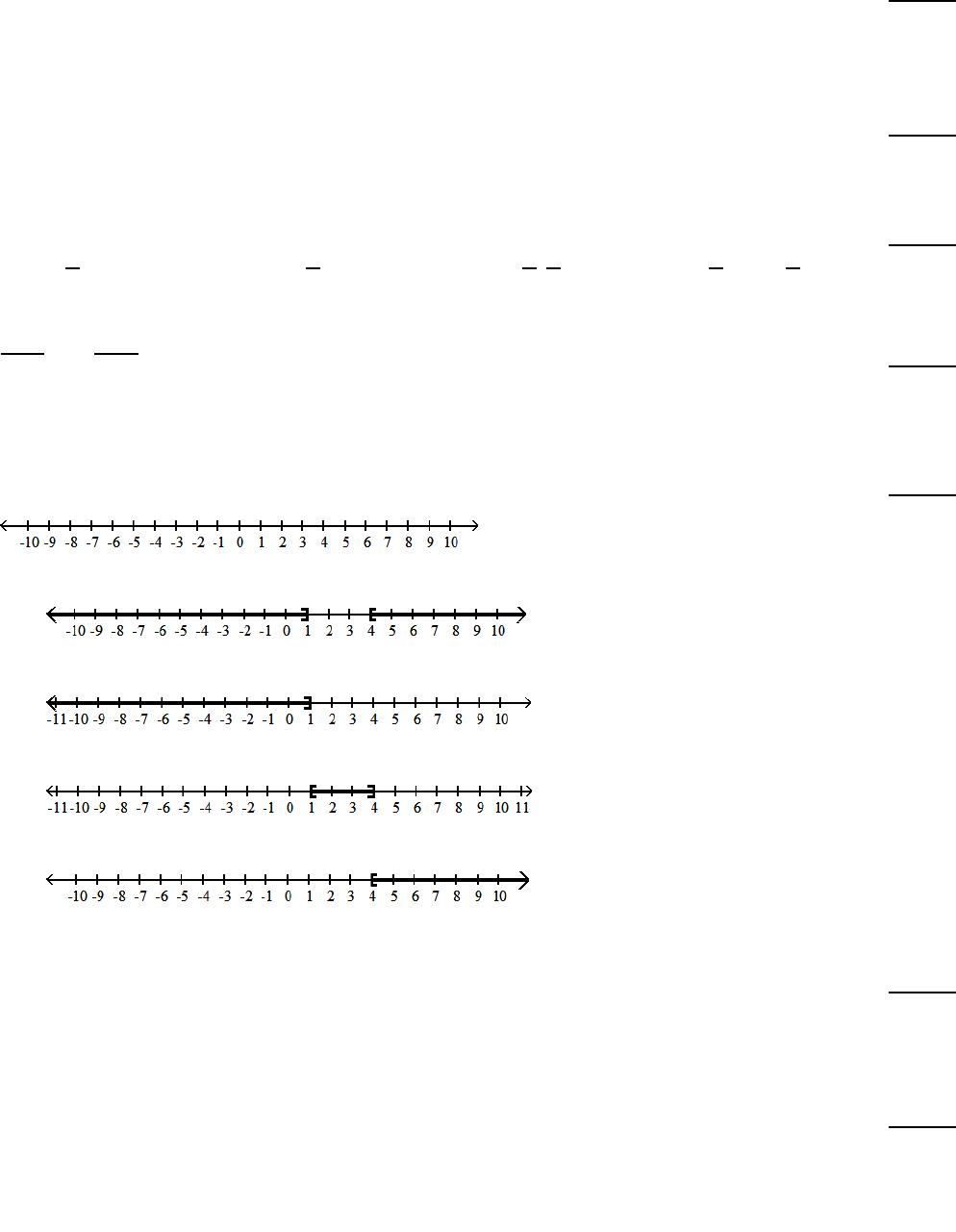
Solve the problem.
22)
A rectangular garden has dimensions of 19 feet by 14 feet. A gravel path of consistent width is to be
built around the garden. How wide can the path be if there is enough gravel for 234 square feet?
22)
A)
5 ft
B)
3 ft
C)
5.5 ft
D)
4 ft
Find the axis of symmetry of the function.
23)
f(x) =4x –x2
23)
A)
x = – 2
B)
x =2
C)
x = – 4
D)
x = – 24
Solve the equation.
24)
16x4–41x2+25 = 0
24)
A)
1, 5
4
B)
–1, –4
5
C)
–1, –4
5, 4
5, 1
D)
–5
4, –1, 1, 5
4
25)
6
x + 5 = 1 –1
x – 5
25)
A)
1, 5
B)
0, 7
C)
0, –5
D)
No solution
Solve. Then graph the solution.
26)
x2– 5x + 4 0
26)
A)
(–
, 1] [4,
)
B)
(–
, 1]
C)
[1, 4]
D)
[4,
)
Solve the problem.
27)
The number of mosquitoes M(x), in millions, in a certain area depends on the June rainfall x, in
inches: M(x) =15x –x2. What rainfall produces the maximum number of mosquitoes?
27)
A)
225 in.
B)
0 in.
C)
7.5 in.
D)
15 in.
Solve the problem. Round your answer to the nearest tenth, if necessary.
28)
Ron takes two hr more time than Paul to mow the lawn. Working together they can mow the lawn
in 5 hr. How long does it take each of them working alone?
28)
A)
Paul: 8 hr; Ron: 10 hr
B)
Paul: 9.1 hr; Ron: 11.1 hr
C)
Paul: 8.3 hr; Ron: 10.3 hr
D)
Paul: 10 hr; Ron: 12 hr
7
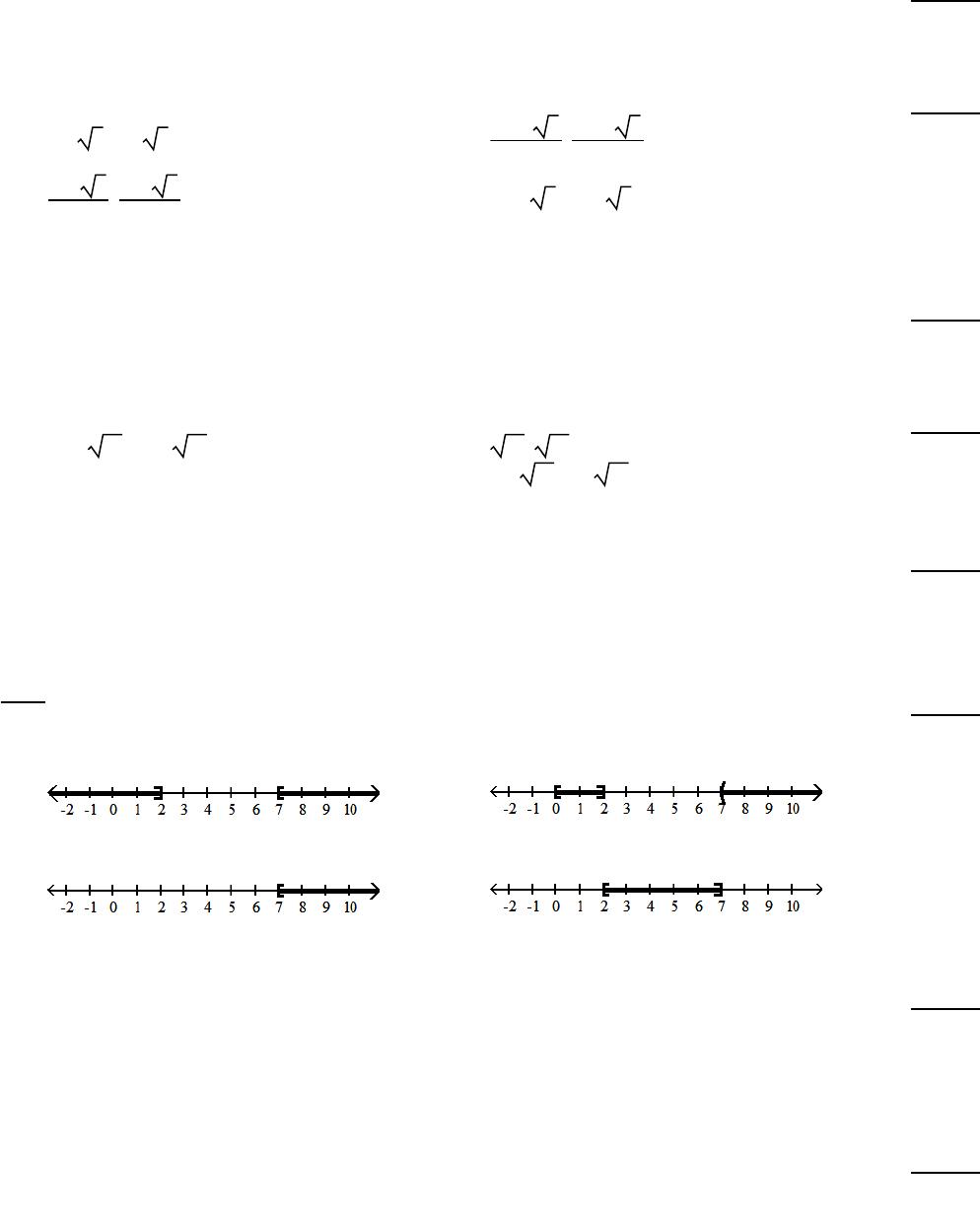
Find the axis of symmetry of the function.
29)
f(x) = –(x + 5)2+ 4
29)
A)
x = –5
B)
x =6
C)
x =4
D)
x =25
Solve.
30)
2x2+15x = –9+25x
30)
A)
5+7, 5–7
B)
–5+7
2, –5–7
2
C)
5+7
2, 5–7
2
D)
–5+7, –5–7
Find the axis of symmetry of the function.
31)
f(x) =3x2– 30x + 79
31)
A)
x =5
B)
x = –5
C)
x = –4
D)
x =4
Solve by using the square root property.
32)
x2+ 10x +25 =13
32)
A)
–5+13, –5–13
B)
13, 13
C)
8
D)
5+13, 5–13
Solve the problem. Round your answer to the nearest tenth, if necessary.
33)
Bill can row 3 mph in still water. It takes him 3 hr 36 min to go 3 mi upstream and then return. Find
the speed of the current.
33)
A)
3 mph
B)
2.5 mph
C)
1.5 mph
D)
2 mph
Solve. Then graph the solution.
34)
35x
7– x 7x
34)
A)
(–
, 2] [7,
)
B)
[0, 2] (7,
)
C)
[7,
)
D)
[2, 7]
Solve the problem.
35)
The length and width of a rectangle have a sum of 72 feet. What dimensions give the maximum
area?
35)
A)
Length 27 ft and width 45 ft
B)
Length 35 ft and width 37 ft
C)
Length 26 ft and width 46 ft
D)
Length 36 ft and width 36 ft
Use a grapher to find the vertex, rounding to the nearest hundredth when necessary.
36)
f(x) =x2+ x +2
36)
A)
(0.5, 1.75)
B)
(0.5, –1.75)
C)
(–0.5, 2)
D)
(–0.5, 1.75)
8
Solve the problem.
37)
An open box is to be made from a rectangular piece of tin by cutting two inch squares out of the
corners and folding up the sides. The volume of the box will be 100 cubic inches. Find the
dimensions of the rectangular piece of tin.
37)
A)
5 in. by 10 in.
B)
5 in. by 9 in.
C)
Not enough information
D)
4 in. by 9 in.
38)
A rectangular garden has an area of 12 feet by 5 feet. A gravel path of equal width is to be built
around the garden. How wide can the path be if there is enough gravel for 138 square feet?
38)
A)
3 ft
B)
10 ft
C)
4 ft
D)
5 ft
Use the discriminant of the equation to determine the number of x–intercepts.
39)
f(x) = –3x2– 6x +3
39)
A)
Two x–intercepts
B)
One x–intercept
C)
No x–intercepts
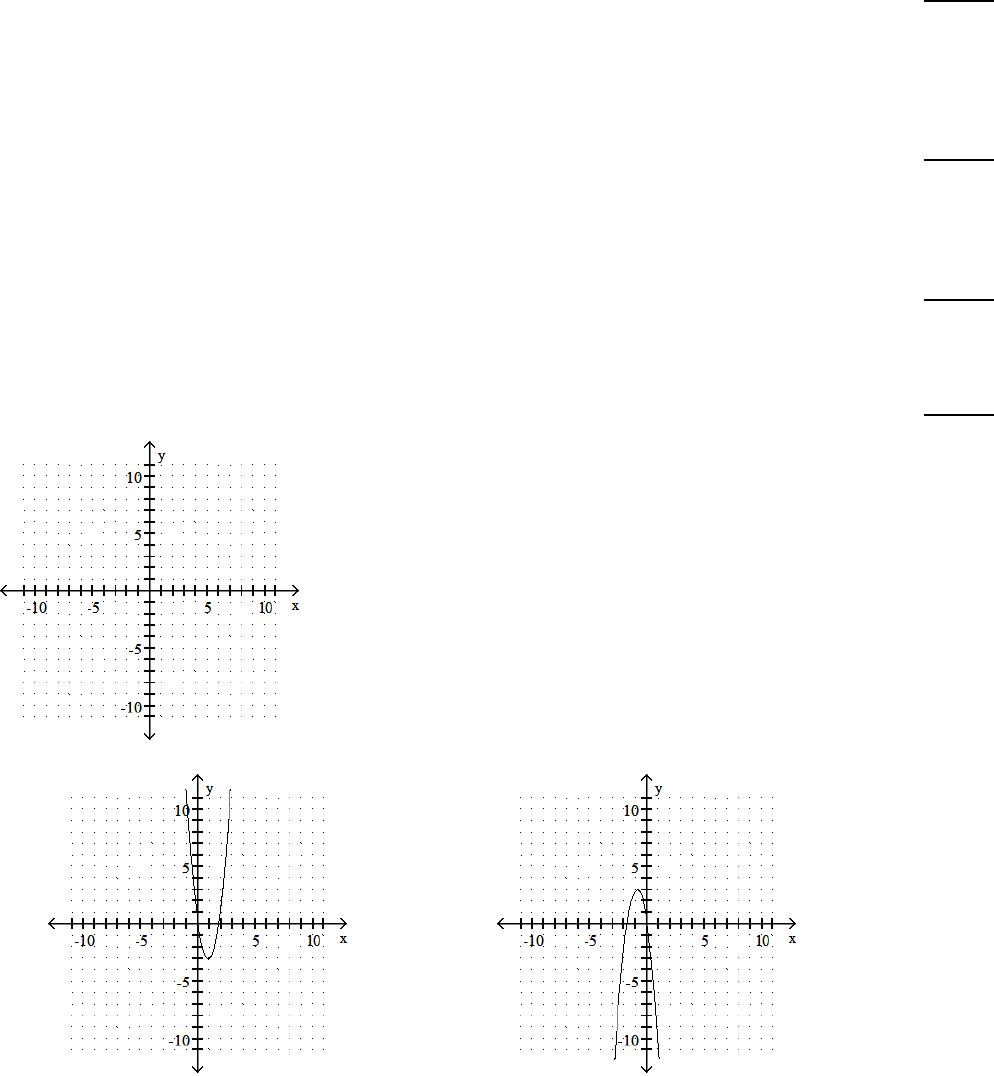
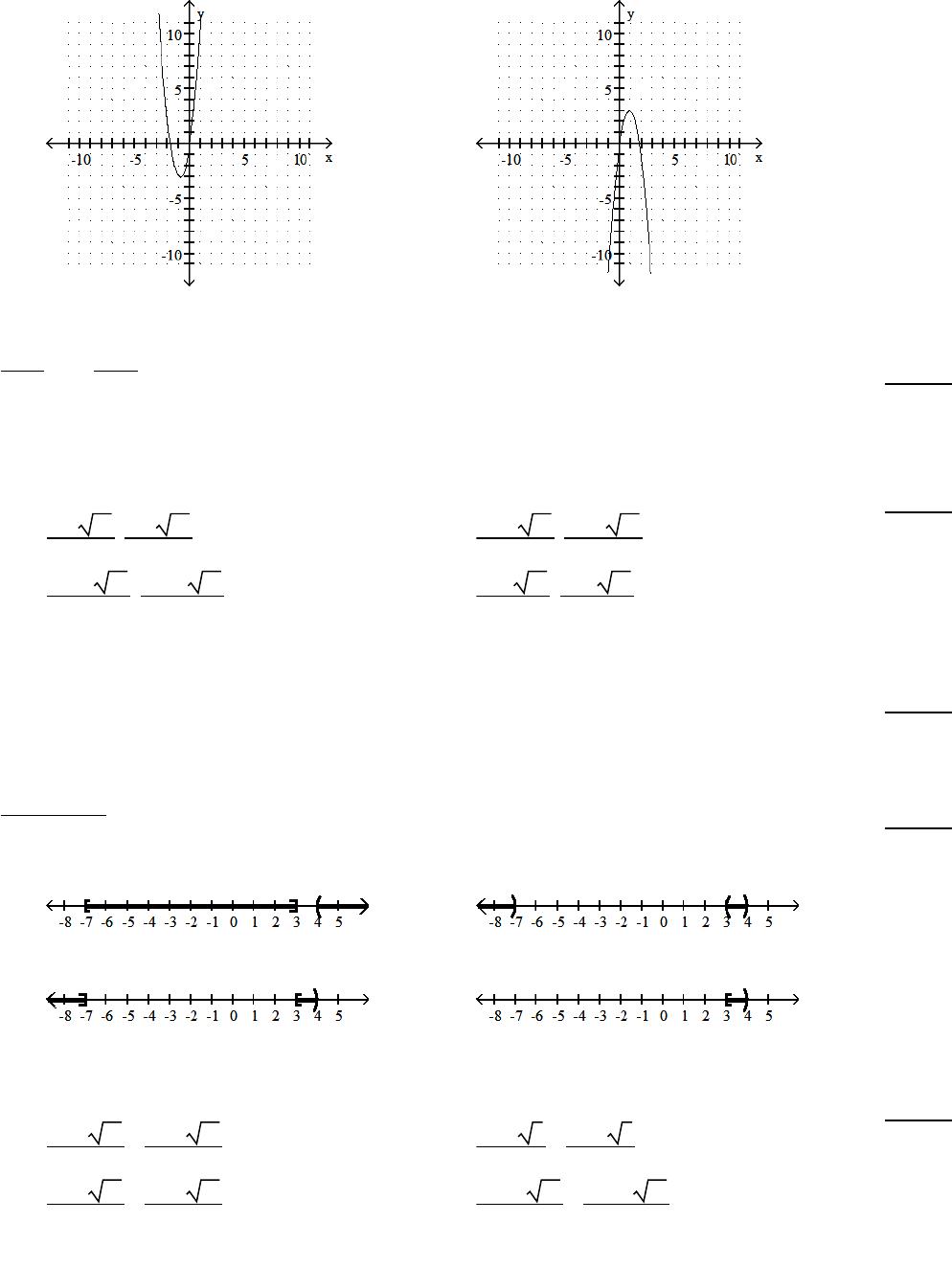
Graph the equation.
40)
g(x) =4x2–7x
40)
A)
B)
9
C)
D)
Solve the equation.
41)
16
b + 2 = 1 +2
b – 4
41)
A)
6, 10
B)
No solution
C)
–2, 4
D)
–12
Solve the equation by completing the square.
42)
x2+ x + 9 = 0
42)
A)
1 +35
2, 1 –35
2
B)
–1 +35
2, –1 –35
2
C)
–1 + i 35
2, –1 – i 35
2
D)
1 + i 35
2, 1 – i 35
2
Find the vertex.
43)
f(x) =(x – 4)2
43)
A)
(0, 4)
B)
(0, –4)
C)
(–4, 0)
D)
(4, 0)
Solve. Then graph the solution.
44)
(x – 3)(x + 7)
x – 4
0
44)
A)
[–7, 3] (4,
)
B)
(–
, –7) (3, 4)
C)
(–
, –7] [3, 4)
D)
[3, 4)
Solve.
45)
2x2= –10x – 1
45)
A)
–5+23
4 , –5–23
4
B)
–5+3
2 , –5–3
2
C)
–5+23
2 , –5–23
2
D)
–10 +23
2 , –10 –23
2
10
Solve the equation by completing the square.
46)
x2–1
5x = – 7
10
46)
A)
–1+ i 69
10 , –1– i 69
10
B)
1+ i 69
10 , 1– i 69
10
C)
1
5i, 0
D)
0, –7
2i
Use the discriminant to determine the number and type of solutions for the equation.
47)
x2+ 4x + 5 = 0
47)
A)
Two real–number solutions
B)
Two complex–number solutions
C)
One real–number solution
Solve the problem.
48)
A coin is tossed upward from a balcony 220 feet high (h0) with an initial velocity (v0) of 48 feet per
second, according to the formula h(t) = –16t2+v0t +h0, where t is time in seconds. During what
interval of time will the coin be at a height of at least 60 feet?
48)
A)
The coin will be at a height of at least 60 feet for any time up to and including 1 sec.
B)
The coin will be at a height of at least 60 feet for any time between and including 4 sec and 5
sec.
C)
The coin will be at a height of at least 60 feet for any time up to and including 5 sec.
D)
The coin will be at a height of at least 60 feet for any time between and including 5 sec and 10
sec.
49)
When water runs out of a hole in a cylindrical container, the height of the water in the container can
often be modeled by a quadratic function. Assume that the height of the water in a particular metal
can with a small hole can be modeled by h =0.0004x2– 0.16x + 8, where x is the time (sec) and h is
the height (cm). Use the quadratic formula to estimate the time when the height is 3 cm. Round
your answer to the nearest second.
49)
A)
41 sec
B)
38 sec
C)
34 sec
D)
40 sec
Graph the function on a grapher. Then use the grapher to find the x– and y–intercepts. Round to the nearest hundredth if
necessary.
50)
f(x) = –3.02x2– 3.75x – 8.25
50)
A)
(–8.25, 0), no y–intercepts
B)
(–2.39, 0), (0, –8.25)
C)
(–2.39, 0), (1.14, 0), (0, –8.25)
D)
No x–intercepts, (0, –8.25)
Solve by using the square root property.
51)
–4x2= –60
51)
A)
15 , –15
B)
16
C)
30
D)
15, –15
Find the vertex.
52)
f(x) =2x2+ 12x + 19
52)
A)
(–1, 3)
B)
(3, –1)
C)
(–3, 1)
D)
(1, –3)
11
Determine if the graph of the function opens upward or downward and whether it has a maximum or a minimum point.
53)
f(x) = –2x2– 5x – 7
53)
A)
Upward, minimum
B)
Upward, maximum
C)
Downward, maximum
D)
Downward, minimum
Solve.
54)
x2+ x + 9 = 0
54)
A)
1 + i 35
2, 1 – i 35
2
B)
–1 + i 35
2, –1 – i 35
2
C)
1 +35
2, 1 –35
2
D)
–1 +35
2, –1 –35
2
Solve the equation by completing the square.
55)
8x2+ 7x = –2
55)
A)
–7 +15
16 , –7 –15
16
B)
–7 + i 15
16 , –7 – i 15
16
C)
7 + i 15
16 , 7 – i 15
16
D)
7 +15
16 , 7 –15
16
Solve the problem.
56)
If a rocket is propelled upward from ground level, its height h in meters after t sec is given by
h(t) = –9.8t2+ 127.4t. During what interval of time will the rocket be higher than 411.6 m?
56)
A)
The rocket will be higher than 411.6 m for times up to, but not including, 7 sec.
B)
The rocket will be higher than 411.6 m for times between, but not including, 12 sec and 13 sec.
C)
The rocket will be higher than 411.6 m for times between, but not including, 6 sec and 7 sec.
D)
The rocket will be higher than 411.6 m for times up to, but not including, 6 sec.
Graph the function on a grapher. Then use the grapher to find the x– and y–intercepts. Round to the nearest hundredth if
necessary.
57)
f(x) = –12.7x2– 2.71x + 4.56
57)
A)
(–0.50, 0), (0.72, 0), (0, –4.56)
B)
(–0.72, 0), (0.50, 0), (0, 4.56)
C)
No x–intercepts, (0, 4.56)
D)
(0.50, 0), (0, 4.56)
Solve the equation.
58)
(k + 3)2/3 – 2(k + 3)1/3 – 8 = 0
58)
A)
No solution
B)
0, 6
C)
11, 61
D)
–11, 61
Determine if the graph of the function opens upward or downward and whether it has a maximum or a minimum point.
59)
f(x) =x2+7
59)
A)
Downward, maximum
B)
Downward, minimum
C)
Upward, maximum
D)
Upward, minimum
Solve the formula for the indicated letter. Assume that all variables represent nonnegative numbers.
60)
M =r2hd for r
60)
A)
r =Mhd
hd
B)
r =Mhd
hd
C)
r =Mhd
D)
r =Mhd
hd
12
Solve.
61)
5x2– 25x + 30 = 0
61)
A)
–2, –3
B)
–2, 3
C)
2, 3
D)
2, –3
Graph the function on a grapher. Then use the grapher to find the x– and y–intercepts. Round to the nearest hundredth if
necessary.
62)
f(x) =0.86x2– 3.38x + 16.09
62)
A)
(6.72, 0), (0, 16.09)
B)
(16.09, 0), no y–intercepts
C)
No x–intercepts, (0, 16.09)
D)
(6.72, 0), (–2.79, 0), (0, 16.09)
Solve.
63)
7x2– 3x + 2 = 0
63)
A)
–3+ i 47
14 , –3– i 47
14
B)
–3+47
14 , –3–47
14
C)
3+ i 47
14 , 3– i 47
14
D)
3+47
14 , 3–47
14
Solve the equation by completing the square.
64)
x2+ 8x =7
64)
A)
–1+23 , –1–23
B)
–4+23 , –4–23
C)
4+23
D)
4–23
Write a quadratic equation having the given numbers as solutions.
65)
4
3, –3
4
65)
A)
4x2– 9x – 12 = 0
B)
4x2–7
3x – 4 = 0
C)
4x2+7
3x – 4 = 0
D)
4x2– 12x – 9 = 0
Solve.
66)
(3x + 9)2– 13 = 0
66)
A)
4
3, –4
3
B)
9+13
3, 9–13
3
C)
–9+13, –9–13
D)
–9+13
3, –9–13
3
Solve. Round the answers as indicated.
67)
0.1x2– 0.2x – 0.2= 0, round to the nearest thousandth
67)
A)
–0.732, 2.732
B)
0.268
C)
0.268, 3.732
D)
2.732
Solve the problem.
68)
The manager of a pet store has found that if the price of a dog collar is p(x) =74 –x
6, then x collars
will be sold. Find an expression for the total revenue from the sale of x collars
(Hint: revenue = demand × price). Use your expression to determine the maximum revenue.
68)
A)
$4107
B)
$32,856
C)
$16,428
D)
$8214
13
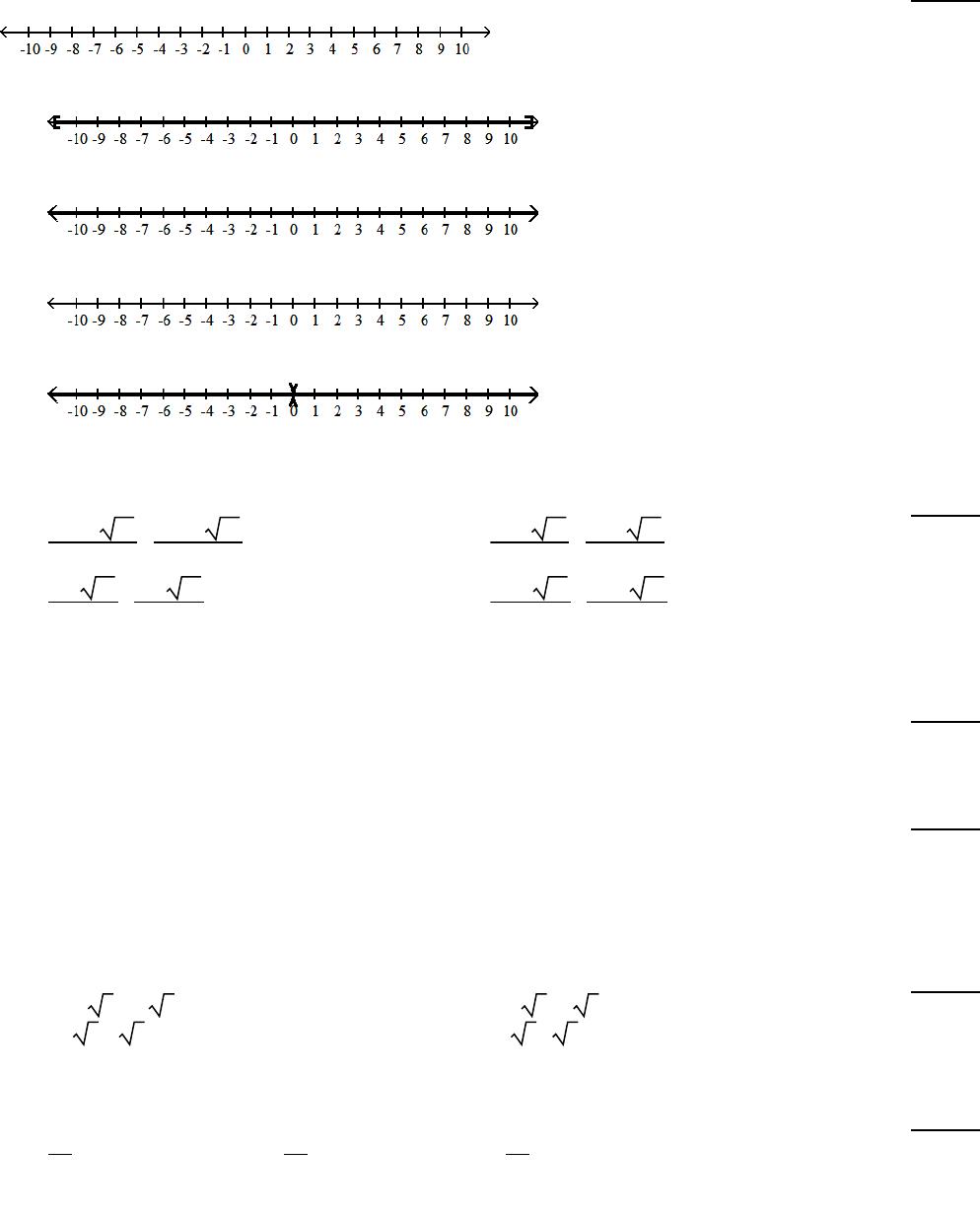
Solve. Then graph the solution.
69)
x2+2x +11 0
69)
A)
[–11, 11]
B)
(–
,
)
C)
D)
(–
, 0) (0,
)
Given f(x) and g(x), find all values of x for which f(x) = g(x).
70)
f(x) =2x2–2x +7 and g(x) =9x +3
70)
A)
–11 +89
4 , –11 –89
4
B)
11 +89
4 , 11 –89
4
C)
5+89
4 , 5–89
4
D)
–5+89
4 , –5–89
4
Find the constant term to be added to the expression to form a perfect square trinomial.
71)
x2+ 16x
71)
A)
256
B)
–64
C)
0
D)
64
Solve the problem.
72)
The demand equation for a certain product is P =55 –0.003x, where x is the number of units sold
per week and P is the price in dollars at which one is sold. The weekly revenue R is given by
R = xP. What number of units sold produces a weekly revenue of $60,000?
72)
A)
17,168 units
B)
1165 units
C)
1033 units
D)
19,981,667 units
Solve by using the square root property.
73)
x2+125= 0
73)
A)
–10i 5, 10i 5
B)
–5i 5, 5i 5
C)
–5 5, 5 5
D)
– i 5, i 5
Solve.
74)
8x(x – 4) – 40 =5x(x – 6)
74)
A)
10
3, –4
B)
–10
3, 4
C)
–10
3, –4
D)
–10, 4
14
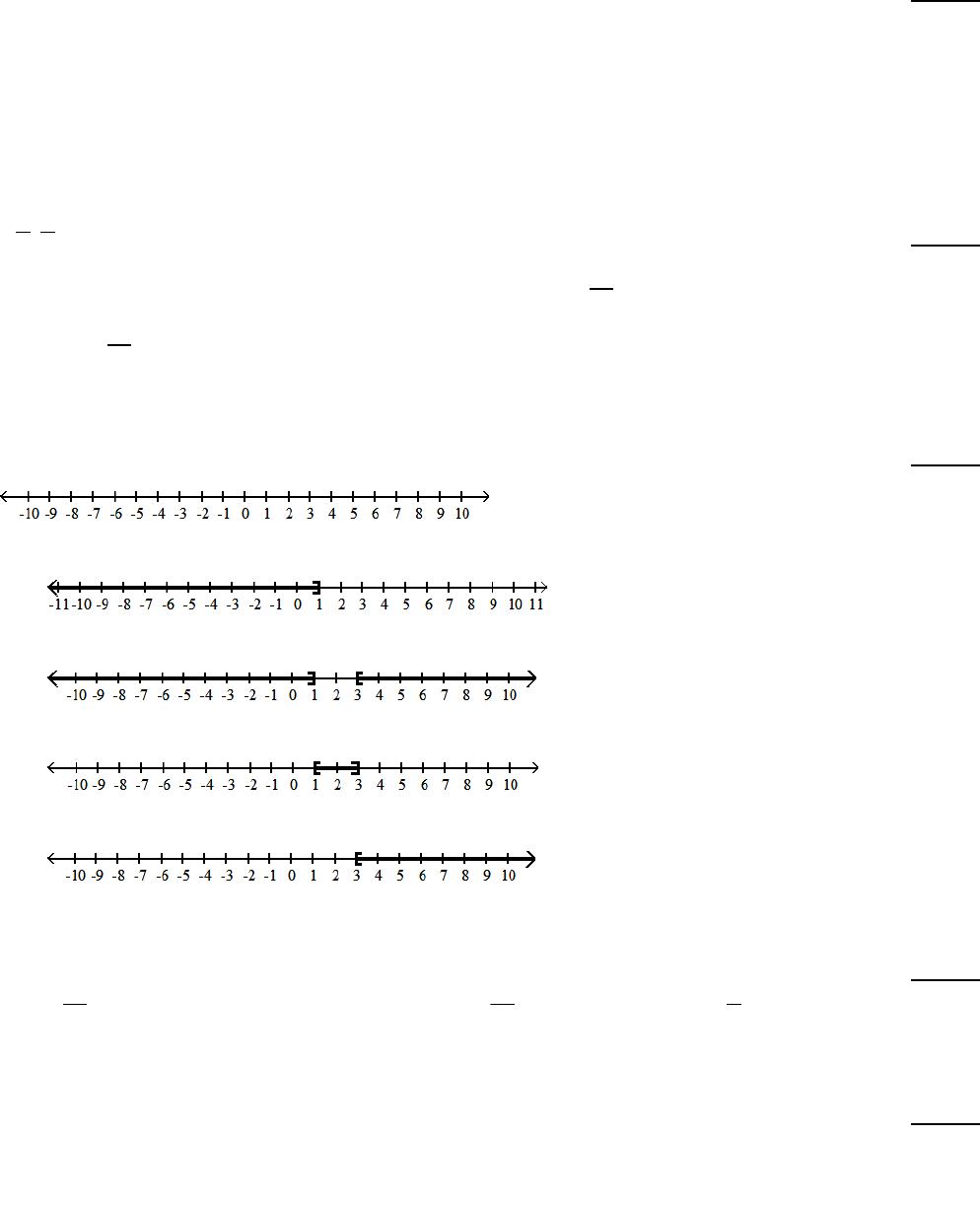
Solve the problem.
75)
A rectangular enclosure must have an area of at least 700 square yards. If 160 yards of fencing is to
be used, and the width cannot exceed the length, within what limits must the width of the
enclosure lie?
75)
A)
Then enclosure must have a width of 10 or fewer yd.
B)
The enclosure must have a width between 10 yd and 70 yd inclusive.
C)
The enclosure must have a width between 40 yd and 70 yd inclusive.
D)
The enclosure must have a width between 10 yd and 40 yd inclusive.
Write a quadratic equation having the given numbers as solutions.
76)
–9
5, 3
2
76)
A)
10x2+ 3x – 27 = 0
B)
10x2+ 3x –27
10 = 0
C)
10x2–27
10x + 3 = 0
D)
10x2+ 3x + 27 = 0
Solve. Then graph the solution.
77)
x2– 4x + 3 0
77)
A)
(–
, 1]
B)
(–
, 1] [3,
)
C)
[1, 3]
D)
[3,
)
Find the constant term to be added to the expression to form a perfect square trinomial.
78)
x2+ 9x
78)
A)
–81
4
B)
0
C)
81
4
D)
–9
2
Determine if the graph of the function opens upward or downward and whether it has a maximum or a minimum point.
79)
f(x) =8+ 6x + 4x2
79)
A)
Upward, minimum
B)
Downward, minimum
C)
Upward, maximum
D)
Downward, maximum
15

Graph the function on a grapher. Then use the grapher to find the x– and y–intercepts. Round to the nearest hundredth if
necessary.
80)
f(x) = –14.6x2+ 4.93x + 7.02
80)
A)
(–0.54, 0), (0.88, 0), (0, 7.02)
B)
(–0.88, 0), (0.54, 0), (0, –7.02)
C)
(–0.54, 0), (0, 7.02)
D)
No x–intercepts, (0, 7.02)
Find the axis of symmetry of the function.
81)
f(x) =x2– 4x + 14
81)
A)
x = 0
B)
x =10
C)
x =2
D)
x = –2
Solve the problem. Round your answer to the nearest tenth, if necessary.
82)
Sue rowed her boat across and back Lake Bend in 3 hr. If her rate rowing back was 2 mph less than
the rate rowing across, and if the distance each way was 7 mi, find her rate rowing across.
82)
A)
1.5 mph
B)
5.5 mph
C)
5.9 mph
D)
3.7 mph
Use a grapher to find the vertex, rounding to the nearest hundredth when necessary.
83)
f(x) = –0.4x2+ 0.8x – 0.3
83)
A)
(–1, –0.1)
B)
(1, –0.7)
C)
(1, 0.1)
D)
(1, –0.3)
Solve.
84)
x2–8x +25 = 0
84)
A)
4+3i, 4–3i
B)
8+6i, 8–6i
C)
–4+3i, –4–3i
D)
7, 1
85)
x1/2 –10x1/4 = –25
85)
A)
625
B)
5
C)
20
D)
45
16
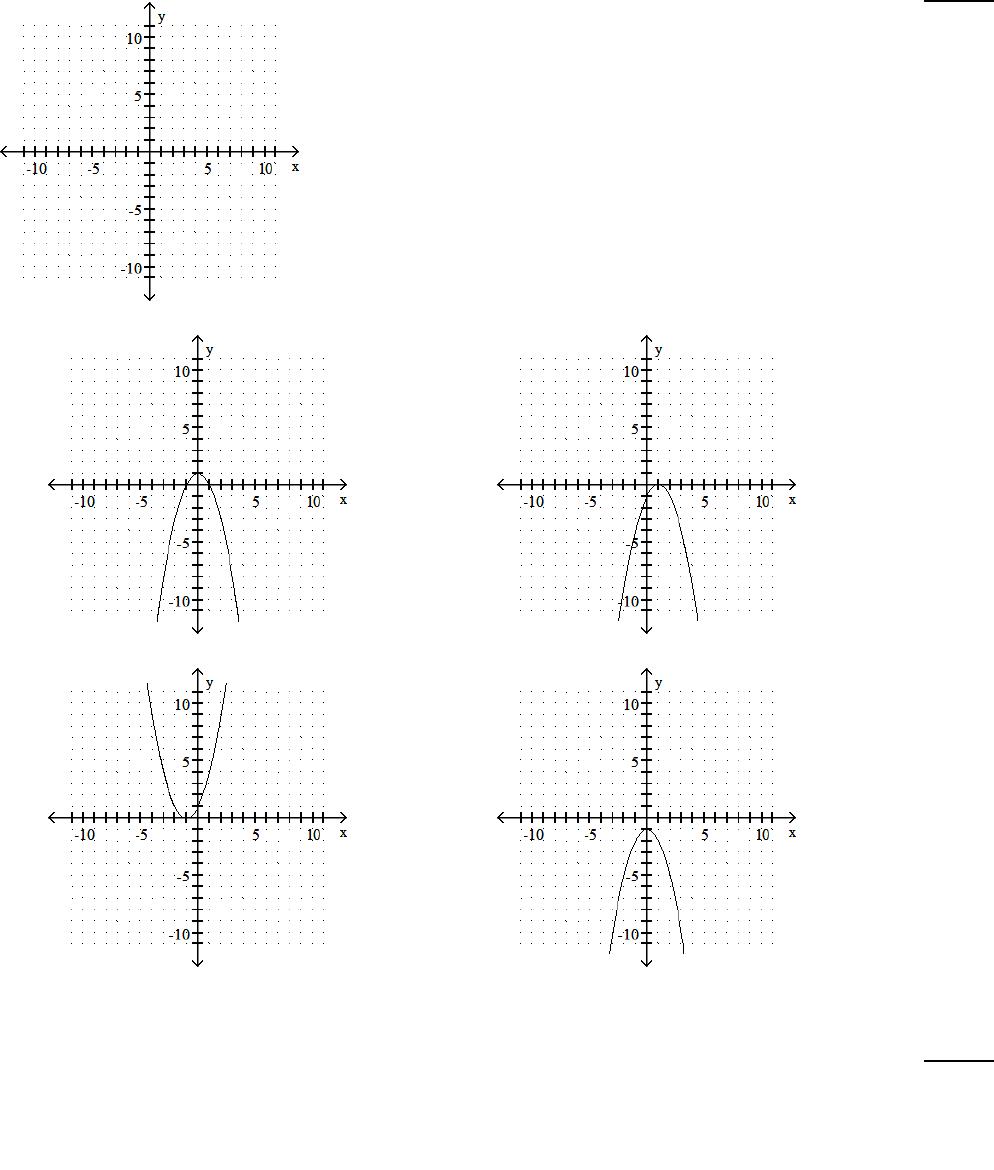
Graph the equation.
86)
f(x) = –x2– 1
86)
A)
B)
C)
D)
Use the discriminant to determine the number and type of solutions for the equation.
87)
x2– 6x + 9 = 0
87)
A)
One real–number solution
B)
Two real–number solutions
C)
Two complex–number solutions
17
Solve the problem.
88)
The height h of a ball thrown is given by h(x) = 2x – .08x2, where x is the horizontal distance
traveled and both measurements are in feet. At what horizontal distances will the height of the ball
be more than 9 ft? (Round distances to the nearest tenth of a foot, if necessary.)
88)
A)
The height of the ball will be more than 9 ft at horizontal distances less than 19.1 ft.
B)
The height of the ball will be more than 9 ft at horizontal distances between, but not
including, 5.9 ft and 19.1 ft.
C)
The height of the ball will be more than 9 ft at horizontal distances less than 5.9 ft or between,
but not including 19.1 ft and 25 ft.
D)
The height of the ball will be more than 9 ft at horizontal distances between, but not
including, 5.9 ft and 25 ft.
Determine the domain and range of the function.
89)
g(x) =(x + 3)2+ 2
89)
A)
Domain: [–
, 3)
Range: [–
, 2)
B)
Domain: [–3,
)
Range: [2,
)
C)
Domain: ( ,
)
Range: [–
, 2)
D)
Domain: ( ,
)
Range: [2,
)
Solve the problem.
90)
For a car traveling at x mph, stopping distance is estimated by the formula D =1
9x2+11
3x. Find a
(maximum) safe speed for a stopping distance of 670 feet. Round your answer to the nearest mph.
90)
A)
67 mph
B)
75 mph
C)
72 mph
D)
63 mph
Find the axis of symmetry of the function.
91)
f(x) =5x2– 50x + 133
91)
A)
x =8
B)
x =5
C)
x = –8
D)
x = 0
Use a grapher to find the vertex, rounding to the nearest hundredth when necessary.
92)
f(x) = –2x2– 6x + 7
92)
A)
(–1.5, 11.5)
B)
(1.5, 11.5)
C)
(3, 11.5)
D)
(–1.5, 2.5)
Solve the equation.
93)
x4+432=57x2
93)
A)
–48, –9, 9, 48
B)
3, 4 3
C)
–4 3, –3, 3, 4 3
D)
9, 48
Find the constant term to be added to the expression to form a perfect square trinomial.
94)
x2– 20x
94)
A)
0
B)
100
C)
–100
D)
None of the above
Graph the equation.
18
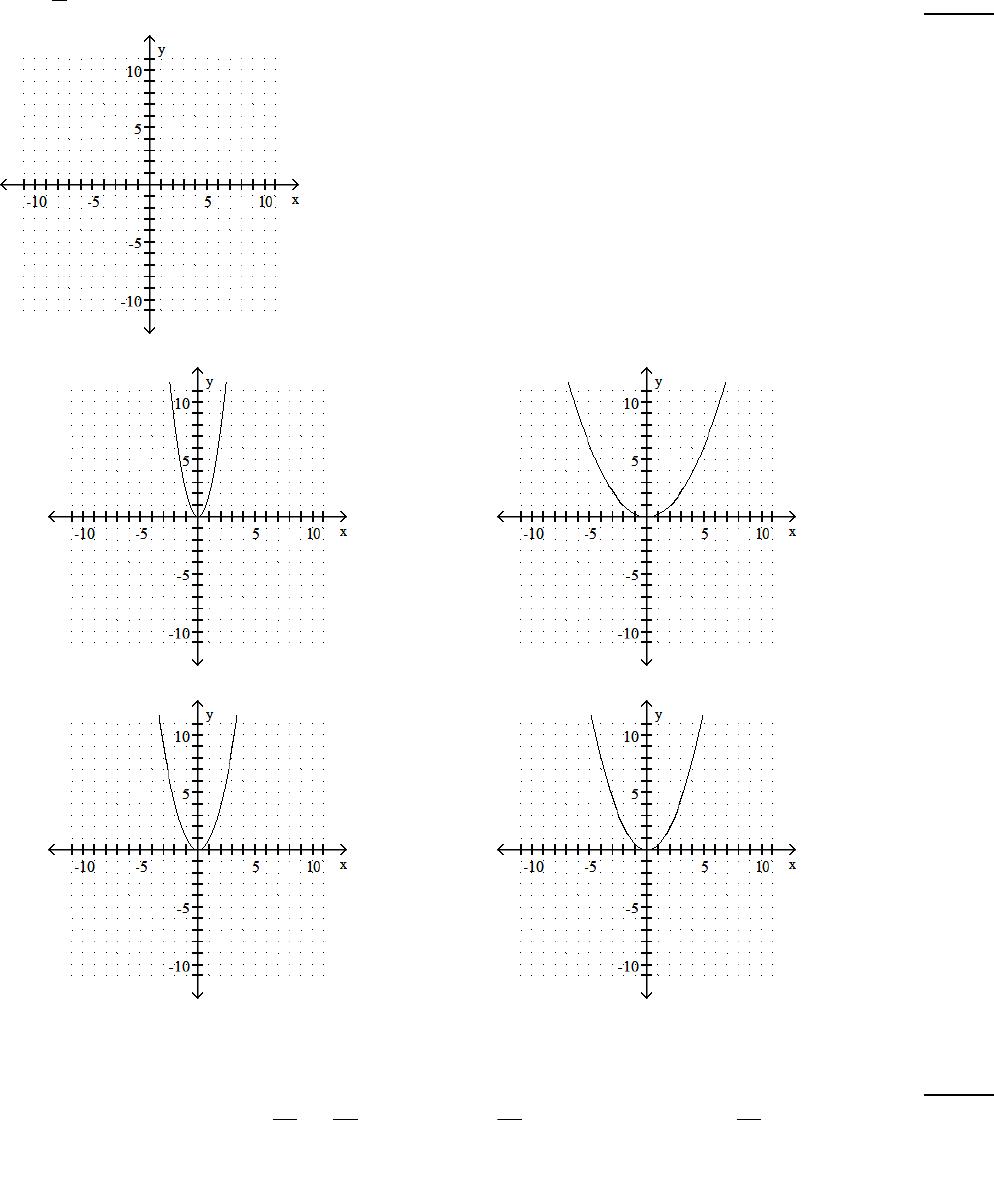
95)
f(x) =1
2x2
95)
A)
B)
C)
D)
Solve the equation by completing the square.
96)
9x2+ 10x = 0
96)
A)
0
B)
10
9 , –10
9
C)
10
9, 0
D)
–10
9, 0
19
Find the y–intercepts and any x–intercepts.
97)
f(x) =x2–3
97)
A)
y–intercept (0, –3), x–intercept ( 3, 0)
B)
y–intercept (0, –3), x–intercepts ( 3, 0) and (–3, 0)
C)
y–intercept (0, –3), x–intercepts (0, 3) and (0, –3)
D)
y–intercept (0, 3), x–intercepts ( 3, 0) and (–3, 0)
Solve the equation.
98)
1 –2
x–35
x2= 0
98)
A)
–7, –5
B)
–7, 5
C)
7, –5
D)
7, 5
Determine if the graph of the function opens upward or downward and whether it has a maximum or a minimum point.
99)
f(x) =6–4x –9x2
99)
A)
Downward, minimum
B)
Upward, minimum
C)
Upward, maximum
D)
Downward, maximum
Solve the problem.
100)
A polygon with n sides has D diagonals, where D is given by the function D(n) =n(n – 3)
2. Find the
number of sides n if 20
D 299.
100)
A)
The number of sides is between 8 and 26, inclusive.
B)
The number of sides is between 9 and 26, inclusive.
C)
The number of sides is between 6 and 27, inclusive.
D)
The number of sides is between 7 and 27, inclusive.
Determine the domain and range of the function.
101)
h(x) = –x2– 8x – 18
101)
A)
Domain: [4,
)
Range: (–
, –2]
B)
Domain: ( ,
)
Range: (–
, –2]
C)
Domain: ( ,
)
Range: (–
, 4]
D)
Domain: ( ,
)
Range: [4,
)
Solve the equation by completing the square.
102)
2x2–2x +8=9x +4
102)
A)
6+89
4 , 6–89
4
B)
11 +89
4 , 11 –89
4
C)
–6+89
4 , –6–89
4
D)
–11 +89
4 , –11 –89
4
Solve the equation.
103)
(–2p + 6)2= –15(–2p + 6) – 54
103)
A)
15
2, 6
B)
–9, –6
C)
3
2, 0
D)
–15
2, – 6
Find the vertex.
104)
f(x) =2x2– 16x + 37
104)
A)
(–4, –5)
B)
(4, 5)
C)
(–5, –4)
D)
(5, 4)
20
Solve.
105)
8x2– 3x + 7 = 0
105)
A)
–3+ i 215
16 , –3– i 215
16
B)
3+ i 215
16 , 3– i 215
16
C)
–3+215
16 , –3–215
16
D)
3+215
16 , 3–215
16
Solve the formula for the indicated letter. Assume that all variables represent nonnegative numbers.
106)
A =1
3r2 for r
106)
A)
r =3
A
B)
r = 3 A
C)
r =3A
D)
r =A
3
Solve.
107)
6x2+ 10x + 3 = 0
107)
A)
–10 +7
6 , –10 –7
6
B)
–5+7
12 , –5–7
12
C)
–5+7
6 , –5–7
6
D)
–5+43
6 , –5–43
6
21
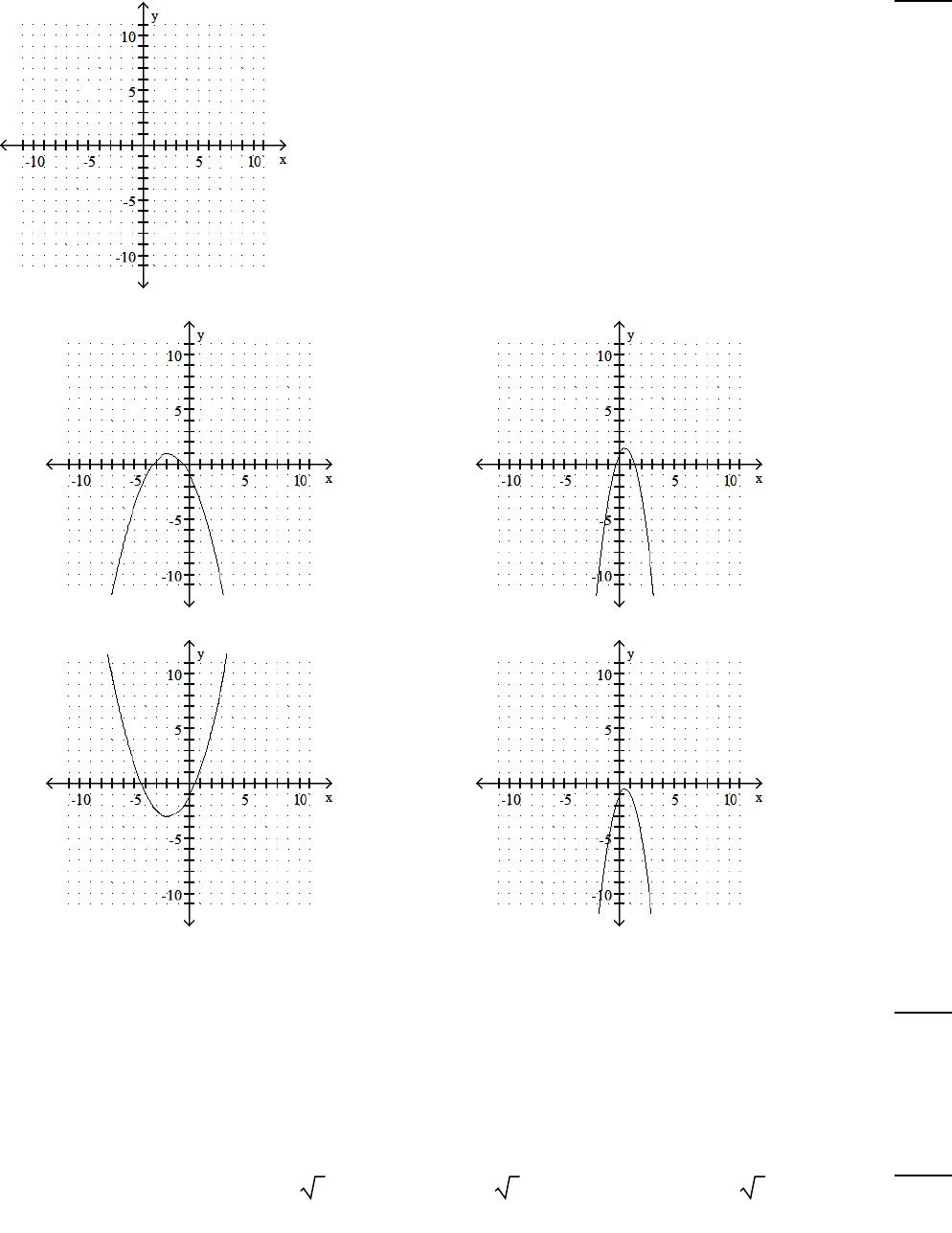
Graph the equation.
108)
g(x) = –2x2+ 2x – 1
108)
A)
B)
C)
D)
Solve the problem.
109)
A ball is dropped from a cliff that is 432 feet high. The distance S (in feet) that it falls in t seconds is
given by the formula S =432– 16t2. How many seconds will it take for the ball to hit the ground?
Round to the nearest tenth when necessary.
109)
A)
20.4 sec
B)
20.8 sec
C)
5.2 sec
D)
11,664 sec
Solve the equation.
110)
x4–14x2+45 = 0
110)
A)
±3, ±5
B)
±3, ±5
C)
3, 5
D)
±3, ±2 5
22
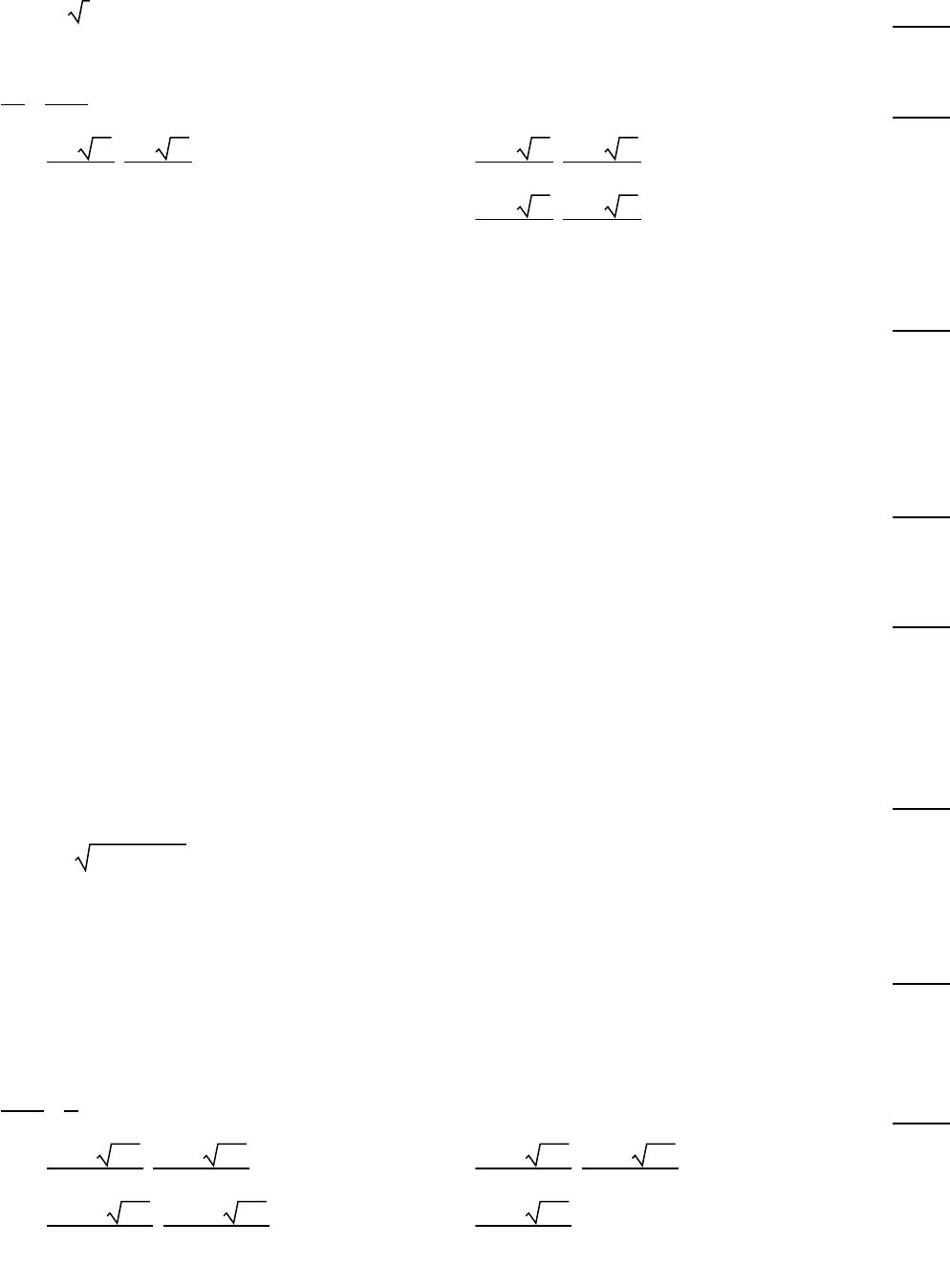
111)
s =8+ 2 s
111)
A)
12
B)
8
C)
16
D)
32
112)
2
3x –1
x +1= 1
112)
A)
2+10
3, 2–10
3
B)
–4+10
3, –4–10
3
C)
No solution
D)
–2+10
3, –2–10
3
Solve the problem.
113)
Given the following revenue and cost functions, find the x–value that makes profit a maximum.
(Recall that profit equals revenue minus cost.)
R(x) =58x – 2x2
C(x) =22x +91
113)
A)
18
B)
9
C)
14.5
D)
10
Find the vertex.
114)
f(x) = x2– 16x + 68
114)
A)
(0, 8)
B)
(8, 4)
C)
(4, 0)
D)
(4, 8)
Find the y–intercepts and any x–intercepts.
115)
f(x) =x2–5x –24
115)
A)
y–intercept (0, –24), x–intercepts (8, 0) and (–3, 0)
B)
y–intercept (0, –24), x–intercepts (–8, 0) and (3, 0)
C)
y–intercept (–24, 0), x–intercepts (0, 8) and (0, –3)
D)
y–intercept (0, 24), x–intercepts (8, 0) and (–3, 0)
Solve the formula for the indicated letter. Assume that all variables represent nonnegative numbers.
116)
c2+ d2+ f2= g2, for c
116)
A)
c = g – d – f
B)
c = –g + d + f
C)
c =g2– d2– f2
D)
c = g2– d2– f2
Graph the function on a grapher. Then use the grapher to find the x– and y–intercepts. Round to the nearest hundredth if
necessary.
117)
f(x) =1.54x2+ 4.235x – 8.85
117)
A)
(4.14, 0), (–1.39, 0), (0, –8.85)
B)
(1.39, 0), (–4.14, 0)
C)
(1.39, 0), (–4.14, 0), (0, –8.85)
D)
No x–intercepts, (0, –8.85)
Solve the equation.
118)
k
6– k –3
k=6
118)
A)
39 +3177
7, 39 –3177
7
B)
33 +3177
14 , 33 –3177
14
C)
–33 +3177
14 , –33 –3177
14
D)
33 + 3 177
14
23
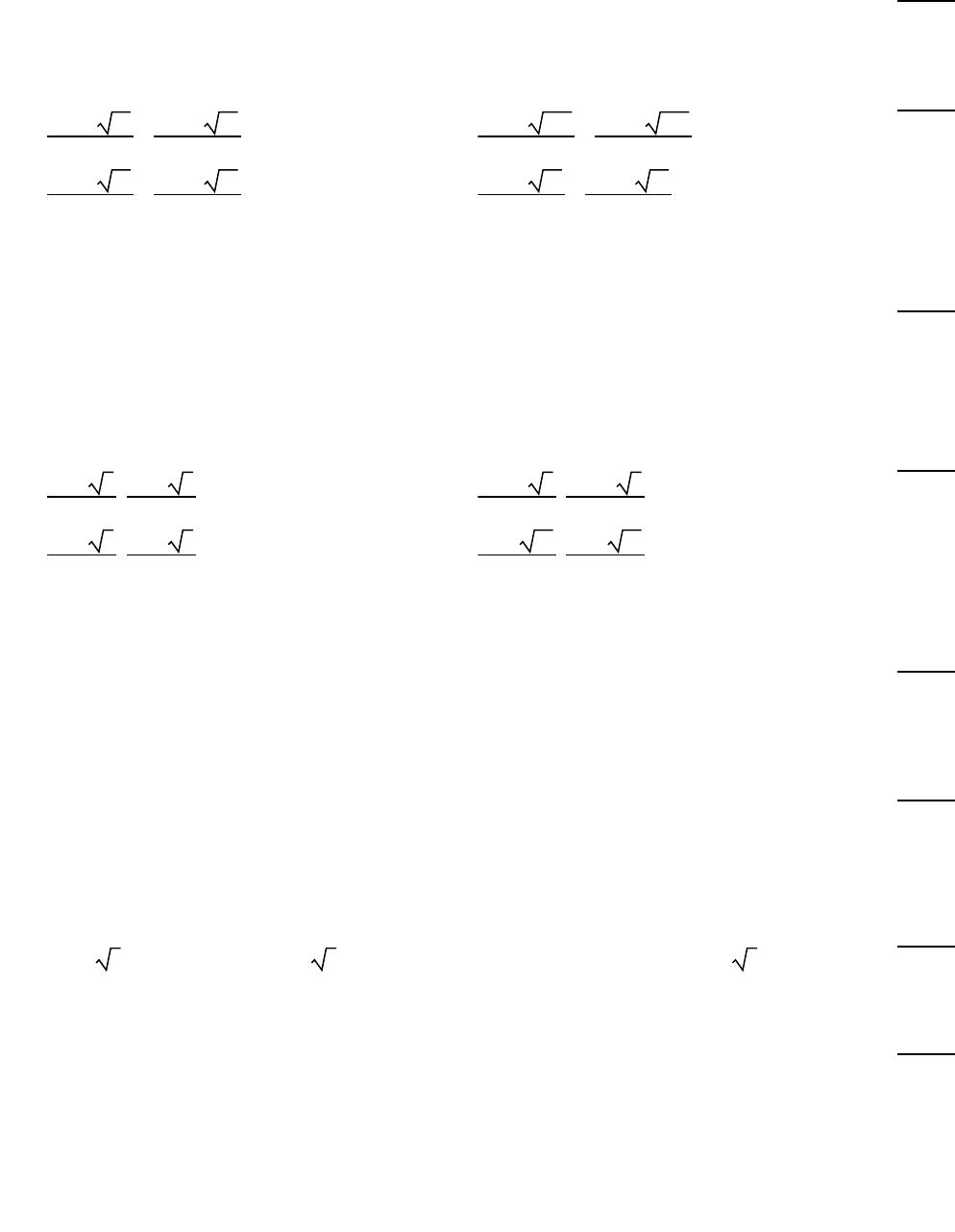
Use a grapher to find the vertex, rounding to the nearest hundredth when necessary.
119)
f(x) =4x2– x +4
119)
A)
(0.13, 4)
B)
(0.13, 4.06)
C)
(0.13, 3.94)
D)
(–0.13, 3.94)
Solve the equation by completing the square.
120)
7x2+ 22x = –14
120)
A)
–11 +23
14 , –11 –23
14
B)
–11 +219
7 , –11 –219
7
C)
–11 +23
7 , –11 –23
7
D)
–22 +23
7 , –22 –23
7
Solve the problem.
121)
The position of an object moving in a straight line is given by s = 2t2– 3t, where s is in meters and t
is the time in seconds the object has been in motion. How long will it take the object to move 10
meters? Round to the nearest tenth.
121)
A)
3.1 sec
B)
11.0 sec
C)
17.0 sec
D)
2.9 sec
Given f(x) and g(x), find all values of x for which f(x) = g(x).
122)
f(x) =6x2 and g(x) = –10x – 3
122)
A)
–5+7
12 , –5–7
12
B)
–10 +7
6, –10 –7
6
C)
–5+7
6, –5–7
6
D)
–5+43
6, –5–43
6
Determine if the graph of the function opens upward or downward and whether it has a maximum or a minimum point.
123)
f(x) = –1– 3x2
123)
A)
Upward, minimum
B)
Downward, maximum
C)
Downward, minimum
D)
Upward, maximum
Write a quadratic equation having the given numbers as solutions.
124)
9i, –9i
124)
A)
x2+81 = 0
B)
x2–81 = 0
C)
x2+81i = 0
D)
x2–18ix +81 = 0
Solve the equation.
125)
x4–36x2+128= 0
125)
A)
±2, ±4 2
B)
±2, ±4 3
C)
±3, ±4
D)
±2, ±2
Solve the problem.
126)
A retailer knows that n games can be sold in a month at a price of 30 – 0.2n dollars per game.
Assume that he buys each game for $16, and sells every one that he buys. If he wishes to make a
profit of at least $240 per month on sales of this game, how many games must he sell each month?
126)
A)
He must sell 30 or fewer games.
B)
He must sell between 30 and 40 games, inclusive.
C)
He must sell between 30 and 70 games, inclusive.
D)
He must sell between 20 and 35 games, inclusive.
Graph the function. Then identify the domain and range.
24
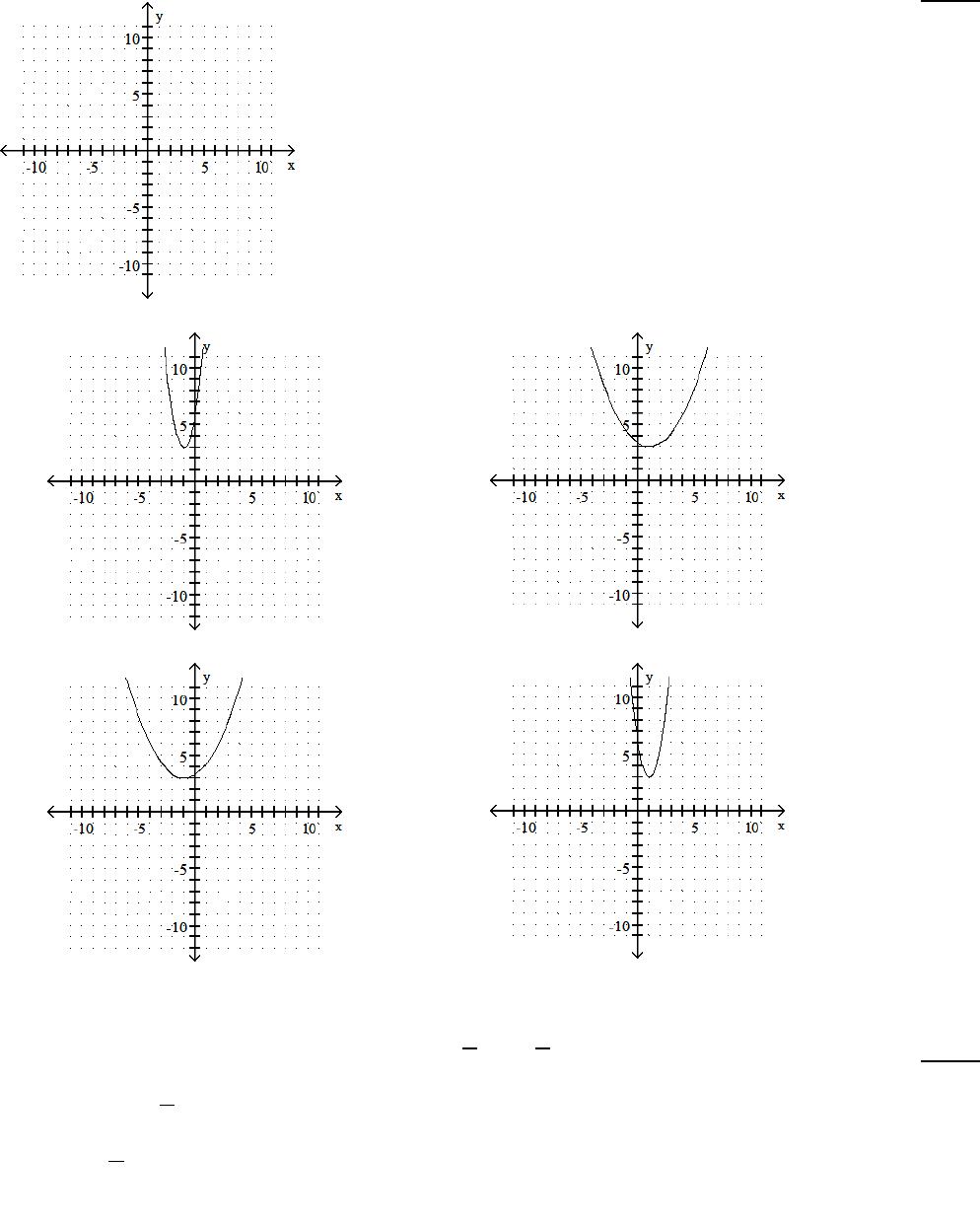
127)
f(x) =3x2– 6x + 6
127)
A)
Domain: (–
,
), Range: [3,
)
B)
Domain: (–
,
), Range: [3,
)
C)
Domain: (–
,
), Range: [3,
)
D)
Domain: (–
,
), Range: [3,
)
Solve.
128)
Find a quadratic equation in n that has the solutions –3
4 and –1
3.
128)
A)
12n2+ 13n +1
4= 0
B)
12n2+ 13n + 3 = 0
C)
12n2+1
4n + 13 = 0
D)
12n2+ 13n – 3 = 0
25
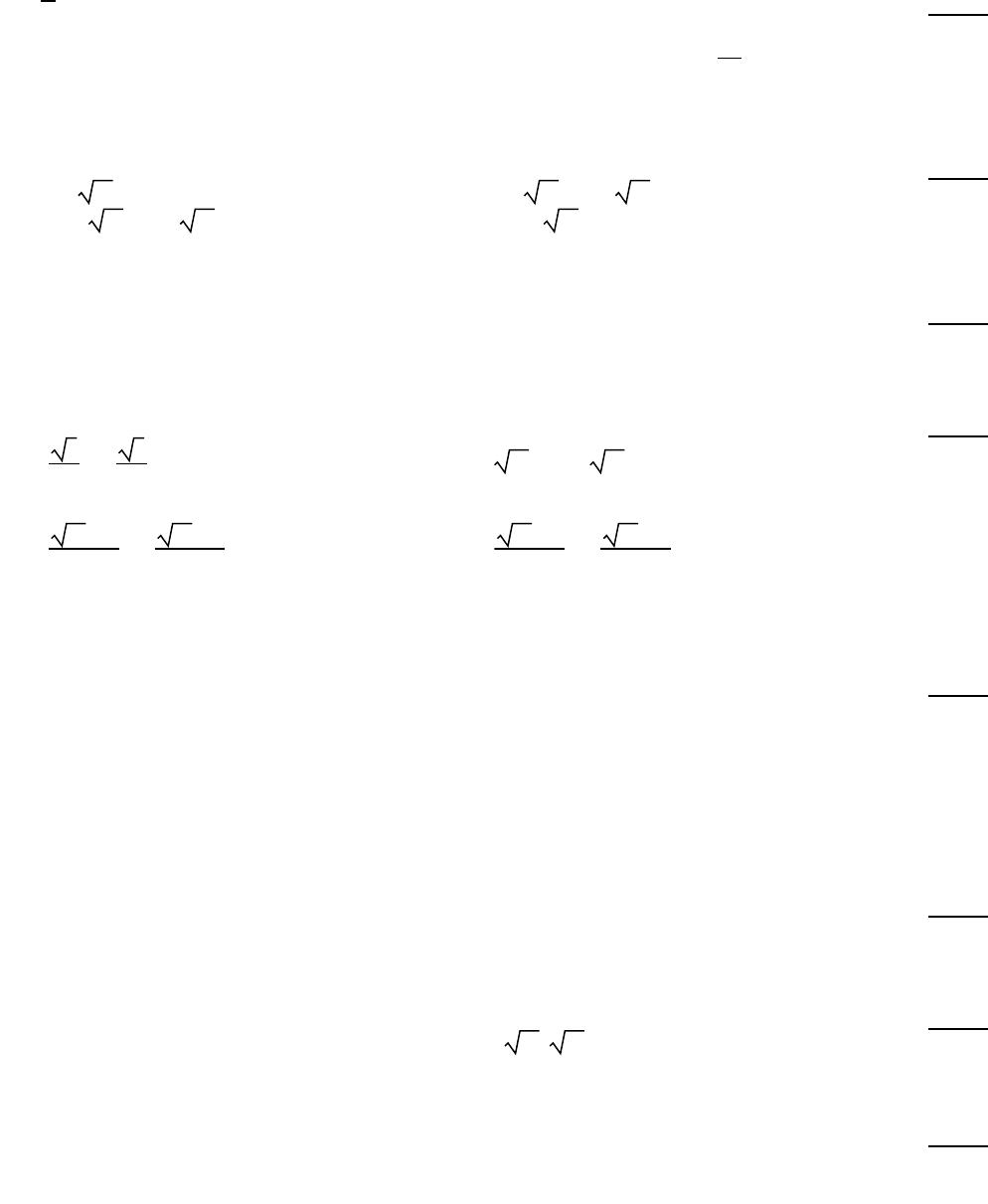
Find the constant term to be added to the expression to form a perfect square trinomial.
129)
x2+2
5x
129)
A)
–25
B)
25
C)
0
D)
1
25
Solve the equation by completing the square.
130)
x2+ 14x + 35 = 0
130)
A)
7+14
B)
7+35 , –7–14
C)
–7+14 , –7–14
D)
–14 +35
Use a grapher to find the vertex, rounding to the nearest hundredth when necessary.
131)
f(x) =x2+ 2x +1
131)
A)
(1, 1)
B)
(–1, 1)
C)
(1, 0)
D)
(–1, 0)
Solve by using the square root property.
132)
(3t + 3)2=10
132)
A)
7
3 , –7
3
B)
10 – 3, –10 – 3
C)
10 + 3
3 , –10 + 3
3
D)
10 – 3
3 , –10 – 3
3
Solve the problem.
133)
The cost C of producing t units is given by C(t) =2t2+ 6t, and the revenue R generated from selling
t units is given by R(t) =3t2+ t. For what values of t will there be a profit?
133)
A)
There will be a profit when more than 6 units are sold
B)
There will be a profit when more than 5 units are sold.
C)
There will be a profit when 0 units are sold.
D)
There will be a profit when more than 7 units are sold.
Find the constant term to be added to the expression to form a perfect square trinomial.
134)
x2+ 10x
134)
A)
25
B)
–25
C)
100
D)
0
Solve by using the square root property.
135)
5x2–55 = 0
135)
A)
27.5
B)
–11, 11
C)
–11, 11
D)
12
Use the discriminant of the equation to determine the number of x–intercepts.
136)
f(x) =x2+4x +5
136)
A)
One x–intercept
B)
Two x–intercepts
C)
No x–intercepts
26
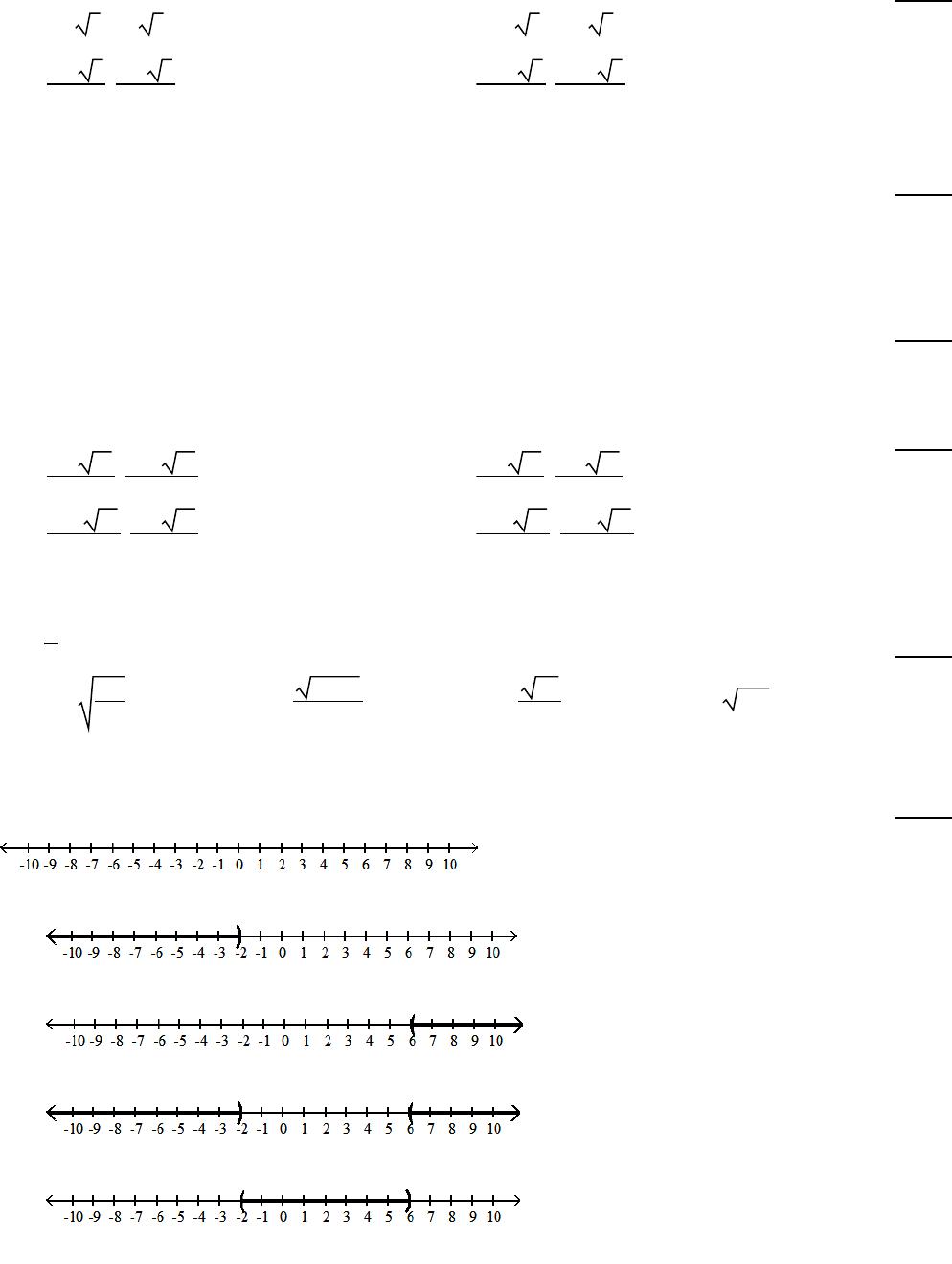
Given f(x) and g(x), find all values of x for which f(x) = g(x).
137)
f(x) = 2x2+9x and g(x) = –3+15x
137)
A)
3+3, 3–3
B)
–3+3, –3–3
C)
3+3
2, 3–3
2
D)
–3+3
2, –3–3
2
Write a quadratic equation having the given numbers as solutions.
138)
–4.6, 0.9
138)
A)
x2+4.6x –4.14 = 0
B)
x2–4.14 = 0
C)
x2–3.7x –4.14 = 0
D)
x2+3.7x –4.14 = 0
Solve the equation by completing the square.
139)
x2– 10x + 9 = 0
139)
A)
8, 1
B)
9, 1
C)
–9, –1
D)
3, –3
Solve.
140)
x2– x – 2 =4x –13
140)
A)
5+19
2, 5– i 19
2
B)
5+19
2, 5–19
2
C)
5+ i 19
2, 5–19
2
D)
5+ i 19
2, 5– i 19
2
Solve the formula for the indicated letter. Assume that all variables represent nonnegative numbers.
141)
Ve =1
2mv2 for v
141)
A)
v =Ve
2m
B)
v =2mVe
m
C)
v =2Ve
m
D)
v =2Ve
Solve. Then graph the solution.
142)
x2– 4x – 12 < 0
142)
A)
(–
, –2)
B)
(6,
)
C)
(–
, –2) (6,
)
D)
(–2, 6)
27
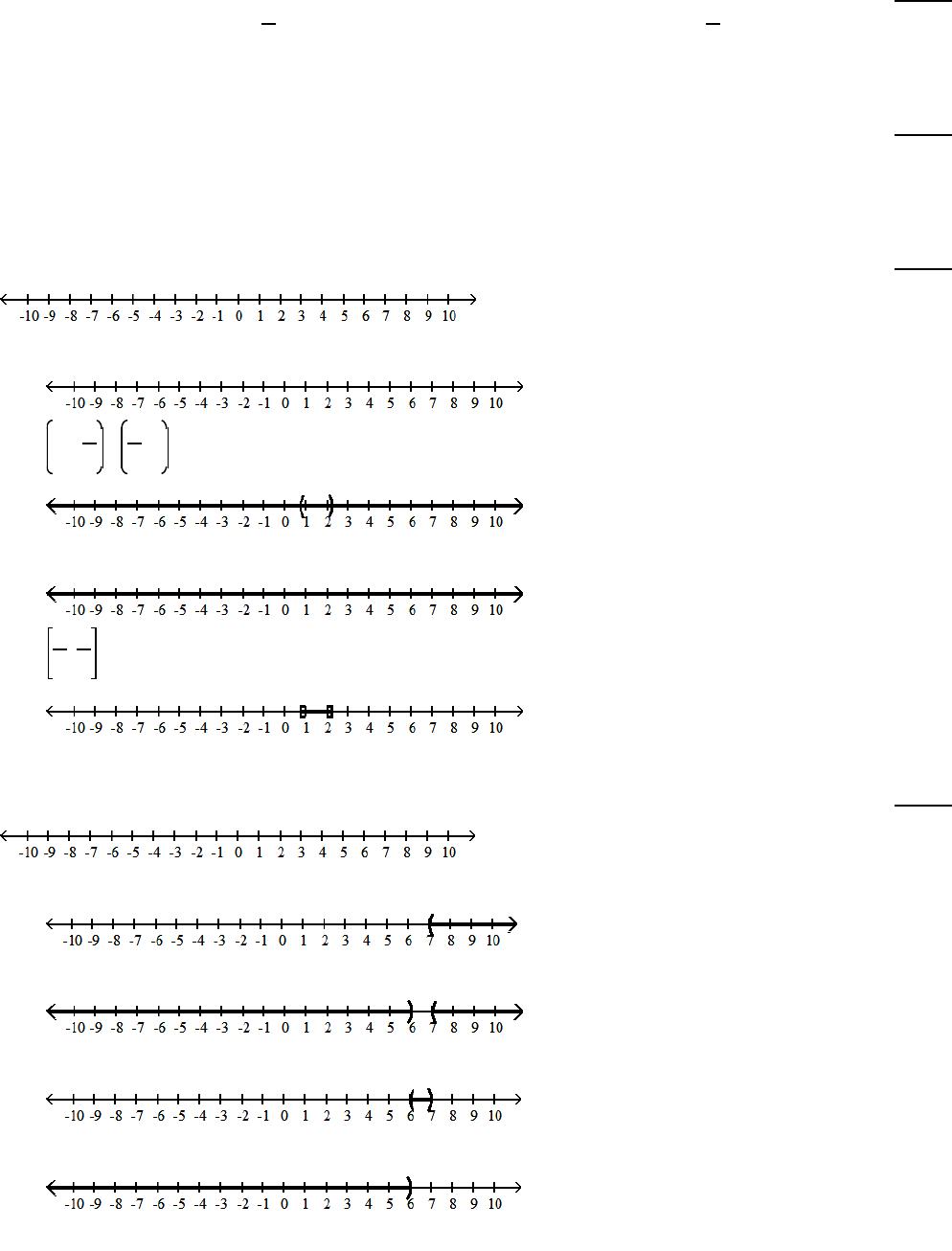
Find the constant term to be added to the expression to form a perfect square trinomial.
143)
x2– 3x
143)
A)
9
B)
9
4
C)
0
D)
–9
4
Solve the problem.
144)
A ball is thrown vertically upward at an initial speed of 64 ft/sec. Its height (in feet) after t seconds
is given by h(t) = t(64 – 16t). After how many seconds does the ball reach its maximum height?
144)
A)
4 seconds
B)
8 seconds
C)
2 seconds
D)
2.67 seconds
Solve. Then graph the solution.
145)
(6 – 4x)2–9
145)
A)
B)
–
, 9
43
4,
C)
(–
,
)
D)
9
4, 3
4
146)
x2– 13x + 42 > 0
146)
A)
(7,
)
B)
(–
, 6) (7,
)
C)
(6, 7)
D)
(–
, 6)
28
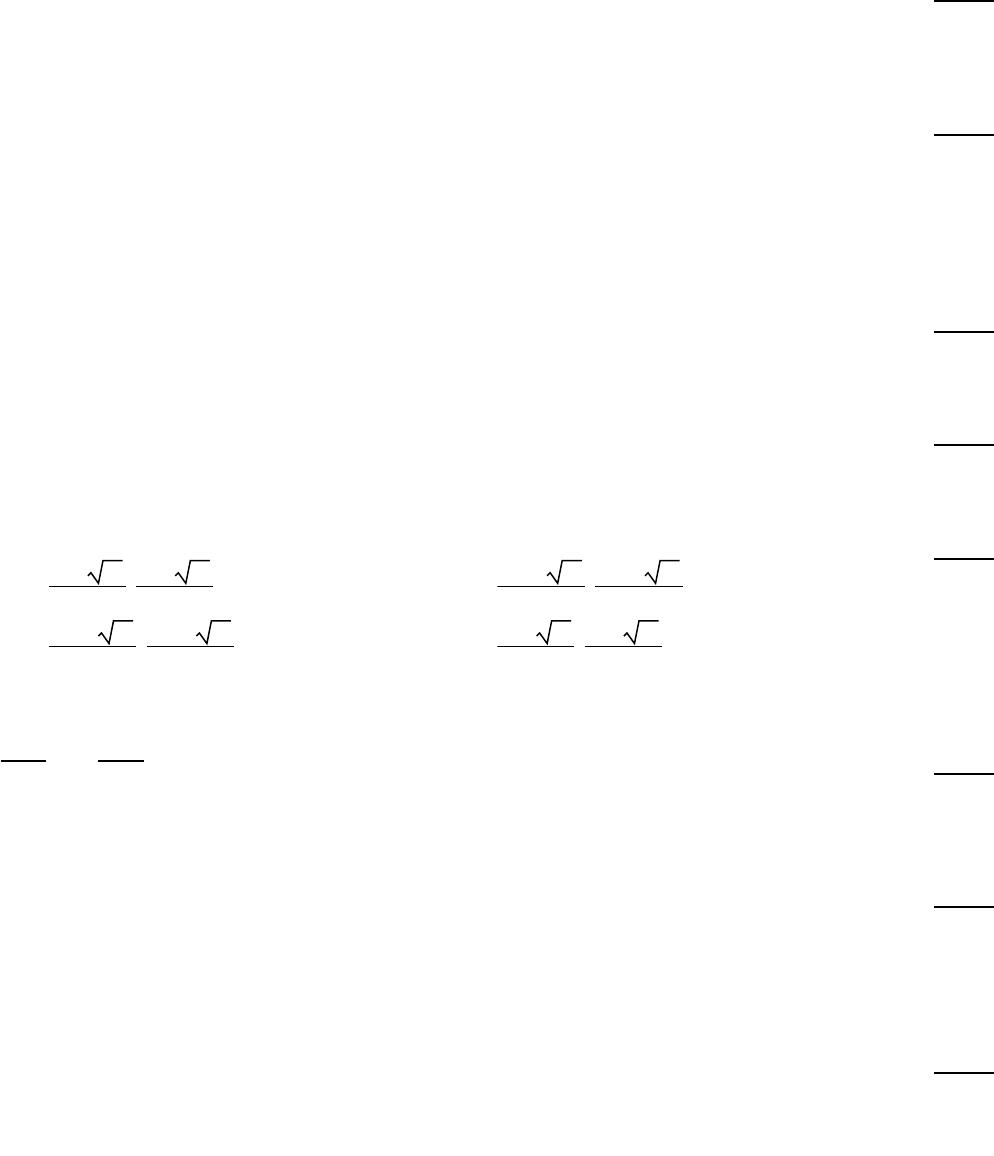
Solve. Round the answers as indicated.
147)
4.9x2+12.3x +1.7 = 0, round to the nearest hundredth
147)
A)
–2.36
B)
–2.36, –0.15
C)
0.15 +2.36i, 0.15 –2.36i
D)
0.15, 2.36
Solve the problem.
148)
Given the following revenue and cost functions, find the maximum profit. (Recall that profit equals
revenue minus cost.)
R(x) =53x – 2x2
C(x) =21x +105
148)
A)
$151
B)
$128
C)
$23
D)
$233
Use a grapher to find the vertex, rounding to the nearest hundredth when necessary.
149)
f(x) = –2x2+ 7x + 7
149)
A)
(1.75, 7)
B)
(–1.75, 13.13)
C)
(1.75, 0.88)
D)
(1.75, 13.13)
Find the vertex.
150)
f(x) =3x2– 60x + 301
150)
A)
(1, 0)
B)
(1, 10)
C)
(10, 1)
D)
(10, 0)
Solve.
151)
0.7x2+ 0.5x + 0.4 = 0
151)
A)
5+ i 87
14 , 5– i 87
14
B)
–5+ i 87
14 , –5– i 87
14
C)
–5+ i 87
7, –5– i 87
7
D)
5+ i 87
7, 5– i 87
7
Solve the equation.
152)
18
x – 2 = 1 +20
x + 2
152)
A)
–8, 10
B)
8, –10
C)
No solution
D)
–20, 10
Use the discriminant to determine the number and type of solutions for the equation.
153)
4x2– 4x + 1 = 0
153)
A)
Two complex–number solutions
B)
One real–number solution
C)
Two real–number solutions
Determine the domain and range of the function.
154)
f(x) =x2– 14x + 59
154)
A)
Domain: ( ,
)
Range: [7,
)
B)
Domain: [7,
)
Range: [10,
)
C)
Domain: ( ,
)
Range: [10,
)
D)
Domain: ( ,
)
Range: (–
, 7]
29
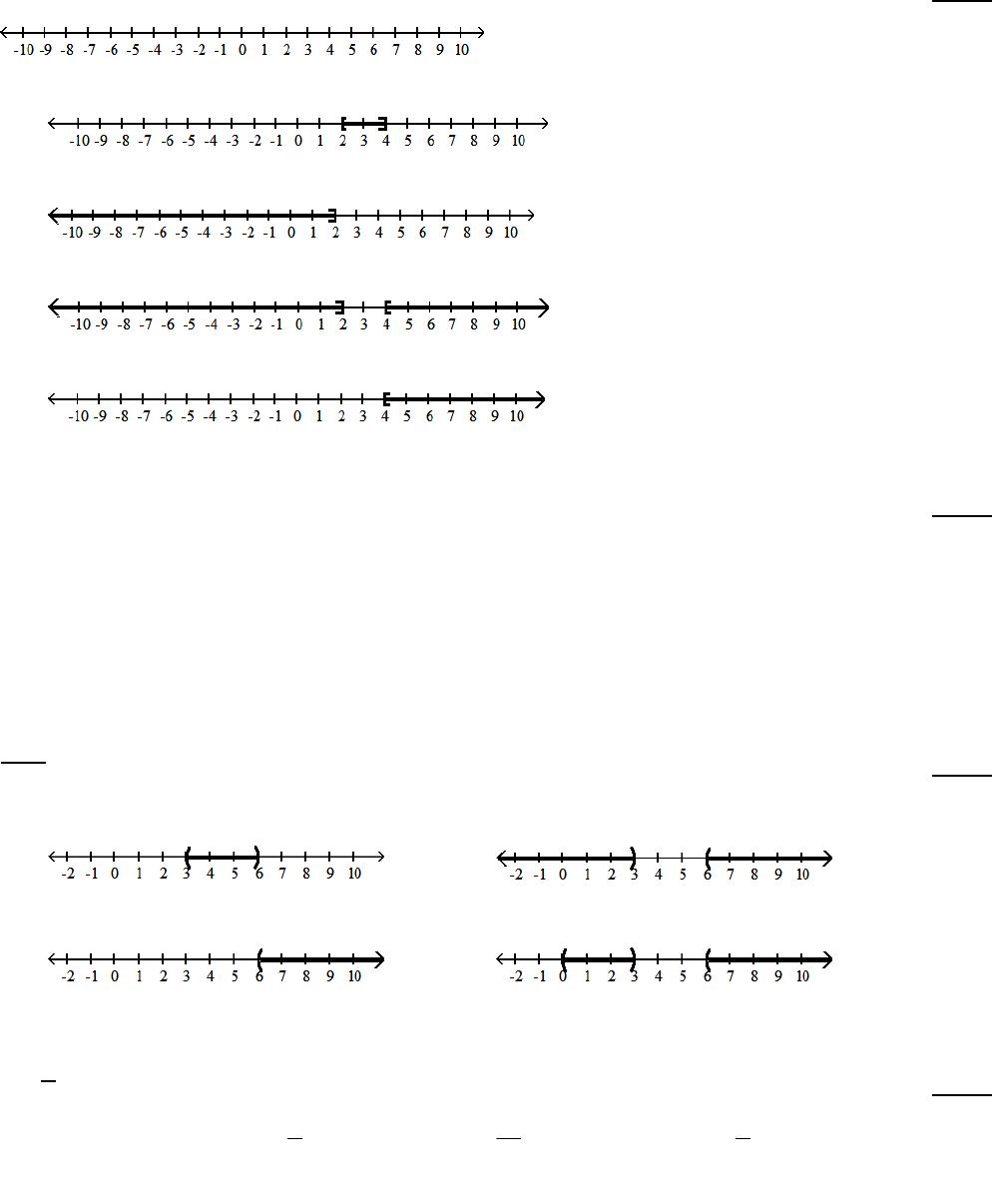
Solve. Then graph the solution.
155)
x2– 6x –8
155)
A)
[2, 4]
B)
(–
, 2]
C)
(–
, 2] [4,
)
D)
[4,
)
Solve the problem.
156)
A flare fired from the bottom of a gorge is visible only when the flare is above the rim. If it is fired
with an initial velocity of 176 feet per second and the gorge is 480 feet deep, during what interval
can the flare be seen? Use the formula h(t) = –16t2+v0t +h0.
156)
A)
The flare can be seen between 10 sec and 11 sec.
B)
The flare can be seen between 15 sec and 16 sec.
C)
The flare can be seen up to, but not including, 5 sec.
D)
The flare can be seen between 5 sec and 6 sec.
Solve. Then graph the solution.
157)
3x
6– x < x
157)
A)
(3, 6)
B)
(–
, 3) (6,
)
C)
(6,
)
D)
(0, 3) (6,
)
Find the constant term to be added to the expression to form a perfect square trinomial.
158)
x2–2
9x
158)
A)
81
B)
–1
9
C)
1
81
D)
–2
9
30
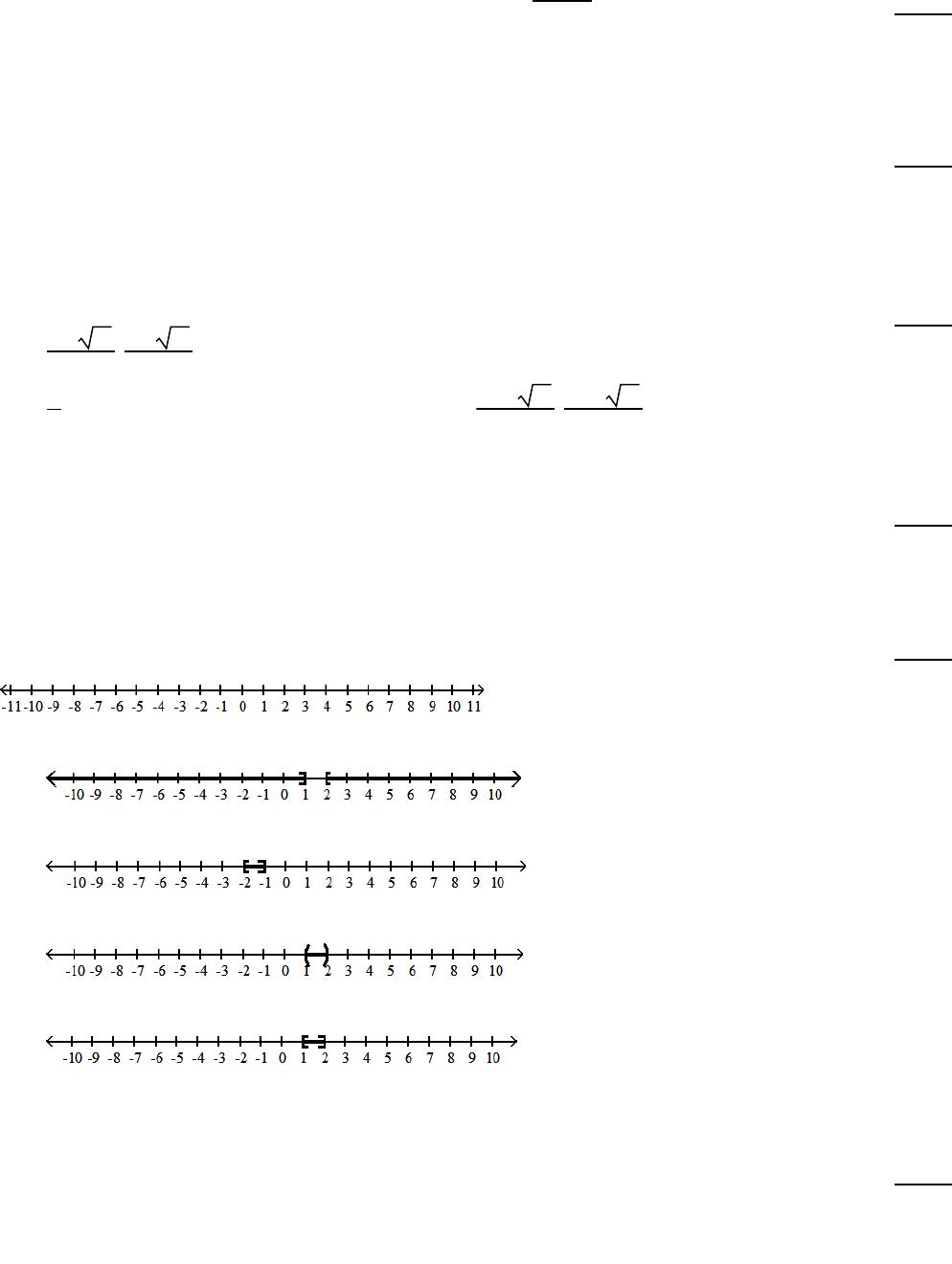
Solve the problem.
159)
The population P, in thousands, of Pine Grove is given by P(t) =500t
2t2+ 9, where t is the time, in
months. Find the interval on which the population was 40 thousand or greater. Round to the
nearest thousandth when necessary.
159)
A)
[0.664, 4.336]
B)
[4.336,
)
C)
[0.83, 5.42]
D)
(–
,
)
160)
A ball is thrown downward from a window in a tall building. Its position at time t in seconds is
given by s(t) = 16t2+ 32t, where s is in feet. How long will it take the ball to fall 90 feet? Round to
the nearest tenth, if necessary.
160)
A)
1.6 sec
B)
1.4 sec
C)
2.6 sec
D)
2.4 sec
Solve.
161)
3x(x + 1) =1
161)
A)
3+21
6, 3–21
6
B)
0
C)
1
2
D)
–3+21
6, –3–21
6
Find the y–intercepts and any x–intercepts.
162)
f(x) =x2+3x +9
162)
A)
y–intercept (0, 9), x–intercept (–3, 0)
B)
y–intercept (0, 9), x–intercept (3, 0)
C)
no y–intercept, no x–intercept
D)
y–intercept (0, 9), no x–intercepts
Solve. Then graph the solution.
163)
x2+ 3x –2
163)
A)
(–
, 1] [2,
)
B)
[–2, –1]
C)
(1, 2)
D)
[1, 2]
Graph the function on a grapher. Then use the grapher to find the x– and y–intercepts. Round to the nearest hundredth if
necessary.
164)
f(x) =0.63x2+ 3.55x + 15.56
164)
A)
(2.90, 0), (0, 15.56)
B)
No x–intercepts, (0, 15.56)
C)
(15.56, 0), no y–intercepts
D)
(2.90, 0), (–8.53, 0), (0, 15.56)
31
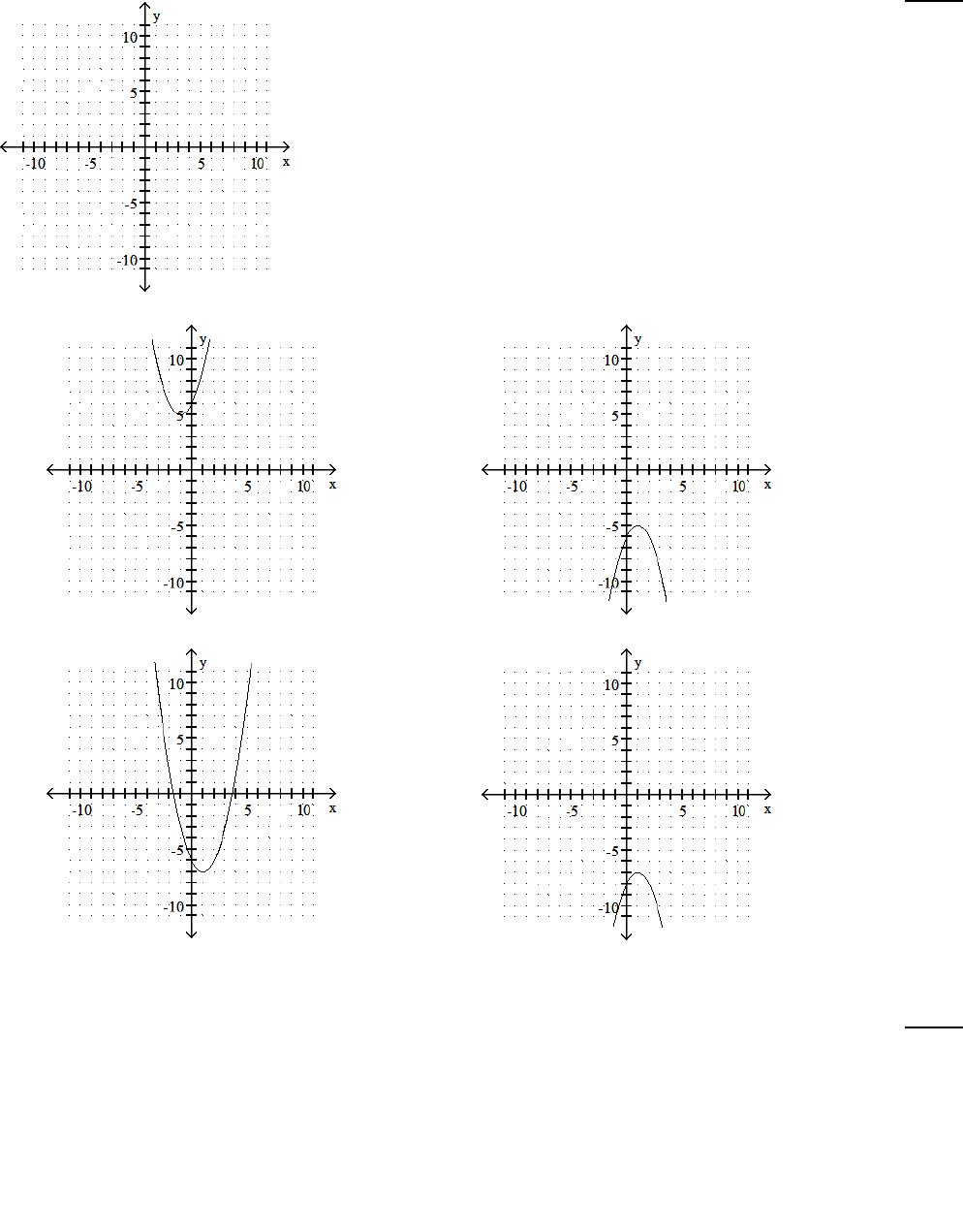
Graph the equation.
165)
h(x) = –x2+ 2x – 6
165)
A)
B)
C)
D)
Solve the problem.
166)
A rectangular garden is bounded on one side by a house and is to be fenced on the other three
sides. Fencing material costs $15 per foot for the side parallel to the house and $25 per foot for the
other two sides. What are the dimensions of the garden of largest possible area if $1500 is to be
spent for fencing material?
166)
A)
54 ft by 13 ft with the long side parallel to the house
B)
50 ft by 15 ft with the long side parallel to the house
C)
52 ft by 14 ft with the long side parallel to the house
D)
46 ft by 17 ft with the long side parallel to the house
32
Find the axis of symmetry of the function.
167)
f(x) =4x2+ 8x – 0
167)
A)
x =4
B)
x =1
C)
x = –1
D)
x = –4
Solve the problem.
168)
Suppose that the temperature T, in degrees Fahrenheit, of a person during an illness is given by the
function T(t) =3t
t2+ 1 + 98.6, where t is the time, in hours. Find the interval on which the
temperature is over 100°. Round to the nearest thousandth when necessary.
168)
A)
(0.687, 1.456)
B)
(–
,
)
C)
(1.264, 2.679)
D)
(0, 1)
Write a quadratic equation having the given numbers as solutions.
169)
4, –8
169)
A)
x2– 32x – 4 = 0
B)
x2+ 4x – 32 = 0
C)
x2– 32x + 4 = 0
D)
x2– 4x – 32 = 0
Solve.
170)
1
2x2+ x –2= 0
170)
A)
1 +5, 1 –5
B)
1 +3, 1 –3
C)
–1 +3, –1 –3
D)
–1 +5, –1 –5
Solve the equation.
171)
8
x – 2 +8
x + 2 =3
171)
A)
–3
2, –6
B)
2, 6
C)
–2
3, 6
D)
2
3, –6
Determine if the graph of the function opens upward or downward and whether it has a maximum or a minimum point.
172)
f(x) =6x2
172)
A)
Downward, minimum
B)
Upward, maximum
C)
Upward, minimum
D)
Downward, maximum
33
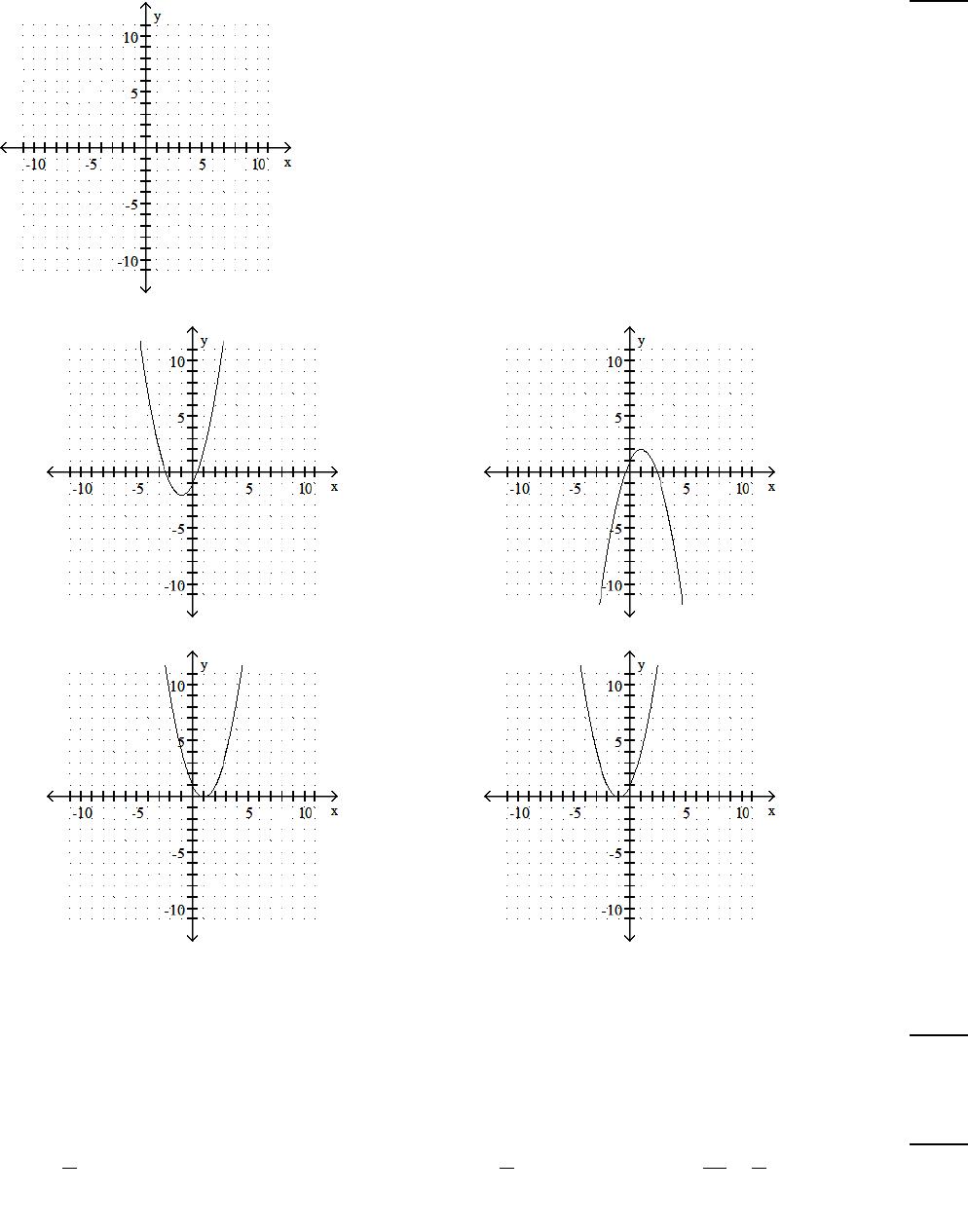
Graph the equation.
173)
g(x) = x2+ 2x + 1
173)
A)
B)
C)
D)
Find the axis of symmetry of the function.
174)
f(x) =x2+ 1
174)
A)
x = –1
B)
x = 6
C)
x = 0
D)
x =1
Solve by using the quadratic formula.
175)
3k2– 11k – 4 = 0
175)
A)
–1
3, 3
B)
–3, 4
C)
–1
3, 4
D)
1
11, –1
3
34
Solve the problem.
176)
A ladder is resting against a wall. The top of the ladder touches the wall at a height of 15 feet. Find
the length of the ladder if the length is 5 feet more than its distance from the wall.
176)
A)
30 ft
B)
20 ft
C)
25 ft
D)
15 ft
177)
Mary lives on a corner lot. The neighborhood children have been cutting diagonally across her
lawn instead of walking around the yard. If the diagonal distance across the lawn is 20 feet and the
longer part of the sidewalk is twice the shorter length, how many feet are the children saving by
cutting across the lawn? Round to the nearest foot if necessary.
177)
A)
27 ft
B)
7 ft
C)
9 ft
D)
12 ft
Find the y–intercepts and any x–intercepts.
178)
f(x) =5x2–4x
178)
A)
y–intercept (0, 0), x–intercepts (0, 0) and (–0.8, 0)
B)
y–intercept (0, 0), x–intercept (0.8, 0)
C)
y–intercept (0, 0), x–intercepts (0, 0) and (0, 0.8)
D)
y–intercept (0, 0), x–intercepts (0, 0) and (0.8, 0)
Determine the domain and range of the function.
179)
f(x) =x2+ 4x – 5
179)
A)
Domain: ( ,
)
Range: (–
, –2]
B)
Domain: ( ,
)
Range: [–2,
)
C)
Domain: ( ,
)
Range: [–9,
)
D)
Domain: [–2,
)
Range: [–9,
)
Solve the problem.
180)
Two cars leave an intersection. One car travels north; the other east. When the car traveling north
had gone 9 miles, the distance between the cars was 3 miles more than the distance traveled by the
car heading east. How far had the eastbound car traveled?
180)
A)
12 mi
B)
15 mi
C)
18 mi
D)
9 mi
Use a grapher to find the vertex, rounding to the nearest hundredth when necessary.
181)
f(x) = –0.1x2– 1.6x + 8.3
181)
A)
(8, 14.7)
B)
(–8, –14.7)
C)
(–8, 14.7)
D)
(–8, 8.3)
Solve.
182)
8x2+ 7x = –2
182)
A)
–7 + i 15
16 , –7 – i 15
16
B)
7 + i 15
16 , 7 – i 15
16
C)
–7 +15
16 , –7 –15
16
D)
7 +15
16 , 7 –15
16
Find the axis of symmetry of the function.
183)
f(x) =3x2+ 30x + 79
183)
A)
x = –5
B)
x =4
C)
x = –4
D)
x =5
35
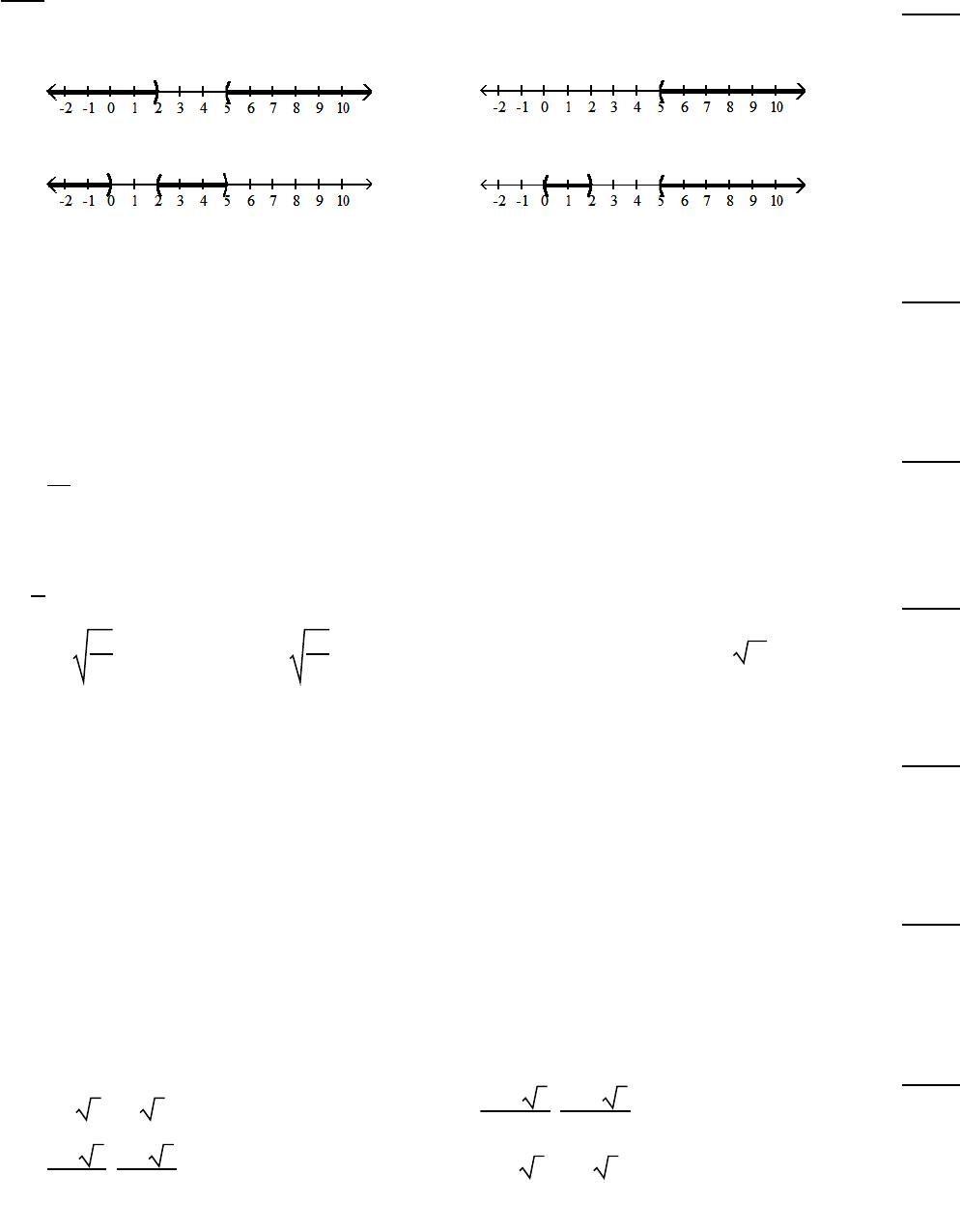
Solve. Then graph the solution.
184)
3x
5– x > x
184)
A)
(–
, 2) (5,
)
B)
(5,
)
C)
(–
, 0) (2, 5)
D)
(0, 2) (5,
)
Solve the problem. Round your answer to the nearest tenth, if necessary.
185)
A jet plane traveling at a constant speed goes 1200 mi with the wind, then turns around and travels
for 1000 mi against the wind. If the speed of the wind is a constant 50 mph, and the total flight took
4 hours, find the speed of the plane.
185)
A)
550 mph
B)
605 mph
C)
525 mph
D)
435 mph
Solve by using the square root property.
186)
5z2+ 4 =49
186)
A)
49
2
B)
4, –4
C)
3
D)
3, –3
Solve the formula for the indicated letter. Assume that all variables represent nonnegative numbers.
187)
S =1
2gt2 for t
187)
A)
t =g
2S
B)
t =2S
g
C)
t = 2gS
D)
t =2gs
Solve the problem.
188)
A square has an area of 49 square inches. If the same amount is added to the length and removed
from the width, the resulting rectangle has an area of 45 square inches. Find the dimensions of the
rectangle.
188)
A)
3 in. by 4 in.
B)
4 in. by 9 in.
C)
5 in. by 10 in.
D)
5 in. by 9 in.
Use the discriminant to determine the number and type of solutions for the equation.
189)
x2+ 5x + 6 = 0
189)
A)
Two complex–number solutions
B)
One real–number solution
C)
Two real–number solutions
Solve.
190)
2x2+15x = –10 +25x
190)
A)
5+5, 5–5
B)
–5+5
2, –5–5
2
C)
5+5
2, 5–5
2
D)
–5+5, –5–5
36
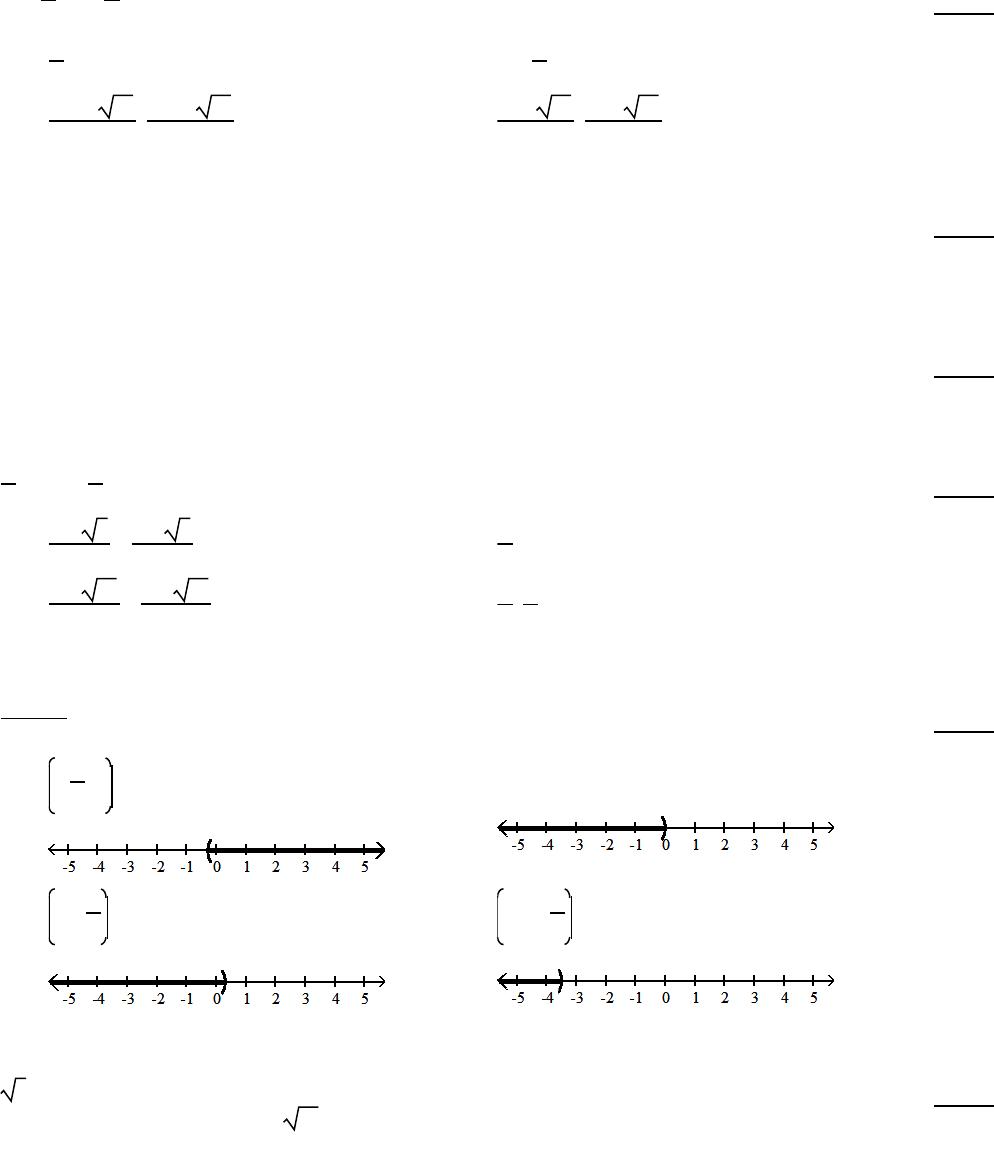
191)
x2–2
3x = – 7
6
191)
A)
2
3i, 0
B)
0, –7
4i
C)
–2+ i 38
6, –2– i 38
6
D)
2+ i 38
6, 2– i 38
6
Solve the problem. Round your answer to the nearest tenth, if necessary.
192)
Working together, Rick and Juanita can complete a job in 6 hr. It would take Rick 9 hr longer than
Juanita to do the job alone. How long would it take Juanita alone?
192)
A)
3 hr
B)
15 hr
C)
9 hr
D)
6 hr
Use the discriminant of the equation to determine the number of x–intercepts.
193)
f(x) = –x2– 9x + 1
193)
A)
No x–intercepts
B)
One x–intercept
C)
Two x–intercepts
Solve.
194)
1
3x2– x +1
3= 0
194)
A)
3 +5
2 , 3 –5
2
B)
5
2
C)
3 +13
2 , 3 –13
2
D)
1
2, 5
2
Solve. Then graph the solution.
195)
–7x + 2
2x2+ 5 > 0
195)
A)
–2
7,
B)
(–
, 0)
C)
–
, 2
7
D)
–
, –7
2
Solve the equation.
196)
x=12 – x
196)
A)
±7
B)
±12
C)
9
D)
–16, –9
37
Solve.
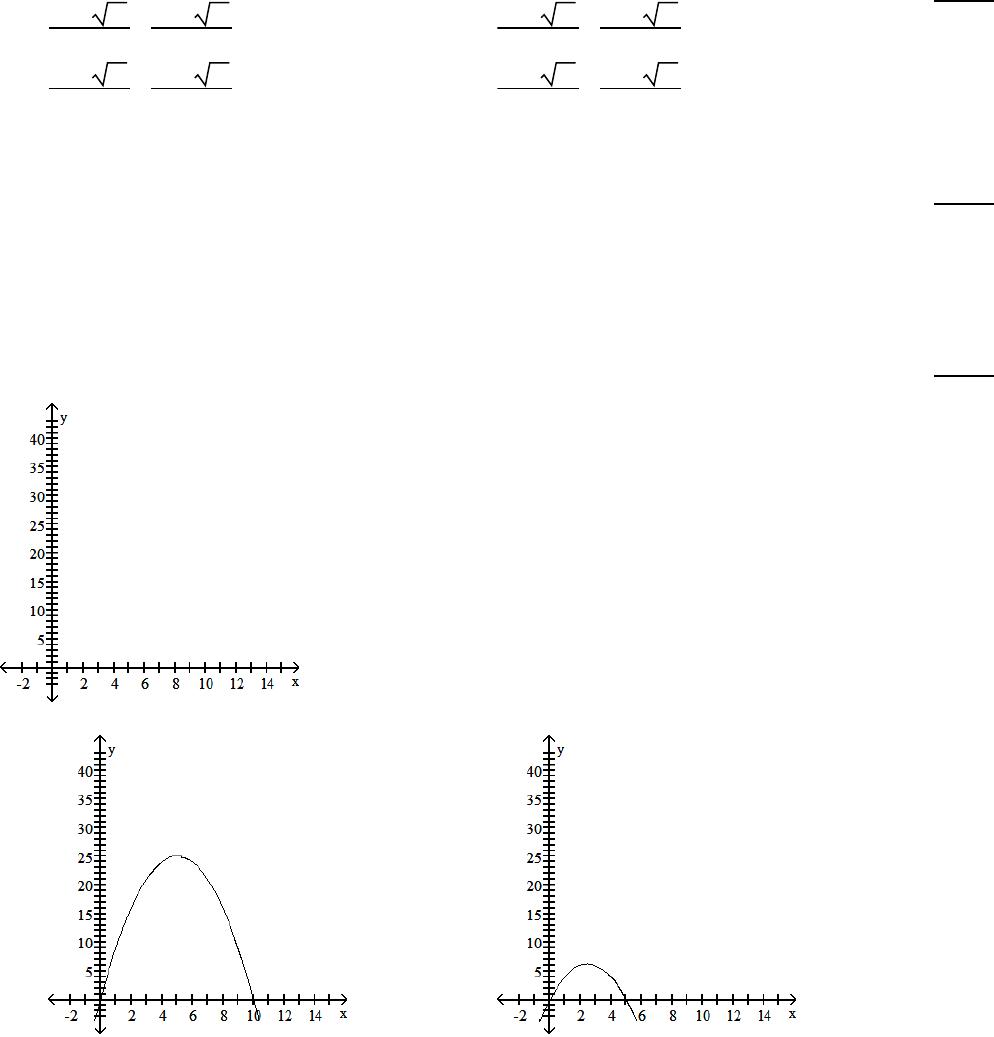
197)
2x2+ 8x = – 3
197)
A)
–4+10
4 , –4–10
4
B)
–4+22
2 , –4–22
2
C)
–8+10
2 , –8–10
2
D)
–4+10
2 , –4–10
2
Solve the problem.
198)
The cumulative number (in thousands) of deaths from a certain disease from 2000 to 2010 is
modeled by A = 2.39x2+ 5.04x + 5.1, where x = 0 corresponds to 2000, x = 1 to 2001, etc. Use the
formula for A to estimate symbolically the year when the total number of deaths reached 120
thousand.
198)
A)
2007
B)
2009
C)
2006
D)
2008
199)
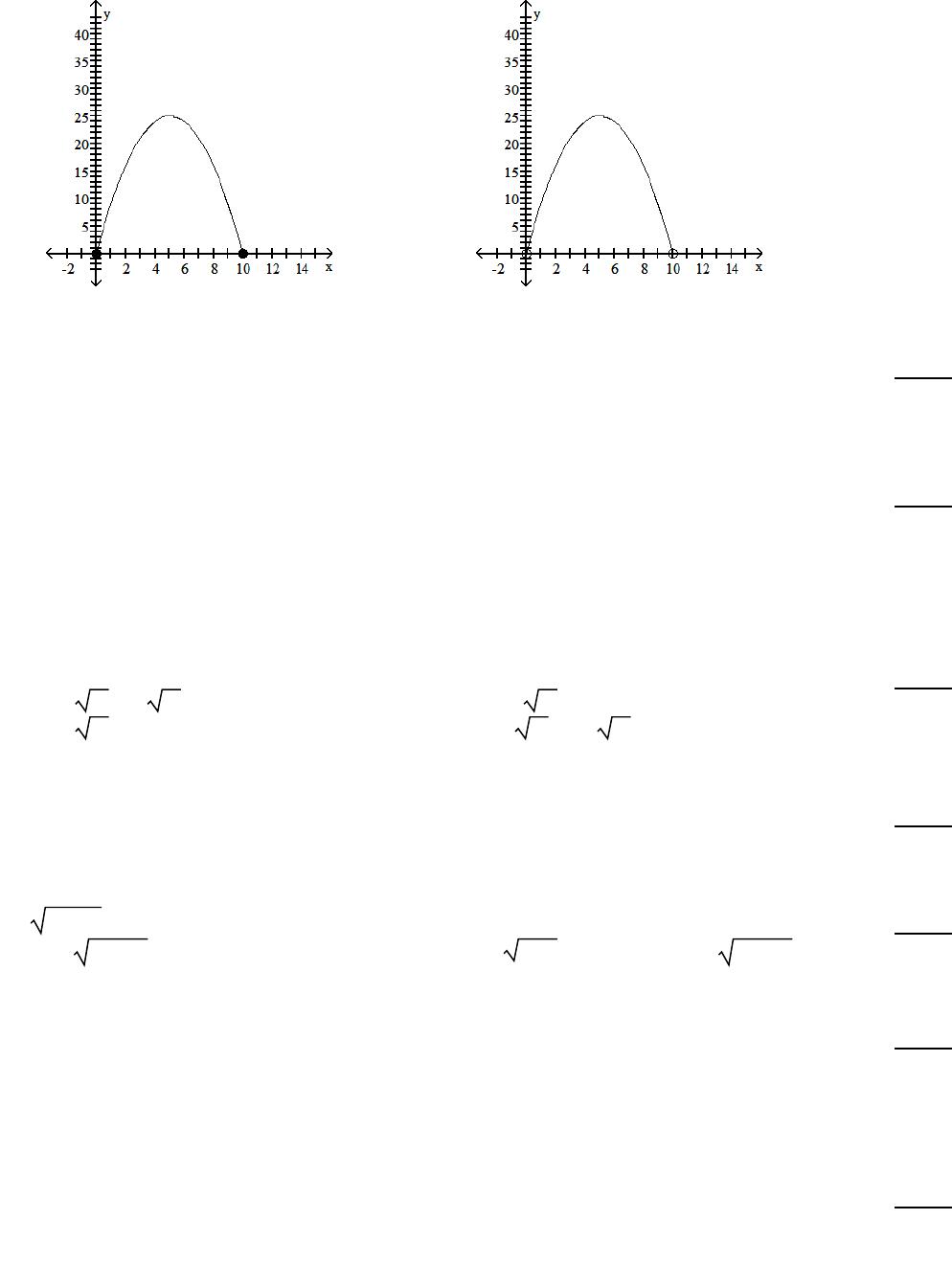
A rectangle has area A m2 with A = w(10 – w), where w is the width of the rectangle and the
perimeter is 20m. Sketch the graph of A as a function of w.
199)
A)
B)
38
C)
D)
Determine the domain and range of the function.
200)
f(x) =9–x2
200)
A)
Domain: ( ,
)
Range: [–9,
)
B)
Domain: ( ,
)
Range: [9,
)
C)
Domain: ( ,
)
Range: (–
, 9]
D)
Domain: ( ,
)
Range: (–
, –9]
Solve the problem.
201)
Two airplanes leave the same airport at the same time. The airplane flying east travels at an
average speed that is 20 mph faster than the airplane flying north. If the two airplanes are 680 mi
apart after 1 hr, find the average speed of each airplane to the nearest mile per hour.
201)
A)
North: 471 mph
East: 451 mph
B)
North: 471 mph
East: 491 mph
C)
North: 491 mph
East: 511 mph
D)
North: 491 mph
East: 471 mph
Solve.
202)
x2+ 12x = –22
202)
A)
6–22, 6+22
B)
–12 +22
C)
6+14
D)
–6–14, –6+14
Find the vertex.
203)
f(x) =2x2+ 4x – 3
203)
A)
(1, 5)
B)
(5, 1)
C)
(–5, –1)
D)
(–1, –5)
Solve the formula for the indicated letter. Assume that all variables represent nonnegative numbers.
204)
x =r2– y2 for r
204)
A)
r =x2+ y2
B)
r = x + y
C)
r =x + y
D)
r =x2– y2
Solve the problem.
205)
The demand equation for a certain product is P =35 –0.004x, where x is the number of units sold
per week and P is the price in dollars at which one is sold. The weekly revenue R is given by
R = xP. What number of units sold produces a weekly revenue of $70,000?
205)
A)
17,491,250 units
B)
1678 units
C)
3094 units
D)
5656 units
Determine the domain and range of the function.
206)
f(x) =2x2– 20x + 56
206)
A)
Domain: ( ,
)
Range: (–
, 5]
B)
Domain: ( ,
)
Range: ( ,
)
C)
Domain: ( ,
)
Range: [6,
)
D)
Domain: (–
, 5]
Range: [6,
)
39
Solve. Then graph the solution.
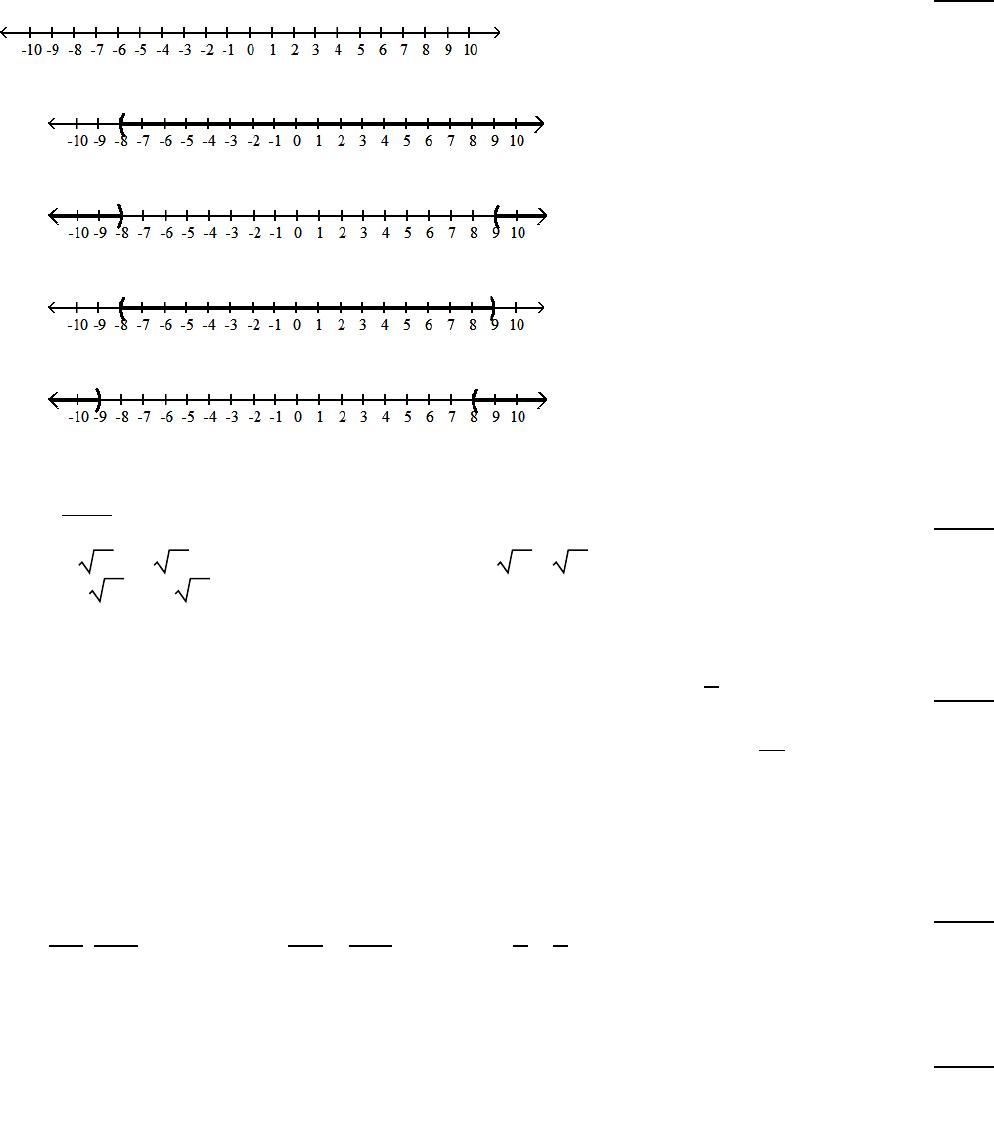
207)
(x – 9)(x + 8) > 0
207)
A)
(–8,
)
B)
(–
, –8) (9,
)
C)
(–8, 9)
D)
(–
, –9) (8,
)
Solve by using the square root property.
208)
x +5=13
x +5
208)
A)
5+13, 5–13
B)
13, –13
C)
–5+13, –5–13
D)
8
Solve the problem.
209)
The manager of a pet store has found that if the price of a dog collar is p(x) =85 –x
6, then x collars
will be sold. An expression for the total revenue from the sale of x collars is R(x) =85x –x2
6. Find
the number of collars that will produce maximum revenue.
209)
A)
295
B)
510
C)
235
D)
255
Solve the equation.
210)
6x2/5 + 17x1/5 + 5 = 0
210)
A)
1
243, 3125
32
B)
–1
243, –3125
32
C)
–1
3, –5
2
D)
3, 2
Find the vertex.
211)
f(x) = –2x2+ 8x – 9
211)
A)
(–2, 1)
B)
(–1, 2)
C)
(1, –2)
D)
(2, –1)
40
Solve the problem.
212)
An assistant accountant takes 2 hr longer to file the same number of tax returns as a senior
accountant. If they work together, they can file the tax returns in 1 hr. To the nearest tenth of an
hour, how long does it take each accountant to file the tax returns working alone?
212)
A)
Senior accountant: 1.4 hr
Assistant accountant: 3.4 hr
B)
Senior accountant: 1.4 hr
Assistant accountant: 2.4 hr
C)
Senior accountant: 2 hr
Assistant accountant: 4 hr
D)
Senior accountant: 3.4 hr
Assistant accountant: 3.4 hr
Solve the formula for the indicated letter. Assume that all variables represent nonnegative numbers.
213)
v2= 2as for v
213)
A)
v =2a
s
B)
v = 2a s
C)
v =2a
s
D)
v =2as
Solve the problem. Round your answer to the nearest tenth, if necessary.
214)
Two pipes together can fill a large tank in 10 hr. One of the pipes, used alone, takes 15 hr longer
than the other to fill the tank. How long would each pipe take to fill the tank alone?
214)
A)
12.5 hr; 27.5 hr
B)
15 hr; 30 hr
C)
25 hr; 40 hr
D)
10 hr; 25 hr
41
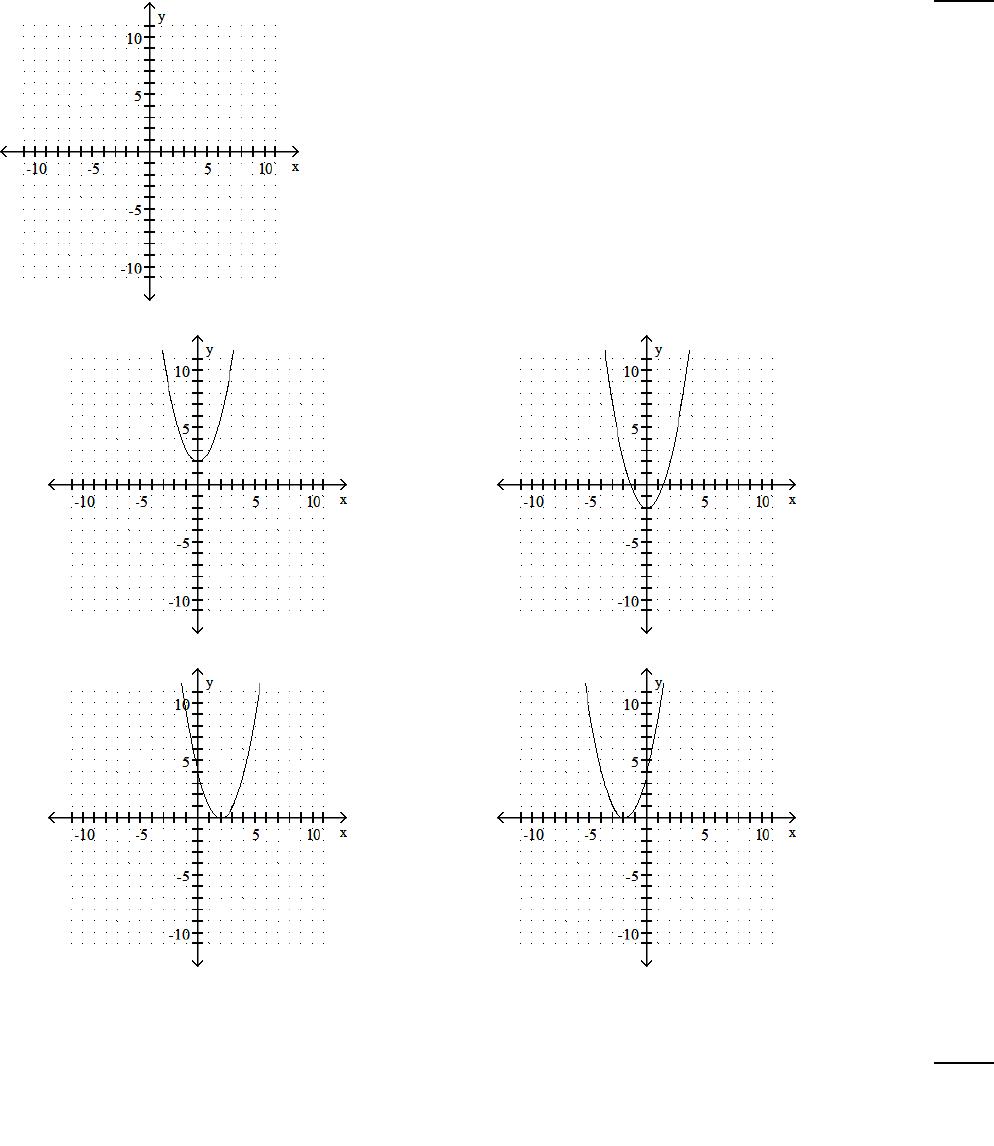
Graph the equation.
215)
f(x) = (x + 2)2
215)
A)
B)
C)
D)
Find the y–intercepts and any x–intercepts.
216)
f(x) =x2+1
216)
A)
y–intercept (0, 1), x–intercept (1, 0)
B)
x–intercept (1, 0), no y–intercepts
C)
y–intercept (1, 0), no x–intercepts
D)
y–intercept (0, 1), no x–intercepts
42
Solve the problem.
217)
Assume that the profit P made when t units are sold, t > 0, is given by P(t) =t2– 29t + 204. For
what values of t will there be a loss (that is, P < 0)?
217)
A)
There will be a loss when 0 units are sold.
B)
There will be a loss when the number of units sold is between, but not including, 12 and 17.
C)
There will be a loss when 12 or 17 units are sold.
D)
There will be a loss when fewer than 12 or more than 17 units are sold.
Solve the equation by completing the square.
218)
7x2– 2x – 9 = 0
218)
A)
7
9, 1
B)
7
9, –1
C)
9
7, –1
D)
9
7, 1
Find the constant term to be added to the expression to form a perfect square trinomial.
219)
x2– 6x
219)
A)
–9
B)
9
C)
0
D)
None of the above
Solve.
220)
x2– x =20
220)
A)
–4, –5
B)
–4, 5
C)
1, 20
D)
4, 5
Solve the problem.
221)
There are n people in a room. The number N of possible handshakes by all the people in the room
is given by the function N(n) =n(n – 1)
2. For what number n of people is 28
N 190.
221)
A)
The number of people is between 9 and 19, inclusive.
B)
The number of people is between 10 and 19, inclusive.
C)
The number of people is between 8 and 20, inclusive.
D)
The number of people is between 7 and 22, inclusive.
Solve. Round the answers as indicated.
222)
2.7x2–0.7x = –1.4, round to the nearest thousandth
222)
A)
0.13 ±0.708i
B)
0.13 ±0.708
C)
0.13 ±2.709i
D)
0.259 ±2.328i
Solve the formula for the indicated letter. Assume that all variables represent nonnegative numbers.
223)
A = 3a2 for a
223)
A)
a =A
3
B)
a =3A
C)
a =A 3
3
D)
a =3A
3
Determine the domain and range of the function.
224)
f(x) = –8x2– 32x – 38
224)
A)
Domain: ( ,
)
Range: [2,
)
B)
Domain: ( ,
)
Range: (–
, 2]
C)
Domain: ( ,
)
Range: (–
, –6]
D)
Domain: [2,
)
Range: (–
, –6]
43
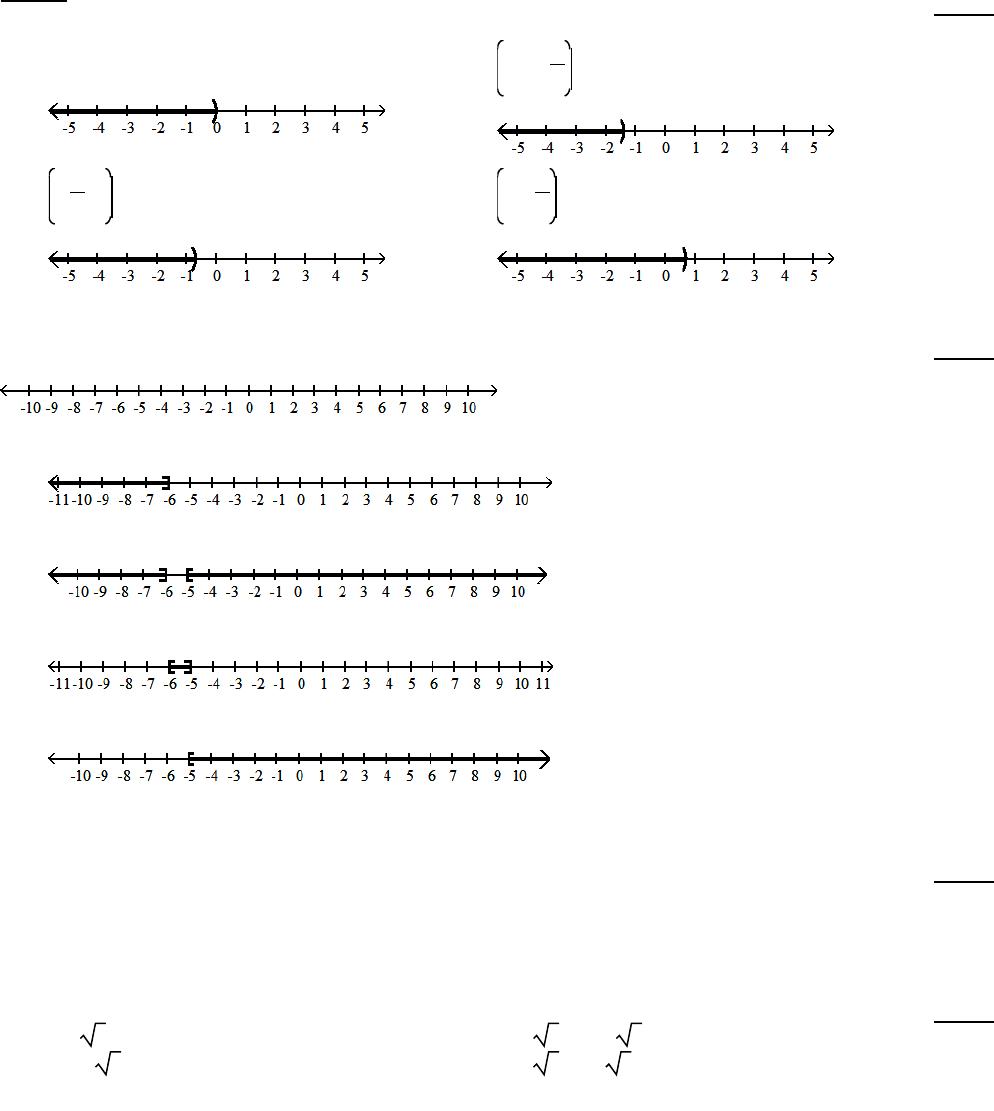
Solve. Then graph the solution.
225)
–7x + 5
2x2+ 3 > 0
225)
A)
(–
, 0)
B)
–
, –7
5
C)
–5
7,
D)
–
, 5
7
226)
–x2– 11x – 30 0
226)
A)
(–
, –6]
B)
(–
, –6] [–5,
)
C)
[–6, –5]
D)
[–5,
)
Solve the problem.
227)
The surface area S of a sphere with radius r is given by the formula S =4r2. If a sphere has surface
area 324 square inches, what is its radius?
227)
A)
9 inches
B)
9 inches
C)
81 inches
D)
18 inches
Solve by completing the square.
228)
5x2–10x +15 = 0
228)
A)
1+ i 2
B)
1+ i 2, –1– i 2
C)
–1– i 2
D)
1+ i 2, 1– i 2
44
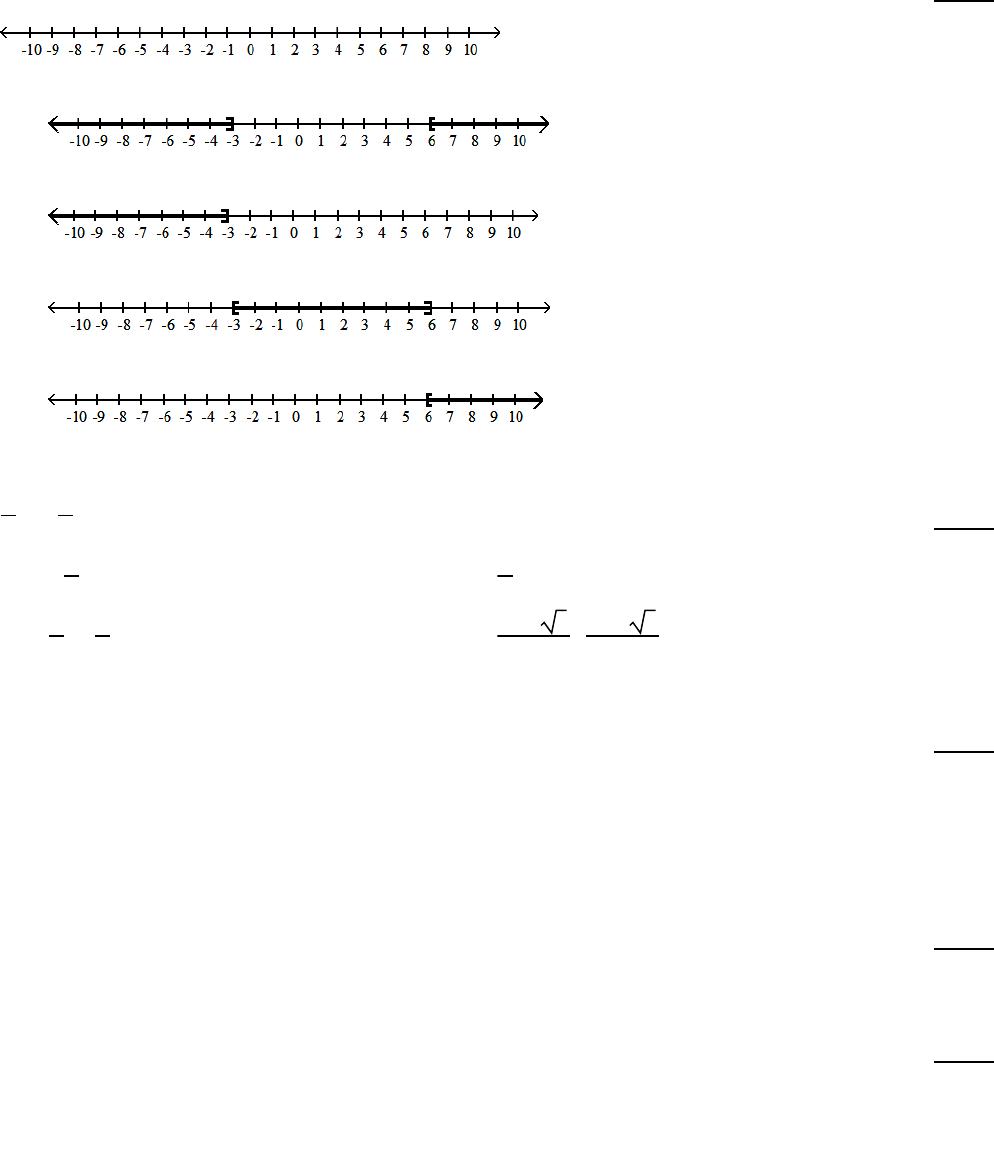
Solve. Then graph the solution.
229)
x2– 3x – 18 0
229)
A)
(–
, –3] [6,
)
B)
(–
, –3]
C)
[–3, 6]
D)
[6,
)
Solve.
230)
4
9x2–4
3x = –1
230)
A)
–3
2
B)
3
2
C)
2
3 , –2
3
D)
3 + 2 2
2 , 3 – 2 2
2
Solve the problem.
231)
A manufacturer determines that the daily cost C, in dollars, to produce x units of a product is
modeled by the function C(x) = 0.1x2–27x +1780. How many units can the manufacturer produce
each day in order to keep the daily cost below $380?
231)
A)
More than 70 units
B)
Fewer than 200 units
C)
Fewer than 70 or more than 200 units
D)
More than 70 but fewer than 200 units
Use the discriminant of the equation to determine the number of x–intercepts.
232)
f(x) =2x2– 4x +2
232)
A)
Two x–intercepts
B)
No x–intercepts
C)
One x–intercept
Use the discriminant to determine the number and type of solutions for the equation.
233)
6x2– 7x + 5 = 0
233)
A)
Two complex solutions (containing i)
B)
One real solution
C)
Two real solutions
45
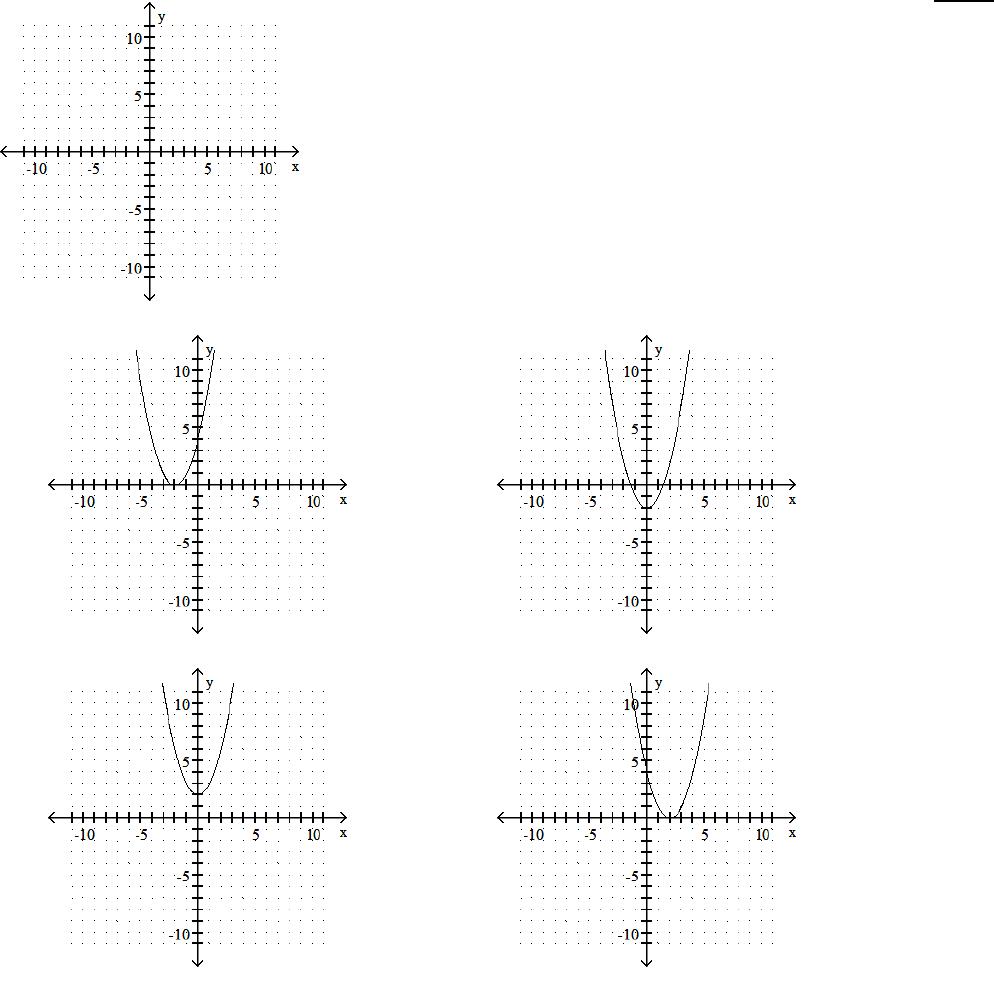
Graph the equation.
234)
f(x) = x2+ 2
234)
A)
B)
C)
D)
46
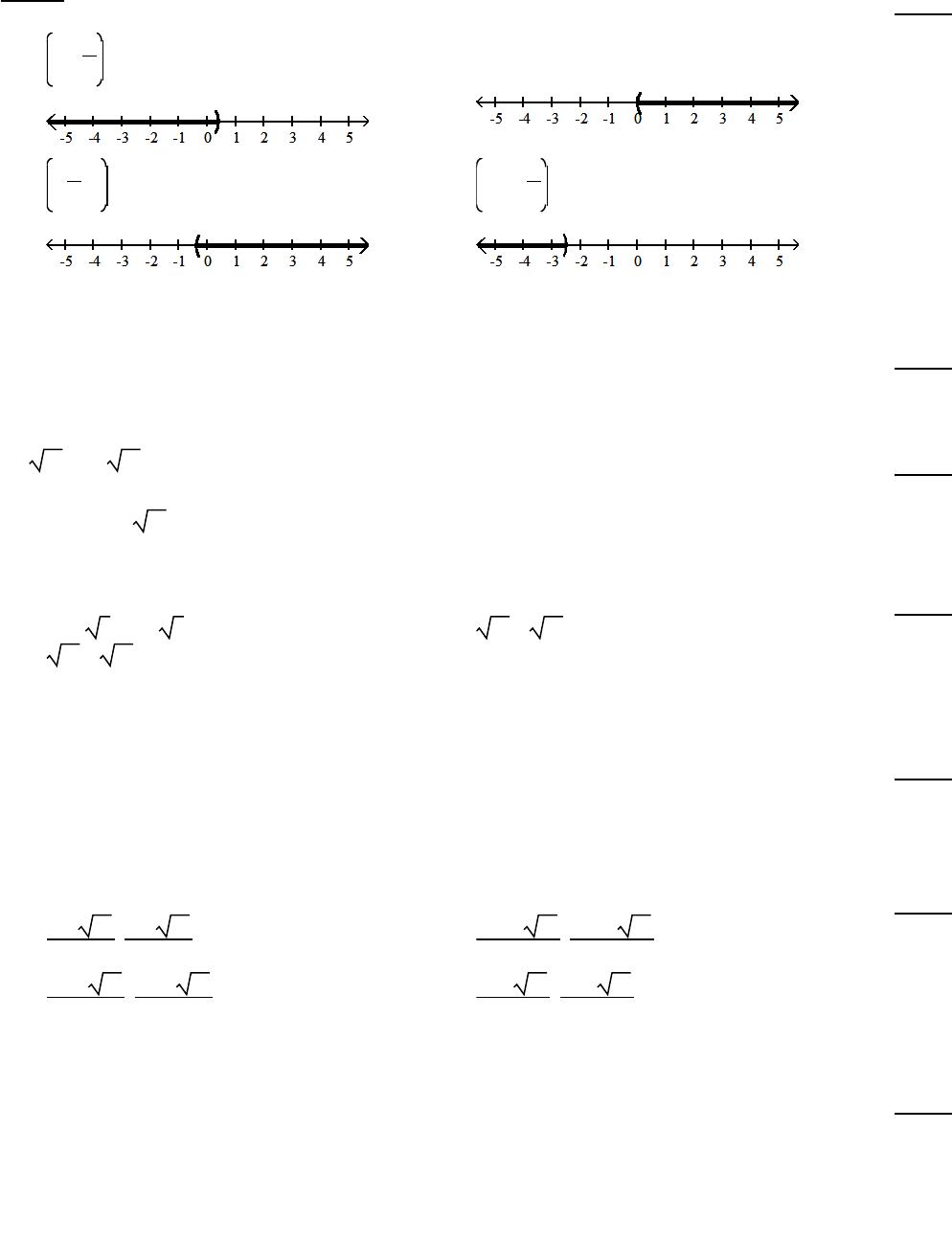
Solve. Then graph the solution.
235)
–5
–5x – 2 > 0
235)
A)
–
, 2
5
B)
(0,
)
C)
–2
5,
D)
–
, –5
2
Use a grapher to find the vertex, rounding to the nearest hundredth when necessary.
236)
f(x) =x2+ 2x – 3
236)
A)
(–1, –4)
B)
(1, 4)
C)
(–1, –3)
D)
(1, –4)
Write a quadratic equation having the given numbers as solutions.
237)
9–10 , 9+10
237)
A)
x2–9x +71 = 0
B)
x2–18x +71 = 0
C)
x2–18x +10x +71 = 0
D)
x2–18x +81 = 0
Solve by using the square root property.
238)
(x + 5)(x – 5) =4
238)
A)
–5+4, –5–4
B)
21, –21
C)
29, –29
D)
–9, –1
Graph the function on a grapher. Then use the grapher to find the x– and y–intercepts. Round to the nearest hundredth if
necessary.
239)
f(x) =2.56x2– 3.468x – 2.07
239)
A)
(1.80, 0), (–0.45, 0)
B)
No x–intercepts, (0, –2.07)
C)
(1.80, 0), (–0.45, 0), (0, –2.07)
D)
(–0.45, 0), (1.80, 0), (0, –2.07)
Solve.
240)
2x2= –5x – 7
240)
A)
5 +31
4, 5 –31
4
B)
–5 + i 31
4, –5 – i 31
4
C)
–5 +31
4, –5 –31
4
D)
5 + i 31
4, 5 – i 31
4
Find the y–intercepts and any x–intercepts.
241)
f(x) =x2+8x
241)
A)
y–intercept (0, 0), x–intercepts (0, 0) and (0, –8)
B)
y–intercept (0, 0), x–intercepts (0, 0) and (8, 0)
C)
y–intercept (0, 0), x–intercepts (0, 0) and (–8, 0)
D)
y–intercept (0, 0), x–intercept (–8, 0)
47
Solve the problem.
242)
A toy rocket is launched straight upward with an initial velocity of 64 feet per second from a 9–foot
high platform. The height h, in feet, of the rocket above ground t sec after it is launched is modeled
by the function h(t) = –16t2+64t +9. When will the rocket reach its maximum height? What is that
height?
242)
A)
25 ft in 4 sec
B)
13 ft in 2 sec
C)
265 ft in 4 sec
D)
73 ft in 2 sec
Solve by using the square root property.
243)
x2=24
243)
A)
2 6 , –2 6
B)
576
C)
6 2 , –6 2
D)
12, –12
Solve the problem.
244)
The height h in feet of a frisbee thrown is given by h(x) = x – .099x2+ 3, where x is the time traveled
in seconds. The frisbee is released at a height of 3 feet. At what time will the height of the frisbee be
3 feet again? (Round your answer to the nearest tenth of a second, if necessary.)
244)
A)
The height of the frisbee will be 3 feet at 10.1 sec.
B)
The height of the frisbee will be 3 feet at 12.5 sec.
C)
The height of the frisbee will be 3 feet at 5.1 sec.
D)
The height of the frisbee will never be 3 feet again.
Find the axis of symmetry of the function.
245)
f(x) = –4x2– 8x – 6
245)
A)
x =2
B)
x = –1
C)
x =1
D)
x = –2
Solve. Then graph the solution.
246)
3x +7
x –5
0
246)
A)
–7
3, 5
B)
–
,–7
3 (5,
)
C)
–7
3, 5
D)
–
,–7
3 [5,
)
48
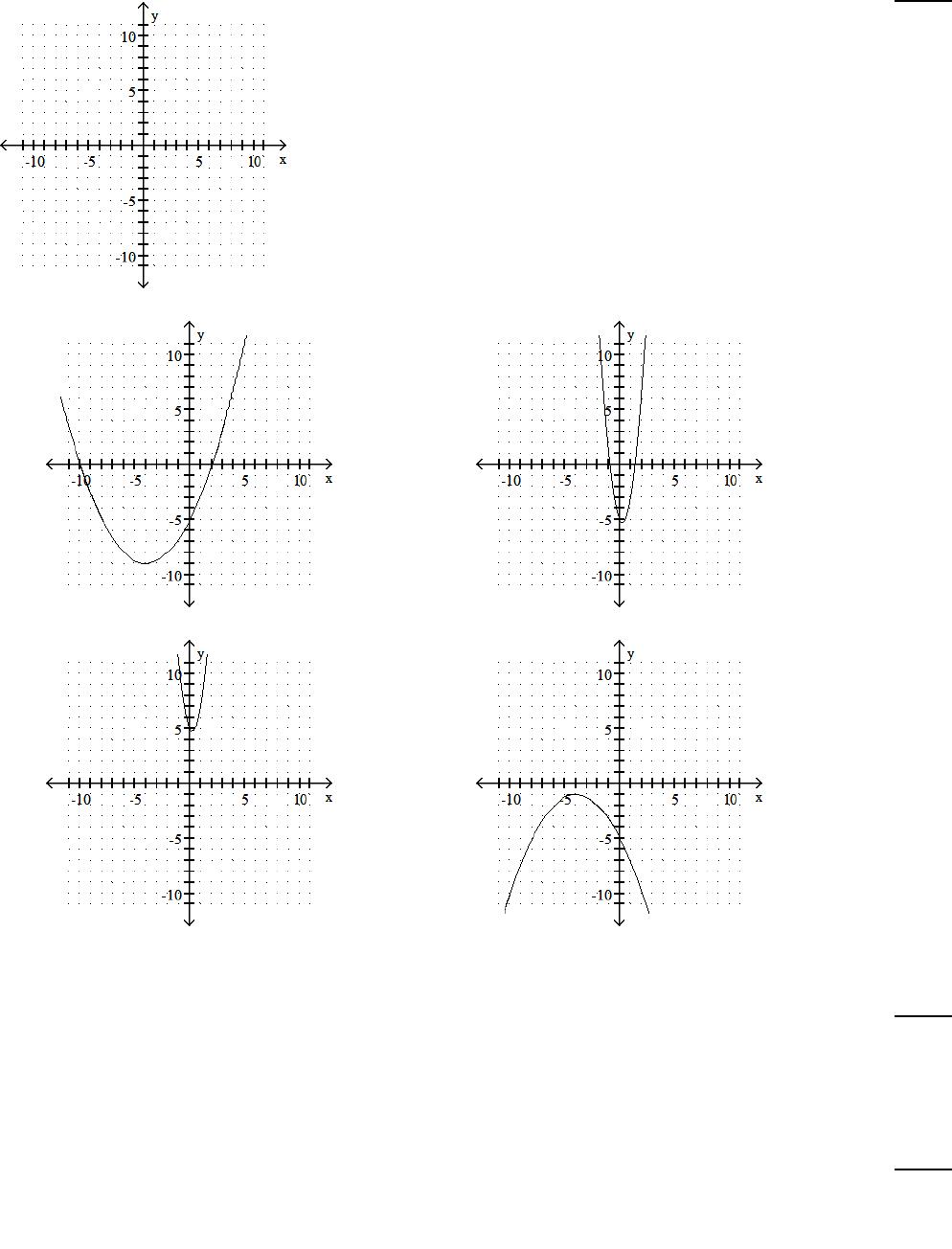
Graph the equation.
247)
f(x) =4x2– 2x – 5
247)
A)
B)
C)
D)
Use the discriminant to determine the number and type of solutions for the equation.
248)
x2+ 7x + 5 = 0
248)
A)
One real–number solution
B)
Two complex–number solutions
C)
Two real–number solutions
Solve the problem.
249)
A ball is thrown vertically upward at an initial speed of 40 ft/sec. Its height (in feet) after t seconds
is given by h(t) = t(40 – 16t). What is the maximum height attained by the ball?
249)
A)
50 feet
B)
33.3 feet
C)
25 feet
D)
22.2 feet
49
Solve the formula for the indicated letter. Assume that all variables represent nonnegative numbers.
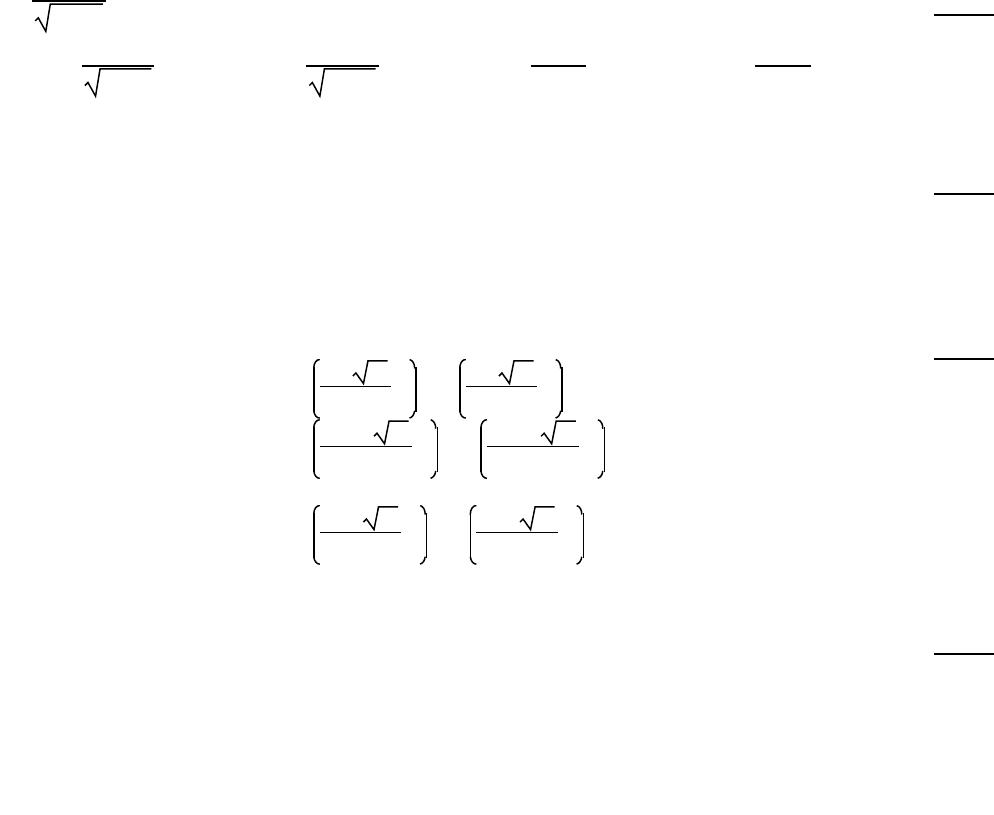
250)
q =p
p2+ 1 , for p
250)
A)
p =q
q2– 1
B)
p =q
1 – q2
C)
p =q
1 – q2
D)
p =q
q2+ 1
Use the discriminant to determine the number and type of solutions for the equation.
251)
3x2= –7x – 8
251)
A)
One real–number solution
B)
Two complex–number solutions
C)
Two real–number solutions
Find the y–intercepts and any x–intercepts.
252)
f(x) = –3x2–8x + 2
252)
A)
y–intercept (0, 2), x–intercepts 4+22
3, 0 and 4–22
3, 0
B)
y–intercept (0, 2), x–intercepts –4+ 2 22
3, 0 and –4– 2 22
3, 0
C)
y–intercept (0, 2), no x–intercepts
D)
y–intercept (0, 2), x–intercepts –4+22
3, 0 and –4–22
3, 0
Solve the problem.
253)
Assume that the profit P made when t units are sold, t > 0, is given by P(t) =t2– 23t + 102. For
what values of t will there be a profit (that is, P > 0)?
253)
A)
There will be a profit when 23 units are sold.
B)
There will be a profit when fewer than 6 or more than 17 units are sold.
C)
There will be a profit when 6 or 17 units are sold.
D)
There will be a profit when the number of units sold is between, but not including, 6 and 17.
50
Answer Key
Testname: C10
Answer Key
Testname: C10
Answer Key
Testname: C10
Answer Key
Testname: C10
Answer Key
Testname: C10

Answer Key
Testname: C10
56