Chapter 10 – Inventory Models
True / False
1. To be considered as inventory, goods must be finished and waiting for delivery.
a.
True
b.
False
False
1
Introduction
2. When demand is independent, it is not related to demand for other components or items produced by the firm.
a.
True
b.
False
True
1
Introduction
3. Constant demand is a key assumption of the EOQ model.
a.
True
b.
False
True
1
EOQ model
4. In the EOQ model, the average inventory per cycle over many cycles is Q/2.
a.
True
b.
False
True
1
EOQ model
5. The single-period inventory model is most applicable to items that are perishable or have seasonal demand.
a.
True
b.
False
True
1
When-to-order decision
6. The time between placing orders is the lead time.
a.
True
b.
False
False
1
When-to-order decision
7. If the optimal production lot size decreases, average inventory increases.
Chapter 10 – Inventory Models
a.
True
b.
False
True
1
8. If an item’s per-unit backorder cost is greater than its per-unit holding cost, no intentional shortage should be planned.
a.
True
b.
False
False
1
9. When quantity discounts are available, order an amount from the highest discount category.
a.
True
b.
False
False
1
10. When there is probabilistic demand in a multi-period model, the inventory level will not decrease smoothly and can
fall below 0.
a.
True
b.
False
True
1
11. In the periodic review model, the order quantity at each review period must be sufficient to cover demand for the
review period plus the demand for the following lead time.
a.
True
b.
False
True
1
12. Periodic review systems require smaller safety stock levels than corresponding continuous review systems.
a.
True
b.
False
False
1
13. The cost of overestimating demand is usually harder to determine than the cost of underestimating demand.
a.
True
Chapter 10 – Inventory Models
b.
False
False
1
14. The terms “inventory on hand” and “inventory position” have the same meaning.
a.
True
b.
False
False
1
15. The EOQ model is insensitive to small variations or errors in the cost estimates.
a.
True
b.
False
True
1
16. At the optimal order quantity for the quantity discount model, the sum of the annual holding and ordering costs is
minimized.
a.
True
b.
False
False
1
17. As lead time for an item increases, the cycle time increases.
a.
True
b.
False
False
1
18. An assumption in the economic production lot size model is that there is storage capacity to hold the entire production
lot.
a.
True
b.
False
False
1
19. If lead time is longer than the review period, the order quantity at any review point is the amount needed for the
inventory on hand plus all outstanding orders to reach the replenishment level.
a.
True
b.
False
Chapter 10 – Inventory Models
True
1
Periodic review model with probabilistic demand
20. For the periodic review inventory model presented in the textbook, it is assumed that a special replenishment order
will be placed in the event of a stockout between review points.
a.
True
b.
False
False
1
Periodic review model with probabilistic demand
Multiple Choice
21. Inventory
a.
is held against uncertain usage so that a supply of items is available if needed.
b.
constitutes a small part of the cost of doing business.
c.
is not something that can be managed effectively.
d.
All of the alternatives are correct.
a
1
Introduction
22. Inventory models in which the rate of demand is constant are called
a.
fixed models.
b.
deterministic models.
c.
JIT models.
d.
requirements models.
b
1
Introduction
23. The EOQ model
a.
determines only how frequently to order.
b.
considers total cost.
c.
minimizes both ordering and holding costs.
d.
All of the alternatives are correct.
b
1
EOQ model
24. Which cost would not be considered part of a holding cost?
a.
cost of capital
b.
shipping cost
c.
insurance cost
Chapter 10 – Inventory Models
d.
warehouse overhead
b
1
EOQ model
25. For inventory systems with constant demand and a fixed lead time,
a.
the reorder point = lead-time demand.
b.
the reorder point > lead-time demand.
c.
the reorder point < lead-time demand.
d.
the reorder point is unrelated to lead-time demand.
a
1
When-to-order decision
26. Safety stock
a.
can be determined by the EOQ formula.
b.
depends on the inventory position.
c.
depends on the variability of demand during lead time.
d.
is not needed if Q* is the actual order quantity.
c
1
EOQ model
27. The economic production lot size model is appropriate when
a.
demand exceeds the production rate.
b.
there is a constant supply rate for every period, without pause.
c.
ordering cost is equivalent to the production setup cost.
d.
All of the alternatives are correct.
c
1
Economic production lot-size model
28. The maximum inventory with backorders is
a.
Q
b.
Q − S
c.
S
d.
(Q − S) / 2
b
1
Inventory model with planned shortages
29. Annual purchase cost is included in the total cost in
a.
the EOQ model.
b.
the economic production lot size model.
c.
the quantity discount model.
Chapter 10 – Inventory Models
d.
all inventory models.
1
Quantity discounts for the EOQ model
30. In the single-period inventory model with probabilistic demand,
a.
surplus items are not allowed to be carried in future inventory.
b.
co = cu.
c.
probabilities are used to calculate expected losses.
d.
All of the alternatives are correct.
1
Single-period inventory model
31. For the inventory model with planned shortages, the optimal order quantity results in
a.
annual holding cost = annual ordering cost.
b.
annual holding cost = annual backordering cost.
c.
annual ordering cost = annual holding cost + annual backordering cost.
d.
annual ordering cost = annual holding cost − annual backordering cost.
1
Inventory model with planned shortages
32. The definition of service level used in this chapter is
a.
the percentage of all demand that can be satisfied from inventory.
b.
the percentage of all order cycles that do not experience a stockout.
c.
the percentage of demand during the lead-time period that can be satisfied from inventory
d.
None of the alternatives is correct.
b
1
Inventory models with probabilistic demand
33. Periodic review inventory systems
a.
are less subject to stockouts than corresponding continuous review systems.
b.
require larger safety stock levels than corresponding continuous review systems.
c.
have constant order quantities.
d.
make the coordination of orders for multiple products more difficult.
b
1
Periodic review model with probabilistic demand
34. Inventory position is defined as
a.
the amount of inventory on hand in excess of expected demand.
b.
the amount of inventory on hand.
Chapter 10 – Inventory Models
c.
the amount of inventory on hand plus the amount of inventory on order.
d.
None of the alternatives is correct.
1
The when-to-order decision
35. A firm that is presently using the Economic Order Quantity model and is planning to switch to the Economic
Production Lot-Size model can expect
a.
the Q* to increase
b.
the maximum inventory level to increase.
c.
the order cycle to decrease.
d.
annual holding cost to be less than annual setup cost.
1
Economic production lot-size model
36. Which of the following is not implied when average inventory is Q/2, where Q is the order quantity?
a.
An entire order quantity arrives at one time.
b.
The previous order quantity is entirely depleted when the next order arrives.
c.
An order quantity is depleted at a uniform rate over time.
d.
Backorders are permitted.
d
1
37. For the EOQ model, which of the following relationships is incorrect?
a.
As the order quantity increases, the number of orders placed annually decreases.
b.
As the order quantity increases, annual holding cost increases.
c.
As the order quantity increases, annual ordering cost increases.
d.
As the order quantity increases, average inventory increases.
1
EOQ model
38. The objective of the EOQ with quantity discounts model is to
a.
determine the minimum order quantity required for the maximum discount.
b.
balance annual ordering and holding costs.
c.
minimize annual purchase cost.
d.
minimize the sum of annual carrying, holding, and purchase costs.
d
1
Quantity discounts for the EOQ model
39. When the reorder point r exceeds Q*, the difference is
a.
safety stock
b.
one or more outstanding orders
Chapter 10 – Inventory Models
c.
surplus inventory
d.
backorders
b
1
Economic order quantity model
40. Inventory position is defined as the amount of inventory on hand plus the amount
a.
on order
b.
promised to customers
c.
on reserve
d.
to be returned to suppliers
a
1
The when-to-order decision
41. For the EOQ model, cycle time is the time between
a.
placing successive orders
b.
placing and receiving an order
c.
stocking out and receiving an order
d.
receiving and storing an order
a
1
The when-to-order decision
Subjective Short Answer
42. Show the total cost expression and calculate the EOQ for an item with holding cost rate 18%, unit cost $8.00, annual
demand of 40000, and ordering cost of $48.
1
EOQ model
43. Demand for a popular athletic shoe is nearly constant at 800 pairs per week for a regional division of a national
retailer. The cost per pair is $54. It costs $72 to place an order, and annual holding costs are charged at 22% of the cost
per unit. The lead time is two weeks.
a.
What is the EOQ?
b.
What is the reorder point?
c.
What is the cycle time?
d.
What is the total annual cost?
a.
b.
r = 1600
c.
T = 710.1/800 = .8876 weeks or .8876(7) = 6.2 days
d.
1
EOQ model
44. The Super Discount store (open 24 hours a day, every day) sells 8-packs of paper towels, at the rate of approximately
420 packs per week. Because the towels are so bulky, the annual cost to carry them in inventory is estimated at $.50. The
cost to place an order for more is $20 and it takes four days for an order to arrive.
a.
Find the optimal order quantity.
b.
What is the reorder point?
Chapter 10 – Inventory Models
c.
How often should an order be placed?
a.
b.
r = (60)(4) = 240
c.
T = 365(1322)/21840 = 22 days
1
EOQ model
45. An office supply store open 5 days a week must determine the best inventory policy for boxes of copier paper. Weekly
demand is nearly constant at 250 boxes and when orders are placed, then entire shipment arrives at once. The cost per box
is $22 and the inventory holding cost is 30%. Orders are placed at a cost of $40 each, including preparation time and
communication charges, and the lead time is 2 days.
a.
Find the optimal order quantity.
b.
What is the reorder point?
c.
How often should an order be placed?
d.
What is the cycle time?
a.
b.
c.
r = 100
d.
Cycle = 7.94 days
1
EOQ model
46. Zip Games purchases blank DVD disks onto which it copies its software for sale through its mail order operation. A
disk costs Zip $.20. Processing an order for more disks cost $15. Zip uses 60000 disks annually, and the company has a
25% cost of capital.
a.
Find the optimal order quantity.
b.
How many orders are placed annually?
c.
How frequently will orders be placed?
a.
b.
10 orders placed annually
c.
every 36.5 days
1
EOQ model
47. Kellam Images prints snack food bags on long rolls of plastic film. The plant operates 250 days a year. The daily
production rate is 6000 bags, and the daily demand is 3500 bags. The cost to set up the design for printing is $300. The
holding cost is estimated at 2 cents per bag.
a.
What is the recommended production lot size?
b.
If there is a five-day lead time to set up the line, what is the recommended reorder point?
a.
b.
1
Economic production lot-size model
48. Henderson Furniture sells reproductions of 18th century furniture. For a particular table, the assumptions of the
inventory model with backorders are valid.
Chapter 10 – Inventory Models
D = 200 tables per year
I = 25% per year
C = $800 per table
Co = $80 per order
Cb = $50 per table per year
The store is open 250 days a year.
a.
What are the values for order quantity and number of planned backorders that will minimize
total cost?
b.
What is the maximum inventory?
c.
What is the cycle time?
d.
What is total cost?
a.
Q* = 28.28
b.
28 − 23 = 5 tables
c.
Cycle time = (28/200)250 = 35 days
d.
POINTS:
1
TOPICS:
Inventory model with planned shortages
49. The Tiernan Gallery and Art Museum distributes to its visitors a printed guide to its collections. There are about
18000 visitors per year. Holding costs for the brochures are 20% and it costs $30 to place an order with the printer. The
printer has offered the following discount schedule:
Category
Order Size
Unit Cost
1
0 – 1499
$2.50
2
1500 – 2999
$2.20
3
3000 and over
$1.80
How many brochures should be printed at a time?
POINTS:
1
TOPICS:
Quantity discounts for the EOQ model
50. A weekly sports magazine publishes a special edition for the World Series. The sales forecast is for the number of
copies to be normally distributed with mean 800,000 copies and standard deviation 60,000 copies. It costs $.35 to print a
copy, and the newsstand price is $1.95. Unsold copies will be scrapped. How many copies should be printed?
ANSWER:
P(demand < Q*) = 1.6/1.95 = .8205
Q* = 800000 + .92(60000) = 855,200
POINTS:
1
TOPICS:
Single-period inventory model with probabilistic demand
51. The Fitness Shop is considering ordering a special model exercise machine. Each unit will cost the shop $410 and it
will sell for $750. Any units not sold at the regular price will be sold at the year-end model clearance for $340. Assume
that demand follows a normal probability distribution with μ = 20 and σ = 6. What is the recommended order quantity?
Chapter 10 – Inventory Models
Single-period inventory model with probabilistic demand
52. Daily demand for packages of five videotapes at a warehouse store is found to be normally distributed with mean 50
and standard deviation 5. When the store orders more tapes, the ordering cost is $42 and the orders take 4 days to arrive.
Each pack of tapes costs $7.20 and there is a 24% annual holding cost for inventory. Assume the store is open 360 days a
year.
a.
What is the EOQ?
b.
If the store wants the probability of stocking out to be no more than 5%, and demand each
day is independent of the day before, what reorder point should be set?
c.
How much of your reorder point in part b) is safety stock?
a.
DDLT is N(200,10)
r = 200 + 1.645(10) = 216.45
c.
Order quantity, reorder point model with probabilistic demand
53. A gourmet food store uses a one-week periodic review system for its supply of coffee beans. There is a five-day lead
time for orders, and the store will allow two stockouts per year.
a.
What is the probability of a stockout associated with each replenishment decision?
b.
What is the replenishment level if demand during the review and lead-time periods is
normally distributed with mean 120 pounds and standard deviation 8 pounds?
c.
How many pounds of beans should be ordered if there are 42 pounds of beans on hand?
a.
2/52 = .0385
M = 120 + 1.77 (8) = 134.16
c.
Periodic review model with probabilistic demand
54. Chez Paul Restaurant orders special Styrofoam “doggy bags” for its customers once a month and lead time is one
week. Weekly demand for doggy bags is approximately normally distributed with an average of 120 bags and a standard
deviation of 25. Chez Paul wants at most a 3% chance of running out of doggy bags during the replenishment period. If he
has 150 bags in stock when he places an order, how many additional bags should he order? What is the safety stock in this
case?
Order 555 doggy bags. Safety stock is 105 bags.
Periodic review model with probabilistic demand
55. Every year in early October Steven King buys pumpkins of one size from a farmer in Maine and then hires an artist to
carve bewitching faces in them. He then tries to sell them at his produce stand in a public market in Boston.
The farmer charges Steven $2.50 per pumpkin and the artist is paid $2.00 per carved pumpkin. Steven sells a carved
pumpkin for $8.00. Any pumpkins not sold by 5:00 p.m. on Halloween are donated to Steven’s favorite children’s hospital.
Steven pays the artist $0.75 per pumpkin to rush the pumpkins to the hospital for the youngsters to enjoy.
Chapter 10 – Inventory Models
Steven estimates the demand for his pumpkins this season to be uniformly distributed within a range of 30 to 70.
a.
How many pumpkins should Steven have available for sale?
b.
Based on your answer to (a), what is the probability that Steven will be short five or more
pumpkins?
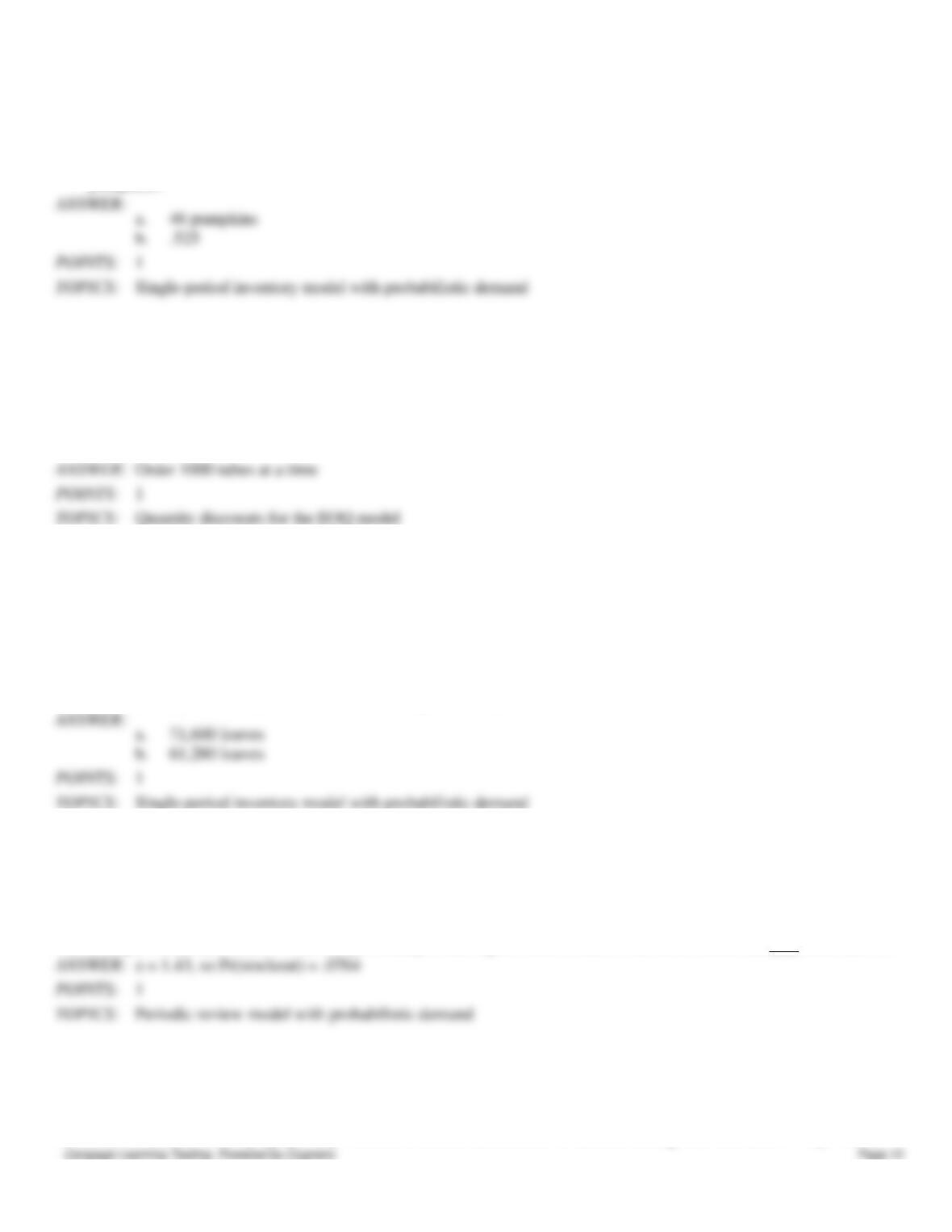
a.
.525
Single-period inventory model with probabilistic demand
56. Bank Drugs sells Jami Michelle lipstick. The Jami Michelle Company offers a 6% discount on orders of at least 500
tubes, a 10% discount on orders of at least 1,000 tubes, a 12% discount on orders of at least 1,800 tubes and a 15%
discount on orders at least 2,500 tubes.
Bank sells an average of 40 tubes of Jami Michelle lipstick weekly. The normal price paid by Bank drugs is $1 per tube. If
it costs Bank $30 to place an order, and Bank’s annual holding cost rate is 27%, determine the optimal order policy for
Bank Drugs.
Order 1000 tubes at a time
Quantity discounts for the EOQ model
57. Amazing Bakers sells bread to 40 supermarkets. It costs Amazing $1,250 per day to operate its plant. The profit per
loaf of bread sold in the supermarket is $.025. Any unsold bread is returned to the Amazing Thrift Store to be sold at a
loss of $.015.
a.
If sales follow a normal distribution with μ = 70,000 and σ = 5,000 per day, how many
loaves should Amazing bake daily?
b.
Amazing is considering a different sales plan for which the profit per loaf of bread sold in
the supermarket is $.03 and the loss per loaf bread returned is $.018. If μ = 60,000 and σ =
4,000 per day, how many loaves should Amazing bake daily?
a.
71,600 loaves
61,280 loaves
Single-period inventory model with probabilistic demand
58. A lawn and garden shop that is open for business seven days a week orders bags of grass seed every OTHER Monday.
Lead time for seed orders is 5 days. On Monday, at ordering time, a clerk found 112 bags of seed in stock, and so he
ordered 198 bags. Daily demand for grass seed is normally distributed with a mean of 15 bags and a standard deviation of
four bags.
The manager would like to know what the probability is that a grass seed stockout will occur before the next order arrives.
z = 1.43, so Pr(stockout) = .0764
Periodic review model with probabilistic demand
59. Kelly’s Service Station does a large business in tune-ups. Demand has been averaging 210 spark plugs per week.
Holding costs are $.01 per plug per week and reorder costs are estimated at $10 per order.
Kelly does not want to be out of stock on more than 1% of his orders. There is a one-day delivery time. The standard
deviation of demand is five plugs per day. Assume a normal distribution of demand during lead time and a 7-day work
Chapter 10 – Inventory Models
week.
a.
What inventory policy do you suggest for Kelly’s station?
b.
What is the average amount of safety stock for the reorder point in (a)?
c.
What are the total variable weekly costs including safety stock costs?
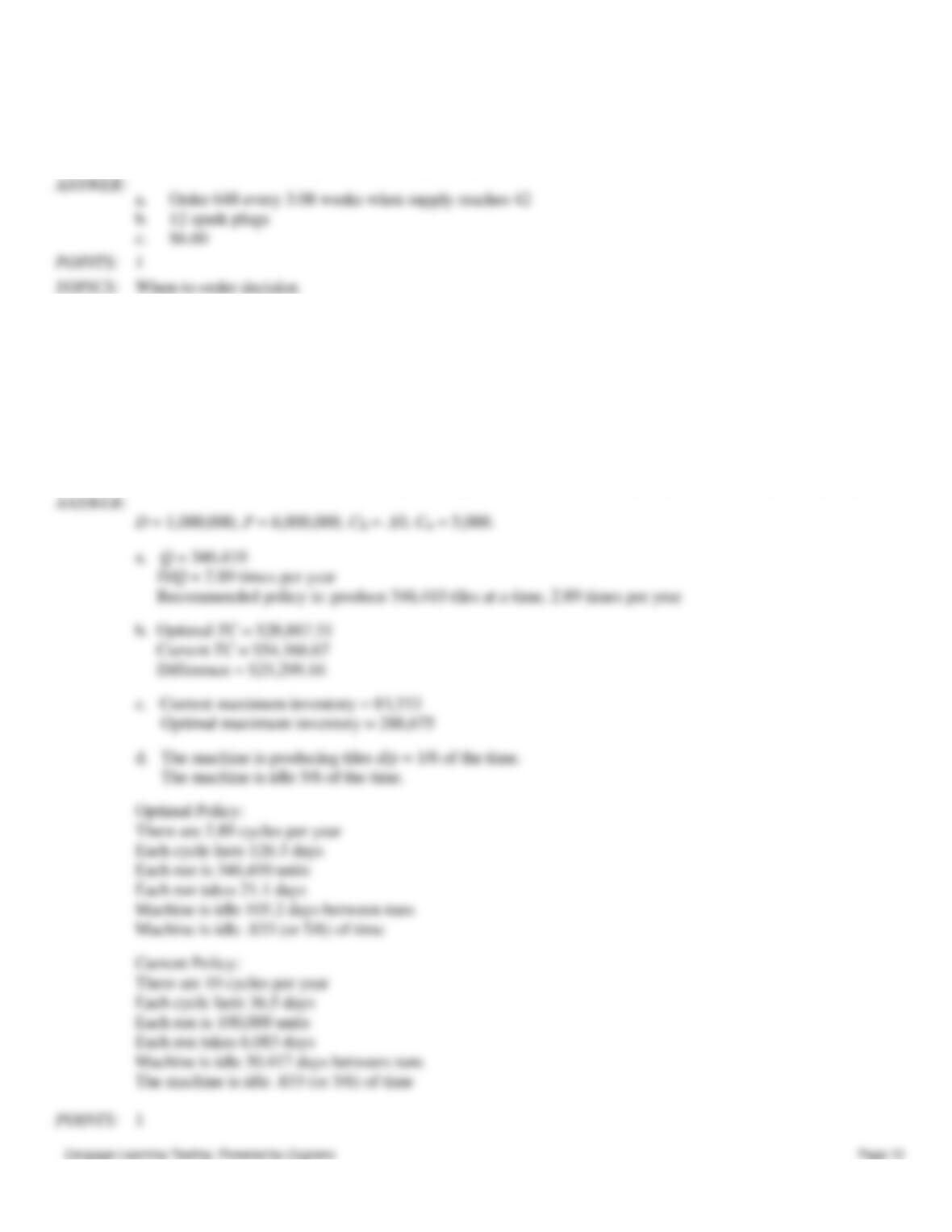
a.
Order 648 every 3.08 weeks when supply reaches 42
b.
12 spark plugs
c.
1
60.
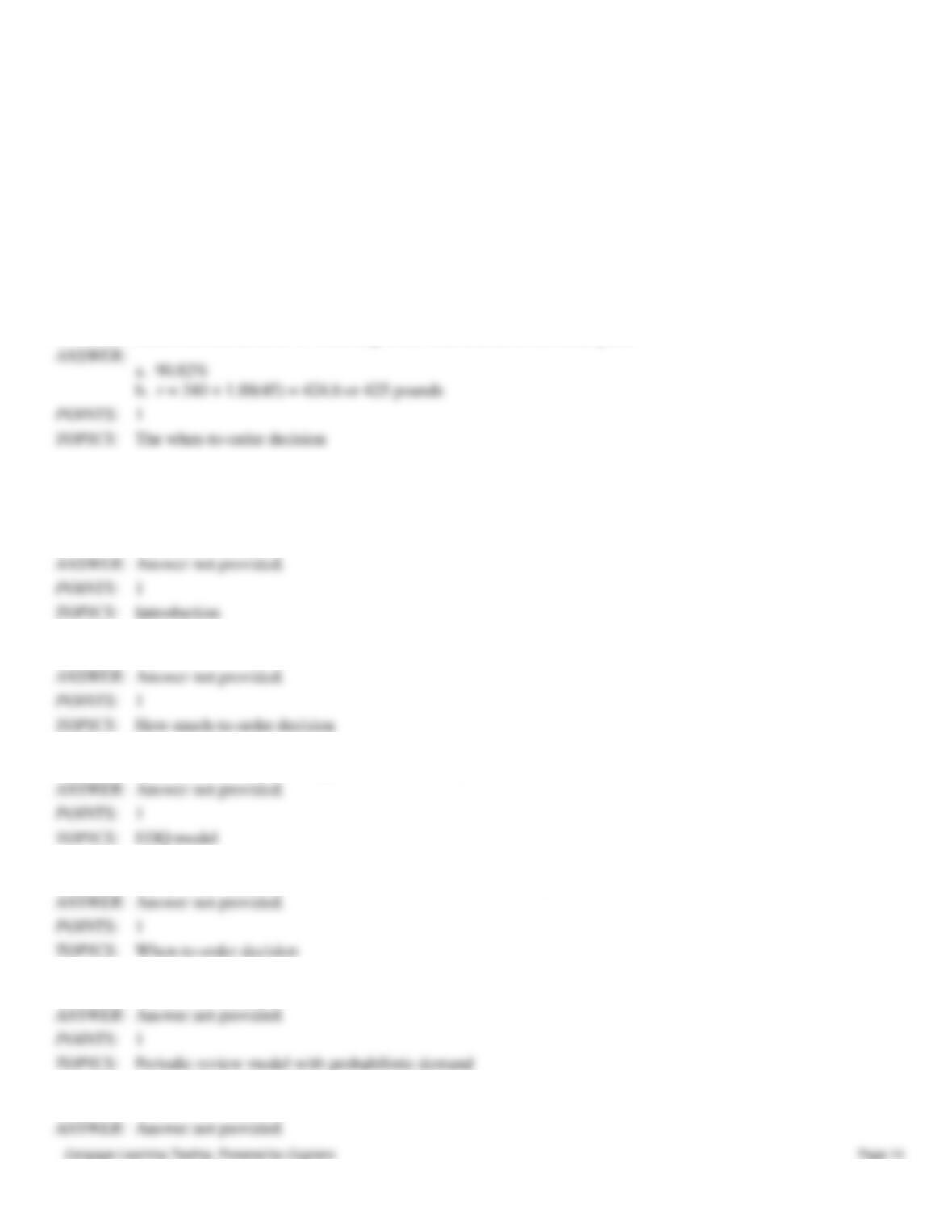
Non-Slip Tile Company (NST) has been using production runs of 100,000 tiles, 10 times per year to meet the demand of
1,000,000 tiles annually. The set–up cost is $5,000 per run and holding cost is estimated at 10% of the manufacturing cost
of $1 per tile. The production capacity of the machine is 500,000 tiles per month. The factory is open 365 days per year.
a. What production schedule do you recommend?
b. How much is NST losing annually with their present production schedule?
c. What is the maximum number of tiles in inventory under the current policy? under the optimal policy?
d. What fraction of time is the machine idle (not producing tiles) under the current policy? Under the optimal policy?
1
Chapter 10 – Inventory Models
TOPICS:
Economic production lot size model
61.
Ken Ells, owner and operator of Kennels, Inc. is concerned that the person in charge of ordering dog food is often
incurring an order expediting expense because he is waiting too long (letting the inventory level drop too low) before
ordering.
Past data indicates that demand during lead time (when expediting does not occur) is normally distributed with a mean of
340 pounds and a standard deviation of 45 pounds.
Ken wants the probability of running out of dog food to be .03.
a. If the current order point is 400 pounds, what is the resulting service level?
b. If Ken wants a service level of 97% for dog food, what should be the order point?
POINTS:
TOPICS:
The when-to-order decision
Essay
62. What are the two most critical behaviors of an inventory system you need to recognize in order to apply the best
model?
ANSWER:
Answer not provided.
POINTS:
TOPICS:
Introduction
63. What compromise must be made in the how-much-to-order decision?
ANSWER:
Answer not provided.
POINTS:
TOPICS:
How-much-to-order decision
64. Derive and explain the total cost expression for the EOQ model.
ANSWER:
Answer not provided.
POINTS:
TOPICS:
EOQ model
65. What could be meant by service level? Why is a clear understanding of this term important?
ANSWER:
Answer not provided.
POINTS:
TOPICS:
When-to-order decision
66. Explain the difference between a periodic and a continuous review system.
ANSWER:
Answer not provided.
POINTS:
TOPICS:
Periodic review model with probabilistic demand
67. List five assumptions of the EOQ model.
ANSWER:
Answer not provided.