2. What is a market segment? Define market segmentation and discuss why market segmentation is
important to the well-being of most companies.
analyze characteristics and buying behavior of those groups.
specifically matched with characteristics and desires of one or more segments.
3. You are given the following limited information about a market consisting of ten people. Describe all
the possible ways to segment this market.
Gender
Income
Male
Medium
Female
Low
Female
Low
Male
High
Female
Low
Male
Low
Male
Medium
Male
High
Female
High
Female
High
4. To be useful, a segmentation scheme must produce segments that meet four basic criteria. Name and
briefly describe each of these four criteria.
5. What is a segmentation base (or segmentation variable)? Name the common segmentation bases used
by marketers to segment consumer markets.
6. Discuss the advantages and disadvantages of single-variable segmentation and multiple-variable
segmentation.
7. What is geographic segmentation? Name four reasons why a company would use a regional marketing
approach. Then give a specific example of a company marketing its product(s) regionally.
8. Marketers use demographic information to segment markets because it is widely available and often
related to consumers’ purchasing and consumption behavior. List five common bases used by
marketers for demographic segmentation. For each base listed, give an example of a product
specifically targeted to the needs and wants of the segment identified within the base.
•
9. Marketers use a variety of terms to refer to different age groups. Name several examples and describe
some characteristics of each.
10. What is the family life cycle (FLC)? Using the following selected stages from the FLC, briefly
describe the lifestyle and purchasing needs of consumers in that stage: (1) Young single, (2) Young
married without children, (3) Young married with children, (4) Middle-aged married without children,
and (5) Older unmarried.
11. Describe psychographic segmentation and discuss why marketers use the basis for segmenting
markets. List the four psychographic variables commonly used as segmentation bases.
12. What is geodemographic segmentation? What is the result of geodemographic segmentation? Give one
specific example that illustrates this type of segmentation.
13. What is benefit segmentation? For toothpaste, list six benefits that might be sought by consumers. For
each benefit, give an existing brand name that best exemplifies segmentation according to that benefit.
14. What is usage-rate segmentation? What is the 80/20 principle, and how does it apply to usage-rate
segmentation?
15. The purchasing strategies of business buyers may provide useful segments. Two purchasing profiles
for business buyers have been identified. Name and describe them.
16. List, in correct order, the steps in segmenting a market.
17. Name and describe the three targeting strategies. For each strategy, name one advantage and one
disadvantage of using the strategy.
18. Define cannibalization. Is it always bad? Explain.
19. Compare and contrast traditional mass marketing and one-to-one marketing. What is the primary goal
for companies that adopt the one-to–one marketing approach?
20. Discuss the four trends that have resulted in the continuing growth of one-to-one marketing.
21. Explain what is meant by positioning and describe the bases marketers use to position products and
services.
22. What is product differentiation and how can it be achieved?
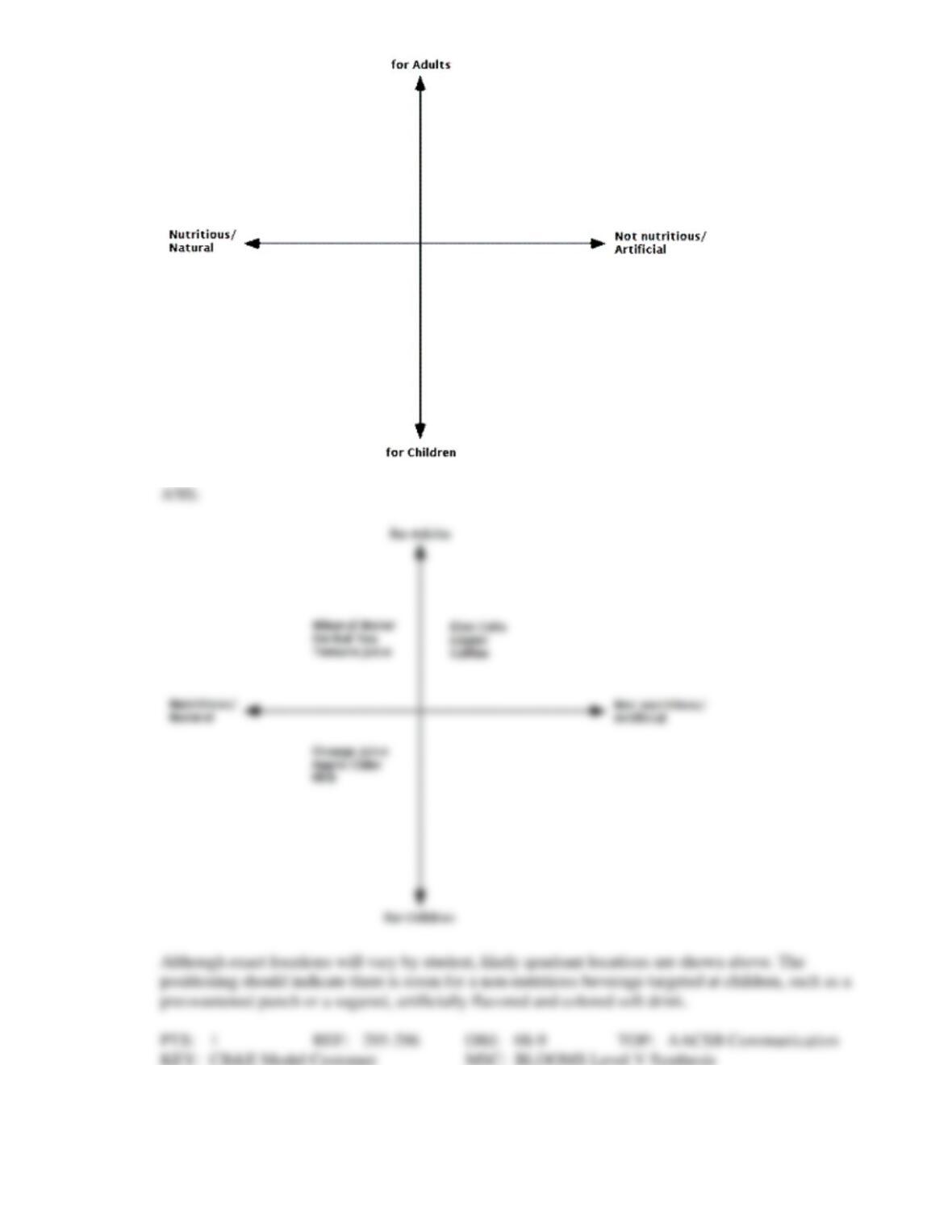
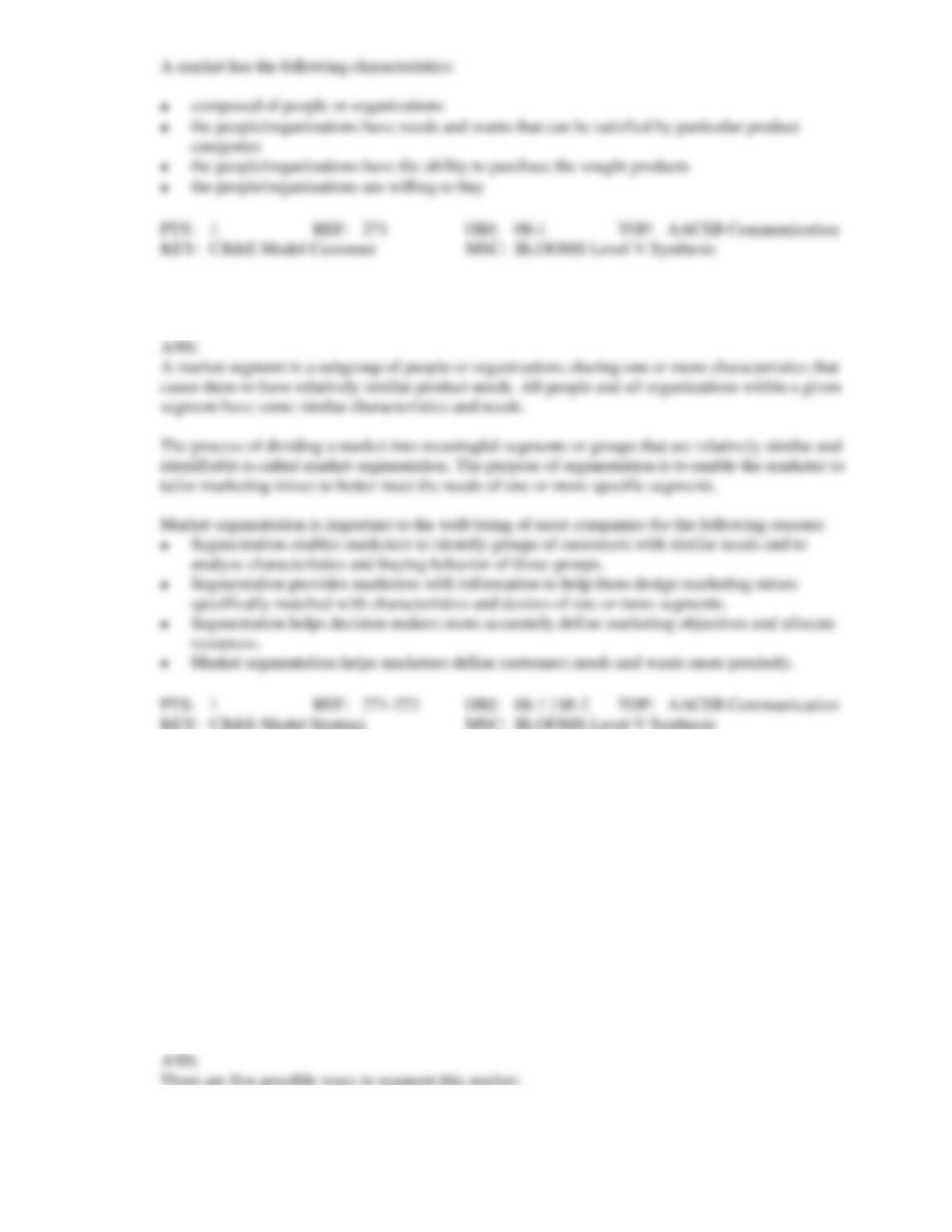
23. You are the marketing manager for a food products firm. Your firm would like to introduce a new
beverage to the marketplace. You have determined that two important dimensions for positioning a
product are (1) nutritional value and (2) age orientation. Place the following beverages on the
perceptual map provided: Coffee, Orange Juice, Diet Cola, Apple Cider, Mineral Water, Milk, Herbal
Tea, Liquor, Tomato Juice. Assuming the listed beverages comprise all competitive beverages, what
position should your firm’s new beverage have? Describe the new beverage.