271) A consumer’s purchases are often influenced by the views, opinions, or behaviors of others.
Which of the following is an aspect of this personal influence?
A) parental guidance
B) peer pressure
C) opinion leadership
D) government regulation
E) psychographics
272) Consumers’ purchases are often influenced by the views, opinions, or behaviors of others.
Two aspects of personal influence that are important to marketers are opinion leadership and
A) consumer socialization.
B) word-of-mouth activity.
C) peer pressure.
D) government regulation.
E) sales promotion.
273) Individuals who exert direct or indirect social influence over others are referred to as
A) decision makers.
B) achievers.
C) innovators.
D) buzz managers.
E) opinion leaders.
274) An opinion leader is an individual
A) within an organization who influences decision making.
B) who is able to use moral persuasion to get others to comply with the latest trends.
C) in an organization who encourages other paid individuals to forward marketer-initiated
messages to others via e-mail, social networking, websites, and blogs.
D) who exerts direct or indirect social influence over others.
E) who is able and willing to cut red tape and move an organization’s marketing program
forward.
275) A study by Popular Mechanics magazine identified 18 million ________ who influence the
purchases of some 85 million consumers for do-it-yourself products.
A) lifestyle makers
B) aspirational people
C) autonomous leaders
D) opinion leaders
E) joint decision makers
276) Your company is introducing a new line of activewear for teenagers and invites the
members of the high school track team to a private showing of the line. This group consists of
________ for activewear clothing.
A) lifestyle makers
B) aspirational people
C) autonomous leaders
D) opinion leaders
E) joint decision makers
277) About what percentage of adults is considered to be opinion leaders?
A) 1 percent
B) 5 percent
C) 10 percent
D) 25 percent
E) It depends upon the type of product.
278) When Citizen, a watch company, uses a spokesperson such as singer Kelly Clarkson to
promote its watches, it believes she is ________ who can influence the purchase decision of its
target market.
A) an opinion leader
B) a product champion
C) an innovator
D) a BzzAgent
E) a rainmaker
279) The influencing of people during conversations is referred to as
A) opinion formations.
B) peer persuasion.
C) interpersonal gossip.
D) word of mouth.
E) consumer socialization.
280) Word of mouth refers to
A) advertising or public service announcements that rely solely on auditory or voice messages to
reach an organization’s target market.
B) subjective, often negative, misconceptions that are passed from one person to another as the
result of selective perception.
C) the influencing of people during conversations.
D) the individuals who exert direct or indirect social influence over others.
E) casual or unconstrained conversation or reports about other people or offerings involving
details that are not confirmed as being true.
281) What percentage of all consumer conversations about brands happen face to face?
A) 25 percent
B) 33 percent
C) 50 percent
D) 75 percent
E) 90 percent
282) What percentage of U.S. product sales is directly tied to word of mouth among friends,
family, and colleagues?
A) 10 percent
B) 25 percent
C) 33 percent
D) 50 percent
E) 67 percent
283) All of the following are marketing activities designed to stimulate conversations that
promote positive or retard negative word of mouth except which?
A) using slogans, music, and humor in advertising
B) giving appropriate product demonstrations
C) recruiting and deploying people to produce buzz
D) employing VALS segmentation strategies
E) running teaser advertising campaigns in advance of new-product introductions
284) Febreze is an odor-controlling spray that is manufactured by Procter & Gamble. When
Febreze was introduced, a few people in an Internet chat room stated that the product was
harmful to house pets. Though untrue, the rumor spread. This is an example of
A) negative word of mouth.
B) a lack of back translation.
C) propaganda.
D) consumer ethnocentrism.
E) poor opinion leadership.
285) Popularity created by consumer word of mouth is called
A) hype.
B) buzz.
C) propaganda.
D) tweet.
E) spin.
286) BzzAgent is a firm that specializes in a marketing strategy known as
A) corporate espionage.
B) teaser advertising.
C) spin.
D) buzz.
E) viral marketing.
287) BzzAgent
A) is the top consumer information source in developing countries.
B) captures honest word-of-mouth testimonials from satisfied customers who will promote new
products or services.
C) was the first on the Internet to create a public forum for new products.
D) counteracts false rumors or negative buzz for quality products or services that have been
unjustly accused on social networking websites.
E) uses ethnographic research techniques to discover subtle behavioral and emotional reactions
to products in their natural use environment.
288) People to whom an individual looks as a basis for self-appraisal or as a source of personal
standards are referred to as
A) action-oriented consumers.
B) spokespersons.
C) opinion leaders.
D) social classes.
E) reference groups.
289) Reference groups refer to
A) the relatively permanent, homogeneous divisions in a society that consists of people who
share similar values, interests, and behaviors.
B) individuals who exert direct or indirect social influence over others.
C) people to whom an individual looks as a basis for self-appraisal or as a source of personal
standards.
D) those buyers who, through the size of their purchases, affect where marketing dollars will be
spent.
E) those with whom a person does not wish to be a member of or identified.
290) A reference group to which a person actually belongs is referred to as ________ group.
A) a primary
B) an associative
C) an aspiration
D) a dissociative
E) an integrated
291) College students who wear clothing displaying the Greek letters for fraternities or sororities
to which they belong are demonstrating pride in ________ group.
A) a dissociative
B) an aspiration
C) an associative
D) an identificational
E) a political
292) The specialized group of consumers with a structured set of relationships involving a
particular brand, fellow customers of that brand, and the product in use is referred to as
A) a brand community.
B) a VALS.
C) an opinion leader.
D) a social class.
E) a buzz group.
293) A brand community refers to
A) the relatively permanent, homogeneous divisions in a society that consists of people who
share similar values, interests, behaviors, and brands.
B) a specialized group of consumers with a structured set of relationships involving a particular
brand, fellow customers of that brand, and the product in use.
C) people to whom an individual looks as a basis for purchasing particular brands.
D) those buyers who, through the size of their purchases, affect where marketing dollars will be
spent on a particular brand.
E) those brands with which a person does not wish to be identified.
294) A brand community is a specialized form of the ________ reference group.
A) dissociative
B) aspiration
C) associative
D) VALS
E) social class
295) Many University of Florida students, fans, and others view themselves part of “Gator
Nation,” the name of the ________ given to supporters of the University of Florida’s educational
and athletic programs.
A) VALS type
B) aspiration group
C) social class
D) brand community
E) market segment
296) A reference group that a person wishes to be a member of or wishes to be identified with is
referred to as ________ group.
A) a preference
B) an associative
C) an aspiration
D) an assimilation
E) an integrated
297) An aspiration group is one
A) to which a person belongs and wishes to continue with.
B) that a person wishes to be a member of or wishes to be identified with.
C) that a person wishes to maintain a distance from because of differences in values or
behaviors.
D) that a person knows he or she can never really fit into because of basic cultural differences.
E) that a person feels is significantly above him or her in terms of socioeconomics.
298) A local country club has a great golf course, swimming pool, tennis courts, and even a
stable for horses. It also has numerous high-profile businesspeople, doctors, and local politicians
as members. To attract new members, the club’s board of directors should focus its marketing
efforts on people who view its current members as ________ group.
A) an associative
B) an aspiration
C) a dissociative
D) a pressure
E) an involvement
299) An American Express advertising claim that “membership has its privileges” creates which
type of reference group?
A) aspiration group
B) dissociative group
C) assimilation group
D) integrated group
E) associative group
300) A reference group that a person wishes to maintain distance from because of differences in
values or behaviors is referred to as ________ group.
A) a socialization
B) an associative
C) an aspiration
D) a dissociative
E) an antisocial
301) In the United States, there are two major political parties whose members disagree with
each other on a variety of issues. Many Republicans and Democrats view one another as being
part of ________ group.
A) an associative
B) an aspiration
C) a dissociative
D) a reference
E) an involvement
302) ________ influences on consumer behavior result from three sources: consumer
socialization, passage through the life cycle, and decision making within the household.
A) Lifestyle
B) Situational
C) Social
D) Family
E) Personal
303) The process by which people acquire the skills, knowledge, and attitudes necessary to
function as consumers is referred to as
A) consumer assimilation.
B) consumer socialization.
C) consumer lifestyle.
D) purchase decision process.
E) purchasing enculturation.
304) Consumer socialization refers to
A) the distinct phases that a family progresses through from formation to retirement, each phase
bringing with it identifiable purchasing behaviors.
B) the people to whom an individual looks as a basis for self-appraisal or as a source of personal
standards.
C) the process by which people acquire the skills, knowledge, and attitudes necessary to function
as consumers.
D) the modes of living that are identified by how people spend their time and resources, what
they consider important in their environment, and what they think of themselves and the world
around them.
E) the relatively permanent, homogeneous divisions in a society into which people sharing
similar values, interests, and behavior can be grouped.
305) Research shows that consumer socialization with respect to brand preferences is evidenced
among children
A) at the age of 2.
B) by the age of 5 when their cognitive skills have developed to understand the concept of
money.
C) by the age of 13 when they become teenagers, when they can understand the responsibility
involved in saving money to be able to consume products and services.
D) around the age of 18 when they become college students, living outside their parents’ home
for the first time and being responsible for their purchase decisions.
E) at any time, though most people change their brand preferences many times during their
lifetimes.
306) Nicole gives her young daughter Kelli an allowance of $5 a week. Sometimes, Nicole takes
Kelli shopping. But if Kelli wants something that costs more than she has saved, Nicole reminds
her she needs to keep saving. When Kelli is finally able to purchase a special, more expensive
item, she is allowed to pay for it herself, including bringing the product to the salesclerk to
complete the purchase. In this way, Nicole encourages the development of Kelli’s
A) consumer assimilation.
B) consumer acculturation.
C) purchasing socialization.
D) consumer socialization.
E) purchasing enculturation.
307) The concept that consists of the distinct phases that a family progresses through from
formation to retirement, each phase bringing with it identifiable purchasing behaviors, is referred
to as the
A) family scale.
B) family life cycle.
C) family continuum.
D) household socialization.
E) household patterning.
308) The family life cycle concept refers to
A) the distinct phases a family progresses through from the birth of children to when the children
leave home, each phase bringing with it identifiable purchasing behaviors.
B) the distinct phases an individual progresses through, from birth to marriage to having children
to retirement, which each have identifiable purchasing behaviors.
C) the phases a blended family progresses through from marriage to separation, divorce, and
remarriage, each phase bringing with it identifiable purchasing behaviors.
D) the distinct phases a family progresses through from formation to retirement, each with
identifiable purchasing behaviors.
E) the intergenerational purchasing habits and product preferences that are passed down from
one generation to the next.
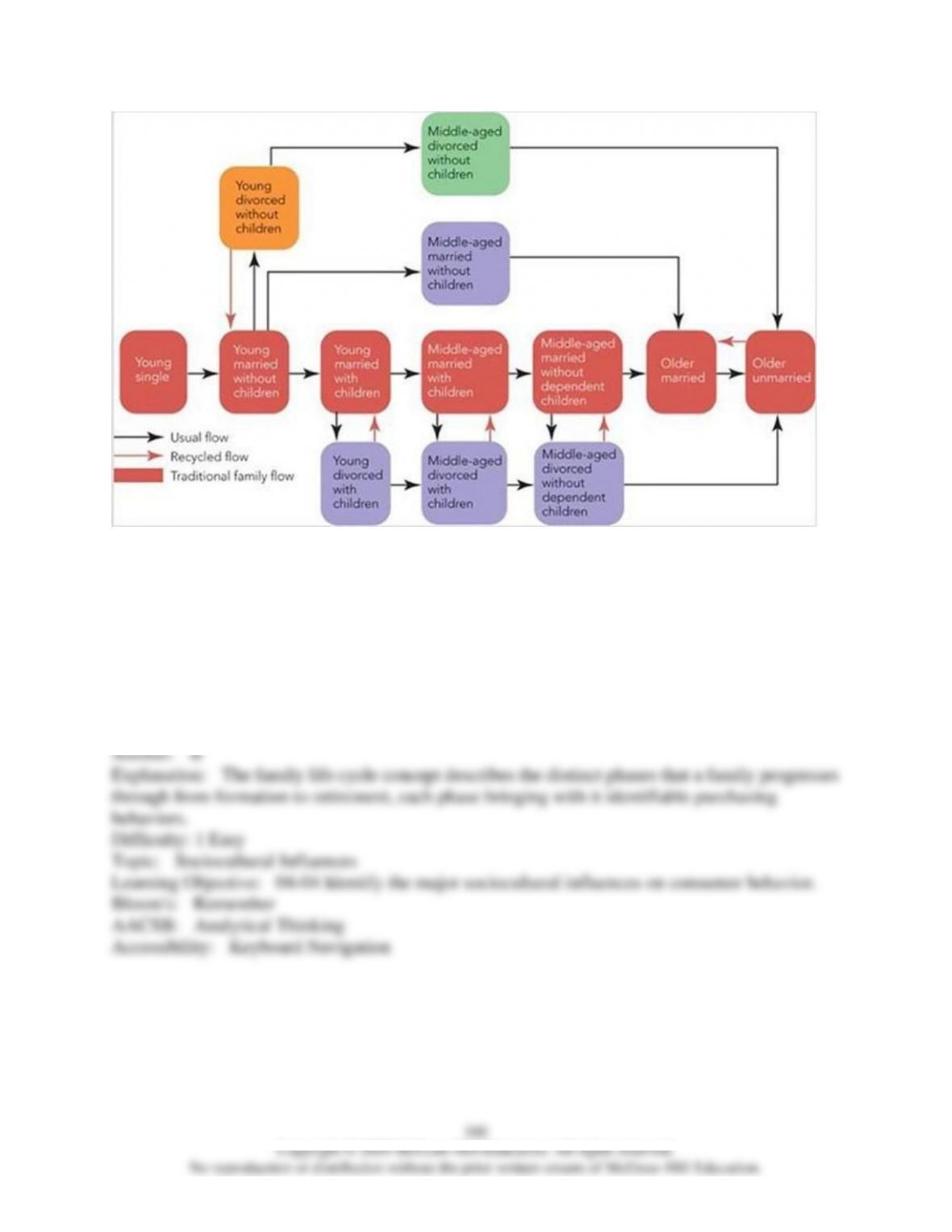
Figure 4-8
309) Figure 4-8 illustrates the traditional progression as well as contemporary variations of
A) the family scale.
B) the family life cycle.
C) the family continuum.
D) household socialization.
E) household patterning.