79) Firms such as GM and Frito-Lay have learned which of the following marketing lessons?
A) It is a lot easier to find new customers than to retain existing ones.
B) According to research, it is equally costly to acquire new customers and retain existing ones.
C) Existing customers do not spend as much as new customers since the former like the old
products rather than the new ones new customers like.
D) The buying experience, customer satisfaction, and customer retention can increase a firm’s
profits.
E) Unless a marketing promotion to retain customer loyalty can increase market share by at least
5 percent, it is not worth the expenditure.
80) The feeling of postpurchase psychological tension or anxiety consumers may experience
when faced with two or more highly attractive alternatives is referred to as
A) angst.
B) the temporal state.
C) the dissociative state.
D) selective perception.
E) cognitive dissonance.
81) Cognitive dissonance refers to
A) feelings of guilt for purchasing a product or service that was not consistent with a consumer’s
moral or ethical beliefs.
B) feelings of discomfort associated with purchasing something purely for the sake of prestige.
C) the feeling of postpurchase psychological tension or anxiety consumers may experience when
faced with two or more highly attractive alternatives.
D) feelings of discontent after a purchase has been made when the product fails to perform up to
expectations.
E) feelings of discontent before a purchase has been made when the customer finds out that he or
she paid more for the product than necessary.
82) Rackspace U.S. Inc. is a web hosting company. If you want to have a website, you can buy
Internet space as well as technical support and design services from the company. When its ad
tells you that its users consider Rackspace “the risk-free host because it offers dedicated and
helpful support any time day or night,” you know that Rackspace is most likely trying to do
which of the following?
A) Identify its core values.
B) Reduce new buyers’ cognitive dissonance.
C) Simplify new buyers’ evaluative criteria.
D) Produce a consideration set.
E) Evoke problem recognition.
83) You have just purchased an Amazon Fire HD 10 tablet device. After you get home from the
store, you brood about whether your choice was right or whether you should have bought a
Samsung Galaxy Tab S3 when you see an ad for it on TV. This is most likely an example of
A) indecisiveness.
B) cognitive dissonance.
C) postpurchase stress.
D) market anxiety.
E) extended problem solving.
84) How would consumers who purchased a new and innovative Nike LeBron 15 basketball shoe
for $185 try to reduce any cognitive dissonance they feel?
A) limit their information search to an internal one
B) minimize problem-solving involvement
C) read ads for the new basketball shoe even after the purchase has been made
D) conceal the product purchase from others
E) If the shoe is comfortable and gives the requisite support, there will be no cognitive
dissonance.
85) Stephan was excited about his newly purchased laptop. It had all the features he wanted and
was really fast with a great display for his gaming. In addition, the $1,200 price tag was
reasonable. The same day he took it out of the box, he saw an online special for a similar
computer, on sale for only $1,000. Suddenly he began to doubt his purchase decision and
worried that maybe he hadn’t gotten such a good deal. Stephan was most likely experiencing
A) limited problem solving.
B) cognitive dissonance.
C) selective discord.
D) product conflict.
E) product uncertainty.
86) The personal, social, and economic significance of the purchase to the consumer, which is
known as the level of ________, may cause him or her to skip or minimize one or more stages in
the purchase decision process.
A) aspiration
B) cognitive dissonance
C) motivation
D) situational influences
E) involvement
87) In terms of consumer behavior, involvement refers to
A) the external influences that affect a consumer’s purchase.
B) the personal, social, and economic significance of the purchase to the consumer.
C) the level of difficulty involved in making a purchase.
D) the total number of people involved in the actual exchange process.
E) the time, energy, and personal investment that will be required to use a product.
88) High-involvement purchases typically have which of the following characteristics?
A) The item is inexpensive, widely available, or simple to use.
B) The item is inexpensive, very safe to use, or purchased with great frequency.
C) The item is expensive, new to the market, or recommended by influential personal sources.
D) The item is expensive, can have serious personal consequences, or could reflect on one’s
social image.
E) The item is inexpensive, new to the market, or is used for more than five years.
89) For high-involvement purchases, consumers typically do all of the following except which?
A) spend considerable time evaluating criteria for the consideration set
B) participate in word-of-mouth communication
C) evaluate a single product attribute, such as price
D) consider many brands
E) use both internal and external sources in information search
90) NetJets is a company that offers one-sixteenth or more ownership in a jet plane for a price
beginning at $325,000. It gives purchasers privacy, convenience, and flexibility as well as saves
them time since the plane is available within four hours unless it’s booked by one of the other
shareholders. This is most likely an example of
A) a medium-involvement purchase that involves limited problem solving.
B) a high-involvement purchase that involves routine problem solving.
C) a high-involvement purchase that involves extended problem solving.
D) a low-involvement purchase that involves limited problem solving.
E) a low-involvement purchase that involves extended problem solving.
91) Which of the following products and services is an example of a low-involvement purchase?
A) knee surgery
B) a Trek bicycle
C) membership into a local country club
D) a vacation to Italy
E) Bounty paper towels
92) Lexi wants to find the perfect gift for her older sister’s college graduation. She started
looking for the gift last month and expects to spend another couple of weeks to find a gift her
sister will use and like. Lexi is engaging in
A) routine problem solving.
B) limited problem solving.
C) extended problem solving.
D) problem recognition.
E) integrated problem solving.
93) In ________, consumers typically seek only a few information sources about several sellers
and their brands, and they may identify and evaluate a moderate number of attributes for each
brand that eventually will comprise the consideration set.
A) limited problem solving
B) extended problem solving
C) short-term problem solving
D) routine problem solving
E) relational problem solving
94) Which problem solving variation would likely be used for winter coats, sheets, movie tickets,
or pressure cookers?
A) routine response behavior
B) limited problem solving
C) extended problem solving
D) simulated selection
E) integrated problem solving
95) Which problem solving variation would typically be used for blenders, a restaurant for lunch,
or professional ball game tickets?
A) routine response behavior
B) extended problem solving
C) simulated selection
D) integrated problem solving
E) limited problem solving
96) Elizabeth has decided to purchase a new electric juicer and plans to call several friends for
the latest information about alternative brands. She is not concerned about where she buys it as
long as she receives a very liberal return policy should anything go wrong. In making her
decision, Elizabeth will engage in which of the following problem solving variations?
A) limited problem solving
B) extended problem solving
C) routine problem solving
D) alternative problem solving
E) integrated problem solving
97) Danilo has decided to purchase a new video game console, not having owned one before. He
calls his gamer friends for recommendations about alternative brands and options. He has few
concerns about the purchase but wants a quick rundown of the most important aspects to
consider. In making his decision, Danilo seems likely to engage in which of the following
problem solving variations?
A) limited problem solving
B) extended problem solving
C) routine problem solving
D) alternative problem solving
E) integrated problem solving
98) Consumers spend little time and effort evaluating alternatives in the purchase of flour and
soap. The consumer purchase decision process for such staples involves ________, which is
virtually a habit and typifies low-involvement decision making.
A) limited problem solving
B) extended problem solving
C) situational problem solving
D) rational problem solving
E) routine problem solving
99) Which problem solving variation would normally be used to purchase items such as crackers
or laundry detergent?
A) limited problem solving
B) extended problem solving
C) routine problem solving
D) situational problem solving
E) integrated problem solving
100) Dina manages a three-story apartment building near campus. When a tenant recently moved
out, she changed the locks and had another set of keys made at Home Depot, as she does every
time a tenant moves. This is an example of
A) limited problem solving.
B) extended problem solving.
C) situational problem solving.
D) routine problem solving.
E) integrated problem solving.
101) Between classes, many college students stop at conveniently located vending machines for
their favorite snacks and drinks. Their choices are generally made quickly and with little or no
effort to consider alternative product offerings. These college students are most likely involved
in ________ problem-solving purchase situations.
A) limited
B) routine
C) extensive
D) intensive
E) unlimited
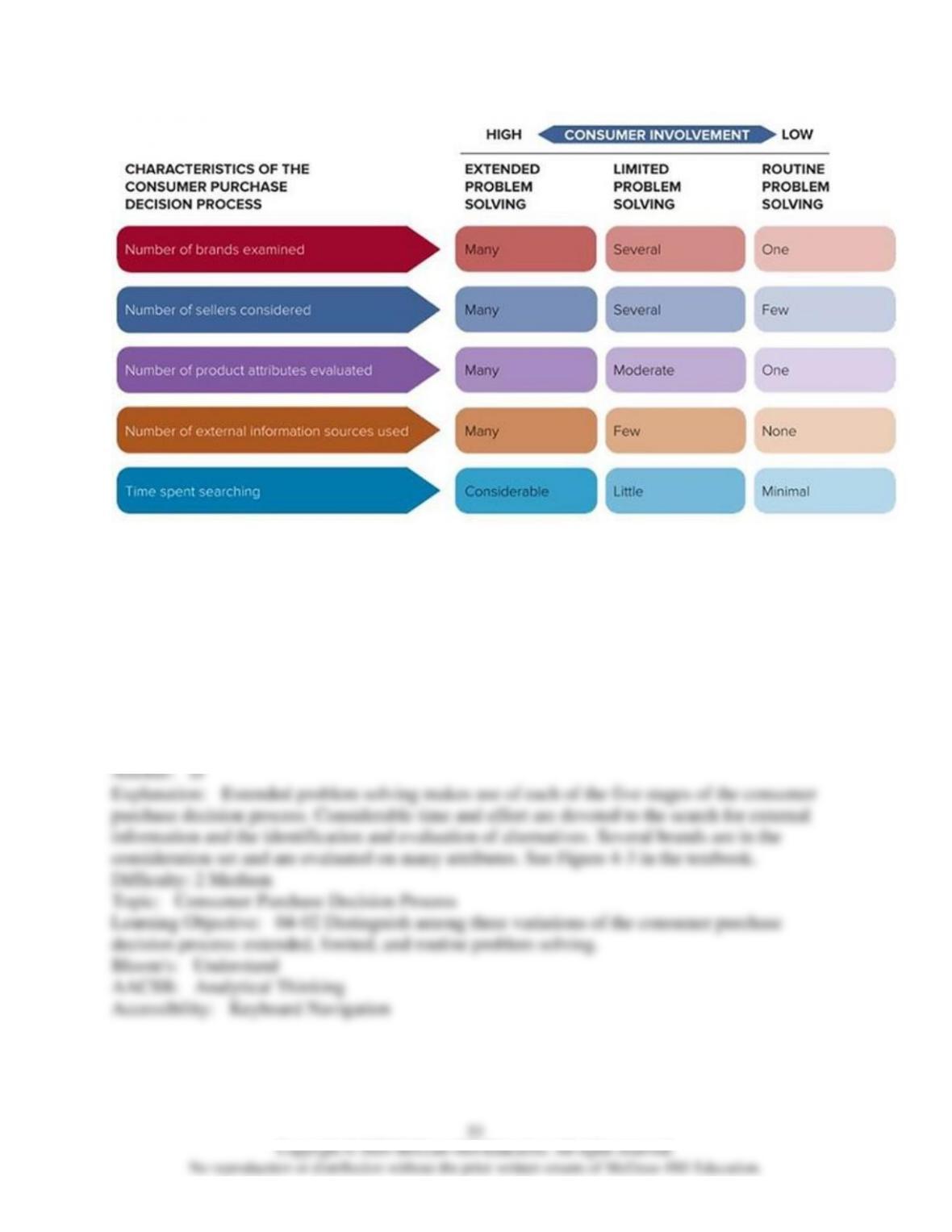
Figure 4-3
102) In Figure 4-3, column A represents which of the following in terms of consumer
involvement and product knowledge?
A) consideration set
B) routine problem solving
C) limited problem solving
D) extended problem solving
E) integrated problem solving
103) In Figure 4-3, column B represents which of the following in terms of consumer
involvement and product knowledge?
A) intermediate problem solving
B) routine problem solving
C) limited problem solving
D) extended problem solving
E) integrated problem solving
104) In Figure 4-3, column C represents which of the following in terms of consumer
involvement and product knowledge?
A) routine problem solving
B) limited problem solving
C) nominal problem solving
D) basic problem solving
E) integrated problem solving
105) Which of the following is a strategy for a market leader (rather than a market challenger)
when marketing a low-involvement product?
A) Use sales promotion such as free samples, coupons, and rebates to encourage trial of the
brand.
B) Link the brand attributes with high-involvement issues.
C) Use Internet search engines such as Google to assist buyers.
D) Use advertising messages that focus on getting the brand into a consumer’s consideration set.
E) Use repetitive advertising messages that reinforce a consumer’s knowledge or assure buyers
they made the right choice.
106) The purchase of bottled sparkling water is a low-involvement purchase. How can a market
leader such as Perrier keep people buying its brand instead of one of the numerous other brands
displayed on retailers’ shelves?
A) Avoid Perrier brand stock-outs on retailers’ shelves.
B) Make the purchase decision a high-involvement one.
C) Offer coupons for Perrier bottled water.
D) Convince retailers to offer only Perrier water.
E) Denigrate its competition.
107) Which of the following is more essential as a strategy for a low-involvement offering than
for a high-involvement one?
A) Use personal selling to provide consumers with information.
B) Use social media to create online experiences for the brand.
C) Avoid stock-out situations so that buyers don’t substitute a competing brand.
D) Optimize internet search engines such as Google to assist buyers during information search.
E) Run ads to provide consumers with information.
108) Purchase task, social surroundings, physical surroundings, temporal effects, and antecedent
states can have an impact on a consumer’s purchase decision process. These are referred to as
A) marketing mix influences.
B) situational influences.
C) psychological influences.
D) sociocultural influences.
E) evaluative criteria.
109) Situational influences refer to
A) the aspects of the purchase situation that impact the consumer purchase decision process:
purchase task, social surroundings, physical surroundings, temporal effects, and antecedent
states.
B) the temporary impediments to a consumer’s purchase decision.
C) psychological concepts that are useful for interpreting buying processes and directing
marketing efforts.
D) the feelings of postpurchase anxiety that can arise from a number of different factors
including social surroundings, physical surroundings, psychological effects, and precedent states.
E) both the objective and subjective attributes a consumer uses to compare different products and
brands.
110) All of the following are situational influences that can have an impact on a consumer’s
purchase decision process except which?
A) physical surroundings
B) purchase task
C) temporal effects
D) consumer involvement
E) antecedent states
111) Five situational influences have an impact on a consumer’s purchase decision process. One
of these is
A) competitive offerings.
B) core values.
C) perception.
D) consumer socialization.
E) temporal effects.
112) Louie is selecting a bottle of wine and passes up his usual choice for a more expensive one
because he plans to bring it to a dinner party that evening. This is an example of which
situational influence?
A) purchase task
B) social surroundings
C) physical surroundings
D) temporal effects
E) antecedent states
113) Consumers accompanied by children
A) purchase twice as much as they normally would if shopping with other adults.
B) purchase about 40 percent more than when shopping alone.
C) purchase less than 50 percent of what they normally would if shopping with their spouses.
D) are usually unable to complete nonessential shopping tasks.
E) avoid purchases of household and entertainment offerings.
114) Three teenage girls spent an hour at a store trying on various outfits, looking at possible
combinations, and asking each other, “How do you think this looks on me?” This situation is
most closely related to which of the following situational influences?
A) purchase task
B) social surroundings
C) physical surroundings
D) temporal effects
E) antecedent states
115) Which of the following is not part of the physical surroundings of a retail store that can
influence how purchase decisions are made?
A) decor
B) crowding
C) lighting
D) music
E) time of day
116) The crowded aisles in retail stores at holiday time may cause some shoppers to lose
patience and decide on their purchases with far less thought than they otherwise would. This
situation is most closely related to which of the following situational influences?
A) purchase task
B) social surroundings
C) physical surroundings
D) temporal effects
E) spatial surroundings