
111) Web-crawling technology searches for counterfeit storefronts and sales by detecting domain
names similar to legitimate brands.
112) As required levels of distribution increase, so do customer prices relative to the importer’s
price.
113) Country-of-origin effects refer to the attitude anything produced by the home country is
better than imported goods.
114) Country-of-origin perceptions, once formed, are very difficult to change.
115) People are often ethnocentric and favorably predisposed to their own country’s products,
unless they come from a less developed country.
116) The impact of country of origin is independent of the type of product.
117) A firm normally gets into international marketing simply by shipping out its goods.
118) The international division that is responsible for a firm’s worldwide marketing activities is
headed by a division president who sets goals and budgets and is in charge of the company’s
international growth.
119) When forces for both global integration and national responsiveness prevail to some extent,
a “global” strategy that standardizes certain elements and localizes other elements can be the way
to go.
120) Most companies would prefer to remain domestic if their domestic market were large
enough. Yet several factors are drawing more and more companies into the international arena.
List some of these factors.
121) What are the various risks that a company must consider before making a decision to enter
foreign markets?
122) Outline the major decisions that a firm must undergo in making a decision to market
internationally.
123) Regional free trade zones exist around the world. One of the oldest is the European Union,
formed in 1957. Describe the purpose of the EU and discuss some of the benefits to firms
engaged in trade within the European Union.
124) Once a company decides to target a particular country, it must determine the best mode of
entry. Each of its market entry strategies involves more commitment, risk, control, and profit
potential. List these market entry strategies in order from low risk to high risk.
125) Explain how marketers are using the Web for international business.
126) Define a joint venture and list some of the advantages and disadvantages.
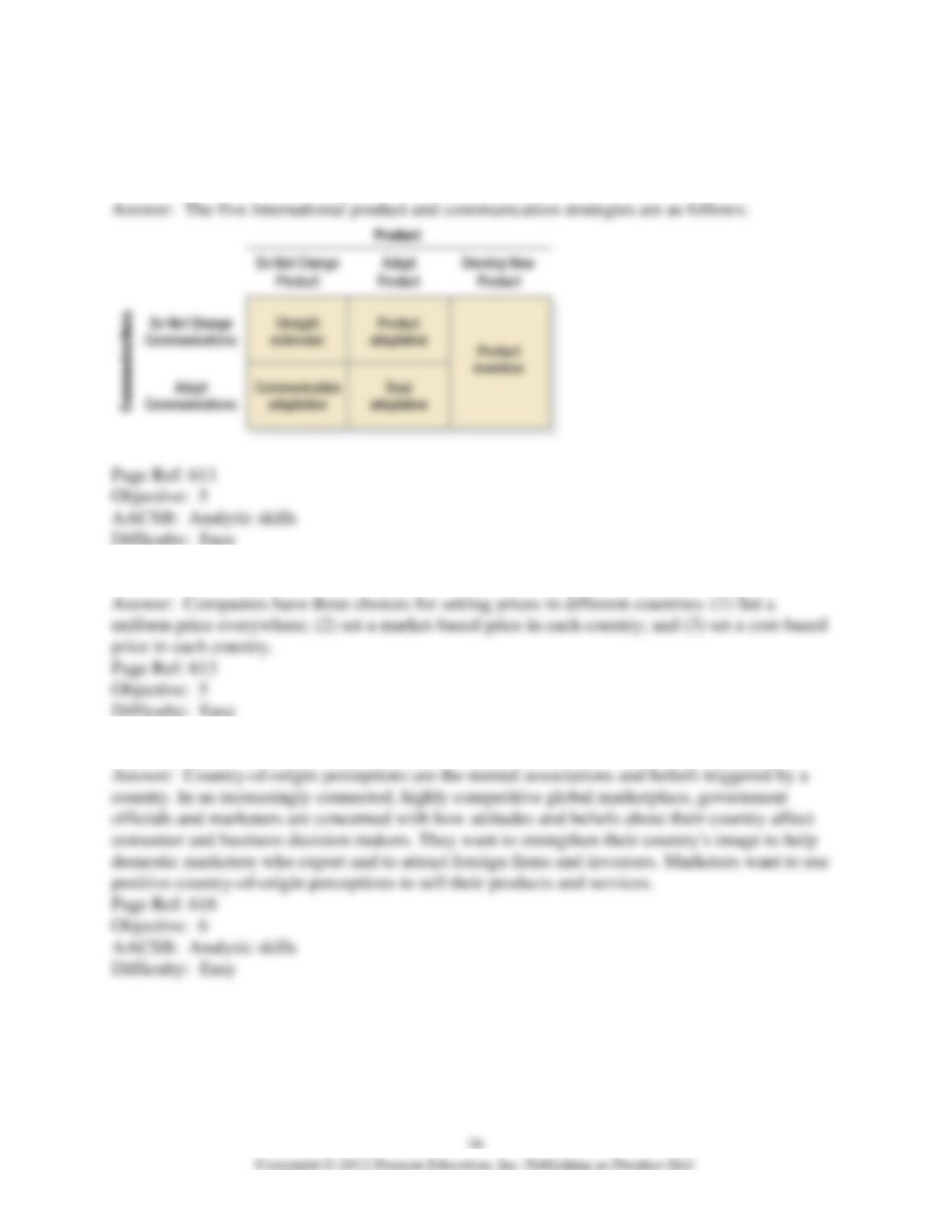
127) Most brands are adapted to some extent to reflect significant differences in consumer
behavior, brand development, competitive forces, and the legal or political environment. Identify
the five international product and communication strategies available to firms that expand their
businesses to foreign countries.
128) Name the three choices that companies have for setting prices in different countries.
129) Explain the country-of-origin effect.
130) Define the internationalization process’ four stages.
131) A company that is planning to go global must decide on how many countries to enter and
how fast to expand. A company’s entry strategy typically follows one of two possible
approaches. What are those approaches?
132) Define psychic proximity and explain why it is important for companies engaged in
exporting products.
133) When deciding where to operate internationally, it often makes sense to operate in fewer
countries, with a deeper commitment and penetration in each. Mention some of the criteria that a
country should possess in order to be a viable and attractive investment destination.
134) Briefly describe the advantages of direct investment.
135) “No matter which nation a person belongs to, people’s inherent needs and requirements are
essentially the same.” – Do you agree with this statement? How relevant is this statement in the
context of marketing?
136) International companies must decide how much to adapt their marketing strategy to local
conditions. Identify and explain the two strategies companies can use.
137) Discuss three disadvantages of standardizing the marketing mix worldwide.
138) Discuss three advantages of standardizing the marketing mix worldwide.
139) Satisfying different consumer needs and wants can require different marketing programs.
Name the four cultural dimensions that differentiate countries, as identified by Hofstede.
140) Some types of products travel better across borders than others. What types of products are
most likely to be successful as straight extensions.
141) You work for a company that produces and markets apparel for men and women, and is
planning to enter the Chinese market. If you were asked if the company should opt for a straight
extension or a product adaptation, what would you choose, and why?
142) Product adaptation alters the product to meet local conditions or preferences. Identify four
levels of adaptation.
143) When companies sell their goods abroad, they face a price escalation problem. Define price
escalation.
144) What are the choices available to companies when setting prices to avoid price escalation
problems?
145) Your company manufactures travel bags and is keen on establishing its presence in the
Indian market. If you were given the responsibility to decide the pricing strategy the company
should use, what would you decide? Explain your answer.
146) Define the gray market.
147) How do multinationals try to prevent gray markets?
148) Describe the whole-channel concept of international marketing.
149) What are global organizations?