
188) The Boston Consulting Group (BCG) has given specific names and descriptions to the four
resulting quadrants in its growth-share matrix based on the amount of cash they generate for or
require from the organization. Stars are SBUs that are classified as having
A) high market growth rates and high relative market shares.
B) low market growth rates but high relative market shares.
C) low market growth rates and low relative market shares.
D) high market growth rates but low relative market shares.
E) medium market growth rates and medium relative market shares.
189) Strategic business units (SBUs) with a high share of high-growth markets that may not
generate enough cash to support their own demanding needs for future growth are referred to as
A) dogs.
B) sprouts.
C) question marks.
D) stars.
E) cash cows.
190) The Boston Consulting Group (BCG) has given specific names and descriptions to the four
resulting quadrants in its growth-share matrix based on the amount of cash they generate for or
require from the organization. Stars are located in which quadrant of the BCG growth-share
matrix?
A) upper left quadrant
B) upper right quadrant
C) center of the four quadrants
D) lower right quadrant
E) lower left quadrant
191) Solarcom is a 30-year-old information technology company that owns several subsidiaries.
One of its subsidiaries is Atlantix Global Systems, which is one of the leading wholesalers for
refurbished computer equipment. It has a large share of an industry that is growing worldwide.
According to the BCG business portfolio analysis framework, Atlantix Global would most likely
be classified as a
A) dog.
B) cash cow.
C) question mark.
D) exclamation point.
E) star.

192) Strategic business units with a low share of high-growth markets that may require large
cash injections just to maintain market share are referred to as
A) dogs.
B) cash cows.
C) question marks.
D) stars.
E) hogs.
193) The Boston Consulting Group (BCG) has given specific names and descriptions to the four
resulting quadrants in its growth-share matrix based on the amount of cash they generate for or
require from the organization. Question marks are SBUs that are classified as having
A) high market growth rates and high relative market shares.
B) low market growth rates but high relative market shares.
C) low market growth rates and low relative market shares.
D) high market growth rates but low relative market shares.
E) medium market growth rates and medium relative market shares.
194) Strategic business units (SBUs) with a low share of slow-growth markets that may generate
enough cash to sustain themselves but do not hold the promise of ever becoming real winners for
the organization are referred to as
A) dogs.
B) cash cows.
C) stars.
D) question marks.
E) hedgehogs.
195) The Boston Consulting Group (BCG) has given specific names and descriptions to the four
resulting quadrants in its growth-share matrix based on the amount of cash they generate for or
require from the organization. Dogs are SBUs that are classified as having
A) high market growth rates and high relative market shares.
B) low market growth rates but high relative market shares.
C) low market growth rates and low relative market shares.
D) high market growth rates but low relative market shares.
E) medium market growth rates and medium relative market shares.

196) In its business portfolio analysis, an organization’s strategic business units (SBUs) often
start as ________ and eventually become ________.
A) dogs; question marks
B) question marks; stars
C) stars; question marks
D) stars; dogs
E) question marks; dogs
197) While hybrid vehicles are very fuel-efficient, they are also expensive to purchase. Still,
hybrid vehicles sales have a compound annual growth rate of 88.6 percent in recent years.
Several years ago, the Honda Motor Co. unveiled the hybrid version of the Honda Civic. Sales of
the Civic eventually surpassed those of the Toyota Prius, making it the top-selling hybrid car in
the United States. For years, Honda has experienced tremendous success with its Accords; these
Honda cars are the top-selling automobiles in the United States. Where would the Honda Civic
(hybrid version) and the Honda Accord fall in the BCG business portfolio analysis matrix?
A) The hybrid Civic is a star; the Accord is a cash cow.
B) The hybrid Civic is a cash cow; the Accord is a star.
C) Due to the overwhelming success of Honda cars, both the Accord and the hybrid Civic are
cash cows.
D) The hybrid Civic is a dog; the Accord is a cash cow.
E) The hybrid Civic is a dog; the Accord is a star.
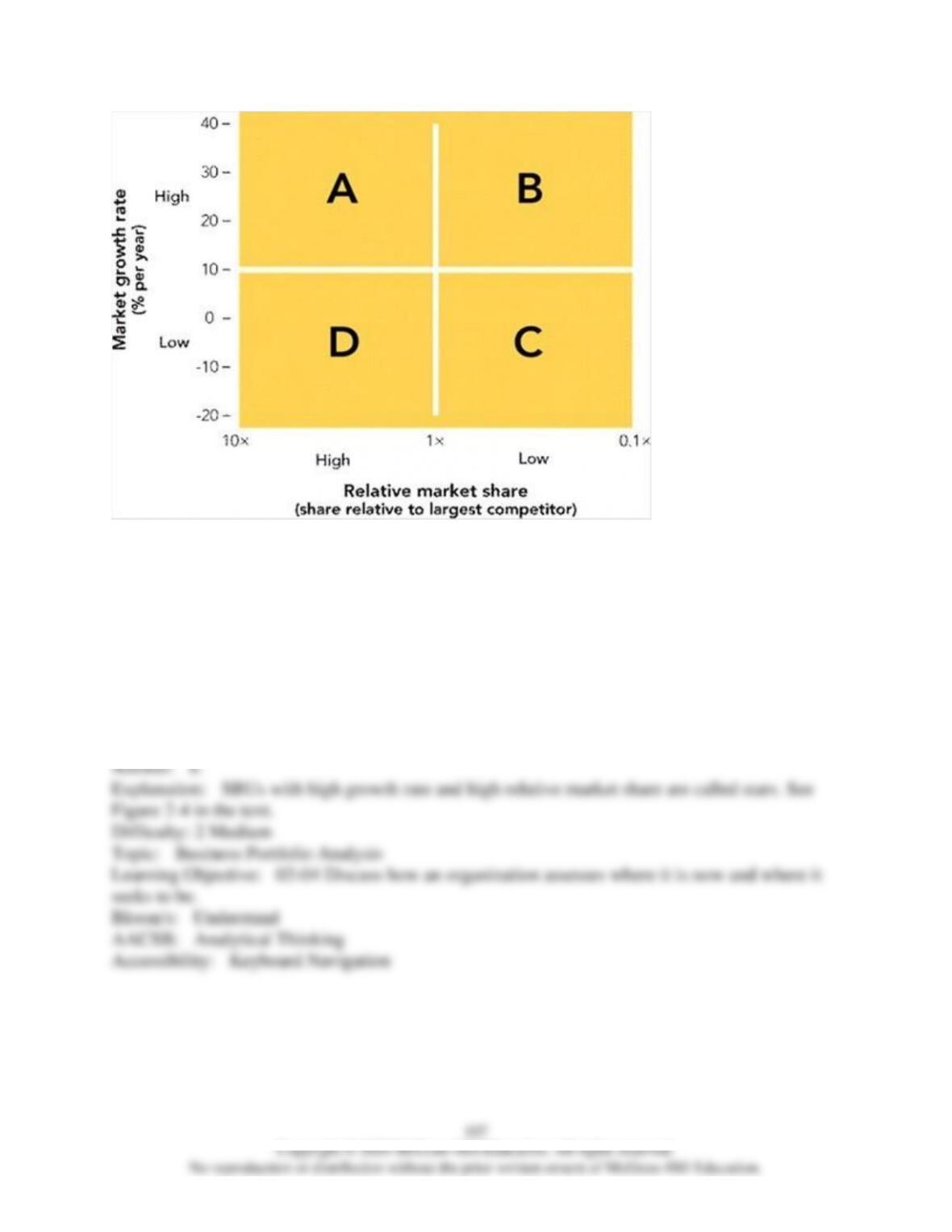
Figure 2-4
198) In Figure 2-4, a representation of the BCG business portfolio analysis, SBUs found in
quadrant A would be called
A) cash cows.
B) question marks.
C) dogs.
D) hedgehogs.
E) stars.

199) In Figure 2-4, a representation of the BCG business portfolio analysis, SBUs found in
quadrant B would be called
A) cash cows.
B) stars.
C) question marks.
D) dogs.
E) hedgehogs.
200) In Figure 2-4, a representation of the BCG business portfolio analysis, SBUs found in
quadrant C would be called
A) cash cows.
B) stars.
C) question marks.
D) dogs.
E) hedgehogs.
201) In Figure 2-4, a representation of the BCG business portfolio analysis, SBUs found in
quadrant D would be called
A) cash cows.
B) stars.
C) question marks.
D) dogs.
E) hedgehogs.
202) To move an SBU from its current position on a BCG business portfolio analysis, a manager
should concentrate mostly on
A) influencing the relative market share.
B) enhancing employee motivation to move a low-valued SBU to a higher one.
C) adding a variety of new SBUs that will force out older ones.
D) influencing the market growth rate.
E) simplifying its offerings by removing features.
203) Because an organization has limited influence on market growth rate, its main alternative
for moving an SBU on the portfolio analysis matrix is to try to change its relative market share.
The most likely way for a company to turn a question mark into a star rather than a dog is to
A) divert funds to other SBUs.
B) reduce advertising for it.
C) inject cash into it.
D) reduce the feature set for it.
E) decrease the market growth rate.
204) With the arrival of tablet devices, such as Apple’s iPad in 2010, growth in the global PC
industry slowed considerably and actually saw negative growth by 2015. If a firm offering a
range of PCs had slightly increased its global unit market share of PC sales from 10 to 12 percent
but still was not the industry leader, the company should be concerned that this product is a
A) question mark.
B) star.
C) hedgehog.
D) cash cow.
E) dog.
205) Apple entered the music player market in 2001 with its iPod device, selling more that 50
million units annually until 2007, when the iPhone integrated a mobile phone with a music
player. Since 2010, iPod sales have been declining dramatically. In 2014 Apple announced that it
was discontinuing the iPod classic, and in 2017 it announced that it was discontinuing the iPod
shuffle and nano. Today Apple still sells the iPod touch, although declining sales and
discontinued products suggest that this SBU appears to be a
A) question mark.
B) star.
C) hedgehog.
D) cash cow.
E) dog.
206) Apple recently launched its revolutionary Apple watch as the first wearable technology that
used a multitouch user interface. Industry analysts estimate that Apple’s annual unit sales reached
18 million in 2017 and will reach 45 million watches in 2019, suggesting a 58 percent growth
rate. The Apple watch entered the market as a
A) question mark.
B) raptor.
C) hedgehog.
D) cash cow.
E) dog.
207) Apple launched its revolutionary iPhone smartphone in 2007. iPhone unit sales skyrocketed
and Apple’s U.S. market share is now greater than 44 percent, exceeding the market share of its
largest competitor, Samsung. The smartphone market is expected to grow at an annual rate of 7
percent due to growth in India, Indonesia, and Africa. Currently, Apple’s iPhone SBU appears to
be a
A) question mark.
B) star.
C) hedgehog.
D) cash cow.
E) dog.
208) One of the strengths inherent in the use of the BCG business portfolio analysis is that it
A) is based solely on company perception rather than actual data.
B) considers all factors that might impact an SBU’s value to an organization.
C) acts as a strong motivational tool for employees in SBUs that have been labeled “dogs” or
“question marks.”
D) forces a firm to place each of its SBUs in the growth-share matrix, which in turn suggests
which SBUs will be cash producers or cash users in the future.
E) identifies specific marketing strategies and marketing tactics on how to solve SBU
shortcomings.
209) One of the weaknesses inherent in the use of the BCG business portfolio analysis is that it
A) causes dissension between different divisions when one is labeled a “star” and another a
“dog.”
B) reduces employee motivation to move a low valued SBU to a higher one.
C) considers too many SBU factors beyond market growth rate and relative market share.
D) does not require sales forecasts in order to be implemented.
E) is often difficult to obtain the needed information to correctly place SBUs in the matrix.
210) A technique that helps a firm search for growth opportunities from among current and new
markets as well as current and new products is referred to as
A) diversification analysis.
B) business portfolio analysis.
C) a market-product grid framework.
D) synergy analysis.
E) market segmentation.
211) Diversification analysis refers to
A) a technique that seeks opportunities by finding the optimum balance between marketing
efficiencies versus R&D-manufacturing efficiencies.
B) a framework to relate the market segments of potential buyers to products offered or potential
marketing actions by an organization.
C) a technique that helps a firm search for growth opportunities from among current and new
markets as well as current and new products.
D) a technique used to determine the appeal of each SBU or offering and then the amount of
cash, if any, each should receive.
E) a framework that identifies four “generic” strategies to achieve a competitive advantage.
212) Which of the following statements regarding diversification analysis is most accurate?
A) Companies should only use diversification analysis if they are well-established; new
companies that use this process run the risk of trying to do too much too soon.
B) For any product, there is both a current and a new market; for any market, there is both a
current and a new product.
C) Most companies discover that there is at least one product that is targeted to the wrong
market.
D) Diversification analysis is only effective for consumer products.
E) Diversification analysis is used to forecast and calculate industry sales for new products.

213) A marketing strategy to increase sales of current products in current markets is referred to
as
A) market penetration.
B) market development.
C) product development.
D) diversification.
E) marketing synergy.
214) Market penetration refers to the marketing strategy of
A) selling current products to new markets.
B) selling new products to new markets.
C) selling new products to current markets.
D) selling the same brands in both current and new markets.
E) increasing sales of current products in current markets.
215) One way a company can benefit from implementing a market penetration strategy would be
to
A) sell more products at a lower price in new markets.
B) sell the same amount of product at a higher price in the same market.
C) find a new market and sell the product at a much higher price.
D) alter the product and sell it to a new market.
E) reduce promotion and distribution costs to improve production efficiencies for the product in
reaching new markets.
216) When using a ________ strategy, there is no change in either the basic product line or the
markets served. Instead, increased sales are generated by selling either more products through
better promotion or distribution or the same number of products at a higher price.
A) product development
B) market development
C) diversification
D) market saturation
E) market penetration
217) If Ben & Jerry’s sold more units of its Chocolate Chip Cookie Dough super premium ice
cream to U.S. consumers as a result of increased promotion while keeping its price per pint the
same, it would be using a ________ strategy.
A) product development
B) market development
C) market penetration
D) diversification
E) market saturation
218) If sales revenues for Starbucks VIA Ready Brew instant coffee sold to U.S. consumers
increased as a result of a slight price increase of $0.25 per pack, it would be using a ________
strategy.
A) product development
B) market development
C) market penetration
D) diversification
E) market saturation

219) The marketing strategy to sell current products to new markets is referred to as
A) market penetration.
B) market infiltration.
C) market development.
D) product development.
E) diversification.
220) Market development refers to the marketing strategy of
A) increasing sales of current products in current markets.
B) selling new products to new markets.
C) selling new products to current markets.
D) selling the same brands in both current and new markets.
E) selling current products to new markets.

221) If Ben & Jerry’s starts selling its super premium ice cream in Brazil for the first time, it will
be using a ________ strategy.
A) product development
B) market development
C) diversification
D) market saturation
E) market penetration
222) Part of the growth strategy for Yum! Brands, the parent company of KFC, Pizza Hut, and
Taco Bell, is expansion of its current fast-food businesses into untapped international markets,
such as China, Russia, and India. This type of expansion would be a ________ strategy.
A) product development
B) market penetration
C) diversification
D) market development
E) market saturation

223) The marketing strategy of selling new products to current markets is referred to as
A) product penetration.
B) product development.
C) market development.
D) diversification.
E) market penetration.
224) Product development refers to the marketing strategy of
A) increasing sales of current products in current markets.
B) selling current products to new markets.
C) selling new products to new markets.
D) selling new products to current markets.
E) selling the same brands in both current and new markets.