Imagine you’re planning an after-symphony fund-raising party, and you need a life-size grand piano
cake. Or, you are a developer proposing a new shopping center to a group of investors, and you want
to serve a cake shaped like an architectural rendition of the center. Is this impossible? No, you just
need to contact Cecilia Villaveces Cakes. She actually built a life-size grand piano for a gala in Macon,
Georgia. You can expect to pay anywhere from $75 to $10,000 for one of Cecilia’s artistic creations,
depending on complexity of design and size. She uses only the best ingredients, and no two cakes are
ever quite alike.
113. Refer to Specialty Cakes. Although many factors determine the prices charged by Cecilia Villaveces
Cakes, the two primary determinants are:
a.
costs of manufacturing and distribution costs
b.
stage of the product life cycle and costs to the consumers
c.
the demand for the good and cost to the seller
d.
demand by the consumer and perceived quality
e.
distribution and promotion strategies used by the cake maker
114. Refer to Specialty Cakes. Many party planners in the Southeast will only use Cecilia Villaveces Cakes
at their parties—no matter what the price is. They know that Cecilia’s cakes can make a party a
success. Moreover, the cakes are what people remember most about the parties. From this description,
you should assume Cecilia Villaveces Cakes have a(n):
a.
elastic demand
b.
unitary elasticity
c.
inelastic supply
d.
inelastic demand
e.
elastic supply
115. Refer to Specialty Cakes. Which of the following is the BEST example of a fixed cost for Cecilia
Villaveces Cakes?
a.
Eggs, butter, sugar
b.
Delivery costs
c.
Part-time employees
d.
Electricity consumption
e.
Food preparation licenses
116. Refer to Specialty Cakes. Which of the following is the BEST example of a variable cost for Cecilia
Villaveces Cakes?
a.
Life insurance on Cecilia
b.
Flour and sugar
c.
Ovens used for cooking cakes
d.
Business license
e.
Interest payment to the bank
117. Refer to Specialty Cakes. To set the price of her cakes, Cecilia simply doubles her costs, which often
include several hours of labor and expensive raw materials. This method of price setting is called:
a.
mark-on pricing
b.
premium pricing
c.
keystoning
d.
add-on pricing
e.
superimposed pricing
118. Refer to Specialty Cakes. There are many occasions for which people may need to buy a cake, but
most people do not have the time or interest to learn about cakes and their bakers. These people who
do not know about the quality of the Cecilia Villaveces Cakes might choose them because they:
a.
equate price and quality
b.
know cakes are in the mature stage of their product life cycle
c.
realize that this is a monopolistic industry
d.
believe there is not a relationship between price and quality
e.
desire value-added services
The American Girl catalog began as a concept to introduce today’s girls to girls who lived in the past.
Each historically accurate doll is carefully crafted and dressed and has books to describe her life. For
example, Kristen is an 1854 pioneer girl who is growing up in Minnesota. Her story begins with her
long sea voyage from Sweden. The basic doll dressed in a calico dress and striped apron plus the
hardcover story of how she got to Minnesota costs $90. Six more hardback books of Kristen’s life are
available for $74.95. Kristen’s nightgown costs $20, and a matching one for the doll owner is an
additional $38. Buy both together and the price is only $50. A hand-painted wooden bed and trunk for
Kristen are available for $213. Shipping costs vary with the price of the merchandise ordered.
119. Refer to the American Girl Doll. What is the revenue to American Girl if it sells 20 basic Kristen doll
and books?
a.
$90.00
b.
$100.95
c.
$427.95
d.
$1,800.00
e.
$3,600
120. Refer to the American Girl Doll. American Girl is the primary seller of historically accurate dolls with
accompanying books in a market where there is very little competition. It has no cash flow problems
and is not interested in maximizing its sales. From this information, you should know American Girl
has _____ pricing objectives.
a.
status quo
b.
psychological
c.
profit-oriented
d.
sales-oriented
e.
supply-derived
121. Refer to the American Girl Doll. The popularity of the American girl dolls is so great that an increase
in the price of the basic Kristen doll and books by 5 percent will not significantly affect the demand for
the product. The means that the demand for the American Girl doll is:
a.
elastic
b.
derived
c.
a multiplier
d.
inelastic
e.
symmetrical
122. Refer to the American Girl Doll. Based on the information in the narrative above, which of the
following factors is most likely to affect the elasticity of demand for the doll?
a.
the absence of substitutes
b.
the existence of complementary products
c.
the price relative to purchasing power
d.
product durability
e.
a variety of alternative uses for the product
123. Refer to the American Girl Doll. In terms of the costs of producing the doll and its accessories, the
salary of the graphic designer who does the layout for the American Girl catalog is a(n):
a.
markup cost
b.
variable cost
c.
fixed cost
d.
derived cost
e.
elastic cost
124. Refer to the American Girl Doll. In terms of producing the doll and its accessories, the calico fabric
used to make Kristen’s dress is an example of a(n):
a.
markup cost
b.
variable cost
c.
fixed cost
d.
derived cost
e.
elastic cost
125. Refer to the American Girl Doll. You can buy a doll at Walmart for $5.99. The high price of the
American Girl doll is used to promote a high-quality image. The American Girl uses a _____ pricing
strategy.
a.
markup
b.
demand-based
c.
prestige
d.
penetration
e.
supply-derived
At first glance there is little to like about the durian. The durian is a fruit popular in Thailand that is
spiky outside and stinky on the inside. When confronted with the durian for the first time, the Wall
Street Journal recently reported that westerners often describe its distinctive sulphurous smell with
words like stinky socks and manure. However, the durian is so popular in Thailand that one variety of
the durian fruit, called the Kan Yao, has been selling for as high as $200. Even at that price, supply of
the Kan Yao cannot keep up with demand. There are approximately 30 varieties of the durian grown in
Thailand, with the most plentiful selling in the $15 range. The yellow flesh of the durian, the part you
eat, has very powerful smell, but possesses a sweet, nutty taste that Thais cannot seem to get enough of
at any price.
126. Refer to Smelly Fruit. If it cost a Thai farmer $100 to produce and $25 to market the Kan Yao durian
that she sells for $200 at the marketplace, her revenue would be _____.
a.
$125
b.
$200
c.
$25
d.
$100
e.
$325
127. Refer to Smelly Fruit. Suppose a Thai farmer sells ten Kan Yao durians in the marketplace at the going
rate of $200 each. If it cost a Thai farmer $125 to produce and market the Kan Yao durian that she has
sold, the difference between these two numbers ($75), times the number sold (ten), represents the
farmer’s:
a.
ROI
b.
revenue
c.
profit
d.
returns
e.
COGS
128. Refer to Smelly Fruit. Suppose you have decided to buy land in Thailand and become a durian
producer. You see that the customary price for a Kan Yao is $200, so that is the price you decide to
charge for your durian crop. This suggests you are using a _____ approach to setting your price.
a.
profit maximization
b.
market share
c.
return on investment (ROI)
d.
sales maximization
e.
status quo
129. Refer to Smelly Fruit. At $200 per Kan Yao demand for the fruit appears to be higher than supply.
Suppose at a price of $225, the amount demanded exactly meets the amount farmers are willing and
able to supply. In this case the $225 price would be considered the _____ price.
a.
price equilibrium
b.
sales maximization
c.
profit maximization
d.
ROI maximization
e.
yield management
130. Refer to Smelly Fruit. Over the past two years the price for Kan Yao durian fruit has increased by 50
percent. If the amount sold has remained almost constant, we would say that demand is:
a.
elastic
b.
inelastic
c.
unitary
d.
highly elastic
e.
moderately elastic
131. Refer to Smelly Fruit. The durian fruit is a very unique product. To many Thai’s no other fruit taste or
smells anything like the durian. Its uniqueness, in the eyes of the customer, would tend to have which
of the following?
a.
It would have little effect.
b.
It would tend to make the durian more price elastic.
c.
It would tend to make the durian more price inelastic.
d.
It would tend to raise the price in comparison to purchasing power.
e.
It would tend to impact the durian’s stage in the PLC.
ESSAY
1. Define price and discuss the two roles price plays in the evaluation of product alternatives.
2. One of the most stressful and pressure-filled tasks of the marketing manager is attempting to set the
right price. Specify three aspects of the current pricing environment in consumer markets that have
contributed to the difficulty in setting correct prices.
3. List the three categories of pricing objectives and then two specific strategies in each category that a
marketer could implement to achieve those objectives.
4. Last quarter Abingdon Company sold 1,000 decorative decals for $1 each, Cedar Decaliania sold 200
decorative decals at $4 each, Creative Decals sold 500 decals at $2 each, and Donnelly, Inc. sold 300
decals for $4 apiece. Assuming the four companies are the only firms competing in the decorative
decal market, calculate unit and dollar market share for each company for last quarter. For each
company, which market share figure might be used in an advertisement for that company?
5. List the two primary determinants of price. What other factors can affect price setting?
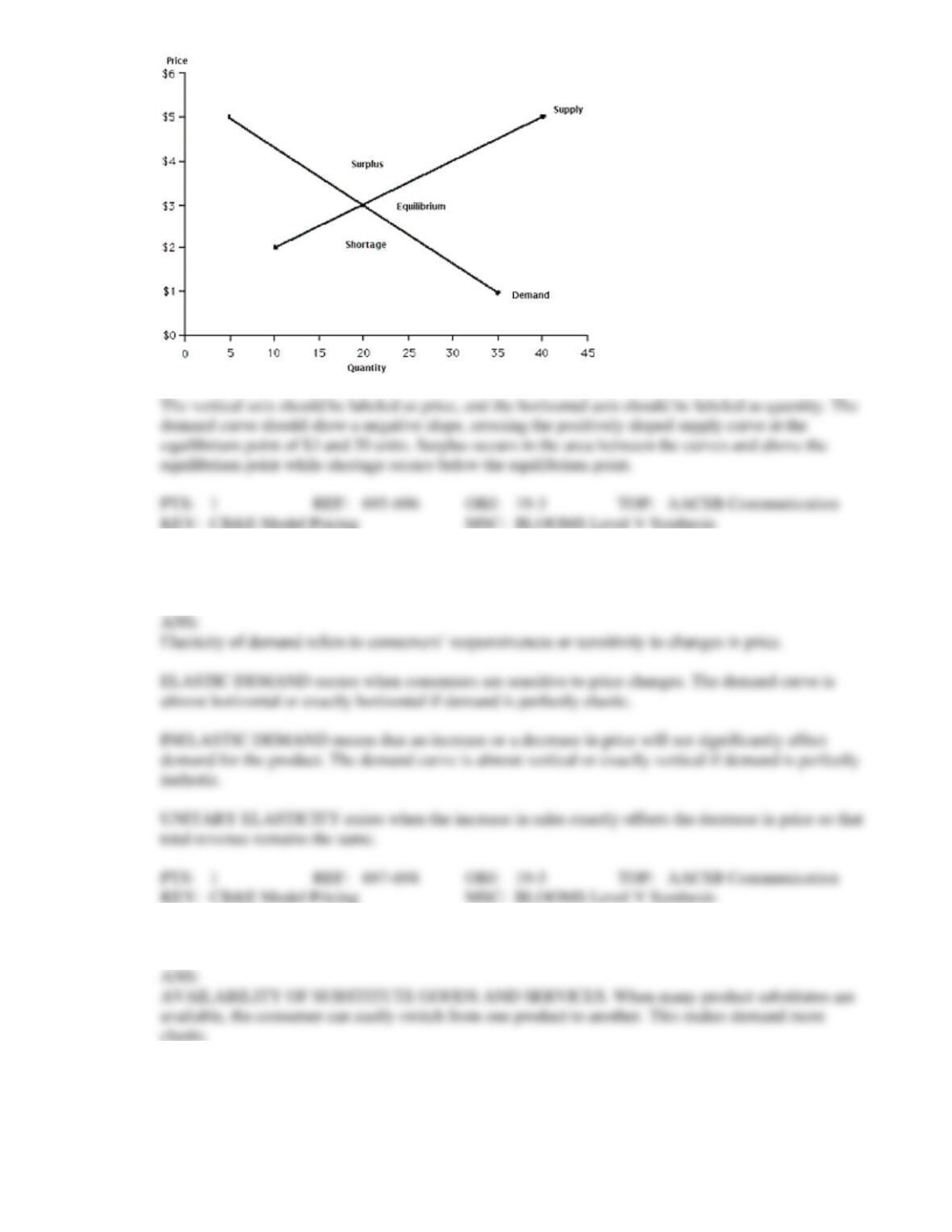
6. The daily demand for bottled water is 35 bottles when the price is set at $1. However, if the price is
raised to $5, the demand is only 5 bottles. The bottled water producer is willing to supply 40 bottles if
the price is set at $5 per bottle, but will only supply 10 bottles if the price is set at $2. Draw the supply
and demand curves for the water bottles on the graph below. Label each curve and each axis. At what
level does equilibrium occur? What are the areas of surplus and shortage?
7. Define elasticity of demand and compare and contrast the three types of demand: elastic, inelastic, and
unitary. What would the demand curve for elastic and inelastic demand look like when graphed?
8. List five factors that affect elasticity of demand and briefly describe how each affects demand.
9. Explain yield management systems (YMS) and discuss the types of industry were they are most
appropriate.
10. What are the problems associated with the use of a cost-based pricing strategy? What contribution
does cost make to the setting of prices?
11. What is the difference between fixed and variable costs? Give examples of each type of cost.
12. Calculate answers for the following scenarios if retailer markups are based on their selling price:
a)
A retailer sells a set of measuring cups for $2.50 after adding $.50 to the original cost. What
is the markup percentage?
b)
The cost of a food blender for the retailer is $40 and the retailer applies a markup of $60.
What is the retail markup percentage?
c)
A retailer marks up all products by 20 percent. If a set of glasses costs the retailer $10, what
will the final selling price be?
d)
A retailer marks up all products by 75 percent. If the selling price of a set of plastic bowls is
$4, what was the cost to the retailer?
Dollar markup selling price = percent markup
$0.50 $2.50 = 20%
b)
Selling price = (dollar markup + cost)
Dollar markup selling price = percent markup
$60 ($60 + $40) = 60%
Dollar markup = (selling price – cost)
(Selling price – cost) selling price = percent markup
(S – $10) S = .20
(S – $10) = .20S
$10 = .80S
Selling price = $12.50
d)
(Selling price – cost) selling price = percent markup
($4 – C) $4 = .75
($4 – C) = (.75 $4)
C = $4 – $3 = $1
13. What is marginal revenue? Based on the provided schedule from the Chesapeake Bay Swing
Company, at which quantity should Chesapeake Bay stop producing additional swings?
Quantity
Marginal Revenue
Marginal Cost
Total Profit
1
$260
$160
$200
2
110
140
270
3
190
120
340
4
170
140
370
5
160
160
370
6
150
180
340
7
120
220
240
14. What is a break-even point? The Catera Company makes and sells cotton candy machines. What is the
break-even volume for Catera machines in units?
Catera Machines Financial Information
Salesperson salary
$ 40,000
Advertising
100,000
Research and development
20,000
Production equipment
20,000
Overhead allocation
20,000
Catera’s selling price
$600
Average variable cost
$350
15. Name two advantages and two disadvantages associated with the use of break-even analysis.
16. As a product moves through its life cycle, the demand for the product and the competitive conditions
tend to change. For each stage in the product life cycle, discuss pricing strategies appropriate for that
stage.
17. How does price interact with the other three Ps of the marketing mix?
18. Research on 1,500 car purchases found that the Internet lowers prices for two distinct reasons. Identify
and discuss each.
19. Discuss how consumers use the price-quality relationship to evaluate goods and explain how marketers
can take advantage of this consumer response.