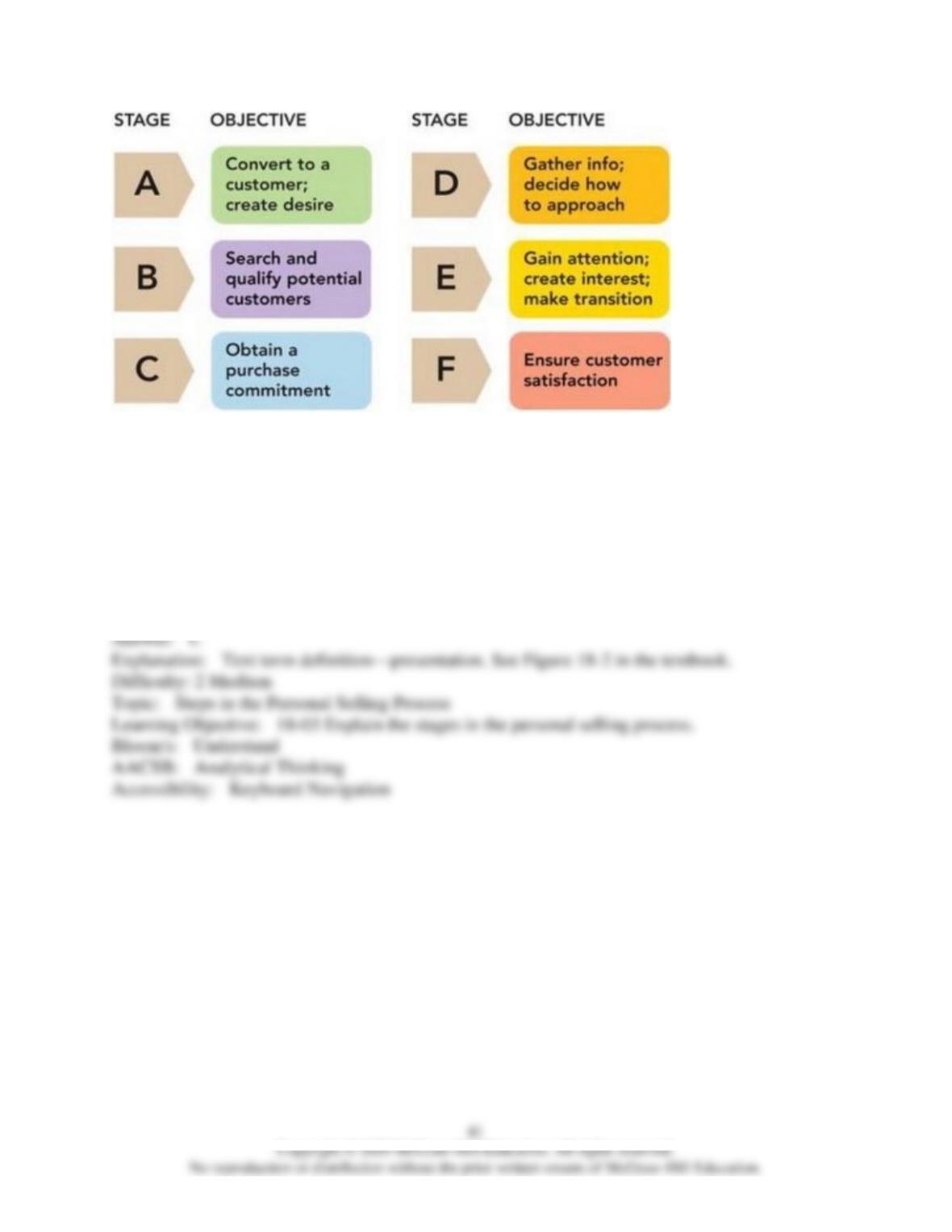
Figure 18-2
80) As shown in Figure 18-2 above, Box A is the ________ stage in the personal selling process.
A) approach
B) preapproach
C) presentation
D) prospecting
E) follow-up

81) As shown in Figure 18-2 above, B is the ________ stage in the personal selling process.
A) presentation
B) approach
C) prospecting
D) follow-up
E) preapproach
82) As shown in Figure 18-2 above, C is the ________ stage in the personal selling process.
A) approach
B) close
C) follow-up
D) prospecting
E) preapproach
83) As shown in Figure 18-2 above, D is the ________ stage in the personal selling process.
A) follow-up
B) prospecting
C) presentation
D) preapproach
E) approach

84) As shown in Figure 18-2 above, E is the ________ stage in the personal selling process.
A) close
B) preapproach
C) follow-up
D) presentation
E) approach
85) As shown in Figure 18-2 above, F is the ________ stage in the personal selling process.
A) presentation
B) follow-up
C) preapproach
D) close
E) approach
86) The salesperson’s objective is to search for and qualify potential customers during which
stage in the personnel selling process?
A) presentation
B) approach
C) prospecting
D) follow-up
E) preapproach
87) The salesperson’s objective is to gather information and decide how to approach the prospect
during which stage in the personnel selling process?
A) follow-up
B) prospecting
C) presentation
D) preapproach
E) approach
88) The salesperson’s objective is to gain a prospect’s attention, stimulate interest, and make a
transition to the presentation during which stage in the personnel selling process?
A) presentation
B) follow-up
C) prospecting
D) preapproach
E) approach
89) The salesperson’s objective is to begin converting a prospect into a customer by creating a
desire for the product or service during which stage in the personnel selling process?
A) approach
B) preapproach
C) presentation
D) prospecting
E) follow-up
90) The salesperson’s objective is to obtain a purchase commitment from the prospect and create
a customer during which stage in the personnel selling process?
A) preapproach
B) close
C) follow-up
D) approach
E) presentation
91) The salesperson’s objective is to ensure that the customer is satisfied with the product or
service during which stage in the personnel selling process?
A) follow-up
B) prospecting
C) presentation
D) preapproach
E) close

92) Personal selling begins with the ________ stage.
A) lead
B) presentation
C) preapproach
D) prospecting
E) introduction
93) The search for and qualification of potential customers during the personal selling process is
referred to as
A) prospecting.
B) customer mining.
C) lead initiation.
D) cold calling.
E) filtering.
94) What are the three types of prospects in personal selling?
A) leads, prospects, and buyers
B) leads, prospects, and qualified prospects
C) cold, warm, and hot
D) awareness, trial, and adoption
E) primary leads, secondary leads, and final leads
95) In personal selling, an individual who may be a possible customer is referred to as
A) an “A” list.
B) a cold call.
C) a lead.
D) a prospect.
E) a qualified prospect.

96) In personal selling, the customer who wants or needs the product is referred to as a
A) hot lead.
B) cold call.
C) lead.
D) prospect.
E) qualified prospect.
97) In personal selling, a ________ is an individual who wants a product, can afford to buy it,
and is the decision maker.
A) qualified prospect
B) customer
C) lead
D) prospect
E) gatekeeper
98) Which of the following statements describes the major difference between a prospect and a
qualified prospect?
A) Prospects are more likely than qualified prospects to become customers.
B) During the sales presentation, prospects are more likely to raise objections than qualified
prospects.
C) There are generally more qualified prospects than prospects.
D) Qualified prospects have not only the need or desire for your product, but also the ability and
authority to purchase it.
E) A qualified prospect has purchased your product in the past and a prospect has not.
99) Alice Faulkner is a professional salesperson. She earns her living by selling advertising for
The New York Times newspaper. In addition to selling advertising to her regular accounts,
Faulkner is responsible for generating new advertising accounts for the newspaper. In order to
fulfill her responsibilities, Faulkner works hard to make sure the potential customers she sells to
are qualified prospects. How can Faulkner know if the prospects she is selling to are in fact
qualified prospects?
A) Qualified prospects have heard of and now have an interest in buying advertising in the
newspaper.
B) Qualified prospects are part of an industry that buys advertising in the newspaper.
C) Qualified prospects have a need for the advertising, can afford to buy it, and have the
authority to make the purchase decision.
D) Qualified prospects will participate in the decision to buy the advertising as part of a cross-
functional team.
E) Qualified prospects read the newspaper daily and recognize that it is a good advertising
medium.
100) All of the following tactics are used to generate leads except which?
A) cold canvassing
B) suggestive selling
C) toll-free numbers
D) coupons
E) trade shows
101) Advertising with a coupon, using a toll-free number, exhibiting at trade shows, using email,
and making cold calls are all activities that would take place during the ________ stage of the
personal selling process.
A) data mining
B) preapproach
C) approach
D) presentation
E) prospecting

102) A method of selling in which a salesperson makes a telephone call or a visit to a prospective
customer without a referral is called
A) team selling.
B) cold calling.
C) hot canvassing.
D) formula selling.
E) telemarketing.
103) Another name for cold calling is
A) cold canvassing.
B) telemarketing.
C) hot canvassing.
D) missionary selling.
E) trial close selling.
104) Which of the following statements regarding cold canvassing is most accurate?
A) Currently, there are no federal regulations regarding cold canvassing.
B) Finding a list to use for cold canvassing is its biggest challenge.
C) Cold calling is the most common type of sales prospecting in Asia and Latin America.
D) The majority of U.S. consumers consider cold canvassing an intrusion on their privacy.
E) The Telephone Consumer Protection Act ensures the rights of telemarketers to call anyone
listed in a public directory, whether they choose to be called or not.
105) Russ Berry Co. is a company that makes gifts and collectibles. When its southeastern sales
representative is driving through a community on her way to make a sales call, she looks for
small independent florists and gift shops. When she finds a retailer she knows is not carrying
Russ products, she stops and makes a sales call. The company’s sales rep uses ________ to find
its prospects.
A) stimulus-response selling
B) order taking
C) cold canvassing
D) formula selling
E) telemarketing
106) Mark wanted to make some extra money, so he went door-to-door in his neighborhood
asking residents if they had any small jobs that they could hire him to perform. Mark had no idea
of whether anyone had work for him, so he picked the houses randomly and knocked on the
doors to see if anyone was home and perhaps interested in his services. In terms of the personal
selling process, Mark was engaged in
A) stimulus-response selling.
B) showrooming.
C) cold canvassing.
D) closing.
E) traffic generation.
107) Federal regulations contain provisions that allow consumers to avoid being called at any
time through the ________ and impose fines for violations.
A) Do Not Disturb Registry
B) Do Not Call Registry
C) Do Not Interrupt Registry
D) Do Not Infringe Registry
E) Do Not Agitate Registry
108) In the personal selling process, a telemarketer for a life insurance firm who calls and asks
the head of the household, “If you were to die tomorrow, would your family be cared for?” is
engaged in
A) stimulus-response selling.
B) closing the sale.
C) prospecting.
D) order taking.
E) creating a preapproach.
109) Encyclopedia Britannica used to pay to have a business reply card bound into magazines
adjacent to its advertisement. The ad asks people to return the card for more information on how
its encyclopedias can help children do better in school. Encyclopedia Britannica was engaged in
A) cold canvassing.
B) order taking.
C) sales follow-up.
D) stimulus-response selling.
E) prospecting.
110) At which stage in the personal selling process would the salesperson obtain further
information about the prospect and decide on the best method of contact?
A) prospecting
B) preapproach
C) approach
D) presentation
E) close
111) What would most likely occur at the preapproach stage in a business selling situation?
A) The order getter would make initial contact with the order taker.
B) The search for and qualification of prospects would begin.
C) The initial meeting would transpire and business would be concluded.
D) A decision would be made concerning whether the sale would be a straight rebuy, a modified
rebuy, or a new buy.
E) The prospect’s buying role, important buying criteria, and receptivity to a presentation would
be determined.
112) Identifying the buying role of the prospect would be typically done at the ________ stage of
the personal selling process.
A) prospecting
B) preapproach
C) approach
D) presentation
E) closing
113) During the ________ stage of personal selling, a salesperson would learn if her prospect
liked to talk about sports before getting down to business or preferred not to waste time with idle
chatter.
A) prospecting
B) preapproach
C) approach
D) presentation
E) closing
114) The preapproach stage of the personal selling process is especially important in
A) international sales.
B) government sales.
C) high-technology product sales.
D) high-ticket item sales.
E) the sale of services.
115) Which of the following statements regarding the preapproach stage with respect to
international selling is most accurate?
A) The preapproach protocol is standardized in most areas of the world.
B) The preapproach stage is shorter and less intensive abroad than with domestic consumers.
C) Customs are very important in dictating appropriate protocol.
D) In most cases, the buyer rather than the seller initiates the contact between seller and buyer
internationally.
E) Pricing or price ranges are presented to the customer in order to determine if the customer is a
qualified lead in most countries.
116) At the ________ stage in the personal selling process, a salesperson gains a prospect’s
attention, stimulates interest, and builds the foundation for the sales presentation itself.
A) approach
B) prospecting
C) preapproach
D) qualifying
E) trial close
117) In the ________ stage of the personal selling process, the first impression is critical.
A) prospecting
B) preapproach
C) approach
D) close
E) follow-up
118) In the ________ stage of the personal selling process, the cultural setting is very important
for international sales.
A) presentation
B) prospecting
C) preapproach
D) approach
E) close
119) In many societies outside the United States, considerable time is devoted to nonbusiness
talk designed to establish a rapport between buyers and sellers. This occurs during the ________
stage of the personal selling process.
A) close
B) approach
C) preapproach
D) presentation
E) prospecting