55) A ________ is a subset of the ________.
A) universe; population
B) population; sample
C) sample; population
D) population; universe
E) universe; sample
56) When a researcher selects the most accessible population members from whom to obtain the
information, this is considered a ________.
A) simple random sample
B) convenience sample
C) judgment sample
D) cluster sample
E) quota sample
57) When a researcher divides the population into mutually exclusive groups (such as age
groups), then random samples are drawn from each group, this is known as a ________ sample.
A) simple random
B) quota
C) stratified random
D) cluster
E) systematic random

58) In a ________, every member of the population has a known and equal chance of being
selected.
A) simple random sample
B) judgment sample
C) convenience sample
D) systematic random sample
E) cluster sample
59) A researcher who was developing a segmentation strategy for a new online dating service
might collect ________, such as population statistics from the U.S. Census, then conduct a
________, such as a focus group, to gather information about the target populations attitudes and
concerns.
A) primary data; qualitative research
B) qualitative research; questionnaire
C) secondary data; quantitative research
D) qualitative research; secondary data
E) secondary data; qualitative research
60) Frequently, ideas stemming from ________ are tested empirically with a larger sample
through ________.
A) qualitative research; quantitative studies
B) quantitative research; qualitative studies
C) primary research; secondary data studies
D) quantitative research; complaint analysis studies
E) qualitative research; complaint analysis studies

61) In ________, the moderator-researcher usually analyzes the responses received, whereas in
________, the researcher supervises the analysis.
A) observational research; physiological research
B) quantitative research; qualitative research
C) qualitative research; quantitative research
D) physiological research; observational research
E) secondary research; primary research
62) Which of the following is NOT a part of a research report?
A) a brief executive summary of the findings
B) recommendations for marketing action
C) a full description of the methodology used
D) the results of the research efforts
E) All of the above are part of a research report.
63) In the COOKING OIL MINI CASE, the Value Mart focus group research format is best
described as a ________.
A) quantitative study
B) motivational study
C) behavioral study
D) descriptive study
E) qualitative study
64) In the COOKING OIL MINI CASE, the sales data collected from scanners at checkout
points constitutes ________.
A) external primary data
B) internal secondary data
C) mechanical primary data
D) internal primary data
E) external secondary data

65) In the COOKING OIL MINI CASE, the methodology used to collect sales data from
checkout scanners is known as ________.
A) physiological observation
B) metaphor analysis
C) focus group
D) mechanical observation
E) consumer profiling
66) In the COOKING OIL MINI CASE, the information collected in the Value Mart focus
groups constitutes ________.
A) primary data
B) commercial data
C) objective data
D) mechanical data
E) secondary data
67) In the COOKING OIL MINI CASE, after conducting its focus group, Value Mart decides to
try offering store-brand cooking oil in a limited geographical area to see how consumers will
respond to the new product. This is known as ________.
A) test marketing
B) surveying
C) mechanical observation
D) mystery shopping
E) probability sampling
68) In the PEN MINI CASE, test subjects were chosen based on their level of education and the
ages of their children. The sample used would be best described as a ________.
A) judgment sample
B) simple random sample
C) convenience sample
D) cluster sample
E) quota sample
69) In the PEN MINI CASE, the research study design is an example of ________.
A) physiological observation
B) mystery shopping
C) test marketing
D) metaphor analysis
E) mechanical observation
70) In the PEN MINI CASE, the manipulated treatment is ________.
A) the store environment
B) the product features
C) the product packaging
D) the product price
E) the advertising theme

71) In the PEN MINI CASE, subjects are asked: “What do you remember about the pen
advertisement you saw?” This is an example of a(n) ________.
A) metaphor analysis
B) open-ended question
C) word association
D) multiple choice question
E) closed-ended question
72) In the PEN MINI CASE, the study described is best characterized as a(n) ________.
A) consumer panel
B) qualitative study
C) secondary study
D) exploratory study
E) quantitative study
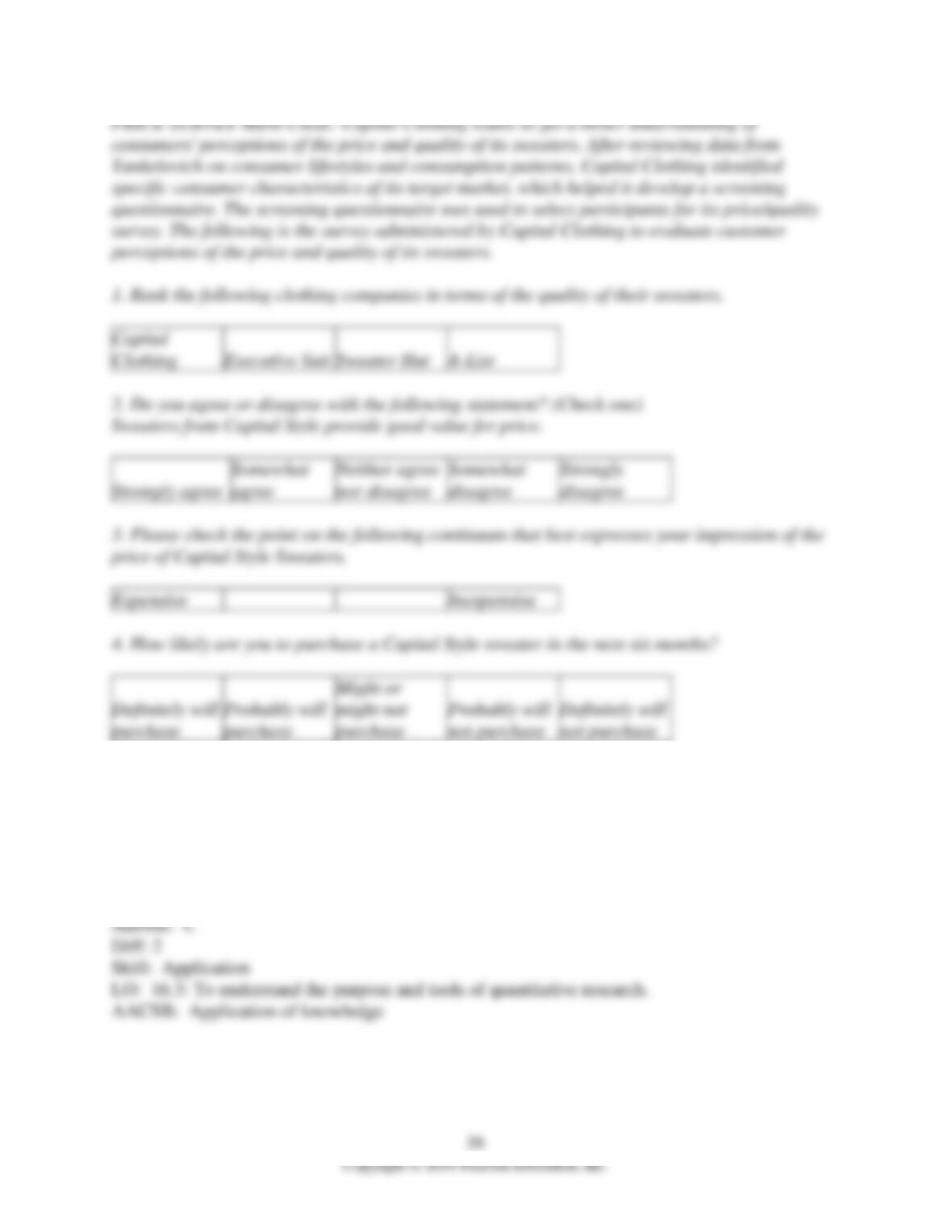
73) In the PRICE SURVEY MINI CASE, the screening questionnaire is developed based on
________ from Yankelovich.
A) internal secondary data
B) quantitative primary data
C) external secondary data
D) qualitative primary data
E) qualified primary data

74) In the PRICE SURVEY MINI CASE, question #1 measures response on a ________.
A) bipolar scale
B) Likert scale
C) rank order scale
D) behavior intention scale
E) semantic differential scale
75) In the PRICE SURVEY MINI CASE, question #2 measures response on a ________.
A) Likert scale
B) semantic differential scale
C) behavior intention scale
D) bipolar scale
E) rank-order scale
76) In the PRICE SURVEY MINI CASE, question #3 measures response on a ________.
A) Likert scale
B) bipolar preference scale
C) semantic differential scale
D) behavior intention scale
E) rank-order scale
77) In the PRICE SURVEY MINI CASE, question #4 measures response on a ________.
A) Likert scale
B) bipolar preference scale
C) semantic differential scale
D) behavior intention scale
E) rank-order scale

78) Consumers are always aware of their decisions and can rationalize their consumption
behaviors.
79) If samples are collected randomly from a population of interest, the results of quantitative
research can be generalized to larger populations.
80) Quantitative research is descriptive in nature and is used to understand the effects of various
promotional inputs on the consumer, making it easier to predict consumer behavior.
81) Qualitative research studies are conducted by highly trained interviewers who analyze the
findings; thus, the findings tend to be somewhat objective.
82) Focus groups and depth interviews are quantitative research methods.
83) Qualitative research findings are usually generalized to the larger population.

84) If the purpose of a study is to come up with ideas for the next Campbell’s soup ad campaign,
then a qualitative study is usually undertaken.
85) Qualitative research uses open-ended, unstructured questions, while quantitative research
uses closed-ended questions with pre-defined possible responses and open-ended questions that
have to be coded numerically.
86) When conducting a research study, primary data is collected before secondary data.
87) Drawn from internal secondary data, customer lifetime value profiles include customer
acquisition costs, the profits generated from individual sales to each customer, the costs of
handling customers and their orders, and the expected duration of the relationship.
88) Secondary data can be obtained more cheaply and quickly than primary data.
89) As consumers use more and more highly convenient technologies, it becomes harder and
harder for consumer researchers to gather electronic records of their consumption patterns.

90) Respondents are less willing to interact with an electronic voice than with a live interviewer
when conducting telephone surveys.
91) In order to increase the response rate to telephone surveys, researchers typically send
notification letters as well as follow-up letters.
92) A study is said to have validity if the same questions, asked of a similar sample, produce the
same findings.
93) People are most likely to take the time to respond to surveys if the questionnaires are
interesting, objective, unambiguous, and easy to complete.
94) Open-ended questions yield more insightful information but are more difficult to code and
analyze.
95) The sequence of questions in a questionnaire is not important.

96) When conducting focus groups, respondents are recruited on the basis of a randomly drawn
sample and are paid a fee for their participation.
97) Most unsatisfied customers complain to customer service and switch to competitors.
98) Interviewing the correct target market or potential target market is fundamental to the
reliability of the study.
99) Judgment samples are used to select population members who, according to the researcher,
are a good source for accurate information.
100) When designing questionnaires, research has shown that the more ambiguous the questions,
the more motivated the respondent will be to complete the questionnaire.
101) The larger the sample, the more likely the responses will reflect the total universe under
study.

102) The size of the sample is dependent both on the size of the budget and on the degree of
confidence that the marketer wants to place in the findings.
103) Marketers may use qualitative research findings to discover new ideas and develop
promotional strategies and quantitative research findings to estimate the extent or amount of
consumers who react in a particular way.
104) In marketing-oriented firms, consumer research is almost always composed of a single
study.
105) In both qualitative and quantitative research, the research report includes an executive
summary of the findings, a description of the methodology used, and recommendations for
marketing actions.
106) In quantitative research, the researcher usually analyzes the responses received. In
qualitative research, the responses are coded and analyzed statistically.
107) Differentiate between qualitative and quantitative research designs. What are the
differences between the two in terms of study purpose, data collection methods, and sampling
methods?
108) Identify and discuss the major steps in the consumer research process. Why is each step
important to the success of the process as a whole?
109) What is secondary data? Give an example of a set of secondary data, and name a source of
secondary data.
110) What is observational research, and why is it used?
111) Discuss the concepts of research validity and reliability.
112) Give an example of a research objective where qualitative research methods would be
appropriate to use.
113) Identify and discuss the elements of a good complaint analysis system.
114) Compare the advantages and disadvantages of mail, personal interview, and online
surveying in terms of cost, speed, and quality of response.
115) Give an example of a Likert scale that may appear on a study investigating online shopping.
116) What is the difference between probability samples and non-probability samples? Give an
example of each.