79) A virtual ________ is a social network of individuals who interact through user-to-user
communications hosted by a company to enhance customer experience and build a favorable
buyer-seller relationship.
A) village
B) community
C) district
D) area
E) population
80) In terms of the online customer experience, community refers to
A) an information system where anyone can post content depending upon his or her level of self-
disclosure.
B) websites that allow people to congregate in online chat rooms to exchange views on topics of
common interest.
C) a social network of individuals who interact through specific media, potentially crossing
geographical and political boundaries, in order to pursue mutual interests or goals.
D) user-to-user communications hosted by a company to enhance customer experience and build
favorable buyer-seller relationships.
E) a customer’s network of family, friends, acquaintances, and coworkers with whom he or she
communicates on regular basis.
81) The Harley Owners Group (HOG), sponsored by Harley-Davidson and supported by its
website, allows fellow HOG members to communicate with each other. Because it hosts HOG,
the Harley-Davidson website incorporates the ________ design element.
A) context
B) choice
C) community
D) convenience
E) connection
82) A website that provides the ability to conduct sales transactions for products and services
emphasizes the ________ design element.
A) commerce
B) context
C) community
D) content
E) connection
83) In terms of the online customer experience, commerce refers to
A) business-to-business only transactions made between a purchasing manager’s website and
websites from its suppliers.
B) Internet-based networks that permit communication between a company and its suppliers,
distributors, and other partners.
C) websites specifically designed for electronic funds transfer with banks and other institutions
such as PayPal.
D) the application of information and communication technologies in support of the firm’s entire
business activities.
E) the website’s ability to conduct sales transactions for products and services.
84) When Andrea visited www.disneystore.com, she looked at several different classic Winnie
the Pooh plush animals before she selected Piglet and Tigger and put them in her shopping cart.
She next went to checkout where she confirmed her purchase, typed in her address, and
concluded the transaction by providing her credit card information. In terms of customer
experience, this example describes the ________ website design element.
A) context
B) community
C) content
D) commerce
E) connection
85) Most websites do not include every design element. Websites that are used primarily for
advertising and promotion purposes emphasize the ________ and connection elements.
A) communication
B) customization
C) community
D) consent
E) commerce
86) Most websites do not include every design element. Although every website has ________,
they differ in the use of the remaining five elements.
A) content and commerce
B) commerce and customization
C) context and content
D) communication and community
E) context and connection
87) The amount of time per month that visitors spend on a company’s website is referred to as
A) visiting time.
B) stickiness.
C) staying power.
D) browsing time.
E) connectiveness.
88) To gauge stickiness, a company monitors
A) the average time it takes customers to make a purchase from the time they log on to a website
to the time they log off.
B) the average time it takes for customers to move from one page of a website to another.
C) the amount of time per month, in minutes, visitors spend on a company’s website.
D) the number of visits by a unique customer to the same website before an actual purchase is
made.
E) the total time, in hours and minutes, that it takes for a customer to make an online purchase.
89) To gauge stickiness, companies use the following formula
A) Average time spent per unique hourly visitor in minutes = (Average visits per unique hourly
visitor) × (Average time spent per visit in minutes).
B) Average time spent per unique daily visitor in minutes = (Average visits per unique daily
visitor) × (Average time spent per visit in minutes).
C) Average time spent per unique weekly visitor in minutes = (Average visits per unique weekly
visitor) × (Average time spent per visit in minutes).
D) Average time spent per unique yearly visitor in minutes = (Average visits per unique yearly
visitor) × (Average time spent per visit in minutes).
E) Average time spent per unique monthly visitor in minutes = (Average visits per unique
monthly visitor) × (Average time spent per visit in minutes).
90) Automobile dealerships have invested significant time, effort, and money in their websites.
Dealerships commonly measure website performance by tracking visits, visitor traffic, and
________, which refers to the amount of time per month that visitors spend on their websites.
A) stickiness
B) glueyness
C) gumminess
D) adhesiveness
E) connectiveness
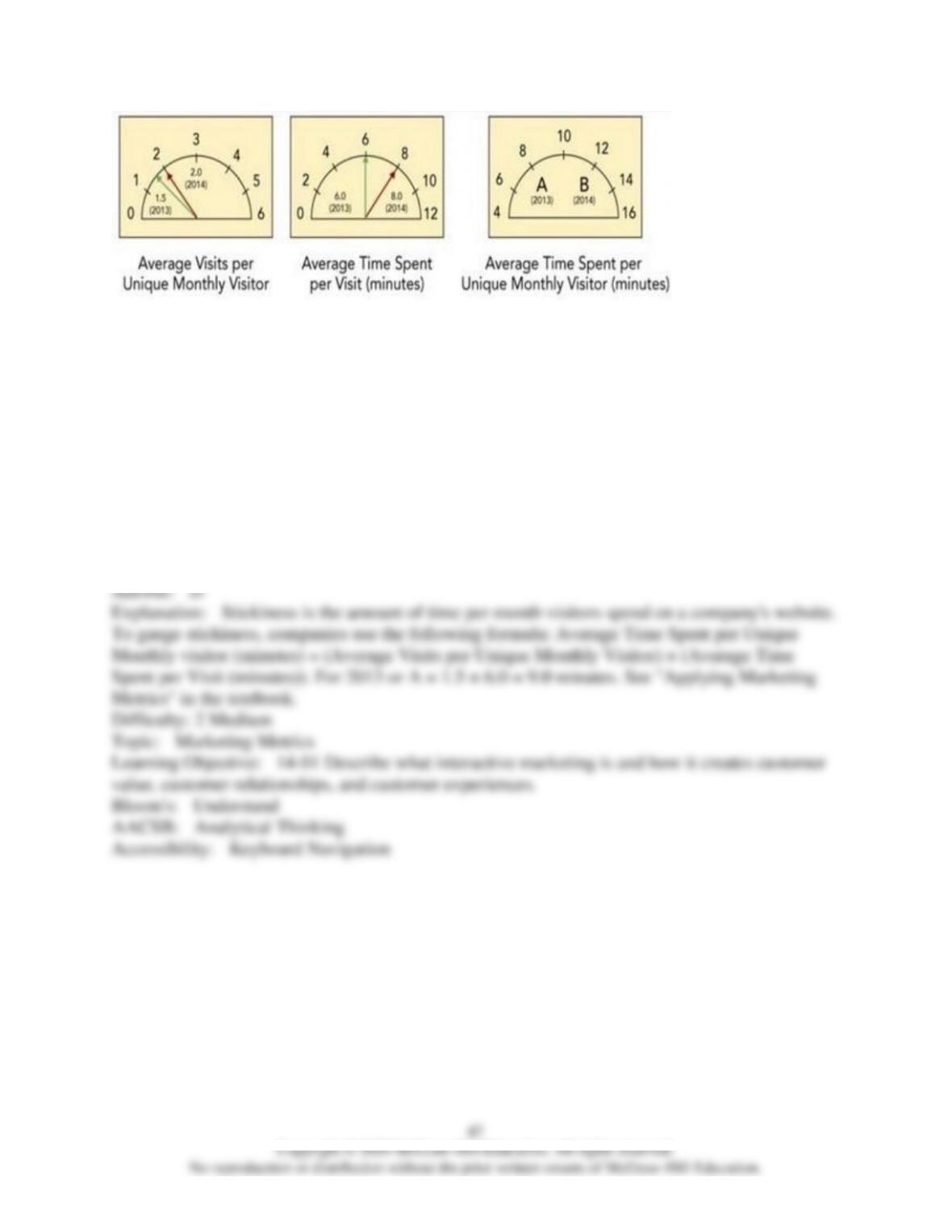
Stickiness Marketing Dashboard
91) Consider the Stickiness Marketing Dashboard above for an automobile dealership. To gauge
the stickiness of its website, the firm monitors several measures. For 2013, where would Arrow
A be shown, as the average time spent per unique monthly visitor (in minutes) on the automobile
dealership’s website?
A) 4.0 minutes
B) 4.5 minutes
C) 7.5 minutes
D) 9.0 minutes
E) cannot be determined
92) Consider the Stickiness Marketing Dashboard above for an automobile dealership. To gauge
the stickiness of its website, the firm monitors several measures. For 2014, where would Arrow
B be shown, as the average time spent per unique monthly visitor (in minutes) on the automobile
dealership’s website?
A) 4.0 minutes
B) 6.0 minutes
C) 10.0 minutes
D) 16.0 minutes
E) cannot be determined
93) The subsegment of all Internet users who employ this technology to research products and
services and make purchases is referred to as
A) digital consumers.
B) online consumers.
C) cyberspace consumers.
D) cross-channel consumers.
E) multichannel consumers.
94) Compared to the general population, online consumers tend to be
A) younger, more educated, more affluent, but equally likely to be male or female.
B) younger, more educated, conservative, and more often male.
C) younger, more educated, socially conscious, and more often female.
D) older, less educated, less affluent, and more often male.
E) older, more educated, more affluent, and more often female.
95) Which of the following statements regarding online consumers is most accurate?
A) With the exception of the setting used to make the exchange (online versus retail store), the
profile of an online customer is almost identical to the traditional shopper.
B) Although online shopping and buying is popular, a small percentage of online consumers still
account for a disproportionate share of online retail sales in the United States.
C) The group most likely to use the Internet to make purchases is comprised of educated males
between the ages of 25 and 39.
D) Although growing in total sales revenues, the percentage of online sales is beginning to
decline due to privacy concerns and the passage of a national Internet sales tax.
E) Many people are put off by the difficulty in navigating so many new websites.
96) Which of the following profiles would most likely describe an online consumer?
A) a tech-savvy grade-school student living with her parents
B) a 21-year-old high-school graduate earning $18,000 annually living in his own apartment
C) a 28-year-old chemical engineer living in the suburbs with her husband and two children
D) a 55-year-old factory worker living with his wife in an apartment
E) a 70-year-old retired naval officer living in a retirement community
97) Among popular purchases online, one category includes items for which product information
is an important part of the purchase decision, but prepurchase trial is not necessarily critical. This
category contains items such as
A) music and videos.
B) computers.
C) books.
D) unique items.
E) gifts.
98) Among popular purchases online, one category includes items like computers, consumer
electronics, and books for which
A) digital delivery is an important factor as well as post-purchase support services.
B) price and speed of delivery are the determinant sales factors.
C) convenience is very important, even more so than price or quality.
D) product information is an important part of the purchase decision, but prepurchase trial is not
necessarily critical.
E) price and delivery time are not key factors, but product warranties are very important.
99) Among popular purchases online, one category includes items such as computer software,
music, and video for which
A) prepurchase trial is critical.
B) digital delivery is the single most important factor.
C) audio or video demonstration is important.
D) price and delivery time are not key factors.
E) price and speed of delivery are the determinant sales factors.
100) Among popular purchases online, one category includes regularly purchased consumer-
packaged goods such as health care and personal care items for which
A) customer value is the most important element.
B) price and delivery time are not key factors.
C) convenience is very important.
D) digital delivery is an important factor.
E) price and speed of delivery are the determinant sales factors.
101) One product and service category of online consumer buying consists of highly
standardized products and services such as automotive products, for which
A) audio or video demonstration is important.
B) price and delivery time are not key factors.
C) digital delivery is an important factor.
D) assortment and speed of delivery are the determinant sales factors.
E) information about price is important.
102) The six reasons consumers shop and buy online are
A) interest, personalization, cost, control, speed, and customization.
B) customization, customerization, price, service, entertainment, and convenience.
C) content, context, utility, entertainment, communication, and cost.
D) convenience, choice, customization, communication, cost, and control.
E) control, utility, interest, personalization, choice, and flexibility.
103) Consumers can visit the BananaRepublic.com website to scan and order from among
thousands of displayed clothing items without fighting traffic, finding a parking space, or
standing in store checkout lines. This describes one example of why consumers shop and buy
online, which is
A) convenience.
B) customization.
C) communication.
D) cost.
E) control.
104) Online buyers of consumer electronics can shop individual websites like QVC.com, a
general online merchant that offers more than 100,000 products. This describes one example of
why consumers shop and buy online, which is
A) convenience.
B) choice.
C) cost.
D) control.
E) customization.
105) Levi’s Japan has a website that caters to those looking to tailor their own denim, allowing
customers to choose from different cuts (502 regular wide, 505 regular wide, 517 boot cut),
coloration (dark used, mid used), button and rivet colors (gold, silver, bronze), inseam length,
and extra treatments (sanding, paint drips). From start to delivery takes about a month. This
describes one example of why consumers shop and shop and buy online, which is
A) control.
B) cost.
C) choice.
D) customization.
E) convenience.
106) iVillage.com is a website targeted at women who share common interests such as career
management, personal finances, parenting, relationships, beauty, and health. The site features
articles, newsletters, and videos on these topics as well as the opportunity for visitors to link to
its social media sites like Facebook and Pinterest. This describes one example of why consumers
shop and buy online, which is
A) control.
B) customization.
C) convenience.
D) choice.
E) communication.
107) Internet-enabled software permits the practice of Delta Air Lines to change its prices in real
time in response to supply and demand conditions. This describes one example of why
consumers shop and buy online, which is
A) convenience.
B) choice.
C) cost.
D) customization.
E) control.
108) Consumers deftly use Internet technology to seek information, evaluate alternatives, and
make purchase decisions on their own time, terms, and conditions. This describes which reason
consumers buy and shop online?
A) convenience
B) choice
C) customization
D) control
E) communication
109) Online shopping and buying helps consumers avoid traffic and standing in store checkout
lines; they sometimes use online shopping for
A) customerization.
B) control.
C) convenience.
D) utilitarianism.
E) marketplace value.
110) Which of the following characteristics of online shopping contributes to its convenience?
A) Customers don’t have to fight traffic, find a parking space, walk long aisles, or stand in store
checkout lines.
B) Consumers can avail themselves of numerous websites for almost any product or service they
want.
C) Consumers who prefer one-of-a-kind items that fit their specific needs can create them online.
D) Consumers can engage in an electronic dialogue with marketers.
E) Consumers are in charge in the marketspace.
111) Electronic shopping agents that search websites to compare prices and product or service
features are referred to as
A) cookies.
B) weblinks.
C) intranets.
D) extranets.
E) bots.
112) Bots are
A) web pages that serve as a publicly accessible personal journal for an individual or
organization.
B) computer files that a marketer can download onto the computer or mobile phone of an online
shopper who visits the marketer’s website.
C) electronic shopping agents that search websites to compare prices and product or service
features.
D) filters that reduce the number of unsolicited messages allowed into an individual’s email
account.
E) interactive Internet-enabled systems that allow individual customers to design their own
products and services.
113) Bots contribute to the convenience of online shopping because they
A) reduce time spent online.
B) allow customers to make online comparisons of prices and product features.
C) permit customers to design one-of-a-kind items that fit their specific needs.
D) allow customers to engage in an electronic dialogue with marketers.
E) offer customers almost any product or service they want.
114) Megan is looking for a gift for her older brother who enjoys reading mysteries. A book by
one of his favorite authors was recently published and she plans to buy it. However, because she
is on a limited budget, she wants to find the lowest price. The most convenient way for Megan to
find the best price for the book would be to
A) drive to a large shopping center that is 45 minutes away from home where there are two
bookstores (Barnes & Noble and Half-Priced Books) to see which one has the book at the lowest
price.
B) call all five bookstores in her community to inquire about the price of the book at each one.
C) use a bot to search the websites of online booksellers and locate the one with the best price.
D) use a cookie to contact various bookstores and find the one with the best price.
E) create a choiceboard using the Barnes & Noble’s Facebook page.
115) According to the eight-second rule,
A) it only takes eight seconds for someone to learn how to navigate a marketer’s website.
B) any online purchase should take no more than eight seconds to complete.
C) prospective customers will not wait longer than eight seconds for a response in an online chat.
D) 50 percent of online consumers will spend less than eight seconds viewing a single webpage.
E) customers will abandon a website if download time exceeds eight seconds.
116) It is commonly believed that that customers will abandon their efforts to enter and navigate
a website if download time exceeds eight seconds, which is referred to as
A) the stickiness guideline.
B) the 80/20 principle.
C) the eight-second rule.
D) the law of limited patience.
E) the expedience factor.
117) On eBay.com, the Internet auction website, sellers design the web page on which they sell
their merchandise. One individual who was selling a Coca-Cola tray from the 1920s used a
background that resembled fluffy clouds in a blue sky. The page contained six high resolution
pictures of the tray from different angles and an animated depiction of a waving American flag.
Many potential buyers abandoned the web page before all the pictures downloaded. The seller
must have been unaware of the
A) eight-second rule.
B) 80/20 principle.
C) stickiness principle.
D) hierarchy of needs.
E) efficiency rule.