b.
abandon peripheral target markets for trampolines
c.
raise the price of your trampolines because customers are not price sensitive in this stage
d.
eliminate all unnecessary marketing expense
e.
promote trampolines heavily to dealers and customers
108. The marketing manager for a company that manufactures pet foods wants to base the marketing
strategy she implements for the company’s products on the product life cycle stages. In order to do this,
she should:
a.
add new ingredients to products that enter the maturity stage of the product life cycle
b.
start test marketing new products every time an existing product enters the maturity stage
of its product life cycle
c.
change all private brands to generic brands once a product reaches the maturity stage
d.
create a line extension for every product the company makes as soon the product leaves
the introductory stage of its product life cycle
e.
change the labels on its products as they change stages of the life cycle
109. Which of the following statements about the product life cycle (PLC) is true?
a.
The PLC concept encourages marketing managers to think reactively.
b.
Marketers do not yet understand the relationship between the adopter categories and the
stages of the PLC.
c.
There are as many new buyers in the maturity stage of the PLC as in the growth stage.
d.
The PLC is especially useful as a predicting tool.
e.
Just as there are five adopter categories, there are five PLC stages.
The pedometer is getting kicked up a notch with the new Fitbit device. The Fitbit is a $99
motion-detecting sensing device that can measure the user’s activity even when asleep. It digitally
records the distance a user walks or runs, right down to the number of steps, and calories burned. The
device wirelessly sends data to its Web site, fitbit.com, giving users minute-by-minute details. Users
can add consumption information at the Web site, allowing an accurate picture of calorie consumption
and expenditures. Unlike other devices, like the Nike + iPod Sport Kit that monitors walking and
running and sells for $29 or the Zeo Personal Sleep Coach that records brainwaves while the user is
sleeping and sells for $399, the Fitbit combines both functions. The first-time Fitbit setup isn’t very
easy for users, but once over that hurdle, it’s relative easy to use.
110. Refer to Fitbit. The company marketing the Fitbit does not currently market a product like this.
Which of the following best represents the category of new product the Fitbit is for this company?
a.
New-to–the-world product

b.
New product line
c.
Additions to existing product lines
d.
Repositioned product
e.
Incremental product
111. Refer to Fitbit. The idea for the Fitbit was generated from an employee retreat in which everyone was
encouraged to think of unlimited product ideas for the fitness-minded consumer. Participants did not
critique any of the ideas as the goal at that point was just to generate ideas. What idea-generating
technique does this illustrate?
a.
Brainstorming
b.
Brain dumping
c.
Snowball sampling
d.
Laddering
e.
Entropy
112. Refer to Fitbit. In terms of the new-product development process, Fitbit’s availability in retail stores
and online is the _____ stage.
a.
idea screening
b.
idea generation
c.
business analysis
d.
test marketing
e.
commercialization
113. Refer to Fitbit. The process by which the adoption of this innovative product spreads is called the:
a.
diffusion process
b.
product life cycle
c.
consumption process
d.
viral process
e.
two-stage process

114. Refer to Fitbit. The fact that Fitbit can monitor motion while awake and asleep makes it different
from competing products that might increase its rate of adoption. Which product characteristic
affecting the rate of adoption does this illustrate?
a.
complexity
b.
compatibility
c.
relative advantage
d.
observability
e.
trialability
Finland-based Rapala VMC Corporation is the world’s largest fishing lure manufacturer. It developed
its first fishing lure—a cigar-shaped minnow—in 1962. The annual market for fishing lures in terms of
retail sales is approximately $600 million. Rapala VMC garnered one-third of that amount in 2008.
New lures must be introduced each year in order to stay competitive in this industry. Like other lure
manufacturers, Rapala focuses on two questions in developing and making new lures: Does it work,
and does it look good? Developing a new lure takes two or three years and involves extensive field
testing by tournament professionals and fishing guides. At the annual fishing industry trade show in
2008, Rapala unveiled the “dream lure for the 21st century.”
115. Refer to Rapala. The “dream lure for the 21st century will more than likely be an example of a(n):
a.
new product line
b.
addition to existing product line
c.
discontinuous innovation
d.
improvement to existing product
e.
repositioned product
116. Refer to Rapala. The testing of new lures by tournament professionals and fishing guides would take
place in which stage of new-product development?
a.
Commercialization
b.
Idea generation
c.
Idea screening
d.
Concept testing
e.
Product development
117. Refer to Rapala. After the trade show, the newest lure made by Rapala will enter which stage of the
new-product development process?

a.
Commercialization
b.
Idea generation
c.
Idea screening
d.
Concept testing
e.
Product development
118. Refer to Rapala. Because buyers of fishing lures want to have the newest, most technologically
improved lure, most of Rapala’s customers would more than likely fall into the _____ category of
adopters.
a.
laggards
b.
prompt diffusers
c.
early adopters
d.
innovators
e.
early majority
119. Refer to Rapala. The degree to which the newest lures are perceived as superior to earlier models
refers to their _____, a characteristic used to predict the rate of adoption.
a.
trialability
b.
observability
c.
relative advantage
d.
differentiation capability
e.
complexity
120. Refer to Rapala. Fishing lures are most likely in the _____ stage of their product life cycle.
a.
saturation
b.
maturity
c.
growth
d.
innovation
e.
decline

Demand for pet services is greatly increasing across the United States. In fact, Americans will spend
nearly $44 billion dollars on their pets this year. Many American dog owners are seeking out “doggy
daycares” that are more like a resort or spa than an ordinary kennel for their canine companion.
Daycare services for dogs now include toy rooms, outside play areas, doggie massages, treadmills,
swimming pools and cushy beds for nap time. Pet owners can watch their pets via a Web cam and
some doggy daycares have a phone where owners can talk to their dog when they feel their pet needs
to hear their voice. Rates vary from $20 to $45 a day per pet, depending on the amenities that the pet
owner chooses.
121. Refer to Going to the Dogs. The doggy daycare center is more like a dog resort than a dog kennel. A
dog daycare represents what type of new product?
a.
Competitive innovation
b.
Discontinuous innovation
c.
New product lines
d.
Revision to an existing product
e.
Higher-priced product
122. Refer to Going to the Dogs. Suppose before opening the It’s a Dog’s Life doggy resort the owners
gathered together a group of ten dog owners to discuss what they would want to see in the ideal dog
daycare center. This would be an example of:
a.
idea screening
b.
diffusion
c.
a focus group
d.
basic research
e.
observation
123. Refer to Going to the Dogs. Before opening the It’s a Dog’s Life doggy resort the potential company
owners projected the costs involved in providing the services the target market (dog owners) appears
to desire. Unfortunately, a decision was made to not proceed with the doggy resort as the owners felt
the cost to provide the services was too high considering the rates the target market would be willing
to pay. The would be an example of:
a.
idea screening
b.
concept testing
c.
business analysis
d.
commercialization
e.
test marketing

124. Refer to Going to the Dogs. Laura felt a little bad about leaving her dog, Toby, at home all day while
she was at work. She remarked to a coworker one day about her concerns and was surprised when the
coworker told her about the local “doggy daycare” business, which she had never heard of before.
Because Laura did not know such a service existed, “doggy daycare” represented a(n) _____ to her.
a.
heterogeneous shopping product
b.
diffusion
c.
market laggard
d.
product diversification
e.
innovation
125. Refer to Going to the Dogs. For many dog owners it may be hard to understand the difference between
a traditional kennel and a dog daycare, especially given the price differential. As a result, dog daycares
may offer special low rates for first-time users in an effort to reduce which of the following issues
concerning the rate of diffusion:
a.
compatibility
b.
complexity
c.
observability
d.
innovativeness
e.
relative advantage
126. Refer to Going to the Dogs. One challenge to adoption of the dog daycare is the fact that dog owners
are used to paying a somewhat minimal fee for boarding their dog in a kennel, while a daycare center
may demand many times as much for the same time span. This suggests the _____ of the new product
may affect the rate of diffusion.
a.
compatibility
b.
complexity
c.
relative advantage
d.
observability
e.
trialability

127. Refer to Going to the Dogs. Central Bark Doggie Day Care currently has 31 locations, with a new
Gainesville, FL location coming soon. With the opening of competition in the form of Camp Bow
Wow and others, it appears that the dog daycare product is moving into the _____ stage of the product
life cycle.
a.
commercialization
b.
introductory
c.
growth
d.
maturity
e.
decline
ESSAY
1. List four potential advantages that come to the company that is first to market.
2. Name and describe the six categories of new products.

3. List the seven steps of the new-product development process.
4. Name five sources of new-product ideas. Which two techniques are considered the most useful for
generating creative thinking for new-product ideas?
5. Describe the idea screening stage of the new-product development process. Describe a common test
used during the screening stage.
6. Global R&D is important for two reasons. What are they?

7. After successful business analysis of a new product, the development stage begins. Describe the
development process and explain the difference between laboratory testing and use testing.
8. After products and marketing programs have been developed for new products, they are usually tested
in the marketplace. What is test marketing? How may a company benefit from the use of test
marketing? How can test marketing cause problems for a company?
9. Discuss alternatives to traditional test marketing.
10. What is the final stage in the new-product development process? What tasks are set in motion during
this stage?
11. Explain why some products fail and others succeed.
12. Describe how a multinational corporation can most efficiently and effectively meet the needs of the
global market.
13. There are five categories of adopters that participate in the diffusion process. Name and briefly
describe each of these five categories in the correct order from earliest adopter to last adopter.

14. Hemopure is a blood substitute developed by Biopure Corporation. It does not have to be refrigerated
or blood-typed like donated human blood that is currently being used in blood transfusions. It comes
in bags just like donated blood, so it can be used with IV tubes and needles just like donated human
blood is used. As a result, medical personnel will not have to make any adjustments if they adopted
this product. Name and describe the five product characteristics influencing the rate of adoption of
new products and explain how each factor will influence the rate of adoption of a blood substitute like
Hemopure.
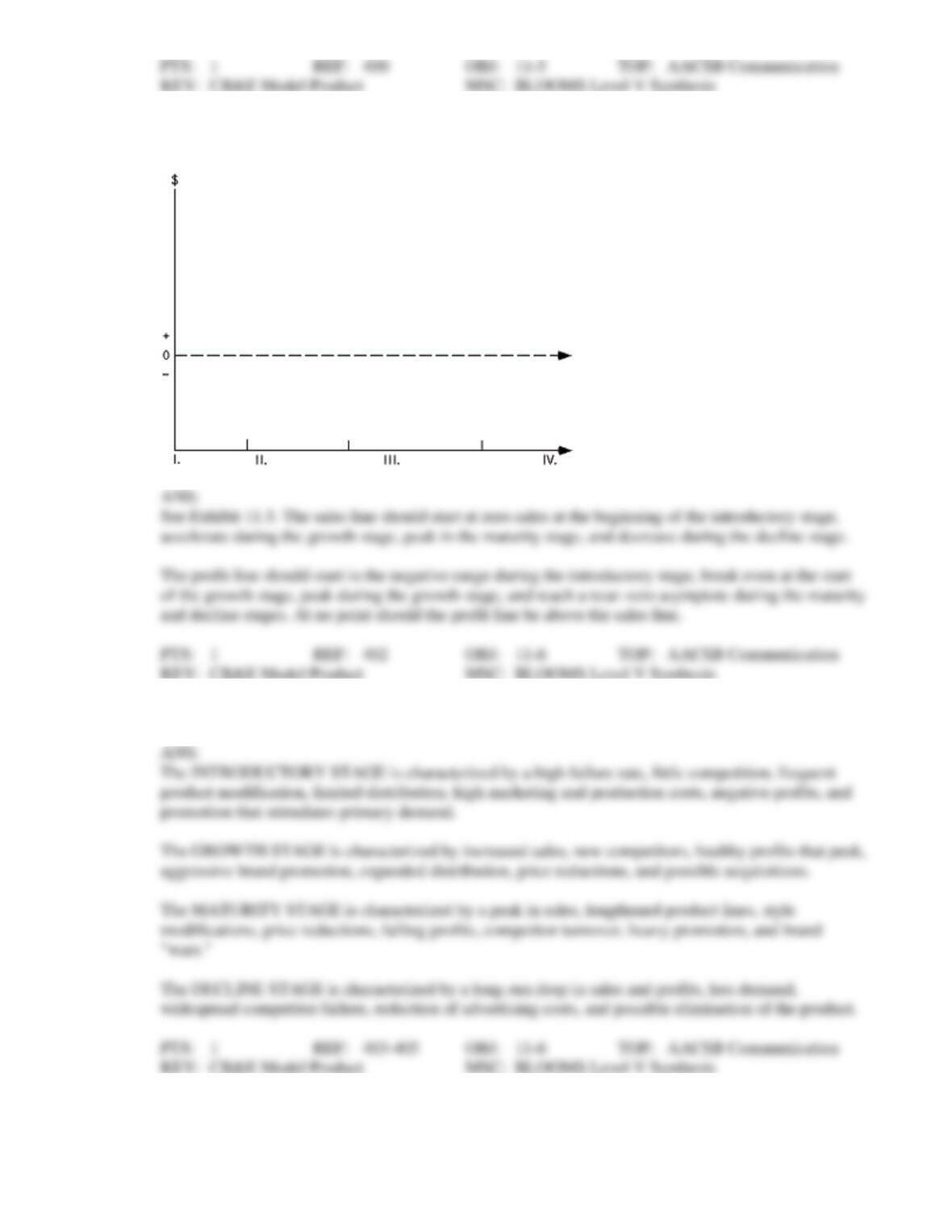
15. Draw the sales line and the profit line of the product life cycle in the following diagram, and label each
line. Then indicate the names of the four stages of the product life cycle in the blanks provided.
16. List the four stages of the product life cycle and discuss the typical characteristics for each stage.
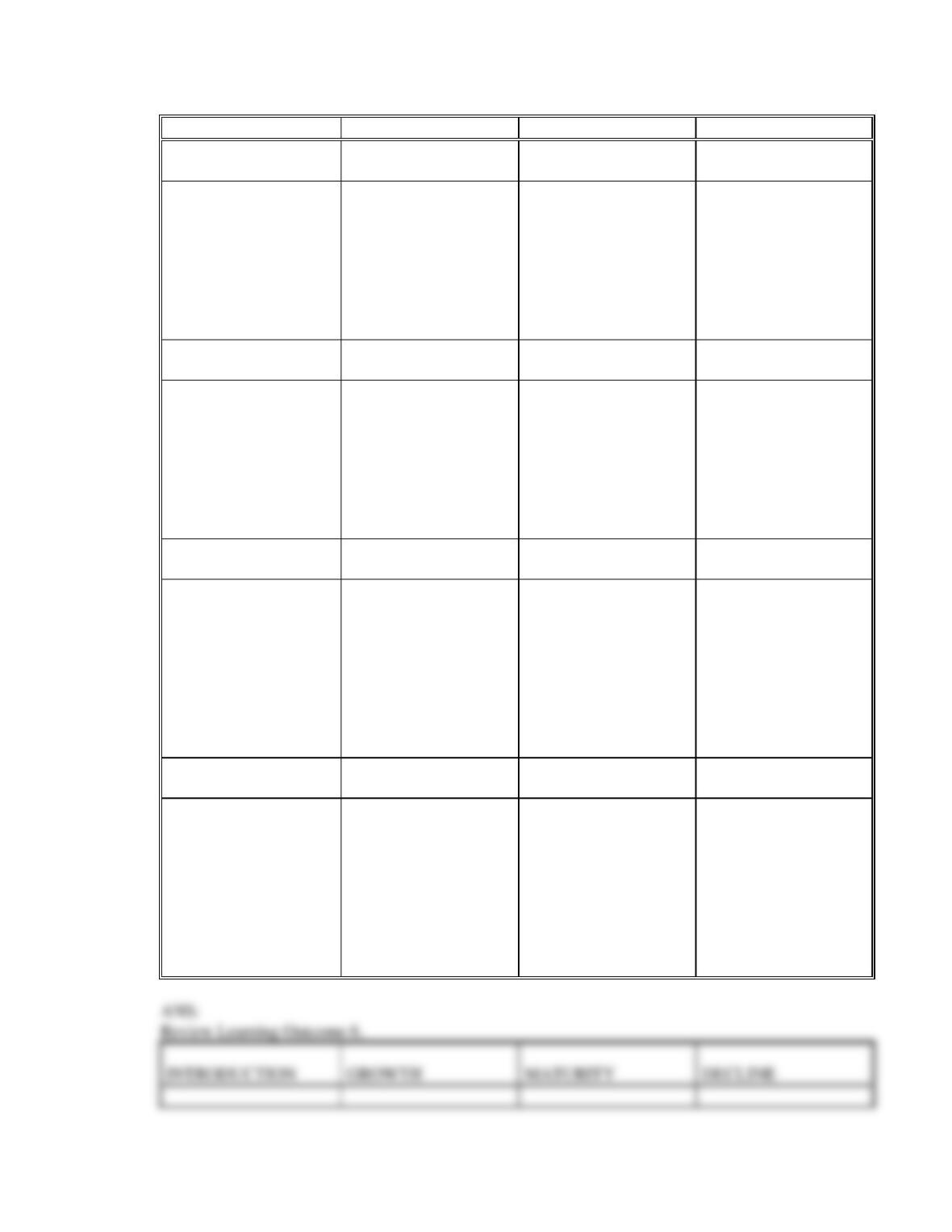
17. Briefly describe a typical marketing strategy followed for the four Ps in each stage of the product life
cycle. Name the stages of the product life cycle at the top of the chart.
Stage I.
Stage II.
Stage III.
Stage IV.
PRODUCT:
DISTRIBUTION:
PROMOTION:
PRICE:
INTRODUCTION