
The sociometric method of measuring opinion leadership captures person-to-person
communications about a product or brand among members of a community where most
people know each other by name.
Answer:
Hispanic Americans are the most diverse ethnic group in the United States today.
Answer:
Sue is looking for a new car. She had eliminated any car without comfortable seating
for at least four people and that gets less than an average of 35 miles per gallon in fuel
efficiency. Sue has used a lexicographic decision rule to narrow down her choices.
Answer:
Because marketers continuously sponsor ads portraying values or behaviors that some
(or many) consumers find distasteful or wrong, we can conclude that public scrutiny
has little impact on marketers.

Answer:
Marketers increasingly use techniques that blur the distinction between figure and
ground, which makes it easier for consumers to clearly distinguish advertising from
entertainment content.
Answer:
Deliberate blurring of figure and ground, as when Absolut Vodka embeds the distinct
shape of its bottle in a print image, can result in greater engagement of the audience
with the advertisement.
Answer:
Intrapersonal gifting is a state of mind where the giver and the receiver are the same
individual.
Answer:

The larger the sample, the more likely the responses will reflect the total universe under
study.
Answer:
The sequence of questions in a questionnaire is not important.
Answer:
Cross-screen marketing consists of tracking and targeting users across their computers,
mobile phones and tablets.
Answer:
Delivery vehicles painted in distinct colors, restaurant matchbooks, packaged hotel
soaps and shampoos are all ways to make service offerings seem more tangible with
visual images.

Answer:
The selling concept does not consider customer satisfaction because consumers who are
aggressively induced to buy products they do not want or need will not buy them again.
Answer:
Once information is perceived, it is first stored in the short-term store, then the
long-term store, then the sensory store.
Answer:
There are four major segments in each country with respect to how its citizens view
global brands. These include: global citizens, global dreamers, antiglobals, and global
agnostics.
Answer:

The family life cycle is a classification of the phases most families go through and each
stage represents an important target segment to many marketers.
Answer:
Quantitative research is descriptive in nature and is used to understand the effects of
various promotional inputs on the consumer, making it easier to predict consumer
behavior.
Answer:
The purchase and consumption of a product are necessary for the formation of attitudes.
Answer:
Differences in market share across geographic markets may be the result of such factors
as the common marketing practice of putting more merchandising dollars behind
markets that sell more.

Answer:
People who are compliant, have a tendency to conform, have a high need for affiliation,
are other-directed and less likely to look for guidance from reference groups.
Answer:
Variety seeking measures a person’s craving for or enjoyment of thinking.
Answer:
Open-ended questions yield more insightful information but are more difficult to code
and analyze.
Answer:

Interviewing the correct target market or potential target market is fundamental to the
reliability of the study.
Answer:
It is generally accepted that older people’s perceptions of their ages are more important
in determining behavior than their chronological ages.
Answer:
When an ad for Green Works from Clorox states the product cleans effectively and is
environmentally friendly, unlike competing brands, it is using the utilitarian approach to
attitude change.
Answer:
Hardship in making buying decisions is more typical of older, less-educated consumers.

Answer:
The largest of the six global consumer market segments are the Altruists.
Answer:
“Tourism of Doom” characterizes a travel industry market segment that pays high prices
to travel to places that are threatened due to climate change.
Answer:
Generation Z is the most diverse American generation ever.
Answer:

Judgment samples are used to select population members who, according to the
researcher, are a good source for accurate information.
Answer:
In buying a truck, Bob will only consider American-made trucks because he believes
foreign truck brands, such as Nissan and Toyota, are of inferior quality. Nissan and
Toyota are items in Bob’s inept set.
Answer:
When conducting focus groups, respondents are recruited on the basis of a randomly
drawn sample and are paid a fee for their participation.
Answer:
In the marketplace, price, styling, packaging, advertising, and store displays all serve as
________ to help consumers fulfill their needs in product-specific ways.
A) feedback

B) cues
C) response
D) motivation
E) reinforcement
Answer:
________ responsibilities have been expanding because attaining good jobs as adults
has become harder and parents feel that children must be ahead of other children from a
young age.
A) Intergenerational brand transfer
B) Peer socialization
C) Consumer socialization
D) Shared shopping experience
E) Parental socialization
Answer:
________ a major application of causal research, in which, prior to launching a new
product, elements such as package, price, and promotion are manipulated in a
controlled setting in order to predict sales and possible responses to the product.
A) Surveys are

B) Focus groups are
C) Secondary research is
D) Test marketing is
E) One-on-one interviewing is
Answer:
NAIL POLISH MINI CASE: Charles Revson, builder of the Revlon cosmetics empire,
began as a manufacturer of nail polish. In order to expand the market for nail polish,
he positioned nail polish as a fashion accessory, introducing new colors every year and
suggesting that a woman’s nail polish should match her clothing, moods, and social
situations. Competing on the basis of perceived quality and greater satisfaction of
women’s needs for fantasy and attention, Revson understood that he was not selling
women mere nail lacquer, but the fantasy that nail polish would attract attention and
bestow class and glamour on the user.
In the NAIL POLISH MINI CASE, Patti wants to paint her nails in order to be more
attractive. This is an example of a(n) ________ goal
A) negative
B) avoidance
C) utilitarian
D) approach
E) prevention-focused
Answer:

________ is based on the premise that consumers are not always aware of the reasons
for their actions.
A) Psychological research
B) Motivational research
C) Physiological research
D) Market research
E) Segmentation research
Answer:
Which of the following global consumer market segments is unselfish in their concern
for others, society, and the future?
A) strivers
B) devouts
C) altruists
D) creatives
E) intimates
Answer:

The availability of professional consumer researchers can vary considerably from
country to country. This is an example of which of the following basic research issues
in cross-cultural analysis?
A) differences in language and meaning
B) differences in marketing research possibilities
C) differences in consumption patterns
D) differences in perceived benefits of products and services
E) differences in economic and social conditions and family structure
Answer:
________ suggests that the human brain is divided into two distinct cerebral
hemispheres that operate together but specialize in the processing of different types of
cognitions.
A) An avatar
B) Hemispheric lateralization
C) Consumer involvement
D) Narrow categorization
E) Broad categorization
Answer:

A creative mobile promotion offered by a restaurant, which gives consumers a live
video feed from its kitchen to their mobile phones, is called ________.
A) Instagram
B) vine voyeurism
C) culinary voyeurism
D) GPS video
E) foodie video
Answer:
The ________ is designed to capture the individual’s attitude toward acting with respect
to an object rather than the attitude toward the object itself.
A) theory-of-reasoned-action model
B) trying-to-consume model
C) attitude-toward-object model
D) attitude-toward-behavior model
E) attitude-toward-the-ad model
Answer:
The medium or communication channel can be impersonal, like ________, or

interpersonal, like ________.
A) telephone conversations with a salesperson; mass media
B) a face to face conversation with a salesperson; print media
C) billboards; an online chat with a salesperson
D) mass media; newspaper ad
E) a radio advertisement; a television advertisement
Answer:
Given the broad and pervasive nature of ________, its study generally requires a
detailed examination of the character of the total society.
A) culture
B) consumer behavior
C) subculture
D) social class
E) individualism
Answer:
CRAFT MINI CASE: Global Craft is an importer of crafts from Indian and African

craftsmen to the United States. The company broadcasts a standardized advertising
campaign nationwide emphasizing the fair price that it pays for the crafts that it
imports, supporting rather than exploiting these craftsmen. Its advertising also serves
to introduce American consumers to international craft products to which they may not
have been already introduced.
In the CRAFT MINI CASE, Global Craft capitalizes on its reputation for ________ to
promote the products it imports.
A) social responsibility
B) global myth
C) quality signaling
D) prestige
E) value
Answer:
In the subjective measurement approach to social classification, most respondents have
a tendency to classify themselves in the ________ class.
A) upper
B) middle
C) lower
D) working
E) highest
Answer:

TEQUILA MINI CASE: Viva Beverages has recently launched its own brand of tequila
under the slogan “I never have, but I’d like to.” Viva’s television advertisements are set
in a trendy night club with a well-dressed man standing at the bar. A scantily clad
woman with a Russian accent is serving drinks. She approaches him and the following
interaction ensues:
WOMAN: What can I do for you?
MAN: I don’t know, something different.
WOMAN: Well, have you ever tried … (WOMAN looks both ways, then leans across the
bar and whispers into MAN’s ear)
MAN: I never have, but I’d like to …
(WOMAN serves MAN a Viva Tequila)
In the TEQUILA MINI CASE, the advertisement would most accurately be described
as appealing to which of the following Freudian elements of the personality?
A) super-id
B) ego
C) self-image
D) superego
E) id
Answer:
PRICE SURVEY MINI CASE: Capital Clothing wants to get a better understanding of
consumers’ perceptions of the price and quality of its sweaters. After reviewing data
from Yankelovich on consumer lifestyles and consumption patterns, Capital Clothing
identified specific consumer characteristics of its target market, which helped it
develop a screening questionnaire. The screening questionnaire was used to select
participants for its price/quality survey. The following is the survey administered by
Capital Clothing to evaluate customer perceptions of the price and quality of its
sweaters.
1. Rank to following clothing companies in terms of the quality of their sweaters.
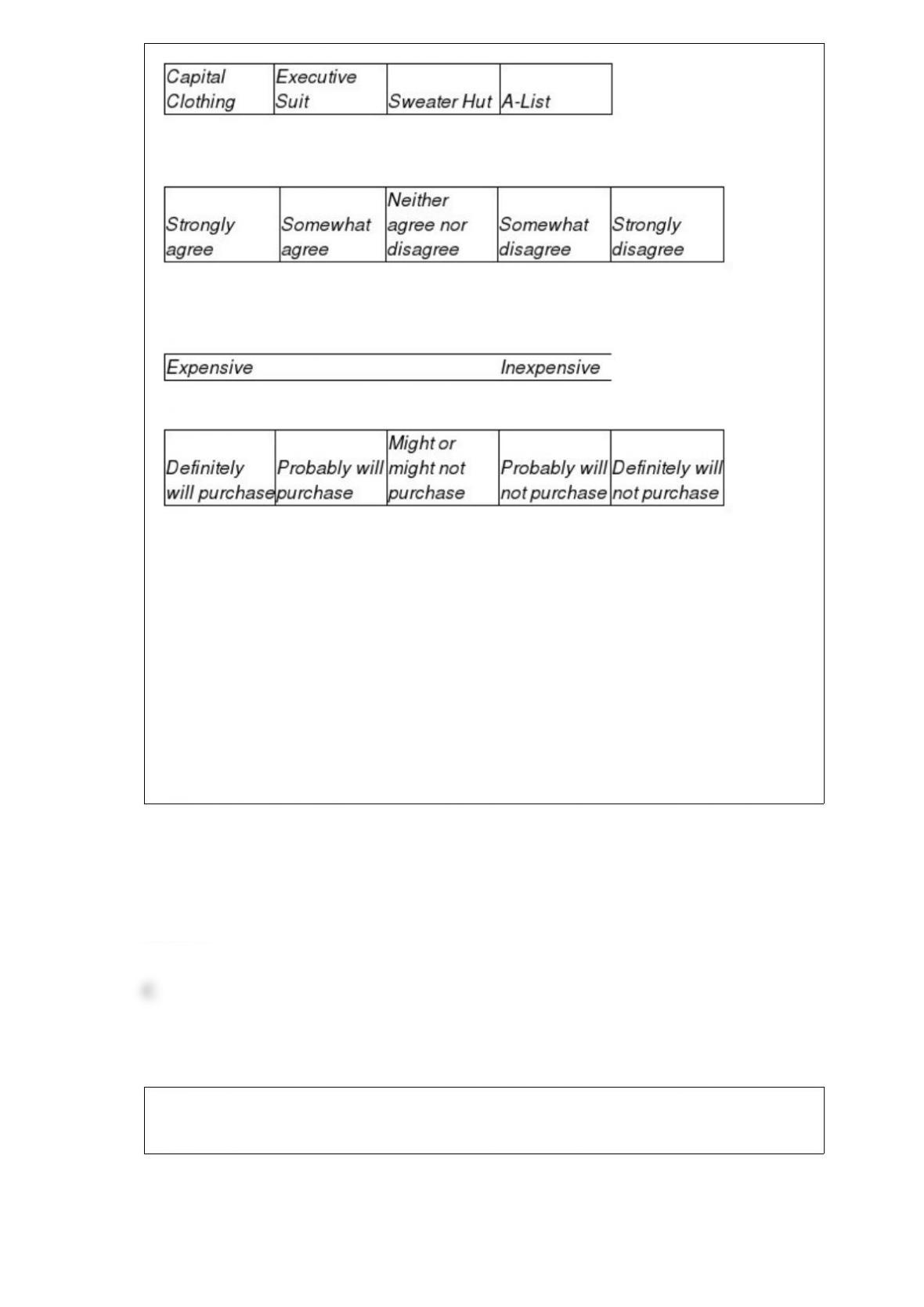
2. Do you agree or disagree with the following statement? (Check one)
Sweaters from Capital Style provide good value for price.
3. Please check the point on the following continuum that best expresses your
impression
of the price of Capital Style Sweaters.
4. How likely are you to purchase a Capital Style sweater in the next six months?
In the PRICE SURVEY MINI CASE, question #1 measures response on a ________.
A) bipolar scale
B) Likert scale
C) rank order scale
D) behavior intention scale
E) semantic differential scale
Answer:
For products of very broad appeal, such as aspirin or toothpaste, African Americans can
probably be most effectively reached through mass media.

Answer:
A ________ advertising strategy involves customizing both the product and
communications program.
A) local
B) national
C) restricted
D) global
E) mixed
Answer:
Barry buys a necklace as a gift for his girlfriend. This is an example of ________.
A) interpersonal gifting
B) intercategory gifting
C) intergroup gifting
D) intrapersonal gifting
E) intragroup gifting
Answer:

Need for affiliation, need to be liked by others and other directedness are examples of
________________________ variables that increase the likelihood an individual is
receptive to group influences.
A) conformity
B) group power
C) individual experience
D) individual personality
E) conspicuousness
Answer:
According to the Rokeach typology of cultural orientation, communications aimed at
individuals who have an interpersonal terminal value focus and moral instrumental
values should emphasize ________.
A) conformity, caring for others, and social consciousness
B) concern for societal issues and intense conviction to advance such causes
C) one’s sense of accomplishment, self-respect, and striving for a comfortable life and
independence
D) helping others and the role of one’s skills in doing so
E) moral inequity and its role in society
Answer:

The ________ stage of consumer socialization occurs when a child is 11-16 years old,
which is when children understand ads’ tactics and appeals, become skeptical about ads,
understand complex shopping scripts, and become capable at influencing.
A) cognitive
B) hedonic
C) perceptual
D) analytical
E) reflective
Answer:
The classic Horatio Alger tale of a penniless young orphan who managed to achieve
great success in business and in life is an example of ________.
A) downward mobility
B) conspicuous consumption
C) downward comparison
D) power
E) upward mobility
Answer:

Why are firms selling their products all over the world?
A) Overseas markets represent an important opportunity for growth when home
markets reach maturity.
B) Trade agreements require all companies operating within the agreement nations to
have a global plan.
C) Companies fear competition from “me too” products elsewhere.
D) Companies want to gain new production and marketing ideas.
E) Companies seek to take advantage of lower labor costs.
Answer:
There are four possible global marketing strategies, one of which is a local strategy,
which is offering ________.
A) a standardized product and a customized message
B) a standardized product and a standardized message
C) a customized product and a standardized message
D) a customized product and a customized message
E) a standardized pricing strategy and a customized product
Answer:

NAIL POLISH MINI CASE: Charles Revson, builder of the Revlon cosmetics empire,
began as a manufacturer of nail polish. In order to expand the market for nail polish,
he positioned nail polish as a fashion accessory, introducing new colors every year and
suggesting that a woman’s nail polish should match her clothing, moods, and social
situations. Competing on the basis of perceived quality and greater satisfaction of
women’s needs for fantasy and attention, Revson understood that he was not selling
women mere nail lacquer, but the fantasy that nail polish would attract attention and
bestow class and glamour on the user.
In the NAIL POLISH MINI CASE, Jenny wants a bottle of Revlon Berry Bon Bon nail
polish to match her new sweater. This is an example of a ________.
A) generic goal
B) general goal
C) needs-driven goal
D) product-specific goal
E) subjective goal
Answer:
________ is concerned with the likelihood or tendency than an individual will
undertake a specific action or behave in a particular way with regard to the attitude
object.
A) Cognition
B) Affectation
C) Situation
D) Perspective
E) Conation

Answer:
MUSEUM MINI CASE: Central City Art Museum is looking to increase museum
revenues by trying to draw more people to the museum. Research has shown that the
most frequent users of the museum are over 55 years old, have college degrees, and
have a household income of over $100,000. Less frequent users of the museum have the
same education and income profile as frequent users, but tend to be younger, between
35 and 55. Surveys suggest that these younger adults would use the museum more
frequently, but do not have enough time due to the demands of their children and
families. In order to increase museum entrance revenues, the administrative team wants
to attract people who are likely to become heavy users of the museum when they get
older, and try to bring them into the heavy user category at an earlier age. In an effort
to encourage heavy museum use, the museum has begun a membership program that
offers discounts on museum entrance and gift shop purchases and special exhibit
preview events for members. The museum has also begun to offer free children’s art and
museum appreciation classes on weekend afternoons that will allow younger adults to
drop their children off once a week and then enjoy the museum’s exhibits and caf. In
order to promote its new children’s programming, the museum acquired an address list
of local households with children, including the ages of those children, and intends to
send tailored messages specifically highlighting programming that is age-appropriate
for each household’s children.
In the MUSEUM MINI CASE, the museum’s approach to promoting its new children’s
programming is best described as ________.
A) countersegmentation
B) mass marketing
C) narrowcasting
D) concentrated marketing
E) demographic segmentation
Answer:

Jake feels that shopping in thrift shops shows a lack of class and sophistication. This
attitude would be captured by which of the following multiattribute attitude models?
A) theory-of-reasoned-action model
B) trying-to-consume model
C) attitude-toward-object model
D) attitude-toward-behavior model
E) attitude-toward-the-ad model
Answer:
When Fizzy Cola advertizes that it will donate a portion of all the proceeds of cola
packaged in its Olympic can to the Special Olympics, it is engaging in ________.
A) buzz marketing
B) stimulus generalization
C) viral marketing
D) deceptive advertising
E) cause-related marketing
Answer:

In the figure and ground principle of Gestalt psychology, ________.
A) the ground is usually perceived as distinct and central to the image
B) the common line that separates the figure and the ground is generally attributed to
the ground
C) figure and ground relationships are always interpreted in the same way
D) figure typically appears to be subordinate to ground and, therefore, less important
E) the ground is usually perceived as indefinite, hazy, and continuous
Answer:
The segment of online consumers that uses the Internet 20.7 hours per week, engages in
some browsing and shopping but is a very heavy user of blogging, chatting, video
streaming, and downloading, is known as ________.
A) Basic Communications
B) Lurking Shoppers
C) Social Strivers
D) Sports Fans
E) Value-Added Shoppers
Answer:

In the consumer decision-making process, the ________ stage focuses on how
consumers make decisions.
A) analysis
B) evaluation
C) input
D) process
E) output
Answer:
The globally aware, charitable segment of Millenials that is characterized by a belief
that they can have an impact on the world and make it better is known as ________.
A) Hip-ennials
B) Millennial Moms
C) Anti-Millenials
D) Gadget Gurus
E) Old-School Millenials
Answer:
Compare Baby Boomers and Generation Xers in terms of attitudes toward brands and

price-quality attitudes.
Answer:
What are four things a reference group must do to influence group members?
Answer:
Provide an example of an advertisement that used deceptive or false promotional
claims. Identify the issue associated with the ad and describe why it was misleading.

Answer:
Provide an example of a brand image update that was designed to create emotional
bonds between the brand and the consumer.
Answer:
What is the foot-in-the door technique? Give an example.
Answer:
How does the societal marketing concept differ from the marketing concept?
Answer:
How do marketers take advantage of the JND?
Answer:
What are the advantages of impression-based targeting (relative to segment-based
targeting)?
Answer:
What is stealth marketing and how does it impact consumers perceptions of product
information?
Answer:
Define and give examples of the five product characteristics that influence the diffusion
of innovation.
Answer:
Roper Starch Worldwide conducted a major multinational study and found out that most
of the world can be segmented into six major segments. Talk about two of those
segments.
Answer:
Identify the three dimensions underlying consumers’ engagement in e-wom.

Answer:
Provide three examples of effective Tweeting from marketers.
Answer:
What is the difference between behavioral data and cognitive data? Explain the
difference in measurement and provide examples of consumer-intrinsic and
consumption-based information associated with each type.
Answer:
What are some general characteristics of materialistic people?
Answer:
What is the theory of classical conditioning? Explain using an example.
Answer:
What is observational research, and why is it used?
Answer:
Position a health club offering to one of the VALS segments. In your description of the
positioning for the segment, please note the segment’s primary motivation, level of
resources, level of innovativeness, and values and consumption patterns.
Answer:

How can marketers utilize the knowledge function to influence the basic motivational
function?
Answer:
Identify and discuss the major steps in the consumer research process. Why is each step
important to the success of the process as a whole?
Answer: